

Performance of active learning models for screening prioritization in systematic reviews: a simulation study into the Average Time to Discover relevant records
Open accessThe DOI matches its Crossref record; 55 of the 60 references it cites were found in a registry or an index; 28 of the 38 sources its claims cite were checked for support.
Abstract
BACKGROUND: Conducting a systematic review demands a significant amount of effort in screening titles and abstracts. To accelerate this process, various tools that utilize active learning have been proposed. These tools allow the reviewer to interact with machine learning software to identify relevant publications as early as possible. The goal of this study is to gain a comprehensive understanding of active learning models for reducing the workload in systematic reviews through a simulation study. METHODS: The simulation study mimics the process of a human reviewer screening records while interacting with an active learning model. Different active learning models were compared based on four classification techniques (naive Bayes, logistic regression, support vector machines, and random forest) and two feature extraction strategies (TF-IDF and doc2vec). The performance of the models was compared for six systematic review datasets from different research areas. The evaluation of the models was based on the Work Saved over Sampling (WSS) and recall. Additionally, this study introduces two new statistics, Time to Discovery (TD) and Average Time to Discovery (ATD). RESULTS: The models reduce the number of publications needed to screen by 91.7 to 63.9% while still finding 95% of all relevant records (WSS@95). Recall of the models was defined as the proportion of relevant records found after screening 10% of of all records and ranges from 53.6 to 99.8%. The ATD values range from 1.4% till 11.7%, which indicate the average proportion of labeling decisions the researcher needs to make to detect a relevant record. The ATD values display a similar ranking across the simulations as the recall and WSS values. CONCLUSIONS: Active learning models for screening prioritization demonstrate significant potential for reducing the workload in systematic reviews. The Naive Bayes + TF-IDF model yielded the best results overall. The Average Time to Discovery (ATD) measures performance of active learning models throughout the entire screening process without the need for an arbitrary cut-off point. This makes the ATD a promising metric for comparing the performance of different models across different datasets.
Overview
CoChat Summary
TL;DR
This simulation study compared seven active-learning models across six systematic review datasets and introduced Average Time to Discovery (ATD) as a screening-prioritization metric. It found substantial workload reductions, with NB + TF-IDF generally performing best and ATD ranking models similarly to recall and WSS@95.
Key findings
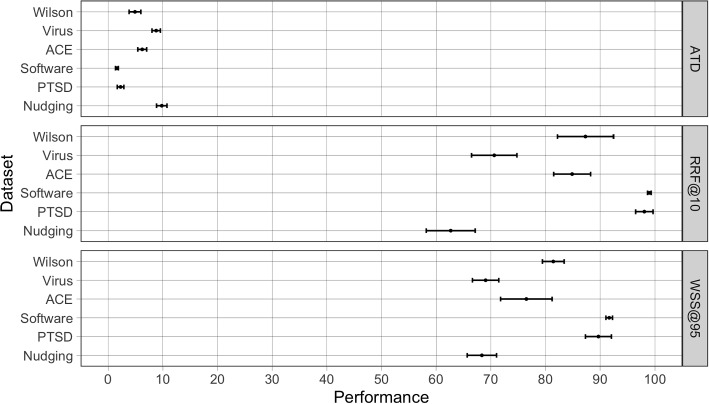
- Across models and datasets, WSS@95 ranged from 63.9% to 91.7%, meaning models reduced the number of publications needed to screen while still finding 95% of relevant records.
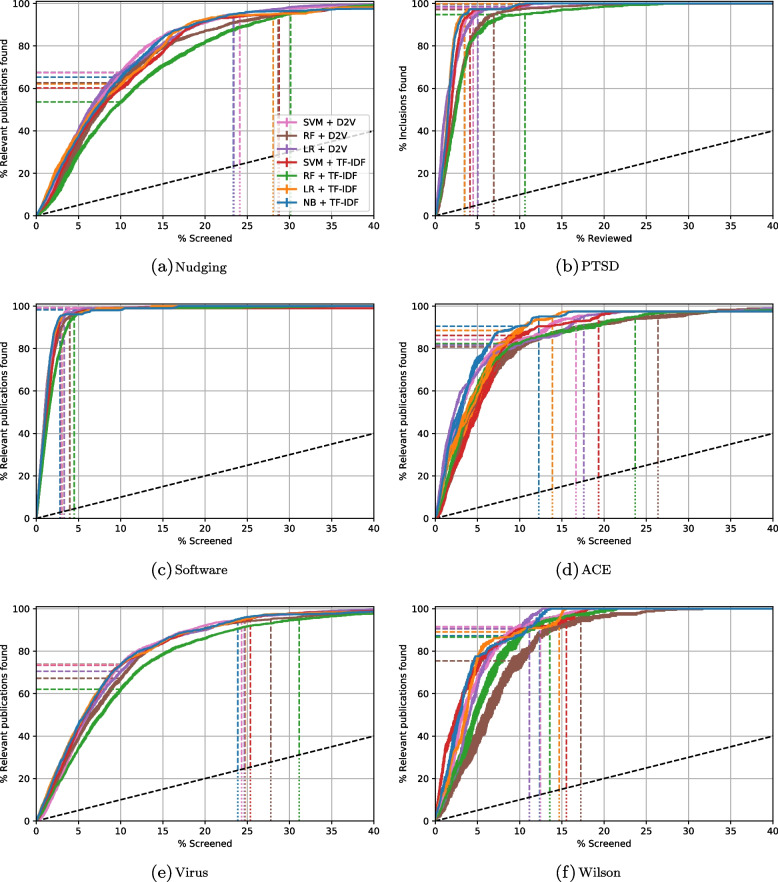
- Recall after screening 10% of records (RRF@10) ranged from 53.6% to 99.8%; ATD values ranged from 1.4% to 11.7%, indicating the average proportion of labeling decisions needed to detect a relevant record.
- NB + TF-IDF yielded the best results overall: it ranked first in ACE, Virus, and Wilson, shared first in PTSD and Software, and second in Nudging. RF + TF-IDF never performed best on any measure across datasets.
- ATD values showed a similar ranking across simulations as recall and WSS values, and all models exceeded random screening.
Methods
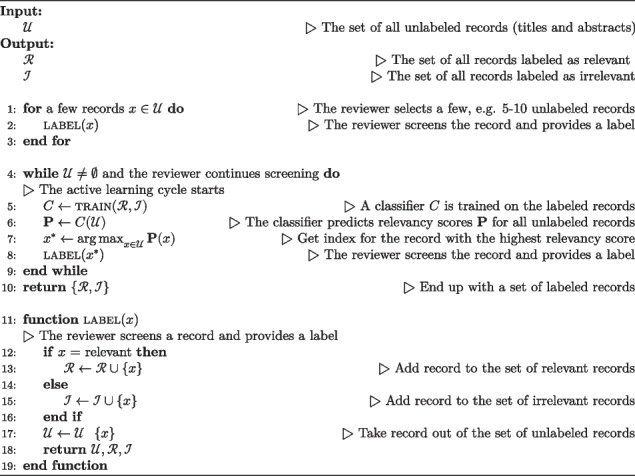
- Simulation study mimicking human title/abstract screening with active learning; seven models combined four classifiers (naive Bayes, logistic regression, support vector machines, random forest) with two feature-extraction strategies (TF-IDF, doc2vec), excluding NB + D2V because multinomial NB requires positive feature values.
- Six labeled systematic review datasets from medicine, computer science, and social science were used, yielding 42 simulations. Each simulation started with one relevant and one irrelevant record, retrained after each label, ended after all records were labeled, and was repeated 15 times with random initial training sets held constant within dataset.
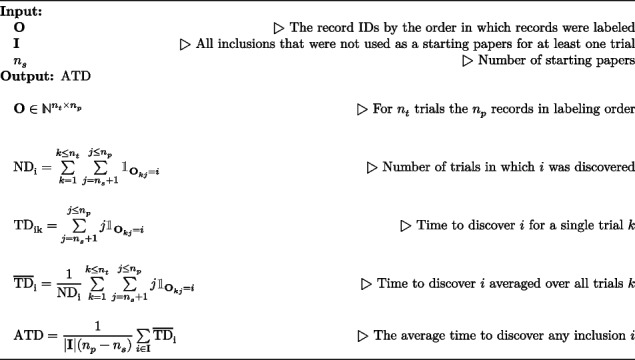
- Hyperparameters were optimized via Tree of Parzen Estimators; simulations used ASReview 0.9.3 and analyses used R 3.6.1. Performance metrics were WSS@95, RRF@10, Time to Discovery (TD), and Average Time to Discovery (ATD), with recall curves, means with standard deviations, medians with MAD, and 95% confidence intervals.
Limitations
- Stated: hyperparameters were optimized for each model-dataset combination, so results reflect maximum model performance and generalizability to datasets without optimized hyperparameters remains unknown; the sample size of six datasets does not allow investigating how data characteristics relate to model performance.
- Stated: runtime varied widely across models, with implications for practical use because an efficient model should keep up with reviewer decision speed; ATD is not set against a baseline, and more research is needed on its statistical bias, outliers, sparse data, sensitivity to dataset characteristics, and construct/face validity.
- Evident: the study is a simulation using existing labels rather than real reviewer interaction, and the six datasets are a convenience sample; D2V versus TF-IDF results were inconclusive.
Model-written summary. Check it against the paper before relying on it.
Integrity signals
Registry
Cites
Statistics
Figures
Verification
Claims the paper makes
15 Valid · 2 Not valid · 3 Not checked · 70 Own results and interpretations
Some cited sources support this claim and some don’t — read each source’s verdict below.
In the paper
“ready-to-use software tools implementing such models (Abstrackr [22], Colandr [23], FASTREAD [11], Rayyan [24], and RobotAnalyst [25]) currently use the same classification technique to predict relevance of publications, namely support vector machines (SVM).”
What the sources say
- Not checked — no full text of the sourcecites [22] 22. Wallace BC, Small K, Brodley CE, Lau J, Trikalinos TA. Deploying an interactive machine learning system in an evidence-based practice center: Abstrackr. In: Proceedings of the 2nd ACM SIGHIT International Health Informatics Symposium. IHI '12. Association for Computing Machinery; 2012. p. 819-824. https:// doi. org/ 10. 1145/ 21103 63. 21104 64. source
- Disputedcites [23] 23. Cheng SH, Augustin C, Bethel A, Gill D, Anzaroot S, Brun J, et al. Using machine learning to advance synthesis and use of conservation and environmental evidence. Conserv Biol. 2018;32(4):762-4. https:// doi. org/ 10. 1111/ cobi. 13117. sourceExperimental — accuracy not yet measured
The paper describes Colandr as a tool that learns from users’ relevance decisions, but identifies its relevance-ranking method as word2vec, not SVM (Abstract, page not specified in our copy). It does not establish what classification techniques the other named tools use. (LLM, conf=0.86)
Checked by a reasoning model — may be wrong.
- Supportedcites [11] 11. Yu Z, Kraft NA, Menzies T. Finding better active learners for faster literature reviews. Empir Softw Eng. 2018;23(6):3161-86. https:// doi. org/ 10. 1007/ s10664- 017- 9587-0. source
The citation is attached to FASTREAD, not to the other tools in the list. Finding 2 (p. 14) identifies FASTREAD as the method developed in this paper, and §5.4 (p. 12) states that all tested treatments use a linear SVM classifier. (LLM, conf=0.92)
plain- Asserted: passes — The authors put it forward as true.
- Checkable: passes — It can be checked against evidence.
- Load-bearing: passes — The paper’s conclusions depend on it.
- Based: passes — The paper gives a reason why it holds.
The cited sources support only part of this claim — read each source’s verdict below.
In the paper
“Screening prioritization via active learning allows for substantial time-saving as the reviewer can decide to stop screening after a sufficient number of relevant publications have been found [7, 10].”
What the sources say
- Partly supportedcites [7] 7. Cohen AM, Ambert K, McDonagh M. Cross-topic learning for work prioritization in systematic review creation and update. J Am Med Inform Assoc. 2009;16(5):690-704. sourceExperimental — accuracy not yet measured
The Conclusions (page unavailable) support prioritizing likely includable articles to make better use of reviewers’ time. They propose screening the remaining citations later, not stopping once enough relevant publications have been found. The Results distinguish this approach from active learning and describe active learning as less attractive for systematic-review work prioritization because the system, rather than reviewers, chooses which articles are read first. (LLM, conf=0.86)
- Supportedcites [10] 10. Yu Z, Menzies T. FAST2: an intelligent assistant for finding relevant papers. Expert Syst Appl. 2019;120:57-71. https:// doi. org/ 10. 1016/j. eswa. 2018. 11. 021. source
The Abstract (p. 1) says FAST2 reduces the effort needed to find most relevant papers and estimates how many remain, helping the reviewer decide when to stop. Section 4.2 (p. 12) describes a stopping target of 95% recall, consistent with stopping after a sufficient number—not necessarily all—relevant papers have been found. (LLM, conf=0.92)
plainstates a cause- Asserted: passes — The authors put it forward as true.
- Checkable: passes — It can be checked against evidence.
- Load-bearing: passes — The paper’s conclusions depend on it.
- Based: passes — The paper gives a reason why it holds.
- Partly supported
Every source the paper cites for this claim was checked and supports it.
In the paper
“In a previous study, the ACE dataset was used to simulate a model that did not use active learning, finding a WSS@95 value of 56.61% [31]”
What the sources say
- Supportedcites [31] 31. Cohen AM, Hersh WR, Peterson K, Yen PY. Reducing workload in systematic review preparation using automated citation classification. J Am Med Inform Assoc. 2006;13(2):206-19. https:// doi. org/ 10. 1197/ jamia. M1929. source
Table 6 (Results; page not provided in our copy) reports WSS@95% of 56.61% for the ACEInhibitors review dataset. The Evaluating the Classifier section describes cross-validation of a classifier, consistent with the cited non-active-learning comparison. (LLM, conf=0.90)
plain- Asserted: passes — The authors put it forward as true.
- Checkable: passes — It can be checked against evidence.
- Load-bearing: passes — The paper’s conclusions depend on it.
- Based: passes — The paper gives a reason why it holds.
- Supported
Every source the paper cites for this claim was checked and supports it.
In the paper
“Typical for systematic reviewing is that only a fraction of the publications belong to the relevant class [4].”
What the sources say
- Supportedcites [4] 4. Borah R, Brown AW, Capers PL, Kaiser KA. Analysis of the time and workers needed to conduct systematic reviews of medical interventions using data from the PROSPERO registry. BMJ Open. 2017;7(2):e012545. source
The Results report that, in the systematic reviews analysed, a mean of 2.94% of publications found in the initial search were ultimately included. This supports the claim that only a fraction of retrieved publications belong to the relevant set, though the measured reviews concerned medical interventions. (LLM, conf=0.91)
plain- Asserted: passes — The authors put it forward as true.
- Checkable: passes — It can be checked against evidence.
- Load-bearing: passes — The paper’s conclusions depend on it.
- Based: passes — The paper gives a reason why it holds.
- Supported
Every source the paper cites for this claim was checked and supports it.
In the paper
“Another advantage of this technique is its short computation time, see [51] for a detailed comparison of computation times.”
What the sources say
- Supportedcites [51] 51. Teijema J, Hofstee L, Brouwer M, de Bruin J, Ferdinands G, de Boer J, et al. Active learning-based Systematic reviewing using switching classification models: the case of the onset, maintenance, and relapse of depressive disorders. PsyArXiv; 2022. https:// doi. org/ 10. 31234/ osf. io/ t7bpd. source
The Discussion states that TF-IDF has significantly lower computational time than SBERT. Table 1 provides the detailed comparison: TF-IDF feature extraction took seconds in the listed combinations, versus more than six hours for SBERT. (LLM, conf=0.93)
plain- Asserted: passes — The authors put it forward as true.
- Checkable: passes — It can be checked against evidence.
- Load-bearing: passes — The paper’s conclusions depend on it.
- Based: passes — The paper gives a reason why it holds.
- Supported
50 more claims · 1 with their cited sources checked
Create a free account to see all 90 claims and to verify the 2 references still open.
- Probably not a substantial claim. 24
- It may state two separate claims as one. 16
- The quote only partly states this claim. 1
Claims other papers make about this one
Each is checked against this paper’s own text: does it say what the citing paper says it does?
The cited source doesn’t support the claim as written.
In the citing paper
“For last-to-find records [7,19,22], advanced models significantly outperform simpler models due to their ability to detect contextual and semantic relationships.”
From Large-scale simulation study of active learning models for systematic reviews (2025) · cites this paper as [19]
Checked by a reasoning model — may be wrong.
Experimental — accuracy not yet measuredThe source backs part of the claim, not all of it — or backs it for a different population, condition or comparison.
In the citing paper
“Previous benchmark studies showed that substantial workload reductions with active learning mostly occur in large sample sizes ( > 2000 publications) where approximately less than 5% of publications are relevant 13,20 .”
From AIM review tool: artificial intelligence for smarter systematic review screening (2026) · cites this paper as [20]
Experimental — accuracy not yet measuredIn the citing paper
“While useful for evaluating performance at a fixed recall level, WSS@95% provides no insight into how a model performs in scenarios such as quickly retrieving relevant records after a cold start or identifying the last-to-find records [7,19,22].”
From Large-scale simulation study of active learning models for systematic reviews (2025) · cites this paper as [19]
In the citing paper
“So, ASReview has demonstrated its ability to speed up systematic reviews.26,27,28,29,30,31,32,33,34,35,36”
From ASReview LAB v.2: Open-source text screening with multiple agents and a crowd of experts (2025) · cites this paper as [27]
In the citing paper
“At that point, metrics such as recall, loss, time to discovery,27 or work saved over sampling (WSS@95)53 can be calculated.”
From ASReview LAB v.2: Open-source text screening with multiple agents and a crowd of experts (2025) · cites this paper as [27]
Self-check
Percentages, sums and reported differences re-computed from the paper’s own numbers.
Each contradiction between two passages listed here was confirmed by an independent check.
Rated minor: it would not touch a result — a value no result rests on, a p-value that stays on the same side of the significance level, or a conflict that is clerical, resolved elsewhere in the paper, or outside its own findings.
In the paper
§ Datasets
“For the remaining six datasets, the proportions of relevant publications were centered around 1-2% (Table 1).”
§ Datasets
“The screening process was simulated on a convenience sample of six labeled datasets.”
Rated minor: it would not touch a result — a value no result rests on, a p-value that stays on the same side of the significance level, or a conflict that is clerical, resolved elsewhere in the paper, or outside its own findings.
In the paper
§ Abstract
“The models reduce the number of publications needed to screen by 91.7 to 63.9% while still finding 95% of all relevant records (WSS@95).”
§ Results
“| NB + TF-IDF | 71.7 (1.37) | 91.7 (0.27) | 92.3 (0.08) | 82.9 (0.99) | 71.2 (0.62) | 83.4 (0.89) |”
Citations
Cites
Breiman, L. (2001) · Machine Learning · doi:10.1023/a:1010933404324 · Cited by 133,538
Scikit-learn: Machine Learning in Python
Pedregosa, F., Varoquaux, G., Gramfort, A., Michel, V., Thirion, B., Grisel, O., Blondel, M., Müller, A., Nothman, J., Louppe, G., et al. (2012) · arXiv · doi:10.48550/arxiv.1201.0490 · Cited by 71,016
PRISMA-P Group, Moher, D., Shamseer, L., Clarke, M., Ghersi, D., Liberati, A., Petticrew, M., Shekelle, P., & Stewart, L. A. (2015) · Systematic Reviews · doi:10.1186/2046-4053-4-1 · Cited by 26,223
Rayyan-a web and mobile app for systematic reviews.
Ouzzani, M., Hammady, H., Fedorowicz, Z., & Elmagarmid, A. (2016) · Systematic Reviews · doi:10.1186/s13643-016-0384-4 · Cited by 26,092 · cited 1×
“While previous studies have evaluated active learning models in many forms and shapes [10–15, 17–19], ready-to-use software tools implementing such models (Abstrackr [22], Colandr [23], FASTREAD [11], Rayyan [24], and RobotAnalyst [25]) currently use the same classification technique to predict relevance of publicatio…”
MethodAn open source machine learning framework for efficient and transparent systematic reviews
van de Schoot, R., de Bruin, J., Schram, R., Zahedi, P., de Boer, J., Weijdema, F., Kramer, B., Huijts, M., Hoogerwerf, M., Ferdinands, G., et al. (2021) · Nature Machine Intelligence · doi:10.1038/s42256-020-00287-7 · Cited by 1,157
Self-citationA Systematic Literature Review on Fault Prediction Performance in Software Engineering
Hall, T., Beecham, S., Bowes, D., Gray, D., & Counsell, S. (2012) · IEEE Transactions on Software Engineering · doi:10.1109/tse.2011.103 · Cited by 1,154
A Survey of Text Classification Algorithms
Aggarwal, C. C., & Zhai, C. (2012) · Mining Text Data · doi:10.1007/978-1-4614-3223-4_6 · Cited by 842 · cited 1×
“These are widely adopted techniques in text classification [28] and are fit for software tools to be used in scientific practice due to their relatively short computation time.”
MethodBorah, R., Brown, A. W., Capers, P. L., & Kaiser, K. A. (2017) · BMJ Open · doi:10.1136/bmjopen-2016-012545 · Cited by 737 · cited 2×
“However, conducting a systematic review is a costly endeavor that often requires over a year of work by a team of researchers [4], and includes the manual screening of thousands of titles and abstracts.”
BackgroundThe GRoLTS-Checklist: Guidelines for Reporting on Latent Trajectory Studies
van de Schoot, R., Sijbrandij, M., Winter, S. D., Depaoli, S., & Vermunt, J. K. (2017) · Structural Equation Modeling: A Multidisciplinary Journal · doi:10.1080/10705511.2016.1247646 · Cited by 721
O’Mara-Eves, A., Thomas, J., McNaught, J., Miwa, M., & Ananiadou, S. (2015) · Systematic Reviews · doi:10.1186/2046-4053-4-5 · Cited by 681 · cited 3×
“Moreover, the WSS makes assumptions about the acceptable recall level whereas this level might depend on the research question at hand [32].”
BackgroundInfluentialA comparative study of TF*IDF, LSI and multi-words for text classification
Zhang, W., Yoshida, T., & Tang, X. (2011) · Expert Systems with Applications · doi:10.1016/j.eswa.2010.08.066 · Cited by 676
Settles, B. (2012) · Synthesis Lectures on Artificial Intelligence and Machine Learning · doi:10.2200/s00429ed1v01y201207aim018 · Cited by 605
Deploying an interactive machine learning system in an evidence-based practice center: abstrackr
Wallace, B. C., Small, K., Brodley, C. E., Lau, J., & Trikalinos, T. A. (2012) · Proceedings of the 2nd ACM SIGHIT International Health Informatics Symposium · doi:10.1145/2110363.2110464 · Cited by 532 · cited 1×
“While previous studies have evaluated active learning models in many forms and shapes [10–15, 17–19], ready-to-use software tools implementing such models (Abstrackr [22], Colandr [23], FASTREAD [11], Rayyan [24], and RobotAnalyst [25]) currently use the same classification technique to predict relevance of publicatio…”
MethodHarrison, H., Griffin, S. J., Kuhn, I., & Usher-Smith, J. A. (2020) · BMC Medical Research Methodology · doi:10.1186/s12874-020-0897-3 · Cited by 449 · cited 1×
“With the advancement of machine learning (ML), there has been a growing interest in utilizing it to reduce the workload in systematic reviews and meta-analyses [6].”
BackgroundReducing Workload in Systematic Review Preparation Using Automated Citation Classification
Cohen, A. M., Hersh, W. R., Peterson, K., & Yen, P.-Y. (2006) · Journal of the American Medical Informatics Association · doi:10.1197/jamia.m1929 · Cited by 411 · cited 5×
“Of these six datasets, ACE and Software have been used for model simulations in previous studies on ML-aided title and abstract screening [11, 31].”
InfluentialO’Mara-Eves, A., Thomas, J., McNaught, J., Miwa, M., & Ananiadou, S. (2015) · Systematic Reviews · doi:10.1186/s13643-015-0031-5 · Cited by 353
Semi-automated screening of biomedical citations for systematic reviews
Wallace, B. C., Trikalinos, T. A., Lau, J., Brodley, C., & Schmid, C. H. (2010) · BMC Bioinformatics · doi:10.1186/1471-2105-11-55 · Cited by 351 · cited 2×
“While previous studies have evaluated active learning models in many forms and shapes [10–15, 17– 19 ], ready-to-use Another component that influences model performance is how the textual content of titles and abstracts is represented in a model, called the feature extraction strategy [17, 19, 29].”
BackgroundReducing systematic review workload through certainty-based screening
Miwa, M., Thomas, J., O’Mara-Eves, A., & Ananiadou, S. (2014) · Journal of Biomedical Informatics · doi:10.1016/j.jbi.2014.06.005 · Cited by 190 · cited 1×
“The suggestion that active learning is more difficult for datasets from the social sciences compared to data from the medical sciences [12] does not seem to be the case here.”
BackgroundRathbone, J., Hoffmann, T., & Glasziou, P. (2015) · Systematic Reviews · doi:10.1186/s13643-015-0067-6 · Cited by 184 · cited 1×
“A possible explanation for this is that this difficulty has to be attributed to factors more directly related to the systematic review at hand, such as the proportion of relevant publications or the complexity of inclusion criteria used to identify relevant publications [16, 53].”
BackgroundText Categorization Models for High-Quality Article Retrieval in Internal Medicine
Aphinyanaphongs, Y. (2004) · Journal of the American Medical Informatics Association · doi:10.1197/jamia.m1641 · Cited by 177 · cited 1×
“It was found [26, 27] that different classification techniques can serve different needs in the retrieval of relevant publications, for example the desired balance between recall and precision.”
Shemilt, I., Simon, A., Hollands, G. J., Marteau, T. M., Ogilvie, D., O'Mara‐Eves, A., Kelly, M. P., & Thomas, J. (2014) · Research Synthesis Methods · doi:10.1002/jrsm.1093 · Cited by 170 · cited 1×
“One effective method for increasing the efficiency of title and abstract screening is screening prioritization [7, 8] through the use of active learning [9].”
MethodUsing machine learning to advance synthesis and use of conservation and environmental evidence
Cheng, S. H., Augustin, C., Bethel, A., Gill, D., Anzaroot, S., Brun, J., DeWilde, B., Minnich, R. C., Garside, R., Masuda, Y. J., et al. (2018) · Conservation Biology · doi:10.1111/cobi.13117 · Cited by 155 · cited 1×
“While previous studies have evaluated active learning models in many forms and shapes [10–15, 17–19], ready-to-use software tools implementing such models (Abstrackr [22], Colandr [23], FASTREAD [11], Rayyan [24], and RobotAnalyst [25]) currently use the same classification technique to predict relevance of publicatio…”
MethodEvaluation of machine-learning protocols for technology-assisted review in electronic discovery
Cormack, G. V., & Grossman, M. R. (2014) · Proceedings of the 37th international ACM SIGIR conference on Research & development in information retrieval · doi:10.1145/2600428.2609601 · Cited by 149 · cited 1×
“Such recall plots offer insight in model performance throughout the entire screening process [11, 13].”
BackgroundGates, A., Johnson, C., & Hartling, L. (2018) · Systematic Reviews · doi:10.1186/s13643-018-0707-8 · Cited by 148 · cited 1×
“A possible explanation for this is that this difficulty has to be attributed to factors more directly related to the systematic review at hand, such as the proportion of relevant publications or the complexity of inclusion criteria used to identify relevant publications [16, 53].”
BackgroundPrioritising references for systematic reviews with RobotAnalyst: A user study
Przybyła, P., Brockmeier, A. J., Kontonatsios, G., Le Pogam, M., McNaught, J., von Elm, E., Nolan, K., & Ananiadou, S. (2018) · Research Synthesis Methods · doi:10.1002/jrsm.1311 · Cited by 148 · cited 1×
“While previous studies have evaluated active learning models in many forms and shapes [10–15, 17–19], ready-to-use software tools implementing such models (Abstrackr [22], Colandr [23], FASTREAD [11], Rayyan [24], and RobotAnalyst [25]) currently use the same classification technique to predict relevance of publicatio…”
Towards Automatic Recognition of Scientifically Rigorous Clinical Research Evidence
Kilicoglu, H., Demner-Fushman, D., Rindflesch, T. C., Wilczynski, N. L., & Haynes, R. B. (2009) · Journal of the American Medical Informatics Association · doi:10.1197/jamia.m2996 · Cited by 101 · cited 1×
“It was found [26, 27] that different classification techniques can serve different needs in the retrieval of relevant publications, for example the desired balance between recall and precision.”
Virus Metagenomics in Farm Animals: A Systematic Review
Kwok, K. T. T., Nieuwenhuijse, D. F., Phan, M. V. T., & Koopmans, M. P. G. (2020) · Viruses · doi:10.3390/v12010107 · Cited by 97 · cited 1×
“Then, we describe the results of a simulation study (mimicking the labeling process) to evaluate the performance of four different classification techniques, and two different feature extraction strategies for six labeled datasets in the context of systematic review from the fields of medical science [31, 33, 34], com…”
Cross-Topic Learning for Work Prioritization in Systematic Review Creation and Update
Cohen, A. M., Ambert, K., & McDonagh, M. (2009) · Journal of the American Medical Informatics Association · doi:10.1197/jamia.m3162 · Cited by 88 · cited 2×
“One effective method for increasing the efficiency of title and abstract screening is screening prioritization [7, 8] through the use of active learning [9].”
Finding better active learners for faster literature reviews
Yu, Z., Kraft, N. A., & Menzies, T. (2018) · Empirical Software Engineering · doi:10.1007/s10664-017-9587-0 · Cited by 83 · cited 5×
“Of these six datasets, ACE and Software have been used for model simulations in previous studies on ML-aided title and abstract screening [11, 31].”
BackgroundMethodResultInfluentialFAST2: An intelligent assistant for finding relevant papers
Yu, Z., & Menzies, T. (2019) · Expert Systems with Applications · doi:10.1016/j.eswa.2018.11.021 · Cited by 80 · cited 2×
“While previous studies have evaluated active learning models in many forms and shapes [10–15, 17– 19 ], ready-to-use Another component that influences model performance is how the textual content of titles and abstracts is represented in a model, called the feature extraction strategy [17, 19, 29].”
BackgroundA Scoping Review of Empirical Evidence on (Digital) Public Services Co-Creation
Rodriguez Müller, A. P., Casiano Flores, C., Albrecht, V., Steen, T., & Crompvoets, J. (2021) · Administrative Sciences · doi:10.3390/admsci11040130 · Cited by 65
Autonomy and Reliability of Continuous Active Learning for Technology-Assisted Review
Cormack, G. V., & Grossman, M. R. (2015) · arXiv (Cornell University) · doi:10.48550/arxiv.1504.06868 · Cited by 62
ASReview LAB - A tool for AI-assisted systematic reviews
developers, A. L. (2026) · Zenodo · doi:10.5281/zenodo.3345592 · Cited by 59
Appenzeller‐Herzog, C., Mathes, T., Heeres, M. L. S., Weiss, K. H., Houwen, R. H. J., & Ewald, H. (2019) · Liver International · doi:10.1111/liv.14179 · Cited by 51 · cited 1×
“The Wilson dataset [47]—from the field of medicine—is from a review on the effectiveness and safety of treatments of Wilson Disease, a rare genetic disorder of copper metabolism [33].”
MethodNudging healthcare professionals towards evidence-based medicine: A systematic scoping review
Nagtegaal, R., Tummers, L., Noordegraaf, M., & Bekkers, V. (2019) · Journal of Behavioral Public Administration · doi:10.30636/jbpa.22.71 · Cited by 45
Self-citationRespite for SMEs: A Systematic Review of Socio-Technical Cybersecurity Metrics
van Haastrecht, M., Yigit Ozkan, B., Brinkhuis, M., & Spruit, M. (2021) · Applied Sciences · doi:10.3390/app11156909 · Cited by 45
Multi-Faceted Recall of Continuous Active Learning for Technology-Assisted Review
Cormack, G. V., & Grossman, M. R. (2015) · Proceedings of the 38th International ACM SIGIR Conference on Research and Development in Information Retrieval · doi:10.1145/2766462.2767771 · Cited by 38
Ferdinands, G. (2021) · Multivariate Behavioral Research · doi:10.1080/00273171.2020.1853501 · Cited by 37 · cited 1×
“The application of active learning models in systematic reviews has been extensively studied in simulation studies [11–21].”
Self-citationTeijema, J. J., Hofstee, L., Brouwer, M., de Bruin, J., Ferdinands, G., de Boer, J., Vizan, P., van den Brand, S., Bockting, C., van de Schoot, R., et al. (2023) · Frontiers in Research Metrics and Analytics · doi:10.3389/frma.2023.1178181 · Cited by 36 · cited 1×
“See [61] for a study utilizing the TD and ATD metrics for a comparative analysis of different model configurations.”
MethodSelf-citationEditorial: Systematic review automation thematic series
Lau, J. (2019) · Systematic Reviews · doi:10.1186/s13643-019-0974-z · Cited by 27 · cited 1×
“The high demand for systematic reviews far exceeds the available resources [5], making it challenging to provide timely and comprehensive reviews, particularly when the research question is urgent.”
BackgroundGough, D., & Richardson, M. A. (2018) · Routledge eBooks · doi:10.4324/9781315517971-8 · Cited by 23
Mapping Phenomena Relevant to Adolescent Emotion Regulation: A Text-Mining Systematic Review
van Lissa, C. J. (2022) · Adolescent Research Review · doi:10.1007/s40894-021-00160-7 · Cited by 22
Machine learning to optimize literature screening in medical guideline development
Harmsen, W., de Groot, J., Harkema, A., van Dusseldorp, I., de Bruin, J., van den Brand, S., & van de Schoot, R. (2024) · Systematic Reviews · doi:10.1186/s13643-024-02590-5 · Cited by 21
SYNERGY - Open machine learning dataset on study selection in systematic reviews
De Bruin, J., Ma, Y., Ferdinands, G., Teijema, J., & Van de Schoot, R. (2023) · DataverseNL · doi:10.34894/he6naq · Cited by 20
Self-citationBleijendaal, H., Croon, P. M., Pool, M. D. O., Malekzadeh, A., Aufiero, S., Amin, A. S., Zwinderman, A. H., Pinto, Y. M., Wilde, A. A. M., & Winter, M. M. (2023) · Trends in Cardiovascular Medicine · doi:10.1016/j.tcm.2022.01.011 · Cited by 17 · cited 1×
“For some examples, see [56–60].”
Harmsen, W. J., de Groot, J. F., Harkema, A., van Dusseldorp, I., Bruin, J. D., van den Brand, S. A. G. E., & van de Schoot, R. (2021) · Utrecht University Repository (Utrecht University) · doi:10.5281/zenodo.5031906 · Cited by 16 · cited 1×
“For example, identifying which records are the hardest to find can be a starting point for content experts to discuss the labels of those records [52].”
BackgroundSelf-citationTeijema, J. J., Hofstee, L., Brouwer, M., de Bruin, J., Ferdinands, G., de Boer, J., Siso, P. V., van den Brand, S. A. G. E., Bockting, C., van de Schoot, R., et al. (2022) · doi:10.31234/osf.io/t7bpd · Cited by 14
Self-citationASReview: Active learning for systematic reviews
van de Schoot, R., Bruin, J. D., Schram, R. D., Zahedi, P., de Boer, J., Weijdema, F., Kramer, B. M. R., Huijts, M., Hoogerwerf, M., Ferdinands, G., et al. (2021) · Zenodo (CERN European Organization for Nuclear Research) · doi:10.5281/zenodo.4647608 · Cited by 12 · cited 1×
“Simulations were carried out in ASReview version 0.9.3 [44].”
MethodInfluentialSelf-citationImproving Active Learning in Systematic Reviews
Singh, G., Thomas, J., & Shawe-Taylor, J. (2018) · arXiv · doi:10.48550/arxiv.1801.09496 · Cited by 11
Text classification on imbalanced data: Application to systematic reviews automation
Ma, Y. (2007) · uO Research (University of Ottawa) · doi:10.20381/ruor-12126 · Cited by 10
A SLR on Customer Dropout Prediction
Sobreiro, P., Martinho, D. D. S., Alonso, J. G., & Berrocal, J. (2022) · IEEE Access · doi:10.1109/access.2022.3146397 · Cited by 8
Appenzeller‐Herzog, C. (2020) · Zenodo (CERN European Organization for Nuclear Research) · doi:10.5281/zenodo.3625931 · Cited by 8
Appenzeller‐Herzog, C. (2020) · Zenodo (CERN European Organization for Nuclear Research) · doi:10.5281/zenodo.3625930 · Cited by 5
Nudging healthcare professionals towards evidence-based medicine: A systematic scoping review
Nagtegaal, R., Tummers, L. G., Noordegraaf, M., & Bekkers, V. (2019) · EUR Research Repository (Erasmus University Rotterdam) · doi:10.7910/dvn/wmgpgz · Cited by 3
Self-citationFerdinands, G. (2020) · OSF · doi:10.17605/osf.io/7mr2g · Cited by 2
Self-citationdevelopers, A. L. (2022) · Zenodo (CERN European Organization for Nuclear Research) · doi:10.5281/zenodo.6626069 · Cited by 2
Results for "Active learning models for screening prioritization in systematic reviews" [2/2]Preprint
Ferdinands, G. (2020) · OSF · doi:10.17605/osf.io/ag2xp · Cited by 1
Self-citationHarrison, H., Griffin, S., Kuhn, I. L., & Usher‐Smith, J. A. (2020) · Figshare · doi:10.6084/m9.figshare.11598306
(2022) · Zenodo · doi:10.5281/zenodo.7418934
Research works printed but not linked: 5
- 17. Carvallo A, Parra D. Comparing word embeddings for document screening based on active learning. In: BIRNDL@ SIGIR. 2019. p. 100-107.
- 30. Le Q, Mikolov T. Distributed representations of sentences and documents. In: International conference on machine learning. Beijing: PMLR; 2014. p. 1188-1196.
- 43. Bergstra J, Yamins D, Cox D. Making a science of model search: hyperparameter optimization in hundreds of dimensions for vision architectures. In: International Conference on Machine Learning. 2013. p. 115-123. http:// proce edings. mlr. press/ v28/ bergs tra13. html. Accessed Mar 2020.
- 50. Mitchell TM. Does Machine Learning Really Work? AI Mag. 1997;18(3):11.
- 54. Kanoulas E, Li D, Azzopardi L, Spijker R. CLEF 2019 technology assisted reviews in empirical medicine overview. In: CEUR workshop proceedings, vol. 2380. Lugano: CEU; 2019.
Cited by
Artificial intelligence in systematic reviews: promising when appropriately used
van Dijk, S. H. B., Brusse-Keizer, M. G. J., Bucsán, C. C., van der Palen, J., Doggen, C. J. M., & Lenferink, A. (2023) · BMJ Open · doi:10.1136/bmjopen-2023-072254 · Cited by 256
Evaluating the effectiveness of large language models in abstract screening: a comparative analysis
Li, M., Sun, J., & Tan, X. (2024) · Systematic Reviews · doi:10.1186/s13643-024-02609-x · Cited by 125
Utilizing ASReview in screening primary studies for meta-research in SLA: A step-by-step tutorial
Quan, Y., Tytko, T., & Hui, B. (2024) · Research Methods in Applied Linguistics · doi:10.1016/j.rmal.2024.100101 · Cited by 64
Bente, B. E., van Dongen, A., Verdaasdonk, R. M., & van Gemert-Pijnen, L. (2024) · Frontiers in Digital Health · doi:10.3389/fdgth.2024.1332707 · Cited by 81
Oude Wolcherink, M. J., Pouwels, X. G. L. V., van Dijk, S. H. B., Doggen, C. J. M., & Koffijberg, H. (2023) · Expert Review of Pharmacoeconomics & Outcomes Research · doi:10.1080/14737167.2023.2234639 · Cited by 50
Metadata
- Authors
- Ferdinands, G., Schram, R., de Bruin, J., Bagheri, A., Oberski, D. L., Tummers, L., Teijema, J. J., & van de Schoot, R.
- Affiliations
- Utrecht University (NL)
- Corresponding author
- Ferdinands, Gerbrich
- ORCID
- Venue
- Systematic Reviews
- Published
- 2023-06-20
- Volume
- 12
- Issue
- 1
- Pages
- 100-100
- ISSN
- 2046-4053 (ISSN-L)
- PMC
- PMC10280866
- OpenAlex
- W4381435533
- Semantic Scholar
- 37dc639a4cbd17a891b601e3178ee80340856907
- Cited by
- 96
- References
- 54
- Citations by year
- 2026: 30 · 2025: 25 · 2024: 30 · 2023: 10
- FWCI
- 6.70
- Type
- journal article
- Language
- en
- Open access
- gold
- doi.org
- Licence
- cc-by
- creativecommons.org/licenses/by/4.0 (tdm)
- creativecommons.org/licenses/by/4.0 (vor)
- Locations
- Systematic Reviews (publishedVersion, cc-by)
- PubMed Central (publishedVersion, cc-by)
- PubMed (publishedVersion)
- DOAJ (DOAJ: Directory of Open Access Journals) (submittedVersion, cc-by-sa)
- Utrecht University Repository (Utrecht University) (submittedVersion, other-oa)
- Funders
- SURFsara (EINF-156)
- Innovation Fund for IT in Research Projects, Utrecht University, The Netherlands
- Topics
- Social Sciences › Decision Sciences › Statistics, Probability and Uncertainty › Meta-analysis and systematic reviews
- Physical Sciences › Computer Science › Information Systems › Information Retrieval and Search Behavior
- Physical Sciences › Computer Science › Artificial Intelligence › Machine Learning and Algorithms
- Keywords
- active learning (machine learning), systematic review screening, title and abstract screening, classifier comparison, naive Bayes, TF-IDF, Doc2Vec, memory retrieval
- MeSH terms
- Machine Learning, Systematic Reviews as Topic, Bayes Theorem, Computer Simulation, Humans, Software
About these checks
Registry, retraction, Cites and statistics results are computed, not judged, with one exception: a printed reference that no index lists is read once by a model before it counts as a citation error. Claims are extracted by a model and kept only when their quote appears verbatim in the text; each cited source is then checked, with a model’s help, for whether it says what the claim relies on. Those verdicts can be wrong — read the claim’s quote and the cited source before relying on one.
The claim verdicts this report counts are experimental: their accuracy is not yet measured.
A language model drew the claims from the paper on 2026-09-29, under version 3 of the claim definition (model deepseek-v4.1-flash, prompt extract-v3).
A second model labelled each claim on 2026-09-29 (model jev-1.13-20260917, definition revision gold-guideline-v0.2).
Cited sources are checked with a language model’s help (gpt-6-sol).
Statistics and arithmetic are recomputed, not judged.
Confidence bands are shown only for fields calibrated on our annotated test set. None is calibrated yet, so no band is shown.
What counts as a claim ›How we measure confidence ›How we check this ›
Are you an author, or do you see a problem with this page? Request a review
Data sources
Bibliographic data: Semantic Scholar, OpenAlex, Crossref.
Contains information from the Semantic Scholar Academic Graph Datasets, made available under the ODC Attribution License (ODC-BY 1.0).
Semantic Scholar’s data is described in: Kinney, R., et al. (2023). The Semantic Scholar Open Data Platform. arXiv:2301.10140.
