

The relationship between hospital ownership, in-hospital mortality, and medical expenses: an analysis of three common conditions in China
Open accessThe DOI matches its Crossref record; 46 of the 46 references it cites were found in a registry or an index.
Abstract
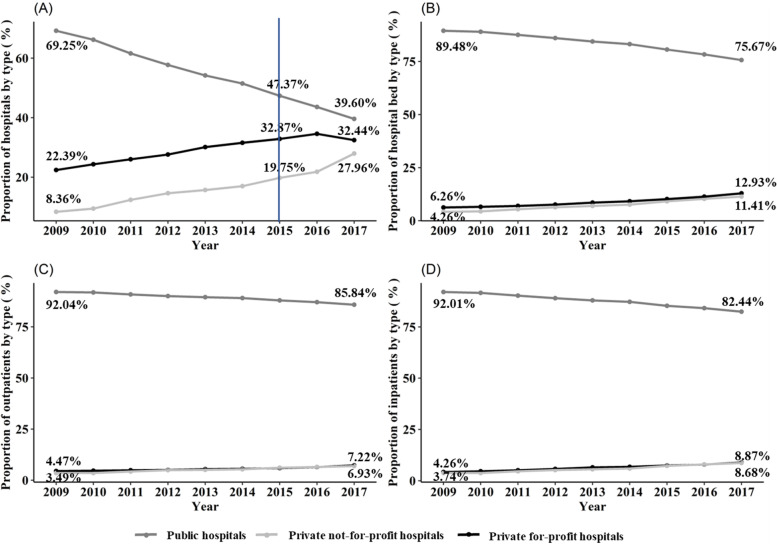
Background: Private hospitals expanded rapidly in China since 2009 following its national health reform encouraging private investment in the hospital sector. Despite long-standing debates over the performance of different types of hospitals, empirical evidence under the context of developing countries remains scant. We investigated the disparities in health care quality and medical expenses among public, private not-for-profit, and private for-profit hospitals. Methods: A total of 64,171 inpatients (51,933 for pneumonia (PNA), 9,022 for heart failure (HF) and 3,216 for acute myocardial infarction (AMI)) who were admitted to 528 secondary hospitals in Sichuan province, China, during the fourth quarters of 2016, 2017, and 2018 were selected for this study. Multilevel logistic regressions and multilevel linear regressions were utilized to assess the relationship between hospital ownership types and in-hospital mortality, as well as medical expenses for PNA, HF, and AMI, after adjusting for relevant hospital and patient characteristics, respectively. Results: The private not-for-profit (adjusted OR, 1.69; 95% CI, 1.08, 2.64) and for-profit (adjusted OR, 1.67; 95% CI, 1.06, 2.62) hospitals showed higher in-hospital mortality than the public ones for PNA, but not for AMI and HF. No significant differences were found in medical expenses across hospital ownership types for AMI, but the private not-for-profit was associated with 9% higher medical expenses for treating HF, while private not-for-profit and for-profit hospitals were associated with 10% and 11% higher medical expenses for treating PNA than the public hospitals. No differences were found between the private not-for-profit and private for-profit hospitals both in in-hospital mortality and medical expenses across the three conditions. Conclusion: The public hospitals had at least equal or even higher healthcare quality and lower medical expenses than the private ones in China, while private not-for-profit and for-profit hospitals had similar performances in these aspects. Our results added evidences on hospitals’ performances among different ownership types under China’s context, which has great potential to inform the optimization of healthcare systems implemented among developing countries confronted with similar challenges.
Overview
The claims and statistics of this paper haven’t been checked yet.
Free: it reads the open-access text and checks the first 5 claims that cite a source we can check. Create a free account to check every claim.
Integrity signals
Registry
Cites
Statistics
Figures
Verification
Claims the paper makes
The claims and statistics of this paper haven’t been checked yet.
Free: it reads the open-access text and checks the first 5 claims that cite a source we can check. Create a free account to check every claim.
Self-check
Percentages, sums and reported differences re-computed from the paper’s own numbers.
The self-check needs the paper’s full text.
Citations
Cites
Charlson, M. E., Pompei, P., Ales, K. L., & MacKenzie, C. R. (1987) · Journal of Chronic Diseases · doi:10.1016/0021-9681(87)90171-8 · Cited by 49,742 · cited 3×
“Abbreviations AMI Acute Myocardial Infarction CCI Charlson Comorbidity Index CI Confident Interval COEF Coefficient HF Heart Failure LOS Length of Stay OR Odds Ratio PFP Private For-Profit PH Public Hospital PNA Pneumonia PNF Private Not-For-Profit UEBMI Urban Employee Basic Medical Insurance URBMI Urban Resident Basi…”
MethodInfluentialCem: Coarsened Exact Matching in Stata
Blackwell, M., Iacus, S., King, G., & Porro, G. (2009) · The Stata Journal: Promoting communications on statistics and Stata · doi:10.1177/1536867x0900900402 · Cited by 1,689 · cited 1×
“In a sensitivity analysis, to further reduce heterogeneity in the characteristics of patients visiting public and private hospitals, we applied coarsened exact matching (CEM) methods [42], to arrive at an analysis sample where private patients (4) log (”
Method10 years of health-care reform in China: progress and gaps in Universal Health Coverage
Yip, W., Fu, H., Chen, A. T., Zhai, T., Jian, W., Xu, R., Pan, J., Hu, M., Zhou, Z., Chen, Q., et al. (2019) · The Lancet · doi:10.1016/s0140-6736(19)32136-1 · Cited by 1,246 · cited 1×
“One of the key policies proposed in the reform was the lift of restrictions on private investments made in the healthcare sector [7].”
BackgroundSelf-citationBasu, S., Andrews, J., Kishore, S., Panjabi, R., & Stuckler, D. (2012) · PLoS Medicine · doi:10.1371/journal.pmed.1001244 · Cited by 845 · cited 2×
“Background Many countries around the world have implemented a healthcare system composed of both public and private hospitals [1, 2], in which public hospitals, private notfor-profit hospitals, and private for-profit hospitals are expected to behave differently [3, 4].”
BackgroundUNCERTAINTY AND THE WELFARE ECONOMICS OF MEDICAL CARE
ARROW, K. J. (1978) · Uncertainty in Economics · doi:10.1016/b978-0-12-214850-7.50028-0 · Cited by 834 · cited 1×
“Given that the healthcare market has its unique characteristics [14], such as information asymmetry between providers and patients, criticism has been raised towards private for-profit hospitals for their stronger incentives to maximize their profits by inducing patients to use unnecessary services [15].”
BackgroundMackintosh, M., Channon, A., Karan, A., Selvaraj, S., Cavagnero, E., & Zhao, H. (2016) · The Lancet · doi:10.1016/s0140-6736(16)00342-1 · Cited by 278 · cited 1×
“Background Many countries around the world have implemented a healthcare system composed of both public and private hospitals [1, 2], in which public hospitals, private notfor-profit hospitals, and private for-profit hospitals are expected to behave differently [3, 4].”
BackgroundDevereaux, P. J., Choi, P. T. L., Lacchetti, C., Weaver, B., Schünemann, H. J., Haines, T., Lavis, J. N., Grant, B. J. B., Haslam, D. R. S., Bhandari, M., et al. (2002) · Europe PMC (PubMed Central) · Cited by 263
Health Care Exceptionalism? Performance and Allocation in the US Health Care Sector
Chandra, A., Finkelstein, A., Sacarny, A., & Syverson, C. (2016) · American Economic Review · doi:10.1257/aer.20151080 · Cited by 257 · cited 1×
“To assess the associations between hospital ownership types and in-hospital mortality and medical expenses, we selected three conditions which are the subject of many studies on quality of care [34, 35], namely acute myocardial infarction (AMI), heart failure (HF), and pneumonia (PNA).”
MethodHospital ownership and quality of care: what explains the different results in the literature?
Eggleston, K., Shen, Y., Lau, J., Schmid, C. H., & Chan, J. (2008) · Health Economics · doi:10.1002/hec.1333 · Cited by 188
Comparing public and private providers: a scoping review of hospital services in Europe
Tynkkynen, L., & Vrangbæk, K. (2018) · BMC Health Services Research · doi:10.1186/s12913-018-2953-9 · Cited by 160 · cited 2×
“Meanwhile, the evidences [17, 18] from European countries reported that the disparities in the quality of care among different hospital ownership types failed to produce a clear conclusion.”
BackgroundDrye, E. E., Normand, S.-L. T., Wang, Y., Ross, J. S., Schreiner, G. C., Han, L., Rapp, M., & Krumholz, H. M. (2012) · Annals of Internal Medicine · doi:10.7326/0003-4819-156-1-201201030-00004 · Cited by 152
Kruse, F. M., Stadhouders, N. W., Adang, E., Groenewoud, S., & Jeurissen, P. (2018) · The International Journal of Health Planning and Management · doi:10.1002/hpm.2502 · Cited by 150
Herrera, C. A., Gabriel Rada, G., Kuhn-Barrientos, L., & Barrios, X. (2014) · PLoS ONE · doi:10.1371/journal.pone.0093456 · Cited by 120 · cited 5×
“Unlike private for-profit hospitals, making profits is not set up as the primary goal for not-for-profit hospitals, which may facilitate the formation of a patient and society-friendly environment where physicians and managers tend to consider patients’ interests as the priority [4].”
BackgroundInfluentialDevereaux, P. J., Heels-Ansdell, D., Lacchetti, C., Haines, T., Burns, K. E. A., Cook, D. J., Ravindran, N., Walter, S. D., McDonald, H., Stone, S. B., et al. (2004) · Canadian Medical Association Journal · doi:10.1503/cmaj.1040722 · Cited by 118 · cited 3×
“Two meta-analysis conducted in US found that private for-profit hospitals increased the risk of death [45] and had higher expenses than the private not-for-profit ones [19].”
BackgroundResultThe Association between For-Profit Hospital Ownership and Increased Medicare Spending
Silverman, E. M., Skinner, J., & Fisher, E. S. (1999) · New England Journal of Medicine · doi:10.1056/nejm199908053410606 · Cited by 117
Nuti, S. V., Qin, L., Rumsfeld, J. S., Ross, J. S., Masoudi, F. A., Normand, S. T., Murugiah, K., Bernheim, S. M., Suter, L. G., & Krumholz, H. M. (2016) · JAMA · doi:10.1001/jama.2016.0278 · Cited by 105
Comparing public and private hospitals’ service quality
Alumran, A. K., Almutawa, H. H. A., Alzain, Z., Althumairi, A., & Khalid, N. (2020) · Journal of Public Health · doi:10.1007/s10389-019-01188-9 · Cited by 92 · cited 1×
“Despite the growing number of studies on high-income countries [21, 22], evidence identified under the context of developing countries remains scant [23, 24].”
BackgroundComparing public and private hospitals in China: Evidence from Guangdong
Eggleston, K. N., Lu, M., Li, C., Wang, J., Yang, Z., Zhang, J., & Quan, H. (2010) · BMC Health Services Research · doi:10.1186/1472-6963-10-76 · Cited by 84 · cited 2×
“For example, in one previous study that performed a multistage design through 2004 to 2005 to collect data from a sample composed of governmentally-owned and private hospitals in Guangdong Province, a southern province in China, no differences were identified in in-hospital mortality for all diseases investigated amon…”
BackgroundZhao, C., Wang, C., Shen, C., & Wang, Q. (2018) · BioScience Trends · doi:10.5582/bst.2017.01289 · Cited by 78 · cited 1×
“As the fee-for-service payment method prevails in China’s nationwide healthcare system, healthcare providers are given unprecedentedly attractive financial incentives from over-treatment [51].”
BackgroundLet's End the Nonprofit Charade
Hasan, M. M. (1996) · New England Journal of Medicine · doi:10.1056/nejm199604183341610 · Cited by 70 · cited 1×
“Advocates for greater private sector participation argue that private for-profit hospitals are more cost-effective [10], more responsive to patients’ demands [11] and provide a higher quality of care [12, 13].”
BackgroundPublic hospital autonomy in China in an international context
Allen, P. W., Cao, Q., & Wang, H. (2013) · The International Journal of Health Planning and Management · doi:10.1002/hpm.2200 · Cited by 68 · cited 1×
“Public hospitals traditionally formed the backbone of China’s healthcare system [26].”
Background[Guideline for diagnosis and treatment of patients with ST-elevation myocardial infarction].
(2010) · PubMed · Cited by 65
Wang, X., & Pan, J. (2016) · BMC Health Services Research · doi:10.1186/s12913-016-1643-8 · Cited by 62 · cited 1×
“Specifically, the primary hospitals are usually equipped with less than 100 beds, as compared to the secondary hospitals with 100–500 beds, and the tertiary hospitals with more than 500 beds [32].”
BackgroundSelf-citationLau, T., Fang, C. X., & Leung, F. K. L. (2015) · Hong Kong Medical Journal · doi:10.12809/hkmj154451 · Cited by 60
Vulnerability of Health to Market Forces
Brezis, M., & Wiist, W. H. (2011) · Medical Care · doi:10.1097/mlr.0b013e31820ab638 · Cited by 57
Comparing the average cost of outpatient care of public and for-profit private providers in India
Garg, S., Tripathi, N., Ranjan, A., & Bebarta, K. K. (2021) · BMC Health Services Research · doi:10.1186/s12913-021-06777-7 · Cited by 55 · cited 1×
“Despite the growing number of studies on high-income countries [21, 22], evidence identified under the context of developing countries remains scant [23, 24].”
BackgroundThe effect of hospital ownership on quality of care: Evidence from England
Moscelli, G., Gravelle, H. S. E., Siciliani, L., & Gutacker, N. (2018) · Journal of Economic Behavior & Organization · doi:10.1016/j.jebo.2018.05.009 · Cited by 53 · cited 1×
“Despite the growing number of studies on high-income countries [21, 22], evidence identified under the context of developing countries remains scant [23, 24].”
BackgroundChina’s encouraging commitment to health
Meng, Q., Yin, D., MILLS, A. J., & Abbasi, K. A. (2019) · BMJ · doi:10.1136/bmj.l4178 · Cited by 50 · cited 1×
“China initiated a systematic reform of its nationwide health system in 2009 [5, 6].”
BackgroundWang, W., Maitland, E., Nicholas, S., Loban, K., & Haggerty, J. L. (2017) · International Journal for Equity in Health · doi:10.1186/s12939-017-0672-1 · Cited by 48 · cited 1×
“Two other studies focused on self-reported patient satisfaction with the services received from private and public clinics and community health centers instead of hospitals [30, 31].”
BackgroundBel, G., & Estève, M. (2019) · International Public Management Journal · doi:10.1080/10967494.2019.1622613 · Cited by 46 · cited 2×
“A recent meta-analysis covering 21 studies found that public hospitals provided public health services at lower costs than the private sector [20].”
BackgroundPrivate or public hospital ownership: Does it really matter?
Bjorvatn, A. (2017) · Social Science & Medicine · doi:10.1016/j.socscimed.2017.11.038 · Cited by 43 · cited 2×
“Unlike previous studies which reported that the private hospitals were more likely to admit patients with less severe symptoms and conditions [21], the Charlson score of patients was found to be the highest in private not-forprofit, followed by private for-profit and public hospitals, with the higher Charlson score to…”
BackgroundResultPrivate hospital expansion in China: a global perspective
Deng, C., Li, X., & Pan, J. (2018) · Global Health Journal · doi:10.1016/s2414-6447(19)30138-1 · Cited by 37 · cited 1×
“Background Many countries around the world have implemented a healthcare system composed of both public and private hospitals [1, 2], in which public hospitals, private notfor-profit hospitals, and private for-profit hospitals are expected to behave differently [3, 4].”
BackgroundSelf-citationThe Evolving Hospital Market in China After the 2009 Healthcare Reform
Jiang, Q., & Pan, J. (2020) · INQUIRY The Journal of Health Care Organization Provision and Financing · doi:10.1177/0046958020968783 · Cited by 30 · cited 1×
“This policy was primarily aimed at enhancing the responsiveness of the health system in meeting the increasingly diverse health care needs of the residents as well as facilitating improved healthcare quality and efficiency via encouraging competition within the hospital market [8, 9].”
BackgroundSelf-citationLan, T., Chen, T., Hu, Y., Yang, Y., & Pan, J. (2021) · Frontiers in Public Health · doi:10.3389/fpubh.2021.719839 · Cited by 28 · cited 1×
“Developing countries are typically confronted with greater constraints posed on their governmental budgets, which is a key financing source of healthcare expenses [25].”
BackgroundSelf-citationEffect of Hospital Ownership on Outcomes of Heart Failure Hospitalization
Akintoye, E. O., Briasoulis, Α., Egbe, A. C., Orhurhu, V., Ibrahim, W., Kumar, K. R., Alliu, S., Nas, H., Levine, D., & Weinberger, J. J. (2017) · The American Journal of Cardiology · doi:10.1016/j.amjcard.2017.06.009 · Cited by 27 · cited 2×
“Prior studies showed that in-hospital mortality varies by age and gender [39].”
BackgroundMethodXu, J., Liu, G., Deng, G., Li, L., Xiong, X., & Basu, K. (2013) · Health Economics · doi:10.1002/hec.3015 · Cited by 26 · cited 2×
“In another study which retrieved self-reported outpatient expenses over the past 2 weeks from China’s Urban Resident Basic Medical Insurance Survey from 2008 to 2010, and used the variable to roughly represent outpatient medical expenses, no differences were observed in this aspect between private and public healthcar…”
MethodYin, X., Gong, Y., Yang, C., Tu, X., Liu, W., Cao, S., Yang, H., & Lu, Z. (2015) · Medical Care · doi:10.1097/mlr.0000000000000414 · Cited by 26 · cited 1×
“Two other studies focused on self-reported patient satisfaction with the services received from private and public clinics and community health centers instead of hospitals [30, 31].”
BackgroundXiong, W., Deng, Y., Yang, Y., Zhang, Y., & Pan, J. (2021) · Frontiers in Public Health · doi:10.3389/fpubh.2021.787865 · Cited by 26 · cited 1×
“Meanwhile, though the prices of health services in public hospitals or private hospitals which join the social insurance payment program are determined by the government, the process for treating and diagnosing diseases varied across hospitals, doctors, and patients [27].”
BackgroundSelf-citationLi, A. H. F. (2016) · China Perspectives · doi:10.4000/chinaperspectives.7140 · Cited by 24 · cited 1×
“Meanwhile, both private notfor-profit and for-profit hospitals have been confronted with bad reputations they previously gained from the occurrence of severe adverse medical events that were exposed to the public to escalate safety concerns [47].”
BackgroundLim, E., Cheng, Y., Reuschel, C., Mbowe, O. B., Ahn, H. J., Taira, D. A., Miyamura, J., Seto, T. B., & Chen, J. J. (2015) · Health Services Research · doi:10.1111/1475-6773.12325 · Cited by 21 · cited 1×
“As suggested by previous research that patients’ age, severity of medical conditions, racial disparities and comorbidities were associated with in-hospital mortality [43, 44], our patient-level investigation based on three commonly diagnosed diseases Table 3 (continued)”
ResultWübker, A., & Wuckel, C. (2019) · CESifo Economic Studies · doi:10.1093/cesifo/ifz005 · Cited by 17 · cited 1×
“clinical guidelines and consensus for the treatments of AMI and HF [48, 49], but not for PNA [50].”
BackgroundHospital Ownership and Hospital Institutional Change: A Qualitative Study in Guizhou Province, China
Xie, Y. H., Liang, D., Huang, J., & Jin, J.-J. (2019) · International Journal of Environmental Research and Public Health · doi:10.3390/ijerph16081460 · Cited by 16 · cited 1×
“Though private not-for-profit hospitals in China are never expected to financially behave like the private for-profit ones, the prior literature [52] indicated that the private not-for-profit hospitals were still on their way towards profit-oriented goals, which would be quite different from the cases in developed cou…”
ResultBriasoulis, Α., Inampudi, C., Akintoye, E. O., Adegbala, O. M., Bhama, J. K., & Alvarez, P. A. (2018) · The Annals of Thoracic Surgery · doi:10.1016/j.athoracsur.2018.08.051 · Cited by 12 · cited 1×
“In our analytical models, we followed the convention in the literature [38, 39] and adjusted for an extensive set of hospital-level and patient-level characteristics, as well as year dummies.”
MethodHayashida, K., Imanaka, Y., Sekimoto, M., Kobuse, H., & Fukuda, H. (2007) · Journal of International Medical Research · doi:10.1177/147323000703500502 · Cited by 10 · cited 1×
“As suggested by previous research that patients’ age, severity of medical conditions, racial disparities and comorbidities were associated with in-hospital mortality [43, 44], our patient-level investigation based on three commonly diagnosed diseases Table 3 (continued)”
ResultThe role of the private sector in health financing and service delivery
Fidler, A. H. (2009) · European Journal of Public Health · doi:10.1093/eurpub/ckp147 · Cited by 10 · cited 1×
“Advocates for greater private sector participation argue that private for-profit hospitals are more cost-effective [10], more responsive to patients’ demands [11] and provide a higher quality of care [12, 13].”
BackgroundThe Association of Market Mix of Hospital Ownership With Medical Disputes: Evidence From China
Lan, T., & Pan, J. (2020) · INQUIRY The Journal of Health Care Organization Provision and Financing · doi:10.1177/0046958020971403 · Cited by 7 · cited 1×
“Advocates for greater private sector participation argue that private for-profit hospitals are more cost-effective [10], more responsive to patients’ demands [11] and provide a higher quality of care [12, 13].”
BackgroundSelf-citation
Research works printed but not linked: 2
- Qingling JJ Pay: Trends on hospital market structure in Sichuan Provinces J Health Policy 2019 12 8 8
- China Society of Cardiology of Chinese Medical Association, Cardiology EBoCJo Guideline for diagnosis and treatment of chronic heart failure Zhonghua Xin Xue Guan Bing Za Zhi 2007 35 3 1076
Cited by
Abbas, Q., Jeong, W., & Lee, S. W. (2025) · Healthcare · doi:10.3390/healthcare13172154 · Cited by 236
“For example, in diagnostic imaging, XAI can highlight specific regions of interest on radiographs or MRIs that contribute to a diagnosis, allowing radiologists to verify and validate the model’s conclusions [22,23].”
Innovative healthcare solutions: robust hand gesture recognition of daily life routines using 1D CNN
Mudawi, N. A., Ansar, H., Alazeb, A., Aljuaid, H., AlQahtani, Y., Algarni, A. M., Jalal, A., & Liu, H. (2024) · Frontiers in Bioengineering and Biotechnology · doi:10.3389/fbioe.2024.1401803 · Cited by 62
Artificial intelligence in stroke rehabilitation: From acute care to long-term recovery
Kopalli, S. R., Shukla, M., Jayaprakash, B., Kundlas, M., Srivastava, A., Jagtap, J., Gulati, M., Chigurupati, S., Ibrahim, E., Khandige, P. S., et al. (2025) · Neuroscience · doi:10.1016/j.neuroscience.2025.03.017 · Cited by 63
Rehman, A. U., Lu, S., Heyat, M. B. B., Iqbal, M. S., Parveen, S., Hayat, M. A. B., Akhtar, F., Ashraf, M. A., Khan, O., Pomary, D., et al. (2025) · International Journal of Intelligent Systems · doi:10.1155/int/8546245 · Cited by 72
Senapati, T., Sarkar, A., & Chen, G. (2024) · Engineering Applications of Artificial Intelligence · doi:10.1016/j.engappai.2024.108794 · Cited by 53
Metadata
- Authors
- Xue, Q., Xu, D. R., Cheng, T. C., Pan, J., & Yip, W.
- Affiliations
- Chengdu Medical College (CN)
- Southern Medical University (CN)
- Harvard University (US)
- Sichuan University (CN)
- Corresponding author
- Pan, Jay
- Venue
- Archives of Public Health
- Published
- 2023-02-10
- Volume
- 81
- Issue
- 1
- Pages
- 19-19
- ISSN
- 0778-7367 (ISSN-L)
- 2049-3258
- PMC
- PMC9911958
- OpenAlex
- W4319984229
- Semantic Scholar
- f052cd71a115e6d706dcbd6b3c0414a381245675
- Cited by
- 50
- References
- 46
- Citations by year
- 2026: 18 · 2025: 15 · 2024: 16 · 2023: 1
- FWCI
- 10.51
- Type
- journal article
- Language
- en
- Open access
- gold
- doi.org
- Licence
- cc-by
- creativecommons.org/licenses/by/4.0 (tdm)
- creativecommons.org/licenses/by/4.0 (vor)
- Locations
- Archives of Public Health (publishedVersion, cc-by)
- PubMed Central (publishedVersion, cc-by)
- PubMed (publishedVersion)
- DOAJ (DOAJ: Directory of Open Access Journals) (submittedVersion, cc-by-sa)
- Funders
- National Natural Science Foundation of China (72204031, 72074163)
- Chengdu Federation of Social Science Association (ZZ05)
- Sichuan University (2018hhf-27)
- National Social Science Fund of China (21ZDA104)
- Sichuan Science and Technology Program (2022YFS0052)
- Topics
- Health Sciences › Medicine › Public Health, Environmental and Occupational Health › Healthcare Systems and Reforms
- Social Sciences › Economics, Econometrics and Finance › Economics and Econometrics › Healthcare Policy and Management
- Health Sciences › Medicine › Public Health, Environmental and Occupational Health › Healthcare Quality and Management
- Keywords
- hospital ownership, in-hospital mortality, health care costs, private hospitals, public hospitals, nonprofit hospitals, for-profit hospitals, pneumonia, heart failure, acute myocardial infarction, quality of care, China health reform, Sichuan
About these checks
Registry, retraction, Cites and statistics results are computed, not judged, with one exception: a printed reference that no index lists is read once by a model before it counts as a citation error. Claims are extracted by a model and kept only when their quote appears verbatim in the text; each cited source is then checked, with a model’s help, for whether it says what the claim relies on. Those verdicts can be wrong — read the claim’s quote and the cited source before relying on one.
Statistics and arithmetic are recomputed, not judged.
Confidence bands are shown only for fields calibrated on our annotated test set. None is calibrated yet, so no band is shown.
What counts as a claim ›How we measure confidence ›How we check this ›
Are you an author, or do you see a problem with this page? Request a review
Data sources
Bibliographic data: Semantic Scholar, OpenAlex, Crossref.
Contains information from the Semantic Scholar Academic Graph Datasets, made available under the ODC Attribution License (ODC-BY 1.0).
Semantic Scholar’s data is described in: Kinney, R., et al. (2023). The Semantic Scholar Open Data Platform. arXiv:2301.10140.
