

Exploring the potential for biomethane production by willow pyrolysis using life cycle assessment methodology
Open accessThe DOI matches its Crossref record; 67 of the 67 references it cites were found in a registry or an index; 4 of the 38 sources its claims cite were checked for support.
Abstract
Biomethane, as a potential substitute for natural gas, reduces the use of fossil-based sources, promoting bioenergy applications. Biomethane for energy use can be produced using a variety of biomass types and technologies. Biomethane from farmland crops is currently produced by anaerobic digestion (AD) of energy crops, which is a biological treatment of organic material resulting in biomethane and digestate. Recently, thermochemical conversion technologies of biomass to biomethane have gained attention. Pyrolysis is a thermochemical process whereby woody biomass is converted to fuel gas and biochar. This study assessed the land use efficiency of producing biomethane through a maize-based AD system compared with switching to a willow-based biomethane system using pyrolysis as an emerging technology. The energy performance and climate impact of the two pathways were assessed from a land use perspective, using life cycle assessment methodology. The entire technical system, from biomass production to delivery of biomethane as the end product, was included within the analysis. The study also investigated how the climate impact was affected when biochar was applied to soil to act as a soil amendment and carbon sequestration agent or when biochar was used as an energy source. Pyrolysis of willow had a higher external energy ratio and climate mitigation effect than maize-based AD as a result of lower primary energy inputs and lower methane loss in the pyrolysis process and upgrading units. Furthermore, the biochar from willow pyrolysis, when used as a soil amendment or energy source, contributed significantly to the climate impact mitigation potential in both cases. Substituting fossil gas with biomethane gave a considerable reduction in climate impact in all scenarios, especially in the case of willow pyrolysis. The willow pyrolysis system acted as a carbon sink, resulting in a negative climate impact, counteracting global warming. From a land use perspective, the transition from maize-based AD to a willow-based pyrolysis system for biomethane production could be beneficial regarding the energy performance and climate impact. Application of biochar to the soil in the willow scenario contributed significantly to counteracting emissions of greenhouse gases.
Overview
CoChat Summary
TL;DR
This LCA compares biomethane from maize anaerobic digestion with willow pyrolysis on the same 2500 ha of southern Swedish arable land over 44 years. Willow pyrolysis had a higher external energy ratio and lower or negative climate impact, especially when biochar was used as a soil amendment or fossil-coal substitute.
Key findings
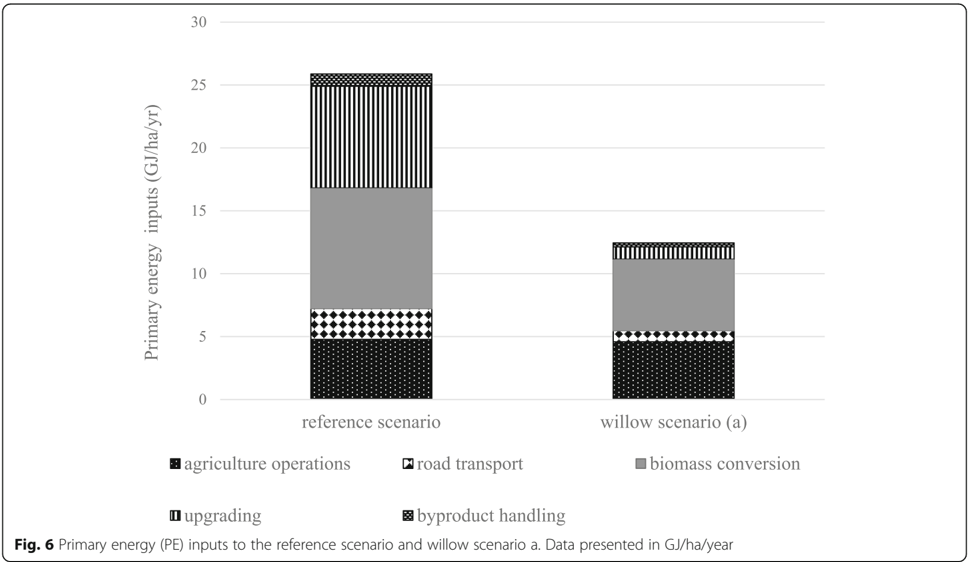
- Willow scenario a had an energy ratio of 8.9 versus 5.4 for the maize AD reference, with primary energy input of 12.5 versus 26.0 GJ/ha/year; biomethane output was 111.0 versus 141.0 GJ/ha/year, plus 10.0 GJ/ha/year exported heat in the willow scenario.
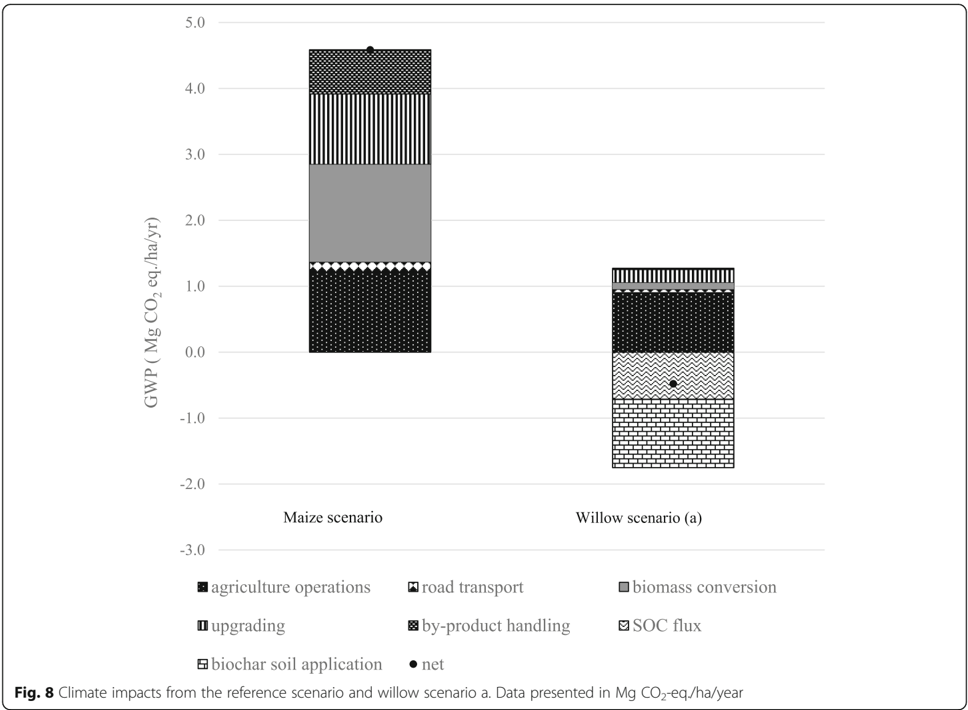
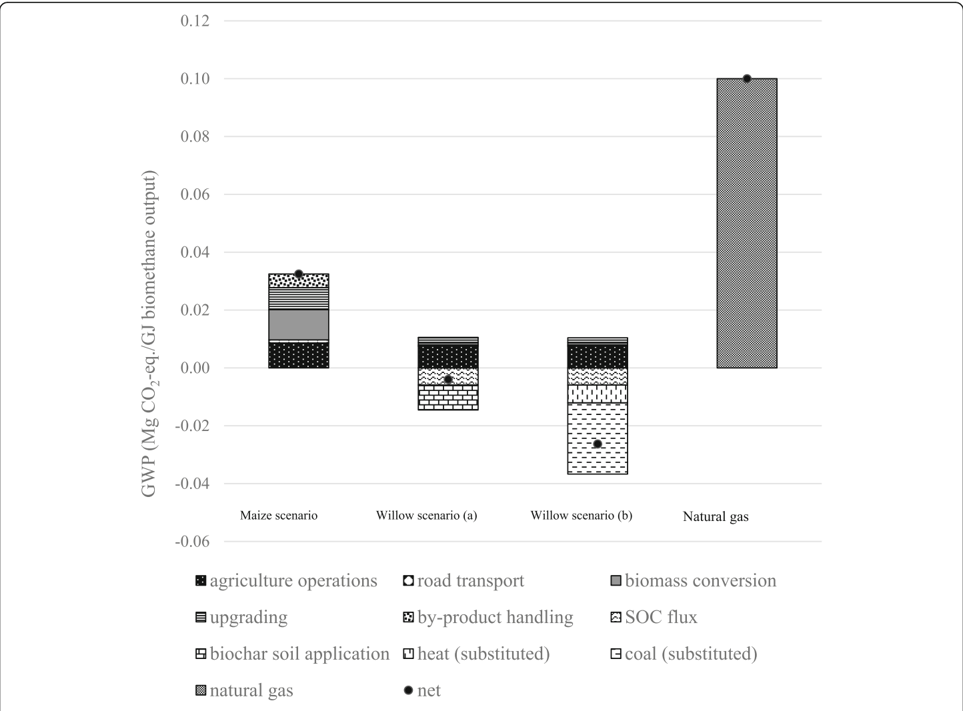
- Climate impact was 4.6 Mg CO2-eq./ha/year for the reference and −0.5 Mg CO2-eq./ha/year for willow scenario a. Per GJ biomethane, impacts were 0.030 (reference), −0.004 (willow a), −0.026 (willow b), and 0.100 Mg CO2-eq./GJ (natural gas).
- In willow scenario a, SOC change contributed −0.7 and biochar application contributed −1.0 Mg CO2-eq./ha/year. Using biochar as an energy source in willow scenario b gave a lower climate impact than using it as a soil amendment.
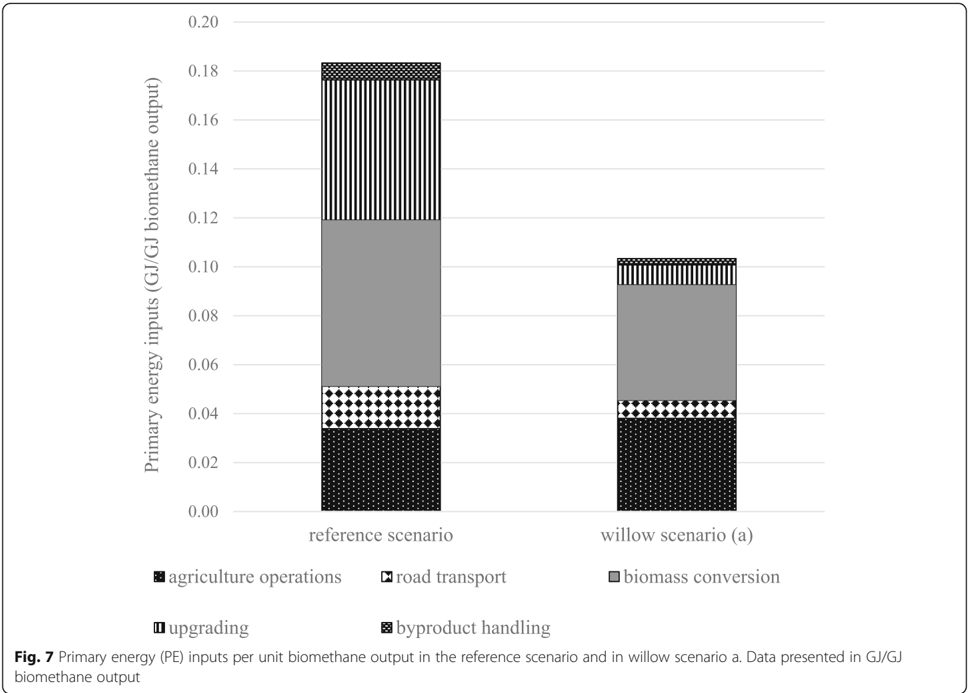
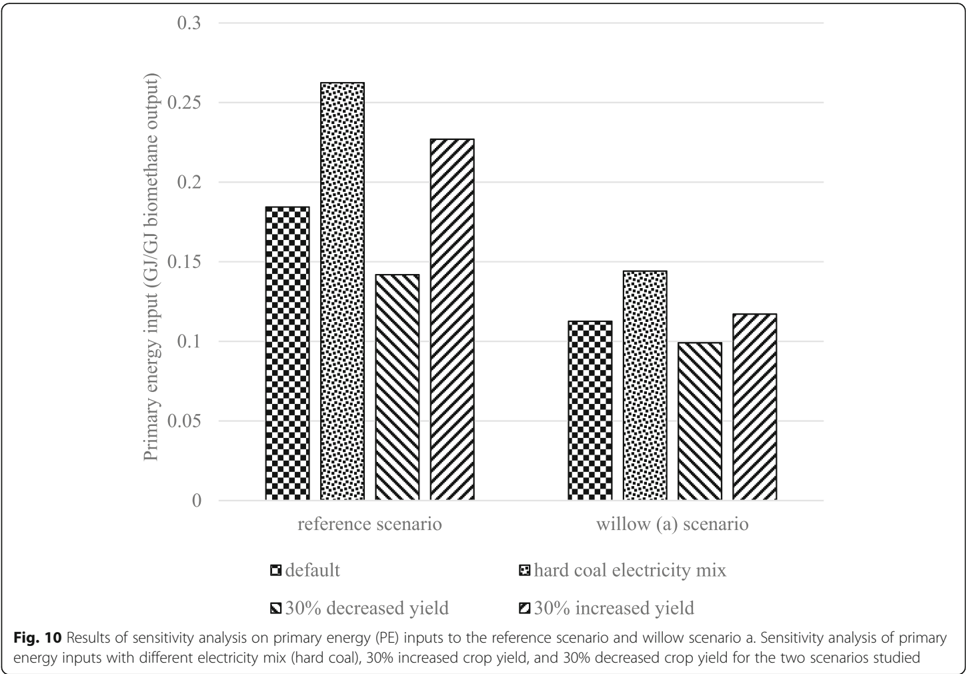
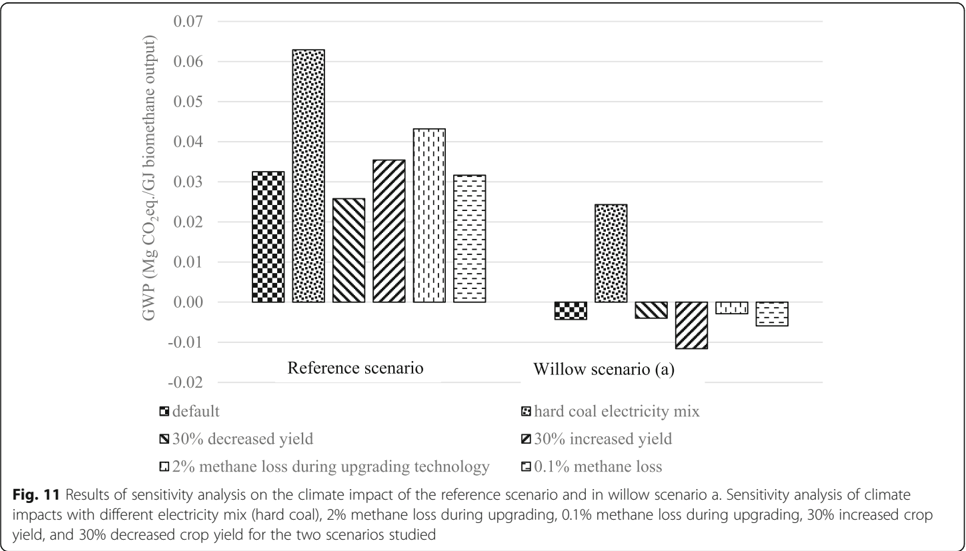
- Sensitivity analysis: hard coal electricity raised primary energy use to 0.26 and 0.14 GJ/GJ and climate impact to 0.063 and 0.024 Mg CO2-eq./GJ for reference and willow a; 2% methane slip raised impacts to 0.043 and −0.002 Mg CO2-eq./GJ; a 30% willow yield increase reduced GHG emissions by −0.011 Mg CO2-eq./GJ.
Methods
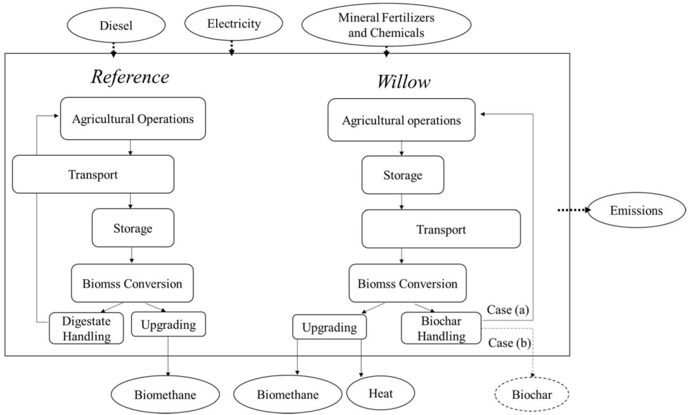
- Attributional LCA of two biomethane pathways: maize AD reference and willow pyrolysis with two sub-scenarios—biochar returned to soil (willow a) or used as energy (willow b). System boundaries covered agricultural operations, transport, conversion, upgrading, and by-product handling; biomethane use phase and capital goods were excluded. Functional units were ha/year and GJ biomethane, over 2500 ha in southern Sweden for 44 years.
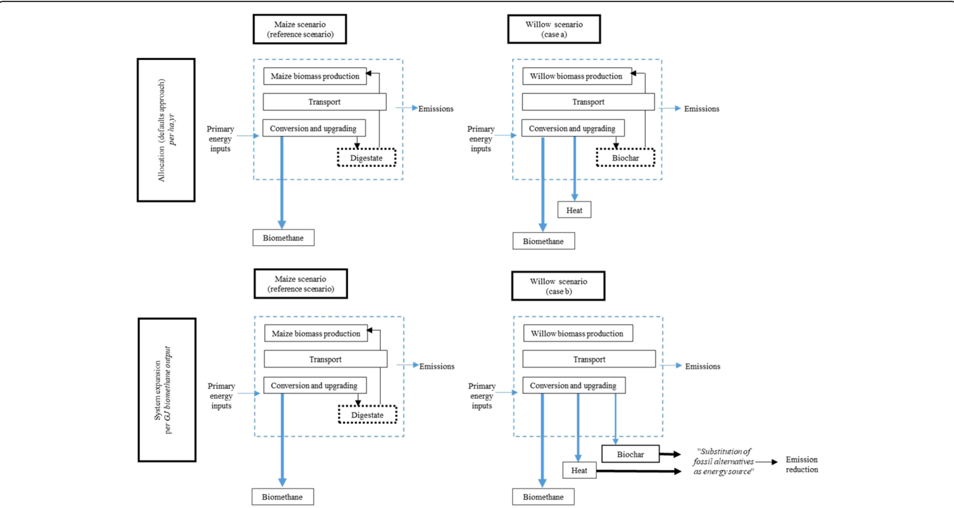
- Inventory calculations used Excel, Ecoinvent v3.3, and literature data. Physical allocation by lower heating value was used for willow a; system expansion was tested for willow b, assuming exported heat substituted natural gas CHP heat and 1 Mg biochar substituted 3 Mg hard coal. SOC was modeled with ICBM, and biochar stock with an exponential decay model.
- Sensitivity analysis varied electricity mix (Nordic vs hard coal), methane losses in upgrading (0.1%, 1%, 2%), and maize/willow yields.
Limitations
- Stated: uncertainties in soil emissions models (biogenic carbon flux and N2O soil emissions) and input data accuracy; biogenic carbon dynamics are complex with few empirical data; IPCC default N2O values are general and do not consider site- or crop-specific conditions.
- Stated: economic feasibility was not assessed and is likely a strong constraining factor; other environmental impact categories such as eutrophication, acidification, and ecotoxicity were not included; differing system boundaries complicate comparison across LCA studies.
- Evident from the text: the analysis is attributional and model-based, excludes biomethane delivery/end use and capital goods, and is set in one 2500 ha southern Swedish context; no life cycle cost or technical assessment was performed.
Model-written summary. Check it against the paper before relying on it.
Integrity signals
Registry
Cites
Statistics
Figures
Verification
Claims the paper makes
3 Valid · 1 Not valid · 22 Not checked · 98 Own results and interpretations
The cited sources support only part of this claim — read each source’s verdict below.
In the paper
“According to [82], maize cultivation requires high mechanical and chemical inputs, especially to combat weeds and pests.”
What the sources say
- Partly supportedcites [82] 82. Melander B, Munier-Jolain N, Charles R, Wirth J, Schwarz J, Van der Weide R, Bonin L, Jensen PK, Kudsk P (2012) Weed Technology 27(1):231 -240. https:// doi.org/10.1614/WT-D-12-00066.1 sourceExperimental — accuracy not yet measured
The Direct Nonchemical Control Methods section describes both mechanical and chemical weed control in maize, and the Concluding Remarks discuss reducing herbicide use through interrow cultivation. Neither passage says maize cultivation requires high levels of both inputs, and the passages do not address inputs for pest control. Page numbers are unavailable in our copy. (LLM, conf=0.84)
plain- Asserted: passes — The authors put it forward as true.
- Checkable: passes — It can be checked against evidence.
- Load-bearing: unclear — It is unclear whether the paper’s conclusions depend on it.
- Based: passes — The paper gives a reason why it holds.
- Partly supported
The cited sources support only part of this claim — read each source’s verdict below.
In the paper
“These could be avoided by storing the digestate in covered tanks and capturing the methane generated [62].”
What the sources say
- Partly supportedcites [62] 62. Whiting A, Azapagic A (2014) Life cycle environmental impacts of generating electricity and heat from biogas produced by anaerobic digestion. Energy 70:181 -193. https://doi.org/10.1016/j.energy.2014.03.103 sourceExperimental — accuracy not yet measured
Section 5.4.1 (Covered storage) says sealed tanks capture up to 80% of methane and that using the captured methane substantially reduces impacts from emissions. It supports reducing open-air storage emissions, but not avoiding them entirely. (LLM, conf=0.84)
plainstates a cause- Asserted: passes — The authors put it forward as true.
- Checkable: passes — It can be checked against evidence.
- Load-bearing: unclear — It is unclear whether the paper’s conclusions depend on it.
- Based: passes — The paper gives a reason why it holds.
- Partly supported
A result the paper states — it cites no source for it, so there is none to check. The quote shows it is in the paper.
In the paper
“Pyrolysis of willow had a higher external energy ratio and climate mitigation effect than maize-based AD as a result of lower primary energy inputs and lower methane loss in the pyrolysis process and upgrading units.”
plainstates a cause- Asserted: passes — The authors put it forward as true.
- Checkable: passes — It can be checked against evidence.
- Load-bearing: passes — The paper’s conclusions depend on it.
- Based: passes — The paper gives a reason why it holds.
A result the paper states — it cites no source for it, so there is none to check. The quote shows it is in the paper.
In the paper
“Furthermore, the biochar from willow pyrolysis, when used as a soil amendment or energy source, contributed significantly to the climate impact mitigation potential in both cases.”
plainstates a cause- Asserted: passes — The authors put it forward as true.
- Checkable: passes — It can be checked against evidence.
- Load-bearing: passes — The paper’s conclusions depend on it.
- Based: passes — The paper gives a reason why it holds.
- Rests on an assumption not shown here.
72 more claims
Create a free account to see all 124 claims and to verify the 9 references still open.
- Probably not a substantial claim. 28
- It may state two separate claims as one. 25
Self-check
Percentages, sums and reported differences re-computed from the paper’s own numbers.
Each contradiction between two passages listed here was confirmed by an independent check.
Rated minor: it would not touch a result — a value no result rests on, a p-value that stays on the same side of the significance level, or a conflict that is clerical, resolved elsewhere in the paper, or outside its own findings.
In the paper
§ Willow scenario
“the biochar was assumed to be applied to the soil of an annual crop plantation”
§ Biochar stock modeling
“In willow scenario a, biochar was assumed to be applied to the soil in the willow plantation.”
Rated minor: it would not touch a result — a value no result rests on, a p-value that stays on the same side of the significance level, or a conflict that is clerical, resolved elsewhere in the paper, or outside its own findings.
In the paper
§ Sensitivity analysis
“Reducing the methane losses to 0.1% by using an amine scrubber instead of a water scrubber reduced the climate impact to 0.031 and -0.006 Mg CO2-eq./GJ biomethane output for the reference scenario and willow scenario a, respectively.”
§ Substitution of fossil alternatives
“the reference scenario (0.030 Mg CO2-eq/GJ biomethane)”
Rated minor: it would not touch a result — a value no result rests on, a p-value that stays on the same side of the significance level, or a conflict that is clerical, resolved elsewhere in the paper, or outside its own findings.
In the paper
§ Substitution of fossil alternatives
“reducing the climate impact by 0.006 Mg CO2-eq./ha/year (Fig. 9)”
§ Sensitivity analysis
“Fig. 9 Climate impact of the reference scenario, the willow scenarios a and b, with physical allocation and system expansion and a natural gasbased system. Data presented in Mg CO2-eq./GJ biomethane output”
Citations
Cites
Klüppel, H.-J. (2005) · The International Journal of Life Cycle Assessment · doi:10.1065/lca2005.03.001 · Cited by 4,639
Lehmann, J. (2007) · Nature · doi:10.1038/447143a · Cited by 2,477 · cited 1×
“The biochar can be used as a soil amendment, as it usually contains 80–90% stable carbon that is resistant to decomposition and mineralization, and therefore can offer a direct method to sequester carbon for long periods [23, 24].”
BackgroundReview of greenhouse gas emissions from crop production systems and fertilizer management effects
Snyder, C. S., Bruulsema, T. W., Jensen, T. L., & Fixen, P. E. (2009) · Agriculture, Ecosystems & Environment · doi:10.1016/j.agee.2009.04.021 · Cited by 1,531 · cited 1×
“Precision fertilization and practices to improve the efficiency of plant nitrogen uptake can lead to lower N2O emissions [80, 81].”
BackgroundRondon, M. A., Lehmann, J., Ramírez, J., & Hurtado, M. (2007) · Biology and Fertility of Soils · doi:10.1007/s00374-006-0152-z · Cited by 1,333 · cited 1×
“Furthermore, when used as a soil amendment, biochar can improve soil fertility, soil structure, nutrient availability, and soil water retention capacity [25, 26].”
BackgroundRoberts, K. G., Gloy, B. A., Joseph, S., Scott, N. R., & Lehmann, J. (2010) · Environmental Science & Technology · doi:10.1021/es902266r · Cited by 1,243 · cited 1×
“The biochar can be used as a soil amendment, as it usually contains 80–90% stable carbon that is resistant to decomposition and mineralization, and therefore can offer a direct method to sequester carbon for long periods [23, 24].”
BackgroundAbiotic and microbial oxidation of laboratory-produced black carbon (biochar)
Zimmerman, A. R. (2010) · Environmental Science & Technology · doi:10.1021/es903140c · Cited by 1,103 · cited 2×
“Zimmerman AR (2010) Abiotic and microbial oxidation of laboratoryproduced black carbon (biochar).”
MethodLaird, D. A. (2008) · Agronomy Journal · doi:10.2134/agrojnl2007.0161 · Cited by 930
Life cycle assessment of bioenergy systems: State of the art and future challenges
Cherubini, F., & Strømman, A. H. (2011) · Bioresource Technology · doi:10.1016/j.biortech.2010.08.010 · Cited by 832 · cited 1×
“This is a common approach in LCA of biofuel systems [52, 53] and is also recommended by the EU regulations on biofuel GHG performance [54].”
BackgroundAnaerobic digestion of biomass for methane production: A review
Nallathambi Gunaseelan, V. (1997) · Biomass and Bioenergy · doi:10.1016/s0961-9534(97)00020-2 · Cited by 794
Evaluation of energy efficiency of various biogas production and utilization pathways
Pöschl, M., Ward, S., & Owende, P. (2010) · Applied Energy · doi:10.1016/j.apenergy.2010.05.011 · Cited by 783
Main routes for the thermo-conversion of biomass into fuels and chemicals. Part 1: Pyrolysis systems
Balat, M., Balat, M., Kırtay, E., & Balat, H. (2009) · Energy Conversion and Management · doi:10.1016/j.enconman.2009.08.014 · Cited by 738 · cited 1×
“low investment costs and high energy performance compared with other processes, especially on a small scale, and can potentially scale up to industrial level [19, 20].”
BackgroundAssessment of energy performance in the life-cycle of biogas production
Berglund, M., & Börjesson, P. (2006) · Biomass and Bioenergy · doi:10.1016/j.biombioe.2005.11.011 · Cited by 555
Pretreatment methods of lignocellulosic biomass for anaerobic digestion
Amin, F. R., Khalid, H., Zhang, H., Rahman, S. U., Zhang, R., Liu, G., & Chen, C. (2017) · AMB Express · doi:10.1186/s13568-017-0375-4 · Cited by 538
Patel, M., Zhang, X., & Kumar, A. (2016) · Renewable and Sustainable Energy Reviews · doi:10.1016/j.rser.2015.09.070 · Cited by 535
Biogas upgrading–technology overview, comparison and perspectives for the future
Bauer, F., Persson, T., Hulteberg, C., & Tamm, D. (2013) · Biofuels, Bioproducts and Biorefining · doi:10.1002/bbb.1423 · Cited by 414
Kimetu, J. M., Lehmann, J., Ngoze, S. O., Mugendi, D. N., Kinyangi, J. M., Riha, S., Verchot, L., Recha, J. W., & Pell, A. N. (2008) · Ecosystems · doi:10.1007/s10021-008-9154-z · Cited by 406
Life cycle assessment of biofuels: Energy and greenhouse gas balances
Gnansounou, E., Dauriat, A., Villegas, J., & Panichelli, L. (2009) · Bioresource Technology · doi:10.1016/j.biortech.2009.05.067 · Cited by 402 · cited 1×
“affecting the carbon balance in the soil [47].”
BackgroundChanges in soil organic carbon under biofuel crops
ANDERSON‐TEIXEIRA, K. J., DAVIS, S. C., MASTERS, M. D., & DELUCIA, E. H. (2009) · GCB Bioenergy · doi:10.1111/j.1757-1707.2008.01001.x · Cited by 391
Cambero, C., & Sowlati, T. (2014) · Renewable and Sustainable Energy Reviews · doi:10.1016/j.rser.2014.04.041 · Cited by 352
Meissle, M., Mouron, P., Musa, T., Bigler, F., Pons, X., Vasileiadis, V. P., Otto, S., Antichi, D., Kiss, J., Pálinkás, Z., et al. (2010) · Journal of Applied Entomology · doi:10.1111/j.1439-0418.2009.01491.x · Cited by 321 · cited 1×
“Options to reduce the high energy and material inputs to the maize agro-ecosystem include a careful choice of variety, cultural control measures, biological control, and optimization of pesticide application techniques [83].”
BackgroundOrder from Chaos: A Preliminary Protocol for Determining the EROI of Fuels
Murphy, D. J., Hall, C. A. S., Dale, M., & Cleveland, C. (2011) · Sustainability · doi:10.3390/su3101888 · Cited by 290
Feasibility of Large-Scale Biofuel Production
Giampietro, M., Ulgiati, S., & Pimentel, D. (1997) · BioScience · doi:10.2307/1313165 · Cited by 289
Whiting, A., & Azapagic, A. (2014) · Energy · doi:10.1016/j.energy.2014.03.103 · Cited by 275
Biomass Pyrolysis for Biochar or Energy Applications? A Life Cycle Assessment
Peters, J. F., Iribarren, D., & Dufour, J. (2015) · Environmental Science & Technology · doi:10.1021/es5060786 · Cited by 272 · cited 1×
“Moreover, biochar can be used for energy purposes, due to its high energy content [27, 28].”
BackgroundEffects of ensiling, silage additives and storage period on methane formation of biogas crops
Herrmann, C., Heiermann, M., & Idler, C. (2011) · Bioresource Technology · doi:10.1016/j.biortech.2011.01.012 · Cited by 266 · cited 1×
“Losses during ensiling were assumed to be compensated for by changes in the composition of fermentation products during ensiling, leading to unchanged methane yield from the maize silage [63].”
BackgroundGrowing fuel: a sustainability assessment of willow biomass crops
Volk, T. A., Verwijst, T., Tharakan, P. J., Abrahamson, L. P., & White, E. H. (2004) · Frontiers in Ecology and the Environment · doi:10.1890/1540-9295(2004)002[0411:gfasao]2.0.co;2 · Cited by 232 · cited 1×
“Willow also has a broad species diversity, which is important in the successful development of the crop and resistance to pests and diseases [38].”
BackgroundLife cycle assessment of biogas upgrading technologies
Starr, K., Gabarrell, X., Villalba, G., Talens, L., & Lombardi, L. (2012) · Waste Management · doi:10.1016/j.wasman.2011.12.016 · Cited by 215
The Environmental Relevance of Capital Goods in Life Cycle Assessments of Products and Services
(2007) · DORA Empa (Swiss Federal Laboratories for Materials Science and Technology (Empa)) · doi:10.1065/lca2007.02.309 · Cited by 195
Nitrate Leaching and Nitrogen Budget as Affected by Maize Nitrogen Rate and Soil Type
Sogbedji, J. M., van Es, H. M., Yang, C. L., Geohring, L. D., & Magdoff, F. R. (2000) · Journal of Environmental Quality · doi:10.2134/jeq2000.00472425002900060011x · Cited by 176 · cited 1×
“Precision fertilization and practices to improve the efficiency of plant nitrogen uptake can lead to lower N2O emissions [80, 81].”
BackgroundDigestate: A New Nutrient Source - Review
Makdi, M., Tomcsik, A., & Orosz, V. (2012) · Biogas · doi:10.5772/31355 · Cited by 170
Gissén, C., Prade, T., Kreuger, E., Nges, I. A., Rosenqvist, H., Svensson, S.-E., Lantz, M., Mattsson, J. E., Börjesson, P., & Björnsson, L. (2014) · Biomass and Bioenergy · doi:10.1016/j.biombioe.2014.03.061 · Cited by 158
ICBM regional model for estimations of dynamics of agricultural soil carbon pools
Andrén, O., Kätterer, T., & Karlsson, T. (2004) · Nutrient Cycling in Agroecosystems · doi:10.1023/b:fres.0000048471.59164.ff · Cited by 154
Melander, B., Munier-Jolain, N., Charles, R., Wirth, J., Schwarz, J., van der Weide, R., Bonin, L., Jensen, P. K., & Kudsk, P. (2013) · Weed Technology · doi:10.1614/wt-d-12-00066.1 · Cited by 153
Vaneeckhaute, C., Meers, E., Michels, E., Buysse, J., & Tack, F. (2013) · Biomass and Bioenergy · doi:10.1016/j.biombioe.2012.12.036 · Cited by 147
Life cycle assessment of energy generation from biogas—Attributional vs. consequential approach
Rehl, T., Lansche, J., & Müller, J. (2012) · Renewable and Sustainable Energy Reviews · doi:10.1016/j.rser.2012.02.072 · Cited by 147
Lamers, P., & Junginger, M. (2013) · Biofuels, Bioproducts and Biorefining · doi:10.1002/bbb.1407 · Cited by 146
Rosenqvist, H., Roos, A., Ling, E., & Hektor, B. (2000) · Biomass and Bioenergy · doi:10.1016/s0961-9534(99)00081-1 · Cited by 100
Assessment of energy crops alternative to maize for biogas production in the Greater Region
Mayer, F., Gerin, P. A., Noo, A., Lemaigre, S., Stilmant, D., Schmit, T., Leclech, N., Ruelle, L., Gennen, J., von Francken-Welz, H., et al. (2014) · Bioresource Technology · doi:10.1016/j.biortech.2014.05.054 · Cited by 90
Weih, M., & Nordh, N.-E. (2005) · Tree Physiology · doi:10.1093/treephys/25.9.1197 · Cited by 77
Biofuels in the long-run global energy supply mix for transportation
Timilsina, G. R. (2014) · Philosophical Transactions of the Royal Society A: Mathematical, Physical and Engineering Sciences · doi:10.1098/rsta.2012.0323 · Cited by 76 · cited 1×
“biomass production, transport, fuel production technologies) [45, 46].”
Energy balance and global warming potential of biogas-based fuels from a life cycle perspective
Ahmadi Moghaddam, E., Ahlgren, S., Hulteberg, C., & Nordberg, Å. (2015) · Fuel Processing Technology · doi:10.1016/j.fuproc.2014.12.014 · Cited by 75 · cited 3×
“This is a common approach in LCA of biofuel systems [52, 53] and is also recommended by the EU regulations on biofuel GHG performance [54].”
BackgroundMethodSelf-citationWagner, A. O., Schwarzenauer, T., & Illmer, P. (2013) · Journal of Environmental Management · doi:10.1016/j.jenvman.2013.07.030 · Cited by 75
Pavlovskaia, E. (2014) · Environmental Sciences Europe · doi:10.1186/s12302-014-0017-2 · Cited by 66
Mola-Yudego, B., & González-Olabarria, J. R. (2010) · Biomass and Bioenergy · doi:10.1016/j.biombioe.2009.12.008 · Cited by 62
Menardo, S., Airoldi, G., Cacciatore, V., & Balsari, P. (2014) · Biosystems Engineering · doi:10.1016/j.biosystemseng.2014.11.010 · Cited by 61
Mola-Yudego, B., & Pelkonen, P. (2008) · Energy Policy · doi:10.1016/j.enpol.2008.03.036 · Cited by 59
Bio-methane via fast pyrolysis of biomass
Görling, M., Larsson, M., & Alvfors, P. (2013) · Applied Energy · doi:10.1016/j.apenergy.2013.01.002 · Cited by 50
Greenhalf, C., Nowakowski, D. J., Harms, A. B., Titiloye, J. O., & Bridgwater, A. V. (2011) · Fuel · doi:10.1016/j.fuel.2011.11.050 · Cited by 48
Fuzzy logic-based predictive model for biomass pyrolysis
Lerkkasemsan, N. (2017) · Applied Energy · doi:10.1016/j.apenergy.2016.02.105 · Cited by 42
Meixner, K., Fuchs, W., Valkova, T., Svardal, K., Loderer, C., Neureiter, M., Bochmann, G., & Drosg, B. (2015) · Separation and Purification Technology · doi:10.1016/j.seppur.2015.03.003 · Cited by 41
Predicting silage maize yield and quality in Sweden as influenced by climate change and variability
Eckersten, H., Herrmann, A., Kornher, A., Halling, M., Sindhøj, E., & Lewan, E. (2011) · Acta Agriculturae Scandinavica Section B - Soil & Plant Science · doi:10.1080/09064710.2011.585176 · Cited by 41
Börjesson, P., Prade, T., Lantz, M., & Björnsson, L. (2015) · Energies · doi:10.3390/en8066033 · Cited by 40
Open-Air Drying of Cut and Windrowed Short-Rotation Poplar Stems
Civitarese, V., Spinelli, R., Barontini, M., Gallucci, F., Santangelo, E., Acampora, A., Scarfone, A., Giudice, A. D., & Pari, L. (2015) · BioEnergy Research · doi:10.1007/s12155-015-9612-3 · Cited by 33
Ericsson, N., Nordberg, Å., Sundberg, C., Ahlgren, S., & Hansson, P. (2014) · Applied Energy · doi:10.1016/j.apenergy.2014.06.049 · Cited by 33
Self-citationVoets, T., Kuppens, T., Cornelissen, T., & Thewys, T. (2011) · Biomass and Bioenergy · doi:10.1016/j.biombioe.2011.01.034 · Cited by 27
Life-cycle-assessment of industrial scale biogas plants
Hartmann, J. K. (2022) · doi:10.53846/goediss-1798 · Cited by 26
Shackley, S. J., Carter, S., Sims, K., & Sohi, S. (2011) · Energy & Environment · doi:10.1260/0958-305x.22.3.167 · Cited by 22
Sub-surface soil carbon changes affects biofuel greenhouse gas emissions
Schmer, M. R., Jin, V. L., & Wienhold, B. J. (2015) · Biomass and Bioenergy · doi:10.1016/j.biombioe.2015.05.011 · Cited by 21 · cited 1×
“Changes in SOC are directly related to the level of GHG emissions in an LCA study, while SOC itself is an important indicator of soil quality [49].”
BackgroundAssessment of Novel Routes of Biomethane Utilization in a Life Cycle Perspective
Moghaddam, E. A., Ahlgren, S., & Nordberg, Å. (2016) · Frontiers in Bioengineering and Biotechnology · doi:10.3389/fbioe.2016.00089 · Cited by 21 · cited 1×
“Choice of electricity mix also had a considerable impact on the results of our previous LCA studies of bioenergy scenarios [52, 86].”
BackgroundSelf-citationEricsson, N., Sundberg, C., Nordberg, Å., Ahlgren, S., & Hansson, P. (2017) · GCB Bioenergy · doi:10.1111/gcbb.12415 · Cited by 15
Self-citationWagner, H., Wulf, C., & Kaltschmitt, M. (2014) · Biomass Conversion and Biorefinery · doi:10.1007/s13399-014-0127-5 · Cited by 14
Nilsson, D., Larsolle, A., Nordh, N., & Hansson, P. (2017) · Biosystems Engineering · doi:10.1016/j.biosystemseng.2017.04.010 · Cited by 10
Self-citationNilsson, D. (1995) · Journal of Agricultural Research · Cited by 8
Ericsson, N. (2015) · Epsilon Open Archive (Sveriges lantbruksuniversitet biblioteket (Swedish University of Agricultural Sciences)) · doi:10.13140/rg.2.1.3508.0164 · Cited by 8
Self-citationBiogaserzeugung aus Energiemais
Amon, T., Kryvoruchko, V., Amon, B., Bodiroza, V., Zollitsch, W. J., & Boxberger, J. (2015) · Kuratorium für Technik und Bauwesen in der Landwirtschaft e. V. (KTBL) · doi:10.15150/lt.2006.1062 · Cited by 4
Patel, M., Zhang, X., & Kumar, A. (2016) · ChemInform · doi:10.1002/chin.201610276 · Cited by 3
Koponen, K. (2016) · Cited by 2
Research works printed but not linked: 9
- 2. Lönnqvist T (2017). Biogas in Swedish transport -a policy-driven systemic transition (Doctoral dissertation), KTH Royal Institute of Technology, Stockholm. ISBN 978-91-7729-389-7
- 39. ISO (2006) Environmental management -life cycle assessment -principles and framework (ISO 14040:2006). European Committee for Standardization, Brussels
- 40. ISO (2006) Environmental management -life cycle assessment -requirements and guidelines (ISO 14044:2006). European Committee for Standardization, Brussels
- 54. Union E (2009) Directive 2009/28/EC of the European Parliament and of the Council of 23 April 2009 on the promotion of the use of energy from renewable sources and amending and subsequently repealing Directives 2001/77/EC and 2003/30/EC. Official Journal of the European Union, 5, 2009
- 67. Boerrigter H, Deurwaarder EP, Bergman PCA, van Paasen SVB, van Ree R (2004) Thermal bio-refinery; high-efficient integrated production of renewable chemicals, (transportation) fuels, and products from biomass, 2004. Presented at ' the 2nd World Conference and Technology Exhibition on Biomass for Energy, Industry and Climate Protection ' in Rome, Italy, 10-14 May 2004 (online: ftp://ftp.ecn.nl/pub/www/library/report/2004/rx04044.pdf). Accessed Nov 2018
- high-efficient integrated production of renewable chemicals, (transportation) fuels, and products from biomass, 2004. Presented at "the 2nd World Conference and Technology Exhibition on Biomass for Energy, Industry and Climate Protection" in Rome, Italy, 10-14 May 2004 (online: ftp://ftp.ecn.nl/pub/www/library/report/2004/rx04044.pdf ). Accessed Nov 2018
- 71. Stocker TF, Qin D, Plattner GK, Alexander LV, Allen SK, Bindoff NL et al (2013) Technical summary. In climate change 2013: the physical science basis. Contribution of Working Group I to the Fifth Assessment Report of the Intergovernmental Panel on Climate Change 33-11. Cambridge University Press, Paris
- 76. Hoyer K, Hulteberg C, Svensson M, Jernberg J, Nørregård Ø (2016) Biogas upgrading - technical Review. Energiforsk. ISBN 978-91-7673-275-5
- 77. Rodhe L, Nordberg Å (2011) Greenhouse gas emissions from the storage of liquid and solid manure and abatement strategies. Conference paper: Emissionen der Tierhaltung. Treibhausgase, Umweltbewertung, Stand det Techik 491:206 -216
Cited by
Life cycle assessment of carbon dioxide removal technologies: a critical review
Terlouw, T., Bauer, C., Rosa, L., & Mazzotti, M. (2021) · Energy & Environmental Science · doi:10.1039/d0ee03757e · Cited by 347
Ubando, A. T., Rivera, D. R. T., Chen, W.-H., & Culaba, A. B. (2019) · Bioresource Technology · doi:10.1016/j.biortech.2019.121837 · Cited by 186
Environmental sustainability of negative emissions technologies: A review
Jeswani, H. K., Saharudin, D. M., & Azapagic, A. (2022) · Sustainable Production and Consumption · doi:10.1016/j.spc.2022.06.028 · Cited by 133
Updates on high value products from cellulosic biorefinery
Rajasekharan, R., Paulose, T. A. P., Philip, E., Thomas, D., Madhavan, A., Sirohi, R., Binod, P., Awasthi, M. K., Pandey, A., & Sindhu, R. (2021) · Fuel · doi:10.1016/j.fuel.2021.122056 · Cited by 85
Review in life cycle assessment of biomass conversion through pyrolysis-issues and recommendations
Yu, Z., Ma, H., Liu, X., Wang, M., & Wang, J. (2022) · Green Chemical Engineering · doi:10.1016/j.gce.2022.08.002 · Cited by 86
Metadata
- Authors
- Ahmadi Moghaddam, E., Ericsson, N., Hansson, P.-A., & Nordberg, Å.
- Affiliations
- Swedish University of Agricultural Sciences (SE)
- Venue
- Energy, Sustainability and Society
- Published
- 2019-02-22
- Volume
- 9
- Issue
- 1
- ISSN
- 2192-0567 (ISSN-L)
- OpenAlex
- W2936504361
- Semantic Scholar
- 510ad753e0f0854b6d22571fae6e82ea9dd72b67
- Cited by
- 25
- References
- 66
- Citations by year
- 2025: 2 · 2024: 3 · 2023: 4 · 2022: 6 · 2021: 8 · 2020: 1 · 2019: 1
- FWCI
- 1.41
- Type
- journal article
- Language
- en
- Open access
- gold
- doi.org
- Licence
- cc-by
- creativecommons.org/licenses/by/4.0 (tdm)
- Locations
- Energy Sustainability and Society (publishedVersion, cc-by)
- DOAJ (DOAJ: Directory of Open Access Journals) (submittedVersion, cc-by-sa)
- Topics
- Physical Sciences › Energy › Fuel Technology › Thermochemical Biomass Conversion Processes
- Life Sciences › Agricultural and Biological Sciences › Agronomy and Crop Science › Bioenergy crop production and management
- Physical Sciences › Energy › Renewable Energy, Sustainability and the Environment › Anaerobic Digestion and Biogas Production
- Keywords
- biomethane production, anaerobic digestion, biochar, soil amendment, carbon sequestration, climate change impacts, land use efficiency, greenhouse gas emissions, biomass thermochemical conversion, bioenergy
About these checks
Registry, retraction, Cites and statistics results are computed, not judged, with one exception: a printed reference that no index lists is read once by a model before it counts as a citation error. Claims are extracted by a model and kept only when their quote appears verbatim in the text; each cited source is then checked, with a model’s help, for whether it says what the claim relies on. Those verdicts can be wrong — read the claim’s quote and the cited source before relying on one.
The claim verdicts this report counts are experimental: their accuracy is not yet measured.
A language model drew the claims from the paper on 2026-09-28, under version 3 of the claim definition (prompt extract-v3).
A second model labelled each claim on 2026-09-28 (model jev-1.13-20260917, definition revision gold-guideline-v0.2).
Cited sources are checked with a language model’s help (gpt-6-sol).
Statistics and arithmetic are recomputed, not judged.
Confidence bands are shown only for fields calibrated on our annotated test set. None is calibrated yet, so no band is shown.
What counts as a claim ›How we measure confidence ›How we check this ›
Are you an author, or do you see a problem with this page? Request a review
Data sources
Bibliographic data: Semantic Scholar, OpenAlex, Crossref.
Contains information from the Semantic Scholar Academic Graph Datasets, made available under the ODC Attribution License (ODC-BY 1.0).
Semantic Scholar’s data is described in: Kinney, R., et al. (2023). The Semantic Scholar Open Data Platform. arXiv:2301.10140.
