

The DOI matches its Crossref record; 3 of the 3 references it cites were found in a registry or an index.
The development of social science research on smart grids: a semi-structured literature review
Abstract
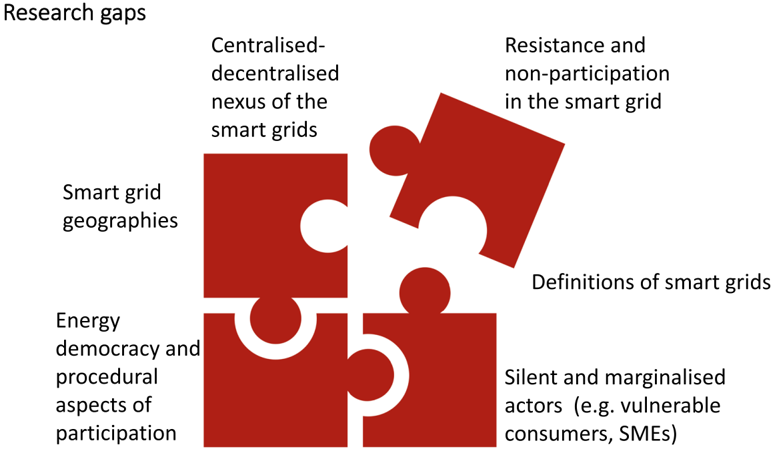
Background: Smart technologies, such as smart grids, are emerging as indispensable aspects of an energy transformation and come with hopes of more sustainable resource use. A substantial amount of research has examined the technical, economic, and environmental implications of these technologies, but less attention has been paid to their social aspects. For the smart grid projects to be realised, studies that include the actors who are supposed to implement the visions are needed. Results: A semi-structured literature review was conducted to investigate the state of social science literature on smart grids and identify the main research avenues and research gaps by addressing a broad research question: “What kind of knowledge is produced in social science studies on smart grids?” We retrieved peer-reviewed articles from the Scopus and Web of Science (WoS) databases up until 2022 and mapped them in terms of features such as topic, design, method, and theory. Conclusions: We found that knowledge development in social science studies on smart grids followed a pattern where most research focused on visions; professionals and users; and smart technologies in homes with a geographical focus on Europe or the USA. We identified six research gaps related to an overly vague definition of the smart grid and the need to include more diverse actors and geographical places to advance our understanding of the smart grid. There is also a lack of studies relating to energy democracy, the resistance of smart grids and the centralised–decentralised nexus of the smart grid. These less studied areas can bring in new knowledge that enhances a deployment of a smart grids supporting not only technological development, but also society and users.
Overview
The claims and statistics of this paper haven’t been checked yet.
Run the check — free, no account needed. It reads the open-access text and checks the sources it cites.
Integrity signals
Registry
Cites
Statistics
Figures
Verification
Claims the paper makes
The claims and statistics of this paper haven’t been checked yet.
Run the check — free, no account needed. It reads the open-access text and checks the sources it cites.
Claims other papers make about this one
Each is checked against this paper’s own text: does it say what the citing paper says it does?
The cited source says what the claim attributes to it.
In the citing paper
“To align this with preferences, behaviours, and identities of prospective users and communities, it is important to acknowledge that governing a smart grid is above all a socio-technical challenge [23].”
From Smart, circular and renewable: The role of cooperative governance in accelerating a sustainable energy transition (2025) · cites this paper as [23]
The cited source says what the claim attributes to it.
In the citing paper
“they can only be truly smart when there are people within it, as indicated earlier by [23,117]”
From Smart, circular and renewable: The role of cooperative governance in accelerating a sustainable energy transition (2025) · cites this paper as [23]
In the citing paper
“As the number of realised smart grid projects remains low, scholars increasingly document the institutional failures of both for-profit and public sector solutions [23].”
From Smart, circular and renewable: The role of cooperative governance in accelerating a sustainable energy transition (2025) · cites this paper as [23]
In the citing paper
“Research on the social aspects of smart grids has been identified to be lagging to knowledge development of its technical aspects, resulting in major research gaps on energy democracy [23,27].”
From Smart, circular and renewable: The role of cooperative governance in accelerating a sustainable energy transition (2025) · cites this paper as [23]
In the citing paper
“Most research on smart grids, as noted in a recent systematic literature review of 111 papers, uses a single case study approach but over shorter periods [23].”
From Smart, circular and renewable: The role of cooperative governance in accelerating a sustainable energy transition (2025) · cites this paper as [23]
In the citing paper
“As smart grids are sociotechnical and incremental grids”
From Smart, circular and renewable: The role of cooperative governance in accelerating a sustainable energy transition (2025) · cites this paper as [23]
Self-check
Percentages, sums and reported differences re-computed from the paper’s own numbers.
The self-check needs the paper’s full text.
Citations
Cites
Literature review as a research methodology: An overview and guidelines
Snyder, H. (2019) · Journal of Business Research · doi:10.1016/j.jbusres.2019.07.039 · Cited by 11,524
Web of Science (WoS) and Scopus: The Titans of Bibliographic Information in Today’s Academic World
Pranckutė, R. (2021) · Publications · doi:10.3390/publications9010012 · Cited by 2,696 · cited 1×
“Both have broad coverage [28] but cover slightly different publications, which rationalises including them both.”
BackgroundTomičić, A., Malešević, A., & Čartolovni, A. (2022) · Science and Engineering Ethics · doi:10.1007/s11948-021-00354-1 · Cited by 27
Research works printed but not linked: 88
- Siemens, University of Oxford, TU Berlin. The grid edge revolution. Innovative drivers towards net-zero energy. 2019. https://new.siemens.com/global/en/company/topic-areas/smart-infrastructure/grid-edge/white-paper-grid-edge-net-zero-energy-drivers.html. Siemens.
- Lunde M, Ropke I, Heiskanen E (2016) Smart grid: hope or hype? Energy Effic 9(2):545–562. https://doi.org/10.1007/s12053-015-9385-8 · DOI
- Maya-Drysdale D, Krog Jensen L, Vad MB (2020) Energy vision strategies for the EU green new deal: a case study of European cities. Energies 13(9):2194 · DOI
- Palm J (2021) Exploring limited capacity in the grid: actors, problems, and solutions. Front Energy Res 9:199
- Li J, Ho MS, Xie C, Stern N (2022) China’s flexibility challenge in achieving carbon neutrality by 2060. Renew Sustain Energy Rev 158:112112 · DOI
- Moneta D. Smart grids: enabler for the energy transition. EPJ Web of Conferences: EDP Sciences; 2018. p. 00012. · DOI
- Raimi KT, Carrico AR (2016) Understanding and beliefs about smart energy technology. Energy Res Soc Sci 12:68–74 · DOI
- Hall S, Foxon TJ (2014) Values in the smart grid: the co-evolving political economy of smart distribution. Energy Policy 74:600–609 · DOI
- Wallsten A, Galis V (2019) The discreet charm of activeness: the vain construction of efficient smart grid users. J Cult Econ 12(6):571–589 · DOI
- Hansen M, Hauge B (2017) Scripting, control, and privacy in domestic smart grid technologies: insights from a Danish pilot study. Energy Res Soc Sci 25:112–123 · DOI
- Bigerna S, Bollino CA, Micheli S (2016) Socio-economic acceptability for smart grid development—a comprehensive review. J Clean Prod 131:399–409 · DOI
- Grunwald A (2014) Modes of orientation provided by futures studies: making sense of diversity and divergence. Eur J Futures Res 2(1):1–9 · DOI
- Reinders A, Übermasser S, Van Sark W, Gercek C, Schram W, Obinna U et al (2018) An exploration of the three-layer model including stakeholders, markets and technologies for assessments of residential smart grids. Appl Sci 8(12):2363 · DOI
- Szulecki K, Overland I (2020) Energy democracy as a process, an outcome and a goal: a conceptual review. Energy Res Soc Sci. https://doi.org/10.1016/j.erss.2020.101768 · DOI
- Lovell H (2022) Understanding energy innovation: learning from smart grid experiments. Springer Nature, Cham · DOI
- De Wildt T, Chappin E, van de Kaa G, Herder P, van de Poel I (2019) Conflicting values in the smart electricity grid a comprehensive overview. Renew Sustain Energy Rev 111:184–196 · DOI · Paper page
- Smale R, van Vliet B, Spaargaren G (2017) When social practices meet smart grids: flexibility, grid management, and domestic consumption in The Netherlands. Energy Res Soc Sci 34:132–140. https://doi.org/10.1016/j.erss.2017.06.037 · DOI
- Wolsink M (2012) The research agenda on social acceptance of distributed generation in smart grids: renewable as common pool resources. Renew Sustain Energy Rev 16(1):822–835 · DOI · Paper page
- Verbong GPJ, Beemsterboer S, Sengers F (2013) Smart grids or smart users? Involving users in developing a low carbon electricity economy. Energy Policy 52:117–125 · DOI
- Skjølsvold TM, Ryghaug M, Berker T (2015) A traveler’s guide to smart grids and the social sciences. Energy Res Soc Sci 9:1–8. https://doi.org/10.1016/j.erss.2015.08.017 · DOI
- Kojonsaari A-R, Palm J (2021) Distributed energy systems and energy communities under negotiation. Technol Econ Smart Grids Sustain Energy 6(1):17. https://doi.org/10.1007/s40866-021-00116-9 · DOI
- Skjølsvold TM, Lindkvist C (2015) Ambivalence, designing users and user imaginaries in the European smart grid: insights from an interdisciplinary demonstration project. Energy Res Soc Sci 9:43–50 · DOI
- Baumeister RF, Leary MR (1997) Writing narrative literature reviews. Rev Gen Psychol 1(3):311–320 · DOI · Paper page
- Bryman A (2007) Effective leadership in higher education: a literature review. Stud High Educ 32(6):693–710 · DOI
- Sovacool BK, Axsen J, Sorrell S (2018) Promoting novelty, rigor, and style in energy social science: towards codes of practice for appropriate methods and research design. Energy Res Soc Sci 45:12–42 · DOI · Paper page
- Hammersley M (2001) On ‘systematic’reviews of research literatures: a ‘narrative’response to Evans & Benefield. Br Educ Res J 27(5):543–554 · DOI
- Coffey A, Atkinson P (1996) Making sense of qualitative data: complementary research strategies. Sage Publications, Inc, Thoudsand Oaks
- Throndsen W (2017) What do experts talk about when they talk about users? Expectations and imagined users in the smart grid. Energy Effic 10(2):283–297 · DOI · Paper page
- Goulden M, Bedwell B, Rennick-Egglestone S, Rodden T, Spence A (2014) Smart grids, smart users? the role of the user in demand side management. Energy Res Soc Sci 2:21–29. https://doi.org/10.1016/j.erss.2014.04.008 · DOI
- Ballo IF (2015) Imagining energy futures: sociotechnical imaginaries of the future Smart Grid in Norway. Energy Res Soc Sci 9:9–20. https://doi.org/10.1016/j.erss.2015.08.015 · DOI
- Engels F, Münch AV (2015) The micro smart grid as a materialised imaginary within the German energy transition. Energy Res Soc Sci 9:35–42. https://doi.org/10.1016/j.erss.2015.08.024 · DOI
- Richter JA, Tidwell AS, Fisher E, Miller TR (2017) STIRring the grid: engaging energy systems design and planning in the context of urban sociotechnical imaginaries. Innovation 30(3):365–384
- Blarke MB, Jenkins BM (2013) Super grid or smart grid: competing strategies for large-scale integration of intermittent renewables? Energy Policy 58:381–390. https://doi.org/10.1016/j.enpol.2013.03.039 · DOI
- Mah DN-Y, van der Vleuten JM, Hills P, Tao J (2012) Consumer perceptions of smart grid development: results of a Hong Kong survey and policy implications. Energy Policy 49:204–216. https://doi.org/10.1016/j.enpol.2012.05.055 · DOI
- Winther T, Bell S (2018) Domesticating in home displays in selected British and Norwegian households. Sci Technol Stud 31(2):19–38
- Sovacool BK, Kivimaa P, Hielscher S, Jenkins K (2017) Vulnerability and resistance in the United Kingdom’s smart meter transition. Energy Policy 109:767–781 · DOI · Paper page
- Langendahl P-A, Roby H, Potter S, Cook M (2019) Smoothing peaks and troughs: intermediary practices to promote demand side response in smart grids. Energy Res Soc Sci 58:101277 · DOI
- Higginson S, Thomson M, Bhamra T (2014) “For the times they are a-changin”: the impact of shifting energy-use practices in time and space. Local Environ 19(5):520–538 · DOI
- Balta-Ozkan N, Amerighi O, Boteler B (2014) A comparison of consumer perceptions towards smart homes in the UK, Germany and Italy: reflections for policy and future research. Technol Anal Strateg Manag 26(10):1176–1195 · DOI
- Balta-Ozkan N, Boteler B, Amerighi O (2014) European smart home market development: public views on technical and economic aspects across the United Kingdom, Germany and Italy. Energy Res Soc Sci 3:65–77 · DOI
- Verkade N, Höffken J (2019) Collective energy practices: a practice-based approach to civic energy communities and the energy system. Sustainability. https://doi.org/10.3390/su11113230 · DOI
- Verkade N, Höffken J (2017) Is the resource man coming home? Engaging with an energy monitoring platform to foster flexible energy consumption in the Netherlands. Energy Res Soc Sci 27:36–44 · DOI
- Ryghaug M, Skjølsvold TM, Heidenreich S (2018) Creating energy citizenship through material participation. Soc Stud Sci 48(2):283–303 · DOI
- Lovell H, Powells G (2020) Smart grid knowledges and the state. Area. https://doi.org/10.1111/area.12613 · DOI
- Mah DNY (2020) Conceptualising government-market dynamics in socio-technical energy transitions: a comparative case study of smart grid developments in China and Japan. Geoforum 108:148–168. https://doi.org/10.1016/j.geoforum.2019.07.025 · DOI
- Joo J, Kim L (2016) Strategic guidelines for the diffusion of smart grid technologies through a Korean testbed. Inf Technol Dev 22(3):503–524 · DOI
- Bertheau P, Dionisio J, Jütte C, Aquino C (2020) Challenges for implementing renewable energy in a cooperative-driven off-grid system in the Philippines. Environ Innov Soc Transit 35:333–345 · DOI
- Ulsrud K (2020) Access to electricity for all and the role of decentralized solar power in sub-Saharan Africa. Nor Geogr Tidsskr 74(1):54–63 · DOI
- Feron S, Cordero RR (2018) Is Peru prepared for large-scale sustainable rural electrification? Sustainability 10(5):1683 · DOI
- Nwaiwu F (2021) Digitalisation and sustainable energy transitions in Africa: assessing the impact of policy and regulatory environments on the energy sector in Nigeria and South Africa. Energy Sustain Soc 11(1):1–16
- Khalid R, Christensen TH, Gram-Hanssen K, Friis F (2019) Time-shifting laundry practices in a smart grid perspective: a cross-cultural analysis of Pakistani and Danish middle-class households. Energy Effic 12(7):1691–1706 · DOI
- Gangale F, Mengolini A, Onyeji I (2013) Consumer engagement: an insight from smart grid projects in Europe. Energy Policy 60:621–628. https://doi.org/10.1016/j.enpol.2013.05.031 · DOI
- Geelen D, Reinders A, Keyson D (2013) Empowering the end-user in smart grids: recommendations for the design of products and services. Energy Policy 61:151–161. https://doi.org/10.1016/j.enpol.2013.05.107 · DOI · Paper page
- Hansen M, Hauge B (2017) Prosumers and smart grid technologies in Denmark: developing user competences in smart grid households. Energy Effic. https://doi.org/10.1007/s12053-017-9514-7 · DOI
- Büscher C, Sumpf P (2015) “Trust” and “confidence” as socio-technical problems in the transformation of energy systems. Energy Sustain Soc 5(1):1–13. https://doi.org/10.1186/s13705-015-0063-7 · DOI
- Chadwick K, Russell-Bennett R, Biddle N (2022) The role of human influences on adoption and rejection of energy technology: a systematised critical review of the literature on household energy transitions. Energy Res Soc Sci 89:102528 · DOI
- Calver P, Mander S, Abi GD (2022) Low carbon system innovation through an energy justice lens: exploring domestic heat pump adoption with direct load control in the United Kingdom. Energy Res Soc Sci 83:102299 · DOI
- Milchram C, Künneke R, Doorn N, van de Kaa G, Hillerbrand R (2020) Designing for justice in electricity systems: a comparison of smart grid experiments in the Netherlands. Energy Policy. https://doi.org/10.1016/j.enpol.2020.111720 · DOI
- Hughes TP (1983) Networks of power : electrification in Western society, 1880–1930. Johns Hopkins Univ. Press, Baltimore · DOI
- Hughes TP (1986) The seamless web: technology, science, etcetera, etcetera. Soc Stud Sci 16(2):281–292. https://doi.org/10.1177/0306312786016002004 · DOI
- Jasanoff S, Kim S-H (2009) Containing the atom: Sociotechnical imaginaries and nuclear power in the United States and South Korea. Minerva 47(2):119 · DOI
- Libertson F (2021) Competing socio-technical narratives in times of grid capacity challenges: the representative case of Sweden. Energy Sustain Soc 11(1):1–13
- Kloppenburg S, Boekelo M (2019) Digital platforms and the future of energy provisioning: promises and perils for the next phase of the energy transition. Energy Res Soc Sci 49:68–73 · DOI
- Skjølsvold TM, Jørgensen S, Ryghaug M (2017) Users, design and the role of feedback technologies in the Norwegian energy transition: an empirical study and some radical challenges. Energy Res Soc Sci 25:1–8 · DOI
- Grandclément C (2019) Electricity engineers and the happening of behaviour: lessons from a real-scale experiment. Distinktion 20(3):246–263 · DOI
- Naus J, Spaargaren G, van Vliet BJM, van der Horst HM (2014) Smart grids, information flows and emerging domestic energy practices. Energy Policy 68:436–446. https://doi.org/10.1016/j.enpol.2014.01.038 · DOI
- Friis F, Christensen TH (2016) The challenge of time shifting energy demand practices: Insights from Denmark. Energy Res Soc Sci 19:124–133 · DOI
- Naus J, Van Der Horst HM (2017) Accomplishing information and change in a smart grid pilot: linking domestic practices with policy interventions. Environ Plan C Gov Policy 35(3):379–396. https://doi.org/10.1177/0263774X16662470 · DOI
- Levenda AM (2019) Mobilizing smart grid experiments: policy mobilities and urban energy governance. Environ Plan C Politics Space 37(4):634–651. https://doi.org/10.1177/2399654418797127 · DOI
- Nyborg S, Røpke I (2015) Heat pumps in Denmark—from ugly duckling to white swan. Energy Res Soc Sci 9:166–177 · DOI
- Lazowski B, Parker P, Rowlands IH (2018) Towards a smart and sustainable residential energy culture: assessing participant feedback from a long-term smart grid pilot project. Energy Sustain Soc 8(1):1–21
- Ford R, Walton S, Stephenson J, Rees D, Scott M, King G et al (2017) Emerging energy transitions: PV uptake beyond subsidies. Technol Forecast Soc Change 117:138–150 · DOI
- Bulkeley H, McGuirk PM, Dowling R (2016) Making a smart city for the smart grid? The urban material politics of actualising smart electricity networks. Environ Plan A 48(9):1709–1726. https://doi.org/10.1177/0308518X16648152 · DOI
- Parks D, Wallsten A (2020) The struggles of smart energy places: regulatory lock-in and the Swedish electricity market. Ann Am Assoc Geogr 110(2):525–534
- Throndsen W, Ryghaug M (2015) Material participation and the smart grid: exploring different modes of articulation. Energy Res Soc Sci 9:157–165 · DOI
- Adams S, Kuch D, Diamond L, Fröhlich P, Henriksen IM, Katzeff C et al (2021) Social license to automate: a critical review of emerging approaches to electricity demand management. Energy Res Soc Sci 80:102210 · DOI
- Levenda A, Mahmoudi D, Sussman G. The neoliberal politics of 'smart': electricity consumption, household monitoring, and the enterprise form. Can J Commun. 2015;40(4). · DOI
- Rosenfeld H (2018) “Plug into choice”? The trouble with common-sense participation in a smart electric grid. Capital Nat Social 29(3):87–108 · DOI
- Shelton T, Zook M, Wiig A (2015) The “actually existing smart city.” Cambridge J Reg Econ Soc 8(1):13–25. https://doi.org/10.1093/cjres/rsu026 · DOI
- Lovell H (2019) The promise of smart grids. Local Environ 24(7):580–594. https://doi.org/10.1080/13549839.2017.1422117 · DOI
- Kumar A (2019) Beyond technical smartness: rethinking the development and implementation of sociotechnical smart grids in India. Energy Res Soc Sci 49:158–168. https://doi.org/10.1016/j.erss.2018.10.026 · DOI · Paper page
- Jelsma J (2003) Innovating for sustainability: involving users, politics and technology. Innovation 16(2):103–116
- Strengers Y (2013) Smart energy technologies in everyday life: smart Utopia? Palgrave Macmillan, London · DOI
- Nicholls L, Strengers Y (2014) Air-conditioning and antibiotics: demand management insights from problematic health and household cooling practices. Energ Policy 67:673–681. https://doi.org/10.1016/j.enpol.2013.11.076 · DOI
- Parks D (2019) Energy efficiency left behind? Policy assemblages in Sweden’s most climate-smart city. Eur Plan Stud 27(2):318–335. https://doi.org/10.1080/09654313.2018.1455807 · DOI
- Hess DJ, Lee D, Biebl B, Fränzle M, Lehnhoff S, Neema H et al (2021) A comparative, sociotechnical design perspective on responsible innovation: multidisciplinary research and education on digitized energy and automated vehicles. J Responsible Innov 8(3):421–444 · DOI
- Trahan RT, Hess DJ (2021) Who controls electricity transitions? Digitization, decarbonization, and local power organizations. Energy Res Soc Sci 80:102219 · DOI
- Strengers Y, Dahlgren K, Pink S, Sadowski J, Nicholls L (2022) Digital technology and energy imaginaries of future home life: comic-strip scenarios as a method to disrupt energy industry futures. Energy Res Soc Sci 84:102366 · DOI
Cited by
Sorted by citations
Van Opstal, W., Bocken, N., & Brusselaers, J. (2025) · Energy Research & Social Science · doi:10.1016/j.erss.2025.104049 · Cited by 20
Metadata
- Authors
- Kojonsaari, A.-R., & Palm, J.
- Venue
- Energy, Sustainability and Society
- Published
- 2023-01-11
- Volume
- 13
- Issue
- 1
- ISSN
- 2192-0567
- Cited by
- 37
- References
- 3
- Language
- en
- Funders
- Familjen Kamprads Stiftelse (20182014)
- Lund University
About these checks
Registry, retraction, Cites and statistics results are computed, not judged, with one exception: a printed reference that no index lists is read once by a model before it counts as a citation error. Claims are extracted by a model and kept only when their quote appears verbatim in the text; each cited source is then checked, with a model’s help, for whether it says what the claim relies on. Those verdicts can be wrong — read the claim’s quote and the cited source before relying on one.
Statistics and arithmetic are recomputed, not judged.
Confidence bands are shown only for fields calibrated on our annotated test set. None is calibrated yet, so no band is shown.
What counts as a claim ›How we measure confidence ›How we check this ›
Are you an author, or do you see a problem with this page? Request a review
