

The brain-bone axis: Unraveling the complex interplay between the central nervous system and skeletal metabolism
Open accessThe DOI matches its Crossref record; 118 of the 119 references it cites were found in a registry or an index.
Abstract
The brain-bone axis has emerged as a captivating field of research, unveiling the intricate bidirectional communication between the central nervous system (CNS) and skeletal metabolism. This comprehensive review delves into the current state of knowledge surrounding the brain-bone axis, exploring the complex mechanisms, key players, and potential clinical implications of this fascinating area of study. The review discusses the neural regulation of bone metabolism, highlighting the roles of the sympathetic nervous system, hypothalamic neuropeptides, and neurotransmitters in modulating bone remodeling. In addition, it examines the influence of bone-derived factors, such as osteocalcin and fibroblast growth factor 23, on brain function and behavior. The therapeutic potential of targeting the brain-bone axis in the context of skeletal and neurological disorders is also explored. By unraveling the complex interplay between the CNS and skeletal metabolism, this review aims to provide a comprehensive resource for researchers, clinicians, and students interested in the brain-bone axis and its implications for human health and disease.
Overview
The claims and statistics of this paper haven’t been checked yet.
Free: it reads the open-access text and checks the first 5 claims that cite a source we can check. Create a free account to check every claim.
Integrity signals
Registry
Cites
Statistics
Figures
Verification
Claims the paper makes
The claims and statistics of this paper haven’t been checked yet.
Free: it reads the open-access text and checks the first 5 claims that cite a source we can check. Create a free account to check every claim.
Claims other papers make about this one
Each is checked against this paper’s own text: does it say what the citing paper says it does?
The source backs part of the claim, not all of it — or backs it for a different population, condition or comparison.
In the citing paper
“Similarly, parasympathetic influences and neuropeptides such as SP, CGRP, and neuropeptide Y have been linked to bone remodeling, but their integration with immune and endocrine pathways is unclear [12,161].”
From Interorgan Communications in Skeletal Pathophysiology: From Molecular Pathways to Multidisciplinary Therapies (2026) · cites this paper as [12]
Experimental — accuracy not yet measuredThe source backs part of the claim, not all of it — or backs it for a different population, condition or comparison.
In the citing paper
“Although evidence supports roles for sympathetic and sensory nerves in bone metabolism, the precise mechanisms remain debated.”
From Interorgan Communications in Skeletal Pathophysiology: From Molecular Pathways to Multidisciplinary Therapies (2026) · cites this paper as [12]
Experimental — accuracy not yet measuredThe source backs part of the claim, not all of it — or backs it for a different population, condition or comparison.
In the citing paper
“Some studies show that sympathetic activation promotes bone loss, while others suggest context-dependent effects.”
From Interorgan Communications in Skeletal Pathophysiology: From Molecular Pathways to Multidisciplinary Therapies (2026) · cites this paper as [12]
Experimental — accuracy not yet measured
Self-check
Percentages, sums and reported differences re-computed from the paper’s own numbers.
The self-check needs the paper’s full text.
Citations
Cites
Ghrelin is a growth-hormone-releasing acylated peptide from stomach
Kojima, M., Hosoda, H., Date, Y., Nakazato, M., Matsuo, H., & Kangawa, K. (1999) · Nature · doi:10.1038/45230 · Cited by 8,479 · cited 1×
“GHRP is mainly synthesized and secreted by neuroendocrine cells, such as the arcuate nucleus of the hypothalamus [42].”
BackgroundOsteoclast differentiation and activation
Boyle, W. J., Simonet, W. S., & Lacey, D. L. (2003) · Nature · doi:10.1038/nature01658 · Cited by 6,670 · cited 1×
“RANKL, in turn, stimulates osteo-clast differentiation and activity, thereby promoting bone resorption [21].”
BackgroundLeptin Inhibits Bone Formation through a Hypothalamic Relay
Ducy, P., Amling, M., Takeda, S., Priemel, M., Schilling, A. F., Beil, F. T., Shen, J., Vinson, C., Rueger, J. M., & Karsenty, G. (2000) · Cell · doi:10.1016/s0092-8674(00)81558-5 · Cited by 2,077 · cited 3×
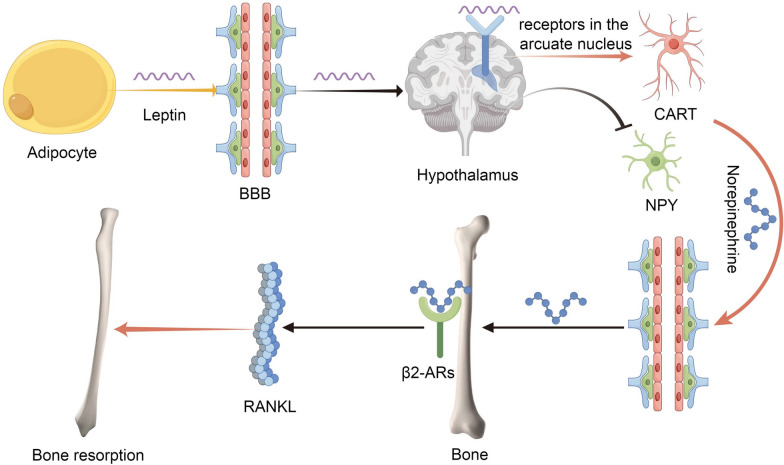
“This hypothalamic response results in increased sympathetic outflow to the skeleton, promoting bone loss through the activation of β2-ARs on osteoblasts [23].”
BackgroundInfluentialLeptin Regulates Bone Formation via the Sympathetic Nervous System
Takeda, S., Elefteriou, F., Levasseur, R., Liu, X., Zhao, L., Parker, K. L., Armstrong, D., Ducy, P., & Karsenty, G. (2002) · Cell · doi:10.1016/s0092-8674(02)01049-8 · Cited by 1,735 · cited 3×
“…of leptin on bone mass are primarily mediated through the SNS, with increased leptin signaling in the hypothalamus resulting in enhanced sympathetic outflow to the skeleton and subsequent activation of β2-ARs on osteoblasts, leading to decreased bone formation and increased bone resorption [6].”
BackgroundLeptin regulation of bone resorption by the sympathetic nervous system and CART
Elefteriou, F., Ahn, J. D., Takeda, S., Starbuck, M., Yang, X., Liu, X., Kondo, H., Richards, W. G., Bannon, T. W., Noda, M., et al. (2005) · Nature · doi:10.1038/nature03398 · Cited by 1,311 · cited 5×
“CART is an anorexigenic neuropeptide expressed in the hypothalamus and peripheral tissues, and has been implicated in the regulation of bone metabolism through both central and peripheral mechanisms [5].”
BackgroundInfluentialBone Morphogenetic Protein (BMP) signaling in development and human diseases
Wang, R. N., Green, J., Wang, Z., Deng, Y., Qiao, M., Peabody, M., Zhang, Q., Ye, J., Yan, Z., Denduluri, S., et al. (2014) · Genes & Diseases · doi:10.1016/j.gendis.2014.07.005 · Cited by 1,031 · cited 1×
“…tissues of AD patients and animal models, the expression of BMP2, BMP4 and BMP6 was up-regulated, while the expression of BMP9 was down-regulated, etc. BMPs can be involved in the pathogenesis of AD by regulating inflammatory response, oxidative stress, Aβ metabolism and other mechanisms [80].”
BackgroundMechanisms of Disease: is osteoporosis the obesity of bone?
Rosen, C. J., & Bouxsein, M. L. (2006) · Nature Clinical Practice Rheumatology · doi:10.1038/ncprheum0070 · Cited by 956 · cited 1×
“…of the sympathetic nervous system (SNS) in bone metabolism is supported by clinical evidence, as evidenced by studies linking conditions marked by heightened sympathetic activity, such as reflex sympathetic dystrophy and postmenopausal osteoporosis, with decreased bone mineral density [24, 25].”
BackgroundMaradit‐Kremers, H., Crowson, C. S., Nicola, P. J., Ballman, K. V., Roger, V. L., Jacobsen, S. J., & Gabriel, S. E. (2005) · Arthritis & Rheumatism · doi:10.1002/art.20853 · Cited by 927 · cited 1×
“The role of the PNS in bone metabolism is further supported by clinical observations of increased fracture risk in patients with conditions characterized by parasympathetic dysfunction, such as diabetes mellitus and inflammatory bowel disease [33, 34].”
BackgroundLeptin Differentially Regulates NPY and POMC Neurons Projecting to the Lateral Hypothalamic Area
Elias, C. F., Aschkenasi, C., Lee, C., Kelly, J., Ahima, R. S., Bjorbæk, C., Flier, J. S., Saper, C. B., & Elmquist, J. K. (1999) · Neuron · doi:10.1016/s0896-6273(01)80035-0 · Cited by 924 · cited 2×
“Leptin crosses the blood–brain barrier and binds to its receptors in the arcuate nucleus of the hypothalamus, leading to the activation of anorexigenic neurons expressing pro-opiomelanocortin (POMC) and CART, while suppressing orexigenic neurons expressing NPY and agouti-related peptide (AgRP) [22].”
BackgroundLrp5 Controls Bone Formation by Inhibiting Serotonin Synthesis in the Duodenum
Yadav, V. K., Ryu, J.-H., Suda, N., Tanaka, K. F., Gingrich, J. A., Schütz, G., Glorieux, F. H., Chiang, C. Y., Zajac, J. D., Insogna, K. L., et al. (2008) · Cell · doi:10.1016/j.cell.2008.09.059 · Cited by 834 · cited 1×
“Mice lacking tryptophan hydroxylase 1 (Tph1), the key enzyme in peripheral serotonin production, display a reduced bone mass phenotype, underscoring the significance of peripheral serotonin signaling in the regulation of skeletal equilibrium [56].”
Background
Cited by
Bone-brain interaction: mechanisms and potential intervention strategies of biomaterials
Yu, J., Ji, L., Liu, Y., Wang, X., Wang, J., & Liu, C. (2025) · Bone Research · doi:10.1038/s41413-025-00404-5 · Cited by 34
“98 Future research should focus on exploring the molecular, genetic, and physiological foundations of the brain-bone axis, as well as investigating the future development directions of this emerging fi eld.”
Luo, Y., Liu, B., Qiu, Y., Li, L., Yang, F., Zhang, C., & Wang, J. (2025) · Bioactive Materials · doi:10.1016/j.bioactmat.2025.01.034 · Cited by 39
Unraveling the Bone–Brain Axis: A New Frontier in Parkinson’s Disease Research
Liu, T., Wu, H., Li, J., Zhu, C., & Wei, J. (2024) · International Journal of Molecular Sciences · doi:10.3390/ijms252312842 · Cited by 26
Versatile application of magnesium-related bone implants in the treatment of bone defects
Tao, M., Cui, Y., Sun, S., Zhang, Y., Ge, J., Yin, W., Li, P., & Wang, Y. (2025) · Materials Today Bio · doi:10.1016/j.mtbio.2025.101635 · Cited by 37
“The brain-bone axis represents a crucial aspect of neuroskeletal regulation, encompassing bidirectional communication between the CNS and bone metabolism [276].”
Yang, M., Zhong, J.-D., Li, X., Tian, G., Bai, W.-Y., Fang, Y.-H., Qiu, M.-C., Yuan, C., Yu, C.-F., Li, N., et al. (2024) · Nature Communications · doi:10.1038/s41467-024-55147-4 · Cited by 25
“The SNS provides innervation to bone tissue, with the sympathetic fi bers directly interacting with osteoblasts and osteoclasts 47 .”
Metadata
- Authors
- Shi, H., & Chen, M.
- Affiliations
- Macau University of Science and Technology (MO)
- Corresponding author
- Chen, Min
- ORCID
- Chen, Min
- Venue
- European journal of medical research
- Published
- 2024-06-08
- Volume
- 29
- Issue
- 1
- Pages
- 317-317
- ISSN
- 0949-2321 (ISSN-L)
- 2047-783X
- PMC
- PMC11161955
- OpenAlex
- W4399465948
- Cited by
- 87
- References
- 119
- Citations by year
- 2026: 52 · 2025: 25 · 2024: 9
- FWCI
- 3.52
- Type
- journal article
- Language
- en
- Open access
- gold
- doi.org
- Licence
- cc-by
- creativecommons.org/licenses/by/4.0 (tdm)
- creativecommons.org/licenses/by/4.0 (vor)
- Locations
- European journal of medical research (publishedVersion, cc-by)
- PubMed Central (publishedVersion, cc-by)
- PubMed (publishedVersion)
- DOAJ (DOAJ: Directory of Open Access Journals) (submittedVersion)
- Funders
- National Natural Science Foundation of China (82374615)
- Shandong Province Key R&D Plan Project (2022CXGC020510)
- The Science and Technology Development Fund, Macau SAR (0114/2022/A)
- Topics
- Life Sciences › Biochemistry, Genetics and Molecular Biology › Molecular Biology › Bone Metabolism and Diseases
- Health Sciences › Medicine › Orthopedics and Sports Medicine › Bone health and osteoporosis research
- Health Sciences › Medicine › Nephrology › Parathyroid Disorders and Treatments
- Keywords
- central nervous system, skeletal metabolism, bone remodeling, sympathetic nervous system, hypothalamic neuropeptides, neurotransmitters, osteocalcin, fibroblast growth factor 23, neurological disorders, bone disease, therapeutic targeting
- MeSH terms
- Animals, Bone and Bones, Brain, Central Nervous System, Humans, Sympathetic Nervous System, Bone Remodeling
About these checks
Registry, retraction, Cites and statistics results are computed, not judged, with one exception: a printed reference that no index lists is read once by a model before it counts as a citation error. Claims are extracted by a model and kept only when their quote appears verbatim in the text; each cited source is then checked, with a model’s help, for whether it says what the claim relies on. Those verdicts can be wrong — read the claim’s quote and the cited source before relying on one.
Statistics and arithmetic are recomputed, not judged.
Confidence bands are shown only for fields calibrated on our annotated test set. None is calibrated yet, so no band is shown.
What counts as a claim ›How we measure confidence ›How we check this ›
Are you an author, or do you see a problem with this page? Request a review
How to cite
Cite CoChat for the checks on this page, and the paper for its own findings.
- This page
- CoChat. (2026). Citation check: The brain-bone axis: Unraveling the complex interplay between the central nervous system and skeletal metabolism. https://app.cochat.ai/papers/10.1186/s40001-024-01918-0
- The paper
- Shi, H., & Chen, M. (2024). The brain-bone axis: Unraveling the complex interplay between the central nervous system and skeletal metabolism. European journal of medical research. https://doi.org/10.1186/s40001-024-01918-0
Data sources
Bibliographic data: Semantic Scholar, OpenAlex, Crossref.
Contains information from the Semantic Scholar Academic Graph Datasets, made available under the ODC Attribution License (ODC-BY 1.0).
Semantic Scholar’s data is described in: Kinney, R., et al. (2023). The Semantic Scholar Open Data Platform. arXiv:2301.10140.
