

An exploratory study of public reports to investigate patterns and themes of requests for sexual images of minors online
Open accessThe DOI matches its Crossref record; 40 of the 42 references it cites were found in a registry or an index.
Abstract
There is a growing body of research on sexually motivated online communication with minors that has been variously described as luring, grooming and solicitation. Evidence from US studies would suggest an increase in aggressive sexual solicitations, with adolescent girls being more likely to be targeted. Existing research has involved adolescent as well as offender populations, and has largely relied on surveys with young people, interviews and official record data with offenders and ethnographic work with police officers. There have also been a number of studies using chat log data between offenders and adults pretending to be children. In addition, while the use of sexual images has been noted in both offender and victim studies, this has not been critically examined. The present study is different as it used reports from the public to Cybertip.ca to make sense of the types of behaviour that alerted concerned adults, and occasionally young people, to make a report; information available about the young person; information about the suspect, and the interaction between the two. The results of this study show strong similarities with previous research in relation to both offender and victim populations. Implications are discussed in relation to the importance of reporting mechanisms, awareness raising with parents and the need to recognize sexual agency and resilience in many adolescents.
Overview
The claims and statistics of this paper haven’t been checked yet.
Free: it reads the open-access text and checks the first 5 claims that cite a source we can check. Create a free account to check every claim.
Integrity signals
Registry
Cites
Statistics
Figures
Verification
Claims the paper makes
The claims and statistics of this paper haven’t been checked yet.
Free: it reads the open-access text and checks the first 5 claims that cite a source we can check. Create a free account to check every claim.
Claims other papers make about this one
Each is checked against this paper’s own text: does it say what the citing paper says it does?
The cited source says what the claim attributes to it.
In the citing paper
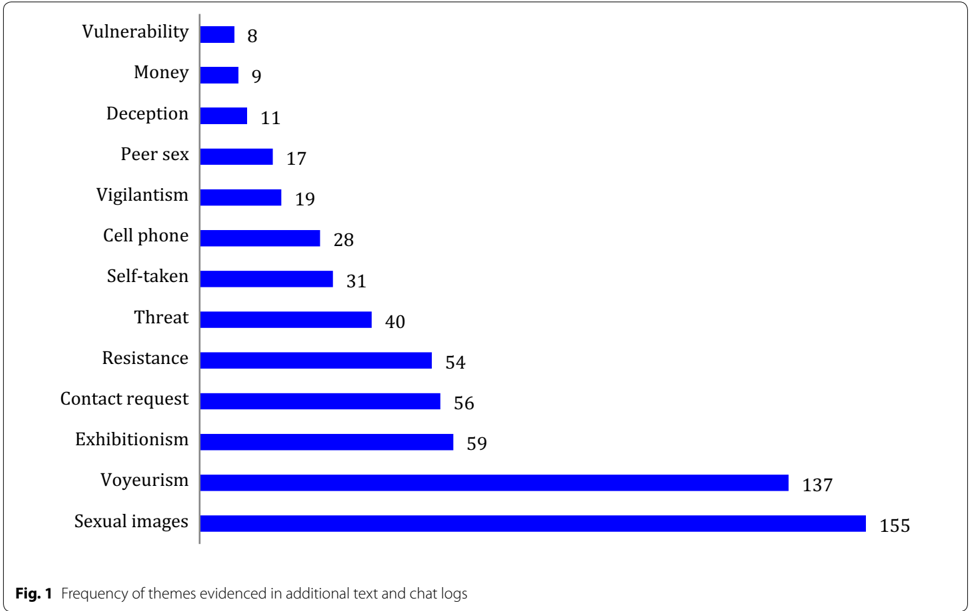
“Quayle and Newman (2016) identified threats in 24% of the 166 cases of children receiving requests to send sexual images as reported to a public Canadian cyber tip site.”
From Offender strategies for engaging children in online sexual activity (2021) · cites this paper as Quayle and Newman (2016)
Self-check
Percentages, sums and reported differences re-computed from the paper’s own numbers.
The self-check needs the paper’s full text.
Citations
Cites
The Content Analysis Guidebook
Neuendorf, K. A. (2017) · doi:10.4135/9781071802878 · Cited by 9,286 · cited 2×
“0, which would be seen as acceptable in most situations (Neuendorf 2002).”
BackgroundInfluentialThe Journal of the American Academy of Psychiatry and the Law.
(2021) · PubMed · doi:10.29158/jaapl.210028-20 · Cited by 3,823
Content Analysis in Mass Communication: Assessment and Reporting of Intercoder Reliability
Lombard, M., Snyder-Duch, J., & Bracken, C. C. (2002) · Human Communication Research · doi:10.1111/j.1468-2958.2002.tb00826.x · Cited by 3,068
Robson, C., & McCartan, K. (2016) · UWE Research Repository (UWE Bristol) · Cited by 1,320
Livingstone, S., Haddon, L., Görzig, A., & Ólafsson, K. (2011) · London School of Economics and Political Science Research Online (London School of Economics and Political Science) · Cited by 993
Livingstone, S., & Smith, P. K. (2014) · Journal of Child Psychology and Psychiatry · doi:10.1111/jcpp.12197 · Cited by 590 · cited 2×
“Nevertheless, for a small number of young people, online sexual activity is likely to be associated with harm (Livingstone and Smith 2014), and in these cases in order to promote recovery, it may be necessary to provide child-sensitive approaches to the recovery of information by law enforcement,…”
BackgroundWolak, J., Finkelhor, D., Mitchell, K. J., & Ybarra, M. L. (2008) · American Psychologist · doi:10.1037/0003-066x.63.2.111 · Cited by 537
Sexual grooming of children: Review of literature and theoretical considerations
Craven, S., Brown, S., & Gilchrist, E. (2006) · Journal of Sexual Aggression · doi:10.1080/13552600601069414 · Cited by 455
UK children go online: surveying the experiences of young people and their parents
Bober, M., & Livingstone, S. (2004) · e-space (Manchester Metropolitan University) · Cited by 341
Trends in Youth Internet Victimization: Findings From Three Youth Internet Safety Surveys 2000–2010
Jones, L. M., Mitchell, K. J., & Finkelhor, D. (2012) · Journal of Adolescent Health · doi:10.1016/j.jadohealth.2011.09.015 · Cited by 313 · cited 2×
“Three US youth Internet safety surveys (2000–2010) indicated that 1 in 10 young people (aged 10–17) reported an unwanted sexual solicitation, which was a 50 % reduction from the 2000 survey (Jones et al. 2012).”
BackgroundMethodBriggs, P., Simon, W. T., & Simonsen, S. (2011) · Sexual Abuse · doi:10.1177/1079063210384275 · Cited by 265 · cited 1×
“This distinction has also been noted in relation to offenders who attempt to entice an adolescent into a sexual relationship using an Internet chat room (Briggs et al. 2011).”
BackgroundA review of young people's vulnerabilities to online grooming
Whittle, H., Hamilton-Giachritsis, C., Beech, A., & Collings, G. (2013) · Aggression and Violent Behavior · doi:10.1016/j.avb.2012.11.008 · Cited by 175
Unwanted online sexual solicitation and risky sexual online behavior across the lifespan
Baumgartner, S. E., Valkenburg, P. M., & Peter, J. (2010) · Journal of Applied Developmental Psychology · doi:10.1016/j.appdev.2010.07.005 · Cited by 166 · cited 1×
“However, prevalence rates vary across studies and in two studies from Europe, 6–8 % of male and 19 % of female adolescents reported experiences of unwanted sexual solicitation or cyber victimization, in young people aged 12–17 (Baumgartner et al. 2010) and 15–17 (Averdijk et al.”
BackgroundEntrapping the innocent: Toward a theory of child sexual predators’ luring communication
Olson, L. N., Daggs, J. L., Ellevold, B. L., & Rogers, T. K. K. (2007) · Communication Theory · doi:10.1111/j.1468-2885.2007.00294.x · Cited by 160
Black, P. J., Wollis, M., Woodworth, M., & Hancock, J. T. (2015) · Child Abuse & Neglect · doi:10.1016/j.chiabu.2014.12.004 · Cited by 153 · cited 2×
“Three studies have examined this model using opensource data from the Perverted Justice Website (Gupta et al.”
Understanding online child pornography use: Applying sexual offense theory to internet offenders
Elliott, I. A., & Beech, A. R. (2009) · Aggression and Violent Behavior · doi:10.1016/j.avb.2009.03.002 · Cited by 150 · cited 2×
“Parallel research into offender typologies has led to a classification according to the function of the images in the offending behavior, the underlying motivation and the level of social networking in the behavior (Elliott and Beech 2009; Merdian et al.”
BackgroundDevelopmental Trajectories of Peer Victimization: Off-line and Online Experiences During Adolescence
Sumter, S. R., Baumgartner, S. E., Valkenburg, P. M., & Peter, J. (2012) · Journal of Adolescent Health · doi:10.1016/j.jadohealth.2011.10.251 · Cited by 145
Seto, M. C., Wood, J. M., Babchishin, K. M., & Flynn, S. (2012) · Law and Human Behavior · doi:10.1037/h0093925 · Cited by 133
Identifying sexual grooming themes used by internet sex offenders
Williams, R., Elliott, I. A., & Beech, A. R. (2013) · Deviant Behavior · doi:10.1080/01639625.2012.707550 · Cited by 121 · cited 2×
“Three studies have examined this model using opensource data from the Perverted Justice Website (Gupta et al.”
Rapid skill acquisition and online sexual grooming of children
Quayle, E., Allegro, S., Hutton, L., Sheath, M., & Lööf, L. (2014) · Computers in Human Behavior · doi:10.1016/j.chb.2014.07.005 · Cited by 113
Self-citation(2003) · Cited by 102
DSM-5 and paraphilic disorders.
First, M. B. (2014) · PubMed · Cited by 92
Mitchell, K. J., Jones, L. M., Finkelhor, D., & Wolak, J. (2013) · Child Abuse & Neglect · doi:10.1016/j.chiabu.2013.07.002 · Cited by 84
Forensic Implications: Adolescent Sexting and Cyberbullying
Korenis, P., & Billick, S. B. (2013) · Psychiatric Quarterly · doi:10.1007/s11126-013-9277-z · Cited by 82 · cited 2×
“Access to sexually explicit materials, along with the ability to create content via media technologies, may be used to aid adolescent understanding of sexuality and the self (Korenis and Billick 2014; Van Ouytsel et al.”
BackgroundPriebe, G., & Svedin, C. G. (2012) · European Child & Adolescent Psychiatry · doi:10.1007/s00787-012-0294-5 · Cited by 82
The three dimensions of online child pornography offending
Merdian, H. L., Curtis, C., Thakker, J., Wilson, N., & Boer, D. P. (2013) · Journal of Sexual Aggression · doi:10.1080/13552600.2011.611898 · Cited by 82
The DSM Diagnostic Criteria for Exhibitionism, Voyeurism, and Frotteurism
Långström, N. (2009) · Archives of Sexual Behavior · doi:10.1007/s10508-009-9577-4 · Cited by 78
Van Ouytsel, J., Ponnet, K., & Walrave, M. (2014) · Cyberpsychology, Behavior, and Social Networking · doi:10.1089/cyber.2014.0365 · Cited by 72
UK children go online: surveying the experiences of young people and their parents
Livingstone, S., & Bober, M. (2004) · London School of Economics and Political Science Research Online (London School of Economics and Political Science) · Cited by 70
Strategic and Nonstrategic Information Acquisition
Berger, C. R. (2002) · Human Communication Research · doi:10.1093/hcr/28.2.287 · Cited by 66
Šmahel, D., & Wright, M. F. (2014) · Cited by 64
Adolescents, Sexting and Human Rights
Gillespíe, A. A. (2013) · Human Rights Law Review · doi:10.1093/hrlr/ngt032 · Cited by 54 · cited 1×
“However, differences between the age of majority and the age of consent in International law may mean that the self-production of images by those under the age of 18 is potentially illegal (Gillespie 2013).”
BackgroundA Comparison of Victim and Offender Perspectives of Grooming and Sexual Abuse
Whittle, H. C., Hamilton-Giachritsis, C. E., & Beech, A. R. (2015) · Deviant Behavior · doi:10.1080/01639625.2014.944074 · Cited by 52
Trends in Unwanted Sexual Solicitations: Findings from the Youth Internet Safety Studies
Mitchell, K. J., & Jones, L. M. (2014) · Cited by 52
Rice, E., Winetrobe, H., Holloway, I. W., Montoya, J., Plant, A., & Kordic, T. (2015) · Archives of Sexual Behavior · doi:10.1007/s10508-014-0366-3 · Cited by 51
Characterizing Pedophile Conversations on the Internet using Online Grooming
Gupta, A., Kumaraguru, P., & Sureka, A. (2012) · arXiv · doi:10.48550/arxiv.1208.4324 · Cited by 45 · cited 2×
“Three studies have examined this model using opensource data from the Perverted Justice Website (Gupta et al.”
The Role of Sexual Images in Online and Offline Sexual Behaviour With Minors
Quayle, E., & Newman, E. (2015) · Current Psychiatry Reports · doi:10.1007/s11920-015-0579-8 · Cited by 29 · cited 1×
“In addition, while the use of sexual images has been noted in both offender and victim studies, this has not been critically examined (Quayle and Newman 2015).”
BackgroundSelf-citationOnline interactions involving suspected paedophiles who engage male children
Grosskopf, A. (2010) · doi:10.52922/ti279750 · Cited by 23
Children, chatrooms and the law
Gillespíe, A. A. (2001) · Lancaster EPrints (Lancaster University) · Cited by 23
Rood, C. J., Thackeray, J. D., Letson, M. M., Leder, R., & Berlan, E. D. (2015) · Journal of Pediatric and Adolescent Gynecology · doi:10.1016/j.jpag.2015.02.024 · Cited by 5 · cited 2×
“A further US study of 100 adolescents (aged 12–17) with suspected sexual abuse seen in a Child Advocacy Centre (Rood et al. 2015) revealed that 74 % had experienced at least one online problematic experience with 50 % indicating five or more exposures.”
Background
Research works printed but not linked: 1
- Averdijk, M., Müller-Johnson, K., & Eisner, M. (2011). Sexual victimization of chil- dren and adolescents in Switzerland. Zurich: UBS Optimus Foundation.
Cited by
Youth Internet Safety Education: Aligning Programs With the Evidence Base
Finkelhor, D., Walsh, K., Jones, L., Mitchell, K., & Collier, A. (2021) · Trauma, Violence, & Abuse · doi:10.1177/1524838020916257 · Cited by 143
“A growing literature on this grooming or luring process has identified a variety of different elements and features (Lorenzo-Dus et al., 2016; Quayle & Newman, 2016; Webster et al., 2014; Whittle et al., 2014).”
BackgroundChildren's online activities, risks and safety: a literature review by the UKCCIS evidence group
Livingstone, S., Davidson, J. C., Bryce, J., Batool, S., Haughton, C., & Nandi, A. (2017) · London School of Economics and Political Science Research Online (London School of Economics and Political Science) · Cited by 178
Offender strategies for engaging children in online sexual activity
Joleby, M., Lunde, C., Landström, S., & Jonsson, L. S. (2021) · Child Abuse & Neglect · doi:10.1016/j.chiabu.2021.105214 · Cited by 59
“Quayle and Newman (2016) identified threats in 24% of the 166 cases of children receiving requests to send sexual images as reported to a public Canadian cyber tip site.”
Gámez-Guadix, M., De Santisteban, P., & Alcazar, M. Á. (2018) · Sexual Abuse · doi:10.1177/1079063217724766 · Cited by 58
“…specific requests by the offenders for pictures or for sexual images (e.g., via webcam), or offenders asking minors to do something sexual online (Quayle & Newman, 2016); questions to minors about their previous sexual experiences (Van Gijn-Grosvenor & Lamb, 2016); the exhibitionism, both…”
BackgroundLorenzo-Dus, N., Kinzel, A., & Di Cristofaro, M. (2020) · Journal of Pragmatics · doi:10.1016/j.pragma.2019.09.010 · Cited by 56
Metadata
- Authors
- Quayle, E., & Newman, E.
- Affiliations
- University of Edinburgh (GB)
- Corresponding author
- Quayle, Ethel
- Venue
- Crime Science
- Published
- 2016-02-24
- Volume
- 5
- Issue
- 1
- ISSN
- 2193-7680 (ISSN-L)
- OpenAlex
- W2279767115
- Cited by
- 38
- References
- 42
- Citations by year
- 2025: 1 · 2024: 4 · 2023: 2 · 2022: 15 · 2021: 3 · 2020: 5 · 2019: 3 · 2018: 2 · 2017: 2 · 2016: 1
- FWCI
- 5.95
- Type
- journal article
- Language
- en
- Open access
- gold
- doi.org
- Licence
- cc-by
- creativecommons.org/licenses/by/4.0 (tdm)
- Locations
- Crime Science (publishedVersion, cc-by)
- Edinburgh Research Explorer (University of Edinburgh) (submittedVersion, cc-by)
- Topics
- Social Sciences › Law › Cybercrime and Law Enforcement Studies
- Social Sciences › Sociology and Political Science › Crime, Deviance, and Social Control
- Social Sciences › Law › Legal and Social Justice Studies
- Keywords
- online child sexual exploitation, grooming, sexual solicitation, public reports, adolescent girls, reporting mechanisms, parental awareness, sexual agency, resilience, victim-offender interaction
About these checks
Registry, retraction, Cites and statistics results are computed, not judged, with one exception: a printed reference that no index lists is read once by a model before it counts as a citation error. Claims are extracted by a model and kept only when their quote appears verbatim in the text; each cited source is then checked, with a model’s help, for whether it says what the claim relies on. Those verdicts can be wrong — read the claim’s quote and the cited source before relying on one.
Statistics and arithmetic are recomputed, not judged.
Confidence bands are shown only for fields calibrated on our annotated test set. None is calibrated yet, so no band is shown.
What counts as a claim ›How we measure confidence ›How we check this ›
Are you an author, or do you see a problem with this page? Request a review
Data sources
Bibliographic data: Semantic Scholar, OpenAlex, Crossref.
Contains information from the Semantic Scholar Academic Graph Datasets, made available under the ODC Attribution License (ODC-BY 1.0).
Semantic Scholar’s data is described in: Kinney, R., et al. (2023). The Semantic Scholar Open Data Platform. arXiv:2301.10140.
