

Genomic characterization of the uncultured Bacteroidales family S24-7 inhabiting the guts of homeothermic animals
Open accessThe DOI matches its Crossref record; 116 of the 117 references it cites were found in a registry or an index, and 1 are not checked yet.
Abstract
BACKGROUND: Our view of host-associated microbiota remains incomplete due to the presence of as yet uncultured constituents. The Bacteroidales family S24-7 is a prominent example of one of these groups. Marker gene surveys indicate that members of this family are highly localized to the gastrointestinal tracts of homeothermic animals and are increasingly being recognized as a numerically predominant member of the gut microbiota; however, little is known about the nature of their interactions with the host. RESULTS: Here, we provide the first whole genome exploration of this family, for which we propose the name "Candidatus Homeothermaceae," using 30 population genomes extracted from fecal samples of four different animal hosts: human, mouse, koala, and guinea pig. We infer the core metabolism of "Ca. Homeothermaceae" to be that of fermentative or nanaerobic bacteria, resembling that of related Bacteroidales families. In addition, we describe three trophic guilds within the family, plant glycan (hemicellulose and pectin), host glycan, and α-glucan, each broadly defined by increased abundance of enzymes involved in the degradation of particular carbohydrates. CONCLUSIONS: "Ca. Homeothermaceae" representatives constitute a substantial component of the murine gut microbiota, as well as being present within the human gut, and this study provides important first insights into the nature of their residency. The presence of trophic guilds within the family indicates the potential for niche partitioning and specific roles for each guild in gut health and dysbiosis.
Overview
The claims and statistics of this paper haven’t been checked yet.
Free: it reads the open-access text and checks the first 5 claims that cite a source we can check. Create a free account to check every claim.
Integrity signals
Registry
Cites
Statistics
Figures
Verification
Claims the paper makes
The claims and statistics of this paper haven’t been checked yet.
Free: it reads the open-access text and checks the first 5 claims that cite a source we can check. Create a free account to check every claim.
Self-check
Percentages, sums and reported differences re-computed from the paper’s own numbers.
The self-check needs the paper’s full text.
Citations
Cites
1 retracted
Molecular characterization of Legionella pneumophila-induced interleukin-8 expression in T cells
Takamatsu, R., Teruya, H., Takeshima, E., Ishikawa, C., Matsumoto, K., Mukaida, N., Li, J.-D., Heuner, K., Higa, F., Fujita, J., et al. (2010) · BMC Microbiology · doi:10.1186/1471-2180-10-1 · Cited by 337
RetractedBasic local alignment search tool
Altschul, S. F., Gish, W., Miller, W., Myers, E. W., & Lipman, D. J. (1990) · Journal of Molecular Biology · doi:10.1006/jmbi.1990.9999 · Cited by 98,669
Moderated estimation of fold change and dispersion for RNA-seq data with DESeq2
Love, M. I., Huber, W., & Anders, S. (2014) · Genome Biology · doi:10.1186/s13059-014-0550-8 · Cited by 95,106
Trimmomatic: a flexible trimmer for Illumina sequence data
Bolger, A. M., Lohse, M., & Usadel, B. (2014) · Bioinformatics · doi:10.1093/bioinformatics/btu170 · Cited by 65,548
Fast and accurate short read alignment with Burrows-Wheeler transform
Li, H., & Durbin, R. (2009) · Bioinformatics · doi:10.1093/bioinformatics/btp324 · Cited by 58,607
MAFFT Multiple Sequence Alignment Software Version 7: Improvements in Performance and Usability
Katoh, K., & Standley, D. M. (2013) · Molecular Biology and Evolution · doi:10.1093/molbev/mst010 · Cited by 46,209
The SILVA ribosomal RNA gene database project: improved data processing and web-based tools
Quast, C., Pruesse, E., Yilmaz, P., Gerken, J., Schweer, T., Yarza, P., Peplies, J., & Glöckner, F. O. (2012) · Nucleic Acids Research · doi:10.1093/nar/gks1219 · Cited by 33,055 · cited 6×
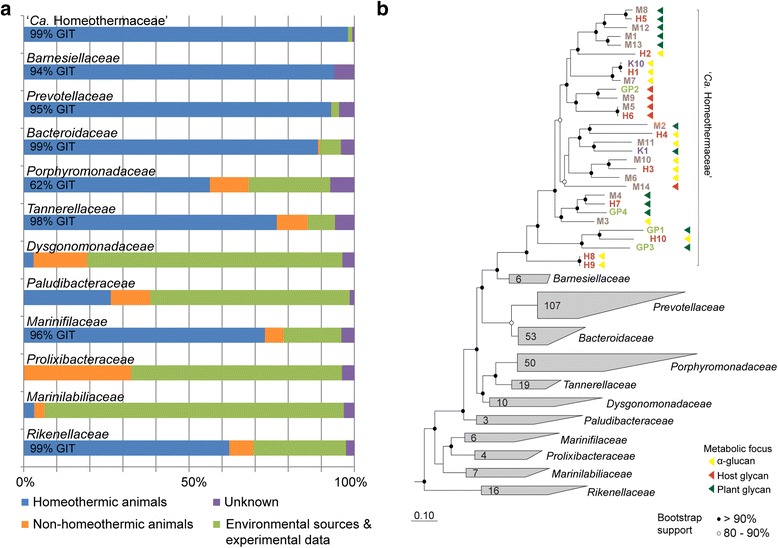
“1 Habitat and phylogenetic positioning of “Ca. Homeothermaceae” (S24-7). a Habitat source of 16S rRNA gene sequences described in the Silva database [9] belonging to members of the Bacteroidales order.”
BackgroundMethodInfluentialvegan: Community Ecology Package
Oksanen, J., Simpson, G. L., Blanchet, F. G., Kindt, R., Legendre, P., Minchin, P. R., O'Hara, R. B., Solymos, P., Stevens, M. H. H., Szoecs, E., et al. (2001) · CRAN: Contributed Packages · doi:10.32614/cran.package.vegan · Cited by 22,615
Prokka: rapid prokaryotic genome annotation
Seemann, T. (2014) · Bioinformatics · doi:10.1093/bioinformatics/btu153 · Cited by 18,818
FastTree 2 – Approximately Maximum-Likelihood Trees for Large Alignments
Price, M. N., Dehal, P. S., & Arkin, A. P. (2010) · PLoS ONE · doi:10.1371/journal.pone.0009490 · Cited by 14,894
Research works printed but not linked: 1
- Krieg NR Staley JT Brown DR Hedlund BP Paster BJ Ward NL Bergey’s manual of systematic bacteriology, 2 edn 2011 New York Springer
Cited by
Items 701–753 of 753
Peng, Y., Wei, J., Jia, X., Luan, F., Man, M., Ma, X., Luo, Y., Li, Y., Li, N., Wang, Q., et al. (2023) · doi:10.3389/fcimb.2022.954347.s001
Usui, Y. (2019) · Institutional Repositories DataBase (IRDB) · doi:10.15083/0002002596
Vasquez-Cardenas, D., Hidalgo-Martinez, S., Hulst, L., Thorleifsdottir, T., Helgason, G. V., Eiriksson, T., Geelhoed, J. S., Agustsson, T., Moodley, L., & Meysman, F. J. R. (2022) · doi:10.3389/fmicb.2022.1034401.s001
Rosas-Plaza, S., Hernández-Terán, A., Navarro-Díaz, M., Escalante, A. E., Morales-Espinosa, R., & Cerritos, R. (2022) · doi:10.3389/fmicb.2022.843170.s001
Larragy, S. J. (2023) · Maynooth University ePrints and eTheses Archive (Maynooth University)
Stothart, M. R. (2018) · The Atrium (University of Guelph)
Golder, H. M., Rehberger, J., Smith, A. H., Block, E., & Lean, I. J. (2023) · doi:10.3389/frmbi.2023.1212255.s003
Li, W. J., Huang, Y., Su, H., Nong, J., Liang, W., Liu, Y., Zhao, L., & Yuan, Q. (2026) · Journal of Agricultural and Food Chemistry · doi:10.1021/acs.jafc.6c05779
Wu, H. (2020) · PolyU Institutional Research Archive (Hong Kong Polytechnic University)
Post-Transplant Gut Dysbiosis is a Targetable Axis
Ma, B., Kensiski, A., Wu, L., Gavzy, S., Zhang, T., Chaudry, I., France, M., Lwin, H. W., WillsonShirkey, M., Lohmar, B., et al. (2026) · American Journal of Transplantation · doi:10.1016/j.ajt.2026.05.101
Reed, K. J., Coleman, S. J., Bruemmer, J., Turk, P., & Bouma, G. (2018) · Digital Collections of Colorado (Colorado State University) · doi:10.25675/3.018543
Taverniti, V., Cesari, V., Gargari, G., Rossi, U., Biddau, C., Lecchi, C., Fiore, W., Arioli, S., Toschi, I., & Guglielmetti, S. (2021) · doi:10.3389/fmicb.2021.706135.s001
Iguchi, A., Mori, R., SUZUKI, K., HASHIMOTO, K., Nomura, K., Hayashi, M., Kose, T., & Shigematsu, T. (2017) · Journal of Japan Society of Civil Engineers Ser G (Environmental Research) · doi:10.2208/jscejer.73.iii_165
Fuerniss, L. K., Martin, J. N., Engle, T. E., Metcalf, J. L., Scanga, J. A., & Garry, F. B. (2019) · Digital Collections of Colorado (Colorado State University) · doi:10.25675/3.023468
Crude oil flowing into the Niitsu River, and exploration of its degrading microorganisms
Iguchi, A. (2021) · Journal of Japan Association on Odor Environment · doi:10.2171/jao.52.337
Taxonomic Abstract for the genera.
Parker, C. T., & Garrity, G. M. (2016) · The NamesforLife Abstracts · doi:10.1601/tx.29399
Nomenclature Abstract for Marinifilaceae Iino et al. 2014 emend. Fu et al. 2020.
Parker, C. T., & Garrity, G. M. (2014) · The NamesforLife Abstracts · doi:10.1601/nm.25989
Nomenclature Abstract for Tannerellaceae Ormerod et al. 2022.
Parker, C. T., & Garrity, G. M. (2020) · The NamesforLife Abstracts · doi:10.1601/nm.36475
Taxonomic Abstract for the genera.
Parker, C. T., Wigley, S., & Garrity, G. M. (2009) · The NamesforLife Abstracts · doi:10.1601/tx.9852
Taxonomic Abstract for the genera.
Parker, C. T., Wigley, S., & Garrity, G. M. (2009) · The NamesforLife Abstracts · doi:10.1601/tx.8035
Nomenclature Abstract for Dysgonomonas Hofstad et al. 2000 emend. Ormerod et al. 2016.
Parker, C. T., & Garrity, G. M. (2013) · The NamesforLife Abstracts · doi:10.1601/nm.8035
Taxonomic Abstract for the species.
Parker, C. T., & Garrity, G. M. (2019) · The NamesforLife Abstracts · doi:10.1601/tx.34309
Taxonomic Abstract for the families.
Parker, C. T., & Garrity, G. M. (2020) · The NamesforLife Abstracts · doi:10.1601/tx.36475
Nomenclature Abstract for Barnesiellaceae García-López et al. 2020.
Parker, C. T., & Garrity, G. M. (2020) · The NamesforLife Abstracts · doi:10.1601/nm.36476
Nomenclature Abstract for Porphyromonadaceae Krieg 2012 emend. Ormerod et al. 2016.
Parker, C. T., Osier, N. D., & Garrity, G. M. (2009) · The NamesforLife Abstracts · doi:10.1601/nm.8019
Taxonomic Abstract for the families.
Parker, C. T., & Garrity, G. M. (2020) · The NamesforLife Abstracts · doi:10.1601/tx.36474
Nomenclature Abstract for Homeothermus Ormerod et al. 2016.
Parker, C. T., & Garrity, G. M. (2019) · The NamesforLife Abstracts · doi:10.1601/nm.34308
Taxonomic Abstract for the families.
Parker, C. T., & Garrity, G. M. (2020) · The NamesforLife Abstracts · doi:10.1601/tx.36477
Taxonomic Abstract for the genera.
Parker, C. T., & Garrity, G. M. (2019) · The NamesforLife Abstracts · doi:10.1601/tx.34308
Taxonomic Abstract for the families.
Parker, C. T., & Garrity, G. M. (2020) · The NamesforLife Abstracts · doi:10.1601/tx.36476
Nomenclature Abstract for Paludibacteraceae Ormerod et al. 2022.
Parker, C. T., & Garrity, G. M. (2020) · The NamesforLife Abstracts · doi:10.1601/nm.36474
Taxonomic Abstract for the orders.
Parker, C. T., Taylor, D., & Garrity, G. M. (2010) · The NamesforLife Abstracts · doi:10.1601/tx.7929
Nomenclature Abstract for Dysgonomonadaceae García-López et al. 2020.
Parker, C. T., & Garrity, G. M. (2020) · The NamesforLife Abstracts · doi:10.1601/nm.36477
Taxonomic Abstract for the families.
Parker, C. T., & Garrity, G. M. (2019) · The NamesforLife Abstracts · doi:10.1601/tx.34307
Nomenclature Abstract for Homeothermaceae Ormerod et al. 2016.
Parker, C. T., & Garrity, G. M. (2019) · The NamesforLife Abstracts · doi:10.1601/nm.34307
Taxonomic Abstract for the genera.
Parker, C. T., Wigley, S., & Garrity, G. M. (2009) · The NamesforLife Abstracts · doi:10.1601/tx.9747
Taxonomic Abstract for the genera.
Parker, C. T., Wigley, S., & Garrity, G. M. (2008) · The NamesforLife Abstracts · doi:10.1601/tx.10183
Taxonomic Abstract for the genera.
Parker, C. T., & Garrity, G. M. (2013) · The NamesforLife Abstracts · doi:10.1601/tx.24786
Taxonomic Abstract for the genera.
Parker, C. T., Wigley, S., & Garrity, G. M. (2009) · The NamesforLife Abstracts · doi:10.1601/tx.8039
Exemplar Abstract for Homeothermus arabinoxylanisolvens Ormerod et al. 2016.
Parker, C. T., & Garrity, G. M. (2019) · The NamesforLife Abstracts · doi:10.1601/ex.34309
Nomenclature Abstract for Homeothermus arabinoxylanisolvens Ormerod et al. 2016.
Parker, C. T., & Garrity, G. M. (2019) · The NamesforLife Abstracts · doi:10.1601/nm.34309
Xu, L. H., Zhang, J., Guo, J., Liu, C., Yang, J., Yu, Y., Liu, W., & Zhu, G. (2022) · Research Square · doi:10.21203/rs.3.rs-2208068/v1
Zhang, R., Jianfei, L., Geng, Y., Gao, W., & Wanlong, Z. (2025) · Indian Journal of Animal Research · doi:10.18805/ijar.bf-1996
Smith, B., Miller, R. A., Ericsson, A., Harrison, D., Strong, R., & Schmidt, T. M. (2019) · Figshare · doi:10.6084/m9.figshare.8273921
Luo, S., Li, W., Li, Q., Zhang, M., Wang, X., Wu, S., & Li, Y. (2023) · doi:10.3389/fcimb.2023.1160993.s002
Guo, C., Xu, Y., Han, X., Liu, X., Xie, R., Cheng, Z., & Fu, X. (2021) · doi:10.3389/fonc.2021.736225.s005
Metadata
- Authors
- Ormerod, K. L., Wood, D. L. A., Lachner, N., Gellatly, S. L., Daly, J. N., Parsons, J. D., Dal’Molin, C. G. O., Palfreyman, R. W., Nielsen, L. K., Cooper, M. A., Morrison, M., Hansbro, P. M., & Hugenholtz, P.
- Affiliations
- The University of Queensland (AU)
- Hunter Medical Research Institute (AU)
- Translational Research Institute (AU)
- Corresponding author
- Hugenholtz, Philip
- ORCID
- Venue
- Microbiome
- Published
- 2016-07-07
- Volume
- 4
- Issue
- 1
- Pages
- 36-36
- ISSN
- 2049-2618 (ISSN-L)
- PMC
- PMC4936053
- OpenAlex
- W2473313158
- Semantic Scholar
- b51360db136b325a8a641509a84140cec658db6b
- Cited by
- 728
- References
- 115
- Citations by year
- 2026: 55 · 2025: 71 · 2024: 51 · 2023: 80 · 2022: 80 · 2021: 100 · 2020: 82 · 2019: 103 · 2018: 59 · 2017: 41 · 2016: 5
- FWCI
- 19.85
- Type
- journal article
- Language
- en
- Open access
- gold
- doi.org
- Licence
- cc-by
- Locations
- Microbiome (publishedVersion, cc-by)
- PubMed Central (publishedVersion, cc-by)
- PubMed (publishedVersion)
- Figshare (submittedVersion, cc-by)
- UTS ePRESS (University of Technology Sydney) (submittedVersion)
- NOVA (University of Newcastle Australia) (submittedVersion, cc-by)
- Funders
- National Health and Medical Research Council (Program Grant APP1071822, Project Grant APP1059239)
- Lung Foundation Australia (AU)
- Topics
- Life Sciences › Biochemistry, Genetics and Molecular Biology › Molecular Biology › Gut microbiota and health
- Life Sciences › Biochemistry, Genetics and Molecular Biology › Molecular Biology › Genomics and Phylogenetic Studies
- Physical Sciences › Environmental Science › Ecology › Microbial Community Ecology and Physiology
- Keywords
- gut microbiota, host-microbe interactions, population genomics, core metabolism, fermentative bacteria, carbohydrate degradation, glycan degradation, trophic guilds, resource partitioning, human gut microbiome, mouse gut microbiome, dysbiosis
- MeSH terms
- Animals, Feces, Guinea Pigs, Humans, Phylogeny, Polysaccharides, Genome, Bacterial, Bacteroidetes, Gastrointestinal Tract, Phascolarctidae, Mice, Host-Pathogen Interactions, Metagenomics, Microbiota
About these checks
Registry, retraction, Cites and statistics results are computed, not judged, with one exception: a printed reference that no index lists is read once by a model before it counts as a citation error. Claims are extracted by a model and kept only when their quote appears verbatim in the text; each cited source is then checked, with a model’s help, for whether it says what the claim relies on. Those verdicts can be wrong — read the claim’s quote and the cited source before relying on one.
Statistics and arithmetic are recomputed, not judged.
Confidence bands are shown only for fields calibrated on our annotated test set. None is calibrated yet, so no band is shown.
What counts as a claim ›How we measure confidence ›How we check this ›
Are you an author, or do you see a problem with this page? Request a review
Data sources
Bibliographic data: Semantic Scholar, OpenAlex, Crossref.
Contains information from the Semantic Scholar Academic Graph Datasets, made available under the ODC Attribution License (ODC-BY 1.0).
Semantic Scholar’s data is described in: Kinney, R., et al. (2023). The Semantic Scholar Open Data Platform. arXiv:2301.10140.
