

The DOI matches its Crossref record; 124 of the 124 references it cites were found in a registry or an index.
Using single‐cell multiple omics approaches to resolve tumor heterogeneity
Open accessAbstract
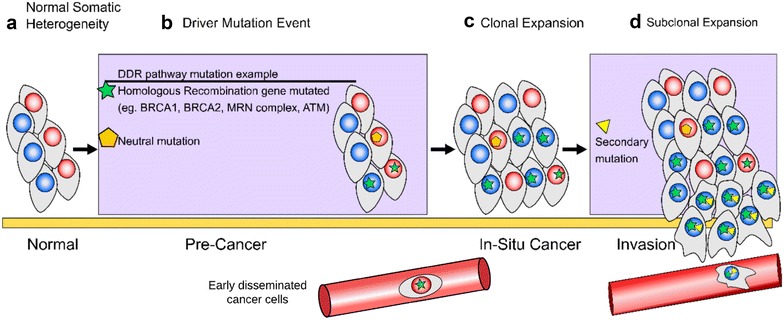
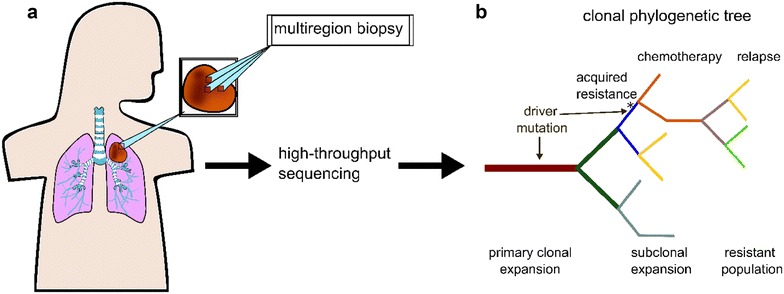
It has become increasingly clear that both normal and cancer tissues are composed of heterogeneous populations. Genetic variation can be attributed to the downstream effects of inherited mutations, environmental factors, or inaccurately resolved errors in transcription and replication. When lesions occur in regions that confer a proliferative advantage, it can support clonal expansion, subclonal variation, and neoplastic progression. In this manner, the complex heterogeneous microenvironment of a tumour promotes the likelihood of angiogenesis and metastasis. Recent advances in next‐generation sequencing and computational biology have utilized single‐cell applications to build deep profiles of individual cells that are otherwise masked in bulk profiling. In addition, the development of new techniques for combining single‐cell multi‐omic strategies is providing a more precise understanding of factors contributing to cellular identity, function, and growth. Continuing advancements in single‐cell technology and computational deconvolution of data will be critical for reconstructing patient specific intra‐tumour features and developing more personalized cancer treatments.
Overview
The claims and statistics of this paper haven’t been checked yet.
Free: it reads the open-access text and checks the first 5 claims that cite a source we can check. Create a free account to check every claim.
Integrity signals
Registry
Cites
Statistics
Figures


Verification
Claims the paper makes
The claims and statistics of this paper haven’t been checked yet.
Free: it reads the open-access text and checks the first 5 claims that cite a source we can check. Create a free account to check every claim.
Claims other papers make about this one
Each is checked against this paper’s own text: does it say what the citing paper says it does?
The cited source says what the claim attributes to it.
In the citing paper
“Recent significant advances in single-cell technologies, especially the single-cell RNA sequencing (scRNA-seq) technology, have enabled the analysis of intercellular heterogeneity at a very fine resolution8,9 and helped us to have many breakthroughs in understanding disease mechanisms10, such as breast cancer11, liver cancer12 and COVID-1913.”
From ASGARD is a single-cell guided pipeline to aid repurposing of drugs (2023) · cites this paper as [10]
Self-check
Percentages, sums and reported differences re-computed from the paper’s own numbers.
The self-check needs the paper’s full text.
Citations
Cites
STAR: ultrafast universal RNA-seq aligner
Dobin, A., Davis, C. A., Schlesinger, F., Drenkow, J., Zaleski, C., Jha, S., Batut, P., Chaisson, M., & Gingeras, T. R. (2013) · Bioinformatics · doi:10.1093/bioinformatics/bts635 · Cited by 51,709
Tissue-based map of the human proteome
Uhlén, M., Fagerberg, L., Hallström, B. M., Lindskog, C., Oksvold, P., Mardinoglu, A., Sivertsson, Å., Kampf, C., Sjöstedt, E., Asplund, A., et al. (2015) · Science · doi:10.1126/science.1260419 · Cited by 15,286
Enrichr: a comprehensive gene set enrichment analysis web server 2016 update
Kuleshov, M. V., Jones, M. R., Rouillard, A. D., Fernandez, N. F., Duan, Q., Wang, Z., Koplev, S., Jenkins, S. L., Jagodnik, K. M., Lachmann, A., et al. (2016) · Nucleic Acids Research · doi:10.1093/nar/gkw377 · Cited by 10,799
Comprehensive Mapping of Long-Range Interactions Reveals Folding Principles of the Human Genome
Lieberman-Aiden, E., van Berkum, N. L., Williams, L., Imakaev, M., Ragoczy, T., Telling, A., Amit, I., Lajoie, B. R., Sabo, P. J., Dorschner, M. O., et al. (2009) · Science · doi:10.1126/science.1181369 · Cited by 8,898
Vogelstein, B., Papadopoulos, N., Velculescu, V. E., Zhou, S., Diaz, L. A., & Kinzler, K. W. (2013) · Science · doi:10.1126/science.1235122 · Cited by 7,863
Intratumor Heterogeneity and Branched Evolution Revealed by Multiregion Sequencing
Gerlinger, M., Rowan, A. J., Horswell, S., Larkin, J., Endesfelder, D., Gronroos, E., Martinez, P., Matthews, N., Stewart, A., Tarpey, P., et al. (2012) · New England Journal of Medicine · doi:10.1056/nejmoa1113205 · Cited by 7,774
Massively parallel digital transcriptional profiling of single cells
Zheng, G. X. Y., Terry, J. M., Belgrader, P., Ryvkin, P., Bent, Z. W., Wilson, R., Ziraldo, S. B., Wheeler, T. D., McDermott, G. P., Zhu, J., et al. (2017) · Nature Communications · doi:10.1038/ncomms14049 · Cited by 7,353
Trapnell, C., Cacchiarelli, D., Grimsby, J., Pokharel, P., Li, S., Morse, M., Lennon, N. J., Livak, K. J., Mikkelsen, T. S., & Rinn, J. L. (2014) · Nature Biotechnology · doi:10.1038/nbt.2859 · Cited by 7,314 · cited 1×
“For example, Monocle2 is an unsupervised algorithm designed to analyze the heterogeneity among cells and reconstruct the micro-evolution timeline from scRNA-seq data [57].”
BackgroundHighly parallel genome-wide expression profiling of individual cells using nanoliter droplets.
Macosko, E. Z., Basu, A., Satija, R., Nemesh, J., Shekhar, K., Goldman, M., Tirosh, I., Bialas, A. R., Kamitaki, N., Martersteck, E. M., et al. (2015) · Cell · doi:10.1016/j.cell.2015.05.002 · Cited by 7,110
Buenrostro, J. D., Giresi, P. G., Zaba, L. C., Chang, H. Y., & Greenleaf, W. J. (2013) · Nature Methods · doi:10.1038/nmeth.2688 · Cited by 6,422
Research works printed but not linked: 5
- 10.1016/j.cell.2015.05.002 · DOI · Paper page
- 10.1038/nature23306 · DOI · Paper page
- Jahn K, 2016, Tree inference for single‐cell data, Genome Biol, 17, 86, 10.1186/s13059-016-0936-x · DOI · Paper page
- 10.1371/journal.pcbi.1005212 · DOI
- 10.1038/nmeth.4155 · DOI · Paper page
Cited by
[Retracted] Global Increase in Breast Cancer Incidence: Risk Factors and Preventive Measures
Kashyap, D., Pal, D., Sharma, R., Garg, V. K., Goel, N., Koundal, D., Zaguia, A., Koundal, S., & Belay, A. (2022) · BioMed Research International · doi:10.1155/2022/9605439 · Cited by 529
RetractedMachine learning approaches to drug response prediction: challenges and recent progress
Adam, G., Rampášek, L., Safikhani, Z., Smirnov, P., Haibe-Kains, B., & Goldenberg, A. (2020) · npj Precision Oncology · doi:10.1038/s41698-020-0122-1 · Cited by 425
Single Cell Multi-Omics Technology: Methodology and Application
Hu, Y., An, Q., Sheu, K., Trejo, B., Fan, S., & Guo, Y. (2018) · Frontiers in Cell and Developmental Biology · doi:10.3389/fcell.2018.00028 · Cited by 190
The Underlying Tumor Genomics of Predominant Histologic Subtypes in Lung Adenocarcinoma
Caso, R., Sanchez-Vega, F., Tan, K. S., Mastrogiacomo, B., Zhou, J., Jones, G. D., Nguyen, B., Schultz, N., Connolly, J. G., Brandt, W. S., et al. (2020) · Journal of Thoracic Oncology · doi:10.1016/j.jtho.2020.08.005 · Cited by 160
Evaluation of Cell Type Annotation R Packages on Single-Cell RNA-Seq Data
Huang, Q., Liu, Y., Du, Y., & Garmire, L. X. (2021) · Genomics, Proteomics & Bioinformatics · doi:10.1016/j.gpb.2020.07.004 · Cited by 149
Self-citation
Metadata
- Authors
- Ortega, M. A., Poirion, O., Zhu, X., Huang, S., Wolfgruber, T. K., Sebra, R., & Garmire, L. X.
- Affiliations
- Cancer Center of Hawaii (US)
- Icahn School of Medicine at Mount Sinai (US)
- Corresponding author
- Garmire, Lana X.
- ORCID
- Venue
- Clinical and Translational Medicine
- Publisher
- Wiley
- Published
- 2017-12
- Volume
- 6
- Issue
- 1
- Pages
- 46-46
- ISSN
- 2001-1326 (ISSN-L)
- PMC
- PMC5746494
- OpenAlex
- W2775981375
- Cited by
- 81
- References
- 122
- Citations by year
- 2026: 4 · 2025: 2 · 2024: 8 · 2023: 4 · 2022: 12 · 2021: 8 · 2020: 15 · 2019: 17 · 2018: 10
- FWCI
- 1.07
- Type
- journal article
- Language
- en
- Open access
- gold
- doi.org
- Licence
- cc-by
- creativecommons.org/licenses/by/4.0/ (vor, 27 d)
- creativecommons.org/licenses/by/4.0 (tdm)
- creativecommons.org/licenses/by/4.0 (vor, 27 d)
- Locations
- Clinical and Translational Medicine (publishedVersion, cc-by)
- Europe PMC (PubMed Central) (publishedVersion, cc-by)
- PubMed Central (publishedVersion, cc-by)
- PubMed (publishedVersion)
- DOAJ (DOAJ: Directory of Open Access Journals) (submittedVersion)
- Funders
- National Institute of Environmental Health Sciences (K01ES025434)
- U.S. National Library of Medicine (R01 LM012373, LM012373)
- National Institute of General Medical Sciences (GM103457)
- National Institute of Child Health and Human Development (HD084633)
- Topics
- Life Sciences › Biochemistry, Genetics and Molecular Biology › Molecular Biology › Single-cell and spatial transcriptomics
- Life Sciences › Biochemistry, Genetics and Molecular Biology › Cancer Research › Cancer Genomics and Diagnostics
- Life Sciences › Biochemistry, Genetics and Molecular Biology › Molecular Biology › Gene expression and cancer classification
- Keywords
- tumor heterogeneity, single-cell multi-omics, intratumoral heterogeneity, clonal evolution, tumor progression, tumor microenvironment, single-cell sequencing, precision oncology
About these checks
Registry, retraction, Cites and statistics results are computed, not judged, with one exception: a printed reference that no index lists is read once by a model before it counts as a citation error. Claims are extracted by a model and kept only when their quote appears verbatim in the text; each cited source is then checked, with a model’s help, for whether it says what the claim relies on. Those verdicts can be wrong — read the claim’s quote and the cited source before relying on one.
Statistics and arithmetic are recomputed, not judged.
Confidence bands are shown only for fields calibrated on our annotated test set. None is calibrated yet, so no band is shown.
What counts as a claim ›How we measure confidence ›How we check this ›
Are you an author, or do you see a problem with this page? Request a review
How to cite
Cite CoChat for the checks on this page, and the paper for its own findings.
- This page
- CoChat. (2026). Citation check: Using single‐cell multiple omics approaches to resolve tumor heterogeneity. https://app.cochat.ai/papers/10.1186/s40169-017-0177-y
- The paper
- Ortega, M. A., Poirion, O., Zhu, X., Huang, S., Wolfgruber, T. K., Sebra, R., & Garmire, L. X. (2017). Using single‐cell multiple omics approaches to resolve tumor heterogeneity. Clinical and Translational Medicine. https://doi.org/10.1186/s40169-017-0177-y
Data sources
Bibliographic data: Semantic Scholar, OpenAlex, Crossref.
Contains information from the Semantic Scholar Academic Graph Datasets, made available under the ODC Attribution License (ODC-BY 1.0).
Semantic Scholar’s data is described in: Kinney, R., et al. (2023). The Semantic Scholar Open Data Platform. arXiv:2301.10140.
