

Self-reported race/ethnicity in the age of genomic research: its potential impact on understanding health disparities
Open accessThe DOI matches its Crossref record; 115 of the 115 references it cites were found in a registry or an index.
Abstract
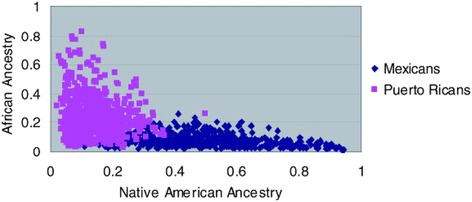
This review explores the limitations of self-reported race, ethnicity, and genetic ancestry in biomedical research. Various terminologies are used to classify human differences in genomic research including race, ethnicity, and ancestry. Although race and ethnicity are related, race refers to a person's physical appearance, such as skin color and eye color. Ethnicity, on the other hand, refers to communality in cultural heritage, language, social practice, traditions, and geopolitical factors. Genetic ancestry inferred using ancestry informative markers (AIMs) is based on genetic/genomic data. Phenotype-based race/ethnicity information and data computed using AIMs often disagree. For example, self-reporting African Americans can have drastically different levels of African or European ancestry. Genetic analysis of individual ancestry shows that some self-identified African Americans have up to 99% of European ancestry, whereas some self-identified European Americans have substantial admixture from African ancestry. Similarly, African ancestry in the Latino population varies between 3% in Mexican Americans to 16% in Puerto Ricans. The implication of this is that, in African American or Latino populations, self-reported ancestry may not be as accurate as direct assessment of individual genomic information in predicting treatment outcomes. To better understand human genetic variation in the context of health disparities, we suggest using "ancestry" (or biogeographical ancestry) to describe actual genetic variation, "race" to describe health disparity in societies characterized by racial categories, and "ethnicity" to describe traditions, lifestyle, diet, and values. We also suggest using ancestry informative markers for precise characterization of individuals' biological ancestry. Understanding the sources of human genetic variation and the causes of health disparities could lead to interventions that would improve the health of all individuals.
Overview
The claims and statistics of this paper haven’t been checked yet.
Free: it reads the open-access text and checks the first 5 claims that cite a source we can check. Create a free account to check every claim.
Integrity signals
Registry
Cites
Statistics
Figures
Verification
Claims the paper makes
The claims and statistics of this paper haven’t been checked yet.
Free: it reads the open-access text and checks the first 5 claims that cite a source we can check. Create a free account to check every claim.
Claims other papers make about this one
Each is checked against this paper’s own text: does it say what the citing paper says it does?
The cited source says what the claim attributes to it.
In the citing paper
“Of note, race can be considered as a social construct rather than a biological construct114,134, as race is a socially derived label that can either be self-reported or assigned and might not justify any biological or genetic differences between populations135,136.”
From A global view of hypertensive disorders and diabetes mellitus during pregnancy (2022) · cites this paper as [136]
Self-check
Percentages, sums and reported differences re-computed from the paper’s own numbers.
The self-check needs the paper’s full text.
Citations
Cites
Inference of Population Structure Using Multilocus Genotype Data
Pritchard, J. K., Stephens, M., & Donnelly, P. (2000) · Genetics · doi:10.1093/genetics/155.2.945 · Cited by 33,908
Initial sequencing and analysis of the human genome
International Human Genome Sequencing Consortium, Whitehead Institute for Biomedical Research, C. F. G. R., Lander, E. S., Linton, L. M., Birren, B., Nusbaum, C., Zody, M. C., Baldwin, J., Devon, K., Dewar, K., et al. (2001) · Nature · doi:10.1038/35057062 · Cited by 24,216 · cited 1×
“The human genome is composed of over three billion bases of DNA and contains between 25,000 and 30,000 protein-coding genes [1].”
An integrated map of genetic variation from 1,092 human genomes
The 1000 Genomes Project Consortium (2012) · Nature · doi:10.1038/nature11632 · Cited by 7,711 · cited 1×
“Because of their sheer number, SNPs are the major sources of genetic and phenotypic diversity, accounting for 95% of all known sequence variations [5].”
THE GENETICAL STRUCTURE OF POPULATIONS
WRIGHT, S. (1949) · Annals of Eugenics · doi:10.1111/j.1469-1809.1949.tb02451.x · Cited by 6,753
Integrating common and rare genetic variation in diverse human populations
The International HapMap 3 Consortium (2010) · Nature · doi:10.1038/nature09298 · Cited by 3,026 · cited 1×
“Large consortium-based next-generation sequencing studies such as the NIH/HLBI GO Exome Sequencing Project, the Consortium on Asthma among African ancestry Populations in the Americas (CAAPA), and the 1000 Genomes Project are currently using next-generation whole exome and whole genome sequencing studies to provide di…”
The Apportionment of Human Diversity
Lewontin, R. C. (1972) · Evolutionary Biology · doi:10.1007/978-1-4684-9063-3_14 · Cited by 2,472 · cited 1×
“Several studies including ours showed that genetic diversity in humans is higher between individuals of the same race (~85%) than between races (~15%) [4,24].”
Identification of Asthma Phenotypes Using Cluster Analysis in the Severe Asthma Research Program
Moore, W. C., Meyers, D. A., Wenzel, S. E., Teague, W. G., Li, H., Li, X., D'Agostino, R., Castro, M., Curran-Everett, D., Fitzpatrick, A. M., et al. (2010) · American Journal of Respiratory and Critical Care Medicine · doi:10.1164/rccm.200906-0896oc · Cited by 2,129 · cited 1×
“A recent study by the NHBLI-SARP caseonly cohort indicated the predictive role of PFT in asthma severity [60,61].”
Prescribing Personalized Nutrition for Cardiovascular Health: Are We Ready?
Juma, S., Imrhan, V., Vijayagopal, P., & Prasad, C. (2014) · Lifestyle Genomics · doi:10.1159/000370213 · Cited by 1,891
The Diploid Genome Sequence of an Individual Human
Levy, S., Sutton, G., Ng, P. C., Feuk, L., Halpern, A. L., Walenz, B. P., Axelrod, N., Huang, J., Kirkness, E. F., Denisov, G., et al. (2007) · PLoS Biology · doi:10.1371/journal.pbio.0050254 · Cited by 1,778 · cited 1×
“(569,000 and 481,000, respectively) [25-27].”
Whole-Genome Patterns of Common DNA Variation in Three Human Populations
Hinds, D. A., Stuve, L. L., Nilsen, G. B., Halperin, E., Eskin, E., Ballinger, D. G., Frazer, K. A., & Cox, D. R. (2005) · Science · doi:10.1126/science.1105436 · Cited by 1,170
Cited by
Cancer health disparities in racial/ethnic minorities in the United States
Zavala, V. A., Bracci, P. M., Carethers, J. M., Carvajal-Carmona, L., Coggins, N. B., Cruz-Correa, M. R., Davis, M., de Smith, A. J., Dutil, J., Figueiredo, J. C., et al. (2021) · British Journal of Cancer · doi:10.1038/s41416-020-01038-6 · Cited by 912
Peterson, R. E., Kuchenbaecker, K., Walters, R. K., Chen, C.-Y., Popejoy, A. B., Periyasamy, S., Lam, M., Iyegbe, C., Strawbridge, R. J., Brick, L., et al. (2019) · Cell · doi:10.1016/j.cell.2019.08.051 · Cited by 797
“For extensive discussion in the context of genomics, including recommendations from professional organizations see: (Banda et al., 2015; Mersha and Abebe, 2015; Race, Ethnicity, and Genetics Working Group, 2005).”
Structure, function, and genetics of lipoprotein (a)
Schmidt, K., Noureen, A., Kronenberg, F., & Utermann, G. (2016) · Journal of Lipid Research · doi:10.1194/jlr.r067314 · Cited by 638
“Genetic studies in African Americans can be complicated by the fact that they represent an admixed population, with substantial contribution of European and Asian ancestry to their gene pool (reviewed in (225)).”
From race-based to race-conscious medicine: how anti-racist uprisings call us to act
Cerdeña, J. P., Plaisime, M. V., & Tsai, J. (2020) · The Lancet · doi:10.1016/s0140-6736(20)32076-6 · Cited by 430
The Burden of Cardiovascular Diseases Among US States, 1990-2016
Global Burden of Cardiovascular Diseases Collaboration, Roth, G. A., Johnson, C. O., Abate, K. H., Abd-Allah, F., Ahmed, M., Alam, K., Alam, T., Alvis-Guzman, N., Ansari, H., et al. (2018) · JAMA Cardiology · doi:10.1001/jamacardio.2018.0385 · Cited by 389
“differed for various regions of the country, suggesting effect modification by local factors.(33,34) The addition of race-”
Metadata
- Authors
- Mersha, T. B., & Abebe, T.
- Affiliations
- University of Northern Iowa (US)
- Venue
- Human Genomics
- Published
- 2015-01-07
- Volume
- 9
- Issue
- 1
- Pages
- 1-1
- ISSN
- 1473-9542 (ISSN-L)
- 1479-7364
- PMC
- PMC4307746
- OpenAlex
- W2113129492
- Cited by
- 450
- References
- 115
- Citations by year
- 2026: 18 · 2025: 49 · 2024: 55 · 2023: 51 · 2022: 56 · 2021: 42 · 2020: 41 · 2019: 39 · 2018: 39 · 2017: 29 · 2016: 22 · 2015: 6
- FWCI
- 22.00
- Type
- journal article
- Language
- en
- Update notices
- correction (2021-06-15)
- Open access
- gold
- doi.org
- Licence
- cc-by
- creativecommons.org/licenses/by/4.0 (tdm)
- creativecommons.org/licenses/by/4.0 (vor)
- Locations
- Human Genomics (publishedVersion, cc-by)
- Europe PMC (PubMed Central) (publishedVersion, cc-by)
- PubMed Central (publishedVersion, cc-by)
- PubMed (publishedVersion)
- UNI ScholarWorks (University of Northern Iowa) (submittedVersion, cc-by)
- UNI ScholarWorks (University of Northern Iowa) (submittedVersion)
- Funders
- National Institutes of Health
- National Heart, Lung, and Blood Institute (K01HL103165)
- Topics
- Social Sciences › Anthropology › Race, Genetics, and Society
- Life Sciences › Biochemistry, Genetics and Molecular Biology › Genetics › Forensic and Genetic Research
- Life Sciences › Biochemistry, Genetics and Molecular Biology › Genetics › Genetic Associations and Epidemiology
- Keywords
- self-reported race, self-reported ethnicity, genetic ancestry, ancestry informative markers, health disparities, African Americans, Latino population, admixture, biogeographical ancestry, human genetic variation, genomic research
- MeSH terms
- Ethnicity, Genetic Markers, Humans, Phenotype, Genomics, Biomedical Research, Racial Groups, Self Report
About these checks
Registry, retraction, Cites and statistics results are computed, not judged, with one exception: a printed reference that no index lists is read once by a model before it counts as a citation error. Claims are extracted by a model and kept only when their quote appears verbatim in the text; each cited source is then checked, with a model’s help, for whether it says what the claim relies on. Those verdicts can be wrong — read the claim’s quote and the cited source before relying on one.
Statistics and arithmetic are recomputed, not judged.
Confidence bands are shown only for fields calibrated on our annotated test set. None is calibrated yet, so no band is shown.
What counts as a claim ›How we measure confidence ›How we check this ›
Are you an author, or do you see a problem with this page? Request a review
Data sources
Bibliographic data: Semantic Scholar, OpenAlex, Crossref.
Contains information from the Semantic Scholar Academic Graph Datasets, made available under the ODC Attribution License (ODC-BY 1.0).
Semantic Scholar’s data is described in: Kinney, R., et al. (2023). The Semantic Scholar Open Data Platform. arXiv:2301.10140.
