

Eating Disorder Examination Questionnaire (EDE-Q-13): expanding on the short form
Open accessThe DOI matches its Crossref record; 31 of the 31 references it cites were found in a registry or an index.
Abstract
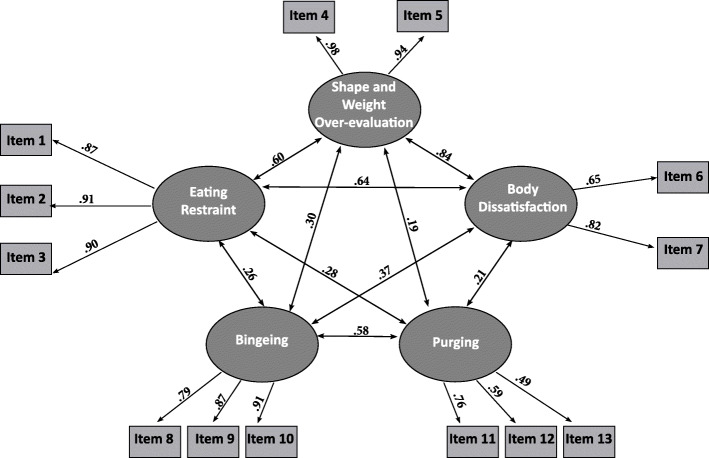
Objective: The Eating Disorders Examination–Questionnaire (EDE-Q) is widely used but time-consuming to complete. In recent years, the advantages and disadvantages of several brief versions have therefore been investigated. A seven-item scale (EDE-Q-7) has excellent psychometric properties but excludes items on bingeing and purging. This study aimed to evaluate a thirteen-item scale (EDE-Q-13) including items on bingeing and purging. Method: Participants were 1160 (188 [11.4%] males) community volunteers of mean age 28.79 ± 9.92. They completed the full EDE-Q in Hebrew, as well as measures of positive body experience, social and emotional connection, life satisfaction, positive and negative affect and positive eating. The six EDE-Q items about bingeing and purging, recoded to correspond to the response categories of the other EDE-Q questions, were added to the EDE-Q-7, resulting in the EDE-Q-13. Results: Confirmatory factor analysis confirmed the hypothesized EDE-Q-13 structure, including the bingeing and purging subscales. Strong positive correlations were found between the EDE-Q-13 and the original EDE-Q scores. The EDE-Q-13 showed convergent validity with related measures. Conclusions: The EDE-Q-13 in Hebrew is a brief version of the EDE-Q that includes bingeing and purging subscales and has satisfactory psychometric properties. Its use in clinical and research contexts is encouraged.
Overview
The claims and statistics of this paper haven’t been checked yet.
Free: it reads the open-access text and checks the first 5 claims that cite a source we can check. Create a free account to check every claim.
Integrity signals
Registry
Cites
Statistics
Figures
Verification
Claims the paper makes
The claims and statistics of this paper haven’t been checked yet.
Free: it reads the open-access text and checks the first 5 claims that cite a source we can check. Create a free account to check every claim.
Self-check
Percentages, sums and reported differences re-computed from the paper’s own numbers.
The self-check needs the paper’s full text.
Citations
Cites
The satisfaction with life scale
Diener, E., Emmons, R. A., Larsen, R. J., & Griffin, S. (1985) · Journal of Personality Assessment · doi:10.1207/s15327752jpa4901_13 · Cited by 31,768 · cited 1×
“The SWLS is a common measure of well-being and has good psychometric properties [22].”
BackgroundAlternative Ways of Assessing Model Fit
Browne, M. W., & Cudeck, R. (1992) · Sociological Methods & Research · doi:10.1177/0049124192021002005 · Cited by 27,200
Significance tests and goodness of fit in the analysis of covariance structures.
Bentler, P. M., & Bonett, D. G. (1980) · Psychological Bulletin · doi:10.1037//0033-2909.88.3.588 · Cited by 19,023 · cited 1×
“90 [27], root mean square error of approximation (RMSEA) < .”
BackgroundTesting Structural Equation Models.
Mueller, C. W., Bollen, K. A., & Long, J. S. (1994) · Contemporary Sociology · doi:10.2307/2074955 · Cited by 14,120
Thompson, E. R. (2007) · Journal of Cross-Cultural Psychology · doi:10.1177/0022022106297301 · Cited by 2,399 · cited 4×
“Positive and negative affect were assessed via the Positive and Negative Affect Schedule – Short Form (PANASSF) [24].”
BackgroundInfluentialEating disorder examination questionnaire (EDE-Q): norms for young adult women
Mond, J. M., Hay, P. J., Rodgers, B., & Owen, C. (2006) · Behaviour Research and Therapy · doi:10.1016/j.brat.2004.12.003 · Cited by 681 · cited 1×
“This widely used self-report questionnaire discriminates between disordered eating and eating disorders in screening community samples [3], in primary care [4] and supports the clinical diagnosis of eating disorders [5].”
Gideon, N., Hawkes, N., Mond, J., Saunders, R., Tchanturia, K., & Serpell, L. (2016) · PLoS ONE · doi:10.1371/journal.pone.0152744 · Cited by 419 · cited 2×
“[10] data by another research group [12] calculated a cut-off score for optimal sensitivity and specificity for the 12-item version, increasing its usefulness as a screening tool.”
BackgroundMethodEating Disorder Examination Questionnaire (EDE‐Q): Norms for undergraduate women
Luce, K. H., Crowther, J. H., & Pole, M. (2008) · International Journal of Eating Disorders · doi:10.1002/eat.20504 · Cited by 381 · cited 1×
“A cut-off of four (for subscales and the global score) indicates risk for a clinical eating disorder, for both men and women [17].”
BackgroundScreening for eating disorders in primary care: EDE-Q versus SCOFF
Mond, J. M., Myers, T. C., Crosby, R. D., Hay, P. J., Rodgers, B., Morgan, J. F., Hubert Lacey, J., & Mitchell, J. E. (2008) · Behaviour Research and Therapy · doi:10.1016/j.brat.2008.02.003 · Cited by 301 · cited 1×
“This widely used self-report questionnaire discriminates between disordered eating and eating disorders in screening community samples [3], in primary care [4] and supports the clinical diagnosis of eating disorders [5].”
Hilbert, A., de Zwaan, M., & Braehler, E. (2012) · PLoS ONE · doi:10.1371/journal.pone.0029125 · Cited by 251 · cited 1×
“subscale with the Weight and Shape Concern items combined into a single factor (Shape and Weight Overevaluation) as in many previous studies [2, 29].”
Result
Cited by
Structural validity of the Eating Disorder Examination—Questionnaire: A systematic review
Jenkins, P. E., & Rienecke, R. D. (2022) · International Journal of Eating Disorders · doi:10.1002/eat.23721 · Cited by 90
“These items are typically excluded from calculations of subscales, although some authors have included them due to their centrality in the diagnosis of EDs, often by adapting them to a Likert (ordinal) scale (e.g., Hrabosky et al., 2008; Lev-Ari et al., 2021).”
BackgroundEsin, K., & Ayyıldız, F. (2022) · Journal of Eating Disorders · doi:10.1186/s40337-022-00628-4 · Cited by 41
“Contrary to other short versions of EDE-Q [17, 18, 22–24], the positive side of EDE-Q-13 has been reported as that it contains items about binge eating and purging [20, 25].”
BackgroundMethodResultInfluentialArslan, N., Esin, K., & Ayyıldız, F. (2025) · BMC Public Health · doi:10.1186/s12889-025-22507-8 · Cited by 22
“This scale was developed by Lev Ari [36] to be used in identifying eating disorder symptoms.”
Habashy, J., Benning, S., Renn, B., Borgogna, N., Lawrence, E., & Kraus, S. W. (2022) · Eating Behaviors · doi:10.1016/j.eatbeh.2022.101696 · Cited by 18
Robbins, M., Rinaldi, K., Brochu, P. M., & Mensinger, J. L. (2025) · Body Image · doi:10.1016/j.bodyim.2025.101860 · Cited by 21
The Positive Eating Scale: Associations with eating behavior, food choice, and body mass index
Sob, C., Siegrist, M., & Hartmann, C. (2023) · Eating Behaviors · doi:10.1016/j.eatbeh.2023.101706 · Cited by 17
Rosenberg, T., Lahav, Y., & Ginzburg, K. (2022) · International Journal of Child Abuse & Neglect · doi:10.1016/j.chiabu.2022.105988 · Cited by 10
Bang, L., Nordmo, M., Nordmo, M., Vrabel, K. R., Danielsen, M., & Rø, Ø. (2023) · Journal of Eating Disorders · doi:10.1186/s40337-023-00920-x · Cited by 19
“It’s also worth mentioning that preliminary research has explored a version of the EDE-Q7 that includes the behavioral items from the EDE-Q [18, 36].”
BackgroundMethodDufour, R., Steiger, H., & Booij, L. (2024) · International Journal of Eating Disorders · doi:10.1002/eat.24330 · Cited by 12
“…forms of the original EDE-Q have indeed been developed in recent years to facilitate the use of the scale for screening purposes, including the EDE-QS (12 items) (Gideon et al. 2016), the EDE- Q-7 (Grilo et al. 2015), and the EDE- Q-13 (Lev-Ari, Bachner-Melman, and Zohar 2021; Machado et al. 2020).”
Carels, R. A., Miller, J. C., Shonrock, A. T., Byrd, R., & Haley, E. N. (2021) · Journal of Contextual Behavioral Science · doi:10.1016/j.jcbs.2021.07.005 · Cited by 13
Dahlgren, C., Bang, L., & Degobi, E. B. (2025) · BMC Psychology · doi:10.1186/s40359-025-03400-w · Cited by 8
“It is therefore noteworthy that the EDE-QS, as well as other brief forms of the EDE-Q [46, 47, 48, 49], show stronger structural validity, suggesting that these abbreviated versions may have a more stable factor structure.”
Too healthy for their own good: orthorexia nervosa and compulsive exercise in the community
Zohar, A., Zamir, M., Lev-ari, L., & Bachner-Melman, R. (2023) · Eating and Weight Disorders · doi:10.1007/s40519-023-01575-y · Cited by 8
“Disordered eating was measured by the 13‐item Eating Disorder Examination—Questionnaire-13 (EDE-Q13); [33].”
MethodSelf-citationPretorius, T. B., Heppner, P. P., Padmanabhanunni, A., & Isaacs, S. A. (2023) · SAGE Open · doi:10.1177/21582440231215633 · Cited by 8
“Third, brief instruments are less resource intensive whereas lengthy questionnaires may contribute to greater monetary cost, particularly if researchers utilize electronic platforms for data collection (Botes et al., 2021; Lev-Ari et al., 2021).”
BackgroundÖZBAY, A., Demirkol, M. E., Tamam, L., Namlı, Z., Karaytuğ, M. O., & Yeşiloğlu, C. (2025) · Behavioral Sciences · doi:10.3390/bs15070842 · Cited by 6
“The subscale scores are divided by the number of items, and the total score is calculated by dividing the sum of all subscale scores by the number of subscales (Lev-Ari et al., 2021).”
Enhancing Understanding of Eating Psychopathology: A Network Analysis Study
Marques, C., Castilho, P., Castelo-Branco, M. S., Pereira, A. T., & Goss, K. (2024) · Behavior Therapy · doi:10.1016/j.beth.2024.09.004 · Cited by 6
Toğuç, H. (2026) · BMC Psychology · doi:10.1186/s40359-026-04168-3 · Cited by 4
“Higher scores on the scale and its subscales indicate more severe cognitive and behavioural problems related to eating disorders and their subscales [22, 23].”
Brenner, I., Ari, L. L., Bachner‐Melman, R., Brand, I., Blondheim, A., Hirschmann, S., Sher, R., & Mintz-Malchi, K. (2025) · Child Abuse & Neglect · doi:10.1016/j.chiabu.2025.107577 · Cited by 3
Self-citationYücel, Ü. Ö., Yücel, M., Tayhan, F., & Helvacı, G. (2025) · International Journal of Gastronomy and Food Science · doi:10.1016/j.ijgfs.2025.101162 · Cited by 2
Lin, Z., Pickett, W., Liu, J., Leatherdale, S. T., & Patte, K. A. (2025) · Journal of Eating Disorders · doi:10.1186/s40337-025-01332-9 · Cited by 3
“While the SCOFF and WCS both only include five items [26] the EDE-Q (28 items) and EAT (40 items) are time-consuming to complete [25, 28].”
Avraham, O., Fridman, R., Shahar, D. R., & Tepper, S. (2025) · Journal of Eating Disorders · doi:10.1186/s40337-025-01346-3 · Cited by 2
“The Cronbach’s α coefficient found in the subscales of this questionnaire is 0.92 for eating restraint, 0.99 for shape and weight overestimation, 0.89 for body dissatisfaction, 0.89 for bingeing, and 0.63 for purging, which indicates a high level of internal consistency [18].”
InfluentialUğraş, S., Mergan, B., Yücekaya, M. A., Sağın, A. E., Ateş, F., & Aykora, E. (2025) · Journal of Eating Disorders · doi:10.1186/s40337-025-01363-2 · Cited by 2
“The short form of the scale (EDE-Q-13) was developed by Lev-Ari et al. [51].”
Arpa, F. Ö., Keskin, E., Sezer, F. E., Kocabaş, B. N., Ömür, S., & Bakırhan, H. (2025) · BMC Public Health · doi:10.1186/s12889-025-24295-7 · Cited by 2
“The Eating Disorder Examination Questionnaire (EDE-Q) was used to assess participants’ ED status [50].”
Miladi, S., Hammouda, O., Trabelsi, S., Miladi, S. C., Ameur, R., & Driss, T. (2025) · Physiology & Behavior · doi:10.1016/j.physbeh.2025.115200 · Cited by 2
Self-Objectification, Disordered Eating and Sexual Orientation in Men
Bachner‐Melman, R., Ari, L. L., Tiram, H., & Zohar, A. H. (2024) · International Journal of Environmental Research and Public Health · doi:10.3390/ijerph21010106 · Cited by 6
Self-citationIn-person and cyber sexual violence are common in young women who have eating disordered symptoms
Albertino, E., Martz, D. M., Wingrove, T., & Curtin, L. (2025) · Eating Disorders · doi:10.1080/10640266.2025.2471210 · Cited by 1
“The Eating Disorder Examination-Questionnaire-13 items (EDE-Q-13) was used to assess eating disordered symptom severity over the past 28 days (Lev-Ari et al., 2021) with higher scores meaning more severity.”
Toğuç, H., Aydın, H., & Fidan, Z. (2025) · Sleep and Biological Rhythms · doi:10.1007/s41105-025-00610-y · Cited by 1
“The EDE-Q-13 scale was developed by Lev-Ari et al. It is designed as a short form containing 13 items and 5 factors [13].”
Çelebi, S. B., Binokay, H., Akman, Ö. A., Keleş, H. K., Ermis, D. K., Cimbar, H., Teke, H., Kutluk, G., & Öğütlü, H. (2026) · European Journal of Pediatrics · doi:10.1007/s00431-026-06854-1 · Cited by 1
Trends in body image among Australian queer men during COVID-19 lockdowns
Bonell, S., Wilson, M., Pikoos, T. D., O’Gorman, K. M., Seidler, Z. E., & Rice, S. (2024) · Psychology and Sexuality · doi:10.1080/19419899.2024.2371439 · Cited by 1
“The EDE-Q-13 is a validated 13-item questionnaire that assesses multiple body image and disordered eating experiences (Lev-Ari et al., 2021).”
Schultz, A., Maurer, L., & Alexandrowicz, R. (2022) · Frontiers in Psychology · doi:10.3389/fpsyg.2022.1002463 · Cited by 1
“, 2019), along with a 13 item (Lev-Ari et al., 2021), a 12 item (Gideon et al.”
BackgroundFour Facet Mindful Eating and Eating Disorder Risk: Mediation By Depression and Body Mass Index.
Aydin, O., & Cetin, A. K. (2026) · Journal of Human Nutrition and Dietetics · doi:10.1111/jhn.70199
Ortorexia nervosa, comer intuitivo e comer positivo em nutricionistas, gastrólogos e população geral
Takeda, G. A. (2023) · Digital Library of Theses and Dissertations (Universidade de São Paulo) · doi:10.11606/d.6.2023.tde-07082023-180503
Bagro, T. (2023) · Family medicine European practices · doi:10.30841/2786-720x.3.2023.289323 · Cited by 2
Daniels, A., Cornelius, T., & Gorin, A. (2023) · Mental Health Science · doi:10.1002/mhs2.42
A Correlational Study of Orthorexia and Positive Body Experiences
Zohar, A. H., Bachner‐Melman, R., & Ari, L. L. (2023) · Journal of Orthopaedics and Sports Medicine · doi:10.26502/josm.511500135
“The measure has been validated in Hebrew and has good psychometric properties [26].”
Self-citationÇetin, A. K., & Aydın, Ö. (2024) · Bingöl Üniversitesi Sağlık Dergisi · doi:10.58605/bingolsaglik.1488160 · Cited by 2
Soyuk, G. N., Emanetoğlu, E., Bilgin, E., & Güme, S. (2024) · Pamukkale University Journal of Social Sciences Institute · doi:10.30794/pausbed.1429792
关, 龙. (2024) · Advances in Social Sciences · doi:10.12677/ass.2024.13111054
Spaces of S(h)elf-Care: Therapeutic Narrative Readings in Anorexia
Riestra-Camacho, R. (2024) · Miscelánea A Journal of English and American Studies · doi:10.26754/ojs_misc/mj.20249736
Effect of Pilates on sleep quality, eating disorders and occupational balance in pregnant women
Tayhan, F., & Karakuş, A. (2025) · Archives of Gynecology and Obstetrics · doi:10.1007/s00404-025-08202-4 · Cited by 1
“Lev-Ari et al. [26] developed the scale, which was later translated into Turkish and validated for reliability and validity by Esin and Ayyıldız [27].”
Bang, L., Nordmo, M., Nordmo, M., Vrabel, K. R., Danielsen, M., & Rø, Ø. (2024) · Figshare · doi:10.6084/m9.figshare.26634984
Extending the Turkish EDE-Q-13 to adolescents: a psychometric validation study
Ayyıldız, F., Esin, K., Yassıbaş, E., Bayramoğlu, E., Turan, H., Evliyaoğlu, O., & Kaya, D. G. (2026) · Journal of Eating Disorders · doi:10.1186/s40337-026-01545-6
“The Eating Disorder Examination Questionnaire-13 (EDE-Q-13) is a brief self-report instrument developed by Lev-Ari et al. [14] to assess the severity of eating disorder-related attitudes and behaviors.”
InfluentialWąsacz, M., Frej, D., Ochojska, D., & Kopańska, M. (2026) · Nutrients · doi:10.3390/nu18071028
Ayhan, B., Gövez, N. E., Bilici, S., Köksal, E., & Tekin, N. (2026) · Nutrients · doi:10.3390/nu18071132
Okamoto, M., Oshio, A., Renner, B., & Sproesser, G. (2026) · Journal of Health Psychology · doi:10.1177/13591053261437584
Kahraman, C. Ş., İnan, C. M., Çetiner, Ö., Артма, Э. Э., & Soylu, M. (2026) · Nutrition and Health · doi:10.1177/02601060261462772
“The shortened version was developed by Lev-Ari et al. (2021).”
Yurtsever, S. S., Vacca, M., & Lombardo, C. (2026) · Archives of Psychiatric Nursing · doi:10.1016/j.apnu.2026.152177
Validation of the Turkish Version of the Eating Attitudes Test-7
Ayakdaş, G., Kahrıman, M., Hajhamidiasl, L., Erol, Y. A., Köksal, S., Türker, P., & Baş, M. (2026) · Nutrients · doi:10.3390/nu18142344
Arslan, S. C., & Okumuş, F. E. E. (2026) · Eating Disorders · doi:10.1080/10640266.2026.2719843
Brochu, P. M., Harrop, E. N., Phelan, S. M., Adams, V., Bernard, A., & Winter, V. R. (2026) · Eating Behaviors · doi:10.1016/j.eatbeh.2026.102121
Çin, N. N. A., Açık, M., & Begdache, L. (2026) · Frontiers in Nutrition · doi:10.3389/fnut.2026.1881290 · Cited by 1
“The scores of the scale are evaluated based on the sum of the scores of the items in the entire scale or each subscale of the scale, and higher scores indicate higher levels of eating-related psychopathology (29).”
Educating towards Weight-Inclusivity: A Multi-Method Exploration of Weight Stigma Interventions
Sullivan, S. (2026) · Digital Commons - DU (University of Denver) · doi:10.56902/etdcrp.2026.124
Çavdar, M., & Çavdar, M. (2026) · Eurasian Journal of Family Medicine · doi:10.33880/ejfm.2026150305
ALATAŞ, H., Arslan, N., Yaman, S., & Bektaş, S. (2026) · Afet ve Risk Dergisi · doi:10.35341/afet.1824043
Metadata
- Authors
- Lev-Ari, L., Bachner-Melman, R., & Zohar, A. H.
- Affiliations
- Ruppin Academic Center (IL)
- Venue
- Journal of Eating Disorders
- Published
- 2021-04-29
- Volume
- 9
- Issue
- 1
- Pages
- 57-57
- ISSN
- 2050-2974 (ISSN-L)
- PMC
- PMC8082853
- OpenAlex
- W3147001033
- Semantic Scholar
- fbfe6866cfc68aede84164bdcd72b8d80be93acc
- Cited by
- 53
- References
- 31
- Citations by year
- 2026: 16 · 2025: 14 · 2024: 9 · 2023: 8 · 2022: 5 · 2021: 1
- FWCI
- 3.92
- Type
- journal article
- Language
- en
- Open access
- gold
- doi.org
- Licence
- cc-by
- creativecommons.org/licenses/by/4.0/ (tdm)
- creativecommons.org/licenses/by/4.0/ (vor)
- Locations
- Journal of Eating Disorders (publishedVersion, cc-by)
- PubMed Central (publishedVersion, cc-by)
- PubMed (publishedVersion)
- DOAJ (DOAJ: Directory of Open Access Journals) (submittedVersion, cc-by-sa)
- Topics
- Social Sciences › Psychology › Clinical Psychology › Eating Disorders and Behaviors
- Health Sciences › Nursing › Nutrition and Dietetics › Nutrition, Health and Food Behavior
- Social Sciences › Psychology › Experimental and Cognitive Psychology › Anxiety, Depression, Psychometrics, Treatment, Cognitive Processes
- Keywords
- eating disorder screening, bingeing, purging, Hebrew translation, psychometric properties, factor structure, convergent validity, short-form questionnaire
About these checks
Registry, retraction, Cites and statistics results are computed, not judged, with one exception: a printed reference that no index lists is read once by a model before it counts as a citation error. Claims are extracted by a model and kept only when their quote appears verbatim in the text; each cited source is then checked, with a model’s help, for whether it says what the claim relies on. Those verdicts can be wrong — read the claim’s quote and the cited source before relying on one.
Statistics and arithmetic are recomputed, not judged.
Confidence bands are shown only for fields calibrated on our annotated test set. None is calibrated yet, so no band is shown.
What counts as a claim ›How we measure confidence ›How we check this ›
Are you an author, or do you see a problem with this page? Request a review
Data sources
Bibliographic data: Semantic Scholar, OpenAlex, Crossref.
Contains information from the Semantic Scholar Academic Graph Datasets, made available under the ODC Attribution License (ODC-BY 1.0).
Semantic Scholar’s data is described in: Kinney, R., et al. (2023). The Semantic Scholar Open Data Platform. arXiv:2301.10140.
