

Eating Disorder Examination Questionnaire (EDE-Q-13): expanding on the short form
Open accessThe DOI matches its Crossref record; 31 of the 31 references it cites were found in a registry or an index.
Abstract
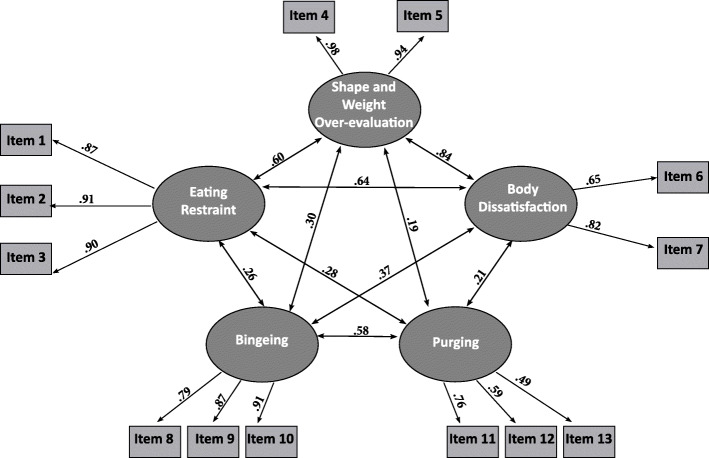
Objective: The Eating Disorders Examination–Questionnaire (EDE-Q) is widely used but time-consuming to complete. In recent years, the advantages and disadvantages of several brief versions have therefore been investigated. A seven-item scale (EDE-Q-7) has excellent psychometric properties but excludes items on bingeing and purging. This study aimed to evaluate a thirteen-item scale (EDE-Q-13) including items on bingeing and purging. Method: Participants were 1160 (188 [11.4%] males) community volunteers of mean age 28.79 ± 9.92. They completed the full EDE-Q in Hebrew, as well as measures of positive body experience, social and emotional connection, life satisfaction, positive and negative affect and positive eating. The six EDE-Q items about bingeing and purging, recoded to correspond to the response categories of the other EDE-Q questions, were added to the EDE-Q-7, resulting in the EDE-Q-13. Results: Confirmatory factor analysis confirmed the hypothesized EDE-Q-13 structure, including the bingeing and purging subscales. Strong positive correlations were found between the EDE-Q-13 and the original EDE-Q scores. The EDE-Q-13 showed convergent validity with related measures. Conclusions: The EDE-Q-13 in Hebrew is a brief version of the EDE-Q that includes bingeing and purging subscales and has satisfactory psychometric properties. Its use in clinical and research contexts is encouraged.
Overview
The claims and statistics of this paper haven’t been checked yet.
Free: it reads the open-access text and checks the first 5 claims that cite a source we can check. Create a free account to check every claim.
Integrity signals
Registry
Cites
Statistics
Figures
Verification
Claims the paper makes
The claims and statistics of this paper haven’t been checked yet.
Free: it reads the open-access text and checks the first 5 claims that cite a source we can check. Create a free account to check every claim.
Self-check
Percentages, sums and reported differences re-computed from the paper’s own numbers.
The self-check needs the paper’s full text.
Citations
Cites
The satisfaction with life scale
Diener, E., Emmons, R. A., Larsen, R. J., & Griffin, S. (1985) · Journal of Personality Assessment · doi:10.1207/s15327752jpa4901_13 · Cited by 31,768 · cited 1×
“The SWLS is a common measure of well-being and has good psychometric properties [22].”
BackgroundAlternative Ways of Assessing Model Fit
Browne, M. W., & Cudeck, R. (1992) · Sociological Methods & Research · doi:10.1177/0049124192021002005 · Cited by 27,200
Significance tests and goodness of fit in the analysis of covariance structures.
Bentler, P. M., & Bonett, D. G. (1980) · Psychological Bulletin · doi:10.1037//0033-2909.88.3.588 · Cited by 19,023 · cited 1×
“90 [27], root mean square error of approximation (RMSEA) < .”
BackgroundTesting Structural Equation Models.
Mueller, C. W., Bollen, K. A., & Long, J. S. (1994) · Contemporary Sociology · doi:10.2307/2074955 · Cited by 14,120
Thompson, E. R. (2007) · Journal of Cross-Cultural Psychology · doi:10.1177/0022022106297301 · Cited by 2,399 · cited 4×
“Positive and negative affect were assessed via the Positive and Negative Affect Schedule – Short Form (PANASSF) [24].”
BackgroundInfluentialEating disorder examination questionnaire (EDE-Q): norms for young adult women
Mond, J. M., Hay, P. J., Rodgers, B., & Owen, C. (2006) · Behaviour Research and Therapy · doi:10.1016/j.brat.2004.12.003 · Cited by 681 · cited 1×
“This widely used self-report questionnaire discriminates between disordered eating and eating disorders in screening community samples [3], in primary care [4] and supports the clinical diagnosis of eating disorders [5].”
Gideon, N., Hawkes, N., Mond, J., Saunders, R., Tchanturia, K., & Serpell, L. (2016) · PLoS ONE · doi:10.1371/journal.pone.0152744 · Cited by 419 · cited 2×
“[10] data by another research group [12] calculated a cut-off score for optimal sensitivity and specificity for the 12-item version, increasing its usefulness as a screening tool.”
BackgroundMethodEating Disorder Examination Questionnaire (EDE‐Q): Norms for undergraduate women
Luce, K. H., Crowther, J. H., & Pole, M. (2008) · International Journal of Eating Disorders · doi:10.1002/eat.20504 · Cited by 381 · cited 1×
“A cut-off of four (for subscales and the global score) indicates risk for a clinical eating disorder, for both men and women [17].”
BackgroundScreening for eating disorders in primary care: EDE-Q versus SCOFF
Mond, J. M., Myers, T. C., Crosby, R. D., Hay, P. J., Rodgers, B., Morgan, J. F., Hubert Lacey, J., & Mitchell, J. E. (2008) · Behaviour Research and Therapy · doi:10.1016/j.brat.2008.02.003 · Cited by 301 · cited 1×
“This widely used self-report questionnaire discriminates between disordered eating and eating disorders in screening community samples [3], in primary care [4] and supports the clinical diagnosis of eating disorders [5].”
Hilbert, A., de Zwaan, M., & Braehler, E. (2012) · PLoS ONE · doi:10.1371/journal.pone.0029125 · Cited by 251 · cited 1×
“subscale with the Weight and Shape Concern items combined into a single factor (Shape and Weight Overevaluation) as in many previous studies [2, 29].”
ResultGrilo, C. M., Reas, D. L., Hopwood, C. J., & Crosby, R. D. (2015) · International Journal of Eating Disorders · doi:10.1002/eat.22358 · Cited by 228 · cited 3×
“’s [8] seven-item version and the six items about bingeing and purging recoded so that their response categories correspond to those of the other items.”
BackgroundMethodKliem, S., Mößle, T., Zenger, M., Strauß, B., Brähler, E., & Hilbert, A. (2016) · International Journal of Eating Disorders · doi:10.1002/eat.22487 · Cited by 153 · cited 1×
“[14] eight-item versions were adequate, only the Grilo et al.”
MethodFurther development of the 12-item EDE-QS: identifying a cut-off for screening purposes
Prnjak, K., Mitchison, D., Griffiths, S., Mond, J., Gideon, N., Serpell, L., & Hay, P. (2020) · BMC Psychiatry · doi:10.1186/s12888-020-02565-5 · Cited by 134 · cited 1×
“[10] data by another research group [12] calculated a cut-off score for optimal sensitivity and specificity for the 12-item version, increasing its usefulness as a screening tool.”
MethodHe, J., Sun, S., & Fan, X. (2020) · Eating and Weight Disorders - Studies on Anorexia Bulimia and Obesity · doi:10.1007/s40519-019-00840-3 · Cited by 129 · cited 1×
“The good psychometric properties of the 12item version were replicated in a Mandarin translation administered to Chinese university students [11].”
MethodEating Disorder Examination – Questionnaire short forms: A comparison
Machado, P. P. P., Grilo, C. M., Rodrigues, T. F., Vaz, A., & Crosby, R. D. (2020) · International Journal of Eating Disorders · doi:10.1002/eat.23275 · Cited by 122 · cited 7×
“[13] recommended the use of the seven-item ver-”
BackgroundMethodInfluentialIdentifying a male clinical cutoff on the Eating Disorder Examination‐Questionnaire (EDE‐Q)
Schaefer, L. M., Smith, K. E., Leonard, R., Wetterneck, C., Smith, B., Farrell, N., Riemann, B. C., Frederick, D. A., Schaumberg, K., Klump, K. L., et al. (2018) · International Journal of Eating Disorders · doi:10.1002/eat.22972 · Cited by 115 · cited 1×
“This widely used self-report questionnaire discriminates between disordered eating and eating disorders in screening community samples [3], in primary care [4] and supports the clinical diagnosis of eating disorders [5].”
Carey, M., Kupeli, N., Knight, R., Troop, N. A., Jenkinson, P. M., & Preston, C. (2019) · Psychological Assessment · doi:10.1037/pas0000703 · Cited by 110 · cited 2×
“The 18-item version was subsequently validated for females, with a three-factor solution: Shape and Weight Concern, Preoccupation and Eating Concern, and Restriction [7].”
BackgroundMethodFriborg, O., Reas, D. L., Rosenvinge, J. H., & Rø, Ø. (2013) · International Journal of Methods in Psychiatric Research · doi:10.1002/mpr.1389 · Cited by 97 · cited 1×
“Other studies have suggested alternate four-factor structures [9].”
BackgroundSubjective well-being among Holocaust survivors: An examination of overlooked differentiations.
Shmotkin, D., & Lomranz, J. (1998) · Journal of Personality and Social Psychology · doi:10.1037//0022-3514.75.1.141 · Cited by 76
Goldfein, J. A., Devlin, M. J., & Kamenetz, C. (2005) · International Journal of Eating Disorders · doi:10.1002/eat.20075 · Cited by 75
Der Dresdner Körperbildfragebogen (DKB-35): Validierung auf der Basis einer klinischen Stichprobe
Pöhlmann, K., Roth, M., Brähler, E., & Joraschky, P. (2013) · PPmP - Psychotherapie · Psychosomatik · Medizinische Psychologie · doi:10.1055/s-0033-1351276 · Cited by 46
Sproesser, G., Klusmann, V., Ruby, M. B., Arbit, N., Rozin, P. N., Schupp, H. T., & Renner, B. (2017) · Psychology and Health · doi:10.1080/08870446.2017.1336239 · Cited by 46 · cited 8×
“Positive eating was reported by completing the Positive Eating Scale (PES) [26], an eight-item questionnaire that asks about enjoyment of eating.”
MethodInfluentialCan Recovery From an Eating Disorder Be Measured? Toward a Standardized Questionnaire
Bachner‐Melman, R., Ari, L. L., Zohar, A. H., & Lev, S. L. (2018) · Frontiers in Psychology · doi:10.3389/fpsyg.2018.02456 · Cited by 37 · cited 1×
“and social and emotional connection [16].”
Self-citationZohar, A. H., Denollet, J., Ari, L. L., & Cloninger, C. R. (2011) · European Journal of Psychological Assessment · doi:10.1027/1015-5759/a000074 · Cited by 32 · cited 1×
“A Hebrew translation previously used in research [25] was administered in this study.”
MethodSelf-citationThe EDE-Q in Hebrew: Structural and Convergent/Divergent Validity in a Population Sample.
Zohar, A. H., Ari, L. L., & Bachner‐Melman, R. (2018) · PubMed · Cited by 26
Self-citationMatthes, J., Franke, G. H., & Jäger, S. (2012) · Zeitschrift für Medizinische Psychologie · doi:10.3233/zmp-2011-2028 · Cited by 16 · cited 1×
“The scale showed good construct validity and stability over 7 days [18].”
BackgroundThe Eating Disorders Recovery Questionnaire: psychometric properties and validity
Bachner‐Melman, R., Ari, L. L., Zohar, A. H., & Linketsky, M. (2021) · Eating and Weight Disorders - Studies on Anorexia Bulimia and Obesity · doi:10.1007/s40519-021-01139-y · Cited by 13 · cited 4×
“Social and emotional connection was assessed using the seven-item Social and Emotional Connection (SEC) subscale of the Eating Disorders Recovery Questionnaire (EDRQ) [21].”
MethodSelf-citationAri, L. L., Zohar, A. H., & Bachner‐Melman, R. (2020) · Australian Journal of Psychology · doi:10.1111/ajpy.12284 · Cited by 12 · cited 1×
“It was translated into Hebrew and English following the star paradigm with permission from the authors [2, 20].”
MethodSelf-citationArmenta, B. E., & Cooper, M. L. (2018) · Psychological Assessment · doi:10.1037/pas0000608 · Cited by 7
Assessment of eating disorders: interview or self-report questionnaire
Fairburn, C. G., & Beglin, S. J. (1994) · International Journal of Eating Disorders · doi:10.1002/1098-108x(199412)16:4<363::aid-eat2260160405>3.0.co;2-# · cited 5×
“Ede-q Eating disorder symptoms were assessed using the original version of the Eating Disorders Examination – Questionnaire [1].”
BackgroundMethodInfluential(1987) · doi:10.1002/1098-108x(198701)6:1<1::aid-eat2260060102>3.0.co;2-9
Cited by
Structural validity of the Eating Disorder Examination—Questionnaire: A systematic review
Jenkins, P. E., & Rienecke, R. D. (2022) · International Journal of Eating Disorders · doi:10.1002/eat.23721 · Cited by 90
“These items are typically excluded from calculations of subscales, although some authors have included them due to their centrality in the diagnosis of EDs, often by adapting them to a Likert (ordinal) scale (e.g., Hrabosky et al., 2008; Lev-Ari et al., 2021).”
BackgroundEsin, K., & Ayyıldız, F. (2022) · Journal of Eating Disorders · doi:10.1186/s40337-022-00628-4 · Cited by 41
“Contrary to other short versions of EDE-Q [17, 18, 22–24], the positive side of EDE-Q-13 has been reported as that it contains items about binge eating and purging [20, 25].”
BackgroundMethodResultInfluentialArslan, N., Esin, K., & Ayyıldız, F. (2025) · BMC Public Health · doi:10.1186/s12889-025-22507-8 · Cited by 22
“This scale was developed by Lev Ari [36] to be used in identifying eating disorder symptoms.”
Habashy, J., Benning, S. D., Renn, B. N., Borgogna, N. C., Lawrence, E., & Kraus, S. W. (2022) · Eating Behaviors · doi:10.1016/j.eatbeh.2022.101696 · Cited by 23
Robbins, M., Rinaldi, K., Brochu, P. M., & Mensinger, J. L. (2025) · Body Image · doi:10.1016/j.bodyim.2025.101860 · Cited by 21
Metadata
- Authors
- Lev-Ari, L., Bachner-Melman, R., & Zohar, A. H.
- Affiliations
- Ruppin Academic Center (IL)
- Venue
- Journal of Eating Disorders
- Published
- 2021-04-29
- Volume
- 9
- Issue
- 1
- Pages
- 57-57
- ISSN
- 2050-2974 (ISSN-L)
- PMC
- PMC8082853
- OpenAlex
- W3147001033
- Semantic Scholar
- fbfe6866cfc68aede84164bdcd72b8d80be93acc
- Cited by
- 53
- References
- 31
- Citations by year
- 2026: 16 · 2025: 14 · 2024: 9 · 2023: 8 · 2022: 5 · 2021: 1
- FWCI
- 3.92
- Type
- journal article
- Language
- en
- Open access
- gold
- doi.org
- Licence
- cc-by
- creativecommons.org/licenses/by/4.0/ (tdm)
- creativecommons.org/licenses/by/4.0/ (vor)
- Locations
- Journal of Eating Disorders (publishedVersion, cc-by)
- PubMed Central (publishedVersion, cc-by)
- PubMed (publishedVersion)
- DOAJ (DOAJ: Directory of Open Access Journals) (submittedVersion, cc-by-sa)
- Topics
- Social Sciences › Psychology › Clinical Psychology › Eating Disorders and Behaviors
- Health Sciences › Nursing › Nutrition and Dietetics › Nutrition, Health and Food Behavior
- Social Sciences › Psychology › Experimental and Cognitive Psychology › Anxiety, Depression, Psychometrics, Treatment, Cognitive Processes
- Keywords
- eating disorder screening, bingeing, purging, Hebrew translation, psychometric properties, factor structure, convergent validity, short-form questionnaire
About these checks
Registry, retraction, Cites and statistics results are computed, not judged, with one exception: a printed reference that no index lists is read once by a model before it counts as a citation error. Claims are extracted by a model and kept only when their quote appears verbatim in the text; each cited source is then checked, with a model’s help, for whether it says what the claim relies on. Those verdicts can be wrong — read the claim’s quote and the cited source before relying on one.
Statistics and arithmetic are recomputed, not judged.
Confidence bands are shown only for fields calibrated on our annotated test set. None is calibrated yet, so no band is shown.
What counts as a claim ›How we measure confidence ›How we check this ›
Are you an author, or do you see a problem with this page? Request a review
Data sources
Bibliographic data: Semantic Scholar, OpenAlex, Crossref.
Contains information from the Semantic Scholar Academic Graph Datasets, made available under the ODC Attribution License (ODC-BY 1.0).
Semantic Scholar’s data is described in: Kinney, R., et al. (2023). The Semantic Scholar Open Data Platform. arXiv:2301.10140.
