

Validity and reliability of the Turkish version of the Eating Disorder Examination Questionnaire (EDE-Q-13): short-form of EDE-Q
Open accessThe DOI matches its Crossref record; 39 of the 39 references it cites were found in a registry or an index.
Abstract
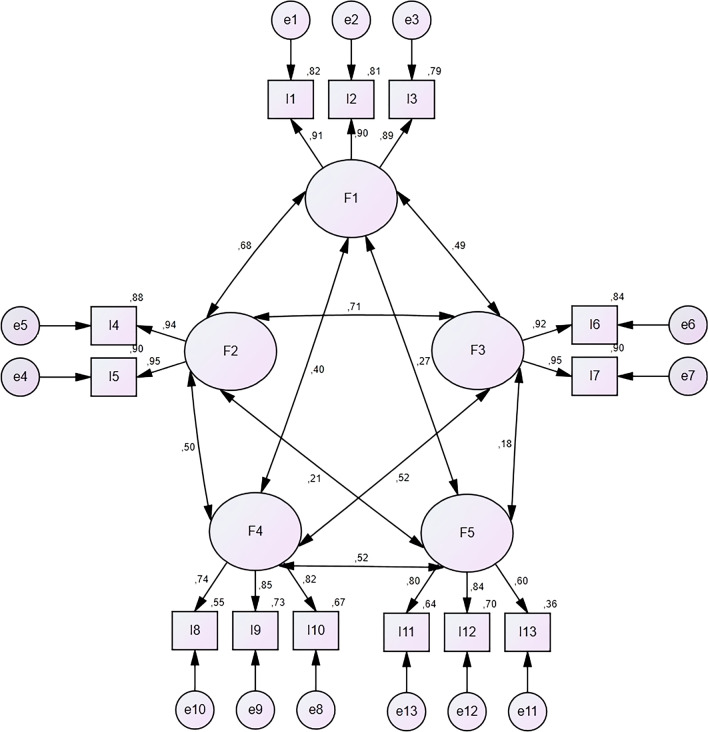
Background: The Eating Disorder Examination Questionnaire (EDE-Q) is a frequently used scale to evaluate eating behaviors and attitudes. In recent years, its use has increased due to the fact that the use of short forms is more practical. The aim of this study was to validate the short Turkish form of the Eating Disorder Examination Questionnaire (EDE-Q) including 13 items. Methods: The study included 924 adults at a mean age of 30.3 ± 10.93 years. EDEQ-13 was translated and adapted to Turkish according to the Beaton Guidelines. The Eating Attitudes Test-26 (EAT-26), the Satisfaction with Life Scale (SWLS), and the Body Appreciation Scale (BAS) were used to analyze their relationships to EDE-Q-13. Results: In this study, the rate of the total variance explained by the factors of EDE-Q-13 according to the Explanatory Factor Analysis (EFA) results of the scale was 83.54%. The Cronbach's alpha value of the scale was 0.89, and the Cronbach's alpha values of the 5 subscales were calculated in the range of 0.75–0.94. The criterion validity analysis showed an acceptable correlation between EDE-Q-13 and EAT-26, SWLS, and BAS. The confirmatory factor analysis (CFA) revealed that the model had fit values that were acceptable or good. Conclusion: Both EFA and CFA results showed that it is appropriate to use the Turkish EDE-Q-13. EDE-Q-13 was significantly correlated with eating disturbances, body appreciation, and life satisfaction. In conclusion, the Turkish version of EDE-Q-13 possesses high levels of validity and reliability.
Overview
The claims and statistics of this paper haven’t been checked yet.
Free: it reads the open-access text and checks the first 5 claims that cite a source we can check. Create a free account to check every claim.
Integrity signals
Registry
Cites
Statistics
Figures
Verification
Claims the paper makes
The claims and statistics of this paper haven’t been checked yet.
Free: it reads the open-access text and checks the first 5 claims that cite a source we can check. Create a free account to check every claim.
Claims other papers make about this one
Each is checked against this paper’s own text: does it say what the citing paper says it does?
The cited source says what the claim attributes to it.
In the citing paper
“The scale was translated into Turkish by Esin and Ayyıldız and its validity and reliability were established [43].”
From Four Facet Mindful Eating and Eating Disorder Risk: Mediation By Depression and Body Mass Index. (2026) · cites this paper as Esin and Ayyıldız [43]
Self-check
Percentages, sums and reported differences re-computed from the paper’s own numbers.
The self-check needs the paper’s full text.
Citations
Cites
The satisfaction with life scale
Diener, E., Emmons, R. A., Larsen, R. J., & Griffin, S. (1985) · Journal of Personality Assessment · doi:10.1207/s15327752jpa4901_13 · Cited by 31,768 · cited 9×
“10 1 negative correlation between the EDE-Q-13 scores of the participants and their BAS (including its subscales) scores and SWLS scores.”
BackgroundMethodInfluentialGuidelines for the process of cross-cultural adaptation of self-report measures
Beaton, D. E., Bombardier, C., Guillemin, F., & Ferraz, M. B. (2000) · Spine · doi:10.1097/00007632-200012150-00014 · Cited by 14,542
A QUANTITATIVE APPROACH TO CONTENT VALIDITY1
LAWSHE, C. H. (1975) · Personnel Psychology · doi:10.1111/j.1744-6570.1975.tb01393.x · Cited by 7,313
Lippa, N. C., & Sanderson, S. C. (2013) · Human Heredity · doi:10.1159/000353712 · Cited by 6,078
The Eating Attitudes Test: psychometric features and clinical correlates
Garner, D. M., Olmsted, M. P., Bohr, Y., & Garfinkel, P. E. (1982) · Psychological Medicine · doi:10.1017/s0033291700049163 · Cited by 4,962 · cited 15×
“This study examined the properties of EDE-Q-13 in terms of its evaluations of eating disorder pathologies as measured by EAT-26.”
MethodInfluentialThe Body Appreciation Scale: Development and psychometric evaluation
Avalos, L., Tylka, T. L., & Wood-Barcalow, N. (2005) · Body Image · doi:10.1016/j.bodyim.2005.06.002 · Cited by 1,094 · cited 9×
“10 1 negative correlation between the EDE-Q-13 scores of the participants and their BAS (including its subscales) scores and SWLS scores.”
BackgroundMethodInfluentialBerg, K. C., Peterson, C. B., Frazier, P., & Crow, S. J. (2012) · International Journal of Eating Disorders · doi:10.1002/eat.20931 · Cited by 1,042 · cited 2×
“It was also not economical in terms of time due to the large number of items [20, 21].”
BackgroundMethodYAŞAM DOYUMU ÖLÇEĞİNİN TÜRKÇE’YE UYARLANMASI: GEÇERLİK VE GÜVENİRLİK ÇALIŞMASI
DAĞLI, A., & BAYSAL, N. (2016) · Elektronik Sosyal Bilimler Dergisi · doi:10.17755/esosder.263229 · Cited by 473 · cited 8×
“10 1 negative correlation between the EDE-Q-13 scores of the participants and their BAS (including its subscales) scores and SWLS scores.”
MethodInfluentialQian, J., Wu, Y., Liu, F., Zhu, Y., Jin, H., Zhang, H., Wan, Y., Li, C., & Yu, D. (2022) · Eating and Weight Disorders - Studies on Anorexia, Bulimia and Obesity · doi:10.1007/s40519-021-01162-z · Cited by 431 · cited 1×
“Although eating disorders are more common in Western societies, the incidence of these disorders has increased recently in both developed and developing countries [2, 3].”
BackgroundGideon, N., Hawkes, N., Mond, J., Saunders, R., Tchanturia, K., & Serpell, L. (2016) · PLoS ONE · doi:10.1371/journal.pone.0152744 · Cited by 419 · cited 1×
“Therefore, 18-item [17], 12-item [22], 11-item [23], 8-item [24], and 7-item [18] versions of the scale have been developed.”
Research works printed but not linked: 2
- Ergüney-Okumuş FE Sertel-Berk HÖ Yeme Tutum Testi kısa formunun (YTT-26) Üniversite örnekleminde Türkçeye uyarlanması ve psikometrik özelliklerinin değerlendirilmesi Psikoloji Çalışmaları 2019 40 1 57 78
- Bakalım O Taşdelen-Karçkay A Body Appreciation Scale: Evaluation of the factor structure and psychometric properties among male and female Turkish university students Mersin Univ J Fac Educ 2016 12 1 410 422
Cited by
Arslan, N., Esin, K., & Ayyıldız, F. (2025) · BMC Public Health · doi:10.1186/s12889-025-22507-8 · Cited by 22
“The validity and reliability of the Turkish scale in adult participants were examined by Esin et al. [37].”
Self-citationÖğütlü, H., Kaşak, M., Doğan, U., Zickgraf, H. F., & Türkçapar, M. H. (2024) · Journal of Eating Disorders · doi:10.1186/s40337-024-00987-0 · Cited by 18
“The validity and reliability study of the Turkish version of this scale in an adult sample was conducted by Esin et al. [13].”
BackgroundBang, L., Nordmo, M., Nordmo, M., Vrabel, K. R., Danielsen, M., & Rø, Ø. (2023) · Journal of Eating Disorders · doi:10.1186/s40337-023-00920-x · Cited by 19
“It’s also worth mentioning that preliminary research has explored a version of the EDE-Q7 that includes the behavioral items from the EDE-Q [18, 36].”
BackgroundKavsara, H. K., Koyuncu, A. G., Yelken, H. D., Barthels, F., & Stroebele-Benschop, N. (2024) · Psychology, Health & Medicine · doi:10.1080/13548506.2024.2439133 · Cited by 9
“The 13-item short form has been validated for the Turkish population, demonstrating high validity and reliability (Esin & Ayyıldız, 2022).”
InfluentialAldubayan, K., Ghafouri, K. J., Mutwalli, H., Kutbi, H. A., & Mumena, W. A. (2023) · Healthcare · doi:10.3390/healthcare11071052 · Cited by 10
“Similar removing were found in versions including the Italian [27], Sweden [51], and Turkish [53].”
MethodResultÖZBAY, A., Demirkol, M. E., Tamam, L., Namlı, Z., Karaytuğ, M. O., & Yeşiloğlu, C. (2025) · Behavioral Sciences · doi:10.3390/bs15070842 · Cited by 6
Toğuç, H. (2026) · BMC Psychology · doi:10.1186/s40359-026-04168-3 · Cited by 4
“Higher scores on the scale and its subscales indicate more severe cognitive and behavioural problems related to eating disorders and their subscales [22, 23].”
Yücel, Ü. Ö., Yücel, M., Tayhan, F., & Helvacı, G. (2025) · International Journal of Gastronomy and Food Science · doi:10.1016/j.ijgfs.2025.101162 · Cited by 2
Durmuş, H., Borlu, A., Arslan, Ş., Öner, N., Eker, Ö., Gürbüz, B. N., & Çelik, Ö. (2025) · BMC Psychiatry · doi:10.1186/s12888-025-07001-0 · Cited by 2
“The EDE-Q-13 is a scale consisting of 13 questions and 5 factors developed by Fairburn and Beglin [19] in 1994 and Turkish validity and reliability studies conducted by Esin and Ayyıldız [22] in 2022.”
Uğraş, S., Mergan, B., Yücekaya, M. A., Sağın, A. E., Ateş, F., & Aykora, E. (2025) · Journal of Eating Disorders · doi:10.1186/s40337-025-01363-2 · Cited by 2
“In our study, the Turkish form, which was adapted in Turkish by Esin and Ayyıldız in [52], was used.”
Arpa, F. Ö., Keskin, E., Sezer, F. E., Kocabaş, B. N., Ömür, S., & Bakırhan, H. (2025) · BMC Public Health · doi:10.1186/s12889-025-24295-7 · Cited by 2
“Higher scores indicate greater levels of eating-related psychopathology [51].”
Akdoğan, R., Çiftçi, N. G., & Orakçi, H. (2026) · Journal of pediatric nursing · doi:10.1016/j.pedn.2026.03.011 · Cited by 2
Hamatani, S., Matsumoto, K., Andersson, G., Tomioka, Y., Numata, S., Kamashita, R., Sekiguchi, A., Sato, Y., Fukudo, S., Sasaki, N., et al. (2023) · JMIR Research Protocols · doi:10.2196/49828 · Cited by 3
Toğuç, H., Aydın, H., & Fidan, Z. (2025) · Sleep and Biological Rhythms · doi:10.1007/s41105-025-00610-y · Cited by 1
“High scores indicate an increase in the severity of psychopathological symptoms related to eating behavior [16].”
Çelebi, S. B., Binokay, H., Akman, Ö. A., Keleş, H. K., Ermis, D. K., Cimbar, H., Teke, H., Kutluk, G., & Öğütlü, H. (2026) · European Journal of Pediatrics · doi:10.1007/s00431-026-06854-1 · Cited by 1
The Turkish validity and reliability of the Reward-Based Eating Drive (RED-13) Scale
YAVUZ, A. Y., Altınsoy, C., Toraman, M. N., & Musdal, N. K. (2025) · PLoS ONE · doi:10.1371/journal.pone.0322097 · Cited by 2
“Eating Attitudes Test-26 (EAT-26), Three-Factor Eating Questionnaire (TFEQ) [11], Dutch Eating Behavior Questionnaire (DEBQ) [12], Yale Food Addiction Scale (YFAS) [13], Power of Food Scale (PFS) [14], Eating Disorder Examination Questionnaire (EDEQ-13) [15] are among these.”
Four Facet Mindful Eating and Eating Disorder Risk: Mediation By Depression and Body Mass Index.
Aydin, O., & Cetin, A. K. (2026) · Journal of Human Nutrition and Dietetics · doi:10.1111/jhn.70199
Bagro, T. (2023) · Family medicine European practices · doi:10.30841/2786-720x.3.2023.289323 · Cited by 2
Çetin, A. K., & Aydın, Ö. (2024) · Bingöl Üniversitesi Sağlık Dergisi · doi:10.58605/bingolsaglik.1488160 · Cited by 2
Soyuk, G. N., Emanetoğlu, E., Bilgin, E., & Güme, S. (2024) · Pamukkale University Journal of Social Sciences Institute · doi:10.30794/pausbed.1429792
Effect of Pilates on sleep quality, eating disorders and occupational balance in pregnant women
Tayhan, F., & Karakuş, A. (2025) · Archives of Gynecology and Obstetrics · doi:10.1007/s00404-025-08202-4 · Cited by 1
“Lev-Ari et al. [26] developed the scale, which was later translated into Turkish and validated for reliability and validity by Esin and Ayyıldız [27].”
Bang, L., Nordmo, M., Nordmo, M., Vrabel, K. R., Danielsen, M., & Rø, Ø. (2024) · Figshare · doi:10.6084/m9.figshare.26634984
From Behaviour to Brain: A Statistical and Neurobehavioural Study of Eating Disorders
Hasan, R., Hosen, M. M., Sanzit, S. H., Talukder, M. A., & Mim, H. S. (2026) · International Journal of Scientific Research and Modern Technology. · doi:10.38124/ijsrmt.v5i1.1141
Extending the Turkish EDE-Q-13 to adolescents: a psychometric validation study
Ayyıldız, F., Esin, K., Yassıbaş, E., Bayramoğlu, E., Turan, H., Evliyaoğlu, O., & Kaya, D. G. (2026) · Journal of Eating Disorders · doi:10.1186/s40337-026-01545-6
“The Turkish adaptation and psychometric evaluation of the scale in adult populations were conducted by Esin et al. [20].”
InfluentialSelf-citationThe Effect of Addiction Prevention Course on Behavioral Addictions and Disordered Eating Behavior
Canoğulları, Ö. (2026) · Bartın University Journal of Faculty of Education · doi:10.14686/buefad.1748430
Pekparmak-Alevli, G., Yıldırım, J. G., Depboylu, G. Y., & Kaner, G. (2026) · BMC Psychology · doi:10.1186/s40359-026-04397-6
“In the validation study by Esin et al. [44], only Cronbach’s alpha (0.89), test– retest correlation (0.93), and Spearman correlation were reported; complementary analysis such as McDonald’s Omega, split-half reliability, or Hotelling’s T-squared test were not included.”
InfluentialÇelik, Y. S., Okumuş, H. G., Öksüzoğlu, M. E., Kaşak, M., Solgun, G., Bryant‐Waugh, R., & Öğütlü, H. (2026) · Journal of Eating Disorders · doi:10.1186/s40337-026-01585-y
“The validity and reliability study of the Turkish version of this scale was conducted by Esin et al. [30].”
Ayhan, B., Gövez, N. E., Bilici, S., Köksal, E., & Tekin, N. (2026) · Nutrients · doi:10.3390/nu18071132
“It was initially developed by Lev-Ari et al. [20], and Esin and Ayyildiz [21] carried out the Turkish validity and reliability study.”
Mohammadi, M., Mansourian, M., Hoghoughi, N., Abdolmaleki, A., & Tarrahi, M. J. (2026) · Journal of Pediatric Nursing · doi:10.1016/j.pedn.2026.04.026
Kahraman, C. Ş., İnan, C. M., Çetiner, Ö., Артма, Э. Э., & Soylu, M. (2026) · Nutrition and Health · doi:10.1177/02601060261462772
Yurtsever, S. S., Vacca, M., & Lombardo, C. (2026) · Archives of Psychiatric Nursing · doi:10.1016/j.apnu.2026.152177
Validation of the Turkish Version of the Eating Attitudes Test-7
Ayakdaş, G., Kahrıman, M., Hajhamidiasl, L., Erol, Y. A., Köksal, S., Türker, P., & Baş, M. (2026) · Nutrients · doi:10.3390/nu18142344
“In this study, the EDE-Q-13 was used to evaluate Convergent validity [19].”
KARADENİZ, İ., Murat, B. D., Samancı, M., Yıldız, Ö. B., & Atalar, B. (2026) · Göç Araştırmaları Dergisi · doi:10.70972/gad.1912423
Arslan, S. C., & Okumuş, F. E. E. (2026) · Eating Disorders · doi:10.1080/10640266.2026.2719843
Aslan, S., Esgin, Ö., Aktaş, S. N., Kudret, D., & Süleymanoğlu, S. (2026) · Clinical Science of Nutrition · doi:10.62210/clinscinutr.2026.141
“24 To assess the digital healthy diet literacy levels of individuals, the e-Healthy Diet Literacy Scale (e-HDLQ) whose validity and reliability study was conducted in the Turkish adult population by Karahan Yılmaz, Eskici and Saraç (2023), was used.”
Çin, N. N. A., Açık, M., & Begdache, L. (2026) · Frontiers in Nutrition · doi:10.3389/fnut.2026.1881290 · Cited by 1
Çavdar, M., & Çavdar, M. (2026) · Eurasian Journal of Family Medicine · doi:10.33880/ejfm.2026150305
Özkan, G. Ö., Yüce, M. N., & Karagöl, B. (2026) · Frontiers in Nutrition · doi:10.3389/fnut.2026.1812469
“The Turkish validity and reliability study of the scale was conducted by Esin and Ayyıldız (23).”
ALATAŞ, H., Arslan, N., Yaman, S., & Bektaş, S. (2026) · Afet ve Risk Dergisi · doi:10.35341/afet.1824043
Toğuç, H., Ayçiçek, A., Tamar, D., Hökelek, B., & Özden, G. (2026) · Frontiers in Psychology · doi:10.3389/fpsyg.2026.1872938
Metadata
- Authors
- Esin, K., & Ayyıldız, F.
- Affiliations
- Tokat Gaziosmanpaşa Üniversitesi (TR)
- Gazi University (TR)
- Corresponding author
- Esin, Kübra
- Venue
- Journal of Eating Disorders
- Published
- 2022-07-14
- Volume
- 10
- Issue
- 1
- Pages
- 102-102
- ISSN
- 2050-2974 (ISSN-L)
- PMC
- PMC9281018
- OpenAlex
- W4285387639
- Semantic Scholar
- fe435a0946923000aed44c0620db81448b8f706e
- Cited by
- 41
- References
- 39
- Citations by year
- 2026: 22 · 2025: 10 · 2024: 5 · 2023: 4
- FWCI
- 4.34
- Type
- journal article
- Language
- en
- Open access
- gold
- doi.org
- Licence
- cc-by
- creativecommons.org/licenses/by/4.0 (tdm)
- creativecommons.org/licenses/by/4.0 (vor)
- Locations
- Journal of Eating Disorders (publishedVersion, cc-by)
- Research Square (acceptedVersion, cc-by)
- PubMed Central (publishedVersion, cc-by)
- PubMed (publishedVersion)
- DOAJ (DOAJ: Directory of Open Access Journals) (submittedVersion)
- Topics
- Social Sciences › Psychology › Clinical Psychology › Eating Disorders and Behaviors
- Social Sciences › Decision Sciences › Management Science and Operations Research › Psychometric Methodologies and Testing
- Health Sciences › Nursing › Nutrition and Dietetics › Nutrition, Health and Food Behavior
- Keywords
- Eating Disorder Examination Questionnaire, Turkish translation, cross-cultural adaptation, eating disorders, dietary habits, eating attitudes, body appreciation, life satisfaction, psychometric validation, short-form questionnaire
About these checks
Registry, retraction, Cites and statistics results are computed, not judged, with one exception: a printed reference that no index lists is read once by a model before it counts as a citation error. Claims are extracted by a model and kept only when their quote appears verbatim in the text; each cited source is then checked, with a model’s help, for whether it says what the claim relies on. Those verdicts can be wrong — read the claim’s quote and the cited source before relying on one.
Statistics and arithmetic are recomputed, not judged.
Confidence bands are shown only for fields calibrated on our annotated test set. None is calibrated yet, so no band is shown.
What counts as a claim ›How we measure confidence ›How we check this ›
Are you an author, or do you see a problem with this page? Request a review
Data sources
Bibliographic data: Semantic Scholar, OpenAlex, Crossref.
Contains information from the Semantic Scholar Academic Graph Datasets, made available under the ODC Attribution License (ODC-BY 1.0).
Semantic Scholar’s data is described in: Kinney, R., et al. (2023). The Semantic Scholar Open Data Platform. arXiv:2301.10140.
