

Validity and reliability of the Turkish version of the Eating Disorder Examination Questionnaire (EDE-Q-13): short-form of EDE-Q
Open accessThe DOI matches its Crossref record; 39 of the 39 references it cites were found in a registry or an index.
Abstract
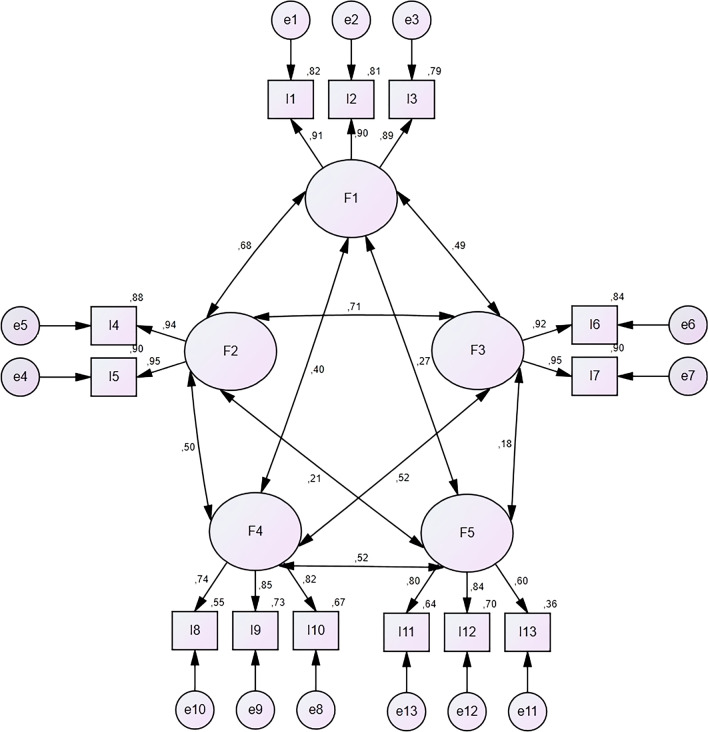
Background: The Eating Disorder Examination Questionnaire (EDE-Q) is a frequently used scale to evaluate eating behaviors and attitudes. In recent years, its use has increased due to the fact that the use of short forms is more practical. The aim of this study was to validate the short Turkish form of the Eating Disorder Examination Questionnaire (EDE-Q) including 13 items. Methods: The study included 924 adults at a mean age of 30.3 ± 10.93 years. EDEQ-13 was translated and adapted to Turkish according to the Beaton Guidelines. The Eating Attitudes Test-26 (EAT-26), the Satisfaction with Life Scale (SWLS), and the Body Appreciation Scale (BAS) were used to analyze their relationships to EDE-Q-13. Results: In this study, the rate of the total variance explained by the factors of EDE-Q-13 according to the Explanatory Factor Analysis (EFA) results of the scale was 83.54%. The Cronbach's alpha value of the scale was 0.89, and the Cronbach's alpha values of the 5 subscales were calculated in the range of 0.75–0.94. The criterion validity analysis showed an acceptable correlation between EDE-Q-13 and EAT-26, SWLS, and BAS. The confirmatory factor analysis (CFA) revealed that the model had fit values that were acceptable or good. Conclusion: Both EFA and CFA results showed that it is appropriate to use the Turkish EDE-Q-13. EDE-Q-13 was significantly correlated with eating disturbances, body appreciation, and life satisfaction. In conclusion, the Turkish version of EDE-Q-13 possesses high levels of validity and reliability.
Overview
The claims and statistics of this paper haven’t been checked yet.
Free: it reads the open-access text and checks the first 5 claims that cite a source we can check. Create a free account to check every claim.
Integrity signals
Registry
Cites
Statistics
Figures
Verification
Claims the paper makes
The claims and statistics of this paper haven’t been checked yet.
Free: it reads the open-access text and checks the first 5 claims that cite a source we can check. Create a free account to check every claim.
Claims other papers make about this one
Each is checked against this paper’s own text: does it say what the citing paper says it does?
The cited source says what the claim attributes to it.
In the citing paper
“The scale was translated into Turkish by Esin and Ayyıldız and its validity and reliability were established [43].”
From Four Facet Mindful Eating and Eating Disorder Risk: Mediation By Depression and Body Mass Index. (2026) · cites this paper as Esin and Ayyıldız [43]
Self-check
Percentages, sums and reported differences re-computed from the paper’s own numbers.
The self-check needs the paper’s full text.
Citations
Cites
The satisfaction with life scale
Diener, E., Emmons, R. A., Larsen, R. J., & Griffin, S. (1985) · Journal of Personality Assessment · doi:10.1207/s15327752jpa4901_13 · Cited by 31,768 · cited 9×
“10 1 negative correlation between the EDE-Q-13 scores of the participants and their BAS (including its subscales) scores and SWLS scores.”
BackgroundMethodInfluentialGuidelines for the process of cross-cultural adaptation of self-report measures
Beaton, D. E., Bombardier, C., Guillemin, F., & Ferraz, M. B. (2000) · Spine · doi:10.1097/00007632-200012150-00014 · Cited by 14,542
A QUANTITATIVE APPROACH TO CONTENT VALIDITY1
LAWSHE, C. H. (1975) · Personnel Psychology · doi:10.1111/j.1744-6570.1975.tb01393.x · Cited by 7,313
Lippa, N. C., & Sanderson, S. C. (2013) · Human Heredity · doi:10.1159/000353712 · Cited by 6,078
The Eating Attitudes Test: psychometric features and clinical correlates
Garner, D. M., Olmsted, M. P., Bohr, Y., & Garfinkel, P. E. (1982) · Psychological Medicine · doi:10.1017/s0033291700049163 · Cited by 4,962 · cited 15×
“This study examined the properties of EDE-Q-13 in terms of its evaluations of eating disorder pathologies as measured by EAT-26.”
MethodInfluentialThe Body Appreciation Scale: Development and psychometric evaluation
Avalos, L., Tylka, T. L., & Wood-Barcalow, N. (2005) · Body Image · doi:10.1016/j.bodyim.2005.06.002 · Cited by 1,094 · cited 9×
“10 1 negative correlation between the EDE-Q-13 scores of the participants and their BAS (including its subscales) scores and SWLS scores.”
BackgroundMethodInfluentialBerg, K. C., Peterson, C. B., Frazier, P., & Crow, S. J. (2012) · International Journal of Eating Disorders · doi:10.1002/eat.20931 · Cited by 1,042 · cited 2×
“It was also not economical in terms of time due to the large number of items [20, 21].”
BackgroundMethodYAŞAM DOYUMU ÖLÇEĞİNİN TÜRKÇE’YE UYARLANMASI: GEÇERLİK VE GÜVENİRLİK ÇALIŞMASI
DAĞLI, A., & BAYSAL, N. (2016) · Elektronik Sosyal Bilimler Dergisi · doi:10.17755/esosder.263229 · Cited by 473 · cited 8×
“10 1 negative correlation between the EDE-Q-13 scores of the participants and their BAS (including its subscales) scores and SWLS scores.”
MethodInfluentialQian, J., Wu, Y., Liu, F., Zhu, Y., Jin, H., Zhang, H., Wan, Y., Li, C., & Yu, D. (2022) · Eating and Weight Disorders - Studies on Anorexia, Bulimia and Obesity · doi:10.1007/s40519-021-01162-z · Cited by 431 · cited 1×
“Although eating disorders are more common in Western societies, the incidence of these disorders has increased recently in both developed and developing countries [2, 3].”
BackgroundGideon, N., Hawkes, N., Mond, J., Saunders, R., Tchanturia, K., & Serpell, L. (2016) · PLoS ONE · doi:10.1371/journal.pone.0152744 · Cited by 419 · cited 1×
“Therefore, 18-item [17], 12-item [22], 11-item [23], 8-item [24], and 7-item [18] versions of the scale have been developed.”
Simon, D., Kriston, L., Loh, A., Spies, C., Scheibler, F., Wills, C., & Härter, M. (2010) · Health Expectations · doi:10.1111/j.1369-7625.2009.00584.x · Cited by 256 · cited 2×
“In CFA, χ2/df ≤ 3.0, RMSEA ≤ 0.05, 0.90 ≤ GFI, 0.95 ≤ AGFI, 0.95 ≤ CFI, 0.95 ≤ NFI and 0.95 ≤ TLI indicate good fit, and 3 ≤ χ2/df ≤ 5, 0.05 ≤ RMSEA ≤ 0.08, 0.80 ≤ GFI ≤ 0.90, 0.85 ≤ AGFI ≤ 0.95, 0.85 ≤ CFI ≤ 0.95, 0.80 ≤ NFI ≤ 0.95, and 0.80 ≤ TLI ≤ 0.95 indicate acceptable fit according to conventions for Model Conf…”
MethodInfluentialGrilo, C. M., Reas, D. L., Hopwood, C. J., & Crosby, R. D. (2015) · International Journal of Eating Disorders · doi:10.1002/eat.22358 · Cited by 228 · cited 1×
“Therefore, 18-item [17], 12-item [22], 11-item [23], 8-item [24], and 7-item [18] versions of the scale have been developed.”
Rø, Ø., Reas, D. L., & Stedal, K. (2015) · European Eating Disorders Review · doi:10.1002/erv.2372 · Cited by 200
The comorbidity of personality disorders in eating disorders: a meta-analysis
Martinussen, M., Friborg, O., Schmierer, P., Kaiser, S., Øvergård, K. T., Neunhoeffer, A.-L., Martinsen, E. W., & Rosenvinge, J. H. (2017) · Eating and Weight Disorders - Studies on Anorexia, Bulimia and Obesity · doi:10.1007/s40519-016-0345-x · Cited by 200 · cited 1×
“Background Eating disorders are a group of chronic psychiatric diseases characterized by severe disturbances in eating behaviors originating from the interactions of genetic, biological, psychological, and socio-cultural factors [1].”
BackgroundKliem, S., Mößle, T., Zenger, M., Strauß, B., Brähler, E., & Hilbert, A. (2016) · International Journal of Eating Disorders · doi:10.1002/eat.22487 · Cited by 153 · cited 2×
“In contrast, for EDEQ-8 [24] and EDE-Q-18 [17], while certain fit indices were within recommended thresholds, the RMSEA values were deemed unacceptable, thus not supporting their proposed constructs.”
ResultHe, J., Sun, S., & Fan, X. (2020) · Eating and Weight Disorders - Studies on Anorexia Bulimia and Obesity · doi:10.1007/s40519-019-00840-3 · Cited by 129 · cited 1×
“There was a significant positive correlation between the EDE-Q-13 scores of the participants and their EAT-26 (including its subscales) scores, and this result was in line with the results of previous studies [39, 40].”
ResultRand-Giovannetti, D., Cicero, D. C., Mond, J., & Latner, J. D. (2017) · Assessment · doi:10.1177/1073191117738046 · Cited by 127
Eating Disorder Examination – Questionnaire short forms: A comparison
Machado, P. P. P., Grilo, C. M., Rodrigues, T. F., Vaz, A., & Crosby, R. D. (2020) · International Journal of Eating Disorders · doi:10.1002/eat.23275 · Cited by 122 · cited 3×
“It was also not economical in terms of time due to the large number of items [20, 21].”
BackgroundMethodYucel, B., Polat, A., Ikiz, T., Dusgor, B. P., Elif Yavuz, A., & Sertel Berk, O. (2011) · European Eating Disorders Review · doi:10.1002/erv.1104 · Cited by 116 · cited 1×
“EDE-Q has been used to evaluate the attitudinal and behavioral symptoms of eating disorders for more than a quarter century [5], and its validity and reliability have been established in many languages [6–12], including Turkish [13].”
MethodHrabosky, J. I., White, M. A., Masheb, R. M., Rothschild, B. S., Burke‐Martindale, C. H., & Grilo, C. M. (2008) · Obesity · doi:10.1038/oby.2008.3 · Cited by 114
Carey, M., Kupeli, N., Knight, R., Troop, N. A., Jenkinson, P. M., & Preston, C. (2019) · Psychological Assessment · doi:10.1037/pas0000703 · Cited by 110 · cited 2×
“In contrast, for EDEQ-8 [24] and EDE-Q-18 [17], while certain fit indices were within recommended thresholds, the RMSEA values were deemed unacceptable, thus not supporting their proposed constructs.”
ResultEating disorder examination questionnaire: Factor structure for adolescent girls and boys
White, H. J., Haycraft, E., Goodwin, H., & Meyer, C. (2014) · International Journal of Eating Disorders · doi:10.1002/eat.22199 · Cited by 109
Friborg, O., Reas, D. L., Rosenvinge, J. H., & Rø, Ø. (2013) · International Journal of Methods in Psychiatric Research · doi:10.1002/mpr.1389 · Cited by 97 · cited 1×
“Therefore, 18-item [17], 12-item [22], 11-item [23], 8-item [24], and 7-item [18] versions of the scale have been developed.”
Structural validity of the Eating Disorder Examination—Questionnaire: A systematic review
Jenkins, P. E., & Rienecke, R. D. (2022) · International Journal of Eating Disorders · doi:10.1002/eat.23721 · Cited by 90
Carrard, I., Rebetez, M. M. L., Mobbs, O., & der Linden, M. V. (2014) · Eating and Weight Disorders - Studies on Anorexia Bulimia and Obesity · doi:10.1007/s40519-014-0148-x · Cited by 87
Tayfur, S. N., & Evrensel, A. (2020) · Rivista di psichiatria · doi:10.1708/3333.33023 · Cited by 66 · cited 1×
“Considering that there is an alarming increase in eating disorders in Turkey, especially in young people [26], it is important and necessary to ensure the cultural validity and reliability of eating disorder measurement instruments.”
BackgroundMantilla, E. F., Birgegård, A., & Clinton, D. N. (2017) · Journal of Eating Disorders · doi:10.1186/s40337-017-0140-8 · Cited by 55
Eating Disorder Examination Questionnaire (EDE-Q-13): expanding on the short form
Lev-Ari, L., Bachner-Melman, R., & Zohar, A. H. (2021) · Journal of Eating Disorders · doi:10.1186/s40337-021-00403-x · Cited by 53 · cited 11×
“Contrary to other short versions of EDE-Q [17, 18, 22–24], the positive side of EDE-Q-13 has been reported as that it contains items about binge eating and purging [20, 25].”
BackgroundMethodResultInfluentialPsychometric properties of the eating disorder examination-questionnaire in japanese adolescents
Mitsui, T., Yoshida, T., & Komaki, G. (2017) · BioPsychoSocial Medicine · doi:10.1186/s13030-017-0094-8 · Cited by 43
Isomaa, R., Lukkarila, I.-L., Ollila, T., Nenonen, H., Charpentier, P., Sinikallio, S., & Karhunen, L. J. (2016) · Nordic Journal of Psychiatry · doi:10.1080/08039488.2016.1179340 · Cited by 36
Diagnostic Categories for Eating Disorders
Walsh, B. T. (2018) · Psychiatric Clinics of North America · doi:10.1016/j.psc.2018.10.001 · Cited by 35 · cited 1×
“The increase in the incidence and prevalence of eating disorders, their comorbidities, tendency to become chronic, and high risk of mortality requires a detailed and accurate evaluation of these conditions [4].”
BackgroundMahmoodi, M. S., Moloodi, R., Ghaderi, A., babai, Z., Saleh, Z., Alasti, H., Naghashian, F., & Mohammadpour, Z. (2016) · PubMed Central · Cited by 34
Tobin, L. N., Lacroix, E., & von Ranson, K. M. (2018) · Eating Behaviors · doi:10.1016/j.eatbeh.2018.11.003 · Cited by 29 · cited 1×
“Some scales such as the modified EDE-Q-7 “reflect less overlap and redundancy” than the original EDE-Q [19].”
Urbanization and eating disorders: a scoping review of studies from 2019 to 2020
Hay, P., & Mitchison, D. (2020) · Current Opinion in Psychiatry · doi:10.1097/yco.0000000000000681 · Cited by 28 · cited 1×
“Although eating disorders are more common in Western societies, the incidence of these disorders has increased recently in both developed and developing countries [2, 3].”
BackgroundThe EDE-Q in Hebrew: Structural and Convergent/Divergent Validity in a Population Sample.
Zohar, A. H., Ari, L. L., & Bachner‐Melman, R. (2018) · PubMed · Cited by 26
Asl, E. M., Mahaki, B., Khanjani, S., & Mohammadian, Y. (2021) · Journal of Research in Medical Sciences · doi:10.4103/jrms.jrms_230_20 · Cited by 12 · cited 1×
“There was a significant positive correlation between the EDE-Q-13 scores of the participants and their EAT-26 (including its subscales) scores, and this result was in line with the results of previous studies [39, 40].”
Prnjak, K., & Jukić, I. (2020) · Eating and Weight Disorders - Studies on Anorexia Bulimia and Obesity · doi:10.1007/s40519-020-00915-6 · Cited by 8 · cited 1×
“EAT-26 scores and BMI values also showed a positive, albeit weaker relationship [41].”
BackgroundAssessment of eating disorders: interview or self-report questionnaire
Fairburn, C. G., & Beglin, S. J. (1994) · International Journal of Eating Disorders · doi:10.1002/1098-108x(199412)16:4<363::aid-eat2260160405>3.0.co;2-# · cited 8×
“EDE‐Q‐13 EDE-Q was developed by Fairburn and Beglin [5] to evaluate eating disorders and consists of 28 items.”
MethodInfluential(1994)
Research works printed but not linked: 2
- Ergüney-Okumuş FE Sertel-Berk HÖ Yeme Tutum Testi kısa formunun (YTT-26) Üniversite örnekleminde Türkçeye uyarlanması ve psikometrik özelliklerinin değerlendirilmesi Psikoloji Çalışmaları 2019 40 1 57 78
- Bakalım O Taşdelen-Karçkay A Body Appreciation Scale: Evaluation of the factor structure and psychometric properties among male and female Turkish university students Mersin Univ J Fac Educ 2016 12 1 410 422
Cited by
Arslan, N., Esin, K., & Ayyıldız, F. (2025) · BMC Public Health · doi:10.1186/s12889-025-22507-8 · Cited by 22
“The validity and reliability of the Turkish scale in adult participants were examined by Esin et al. [37].”
Self-citationÖğütlü, H., Kaşak, M., Doğan, U., Zickgraf, H. F., & Türkçapar, M. H. (2024) · Journal of Eating Disorders · doi:10.1186/s40337-024-00987-0 · Cited by 18
“The validity and reliability study of the Turkish version of this scale in an adult sample was conducted by Esin et al. [13].”
BackgroundBang, L., Nordmo, M., Nordmo, M., Vrabel, K. R., Danielsen, M., & Rø, Ø. (2023) · Journal of Eating Disorders · doi:10.1186/s40337-023-00920-x · Cited by 19
“It’s also worth mentioning that preliminary research has explored a version of the EDE-Q7 that includes the behavioral items from the EDE-Q [18, 36].”
BackgroundKavsara, H. K., Koyuncu, A. G., Yelken, H. D., Barthels, F., & Stroebele-Benschop, N. (2024) · Psychology, Health & Medicine · doi:10.1080/13548506.2024.2439133 · Cited by 9
“The 13-item short form has been validated for the Turkish population, demonstrating high validity and reliability (Esin & Ayyıldız, 2022).”
InfluentialAldubayan, K., Ghafouri, K. J., Mutwalli, H., Kutbi, H. A., & Mumena, W. A. (2023) · Healthcare · doi:10.3390/healthcare11071052 · Cited by 10
“Similar removing were found in versions including the Italian [27], Sweden [51], and Turkish [53].”
MethodResult
Metadata
- Authors
- Esin, K., & Ayyıldız, F.
- Affiliations
- Tokat Gaziosmanpaşa Üniversitesi (TR)
- Gazi University (TR)
- Corresponding author
- Esin, Kübra
- Venue
- Journal of Eating Disorders
- Published
- 2022-07-14
- Volume
- 10
- Issue
- 1
- Pages
- 102-102
- ISSN
- 2050-2974 (ISSN-L)
- PMC
- PMC9281018
- OpenAlex
- W4285387639
- Semantic Scholar
- fe435a0946923000aed44c0620db81448b8f706e
- Cited by
- 41
- References
- 39
- Citations by year
- 2026: 22 · 2025: 10 · 2024: 5 · 2023: 4
- FWCI
- 4.34
- Type
- journal article
- Language
- en
- Open access
- gold
- doi.org
- Licence
- cc-by
- creativecommons.org/licenses/by/4.0 (tdm)
- creativecommons.org/licenses/by/4.0 (vor)
- Locations
- Journal of Eating Disorders (publishedVersion, cc-by)
- Research Square (acceptedVersion, cc-by)
- PubMed Central (publishedVersion, cc-by)
- PubMed (publishedVersion)
- DOAJ (DOAJ: Directory of Open Access Journals) (submittedVersion)
- Topics
- Social Sciences › Psychology › Clinical Psychology › Eating Disorders and Behaviors
- Social Sciences › Decision Sciences › Management Science and Operations Research › Psychometric Methodologies and Testing
- Health Sciences › Nursing › Nutrition and Dietetics › Nutrition, Health and Food Behavior
- Keywords
- Eating Disorder Examination Questionnaire, Turkish translation, cross-cultural adaptation, eating disorders, dietary habits, eating attitudes, body appreciation, life satisfaction, psychometric validation, short-form questionnaire
About these checks
Registry, retraction, Cites and statistics results are computed, not judged, with one exception: a printed reference that no index lists is read once by a model before it counts as a citation error. Claims are extracted by a model and kept only when their quote appears verbatim in the text; each cited source is then checked, with a model’s help, for whether it says what the claim relies on. Those verdicts can be wrong — read the claim’s quote and the cited source before relying on one.
Statistics and arithmetic are recomputed, not judged.
Confidence bands are shown only for fields calibrated on our annotated test set. None is calibrated yet, so no band is shown.
What counts as a claim ›How we measure confidence ›How we check this ›
Are you an author, or do you see a problem with this page? Request a review
Data sources
Bibliographic data: Semantic Scholar, OpenAlex, Crossref.
Contains information from the Semantic Scholar Academic Graph Datasets, made available under the ODC Attribution License (ODC-BY 1.0).
Semantic Scholar’s data is described in: Kinney, R., et al. (2023). The Semantic Scholar Open Data Platform. arXiv:2301.10140.
