

Psychometric properties of the chinese version of multidimensional experiential avoidance questionnaire-30
Open accessThe DOI matches its Crossref record; 45 of the 45 references it cites were found in a registry or an index; 7 of the 24 sources its claims cite were checked for support.
Abstract
Background: Experiential avoidance represents the tendency to avoid negative internal experiences, which is a key concept in Acceptance and Commitment Therapy. However, existing measures of experiential avoidance (i.e., Acceptance and Action Questionnaire–II, AAQ-II) have some limitations. This study aims to assess the psychometric properties of the Chinese version of Multidimensional Experiential Avoidance Questionnaire-30 (MEAQ-30) and provide evidence for the reliability and validity of this new instrument. Methods: Two questionnaire surveys were conducted. The first sample (N = 546) was analyzed using classical test theory (CTT), and the second sample (N = 511) was analyzed using multidimensional item response theory (MIRT). Results: CTT supported the six-factor structure of MEAQ-30, indicating good internal consistency and measurement invariance across genders. Furthermore, the Chinese version of MEAQ-30 showed satisfactory convergent and discriminant validity. The incremental validity test showed that after controlling for the effects of neuroticism and AAQ-II, the Chinese version of MEAQ-30 could still significantly predict depression, anxiety, and stress. MIRT indicated that 30 items had good discrimination and difficulty, and the six subscales were sufficiently reliable across the continuum of experiential avoidance. Conclusion: The Chinese version of MEAQ-30 has good reliability and validity and is suitable for assessing experiential avoidance among Chinese populations. © The Author(s) 2024.
Overview
CoChat Summary
## TL;DR
This study validated the Chinese version of the Multidimensional Experiential Avoidance Questionnaire-30 (MEAQ-30) using two online samples and both classical test theory and multidimensional item response theory. The instrument showed good reliability, validity, and gender invariance, though item 15 appeared weaker than the others.
## Key findings
- In the first sample (N = 546), confirmatory factor analysis supported the six-factor model with good fit: χ²/df = 2.291, CFI = 0.929, TLI = 0.921, RMSEA = 0.049, SRMR = 0.057.
- Measurement invariance across genders was supported, with configural fit CFI = 0.915 and RMSEA = 0.054, and very small changes for metric (ΔCFI = 0.000; ΔRMSEA = 0.001) and scalar invariance (ΔCFI = 0.002; ΔRMSEA = 0.000).
- Internal consistency was satisfactory: Cronbach’s α for the total scale and subscales ranged from 0.77 to 0.89.
- After controlling for neuroticism and AAQ-II, MEAQ-30 still significantly predicted depression, anxiety, and stress, explaining additional variance of 5–8%.
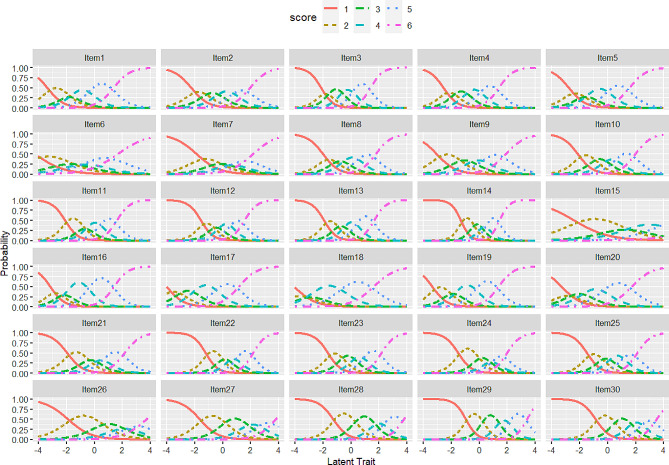
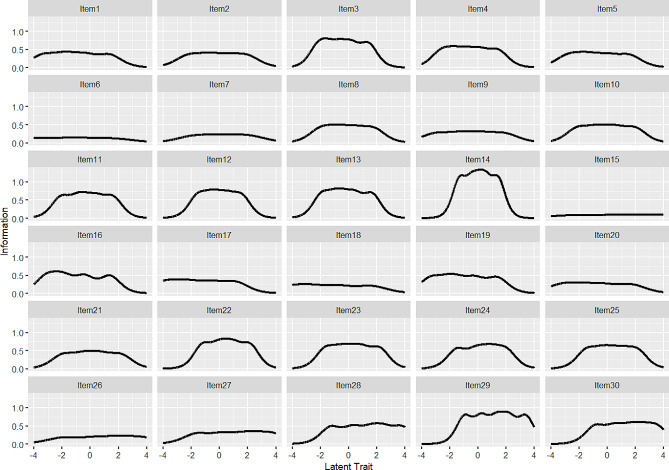
- In the second sample (N = 511), the multidimensional graded response model fit was satisfactory (CFI = 0.925, TLI = 0.913, RMSEA = 0.055), and item discrimination parameters ranged from 0.80 to 2.95; item 14 had the highest discrimination (a = 2.95) and item 15 the lowest (a = 0.80).
## Methods
- Two online questionnaire surveys were conducted in China: the first sample had 546 participants aged 18–32, and the second had 511 participants aged 17–38.
- The first sample was analyzed with classical test theory, including confirmatory factor analysis, internal consistency, measurement invariance across gender, correlations for convergent/discriminant validity, and hierarchical regression for incremental validity.
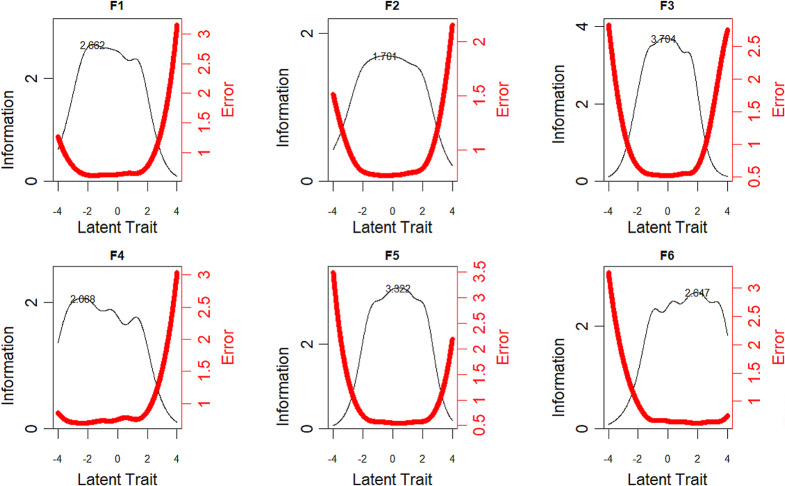
- The second sample was analyzed with multidimensional item response theory using the multidimensional graded response model to estimate item discrimination, difficulty, and information curves.
## Limitations
- The paper states that it relied on self-report only, which may overestimate correlations and introduce common method bias.
- The sample was predominantly college students, and the authors note that measurement invariance between students and employees was not tested because there were too few employees.
- The study lacked longitudinal data, so causal relationships between experiential avoidance and other variables could not be examined.
Model-written summary. Check it against the paper before relying on it.
Integrity signals
Registry
Cites
Statistics
Figures
Verification
Claims the paper makes
6 Valid · 0 Not valid · 6 Not checked · 63 Own results and interpretations
The sources with a verdict support this claim; the rest weren’t checked yet, have no full text we could read, or their verdicts aren’t rated yet.
In the paper
“Several studies have indicated that the AAQ-II exhibits low discriminant validity concerning neuroticism, negative affect, and psychological distress [14–16].”
§ Psychometric properties of the chinese version of multidimensional experiential avoidance questionnaire-30 > Introduction
What the sources say
- Supportedcites [14] Tyndall I Waldeck D Pancani L Whelan R Roche B Dawson DL The Acceptance and Action Questionnaire-II (AAQ-II) as a measure of experiential avoidance: concerns over discriminant validity J Context Behav Sci 2018 12 278 84 10.1016/j.jcbs.2018.09.005 source
The accepted manuscript (p. 7) says the AAQ-II struggles to distinguish experiential avoidance from distress, including negative affect and neuroticism. Its discussion (p. 14) reports substantial correlations with psychological distress and describes the AAQ-II’s items as confounded with measures of negative affect. (LLM, conf=0.91)
- Not checked — no full text of the sourcecites [15] Rochefort C Baldwin AS Chmielewski M Experiential avoidance: an examination of the Construct Validity of the AAQ-II and MEAQ Behav Ther 2018 49 3 435 49 10.1016/j.beth.2017.08.008 29704971 source
- Supportedcites [16] Wolgast M What does the Acceptance and Action Questionnaire (AAQ-II) Really Measure? Behav Ther 2014 45 6 831 9 10.1016/j.beth.2014.07.002 25311291 source
The Discussion (p. 7) reports that AAQ-II items loaded with general-distress items and showed the same pattern of correlations with negative and positive emotionality as the Distress scale, leading the author to question its discriminant validity. The paper also reports earlier findings concerning the AAQ-II’s overlap with neuroticism (p. 3). (LLM, conf=0.90)
hedgedstates an association- Asserted: passes — The authors put it forward as true.
- Checkable: passes — It can be checked against evidence.
- Load-bearing: passes — The paper’s conclusions depend on it.
- Based: passes — The paper gives a reason why it holds.
- Supported
A result the paper reports from its own data — it cites no other source for it, so there is none to check. The quote shows it is in the paper.
In the paper
“The metric invariance model demonstrated adequate fit (ΔCFI = 0.000; ΔRMSEA = 0.001).”
§ Psychometric properties of the chinese version of multidimensional experiential avoidance questionnaire-30 > Results > Measurement invariance across genders
boosted- Asserted: passes — The authors put it forward as true.
- Checkable: passes — It can be checked against evidence.
- Load-bearing: passes — The paper’s conclusions depend on it.
- Based: passes — The paper gives a reason why it holds.
A result the paper reports from its own data — it cites no other source for it, so there is none to check. The quote shows it is in the paper.
In the paper
“For behavioral avoidance, the discrimination parameter ranged from 1.63 to 2.30.”
§ Psychometric properties of the chinese version of multidimensional experiential avoidance questionnaire-30 > Results > Item parameter
plain- Asserted: passes — The authors put it forward as true.
- Checkable: passes — It can be checked against evidence.
- Load-bearing: passes — The paper’s conclusions depend on it.
- Based: passes — The paper gives a reason why it holds.
A result the paper reports from its own data — it cites no other source for it, so there is none to check. The quote shows it is in the paper.
In the paper
“this study found no significant correlation between scores on the distraction/suppression subscale and scores on anxiety and depression.”
§ Psychometric properties of the chinese version of multidimensional experiential avoidance questionnaire-30 > Discussion
plain- Asserted: passes — The authors put it forward as true.
- Checkable: passes — It can be checked against evidence.
- Load-bearing: passes — The paper’s conclusions depend on it.
- Based: passes — The paper gives a reason why it holds.
A result the paper reports from its own data — it cites no other source for it, so there is none to check. The quote shows it is in the paper.
In the paper
“item 14 (“I won’t do something until I absolutely have to”) provided the most information at the medium levels of the latent trait (θ = 0).”
§ Psychometric properties of the chinese version of multidimensional experiential avoidance questionnaire-30 > Results > Item information curves (IIC)
plain- Asserted: passes — The authors put it forward as true.
- Checkable: passes — It can be checked against evidence.
- Load-bearing: unclear — It is unclear whether the paper’s conclusions depend on it.
- Based: passes — The paper gives a reason why it holds.
44 more claims
Create a free account to see all 75 claims and to verify the 1 reference still open.
- Probably not a substantial claim. 7
- It may state two separate claims as one. 22
Citations
Cites
Hu, L., & Bentler, P. M. (1999) · Structural Equation Modeling A Multidisciplinary Journal · doi:10.1080/10705519909540118 · Cited by 108,788
Podsakoff, P. M., MacKenzie, S. B., Lee, J.-Y., & Podsakoff, N. P. (2003) · Journal of Applied Psychology · doi:10.1037/0021-9010.88.5.879 · Cited by 82,194
Henry, J. D., & Crawford, J. R. (2005) · British Journal of Clinical Psychology · doi:10.1348/014466505x29657 · Cited by 5,801
Bond, F. W., Hayes, S. C., Baer, R. A., Carpenter, K. M., Guenole, N., Orcutt, H. K., Waltz, T., & Zettle, R. D. (2011) · Behavior Therapy · doi:10.1016/j.beth.2011.03.007 · Cited by 3,950 · cited 2×
“It consists of seven items, each scored on a seven-point scale, with commendable reliability and validity [11].”
Hayes, S. C., Wilson, K. G., Gifford, E. V., Follette, V. M., & Strosahl, K. (1996) · Journal of Consulting and Clinical Psychology · doi:10.1037//0022-006x.64.6.1152 · Cited by 3,595
mirt: A Multidimensional Item Response Theory Package for the R Environment
Chalmers, R. P. (2012) · Journal of Statistical Software · doi:10.18637/jss.v048.i06 · Cited by 2,643
Measuring experiential avoidance: A preliminary test of a working model
Hayes, S. C., Strosahl, K., Wilson, K. G., Bissett, R. T., Pistorello, J., Toarmino, D., Polusny, M. A., Dykstra, T. A., Batten, S. V., Bergan, J., et al. (2004) · The Psychological Record · doi:10.1007/bf03395492 · Cited by 2,140
Experiential avoidance as a functional dimensional approach to psychopathology: An empirical review
Chawla, N., & Ostafin, B. (2007) · Journal of Clinical Psychology · doi:10.1002/jclp.20400 · Cited by 805
De Vaus, D. (2013) · Routledge eBooks · doi:10.4324/9780203501054 · Cited by 784
Gámez, W., Chmielewski, M., Kotov, R., Ruggero, C., & Watson, D. (2011) · Psychological Assessment · doi:10.1037/a0023242 · Cited by 524
Psychometric analysis of the Ten-Item Perceived Stress Scale.
Taylor, J. M. (2015) · Psychological Assessment · doi:10.1037/a0038100 · Cited by 492
De Vaus, D., & de Vaus, D. (2013) · doi:10.4324/9780203519196 · Cited by 491
The brief experiential avoidance questionnaire: Development and initial validation
Gámez, W., Chmielewski, M., Kotov, R., Ruggero, C., Suzuki, N., & Watson, D. (2014) · Psychological Assessment · doi:10.1037/a0034473 · Cited by 450 · cited 2×
“The multidimensional assessment of EA can help identify potential associations between different facets of EA and various types of psychopathology [21].”
What Does the Acceptance and Action Questionnaire (AAQ-II) Really Measure?
Wolgast, M. (2014) · Behavior Therapy · doi:10.1016/j.beth.2014.07.002 · Cited by 421
Misresponse to Reversed and Negated Items in Surveys: A Review
Weijters, B., & Baumgartner, H. (2012) · Journal of Marketing Research · doi:10.1509/jmr.11.0368 · Cited by 421 · cited 1×
“Moreover, previous studies have shown that adding appropriate reversed items would facilitate a comprehensive assessment of the underlying construct to be measured [45].”
Culture and emotion regulation
Ford, B. Q., & Mauss, I. B. (2015) · Current Opinion in Psychology · doi:10.1016/j.copsyc.2014.12.004 · Cited by 340 · cited 1×
“In Chinese culture, the suppression of emotions may be regarded as an adaptive behavior that reduces conflict and promotes social harmony [27, 47, 48].”
Limited Information Goodness-of-fit Testing in Multidimensional Contingency Tables
Maydeu-Olivares, A., & Joe, H. (2006) · Psychometrika · doi:10.1007/s11336-005-1295-9 · Cited by 333
Tyndall, I., Waldeck, D., Pancani, L., Whelan, R., Roche, B., & Dawson, D. L. (2019) · Journal of Contextual Behavioral Science · doi:10.1016/j.jcbs.2018.09.005 · Cited by 303
Thompson, B. L., & Waltz, J. (2010) · Journal of Anxiety Disorders · doi:10.1016/j.janxdis.2010.02.005 · Cited by 264 · cited 1×
“Numerous studies have demonstrated that high levels of EA are associated with various diagnostic categories, such as anxiety disorder [4], depression disorder [5], and posttraumatic stress disorder [6].”
Mershon, B., & Gorsuch, R. L. (1988) · Journal of Personality and Social Psychology · doi:10.1037/0022-3514.55.4.675 · Cited by 257 · cited 1×
“Moreover, the unidimensional nature of the AAQ-II fails to capture the full spectrum of EA [3], which may obscure variations in different avoidance tendencies, thereby potentially overlooking valuable and predictive information [17].”
Experiential Avoidance: An Examination of the Construct Validity of the AAQ-II and MEAQ
Rochefort, C., Baldwin, A. S., & Chmielewski, M. (2018) · Behavior Therapy · doi:10.1016/j.beth.2017.08.008 · Cited by 247
Measurement Invariance in International Surveys: Categorical Indicators and Fit Measure Performance
Rutkowski, L., & Svetina, D. (2017) · Applied Measurement in Education · doi:10.1080/08957347.2016.1243540 · Cited by 225 · cited 1×
“Established criteria for invariance included ΔCFI 0.004 and ΔRMSEA 0.050 [36].”
InfluentialFull-Information Factor Analysis for Polytomous Item Responses
Muraki, E., & Carlson, J. E. (1995) · Applied Psychological Measurement · doi:10.1177/014662169501900109 · Cited by 184
The abbreviation of personality, or how to measure 200 personality scales with 200 items
Yarkoni, T. (2010) · Journal of Research in Personality · doi:10.1016/j.jrp.2010.01.002 · Cited by 167
A Discussion of Modern Versus Traditional Psychometrics As Applied to Personality Assessment Scales
Reise, S. P., & Henson, J. M. (2003) · Journal of Personality Assessment · doi:10.1207/s15327752jpa8102_01 · Cited by 164
Predicting anxiety: The role of experiential avoidance and anxiety sensitivity
Berman, N. C., Wheaton, M. G., McGrath, P., & Abramowitz, J. S. (2010) · Journal of Anxiety Disorders · doi:10.1016/j.janxdis.2009.09.005 · Cited by 147
Seçer, İ., & Ulaş, S. (2021) · International Journal of Mental Health and Addiction · doi:10.1007/s11469-020-00322-z · Cited by 142 · cited 1×
“To date, MEAQ-30 has been widely used in EA-related fields [19, 24, 25] and translated from English to Turkish [26], which has proved to have sufficient reliability and validity [19, 26].”
Sahdra, B. K., Ciarrochi, J., Parker, P., & Scrucca, L. (2016) · Frontiers in Psychology · doi:10.3389/fpsyg.2016.00189 · Cited by 100 · cited 7×
“It is of significant importance to note that the comprehensive assessment of EA demonstrated by the MEAQ-30 facilitates the identification of potential associations between various avoidance behaviors and other outcomes related to mental health or psycho-pathology [18, 20].”
InfluentialLiu, H., Wang, W., Yang, J., Guo, F., & Yin, Z. (2020) · Journal of Affective Disorders · doi:10.1016/j.jad.2020.12.181 · Cited by 65
Self-citationMellick, W. H., Mills, J. A., Kroska, E. B., Calarge, C. A., Sharp, C., & Dindo, L. N. (2019) · The Journal of Clinical Psychiatry · doi:10.4088/jcp.18m12265 · Cited by 63
Karekla, M., & Michaelides, M. P. (2016) · Journal of Contextual Behavioral Science · doi:10.1016/j.jcbs.2016.11.006 · Cited by 62
Ouden, L. D., Tiego, J., Lee, R. S. C., Albertella, L., Greenwood, L., Fontenelle, L. F., Yücel, M., & Segrave, R. A. (2020) · Addictive Behaviors · doi:10.1016/j.addbeh.2020.106464 · Cited by 45
Masuda, A., Mandavia, A., & Tully, E. C. (2014) · Asian American Journal of Psychology · doi:10.1037/a0034437 · Cited by 42
Maldonado-Murciano, L., Pontes, H. M., Barrios, M., Gómez‐Benito, J., & Guilera, G. (2021) · International Journal of Mental Health and Addiction · doi:10.1007/s11469-021-00704-x · Cited by 31
Zhang, C., Li, X., Si, G., Chung, P., Huang, Z., & Gucciardi, D. F. (2022) · Psychology of sport and exercise · doi:10.1016/j.psychsport.2022.102341 · Cited by 30
Ferrando, P. J., Condon, L., & Chico, E. (2004) · Personality and Individual Differences · doi:10.1016/j.paid.2004.01.003 · Cited by 29
Borgogna, N. C., McDermott, R. C., Berry, A., Lathan, E. C., & Gonzales, J. (2020) · Journal of Contextual Behavioral Science · doi:10.1016/j.jcbs.2020.01.011 · Cited by 29
Psychometric Properties of the German Brief Experiential Avoidance Questionnaire (BEAQ)
Schaeuffele, C., Knaevelsrud, C., Renneberg, B., & Boettcher, J. (2022) · Assessment · doi:10.1177/10731911211010955 · Cited by 25
Wang, W., & Wang, X. (2023) · Comprehensive Psychiatry · doi:10.1016/j.comppsych.2023.152407 · Cited by 22
Self-citationChinese validation of the Brief Experiential Avoidance Questionnaire (BEAQ) in college students
Cao, H., Mak, Y. W., Li, H. Y., & Leung, D. Y. P. (2021) · Journal of Contextual Behavioral Science · doi:10.1016/j.jcbs.2021.01.004 · Cited by 20 · cited 3×
“A growing body of studies has shown that EA is influenced by culture and values [3, 27, 28].”
Fang, S., Huang, M., & Wang, Y. (2023) · Journal of Contextual Behavioral Science · doi:10.1016/j.jcbs.2023.03.008 · Cited by 15 · cited 1×
“In Chinese culture, the suppression of emotions may be regarded as an adaptive behavior that reduces conflict and promotes social harmony [27, 47, 48].”
Doostfatemeh, M., Haem, E., Sarbaraninan, M., & Tafti, M. A. (2022) · Current Psychology · doi:10.1007/s12144-021-02608-4 · Cited by 8
Svicher, A., Palazzeschi, L., Gori, A., & Fabio, A. D. (2022) · International Journal of Environmental Research and Public Health · doi:10.3390/ijerph192416786 · Cited by 8
Conley, S. L., Lee, S. R., Martyn, H. F., & Wu, K. D. (2019) · Journal of Obsessive-Compulsive and Related Disorders · doi:10.1016/j.jocrd.2019.100453 · Cited by 7 · cited 1×
“To date, MEAQ-30 has been widely used in EA-related fields [19, 24, 25] and translated from English to Turkish [26], which has proved to have sufficient reliability and validity [19, 26].”
Validating an Adapted Version of the Brief Experiential Avoidance Questionnaire in Hong Kong Chinese
Lo, H. H. M., Powell, C. L. Y. M., Chan, S. H. W., Leung, B. F. H., Tsang, E. Y. H., & Leung, S. S. M. (2023) · Journal of Psychopathology and Behavioral Assessment · doi:10.1007/s10862-022-10020-w · Cited by 6
Research works printed but not linked: 5
- Ekşi H, Kaya Ç, Kuşcu B. Multidimensional Experiential Avoidance Questionnaire-30: Adaptation and psychometric properties of the Turkish version. In: 8th International Conference on Research in Education, Manisa, Turkey: 2018.
- Cao J Ji Y Zhu ZH Reliability and validity of the Chinese version of the Acceptance and Action Questionnaire-II(AAQ-II) in college students Chin Mental Health J 2013 27 11 873 7
- Wang MC Dai XY Yao SQ Development of the Chinese big five personality inventory (CBF-PI) III: psychometric properties of CBF-PI brief version Chin J Clin Psychol 2011 19 4 454 7 10.16128/j.cnki.1005-3611.2011.04.004 · doi:10.16128/j.cnki.1005-3611.2011.04.004
- Gong X Xie XY Xu R Luo YJ Psychometric properties of the Chinese versions of DASS-21 in Chinese college students Chin J Clin Psychol 2010 18 4 443 6 10.16128/j.cnki.1005-3611.2010.04.020 · doi:10.16128/j.cnki.1005-3611.2010.04.020
- Baker FB The basics of item response theory: College Park 2001, MD ERIC Clearinghouse on Assessment and Evaluation
Cited by
Exploring Factors Affecting Psychological Flexibility After Psychedelic Experiences
Roméo, B., Kervadec, E., Fauvel, B., Strika-Bruneau, L., Amirouche, A., Verroust, V., Piolino, P., & Benyamina, A. (2025) · Journal of Psychoactive Drugs · doi:10.1080/02791072.2025.2495937 · Cited by 1
Metadata
- Authors
- Xue, D., Meng, H., Liu, H., Wang, N., He, J., Feng, L., Su, J., & Wang, X.
- Affiliations
- Tianjin Normal University (CN)
- Tianjin Medical University Cancer Institute and Hospital (CN)
- Corresponding author
- Wang, Xiaozhuang
- Venue
- BMC Psychology
- Published
- 2024-05-24
- Volume
- 12
- Issue
- 1
- Pages
- 290-290
- ISSN
- 2050-7283 (ISSN-L)
- PMC
- PMC11127356
- OpenAlex
- W4399020514
- Cited by
- 1
- References
- 44
- Citations by year
- 2025: 1
- FWCI
- 0.50
- Type
- journal article
- Language
- en
- Open access
- gold
- doi.org
- Licence
- cc-by
- creativecommons.org/licenses/by/4.0 (tdm)
- creativecommons.org/licenses/by/4.0 (vor)
- Locations
- BMC Psychology (publishedVersion, cc-by)
- PubMed Central (publishedVersion, cc-by)
- PubMed (publishedVersion)
- DOAJ (DOAJ: Directory of Open Access Journals) (submittedVersion)
- Funders
- Humanity and Social Science Research Base Key Project of the Ministry of Education of China (22JJD190011)
- Topics
- Social Sciences › Psychology › Clinical Psychology › Mindfulness and Compassion Interventions
- Social Sciences › Psychology › Experimental and Cognitive Psychology › Anxiety, Depression, Psychometrics, Treatment, Cognitive Processes
- Social Sciences › Decision Sciences › Management Science and Operations Research › Psychometric Methodologies and Testing
- Keywords
- experiential avoidance, Chinese version, psychometric properties, acceptance and commitment therapy, Acceptance and Action Questionnaire-II, incremental validity, depression, anxiety, stress, measurement invariance, multidimensional item response theory, factor structure
- MeSH terms
- Adolescent, Adult, Anxiety, Avoidance Learning, China, Depression, Female, Humans, Male, Middle Aged, Psychometrics, Surveys and Questionnaires, Reproducibility of Results, Young Adult
About these checks
Registry, retraction, Cites and statistics results are computed, not judged, with one exception: a printed reference that no index lists is read once by a model before it counts as a citation error. Claims are extracted by a model and kept only when their quote appears verbatim in the text; each cited source is then checked, with a model’s help, for whether it says what the claim relies on. Those verdicts can be wrong — read the claim’s quote and the cited source before relying on one.
The claim verdicts this report counts are experimental: their accuracy is not yet measured.
A language model drew the claims from the paper on 2026-10-11, under version 3 of the claim definition (model deepseek-v4.1-flash, prompt extract-v3).
A second model labelled each claim on 2026-10-11 (model jev-1.13-20260917, definition revision gold-guideline-v0.2).
Cited sources are checked with a language model’s help (gpt-6-sol).
Statistics and arithmetic are recomputed, not judged.
Confidence bands are shown only for fields calibrated on our annotated test set. None is calibrated yet, so no band is shown.
What counts as a claim ›How we measure confidence ›How we check this ›
Are you an author, or do you see a problem with this page? Request a review
Data sources
Bibliographic data: Semantic Scholar, OpenAlex, Crossref.
Contains information from the Semantic Scholar Academic Graph Datasets, made available under the ODC Attribution License (ODC-BY 1.0).
Semantic Scholar’s data is described in: Kinney, R., et al. (2023). The Semantic Scholar Open Data Platform. arXiv:2301.10140.
