

Tunneling nanotube (TNT)-mediated neuron-to neuron transfer of pathological Tau protein assemblies
Open accessThe DOI matches its Crossref record; 74 of the 74 references it cites were found in a registry or an index.
Abstract
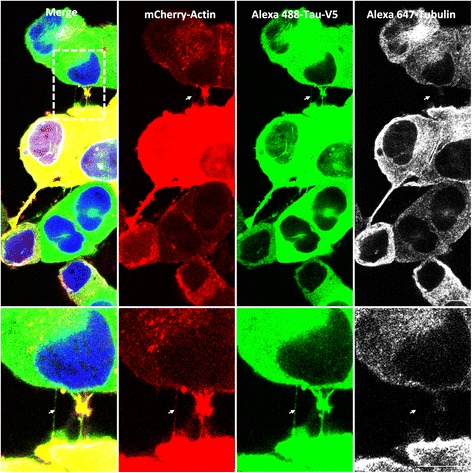
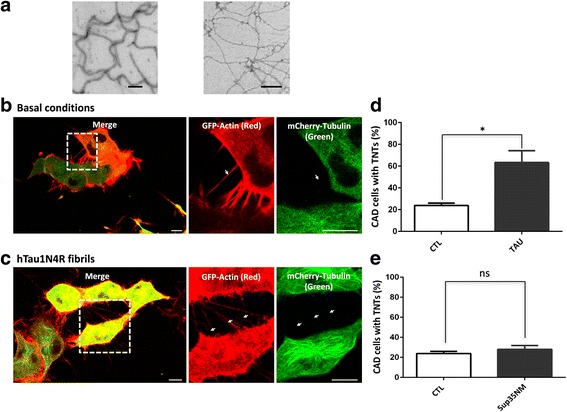
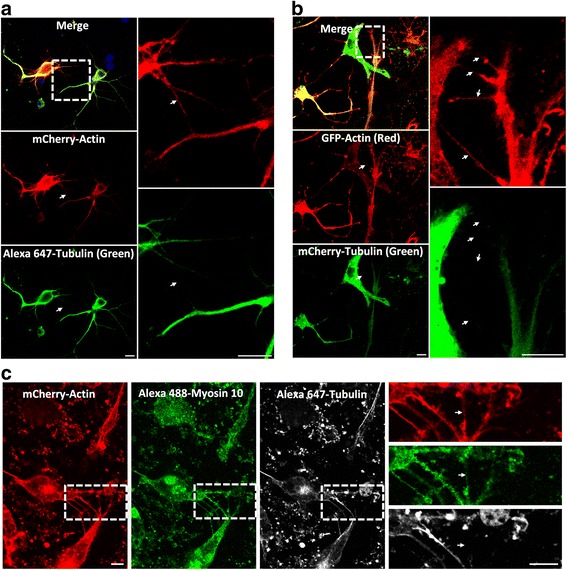
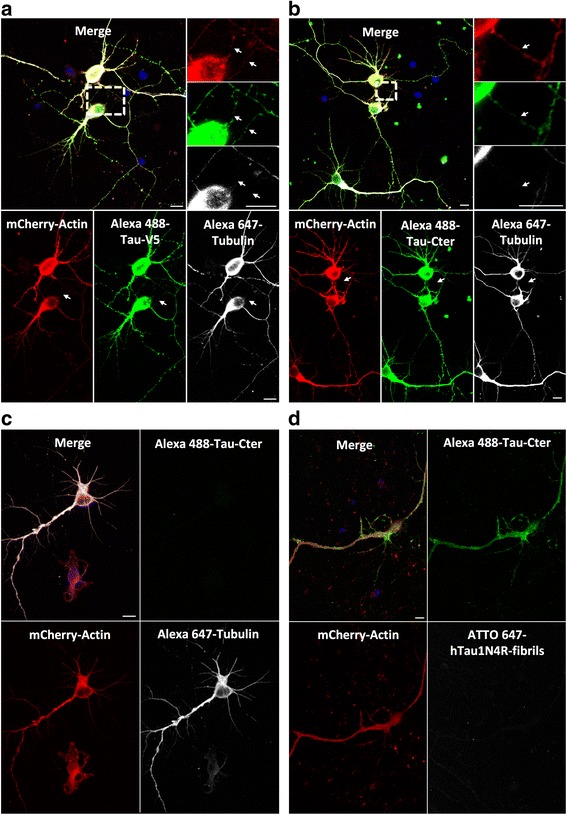
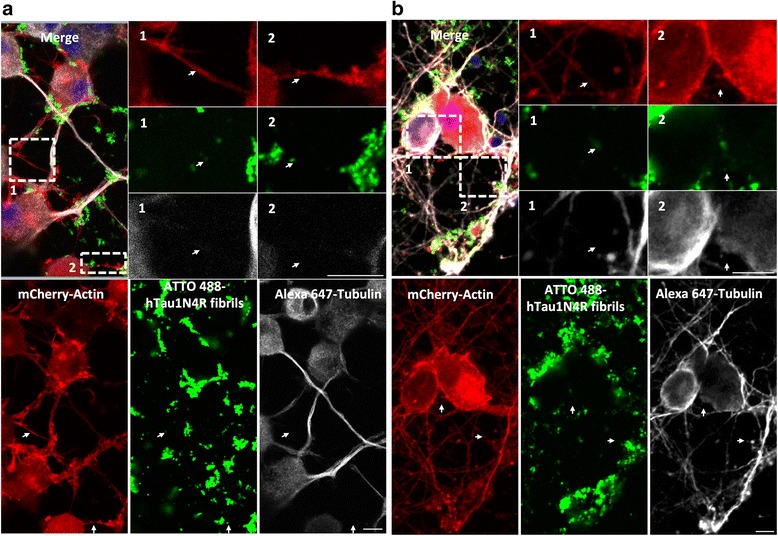
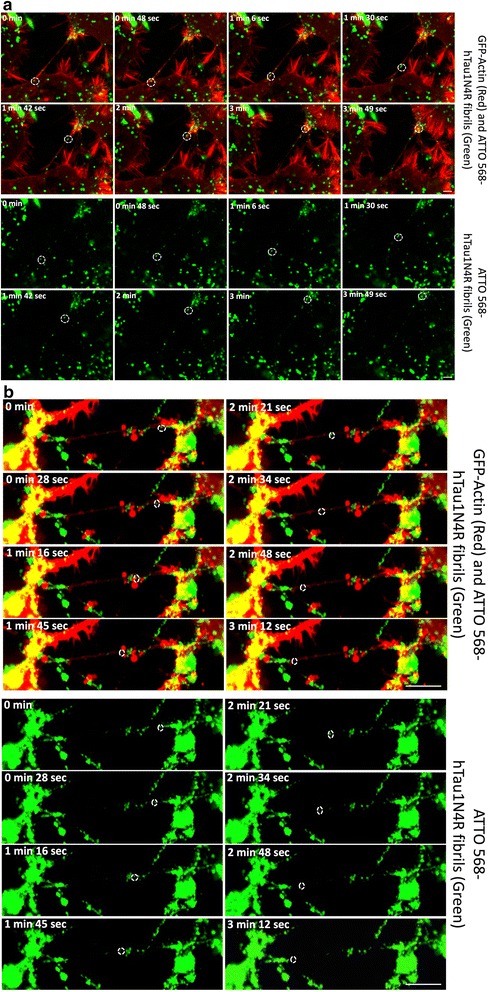
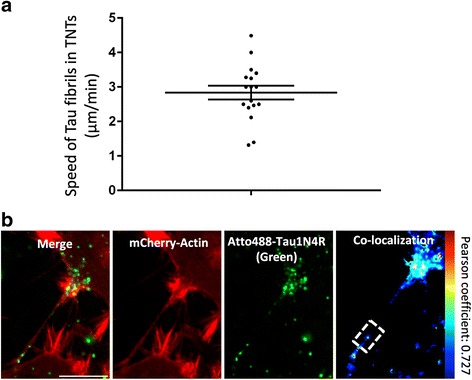
A given cell makes exchanges with its neighbors through a variety of means ranging from diffusible factors to vesicles. Cells use also tunneling nanotubes (TNTs), filamentous-actin-containing membranous structures that bridge and connect cells. First described in immune cells, TNTs facilitate HIV-1 transfer and are found in various cell types, including neurons. We show that the microtubule-associated protein Tau, a key player in Alzheimer's disease, is a bona fide constituent of TNTs. This is important because Tau appears beside filamentous actin and myosin 10 as a specific marker of these fine protrusions of membranes and cytosol that are difficult to visualize. Furthermore, we observed that exogenous Tau species increase the number of TNTs established between primary neurons, thereby facilitating the intercellular transfer of Tau fibrils. In conclusion, Tau may contribute to the formation and function of the highly dynamic TNTs that may be involved in the prion-like propagation of Tau assemblies.
Overview
The claims and statistics of this paper haven’t been checked yet.
Free: it reads the open-access text and checks the first 5 claims that cite a source we can check. Create a free account to check every claim.
Integrity signals
Registry
Cites
Statistics
Figures
Verification
Claims the paper makes
The claims and statistics of this paper haven’t been checked yet.
Free: it reads the open-access text and checks the first 5 claims that cite a source we can check. Create a free account to check every claim.
Claims other papers make about this one
Each is checked against this paper’s own text: does it say what the citing paper says it does?
The source backs part of the claim, not all of it — or backs it for a different population, condition or comparison.
In the citing paper
“Ultimately, Aβ and tau propagate to other neurons via TNT and exosomes [98,99,100,101].”
From The Impact of Neurotoxin Proteins Trafficked by Primary Cilia and Extracellular Vesicles in Neurodegenerative Diseases (2025) · cites this paper as [100]
Experimental — accuracy not yet measuredThe source backs part of the claim, not all of it — or backs it for a different population, condition or comparison.
In the citing paper
“Concurrently, AD-related cellular stressors, such as Aβ exposure, activate actin remodeling pathways that may drive TNT formation, enabling direct neuron-to-neuron transfer of pathological tau protein [100,101].”
From The Impact of Neurotoxin Proteins Trafficked by Primary Cilia and Extracellular Vesicles in Neurodegenerative Diseases (2025) · cites this paper as [100]
Experimental — accuracy not yet measuredThe source backs part of the claim, not all of it — or backs it for a different population, condition or comparison.
In the citing paper
“These coordinated defects in ciliary signaling and intracellular trafficking may collectively facilitate the EV and TNT-dependent propagation of neurotoxic proteins across neural networks, thereby potentially reinforcing progressive circuit dysfunction (Figure 3A) [98,100,101,105].”
From The Impact of Neurotoxin Proteins Trafficked by Primary Cilia and Extracellular Vesicles in Neurodegenerative Diseases (2025) · cites this paper as [100]
Experimental — accuracy not yet measuredThe cited source says what the claim attributes to it.
In the citing paper
“As mentioned above, TNTs may play a significant role in the spreading of misfolded proteins like Aβ and Tau, which are central to AD pathology [100].”
From The Impact of Neurotoxin Proteins Trafficked by Primary Cilia and Extracellular Vesicles in Neurodegenerative Diseases (2025) · cites this paper as [100]
The cited source says what the claim attributes to it.
In the citing paper
“Given their role in intercellular communication and the spread of protein aggregates, TNTs are emerging as potential therapeutic targets for slowing the disease’s progression [100,123,124].”
From The Impact of Neurotoxin Proteins Trafficked by Primary Cilia and Extracellular Vesicles in Neurodegenerative Diseases (2025) · cites this paper as [100]
Self-check
Percentages, sums and reported differences re-computed from the paper’s own numbers.
The self-check needs the paper’s full text.
Citations
Cites
Neuropathological stageing of Alzheimer-related changes.
Braak, H., & Braak, E. (1991) · Acta Neuropathologica · doi:10.1007/bf00308809 · Cited by 16,123
Amyloid oligomers exacerbate tau pathology in a mouse model of tauopathy
Selenica, M.-L. B., Brownlow, M., Jimenez, J. P., Lee, D. C., Pena, G., Dickey, C. A., Gordon, M. N., & Morgan, D. (2013) · Neurodegenerative Diseases · doi:10.1159/000337230 · Cited by 10,359
A protein factor essential for microtubule assembly
Weingarten, M. D., Lockwood, A. H., Hwo, S. Y., & Kirschner, M. W. (1975) · Proceedings of the National Academy of Sciences · doi:10.1073/pnas.72.5.1858 · Cited by 3,089
Nanotubular Highways for Intercellular Organelle Transport
Rustom, A., Saffrich, R., Markovic, I., Walther, P., & Gerdes, H.-H. (2004) · Science · doi:10.1126/science.1093133 · Cited by 2,038
Dendritic Function of Tau Mediates Amyloid-β Toxicity in Alzheimer's Disease Mouse Models
Ittner, L. M., Ke, Y. D., Delerue, F., Bi, M., Gladbach, A., van Eersel, J., Wölfing, H., Chieng, B. C., Christie, M. J., Napier, I. A., et al. (2010) · Cell · doi:10.1016/j.cell.2010.06.036 · Cited by 1,821
Self-propagation of pathogenic protein aggregates in neurodegenerative diseases
Jucker, M., & Walker, L. C. (2013) · Nature · doi:10.1038/nature12481 · Cited by 1,663
Depletion of microglia and inhibition of exosome synthesis halt tau propagation
Asai, H., Ikezu, S., Tsunoda, S., Medalla, M., Luebke, J., Haydar, T., Wolozin, B., Butovsky, O., Kügler, S., & Ikezu, T. (2015) · Nature Neuroscience · doi:10.1038/nn.4132 · Cited by 1,591
Distinct Tau Prion Strains Propagate in Cells and Mice and Define Different Tauopathies
Sanders, D. W., Kaufman, S. K., DeVos, S. L., Sharma, A. M., Mirbaha, H., Li, A., Barker, S. J., Foley, A. C., Thorpe, J. R., Serpell, L. C., et al. (2014) · Neuron · doi:10.1016/j.neuron.2014.04.047 · Cited by 986
Saman, S., Kim, W., Raya, M., Visnick, Y., Miro, S., Saman, S., Jackson, B., McKee, A. C., Alvarez, V. E., Lee, N. C. Y., et al. (2012) · Journal of Biological Chemistry · doi:10.1074/jbc.m111.277061 · Cited by 985
Goedert, M. (2015) · Science · doi:10.1126/science.1255555 · Cited by 976
Research works printed but not linked: 1
- Sautiere PE, Caillet-Boudin ML, Wattez A, Delacourte A. Detection of Alzheimer-type tau proteins in okadaic acid-treated SKNSH-SY5Y neuroblastoma cells. Neurodegeneration. 1994;3:53-60.
Cited by
Items 301–355 of 355
Additional file 1 of Trem2 deletion enhances tau dispersion and pathology through microglia exosomes
Zhu, B., Liu, Y., Hwang, S. Y., Archuleta, K., Huang, H., Campos, A., Murad, R., Piña-Crespo, J., Xu, H., & Huang, T. Y. (2022) · Figshare · doi:10.6084/m9.figshare.20861131
Verelst, J. (2023) · Lirias (KU Leuven)
New Tau Pathology Modulator Promotes Tau Propagation and Uptake in Neurons in Alzheimers Disease
양한슬 (2023) · Seoul National University Open Repository (Seoul National University)
Molecular mechanisms underlying presenilin-dependent tau pathology in neurodegeneration
Soto-Faguás, C. M. (2021) · Tesis Doctorals en Xarxa (Consorci de Serveis Universitaris de Catalunya)
Développement d'un ribozyme spécifique à l'ARNm de Tau pour contrer les Tauopathies
Eyoum Jong, L. (2018) · Corpus Université Laval (Université Laval)
Sala‐Jarque, J. (2023) · Dipòsit Digital de la Universitat de Barcelona (Universitat de Barcelona)
Investigating the uptake and accumulation of Tau monomers and aggregates in human neurons
Tayaranian Marvian, A., Lichtenthaler, S., & München, T. U. (2023)
The Mode of Prion Infection of Neuronal cells with extracellular PrP amyloids
Halim, H. A. B. (2023) · UCL Discovery (University College London)
Inhibiting Phosphorylation and Aggregation of Tau Protein Using R Domain PeptideMimetics
Alqaeisoom, N. (2019) · OhioLink ETD Center (Ohio Library and Information Network)
Oliveira, A. C. (2023) · Portuguese National Funding Agency for Science, Research and Technology (RCAAP Project by FCT) · doi:10.34626/gr6r-ka67
Neu, M., Lichtenthaler, S., & München, T. U. (2025)
Implications of virus-induced stress granules in tauopathies
Sharma, S., Vandenakker, A., Cortes-Pérez, C. M., Milne, S., & Douville, R. N. (2026) · Translational Neurodegeneration · doi:10.1186/s40035-026-00538-4
Yan, N. E. (2020) · TSpace (University of Toronto)
Neurodegenerative Proteinopathy-Specific Dysregulation of Iron Homeostasis in the Human Brain
Lee, S. (2024) · TSpace (University of Toronto)
Extracellular Protein Quality Control in Tau Pathology
Bhunia, P. K., Verma, D., Vimal, P., & Kasturi, P. (2026) · Molecular Neurobiology · doi:10.1007/s12035-026-05834-8
Rességuier, J. (2017) · theses.fr (ABES) · doi:10.70675/97dd6123zf6a1z4243zba0ez476d927d5ec1 · Cited by 1
Development of Inhibitors of Amyloid Fibril Propagation
Bendifallah, M. (2019) · theses.fr (ABES) · doi:10.70675/a872e5bdzc153z41f4z9472z725fd78aab48
Study of the role of Rab proteins and their effectors on Tunneling nanotubes
Bhat, S. (2019) · theses.fr (ABES) · doi:10.70675/7fee92a1zc615z4de9z87cdz4ac590863df0
Study of the Neuron-Astrocyte Relationship in a Rodent Model of Tauopathy
de Gérando, A. M. (2019) · theses.fr (ABES) · doi:10.70675/04658671zaca3z4fefza24dz2f5a011bebfe
Architecture of Tunneling Nanotubes : a Structural Approach
Cervantes, D. C. (2019) · theses.fr (ABES) · doi:10.70675/7134eee8z8acdz4e45za0afz00069cdc5443
Neurotoxicité précoce et mécanismes de neuroprotection dans des modèles poisson‐zèbre de tauopathies
Barbereau, C. (2020) · theses.fr (ABES) · doi:10.70675/dfe1802ez70f2z4da6zb3e5z63d1de7a429c
Ljubojević, N. (2021) · theses.fr (ABES) · doi:10.70675/64151986z4fabz4445zbe11zb41f75c6be3b
Caractérisation d'anticorps à domaine unique dirigés contre la protéine Tau
Danis, C. (2018) · theses.fr (ABES) · doi:10.70675/c783a062zb57bz4024z85d0z509baaed8a1b
Développement de ligands pour l'imagerie des dépôts d'alpha synucléine dans la maladie de parkinson
Olivares‐Rubio, H. F. (2023) · theses.fr (ABES) · doi:10.70675/1f93627ezb47fz4c44z922azfa10f099c223
Manzano, R. N. (2022) · theses.fr (ABES) · doi:10.70675/8f71254bz5af6z4fdbz8550z05cb2822e327
Étude de la physiopathologie des tauopathies et modélisation chez le primate non-humain
Darricau, M. (2023) · theses.fr (ABES) · doi:10.70675/c2288979z9f7ez4b9cza735za409870e0614
Role of T-cell immunity in the pathophysiology of Alzheimer’s disease and other Tauopathies
Matta, K. (2024) · theses.fr (ABES) · doi:10.70675/cea4fe5ez67c3z4445z92f7z39af62ba059b
Siddique, I. A., Hong, M., & Bitan, G. (2026) · Topics in medicinal chemistry · doi:10.1007/7355_2026_189
Exosomes in Amyloid Propagation—Roles in Neurodegeneration
Mishra, R., & Upadhyay, A. (2026) · Molecular Neurobiology · doi:10.1007/s12035-026-05913-w
New insights into tau protein with regard to Alzheimer’s disease and other tauopathies
Billah, M. M., Hossin, A., Nawrin, K., & Ahmed, F. (2021) · Pharmacotherapy and Pharmascience Discovery · doi:10.66944/ptherpscid/ppd2183
Identification of small molecules that inhibit the cell-to-cell propagation of tauopathy
Clemente, E. (2026) · Qucosa (Saxon State and University Library Dresden)
Nanotubular networks in the aging brain: from neuroprotection to neurodegeneration
Jategaonkar, M. S., Miller, N. H., Zur, S., Geula, C., Penzes, P., & Zaccard, C. R. (2026) · Frontiers in Human Neuroscience · doi:10.3389/fnhum.2026.1864090
Glucosylceramides trigger the shedding of alpha-synuclein laden ectosomes
Tegeder, I. (2026) · Extracellular Vesicles and Circulating Nucleic Acids · doi:10.20517/evcna.2026.51
Havemeister, F. (2026) · Chalmers Research (Chalmers University of Technology) · doi:10.63959/chalmers.dt/5917
Webster, J. M., & Harms, A. S. (2026) · npj Parkinson s Disease · doi:10.1038/s41531-026-01502-9
The Function of Tau in Astrocytes: Advantage or Damage
Luis-Hernández, K. G., Beltrán‐Parrazal, L., Morgado‐Valle, C., López‐Meraz, M. L., García, L. I., & Chi-Castañeda, D. (2026) · Neuroglia · doi:10.3390/neuroglia7030030
Therapeutic targeting of tauopathies: From druggable biology to precision intervention
Zhang, C., Ma, J., Wu, X., Wang, X., Huang, X., Zheng, H., & Zhao, Y. (2026) · Pharmacological Research · doi:10.1016/j.phrs.2026.108432
Distinct tau fibril types and their role in prion diseases
Celauro, L. (2023) · SDL
Taouili, R., Camille, L., Oosterlynck, M., Bouillet, T., Eddarkaoui, S., Musiol, D., Formentin, C., Accart, B., Maurage, C., Colin, M., et al. (2026) · iScience · doi:10.1016/j.isci.2026.118083
Self-citationThe nanotubular network as a new dimension of intercellular communication in the nervous system
Chang, M., Ryu, S., & Kwon, H. (2026) · Nature reviews. Neuroscience · doi:10.1038/s41583-026-01098-2
The evolution of prion cell biology: from viruses to prions to prion-like proteins
Vorberg, I. M., & Priola, S. A. (2026) · Acta Neuropathologica · doi:10.1007/s00401-026-03099-y
Mitochondria on the move: Mitochondrial release and transfer in nervous system health and disease
Onraet, T., & Zuryn, S. (2026) · Current Opinion in Neurobiology · doi:10.1016/j.conb.2026.103288
Léal, P., Duwat, C., Adamski, C., Gaillard, M., Aurégan, G., Guillermier, M., Bernier, S., Dufour, N., Petit, F., Jan, C., et al. (2026) · bioRxiv (Cold Spring Harbor Laboratory) · doi:10.64898/2026.11.09.762480
Metadata
- Authors
- Tardivel, M., Bégard, S., Bousset, L., Dujardin, S., Coens, A., Melki, R., Buée, L., & Colin, M.
- Affiliations
- Inserm (FR)
- Centre National de la Recherche Scientifique (FR)
- Corresponding author
- Buée, Luc
- Colin, Morvane
- Venue
- Acta Neuropathologica Communications
- Published
- 2016-11-04
- Volume
- 4
- Issue
- 1
- Pages
- 117-117
- ISSN
- 2051-5960 (ISSN-L)
- PMC
- PMC5096005
- OpenAlex
- W2548465653
- Cited by
- 305
- References
- 74
- Citations by year
- 2026: 21 · 2025: 24 · 2024: 32 · 2023: 23 · 2022: 46 · 2021: 40 · 2020: 36 · 2019: 36 · 2018: 31 · 2017: 15 · 2016: 1
- FWCI
- 22.25
- Type
- journal article
- Language
- en
- Open access
- gold
- doi.org
- Licence
- cc-by
- Locations
- Acta Neuropathologica Communications (publishedVersion, cc-by)
- PubMed Central (publishedVersion, cc-by)
- PubMed (publishedVersion)
- HAL (submittedVersion, other-oa)
- Funders
- Development of Innovative Strategies for a Transdisciplinary approach to ALZheimer's disease
- Agence Nationale de la Recherche (ANR-14-CE13-0031)
- Institut National de la Santé et de la Recherche Médicale
- Association France Alzheimer
- Centre National de la Recherche Scientifique
- Fondation Bettencourt Schueller
- Topics
- Life Sciences › Neuroscience › Cellular and Molecular Neuroscience › Alzheimer's disease research and treatments
- Life Sciences › Biochemistry, Genetics and Molecular Biology › Molecular Biology › Extracellular vesicles in disease
- Life Sciences › Neuroscience › Neurology › Neuroinflammation and Neurodegeneration Mechanisms
- Keywords
- tunneling nanotubes, tau protein, intercellular transfer, Alzheimer's disease, tau fibrils, prion-like propagation, neurons, actin, myosin 10, intercellular communication, neurodegeneration
- MeSH terms
- Actins, Animals, Biological Transport, Cell Communication, Cell Line, Cerebral Cortex, Extracellular Space, Genetic Vectors, Humans, Luminescent Proteins, Myosins, Neurons, Tubulin, Lentivirus, tau Proteins, Rats, Wistar, Mice
About these checks
Registry, retraction, Cites and statistics results are computed, not judged, with one exception: a printed reference that no index lists is read once by a model before it counts as a citation error. Claims are extracted by a model and kept only when their quote appears verbatim in the text; each cited source is then checked, with a model’s help, for whether it says what the claim relies on. Those verdicts can be wrong — read the claim’s quote and the cited source before relying on one.
Statistics and arithmetic are recomputed, not judged.
Confidence bands are shown only for fields calibrated on our annotated test set. None is calibrated yet, so no band is shown.
What counts as a claim ›How we measure confidence ›How we check this ›
Are you an author, or do you see a problem with this page? Request a review
Data sources
Bibliographic data: Semantic Scholar, OpenAlex, Crossref.
Contains information from the Semantic Scholar Academic Graph Datasets, made available under the ODC Attribution License (ODC-BY 1.0).
Semantic Scholar’s data is described in: Kinney, R., et al. (2023). The Semantic Scholar Open Data Platform. arXiv:2301.10140.
