

The DOI matches its Crossref record; 45 of the 45 references it cites were found in a registry or an index.
RNA binding proteins co-localize with small tau inclusions in tauopathy
Open accessAbstract
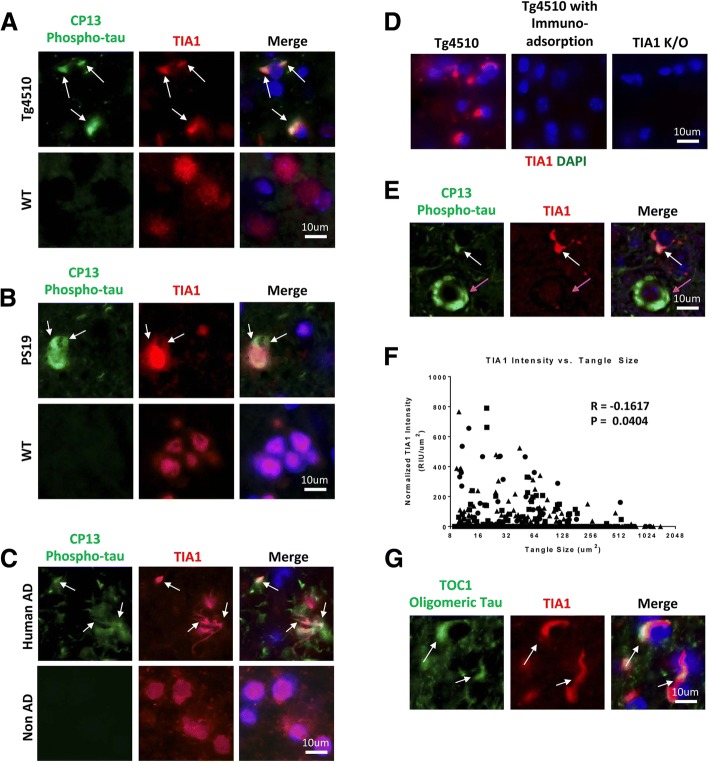
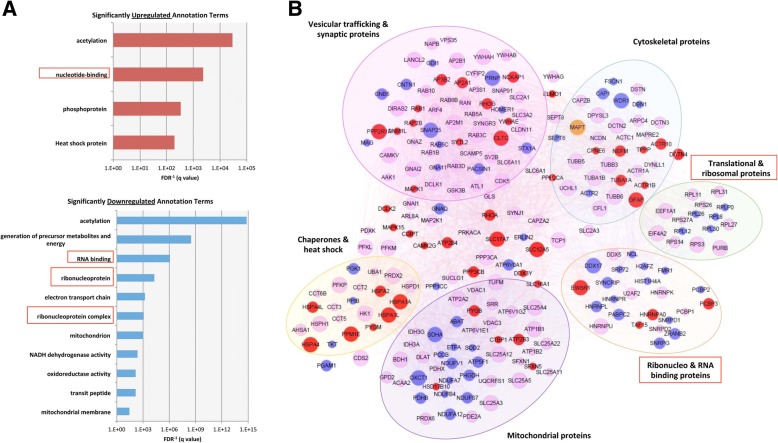
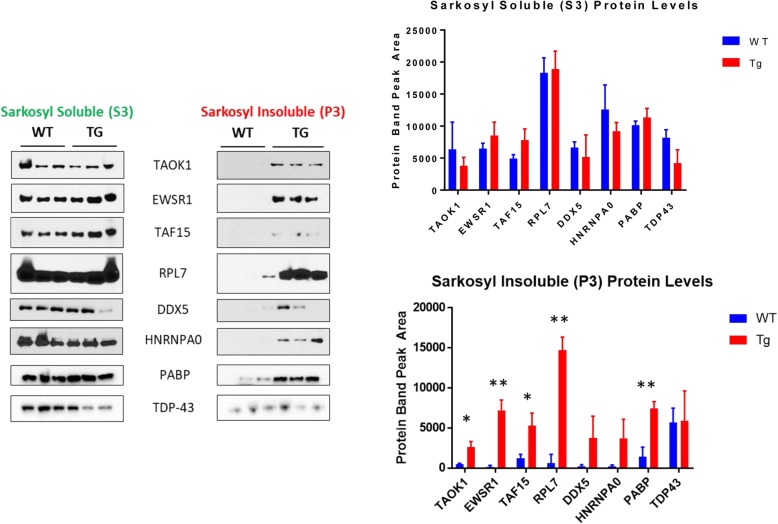
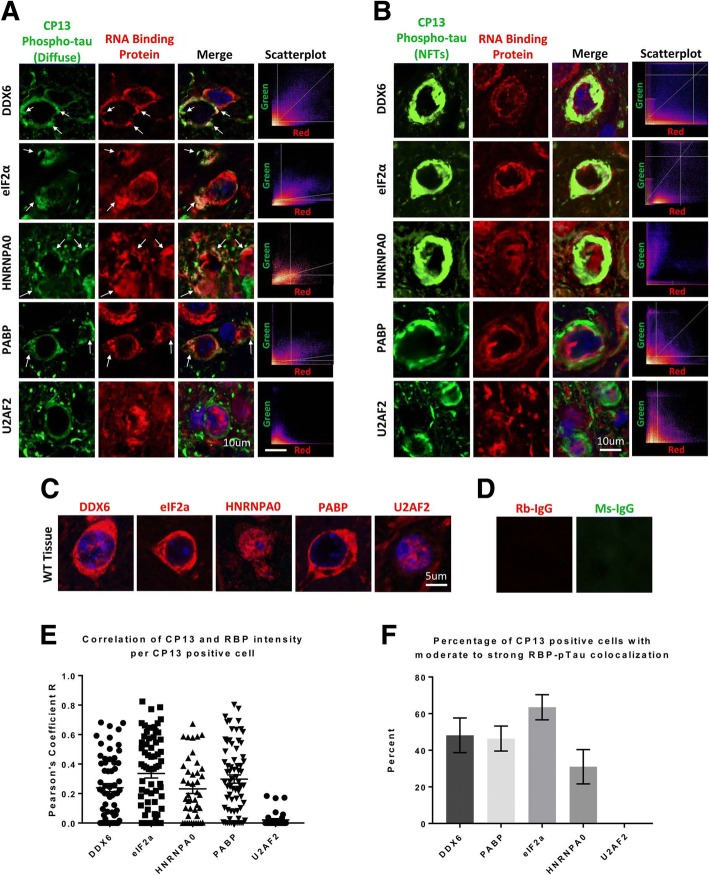
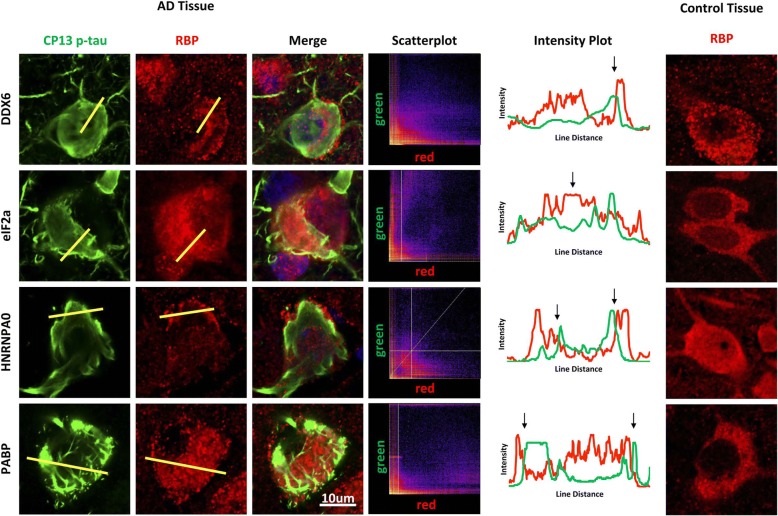
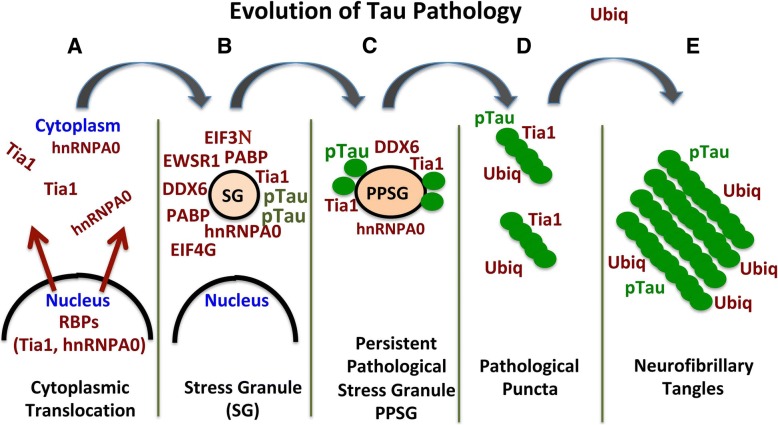
The development of insoluble, intracellular neurofibrillary tangles composed of the microtubule-associated protein tau is a defining feature of tauopathies, including Alzheimer's disease (AD). Accumulating evidence suggests that tau pathology co-localizes with RNA binding proteins (RBPs) that are known markers for stress granules (SGs). Here we used proteomics to determine how the network of tau binding proteins changes with disease in the rTg4510 mouse, and then followed up with immunohistochemistry to identify RNA binding proteins that co-localize with tau pathology. The tau interactome networks revealed striking disease-related changes in interactions between tau and a multiple RBPs, and biochemical fractionation studies demonstrated that many of these proteins including hnRNPA0, EWSR1, PABP and RPL7 form insoluble aggregates as tau pathology develops. Immunohistochemical analysis of mouse and human brain tissues suggest a model of evolving pathological interaction, in which RBPs co-localize with pathological phospho-tau but occur adjacent to larger pathological tau inclusions. We suggest a model in which tau initially interacts with RBPs in small complexes, but evolves into isolated aggregated inclusions as tau pathology matures.
Overview
The claims and statistics of this paper haven’t been checked yet.
Run the check — free, no account needed. It reads the open-access text and checks the sources it cites.
Integrity signals
Registry
Cites
Statistics
Figures
Verification
Claims the paper makes
The claims and statistics of this paper haven’t been checked yet.
Run the check — free, no account needed. It reads the open-access text and checks the sources it cites.
Claims other papers make about this one
Each is checked against this paper’s own text: does it say what the citing paper says it does?
The source backs part of the claim, not all of it — or backs it for a different population, condition or comparison.
In the citing paper
“The cell body MAPT pathology is particularly important because this pathology colocalizes with markers of the translational stress response, such as stress granule proteins HNRNPA2B1, TIA1, EIF3n and PABP, and also neuronal death (as shown by cleaved caspase 3 and loss of NeuN positive cells) (Ash et al., 2014; Apicco et al., 2018; Maziuk et al., 2018; Apicco et al., 2019; Jiang et al., 2019, 2021”
From β-amyloid accumulation enhances microtubule associated protein tau pathology in an APPNL-G-F/MAPTP301S mouse model of Alzheimer’s disease (2024) · cites this paper as Maziuk et al., 2018
Experimental — accuracy not yet measuredIn the citing paper
“previous analyses of the AD brain detergent-insoluble proteome, which have repeatedly demonstrated the association of U1 small nuclear ribonucleoproteins (U1 snRNPs) and other RNA-binding proteins with tau tangles [133–137].”
From Systems-based proteomics to resolve the biology of Alzheimer’s disease beyond amyloid and tau (2021) · cites this paper as [137]
In the citing paper
“Interestingly, our previous studies demonstrated that many of the U1 snRNPs colocalize with neurofibrillary tangles and paired helical filaments in AD brain [24, 32–34], and that accumulation of insoluble snRNPs correlates strongly with both amyloid and Tau pathology [32–37].”
From Deep proteomic network analysis of Alzheimer’s disease brain reveals alterations in RNA binding proteins and RNA splicing associated with disease (2018) · cites this paper as [36]
Self-check
Percentages, sums and reported differences re-computed from the paper’s own numbers.
The self-check needs the paper’s full text.
Citations
Cites
Amyloid oligomers exacerbate tau pathology in a mouse model of tauopathy
Selenica, M.-L. B., Brownlow, M., Jimenez, J. P., Lee, D. C., Pena, G., Dickey, C. A., Gordon, M. N., & Morgan, D. (2013) · Neurodegenerative Diseases · doi:10.1159/000337230 · Cited by 10,359
Liquid phase condensation in cell physiology and disease
Shin, Y., & Brangwynne, C. P. (2017) · Science · doi:10.1126/science.aaf4382 · Cited by 4,143
Molliex, A., Temirov, J. P., Lee, J., Coughlin, M., Kanagaraj, A., Kim, H. J., Mittag, T., & Taylor, J. P. (2015) · Cell · doi:10.1016/j.cell.2015.09.015 · Cited by 2,690
Phase transitions in the assembly of multivalent signalling proteins
Li, P., Banjade, S., Cheng, H., Kim, S., Chen, B., Guo, L., Llaguno, M. C., Hollingsworth, J. V., King, D., Banani, S. F., et al. (2012) · Nature · doi:10.1038/nature10879 · Cited by 2,565
Tau Suppression in a Neurodegenerative Mouse Model Improves Memory Function
SantaCruz, K., Lewis, J., Spires, T., Paulson, J., Kotilinek, L., Ingelsson, M., Guimaraes, A., DeTure, M., Ramsden, M., McGowan, E., et al. (2005) · Science · doi:10.1126/science.1113694 · Cited by 2,014
Nott, T. J., Petsalaki, E., Farber, P., Jervis, D., Fussner, E., Plochowietz, A., Craggs, T. D., Bazett-Jones, D. P., Pawson, T., Forman-Kay, J. D., et al. (2015) · Molecular Cell · doi:10.1016/j.molcel.2015.01.013 · Cited by 1,803
Formation and Maturation of Phase-Separated Liquid Droplets by RNA-Binding Proteins
Lin, Y., Protter, D. S. W., Rosen, M. K., & Parker, R. (2015) · Molecular Cell · doi:10.1016/j.molcel.2015.08.018 · Cited by 1,593
Tau protein liquid–liquid phase separation can initiate tau aggregation
Wegmann, S., Eftekharzadeh, B., Tepper, K., Zoltowska, K. M., Bennett, R. E., Dujardin, S., Laskowski, P. R., MacKenzie, D., Kamath, T., Commins, C., et al. (2018) · The EMBO Journal · doi:10.15252/embj.201798049 · Cited by 1,102
Liu‐Yesucevitz, L., Bilgutay, A. N., Zhang, Y., Vanderwyde, T., Citro, A., Mehta, T., Zaarur, N., McKee, A. C., Bowser, R. P., Sherman, M. Y., et al. (2010) · PLoS ONE · doi:10.1371/journal.pone.0013250 · Cited by 637
Self-citationTherapeutic reduction of ataxin-2 extends lifespan and reduces pathology in TDP-43 mice
Becker, L. A., Huang, B., Bieri, G., Ma, R., Knowles, D. A., Jafar-Nejad, P., Messing, J., Kim, H. J., Soriano, A., Auburger, G., et al. (2017) · Nature · doi:10.1038/nature22038 · Cited by 571
Cited by
Sorted by citations
Items 101–152 of 152
Shapley, S. M., Shantaraman, A., Gadhavi, J. D., Kearney, M. A., Dammer, E. B., Duong, D. M., Bowen, C. A., Watson, C. M., Bagchi, P., Guo, Q., et al. (2025) · Molecular & Cellular Proteomics · doi:10.1016/j.mcpro.2025.101458 · Cited by 9
Liu, Z., Chen, Y., Chen, Y., Zheng, J., Wu, W., Wang, L., Wang, H., & Yu, Y. (2024) · International Journal of Molecular Sciences · doi:10.3390/ijms25084324 · Cited by 7
Pathophysiological implications of RNP granules in frontotemporal dementia and ALS
Desai, P., & Bandopadhyay, R. (2020) · Neurochemistry International · doi:10.1016/j.neuint.2020.104819 · Cited by 9
Atwa, A., Alhadidy, M. M., Lamp, J. A., Combs, B., & Kanaan, N. M. (2025) · Journal of Proteome Research · doi:10.1021/acs.jproteome.5c00473 · Cited by 6
Rational Modulation of Liquid–Liquid Phase Separation Offers Novel Ways to Combat Tauopathies
Zhang, X., Wang, L., Lin, N., Gao, M. Y., & Huang, Y. (2025) · International Journal of Molecular Sciences · doi:10.3390/ijms26146709 · Cited by 7
Younas, N., & Zerr, I. (2025) · Frontiers in Neuroscience · doi:10.3389/fnins.2025.1686571 · Cited by 6
Targeted brain-specific tauopathy compromises peripheral skeletal muscle integrity and function
Alava, B. R., Hery, G. P., Sidhom, S., Gutierrez‐Monreal, M. A., Prokop, S., Esser, K. A., & Abisambra, J. F. (2024) · Aging Brain · doi:10.1016/j.nbas.2024.100110 · Cited by 5
Self-citationMaking tau amyloid models in vitro: a crucial and underestimated challenge
Broc, J., Piersson, C., & Fichou, Y. (2025) · FEBS Letters · doi:10.1002/1873-3468.70022 · Cited by 5
Stress granule‐mediated RNA regulatory mechanism in Alzheimer's disease
Sato, K., Takayama, K., & Inoue, S. (2023) · Geriatrics and gerontology international/Geriatrics & gerontology international · doi:10.1111/ggi.14663 · Cited by 5
Jiang, L., Roberts, R., Wong, M., Zhang, L., Webber, C. J., Kilci, A., Jenkins, M., Sun, G., Rashad, S., Sun, J., et al. (2023) · Research Square · doi:10.1101/2023.03.28.534515 · Cited by 5
Self-citationAxonal tau reduction ameliorates tau and amyloid pathology in a mouse model of Alzheimer’s disease
Zare, A., Salehi, S., Bader, J. M., Wiessler, A.-L., Prokesch, M., Albrecht, V., Villmann, C., Mann, M., Briese, M., & Sendtner, M. (2025) · Translational Neurodegeneration · doi:10.1186/s40035-025-00499-0 · Cited by 4
Liu, Z., Wang, K., & Ye, M. (2023) · Analytical Chemistry · doi:10.1021/acs.analchem.3c01598 · Cited by 4
Cid-Samper, F., Gelabert‐Baldrich, M., Lang, B., Lorenzo-Gotor, N., Ponti, R. D., Severijnen, L.-A. W. F. M., Bolognesi, B., Gelpí, E., Hukema, R. K., Botta‐Orfila, T., et al. (2018) · bioRxiv (Cold Spring Harbor Laboratory) · doi:10.1101/298943 · Cited by 4
A new way to mitigate pathological Tau?
Ghosh, A., & Velde, C. V. (2023) · Neuron · doi:10.1016/j.neuron.2023.08.001 · Cited by 3
Kizhakkeduth, S. T., Vahid, A. A., Hassan, M. S. O., Parambil, A. K., Jain, P., & Vijayan, V. (2024) · ACS Chemical Neuroscience · doi:10.1021/acschemneuro.4c00456 · Cited by 3
Heterotypic phase separation in aggregation: Driver or deterrent?
Jacob, T., & Hoyer, W. (2026) · Biophysical Chemistry · doi:10.1016/j.bpc.2026.107577 · Cited by 3
An Insect Viral Protein Disrupts Stress Granule Formation in Mammalian Cells
Sadasivan, J., Hyrina, A., DaSilva, R., & Jan, E. (2023) · Journal of Molecular Biology · doi:10.1016/j.jmb.2023.168042 · Cited by 3
Fibril formation rewires interactome of the Alzheimer protein Tau by π-stackingPreprint
Ferrari, L., Stucchi, R., Konstantoulea, A., van de Kamp, G., Kos, R., Geerts, W. J. C., Förster, F. G., Altelaar, M. A. F., Hoogenraad, C. C., & Rüdiger, S. (2019) · bioRxiv (Cold Spring Harbor Laboratory) · doi:10.1101/522284 · Cited by 3
Mechanistic Roles of Androgen and Estrogen in Aging and Age-Related Diseases
Takayama, K.-I. (2026) · Journal of Ageing and Longevity · doi:10.3390/jal6010019 · Cited by 2
Pathogenic tau inhibits synaptic plasticity by blocking eIF4B-mediated local protein synthesisPreprint
Kauwe, G., Lokitiyakul, D., Wong, I. L., Schneider, K., Sridhar, V., Sellegounder, D., Ngwala, Y. Y., Yao, L., Chen, J. H., Pareja-Navarro, K. A., et al. (2025) · bioRxiv (Cold Spring Harbor Laboratory) · doi:10.1101/2025.09.11.675671 · Cited by 2
Boers-Escuder, C., Kater, M. S. J., van der Zwan, M., Gouwenberg, Y., Klaassen, R. V., Huffels, C. F. M., Pekny, M., Hol, E. M., Smit, A. B., & Verheijen, M. H. G. (2026) · bioRxiv (Cold Spring Harbor Laboratory) · doi:10.64898/2026.03.24.713865 · Cited by 2
Sergeeva, O. S., Neklesova, M. V., Reushev, V. A., Artemov, A. V., Константинович, Т. К., Константинович, Т. К., Uversky, V. N., & Fonin, A. V. (2025) · Biochemical and Biophysical Research Communications · doi:10.1016/j.bbrc.2025.152808 · Cited by 2
MARK4 enhances stress granule formation and increases tau accumulationPreprint
Nakajima, S., Watanabe, K., Sultanakhmetov, G., Fukuchi, A., Ito, K., Shimizu, S., Saito, T., Asada, A., & Ando, K. (2025) · bioRxiv (Cold Spring Harbor Laboratory) · doi:10.1101/2025.04.30.651577 · Cited by 1
Pathological Tau as a Cause, and Consequence, of Cellular Dysfunction
Meier, S. E. (2019) · UKnowledge (University of Kentucky) · doi:10.13023/etd.2019.368
Jiang, L., Lin, W., Zhang, C., Verma, M., Kwan, J., van Vliet, E., Ash, P. E. A., Cruz, A. L., Boudeau, S., Maziuk, B. F., et al. (2020) · bioRxiv (Cold Spring Harbor Laboratory) · doi:10.1101/2020.12.03.409334
Self-citationJiang, L., Lin, W., Zhang, C., Verma, M., Kwan, J., van Vliet, E., Ash, P. E. A., Cruz, A. L., Boudeau, S., Maziuk, B. F., et al. (2020) · SSRN Electronic Journal · doi:10.2139/ssrn.3751054
Self-citationChanda, D., Sharma, G. D., Chakraborty, N., & Kumar, R. (2023) · Journal of Pure and Applied Microbiology · doi:10.22207/jpam.17.4.02
Caruso, A. C., Kavanagh, T., Waardenberg, A. J., Graham, M. E., Drummond, E., & Nisbet, R. M. (2025) · bioRxiv (Cold Spring Harbor Laboratory) · doi:10.1101/2025.08.13.665777
Pashova, S., Petrov, P. V., Karachanak-Yankova, S., Belezhanska, D., Zhelev, Y., Mehrabian, S., Toncheva, D. I., Traykov, L., & Pashov, A. D. (2025) · Journal of Neuroimmunology · doi:10.1016/j.jneuroim.2025.578775
Ramirez, P., Zuniga, G., Ochoa, E., & Frost, B. E. (2025) · BMC Genomics · doi:10.1186/s12864-025-12111-w
McMillan, P. J., Strovas, T. J., Baum, M., Mitchell, B. K., Eck, R. J., Hendricks, N. E., Wheeler, J. M., Latimer, C. S., Keene, C. D., & Kraemer, B. C. (2021) · Figshare · doi:10.6084/m9.figshare.14880602
Ma, L., Herren, A. W., Espinal, G. M., Randol, J. L., McLaughlin, B. E., Martinez-Cerdeño, V., Pessah, I. N., Hagerman, R. J., & Hagerman, P. J. (2019) · Figshare · doi:10.6084/m9.figshare.9766562
Younas, N., Zafar, S., Saleem, T., Fernandez Flores, L. C., Younas, A., Schmitz, M., & Zerr, I. (2024) · Figshare · doi:10.6084/m9.figshare.26648478
Younas, N., Zafar, S., Saleem, T., Fernandez Flores, L. C., Younas, A., Schmitz, M., & Zerr, I. (2024) · Figshare · doi:10.6084/m9.figshare.26648481
Implications of virus-induced stress granules in tauopathies
Sharma, S., Vandenakker, A., Cortes-Pérez, C. M., Milne, S., & Douville, R. N. (2026) · Translational Neurodegeneration · doi:10.1186/s40035-026-00538-4
Liquid–liquid phase separation of tau in Alzheimer’s disease
Rajkhowa, S., & Tripathi, T. (2026) · International review of neurobiology · doi:10.1016/bs.irn.2026.01.009
Shen, J., Pan, J., Yu, T.-Y., Liu, L.-W., Li, Y., Jin, Y.-Y., & Zhu, M. (2026) · Frontiers in Psychiatry · doi:10.3389/fpsyt.2025.1742710
The Use of Localized Proteomics to Understand the Pathogenesis of Alzheimer's Disease
Pires, G. (2021) · theses.fr (ABES) · doi:10.70675/45826fd6zd2c8z4b3dz91e0za5080544cb17
Denéchaud, M. (2022) · theses.fr (ABES) · doi:10.70675/623e7224z0cb0z47b1z8a22z549acf553ac0
Kashtiban, B. A., Rezazadeh, M., Gharesouran, J., Jafari, B., & Ghafouri‐Fard, S. (2026) · Brain Research Bulletin · doi:10.1016/j.brainresbull.2026.111974
FKBP51 inhibition by SAFit2 modulates tau pathology and cognitive deficits in PS19 mice
Contreras-Marciales, A., Mezquite-Garcia, D., Verdina, L. A., Elnahrawy, A., Wolf, T., Guergues, J., Parikh, P., Hunter, E. R., Acosta, D. H., Stevens, S. M., et al. (2026) · Alzheimer s Research & Therapy · doi:10.1186/s13195-026-02107-3
Liguori, M., Consiglio, A., D’Errico, E., Antonacci, Y., Coffa, M., Introna, A., & Simone, I. L. (2026) · Brain Sciences · doi:10.3390/brainsci16060643
Riboregulation: a non-canonical tau function
LeBlanc, K. R., Eck, R. J., Benbow, S. J., & Kraemer, B. C. (2026) · Molecular Neurodegeneration · doi:10.1186/s13024-026-00949-x
Zhang, M., & Cheng, A. (2026) · Pharmacological Research · doi:10.1016/j.phrs.2026.108312
Gong, Y., Qu, M., Xu, Y., Bao, H., Shen, T., Zeng, L., Wu, X., & He, Q. (2026) · Genes & Diseases · doi:10.1016/j.gendis.2026.102333
Tau physiology and pathology: impacts on cellular structures and neurodegenerative diseases
Akbari, V., & Bahramikia, S. (2026) · Inflammopharmacology · doi:10.1007/s10787-026-02328-w
Garza, T. N., & Abisambra, J. F. (2026) · Cells · doi:10.3390/cells15151365
Self-citationInvestigating the role of EFhd2 protein in modulating tau pathology in a tauopathy mouse model
Soliman, A. S., Umstead, A., & Vega, I. E. (2026) · Frontiers in Molecular Neuroscience · doi:10.3389/fnmol.2026.1833887
Wolozin, B. L., Best, M. N., Ellini, M., Ma, Y., Bok, S., Hwang, D., & Filipponi, C. (2026) · Cells · doi:10.3390/cells15171596
Self-citationMARK4 enhances stress granule formation under oxidative stress and increases tau accumulation
Nakajima, S., Watanabe, K., Sultanakhmetov, G., Fukuchi, A., Ito, K., Shimizu, S., Saito, T., Asada, A., & Ando, K. (2026) · FEBS Open Bio · doi:10.1002/2211-5463.70338 · Cited by 1
Ji, C., Zhu, Y., Erdjument‐Bromage, H., Song, S. C., Chang, N., Liu, A. R., Lee, A. R., DeGulis, O. A., Schoppik, D., Neubert, T. A., et al. (2026) · bioRxiv (Cold Spring Harbor Laboratory) · doi:10.64898/2026.10.05.756807
Metadata
- Authors
- Maziuk, B. F., Apicco, D. J., Cruz, A. L., Jiang, L., Ash, P. E. A., da Rocha, E. L., Zhang, C., Yu, W. H., Leszyk, J., Abisambra, J. F., Li, H., & Wolozin, B.
- Affiliations
- Boston University (US)
- Mayo Clinic (US)
- Columbia University Irving Medical Center (US)
- University of Massachusetts Chan Medical School (US)
- University of Kentucky (US)
- Corresponding author
- Wolozin, Benjamin
- ORCID
- Venue
- Acta Neuropathologica Communications
- Published
- 2018-08-01
- Volume
- 6
- Issue
- 1
- Pages
- 71-71
- ISSN
- 2051-5960 (ISSN-L)
- PMC
- PMC6069705
- OpenAlex
- W2887193453
- Cited by
- 151
- References
- 45
- Citations by year
- 2026: 18 · 2025: 17 · 2024: 14 · 2023: 20 · 2022: 18 · 2021: 17 · 2020: 25 · 2019: 17 · 2018: 5
- FWCI
- 10.98
- Type
- journal article
- Language
- en
- Open access
- gold
- doi.org
- Locations
- Acta Neuropathologica Communications (publishedVersion, cc-by)
- Europe PMC (PubMed Central) (publishedVersion, other-oa)
- PubMed Central (publishedVersion, cc-by)
- PubMed (publishedVersion)
- eScholarship@UMassChan (submittedVersion, cc-by)
- UKnowledge (University of Kentucky) (submittedVersion, cc-by)
- DOAJ (DOAJ: Directory of Open Access Journals) (submittedVersion, cc-by-sa)
- Funders
- National Institute on Aging (AG050471, AG056318, AG028383)
- National Institute of Neurological Disorders and Stroke (NS089544, NS106751, NS091329)
- National Institute of Environmental Health Sciences (ES020395)
- BrightFocus Foundation
- Alzheimer Association
- Cure Alzheimer's Fund
- National Institute of Arthritis and Musculoskeletal and Skin Diseases (MD009205)
- U.S. Department of Defense (AZ140097)
- Topics
- Life Sciences › Neuroscience › Cellular and Molecular Neuroscience › Alzheimer's disease research and treatments
- Health Sciences › Medicine › Psychiatry and Mental health › Dementia and Cognitive Impairment Research
- Health Sciences › Medicine › Clinical Neurology › Amyotrophic Lateral Sclerosis Research
- Keywords
- tauopathy, tau protein, RNA-binding proteins, stress granules, neurofibrillary tangles, EWSR1, poly(A)-binding protein, protein aggregation, phosphorylated tau, Alzheimer's disease, protein colocalization
- MeSH terms
- T-Cell Intracellular Antigen-1, Aged, Aged, 80 and over, Animals, Brain, Inclusion Bodies, Endodeoxyribonucleases, Humans, Male, Mice, Transgenic, Middle Aged, Phosphorylation, Mass Spectrometry, RNA-Binding Proteins, Neurofibrillary Tangles, tau Proteins, Cell Cycle Proteins, Tauopathies, Proteomics, Immunoprecipitation, Mice, Protein Interaction Maps, Protein Aggregation, Pathological
About these checks
Registry, retraction, Cites and statistics results are computed, not judged, with one exception: a printed reference that no index lists is read once by a model before it counts as a citation error. Claims are extracted by a model and kept only when their quote appears verbatim in the text; each cited source is then checked, with a model’s help, for whether it says what the claim relies on. Those verdicts can be wrong — read the claim’s quote and the cited source before relying on one.
Statistics and arithmetic are recomputed, not judged.
Confidence bands are shown only for fields calibrated on our annotated test set. None is calibrated yet, so no band is shown.
What counts as a claim ›How we measure confidence ›How we check this ›
Are you an author, or do you see a problem with this page? Request a review
