

Rejection sensitivity and symptom severity in patients with borderline personality disorder: effects of childhood maltreatment and self-esteem
Open accessThe DOI matches its Crossref record; 87 of the 87 references it cites were found in a registry or an index.
Abstract
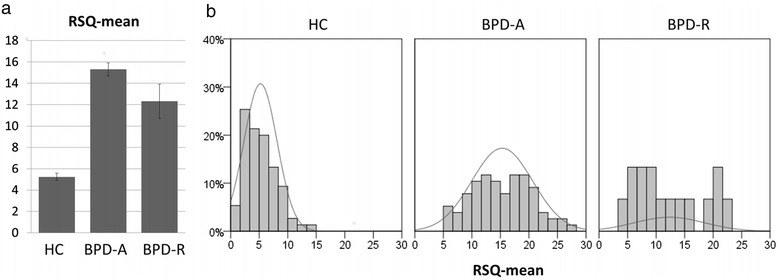
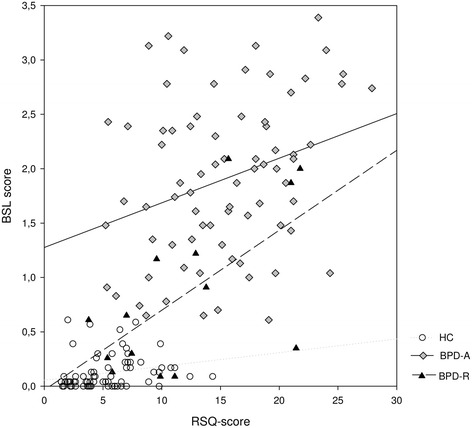
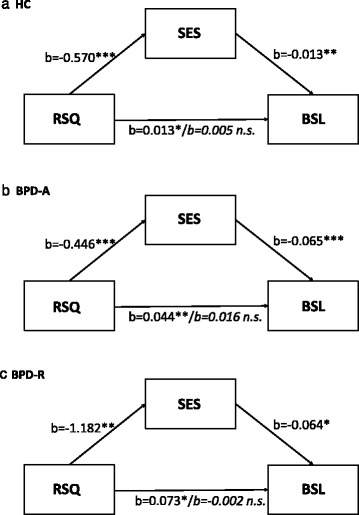
BACKGROUND: Interpersonal dysfunction in Borderline Personality Disorder (BPD) is characterized by an 'anxious preoccupation with real or imagined abandonment' (DSM-5). This symptom description bears a close resemblance to that of rejection sensitivity, a cognitive affective disposition that affects perceptions, emotions and behavior in the context of social rejection. The present study investigates the level of rejection sensitivity in acute and remitted BPD patients and its relation to BPD symptom severity, childhood maltreatment, and self-esteem. METHODS: Data were obtained from 167 female subjects: 77 with acute BPD, 15 with remitted BPD, and 75 healthy controls who were matched with the patients for age and education. The instruments used for assessment were the Rejection Sensitivity Questionnaire, the short version of the Borderline Symptom List, the Childhood Trauma Questionnaire, and the Rosenberg Self-Esteem Scale. RESULTS: Both acute and remitted BPD patients had higher scores on the Rejection Sensitivity Questionnaire than did healthy controls. Lower self-esteem was found to be positively correlated with both increased BPD symptom severity and higher rejection sensitivity, and mediated the relation between the two. History of childhood maltreatment did not correlate with rejection sensitivity, BPD symptom severity, or self-esteem. CONCLUSIONS: Our findings support the hypothesis that rejection sensitivity is an important component in BPD, even for remitted BPD patients. Level of self-esteem appears to be a relevant factor in the relationship between rejection sensitivity and BPD symptom severity. Therapeutic interventions for BPD would do well to target rejection sensitivity.
Overview
The claims and statistics of this paper haven’t been checked yet.
Free: it reads the open-access text and checks the first 5 claims that cite a source we can check. Create a free account to check every claim.
Integrity signals
Registry
Cites
Statistics
Figures
Verification
Claims the paper makes
The claims and statistics of this paper haven’t been checked yet.
Free: it reads the open-access text and checks the first 5 claims that cite a source we can check. Create a free account to check every claim.
Claims other papers make about this one
Each is checked against this paper’s own text: does it say what the citing paper says it does?
The source backs part of the claim, not all of it — or backs it for a different population, condition or comparison.
In the citing paper
“Five studies indicated physical abuse significantly correlated with RS (Bungert, Liebke, et al., 2015;Erozkan, 2015;Feldman & Downey, 1994;Hernandez, Trout, & Liu, 2016;Kahya, 2018) and three studies indicated physical neglect correlated significantly (Bungert, Liebke, et al., 2015;Goodman et al., 2014;Kahya, 2018).”
From The link between rejection sensitivity and borderline personality disorder: A systematic review and meta-analysis (2019) · cites this paper as Bungert, Liebke, et al., 2015
Experimental — accuracy not yet measuredThe source backs part of the claim, not all of it — or backs it for a different population, condition or comparison.
In the citing paper
“Two studies considered the overall CTQ and found significant moderate correlations (Bungert, Liebke, et al., 2015;Kahya, 2018).”
From The link between rejection sensitivity and borderline personality disorder: A systematic review and meta-analysis (2019) · cites this paper as Bungert, Liebke, et al., 2015
Experimental — accuracy not yet measuredThe source backs part of the claim, not all of it — or backs it for a different population, condition or comparison.
In the citing paper
“Sexual abuse did not correlate with RS (Bungert, Liebke, et al., 2015;Chesin et al., 2015).”
From The link between rejection sensitivity and borderline personality disorder: A systematic review and meta-analysis (2019) · cites this paper as Bungert, Liebke, et al., 2015
Experimental — accuracy not yet measuredThe source backs part of the claim, not all of it — or backs it for a different population, condition or comparison.
In the citing paper
“Physical neglect was only measured in one study due to low internal reliability and a small correlation was found with RS (Bungert, Liebke, et al., 2015).”
From The link between rejection sensitivity and borderline personality disorder: A systematic review and meta-analysis (2019) · cites this paper as Bungert, Liebke, et al., 2015
Experimental — accuracy not yet measuredThe cited source says what the claim attributes to it.
In the citing paper
“However, empirical evidence on this association is inconsistent.”
From Child Maltreatment as a Risk Factor for Rejection Sensitivity: A Three-Level Meta-Analytic Review (2024) · cites this paper as Bungert et al., 2015
5 more claims about this paper
Create a free account to see every claim other papers make about this one.
Self-check
Percentages, sums and reported differences re-computed from the paper’s own numbers.
The self-check needs the paper’s full text.
Citations
Cites
Baron, R. M., & Kenny, D. A. (1986) · Journal of Personality and Social Psychology · doi:10.1037/0022-3514.51.6.1173 · Cited by 91,532 · cited 2×
“Following the definition of a mediator given by Baron and Kenny [55] hierarchical regression analyses were computed for the mediational analyses, using the SOBEL script applicable in SPSS [56].”
MethodAn inventory for measuring depression
BECK, A. T. (1961) · Archives of General Psychiatry · doi:10.1001/archpsyc.1961.01710120031004 · Cited by 38,032 · cited 1×
“Depressive symptoms were assessed using the Beck Depression Inventory (BDI [53], Cronbach’s α = .”
MethodSociety and the Adolescent Self-Image
Rosenberg, M. (1965) · doi:10.1515/9781400876136 · Cited by 30,126
James, W. (1913) · Henry Holt and Company eBooks · doi:10.1037/11059-000 · Cited by 25,226
Advances In Experimental Social Psychology
(2022) · Advances in Experimental Social Psychology · doi:10.1016/s0065-2601(22)x0002-6 · Cited by 22,259
SPSS and SAS procedures for estimating indirect effects in simple mediation models
Preacher, K. J., & Hayes, A. F. (2004) · Behavior Research Methods, Instruments, & Computers · doi:10.3758/bf03206553 · Cited by 17,383 · cited 7×
“Data from experimental studies on the experience of social encounters in BPD point in a similar direction: BPD patients felt more excluded in social situations during which they had in fact been included, or during which the behavior of the social partners was determined by predefined rules and not by the partners’ in…”
BackgroundMethodInfluentialScoville, W. B. (1949) · Journal of neurosurgery · doi:10.3171/jns.1949.6.1.0065 · Cited by 7,381
(1993) · Cited by 7,136
Social learning and clinical psychology.
Rotter, J. B. (1954) · Prentice-Hall, Inc eBooks · doi:10.1037/10788-000 · Cited by 3,848
The nature and function of self-esteem: Sociometer theory
Leary, M. R., & Baumeister, R. F. (2000) · Advances in Experimental Social Psychology · doi:10.1016/s0065-2601(00)80003-9 · Cited by 2,521 · cited 2×
“Sociometer theory views self-esteem as an affective state that reflects whether an individual is included or is suited to be included in social groups of important others [38,39].”
Background
Research works printed but not linked: 3
- Downey G Khouri H Feldman S Cicchetti D Toth S Early interpersonal trauma and adult adjustment: the mediational role of rejection sensitivity Rochester symposium on developmental psychopathology, volume VIII: the effects of trauma on the developmental process 1997 New York University of Rochester Press 85 114
- Loranger AW International Personality Disorder Examination (IPDE): DSM-IV and ICD-10 modules 1999 Psychological Assessment Resources Odessa
- Bernstein DPFL Childhood trauma questionnaire: a retrospective self-report 1998 San Antonio, TX Harcourt Brace & Co.
Cited by
Childhood adversity and borderline personality disorder: a meta‐analysis
Porter, C., Palmier‐Claus, J., Branitsky, A., Mansell, W., Warwick, H., & Varese, F. (2020) · Acta Psychiatrica Scandinavica · doi:10.1111/acps.13118 · Cited by 450
Fonagy, P., Speranza, M., Luyten, P., Kaess, M., Hessels, C. J., & Bohus, M. (2015) · European Child & Adolescent Psychiatry · doi:10.1007/s00787-015-0751-z · Cited by 192
Self-citationFoxhall, M., Hamilton‐Giachritsis, C., & Button, K. (2019) · British Journal of Clinical Psychology · doi:10.1111/bjc.12216 · Cited by 107
Miano, A., Fertuck, E. A., Arntz, A., & Stanley, B. (2013) · Journal of Personality Disorders · doi:10.1521/pedi_2013_27_096 · Cited by 94
Schneider, P., Bindila, L., Schmahl, C., Bohus, M., Meyer-Lindenberg, A., Lutz, B., Spanagel, R., & Schneider, M. (2016) · Frontiers in Behavioral Neuroscience · doi:10.3389/fnbeh.2016.00203 · Cited by 89
Self-citation
Metadata
- Authors
- Bungert, M., Liebke, L., Thome, J., Haeussler, K., Bohus, M., & Lis, S.
- Affiliations
- Heidelberg University (DE)
- Corresponding author
- Bungert, Melanie
- Venue
- Borderline Personality Disorder and Emotion Dysregulation
- Published
- 2015-03-20
- Volume
- 2
- Issue
- 1
- Pages
- 4-4
- ISSN
- 2051-6673 (ISSN-L)
- PMC
- PMC4579499
- OpenAlex
- W2127723990
- Semantic Scholar
- 4e744164bf5282153f0ce1eed8e0f95afe63ccd7
- Cited by
- 92
- References
- 87
- Citations by year
- 2026: 4 · 2025: 5 · 2024: 7 · 2023: 5 · 2022: 8 · 2021: 13 · 2020: 11 · 2019: 9 · 2018: 7 · 2017: 11 · 2016: 8 · 2015: 3
- FWCI
- 12.00
- Type
- journal article
- Language
- en
- Open access
- gold
- doi.org
- Locations
- Borderline Personality Disorder and Emotion Dysregulation (publishedVersion, cc-by)
- PubMed Central (publishedVersion, cc-by)
- PubMed (publishedVersion)
- Funders
- Deutsche Forschungsgemeinschaft (KFO-256)
- Topics
- Social Sciences › Psychology › Clinical Psychology › Personality Disorders and Psychopathology
- Social Sciences › Psychology › Clinical Psychology › Personality Traits and Psychology
- Social Sciences › Psychology › Social Psychology › Death Anxiety and Social Exclusion
- Keywords
- rejection sensitivity, borderline personality disorder, symptom severity, self-esteem, child abuse, social rejection, interpersonal problems, mediation
About these checks
Registry, retraction, Cites and statistics results are computed, not judged, with one exception: a printed reference that no index lists is read once by a model before it counts as a citation error. Claims are extracted by a model and kept only when their quote appears verbatim in the text; each cited source is then checked, with a model’s help, for whether it says what the claim relies on. Those verdicts can be wrong — read the claim’s quote and the cited source before relying on one.
Statistics and arithmetic are recomputed, not judged.
Confidence bands are shown only for fields calibrated on our annotated test set. None is calibrated yet, so no band is shown.
What counts as a claim ›How we measure confidence ›How we check this ›
Are you an author, or do you see a problem with this page? Request a review
How to cite
Cite CoChat for the checks on this page, and the paper for its own findings.
- This page
- CoChat. (2026). Citation check: Rejection sensitivity and symptom severity in patients with borderline personality disorder: effects of childhood maltreatment and self-esteem. https://app.cochat.ai/papers/10.1186/s40479-015-0025-x
- The paper
- Bungert, M., Liebke, L., Thome, J., Haeussler, K., Bohus, M., & Lis, S. (2015). Rejection sensitivity and symptom severity in patients with borderline personality disorder: effects of childhood maltreatment and self-esteem. Borderline Personality Disorder and Emotion Dysregulation. https://doi.org/10.1186/s40479-015-0025-x
Data sources
Bibliographic data: Semantic Scholar, OpenAlex, Crossref.
Contains information from the Semantic Scholar Academic Graph Datasets, made available under the ODC Attribution License (ODC-BY 1.0).
Semantic Scholar’s data is described in: Kinney, R., et al. (2023). The Semantic Scholar Open Data Platform. arXiv:2301.10140.
