

Rejection sensitivity and symptom severity in patients with borderline personality disorder: effects of childhood maltreatment and self-esteem
Open accessThe DOI matches its Crossref record; 87 of the 87 references it cites were found in a registry or an index.
Abstract
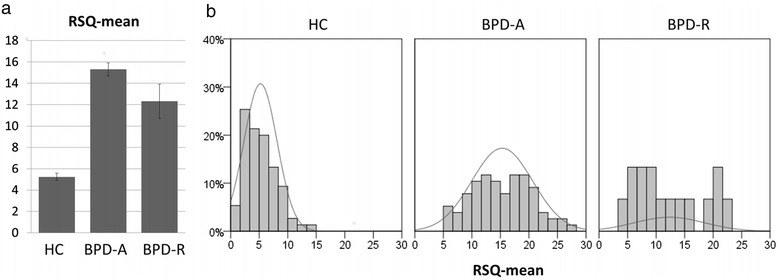
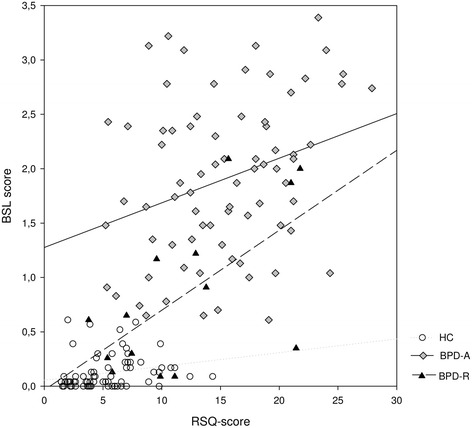
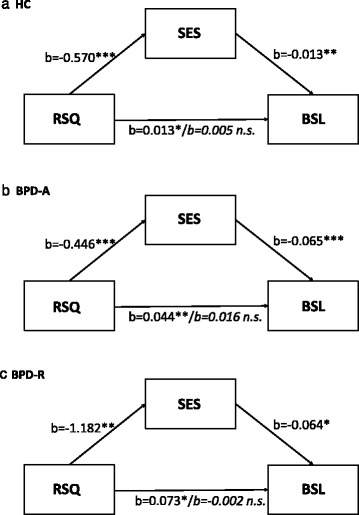
BACKGROUND: Interpersonal dysfunction in Borderline Personality Disorder (BPD) is characterized by an 'anxious preoccupation with real or imagined abandonment' (DSM-5). This symptom description bears a close resemblance to that of rejection sensitivity, a cognitive affective disposition that affects perceptions, emotions and behavior in the context of social rejection. The present study investigates the level of rejection sensitivity in acute and remitted BPD patients and its relation to BPD symptom severity, childhood maltreatment, and self-esteem. METHODS: Data were obtained from 167 female subjects: 77 with acute BPD, 15 with remitted BPD, and 75 healthy controls who were matched with the patients for age and education. The instruments used for assessment were the Rejection Sensitivity Questionnaire, the short version of the Borderline Symptom List, the Childhood Trauma Questionnaire, and the Rosenberg Self-Esteem Scale. RESULTS: Both acute and remitted BPD patients had higher scores on the Rejection Sensitivity Questionnaire than did healthy controls. Lower self-esteem was found to be positively correlated with both increased BPD symptom severity and higher rejection sensitivity, and mediated the relation between the two. History of childhood maltreatment did not correlate with rejection sensitivity, BPD symptom severity, or self-esteem. CONCLUSIONS: Our findings support the hypothesis that rejection sensitivity is an important component in BPD, even for remitted BPD patients. Level of self-esteem appears to be a relevant factor in the relationship between rejection sensitivity and BPD symptom severity. Therapeutic interventions for BPD would do well to target rejection sensitivity.
Overview
The claims and statistics of this paper haven’t been checked yet.
Free: it reads the open-access text and checks the first 5 claims that cite a source we can check. Create a free account to check every claim.
Integrity signals
Registry
Cites
Statistics
Figures
Verification
Claims the paper makes
The claims and statistics of this paper haven’t been checked yet.
Free: it reads the open-access text and checks the first 5 claims that cite a source we can check. Create a free account to check every claim.
Claims other papers make about this one
Each is checked against this paper’s own text: does it say what the citing paper says it does?
The source backs part of the claim, not all of it — or backs it for a different population, condition or comparison.
In the citing paper
“Five studies indicated physical abuse significantly correlated with RS (Bungert, Liebke, et al., 2015;Erozkan, 2015;Feldman & Downey, 1994;Hernandez, Trout, & Liu, 2016;Kahya, 2018) and three studies indicated physical neglect correlated significantly (Bungert, Liebke, et al., 2015;Goodman et al., 2014;Kahya, 2018).”
From The link between rejection sensitivity and borderline personality disorder: A systematic review and meta-analysis (2019) · cites this paper as Bungert, Liebke, et al., 2015
Experimental — accuracy not yet measuredThe source backs part of the claim, not all of it — or backs it for a different population, condition or comparison.
In the citing paper
“Two studies considered the overall CTQ and found significant moderate correlations (Bungert, Liebke, et al., 2015;Kahya, 2018).”
From The link between rejection sensitivity and borderline personality disorder: A systematic review and meta-analysis (2019) · cites this paper as Bungert, Liebke, et al., 2015
Experimental — accuracy not yet measuredThe source backs part of the claim, not all of it — or backs it for a different population, condition or comparison.
In the citing paper
“Sexual abuse did not correlate with RS (Bungert, Liebke, et al., 2015;Chesin et al., 2015).”
From The link between rejection sensitivity and borderline personality disorder: A systematic review and meta-analysis (2019) · cites this paper as Bungert, Liebke, et al., 2015
Experimental — accuracy not yet measuredThe source backs part of the claim, not all of it — or backs it for a different population, condition or comparison.
In the citing paper
“Physical neglect was only measured in one study due to low internal reliability and a small correlation was found with RS (Bungert, Liebke, et al., 2015).”
From The link between rejection sensitivity and borderline personality disorder: A systematic review and meta-analysis (2019) · cites this paper as Bungert, Liebke, et al., 2015
Experimental — accuracy not yet measuredThe cited source says what the claim attributes to it.
In the citing paper
“However, empirical evidence on this association is inconsistent.”
From Child Maltreatment as a Risk Factor for Rejection Sensitivity: A Three-Level Meta-Analytic Review (2024) · cites this paper as Bungert et al., 2015
5 more claims about this paper
Create a free account to see every claim other papers make about this one.
Self-check
Percentages, sums and reported differences re-computed from the paper’s own numbers.
The self-check needs the paper’s full text.
Citations
Cites
Baron, R. M., & Kenny, D. A. (1986) · Journal of Personality and Social Psychology · doi:10.1037/0022-3514.51.6.1173 · Cited by 91,532 · cited 2×
“Following the definition of a mediator given by Baron and Kenny [55] hierarchical regression analyses were computed for the mediational analyses, using the SOBEL script applicable in SPSS [56].”
MethodAn inventory for measuring depression
BECK, A. T. (1961) · Archives of General Psychiatry · doi:10.1001/archpsyc.1961.01710120031004 · Cited by 38,032 · cited 1×
“Depressive symptoms were assessed using the Beck Depression Inventory (BDI [53], Cronbach’s α = .”
MethodSociety and the Adolescent Self-Image
Rosenberg, M. (1965) · doi:10.1515/9781400876136 · Cited by 30,126
James, W. (1913) · Henry Holt and Company eBooks · doi:10.1037/11059-000 · Cited by 25,226
Advances In Experimental Social Psychology
(2022) · Advances in Experimental Social Psychology · doi:10.1016/s0065-2601(22)x0002-6 · Cited by 22,259
SPSS and SAS procedures for estimating indirect effects in simple mediation models
Preacher, K. J., & Hayes, A. F. (2004) · Behavior Research Methods, Instruments, & Computers · doi:10.3758/bf03206553 · Cited by 17,383 · cited 7×
“Data from experimental studies on the experience of social encounters in BPD point in a similar direction: BPD patients felt more excluded in social situations during which they had in fact been included, or during which the behavior of the social partners was determined by predefined rules and not by the partners’ in…”
BackgroundMethodInfluentialScoville, W. B. (1949) · Journal of neurosurgery · doi:10.3171/jns.1949.6.1.0065 · Cited by 7,381
(1993) · Cited by 7,136
Social learning and clinical psychology.
Rotter, J. B. (1954) · Prentice-Hall, Inc eBooks · doi:10.1037/10788-000 · Cited by 3,848
The nature and function of self-esteem: Sociometer theory
Leary, M. R., & Baumeister, R. F. (2000) · Advances in Experimental Social Psychology · doi:10.1016/s0065-2601(00)80003-9 · Cited by 2,521 · cited 2×
“Sociometer theory views self-esteem as an affective state that reflects whether an individual is included or is suited to be included in social groups of important others [38,39].”
Background
Research works printed but not linked: 3
- Downey G Khouri H Feldman S Cicchetti D Toth S Early interpersonal trauma and adult adjustment: the mediational role of rejection sensitivity Rochester symposium on developmental psychopathology, volume VIII: the effects of trauma on the developmental process 1997 New York University of Rochester Press 85 114
- Loranger AW International Personality Disorder Examination (IPDE): DSM-IV and ICD-10 modules 1999 Psychological Assessment Resources Odessa
- Bernstein DPFL Childhood trauma questionnaire: a retrospective self-report 1998 San Antonio, TX Harcourt Brace & Co.
Cited by
Childhood adversity and borderline personality disorder: a meta‐analysis
Porter, C., Palmier‐Claus, J., Branitsky, A., Mansell, W., Warwick, H., & Varese, F. (2020) · Acta Psychiatrica Scandinavica · doi:10.1111/acps.13118 · Cited by 450
Fonagy, P., Speranza, M., Luyten, P., Kaess, M., Hessels, C. J., & Bohus, M. (2015) · European Child & Adolescent Psychiatry · doi:10.1007/s00787-015-0751-z · Cited by 192
Self-citationFoxhall, M., Hamilton‐Giachritsis, C., & Button, K. (2019) · British Journal of Clinical Psychology · doi:10.1111/bjc.12216 · Cited by 107
Miano, A., Fertuck, E. A., Arntz, A., & Stanley, B. (2013) · Journal of Personality Disorders · doi:10.1521/pedi_2013_27_096 · Cited by 94
Schneider, P., Bindila, L., Schmahl, C., Bohus, M., Meyer-Lindenberg, A., Lutz, B., Spanagel, R., & Schneider, M. (2016) · Frontiers in Behavioral Neuroscience · doi:10.3389/fnbeh.2016.00203 · Cited by 89
Self-citationWinter, D., Bohus, M., & Lis, S. (2017) · Current Psychiatry Reports · doi:10.1007/s11920-017-0771-0 · Cited by 101
Self-citationDistinguishing and Addressing Gender Minority Stress and Borderline Personality Symptoms
Goldhammer, H., Crall, C. S., & Keuroghlian, A. S. (2019) · Harvard Review of Psychiatry · doi:10.1097/hrp.0000000000000234 · Cited by 92
State-Dependent Cross-Brain Information Flow in Borderline Personality Disorder
Bilek, E., Stößel, G., Schäfer, A., Clement, L., Ruf, M., Robnik, L., Neukel, C., Tost, H., Kirsch, P., & Meyer-Lindenberg, A. (2017) · JAMA Psychiatry · doi:10.1001/jamapsychiatry.2017.1682 · Cited by 69
Joss, D., Khan, A., Lazar, S. W., & Teicher, M. H. (2019) · Frontiers in Psychology · doi:10.3389/fpsyg.2019.02373 · Cited by 65
“, 2010), which in turn contributes to other psychological health issues (Stein et al., 2002; Dunkley et al., 2010; Bungert et al., 2015).”
BackgroundConfidence in facial emotion recognition in borderline personality disorder.
Thome, J., Liebke, L., Bungert, M., Schmahl, C., Domes, G., Bohus, M., & Lis, S. (2016) · Personality Disorders: Theory, Research, and Treatment · doi:10.1037/per0000142 · Cited by 64
Self-citationJuurlink, T. T., Vukadin, M., Stringer, B., Westerman, M. J., Lamers, F., Anema, J. R., Beekman, A. T. F., & van Marle, H. J. F. (2019) · PLoS ONE · doi:10.1371/journal.pone.0220233 · Cited by 57
Adolescent social rejection alters pain processing in a CB1 receptor dependent manner
Schneider, P., Pätz, M., Spanagel, R., & Schneider, M. (2016) · European Neuropsychopharmacology · doi:10.1016/j.euroneuro.2016.04.007 · Cited by 38
Lu, W.-H., Lee, K., Ko, C., Hsiao, R. C.-J., Hu, H., & Yen, C. (2017) · Journal of Behavioral Addictions · doi:10.1556/2006.6.2017.053 · Cited by 49
“…addiction demonstrated in previous studies (Dalbudak et al., 2014; Wu et al., 2016), the strong association between BPD and mental health problems (Bungert et al., 2015; Gardner et al., 2012; Grant et al., 2008), and the association between mental health problems and increased risk of Internet…”
BackgroundBehavioural mimicry and loneliness in borderline personality disorder
Hauschild, S., Winter, D., Thome, J., Liebke, L., Schmahl, C. G., Bohus, M., & Lis, S. (2018) · Comprehensive Psychiatry · doi:10.1016/j.comppsych.2018.01.005 · Cited by 46
Self-citationXie, G.-D., Chang, J.-J., Yuan, M., Wang, G., He, Y., Chen, S.-S., & Su, P. (2021) · BMC Psychiatry · doi:10.1186/s12888-021-03332-w · Cited by 49
Winter, D. (2016) · Borderline Personality Disorder and Emotion Dysregulation · doi:10.1186/s40479-016-0047-z · Cited by 36
“Individuals with BPD report low selfesteem [116, 117] and provide negative self-descriptions [118].”
BackgroundKeng, S., & Tan, H. H. (2017) · Behaviour Research and Therapy · doi:10.1016/j.brat.2017.11.005 · Cited by 52
Child Maltreatment as a Risk Factor for Rejection Sensitivity: A Three-Level Meta-Analytic Review
Gao, S., Assink, M., Bi, C., & Chan, K. L. (2024) · Trauma, Violence, & Abuse · doi:10.1177/15248380231162979 · Cited by 41
“…some studies have found relatively strong associations between child maltreatment and rejection sensitivity (with correlations > 0.450; e.g., Bungert et al., 2015; Chesin et al., 2015), but other studies reported relatively weak associations between child mal-treatment and rejection…”
ResultInfluentialPohl, S., Steuwe, C., Mainz, V., Drießen, M., & Beblo, T. (2020) · Journal of Clinical Psychology · doi:10.1002/jclp.23070 · Cited by 48
Ikhtabi, S., Pitman, A., Toh, G., Birken, M., Pearce, E., & Johnson, S. (2022) · BMC Psychiatry · doi:10.1186/s12888-022-03767-9 · Cited by 40
Winter, D., Steeb, L., Herbert, C., Sedikides, C., Schmahl, C. G., Bohus, M., & Lis, S. (2018) · Behaviour Research and Therapy · doi:10.1016/j.brat.2018.07.008 · Cited by 41
Self-citationKleindienst, N., Hauschild, S., Liebke, L., Thome, J., Bertsch, K., Hensel, S., & Lis, S. (2019) · Borderline Personality Disorder and Emotion Dysregulation · doi:10.1186/s40479-019-0114-3 · Cited by 39
“Rejection sensitivity was measured with a German version of the Rejection Sensitivity Questionnaire (RSQ) for adults [41, 42].”
MethodSelf-citationMalejko, K., Neff, D., Brown, R. C., Plener, P. L., Bonenberger, M., Abler, B., & Graf, H. (2019) · Brain Topography · doi:10.1007/s10548-019-00712-0 · Cited by 32
Houben, M., Claes, L., Sleuwaegen, E., Berens, A., & Vansteelandt, K. (2018) · Borderline Personality Disorder and Emotion Dysregulation · doi:10.1186/s40479-018-0095-7 · Cited by 35
“Moreover, BPD has consistently been linked to low self-esteem [27, 35].”
BackgroundCan’t stand the look in the mirror? Self-awareness avoidance in borderline personality disorder
Winter, D., Koplin, K., & Lis, S. (2015) · Borderline Personality Disorder and Emotion Dysregulation · doi:10.1186/s40479-015-0034-9 · Cited by 23
“As one factor contributing to these difficulties, studies demonstrated that BPD patients expect to be rejected more frequently in social interactions than healthy controls and are more concerned by this perception in social interactions [4–7].”
BackgroundSelf-citationAl-Salom, P., & Boylan, K. (2019) · Europe PMC (PubMed Central) · Cited by 29
Joss, D., Khan, A., Lazar, S. W., & Teicher, M. H. (2020) · Behavioural Brain Research · doi:10.1016/j.bbr.2020.113023 · Cited by 25
Schneider, I., Bertsch, K., Hidalgo, N. A. I., Müller, L. E., Schmahl, C., & Herpertz, S. (2018) · European Archives of Psychiatry and Clinical Neuroscience · doi:10.1007/s00406-017-0841-7 · Cited by 20
“Nevertheless, certain pathologies seem to be more trait-like: Individuals with current as well as remitted BPD have been found, for instance, to show higher scores of rejection sensitivity [8] and social dysfunction [9, 10].”
Schaich, A., Assmann, N., Köhne, S., Alvarez‐Fischer, D., Borgwardt, S., Schweiger, U., Klein, J. P., & Faßbinder, E. (2021) · European Journal of Psychotraumatology · doi:10.1080/20008198.2021.1934300 · Cited by 29
“However, compared to their study and most other studies investigating childhood maltreatment in patients with BPD (Bøen et al., 2015; Bungert et al., 2015; Ferrer et al., 2017; Nicol, Pope, Romaniuk, & Hall, 2015), BPD patients in our sample reported higher scores on the CTQ while the depressed…”
ResultFlasbeck, V., Enzi, B., & Brüne, M. (2019) · World Journal of Biological Psychiatry · doi:10.1080/15622975.2017.1333147 · Cited by 24
“2011), and the group of Bungert and collegues demonstrated that rejection sensitivity and BPD symptoms severity correlated positively with lower selfesteem (Bungert et al. 2015).”
BackgroundAtypical processing of social anticipation and feedback in borderline personality disorder
Doell, K. C., Olié, E., Courtet, P., Corradi-Dell'Acqua, C., Perroud, N., & Schwartz, S. (2020) · NeuroImage: Clinical · doi:10.1016/j.nicl.2019.102126 · Cited by 21
“(Bungert et al., 2015)), express an attentional bias toward negative emotional information (BPD adults: (Domes et al.”
BackgroundBorderline Personality Disorder Features and Sensitivity to Injustice
Lis, S., Schaedler, A., Liebke, L., Hauschild, S., Thome, J., Schmahl, C. G., Stahlberg, D., Kleindienst, N., & Bohus, M. (2017) · Journal of Personality Disorders · doi:10.1521/pedi_2017_31_292 · Cited by 25
Self-citationEuler, S., Wrege, J. S., Busmann, M., Lindenmeyer, H. J., Sollberger, D., Lang, U. E., Gaab, J., & Walter, M. (2018) · Frontiers in Psychology · doi:10.3389/fpsyg.2018.00824 · Cited by 29
“Consequently, rejection sensitivity has been proposed as a target of therapeutic interventions (Renneberg et al., 2012; Bungert et al., 2015).”
BackgroundBertele, N., Talmon, A., Gross, J. J., Schmahl, C. G., Schmitz, M., & Niedtfeld, I. (2022) · Journal of Personality Disorders · doi:10.1521/pedi.2022.36.3.264 · Cited by 22
Blasczyk-Schiep, S., Kazén, M., Jaworska-Andryszewska, P., & Kühl, J. (2017) · The European Journal of Psychiatry · doi:10.1016/j.ejpsy.2017.10.003 · Cited by 21
Kahya, Y. (2021) · Journal of Interpersonal Violence · doi:10.1177/0886260518786499 · Cited by 16
“Therefore, rejection sensitivity would mediate the association between CAN and IPV-V/IPV-P in the current study.”
BackgroundInfluentialSeewer, N., Skoko, A., Käll, A., Andersson, G., Luhmann, M., Berger, T., & Krieger, T. (2022) · JMIR Research Protocols · doi:10.2196/36358 · Cited by 14
“75) for a healthy sample of adults [97].”
BackgroundD’Astolfo, L., Kirchner, L., & Rief, W. (2020) · Clinical Psychology in Europe · doi:10.32872/cpe.v2i2.2997 · Cited by 20
“…Schonfeld, & Laurent, 2015; Gao, Assink, Cipriani, & Lin, 2017) and the course of various mental disorders (e.g. Bungert et al., 2015; De Panfilis, Riva, Preti, Cabrino, & Marchesi, 2015; Kimbrel, 2008; Slavich, O’Donovan, Epel, & Kemeny, 2010), ecologically…”
High Rejection Sensitivity in Patients With Somatoform Pain Disorder
Nacak, Y., Morawa, E., & Erim, Y. (2021) · Frontiers in Psychiatry · doi:10.3389/fpsyt.2021.602981 · Cited by 19
Howard, R., Hasin, D. S., & Stohl, M. (2020) · Personality and Mental Health · doi:10.1002/pmh.1491 · Cited by 15
Qu, Y. (2024) · Child Abuse & Neglect · doi:10.1016/j.chiabu.2024.107020 · Cited by 15
Winter, D., Koplin, K., Schmahl, C. G., Bohus, M., & Lis, S. (2016) · Psychiatry Research · doi:10.1016/j.psychres.2016.03.042 · Cited by 14
Self-citationApproach and Avoidance Behavior in Female Patients With Borderline Personality Disorder
Wiesenfeller, J., Flasbeck, V., Brown, E. C., & Brüne, M. (2020) · Frontiers in Behavioral Neuroscience · doi:10.3389/fnbeh.2020.588874 · Cited by 14
“, 2018), corroborating the finding that rejection hypersensitivity is a core feature of BPD (Staebler et al., 2011a,b; Bungert et al., 2015).”
BackgroundLaddis, A. (2019) · Journal of Trauma & Dissociation · doi:10.1080/15299732.2018.1451804 · Cited by 9
“For patients with Complex PTSD, staging the psychodynamics of disorder begins with their proneness to “catastrophize” (Bungert et al., 2015; Dunmore et al., 1997).”
BackgroundBrück, C., Derstroff, S., Jacob, H., Wolf‐Arehult, M., Wekenmann, S., & Wildgruber, D. (2016) · Journal of Personality Disorders · doi:10.1521/pedi_2016_30_245 · Cited by 10
“Considering the cognitive underpinnings of a skewed evaluation of emotions, recent ideas suggest a role of dysfunctional expectations in biasing perceptions: Considering, for example, the expectation of rejection linked with BPD (Bungert et al., 2015), one may assume that patients’ interpretations are influenced to re…”
BackgroundJuurlink, T. T. (2021) · Pure Amsterdam UMC · Cited by 13
Richmond, J. R., Edmonds, K. A., Rose, J. P., & Gratz, K. L. (2021) · Personality and Individual Differences · doi:10.1016/j.paid.2020.110532 · Cited by 11
Orth, L., Zweerings, J., Ibrahim, C. N., Neuner, I., & Sarkheil, P. (2020) · NeuroImage Clinical · doi:10.1016/j.nicl.2020.102324 · Cited by 10
“Apart from this, most investigations of self-related processing in BPD have focused largely on the evaluation of self-esteem, revealing low (Bungert et al., 2015; Lynum et al., 2008) or unstable (Hochschild Tolpin et al.”
BackgroundKot, E., Kostecka, B., Radoszewska, J., & Kucharska, K. (2023) · Borderline Personality Disorder and Emotion Dysregulation · doi:10.1186/s40479-023-00232-1 · Cited by 11
“Our result is also in line with the studies on self-referential processing in BPD pointing to decreased self-esteem [66] and increased self-criticism [67].”
Barton, B. B., Reinhard, M. A., Goerigk, S. A., Wüstenberg, T., Musil, R., Ehring, T. W., Jobst, A., Dewald‐Kaufmann, J., & Padberg, F. (2022) · Behaviour Research and Therapy · doi:10.1016/j.brat.2022.104232 · Cited by 14
“Patients with BPD and PDD were found to be highly rejection sensitive (Bungert et al., 2015; Cavicchioli & Maffei, 2020; Foxhall et al., 2019; Gao et al., 2017; Nenov-Matt et al., 2020).”
Richmond, J. R., Edmonds, K. A., Rose, J. P., & Gratz, K. L. (2020) · Personality Disorders Theory Research and Treatment · doi:10.1037/per0000381 · Cited by 11
Sarkar, N. K., Zainal, N. H., & Newman, M. G. (2024) · Journal of Affective Disorders · doi:10.1016/j.jad.2024.08.107 · Cited by 9
Attributional style in Borderline personality disorder is associated with self-esteem and loneliness
Schulze, A., Rommelfanger, B., Schendel, E., Schott, H., Lerchl, A., Vonderlin, R., & Lis, S. (2024) · Borderline Personality Disorder and Emotion Dysregulation · doi:10.1186/s40479-024-00263-2 · Cited by 10
“…to our knowledge no study has so far investigated the association between these constructs for people with a diagnosis of BPD. Low self-esteem, impairments of psychosocial functioning and high loneliness have been well-established findings in many studies on BPD (see for example [32, 41, 43, 44]).”
Self-citationHerpertz, S. C. (2020) · Psychotherapeut · doi:10.1007/s00278-020-00444-8 · Cited by 5
Social pain: A systematic review on interventions
Brooks, B. M., Cordero, F. J., Alchermes, S. L., & Brooks, B. M. (2025) · F1000Research · doi:10.12688/f1000research.159561.1 · Cited by 3
van der Hout, R., Barnasconi, F., Noorloos, J., de Bruin, R., Maijer, K., Legerstee, J. S., Oort, F. J., & Utens, E. M. W. J. (2022) · Clinical Child Psychology and Psychiatry · doi:10.1177/13591045221109871 · Cited by 8
“, smoking/drinking to avoid problems or dysfunctional cognitions), and less selfworth compared to healthy controls (Bungert et al., 2015; Homan, Sim, Fargo, & Twohig, 2017; Knafo et al., 2015; Winsper, Hall, Strauss, & Wolke, 2017).”
BackgroundPhysical activity in the management of borderline personality disorder: A scoping review
Petersen, J., Palić, S., Nyboe, L., Schuster, M. A., Videbech, P., & Midtgaard, J. (2025) · Psychiatry Research · doi:10.1016/j.psychres.2025.116535 · Cited by 5
“In addition to emotional instability, individuals with BPD commonly encounter sleep disturbances (Winsper et al., 2017), negative body image (Wayda-Zalewska et al., 2021), low self-esteem (Bungert et al., 2015; Lynum et al., 2008) and profound feelings of loneliness (Hauschild et al., 2018).”
Richmond, J. R., Edmonds, K. A., Rose, J. P., & Gratz, K. L. (2022) · Journal of Psychopathology and Behavioral Assessment · doi:10.1007/s10862-022-09991-7 · Cited by 5
“…the low self-esteem of individuals with heightened BPD symptoms 1 3 1078 Journal of Psychopathology and Behavioral Assessment (2022) 44:1077–1089 (Bungert et al., 2015), they would be expected to perceive upward SC targets as dissimilar to themselves and to be especially likely to identify with…”
BackgroundLunding, S. H., Ueland, T., Aas, M., Høegh, M. C., Werner, M. C. F., Rødevand, L. N., Johansen, I. T., Hjell, G., Ormerod, M. B. E. G., Ringen, P. A., et al. (2023) · Schizophrenia Research · doi:10.1016/j.schres.2023.09.041 · Cited by 7
“…investigated in the general population and in psychiatric patient samples, including cognitive-and personality characteristics (Aas et al., 2014, 2017a; Bungert et al., 2015; Dauvermann and Donohoe, 2019; Kilian et al., 2018; Reiland and Lauterbach, 2008; Richard-Lepouriel et al., 2019; Roy, 2005).”
BackgroundLafait, A.-C., & Philippot, P. (2022) · European Review of Applied Psychology · doi:10.1016/j.erap.2022.100820 · Cited by 6
The relationship between rejection sensitivity and borderline personality features: A meta-analysis
Zhang, W., Hu, N., Ding, X., & Li, J. (2021) · Advances in Psychological Science · doi:10.3724/sp.j.1042.2021.01179 · Cited by 5
Ocisková, M., Praško, J. P., Kantor, K., Vaněk, J., Nesnídal, V., & Bělohradová, K. (2024) · Psychology Research and Behavior Management · doi:10.2147/prbm.s476768 · Cited by 5
“It also calls for careful examination of variables that might influence self-stigma in highly comorbid populations, such as individuals with BPD, and to avoid equating results of comparisons with severity indicators.”
InfluentialAdolescents' Rejection Sensitivity as Manifested in Their Self-Drawings
Goldner, L., Sachar, S. C., & Abir, A. (2018) · Art Therapy · doi:10.1080/07421656.2018.1459103 · Cited by 5
“For instance, adults with rejection sensitivity might manifest symptoms of atypical depression (Posternak & Zimmerman, 2001) or borderline personality (Bungert et al., 2015; Selby, Ward, & Joiner, 2010).”
BackgroundLecture des troubles de personnalité limite à travers la théorie de l’attachement
Vinet, C., Rahioui, H., & Louppe, F. (2017) · Annales Médico-psychologiques revue psychiatrique · doi:10.1016/j.amp.2017.06.008 · Cited by 3
Barros, K. (2016) · Cited by 3
Schulze, A., Rommelfanger, B., Schendel, E., Kammler-Sücker, K. I., & Lis, S. (2024) · Borderline Personality Disorder and Emotion Dysregulation · doi:10.1186/s40479-024-00275-y · Cited by 6
“…higher levels of experienced social exclusion were found across most experimental conditions including even conditions with an overinclusion of the participants or ball-tossing sequences that were determined by predefined rules instead of by the intentions of the alleged co-players [12, 16, 17].”
Self-citationHow does stigma impact acts of compassion among people with borderline personality disorder
Street-Mattox, C., Broome, M. R., Ng, F., Griffiths, L., & Jordan, G. (2025) · Irish Journal of Psychological Medicine · doi:10.1017/ipm.2024.72 · Cited by 2
“This heightened sensitivity can lead to increased fears of potential negative outcomes, such as rejection, judgement, or misunderstanding (Bungert et al., 2015).”
Estimating and learning personality traits of and from women with borderline personality disorder
Doppelhofer, L. M., Perla, R., Frolichs, K., Rosenblau, G., Herpertz, S. C., & Korn, C. W. (2026) · Borderline Personality Disorder and Emotion Dysregulation · doi:10.1186/s40479-025-00320-4 · Cited by 2
“Moreover, numerous studies have demonstrated that BPD is associated with lower self-esteem [121–125], heightened levels of self-criticism [13], trait-shame proneness [126], and self-disgust [127–130].”
The Research Process and Prospect of Rejection Sensitivity
郭, 瑞. (2016) · Advances in Psychology · doi:10.12677/ap.2016.64058 · Cited by 2
The Impact of Childhood Maltreatment on Risk of Borderline Personality Disorder
Feng, X., & Zhang, X. (2023) · Lecture Notes in Education Psychology and Public Media · doi:10.54254/2753-7048/3/2022490 · Cited by 1
“Individuals with high RS overrate rejection and feel that they have been hurt and rejected by their peers frequently [8].”
BackgroundTyler, K. A., & Ray, C. M. (2024) · Journal of Child Sexual Abuse · doi:10.1080/10538712.2024.2326543 · Cited by 6
“In terms of environmental influences, individuals with a history of maltreatment and maternal rejection (Bungert et al., 2015; Clift & Dutton, 2011; Krause-Utz et al., 2021; Staebler et al., 2011) are at greater risk for BP. Unlike the relatively rare BP disorder, which is a distinct diagnostic…”
BackgroundBalaya, M., & Sündermann, O. (2024) · Asia Pacific Journal of Counselling and Psychotherapy · doi:10.1080/21507686.2024.2363784 · Cited by 2
“Indeed, RS has been identified as being involved in the development of BDD (Bungert et al., 2015; Chango et al., 2012; Rowe et al., 2015; Webb et al., 2015).”
Dialectical Behavior Therapy: A Portuguese Pilot Program
Sousa-Ferreira, T., Moreira, T. A., Meireles, L., Ferreira, M. D. C., Cardoso, M., Mendes, M., Ferreira, S., & Silva, J. P. M. P. E. (2017) · Journal of Psychology Research · doi:10.17265/2159-5542/2017.08.001
Wilfer, T., Armbrust, M., Aalderink, T., & Spitzer, C. (2020) · Psychotherapeut · doi:10.1007/s00278-020-00452-8
Woods, R. (2016) · Carleton University's Institutional Repository (MacOdrum Library, Carleton University) · doi:10.22215/etd/2016-11621
Zadafshar, S., & Akrami, N. (2020) · DOAJ (DOAJ: Directory of Open Access Journals) · doi:10.22051/jwfs.2020.30205.2358 · Cited by 4
سلیم, ب. ب. ا., & الکبیر, أ. ع. م. إ. (2021) · التربية (الأزهر) مجلة علمية محکمة للبحوث التربوية والنفسية والاجتماعية) · doi:10.21608/jsrep.2021.203968
Ryle, A., & Kerr, I. B. (2020) · Wiley eBooks · doi:10.1002/9781119375210.refs
Sources for Psychotherapy’s Improvement and Criteria for Psychotherapy’s Efficacy
Laddis, A. (2017) · Frontiers in the Psychotherapy of Trauma and Dissociation · doi:10.46716/ftpd.2017.0003
Lunding, S. H., Ueland, T., Aas, M., Høegh, M. C., Werner, M. C. F., Rødevand, L. N., Johansen, I. T., Hjell, G., Ormerod, M. B. E. G., Ringen, P. A., et al. (2022) · SSRN Electronic Journal · doi:10.2139/ssrn.4113866
اضطراب صورة الجسم وعلاقته بالحساسية الانفعالية وتقدير الذات لدي المراهقين دراسة تنبؤية
حشیش, ح. إ. م. أ. (2023) · مجلة کلية التربية · doi:10.21608/jfe.2023.311812 · Cited by 1
Sun, Q., Jiang, N., Qiu, Y., & Li, F. (2025) · Asian Journal Of Social Psychology · doi:10.1111/ajsp.70000 · Cited by 1
The Sociocultural Context of Borderline Traits
Rogers, B., Wisco, B. E., & Nelson‐Gray, R. O. (2025) · Journal of Personality Disorders · doi:10.1521/pedi.2025.39.4.320
Guodie, X., Chang, J.-J., Yuan, M., Wang, G., He, Y., Chen, S.-S., & Su, P.-Y. (2021) · Figshare · doi:10.6084/m9.figshare.14897221
Guodie, X., Chang, J.-J., Yuan, M., Wang, G., He, Y., Chen, S.-S., & Su, P.-Y. (2021) · Figshare · doi:10.6084/m9.figshare.14897218
Guodie, X., Chang, J.-J., Yuan, M., Wang, G., He, Y., Chen, S.-S., & Su, P.-Y. (2021) · Figshare · doi:10.6084/m9.figshare.14897227
Guodie, X., Chang, J.-J., Yuan, M., Wang, G., He, Y., Chen, S.-S., & Su, P. (2021) · Figshare · doi:10.6084/m9.figshare.14897212
Guodie, X., Chang, J.-J., Yuan, M., Wang, G., He, Y., Chen, S.-S., & Su, P. (2021) · Figshare · doi:10.6084/m9.figshare.14897215
Xie, G.-D., Chang, J.-J., Yuan, M., Wang, G., He, Y., Chen, S.-S., & Su, P. (2021) · Figshare · doi:10.6084/m9.figshare.14897224
Krause-Utz, A., Ivory, I. A. M., Delibaş, B. D., Muñoz, I. B., & Lis, S. (2026) · Borderline Personality Disorder and Emotion Dysregulation · doi:10.1186/s40479-026-00350-6
“Additional relevant aspects could be maladaptive schemas [11], mentalization abilities, self-other distinctions [14], dissociation [15], and emotion regulation, self-esteem [26], as well as neurobiological and contextual, situational factors [8].”
Self-citationde Weerd, A., Krabbendam, A. A., Koudstaal, A., Sins, J. W. R., Schraven, J., Vermeiren, R. R. J. M., Roeleveld, J., Koopman‐Verhoeff, M. E., & Nooteboom, L. A. (2026) · PLoS ONE · doi:10.1371/journal.pone.0340173
“Moreover, they frequently engage in suicidal behaviours, non-suicidal self-injury, low self-esteem, and behavioural problems including running away and substance misuse [4,14,15].”
Kuru, E., Özdemir, İ., Öztürk, M. E., & Doğan, T. (2026) · Archives of Current Medical Research · doi:10.47482/acmr.1930382
Metadata
- Authors
- Bungert, M., Liebke, L., Thome, J., Haeussler, K., Bohus, M., & Lis, S.
- Affiliations
- Heidelberg University (DE)
- Corresponding author
- Bungert, Melanie
- Venue
- Borderline Personality Disorder and Emotion Dysregulation
- Published
- 2015-03-20
- Volume
- 2
- Issue
- 1
- Pages
- 4-4
- ISSN
- 2051-6673 (ISSN-L)
- PMC
- PMC4579499
- OpenAlex
- W2127723990
- Cited by
- 92
- References
- 87
- Citations by year
- 2026: 4 · 2025: 5 · 2024: 7 · 2023: 5 · 2022: 8 · 2021: 13 · 2020: 11 · 2019: 9 · 2018: 7 · 2017: 11 · 2016: 8 · 2015: 3
- FWCI
- 12.00
- Type
- journal article
- Language
- en
- Open access
- gold
- doi.org
- Locations
- Borderline Personality Disorder and Emotion Dysregulation (publishedVersion, cc-by)
- PubMed Central (publishedVersion, cc-by)
- PubMed (publishedVersion)
- Funders
- Deutsche Forschungsgemeinschaft (KFO-256)
- Topics
- Social Sciences › Psychology › Clinical Psychology › Personality Disorders and Psychopathology
- Social Sciences › Psychology › Clinical Psychology › Personality Traits and Psychology
- Social Sciences › Psychology › Social Psychology › Death Anxiety and Social Exclusion
- Keywords
- rejection sensitivity, borderline personality disorder, symptom severity, self-esteem, child abuse, social rejection, interpersonal problems, mediation
About these checks
Registry, retraction, Cites and statistics results are computed, not judged, with one exception: a printed reference that no index lists is read once by a model before it counts as a citation error. Claims are extracted by a model and kept only when their quote appears verbatim in the text; each cited source is then checked, with a model’s help, for whether it says what the claim relies on. Those verdicts can be wrong — read the claim’s quote and the cited source before relying on one.
Statistics and arithmetic are recomputed, not judged.
Confidence bands are shown only for fields calibrated on our annotated test set. None is calibrated yet, so no band is shown.
What counts as a claim ›How we measure confidence ›How we check this ›
Are you an author, or do you see a problem with this page? Request a review
Data sources
Bibliographic data: Semantic Scholar, OpenAlex, Crossref.
Contains information from the Semantic Scholar Academic Graph Datasets, made available under the ODC Attribution License (ODC-BY 1.0).
Semantic Scholar’s data is described in: Kinney, R., et al. (2023). The Semantic Scholar Open Data Platform. arXiv:2301.10140.
