

Geothermal exploration in a sedimentary basin: new continuous temperature data and physical rock properties from northern Oman
Open accessThe DOI matches its Crossref record; 50 of the 50 references it cites were found in a registry or an index.
Abstract
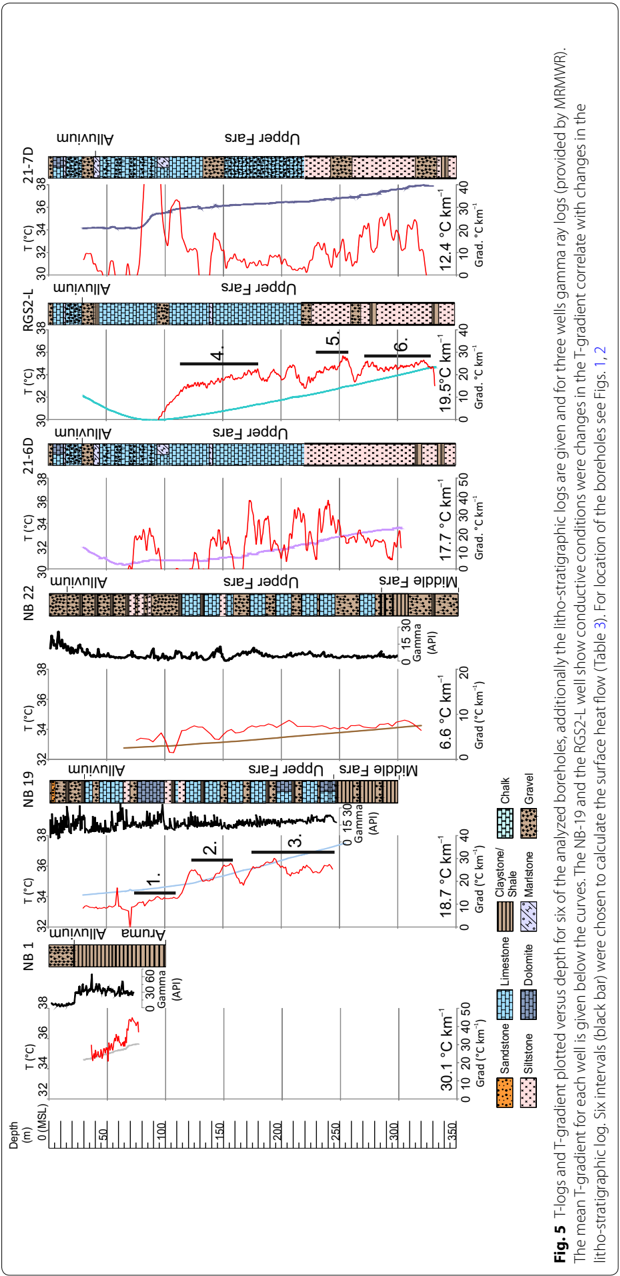
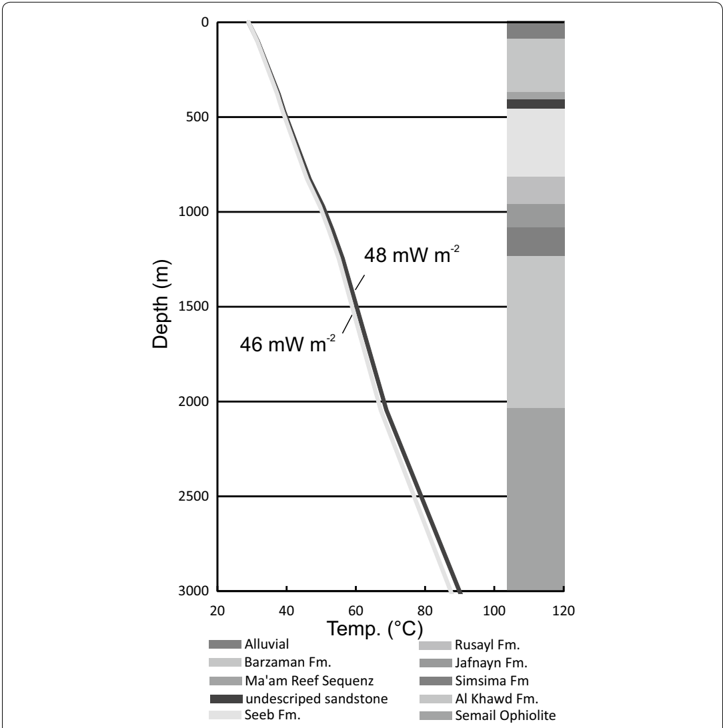
The lateral and vertical temperature distribution in Oman is so far only poorly understood, particularly in the area between Muscat and the Batinah coast, which is the area of this study and which is composed of Cenozoic sediments developed as part of a foreland basin of the Makran Thrust Zone. Temperature logs (T-logs) were run and physical rock properties of the sediments were analyzed to understand the temperature distribution, thermal and hydraulic properties, and heat-transport processes within the sedimentary cover of northern Oman. An advective component is evident in the otherwise conduction-dominated geothermal play system, and is caused by both topography and density driven flow. Calculated temperature gradients (T-gradients) in two wells that represent conductive conditions are 18.7 and 19.5 °C km−1, corresponding to about 70–90 °C at 2000–3000 m depth. This indicates a geothermal potential that can be used for energy intensive applications like cooling or water desalinization. Sedimentation in the foreland basin was initiated after the obduction of the Semail Ophiolite in the late Campanian, and reflects the complex history of alternating periods of transgressive and regressive sequences with erosion of the Oman Mountains. Thermal and hydraulic parameters were analyzed of the basin’s heterogeneous clastic and carbonate sedimentary sequence. Surface heat-flow values of 46.4 and 47.9 mW m−2 were calculated from the T-logs and calculated thermal conductivity values in two wells. The results of this study serve as a starting point for assessing different geothermal applications that may be suitable for northern Oman.
Overview
The claims and statistics of this paper haven’t been checked yet.
Free: it reads the open-access text and checks the first 5 claims that cite a source we can check. Create a free account to check every claim.
Integrity signals
Registry
Cites
Statistics
Figures
Verification
Claims the paper makes
The claims and statistics of this paper haven’t been checked yet.
Free: it reads the open-access text and checks the first 5 claims that cite a source we can check. Create a free account to check every claim.
Claims other papers make about this one
Each is checked against this paper’s own text: does it say what the citing paper says it does?
The cited source says what the claim attributes to it.
In the citing paper
“Using information from the geothermal gradient from well NB-22 [62], the Jurassic sample should have reached 169 • C at a maximum burial depth of 8 km, while the Permian sample reached 187 • C at 9 km (Table 3).”
From Clumped Isotope Reordering and Kinetic Differences in Co-Hosted Calcite and Dolomite Minerals throughout Burial Diagenesis and Exhumation (2023) · cites this paper as [62]
Self-check
Percentages, sums and reported differences re-computed from the paper’s own numbers.
The self-check needs the paper’s full text.
Citations
Cites
Thermal thickness and evolution of Precambrian lithosphere: A global study
Artemieva, I. M., & Mooney, W. D. (2001) · Journal of Geophysical Research: Solid Earth · doi:10.1029/2000jb900439 · Cited by 882 · cited 1×
“Assuming a normal heat flow at the Moho (qm = 25 mW m−2, Artemieva and Mooney 2001) and moderate radiogenic heat production in each of the crustal layers a surface heat flow of around 58 mW m−2 would be expected.”
BackgroundJohnson, P. R., Andresen, A., Collins, A. S., Fowler, A. R., Fritz, H., Ghebreab, W., Kusky, T., & Stern, R. J. (2011) · Journal of African Earth Sciences · doi:10.1016/j.jafrearsci.2011.07.003 · Cited by 817 · cited 3×
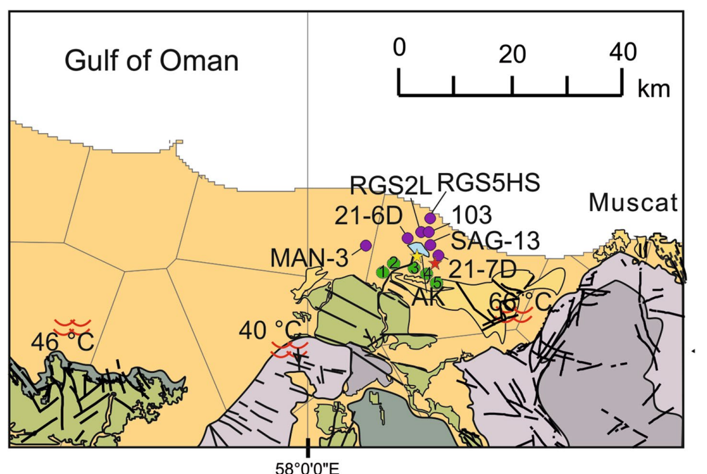
“Black lines—major faults [modified from NF40-03, Seeb sheet, 1992, Sultanate of Oman, Ministry of Petroleum and Minerals; Kusky et al. (2005), Fournier et al. (2006)]”
BackgroundContinental lithosphere of the Arabian Plate: A geologic, petrologic, and geophysical synthesis
Stern, R. J., & Johnson, P. (2010) · Earth-Science Reviews · doi:10.1016/j.earscirev.2010.01.002 · Cited by 709 · cited 3×
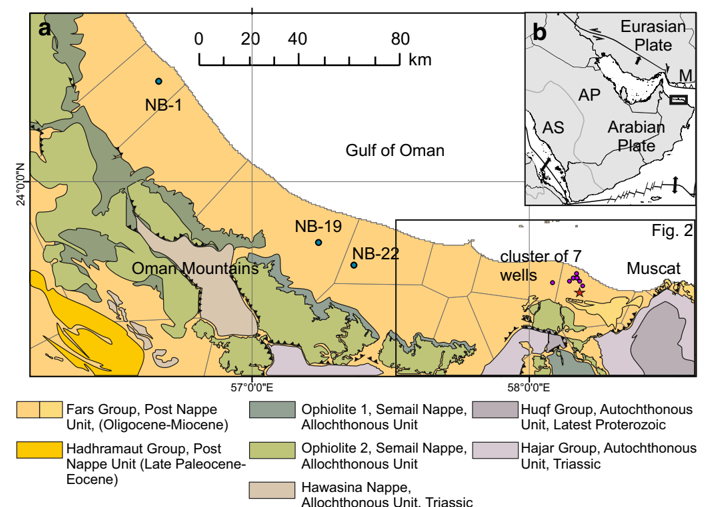
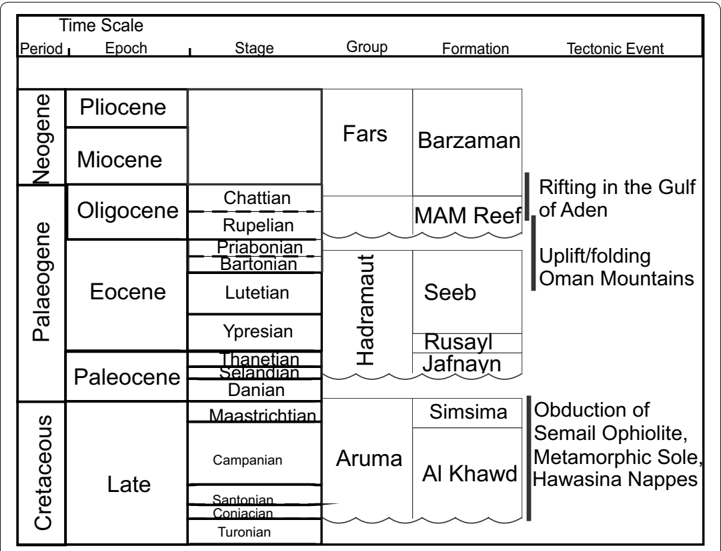
“The Hadhramaut Group and the Fars Group are an assemblage of late Maastrichtian and Tertiary sediments, unconformably deposited on top of the allochthonous units (Stern and Johnson 2010) and forming the neoautochthonous sedimentary cover (termed post nappe unit in Fig.”
BackgroundThermal structure, thickness and composition of continental lithosphere
Rudnick, R. L., McDonough, W. F., & O'Connell, R. J. (1998) · Chemical Geology · doi:10.1016/s0009-2541(97)00151-4 · Cited by 539
Metabasalts, axial hot springs, and the structure of hydrothermal systems at mid-ocean ridges
MOTTL, M. J. (1983) · Geological Society of America Bulletin · doi:10.1130/0016-7606(1983)94<161:mahsat>2.0.co;2 · Cited by 437
Tectonic setting for ophiolite obduction in Oman
Coleman, R. G. (1981) · Journal of Geophysical Research: Solid Earth · doi:10.1029/jb086ib04p02497 · Cited by 434
Thermal properties and temperature-related behavior of rock/fluid systems
(1992) · Developments in Petroleum Science · doi:10.1016/s0376-7361(09)x7002-0 · Cited by 376 · cited 1×
“To correct the thermal conductivity to the expected in situ temperature the approach of Somerton (1992) was used: where λ20 (W m−1 K−1) is the thermal conductivity at 20 °C and T (K) is the expected in situ temperature.”
MethodDesert sediments: ancient and modern
Glennie, K. W. (1987) · Geological Society, London, Special Publications · doi:10.1144/gsl.sp.1987.035.01.01 · Cited by 319
Characterization of rock thermal conductivity by high-resolution optical scanning
Popov, Y. A., Pribnow, D. F. C., Sass, J. H., Williams, C. F., & Burkhardt, H. (1999) · Geothermics · doi:10.1016/s0375-6505(99)00007-3 · Cited by 311
Comparison of Klinkenberg-corrected gas permeability and water permeability in sedimentary rocks
Tanikawa, W., & Shimamoto, T. (2009) · International Journal of Rock Mechanics and Mining Sciences · doi:10.1016/j.ijrmms.2008.03.004 · Cited by 273 · cited 1×
“2011), a procedure described in detail by Tanikawa and Shimamoto (2009).”
MethodVilà, M., Fernández, M., & Jiménez-Munt, I. (2010) · Tectonophysics · doi:10.1016/j.tecto.2010.05.003 · Cited by 233
Mantle plumes and associated flow beneath Arabia and East Africa
Chang, S.-J., & Van der Lee, S. (2011) · Earth and Planetary Science Letters · doi:10.1016/j.epsl.2010.12.050 · Cited by 228
Nyblade, A. A., & Pollack, H. N. (1993) · Journal of Geophysical Research: Solid Earth · doi:10.1029/93jb00521 · Cited by 209 · cited 1×
“Heatflow values in the middle and upper 50 mW m−2 are determined in other regions for provinces of Neoproterozoic age (Nyblade and Pollack 1993; Rudnick et al.”
BackgroundReiche, D. (2010) · Energy Policy · doi:10.1016/j.enpol.2009.12.031 · Cited by 208 · cited 1×
“The same applies to the other GCC countries, which all fall in the top 25 countries of carbon dioxide emissions per capita (Reiche 2010).”
BackgroundGeothermal Energy Systems: Exploration, Development, and Utilization
(2010) · Wiley eBooks · doi:10.1002/9783527630479 · Cited by 194 · cited 1×
“(2005), Stern and Johnson (2010), Johnson et al. (2011)].”
Self-citationPowell, W. G., Chapman, D. S., Balling, N., & Beck, A. E. (1988) · Springer eBooks · doi:10.1007/978-94-009-2847-3_5 · Cited by 178 · cited 1×
“This method is described by Powell et al. (1988) and has been applied successfully in recent heat flow studies (Förster et al.”
MethodNolan, S. C., Skelton, P. W., Clissold, B. P., & Smewing, J. D. (1990) · Geological Society, London, Special Publications · doi:10.1144/gsl.sp.1992.049.01.31 · Cited by 178 · cited 1×
“6 Geotherms calculated for a heat flow of 46 and 48 mW m−2 plotted next to stratigraphic information determined from Nolan et al. (1990)”
Searle, M. P., James, N. P., Calon, T. J., & Smewing, J. D. (1983) · Geological Society of America Bulletin · doi:10.1130/0016-7606(1983)94<1381:saseot>2.0.co;2 · Cited by 175
Sequence of thrusting and origin of culminations in the northern and central Oman Mountains
Searle, M. P. (1985) · Journal of Structural Geology · doi:10.1016/0191-8141(85)90127-0 · Cited by 152 · cited 2×
“where λlab (W m−1 K−1) is the thermal conductivity determined in the lab with zero pressure and p (MPa) is the assumed in situ pressure. To correct the thermal conductivity to the expected in situ temperature the approach of Somerton (1992) was used:”
MethodGPS evidence for northward motion of the Sinai Block: Implications for E. Mediterranean tectonics
Mahmoud, S. M., Reilinger, R. E., McClusky, S., Vernant, P., & Tealeb, A. A. (2005) · Earth and Planetary Science Letters · doi:10.1016/j.epsl.2005.06.063 · Cited by 142 · cited 1×
“AS Arabian Shield, AP Arabian Platform, M Makran Thrust Zone [modified from Mahmoud et al. (2005), Stern and Johnson (2010), Johnson et al. (2011)].”
BackgroundBreton, J.-P., Béchennec, F., Le Métour, J., Moen-Maurel, L., & Razin, P. (2004) · GeoArabia · doi:10.2113/geoarabia090241 · Cited by 130
Fournier, M., Lepvrier, C., Razin, P., & Jolivet, L. (2006) · GeoArabia · doi:10.2113/geoarabia110417 · Cited by 119 · cited 2×
“Black lines—major faults [modified from NF40-03, Seeb sheet, 1992, Sultanate of Oman, Ministry of Petroleum and Minerals; Kusky et al. (2005), Fournier et al. (2006)]”
BackgroundFuchs, S., Balling, N., & Förster, A. (2015) · Geophysical Journal International · doi:10.1093/gji/ggv403 · Cited by 115 · cited 1×
“Another option is to determine the thermal conductivity indirectly by use of different petrophysical logs (Fuchs et al. 2015).”
BackgroundNorden, B., & Förster, A. (2006) · AAPG Bulletin · doi:10.1306/01250605100 · Cited by 113 · cited 3×
“For rock types, not measured in this study, we used literature data (Norden and Förster 2006; Fuchs and Förster 2010).”
MethodInfluentialTertiary–Quaternary faulting and uplift in the northern Oman Hajar Mountains
Kusky, T., Robinson, C. A., & El‐Baz, F. (2005) · Journal of the Geological Society · doi:10.1144/0016-764904-122 · Cited by 101 · cited 2×
“AS Arabian Shield, AP Arabian Platform, M Makran Thrust Zone [modified from Mahmoud et al. (2005), Stern and Johnson (2010), Johnson et al.”
BackgroundA crustal transect across the Oman Mountains on the eastern margin of Arabia
Al-Lazki, A. I., Seber, D., Sandvol, E., & Barazangi, M. (2002) · GeoArabia · doi:10.2113/geoarabia070147 · Cited by 95
Petroleum systems in the Middle East
Alsharhan, A. S. (2014) · Geological Society London Special Publications · doi:10.1144/sp392.19 · Cited by 88
Plio-Pleistocene raised channel systems of the western Sharqiya (Wahiba), Oman
Maizels, J. K. (1987) · Geological Society London Special Publications · doi:10.1144/gsl.sp.1987.035.01.04 · Cited by 87 · cited 1×
“57.8264319), where the former alluvial stream deposits form complex systems of ‘raised’ or upstanding, sinuous, superimposed linear ridges and broad gravel sheets (Maizels 1987).”
BackgroundInfluentialMount, V. S., Crawford, R. I. S., & Bergman, S. C. (1998) · GeoArabia · doi:10.2113/geoarabia0304475 · Cited by 87
Rock thermal conductivity of Mesozoic geothermal aquifers in the Northeast German Basin
Fuchs, S., & Förster, A. (2010) · Geochemistry · doi:10.1016/j.chemer.2010.05.010 · Cited by 86 · cited 2×
“For rock types, not measured in this study, we used literature data (Norden and Förster 2006; Fuchs and Förster 2010). The Al Khawd Formation is composed of conglomerates and sandstones and a thermal conductivity of 3.2 is assumed (Beach et al. 1986; Norden and Förster 2006). The Simsima Formation is composed of biocl…”
MethodInfluentialFuchs, S., & Förster, A. (2013) · Geophysical Journal International · doi:10.1093/gji/ggt382 · Cited by 79 · cited 2×
“Pressure correction was performed of the thermal conductivity to reflect the in situ pressure conditions with the following equation (Fuchs and Förster 2013):”
MethodBeavington-Penney, S. J., Nadin, P. A., Wright, V. P., Clarke, E., McQuilken, J., & Bailey, H. W. (2008) · Sedimentary Geology · doi:10.1016/j.sedgeo.2008.06.006 · Cited by 71
Mann, A., Hanna, S. S., Nolan, S. C., Mann, A., & Hanna, S. S. (1990) · Geological Society, London, Special Publications · doi:10.1144/gsl.sp.1992.049.01.33 · Cited by 71
Borehole climatology : a new method on how to reconstruct climate
Bodri, L., & Čermák, V. (2007) · Cited by 67
Beach, R. D. W., Jones, F. W., & Majorowicz, J. A. (1987) · Geothermics · doi:10.1016/0375-6505(87)90075-7 · Cited by 62
Poupeau, G., Saddiqi, O., Michard, A., Goffé, B., & Oberhänsli, R. (1998) · Geology · doi:10.1130/0091-7613(1998)026<1139:lteoto>2.3.co;2 · Cited by 57
Walther, M., Delfs, J., Grundmann, J., Kolditz, O., & Liedl, R. (2012) · Journal of Computational and Applied Mathematics · doi:10.1016/j.cam.2012.02.008 · Cited by 53
Obduction-related planar and linear fabrics in Oman
Michard, A., Bouchez, J., & Ouazzani-Touhami, M. (1984) · Journal of Structural Geology · doi:10.1016/0191-8141(84)90082-8 · Cited by 52
Geothermal energy resources of wadi Al-Lith, Saudi Arabia
Lashin, A., Chandrasekharam, D., Al‐Arifi, N., Bassam, A. A., & Varun, C. (2014) · Journal of African Earth Sciences · doi:10.1016/j.jafrearsci.2014.05.016 · Cited by 50
Tomás, S., Frijia, G., Bömelburg, E., Zamagni, J., Perrin, C., & Mutti, M. (2016) · Sedimentary Geology · doi:10.1016/j.sedgeo.2016.05.016 · Cited by 50
New heat flow measurements in Oman and the thermal state of the Arabian Shield and Platform
Rolandone, F., Lucazeau, F., Leroy, S., Mareschal, J., Jorand, R., Goutorbe, B., & Bouquerel, H. (2013) · Tectonophysics · doi:10.1016/j.tecto.2012.12.034 · Cited by 45 · cited 3×
“Thus, the surface heat flow determined in the present and previous study (Rolandone et al. 2013) are around 10 mW m−2 lower, than the crustal setting would imply.”
BackgroundResultInfluentialWinterleitner, G., Schütz, F., Wenzlaff, C., & Huenges, E. (2018) · Geothermics · doi:10.1016/j.geothermics.2018.02.005 · Cited by 45
Self-citationDill, H. G., Wehner, H., Kus, J., Botz, R., Berner, Z. A., Stüben, D., & Al‐Sayigh, A. (2007) · International Journal of Coal Geology · doi:10.1016/j.coal.2006.12.012 · Cited by 44
Permeability of gypsum samples dehydrated in air
Milsch, H. H., Priegnitz, M., & Blöcher, G. (2011) · Geophysical Research Letters · doi:10.1029/2011gl048797 · Cited by 41 · cited 4×
“This was done using a conventional gas permeameter, and the results were adjusted with the Klinkenberg‐correction method (Milsch et al. 2011), a procedure described in detail by Tanikawa and Shimamoto (2009). The sampled rocks comprise a range of different lithologies including: conglomerate, sandstone, limestone, mud…”
BackgroundMethodInfluentialThe surface heat flow of the Arabian Shield in Jordan
Förster, A., Förster, H., Masarweh, R., Masri, A., & Tarawneh, K. (2006) · Journal of Asian Earth Sciences · doi:10.1016/j.jseaes.2006.09.002 · Cited by 38
Schütz, F., Norden, B., & A. Förster, D. G. (2011) · Basin Research · doi:10.1111/j.1365-2117.2011.00529.x · Cited by 37
Self-citationÖzcan, E., Abbasi, İ. A., Drobne, K., Govindan, A., Jovane, L., & Boukhalfa, K. (2015) · Geodinamica Acta · doi:10.1080/09853111.2015.1107437 · Cited by 34
Chitrakar, P., & Sana, A. (2015) · Journal of Hydrologic Engineering · doi:10.1061/(asce)he.1943-5584.0001284 · Cited by 22 · cited 1×
“2014; Chitrakar and Sana 2016).”
Schütz, F., Förster, H., & Förster, A. (2014) · Journal of Geodynamics · doi:10.1016/j.jog.2014.02.010 · Cited by 15 · cited 1×
“(1988) and has been applied successfully in recent heat flow studies (Förster et al. 2007; Schütz et al. 2014).”
MethodSelf-citationGeothermal Energy Systems : Exploration, Development and Utilization
Huenges, E. (2010) · Cited by 9
Self-citation
Research works printed but not linked: 2
- 1. Al-Husseini M. Launch of the Middle East geologic time scale. GeoArabia. 2008;13(4):11, 185-8.
- 19. Grundmann J, Schütze N, Heck V. Optimal integrated management of groundwater resources and irrigated agriculture in arid coastal regions. Evolving water resources systems: understanding, predicting and managing water-society interactions. In: Proceedings of ICWRS2014, Bologna, Italy, June 2014 (IAHS Publ. 364, 2014). 2014.
Cited by
Ekinci, Y. L., Balkaya, Ç., Göktürkler, G., & Özyalın, Ş. (2020) · Geophysical Journal International · doi:10.1093/gji/ggaa492 · Cited by 74
A review of recent renewable energy status and potentials in Oman
Amoatey, P., Al‐Hinai, A., Al-Mamun, A., & Baawain, M. (2021) · Sustainable Energy Technologies and Assessments · doi:10.1016/j.seta.2021.101919 · Cited by 62
Modeling, simulation, and optimization of geothermal energy production from hot sedimentary aquifers
Blank, L., Rioseco, E. M., Caiazzo, A., & Wilbrandt, U. (2020) · Computational Geosciences · doi:10.1007/s10596-020-09989-8 · Cited by 56
Winterleitner, G., Schütz, F., Wenzlaff, C., & Huenges, E. (2018) · Geothermics · doi:10.1016/j.geothermics.2018.02.005 · Cited by 45
Self-citationA review of geothermal energy status and potentials in Middle-East countries
Amoatey, P., Chen, M., Al-Maktoumi, A. K., Izady, A., & Baawain, M. (2021) · Arabian Journal of Geosciences · doi:10.1007/s12517-021-06648-9 · Cited by 40
“These geothermal parameters were estimated up to the depth of 3 km of the reservoir (Schütz et al. 2018).”
Background
Metadata
- Authors
- Schütz, F., Winterleitner, G., & Huenges, E.
- Affiliations
- GFZ Helmholtz Centre for Geosciences (DE)
- University of Potsdam (DE)
- Corresponding author
- Schütz, Felina
- Venue
- Geothermal Energy
- Published
- 2018-03-15
- Volume
- 6
- Issue
- 1
- ISSN
- 2195-9706 (ISSN-L)
- OpenAlex
- W2797791765
- Cited by
- 24
- References
- 49
- Citations by year
- 2026: 2 · 2025: 1 · 2024: 4 · 2023: 7 · 2022: 3 · 2021: 4 · 2020: 2 · 2019: 1
- FWCI
- 0.40
- Type
- journal article
- Language
- en
- Open access
- gold
- doi.org
- Licence
- cc-by
- creativecommons.org/licenses/by/4.0 (tdm)
- Locations
- Geothermal Energy (publishedVersion, cc-by)
- DOAJ (DOAJ: Directory of Open Access Journals) (submittedVersion, cc-by-sa)
- Publication Database GFZ (GFZ German Research Centre for Geosciences) (submittedVersion)
- Publication Database GFZ (GFZ German Research Centre for Geosciences) (submittedVersion, other-oa)
- publish.UP (University of Potsdam) (submittedVersion, cc-by)
- Funders
- The Research Council
- Topics
- Physical Sciences › Energy › Renewable Energy, Sustainability and the Environment › Geothermal Energy Systems and Applications
- Physical Sciences › Earth and Planetary Sciences › Geophysics › Geophysical and Geoelectrical Methods
- Physical Sciences › Earth and Planetary Sciences › Geology › Geological Studies and Exploration
- Keywords
- geothermal exploration, temperature logs, sedimentary basins, foreland basin, heat flow, thermal conductivity, advection, gravity currents, temperature gradient, Cenozoic sediments, Samail ophiolite, Oman Mountains, geothermal cooling, northern Oman
About these checks
Registry, retraction, Cites and statistics results are computed, not judged, with one exception: a printed reference that no index lists is read once by a model before it counts as a citation error. Claims are extracted by a model and kept only when their quote appears verbatim in the text; each cited source is then checked, with a model’s help, for whether it says what the claim relies on. Those verdicts can be wrong — read the claim’s quote and the cited source before relying on one.
Statistics and arithmetic are recomputed, not judged.
Confidence bands are shown only for fields calibrated on our annotated test set. None is calibrated yet, so no band is shown.
What counts as a claim ›How we measure confidence ›How we check this ›
Are you an author, or do you see a problem with this page? Request a review
Data sources
Bibliographic data: Semantic Scholar, OpenAlex, Crossref.
Contains information from the Semantic Scholar Academic Graph Datasets, made available under the ODC Attribution License (ODC-BY 1.0).
Semantic Scholar’s data is described in: Kinney, R., et al. (2023). The Semantic Scholar Open Data Platform. arXiv:2301.10140.
