

Large language models, social demography, and hegemony: comparing authorship in human and synthetic text
Open accessPublished version of a preprint
The DOI matches its Crossref record; 84 of the 84 references it cites were found in a registry or an index.
Abstract
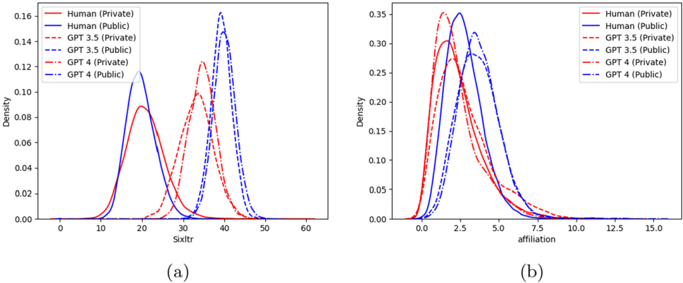
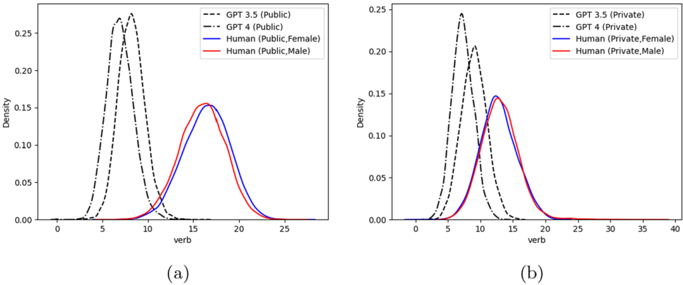
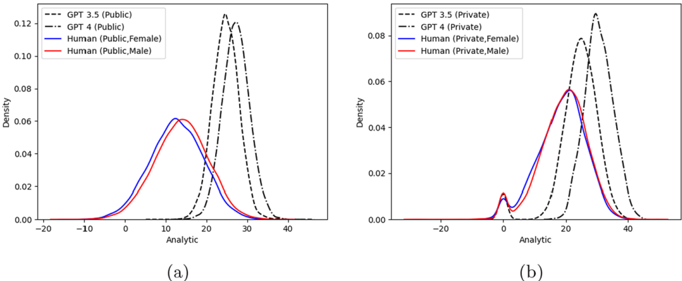
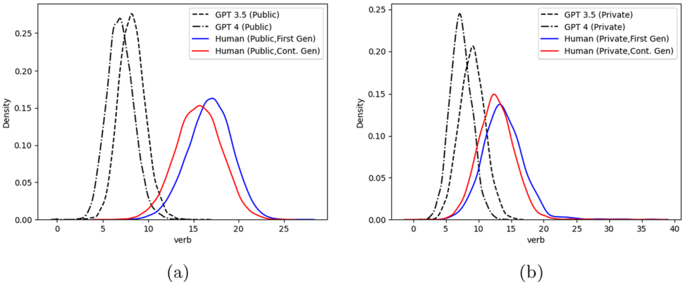
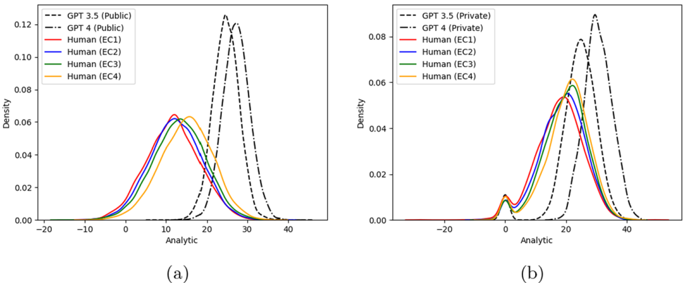
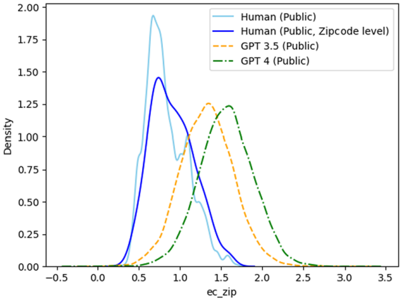
Large language models have become popular over a short period of time because they can generate text that resembles human writing across various domains and tasks. The popularity and breadth of use also put this technology in the position to fundamentally reshape how written language is perceived and evaluated. It is also the case that spoken language has long played a role in maintaining power and hegemony in society, especially through ideas of social identity and “correct” forms of language. But as human communication becomes even more reliant on text and writing, it is important to understand how these processes might shift and who is more likely to see their writing styles reflected back at them through modern AI. We therefore ask the following question: who does generative AI write like? To answer this, we compare writing style features in over 150,000 college admissions essays submitted to a large public university system and an engineering program at an elite private university with a corpus of over 25,000 essays generated with GPT-3.5 and GPT-4 to the same writing prompts. We find that human-authored essays exhibit more variability across various individual writing style features (e.g., verb usage) than AI-generated essays. Overall, we find that the AI-generated essays are most similar to essays authored by students who are males with higher levels of social privilege. These findings demonstrate critical misalignments between human and AI authorship characteristics, which may affect the evaluation of writing and calls for research on control strategies to improve alignment.
Overview
The claims and statistics of this paper haven’t been checked yet.
Free: it reads the open-access text and checks the first 5 claims that cite a source we can check. Create a free account to check every claim.
Integrity signals
Registry
Cites
Statistics
Figures

Verification
Claims the paper makes
The claims and statistics of this paper haven’t been checked yet.
Free: it reads the open-access text and checks the first 5 claims that cite a source we can check. Create a free account to check every claim.
Claims other papers make about this one
Each is checked against this paper’s own text: does it say what the citing paper says it does?
The source backs part of the claim, not all of it — or backs it for a different population, condition or comparison.
In the citing paper
“This makes LLM outputs less diverse and novel than human-written text (43, 44).”
From Delving into LLM-assisted writing in biomedical publications through excess vocabulary (2025) · cites this paper as [44]
Experimental — accuracy not yet measured
Self-check
Percentages, sums and reported differences re-computed from the paper’s own numbers.
The self-check needs the paper’s full text.
Citations
Cites
Language Models are Few-Shot Learners
Brown, T. B., Mann, B., Ryder, N., Subbiah, M., Kaplan, J., Dhariwal, P., Neelakantan, A., Shyam, P., Sastry, G., Askell, A., et al. (2020) · arXiv · doi:10.48550/arxiv.2005.14165 · Cited by 23,372 · cited 1×
“Recent advances in transformer-based architectures have enabled the development of LLMs that can generate impressively human-like text and respond to complex questions and prompts [19].”
BackgroundAdvances in neural information processing systems 7
Cios, K., & Shields, M. (1997) · Neurocomputing · doi:10.1016/s0925-2312(97)90018-7 · Cited by 22,059
On the Dangers of Stochastic Parrots: Can Language Models Be Too Big? 🦜
Bender, E. M., Gebru, T., McMillan-Major, A., & Shmitchell, S. (2021) · Proceedings of the 2021 ACM Conference on Fairness, Accountability, and Transparency · doi:10.1145/3442188.3445922 · Cited by 6,988 · cited 1×
“A better understanding of LLMs will therefore require consideration of the bias literature alongside studies of sociolinguistic profiles of LLMs. Extensive research has uncovered notable biases within LLMs [13, 25, 32, 47, 50, 63, 65, 80].”
BackgroundThe Development and Psychometric Properties of LIWC2015
Pennebaker, J. W., Boyd, R. L., Jordan, K., & Blackburn, K. (2015) · University of Texas at Austin · doi:10.15781/t25p41 · Cited by 1,674
Artificial hallucinations in ChatGPT: implications in scientific writing
Alkaissi, H., & McFarlane, S. I. (2023) · Cureus · doi:10.7759/cureus.35179 · Cited by 1,540 · cited 1×
“However, the self-evident potential of LLMs has raised critical questions about their biases, tendency to emulate certain political and moral stances, and ability to fabricate references when used as a research assistant [1, 73].”
BackgroundLaMDA: Language Models for Dialog Applications
Thoppilan, R., De Freitas, D., Hall, J., Shazeer, N., Kulshreshtha, A., Cheng, H.-T., Jin, A., Bos, T., Baker, L., Du, Y., et al. (2022) · arXiv · doi:10.48550/arxiv.2201.08239 · Cited by 778 · cited 1×
“For example, Wordcraft [88] employs a LLM [81] to assist writers with tasks such as proofreading, scene interpolation, and content generation.”
MethodSelf-citationRacial disparities in automated speech recognition
Koenecke, A., Nam, A., Lake, E., Nudell, J., Quartey, M., Mengesha, Z., Toups, C., Rickford, J. R., Jurafsky, D., & Goel, S. (2020) · Proceedings of the National Academy of Sciences · doi:10.1073/pnas.1915768117 · Cited by 765
Artificial intelligence and illusions of understanding in scientific research
Messeri, L., & Crockett, M. J. (2024) · Nature · doi:10.1038/s41586-024-07146-0 · Cited by 707 · cited 1×
“The reduced variation could potentially narrow the scope of what is considered an appropriate way to present oneself in writing if the treatment of AI as an “oracle” that is always correct persists [59].”
BackgroundGPT detectors are biased against non-native English writers
Liang, W., Yuksekgonul, M., Mao, Y., Wu, E., & Zou, J. (2023) · Patterns · doi:10.1016/j.patter.2023.100779 · Cited by 673 · cited 1×
“Conversely, students who do not speak English as a first language might find that their writing is more often labeled as “AI-generated” [52], pointing to additional ways that the current AI eco-system could reinforce linguistic hegemony (in this case, English language hegemony).”
Background
Research works printed but not linked: 17
- 12. Bellemare MG, Dabney W, Munos R. A distributional perspective on reinforcement learning. In: International confer- ence on machine learning, PMLR, pp 449-458. 2017.
- 17. Bohacek M, Farid H. Nepotistically trained generative-AI models collapse. arXiv preprint. 2023. arXiv: 2311. 12202.
- 26. Dhingra H, Jayashanker P, Moghe S, et al. Queer people are people first: deconstructing sexual identity stereotypes in large language models. http:// arxiv. org/ abs/ 2307. 00101, [cs] 2023.
- 32. Gallegos IO, Rossi RA, Barrow J, et al. Bias and fairness in large language models: a survey. http:// arxiv. org/ abs/ 2309. 00770, [cs] 2023.
- 36. Gramsci A. Prison notebooks, vol. 1. New York: Columbia University Press; 1992.
- 43. Kim J, Lee B. Ai-augmented surveys: leveraging large language models for opinion prediction in nationally repre- sentative surveys. arXiv preprint arXiv: 2305. 09620. 2023.
- 45. Kirk HR, Whitefield A, Röttger P, et al. The PRISM alignment project: what participatory, representative and individu- alised human feedback reveals about the subjective and multicultural alignment of large language models. arXiv preprint. 2024. arXiv: 2404. 16019.
- 49. Lee J, Thymes B, Zhou J, et al. Augmenting holistic review in university admission using natural language processing for essays and recommendation letters. arXiv preprint arXiv: 2306. 17575. 2023.
- 50. Lee J, Hicke Y, Yu R, et al (in press) The life cycle of large language models in education: a framework for understand- ing sources of bias. Br J Educ Technol.
- 53. Liang W, Izzo Z, Zhang Y, et al. Monitoring AI-modified content at scale: a case study on the impact of chatgpt on ai conference peer reviews. arXiv preprint. 2024. arXiv: 2403. 07183.
- 56. Lucy L, Blodgett SL, Shokouhi M, et al. "One-size-fits-all"? Observations and expectations of NLG systems across identity-related language features. http:// arxiv. org/ abs/ 2310. 15398, [cs] 2023.
- 58. Matelsky JK, Parodi F, Liu T, et al. A large language model-assisted education tool to provide feedback on open- ended responses. http:// arxiv. org/ abs/ 2308. 02439, [cs] 2023.
- 78. Shen H, Wu T. Parachute: evaluating interactive human-LM co-writing systems. arXiv: 2303. 06333. [cs] 2023.
- 79. Stevens ML. Creating a class. Cambridge: Harvard University Press; 2009.
- 80. Tao Y, Viberg O, Baker RS, et al. Auditing and mitigating cultural bias in llms. arXiv preprint arXiv: 2311. 14096. 2023.
- 83. Wang A, Morgenstern J, Dickerson JP. Large language models cannot replace human participants because they cannot portray identity groups. arXiv preprint arXiv: 2402. 01908. 2024.
- 87. Wu S, Irsoy O, Lu S, et al. BloombergGPT: a large language model for finance. http:// arxiv. org/ abs/ 2303. 17564, [cs, q-fin] 2023.
Cited by
Bias in Large Language Models: Origin, Evaluation, and Mitigation
Guo, Y., Guo, M., Su, J., Yang, Z., Zhu, M., Li, H., Qiu, M., & Liu, S. S. (2026) · Electronics · doi:10.3390/electronics15091824 · Cited by 251
“Another example is that the Latinx population, especially Mexican-American students, remains underrepresented in U.S. higher education (Alvero et al., 2024).”
Delving into LLM-assisted writing in biomedical publications through excess vocabulary
Kobak, D., González-Márquez, R., Horvát, E.-Á., & Lause, J. (2024) · arXiv · doi:10.48550/arxiv.2406.07016 · Cited by 214
“This makes LLM outputs less diverse and novel than human-written text (Padmakumar and He, 2023; Alvero et al., 2024).”
Delving into LLM-assisted writing in biomedical publications through excess vocabulary
Kobak, D., González-Márquez, R., Horvát, E.-Á., & Lause, J. (2025) · Science Advances · doi:10.1126/sciadv.adt3813 · Cited by 213
“This makes LLM outputs less diverse and novel than human-written text (Padmakumar and He, 2023; Alvero et al., 2024).”
Bias in Large Language Models: Origin, Evaluation, and Mitigation
Guo, Y., Guo, M., Su, J., Yang, Z., Zhu, M., Li, H., Qiu, M., & Liu, S. S. (2024) · arXiv · doi:10.48550/arxiv.2411.10915 · Cited by 208
“Another example is that the Latinx population, especially Mexican-American students, remains underrepresented in U.S. higher education (Alvero et al., 2024).”
Tejeda, A. S., Oller, J. C. D., Escandell, J. M. B., Gómez-Díaz, R., & Rodríguez, A. G. (2026) · Frontiers in Education · doi:10.3389/feduc.2025.1711718 · Cited by 131
“There is also concern about the homogenization of language, as GAI could impose uniformity in expression (Alvero et al., 2024).”
InfluentialThe homogenizing effect of large language models on human expression and thought
Sourati, Z., Ziabari, A. S., & Dehghani, M. (2026) · Trends in Cognitive Sciences · doi:10.1016/j.tics.2026.01.003 · Cited by 131
The shrinking landscape of linguistic diversity in the age of large language models
Sourati, Z., Karimi-Malekabadi, F., Ozcan, M., McDaniel, C., Ziabari, A. S., Trager, J. P., Tak, A. N., Chen, M., Morstatter, F., & Dehghani, M. (2026) · Nature Human Behaviour · doi:10.1038/s41562-026-02550-0 · Cited by 79
Generative AI Meets Open-Ended Survey Responses: Research Participant Use of AI and Homogenization
Zhang, S., Xu, J., & Alvero, A. (2025) · Sociological Methods & Research · doi:10.1177/00491241251327130 · Cited by 102
Self-citationCui, Z., Li, N., & Zhou, H. (2025) · Nature Computational Science · doi:10.1038/s43588-025-00840-7 · Cited by 125
Machine Bias. How Do Generative Language Models Answer Opinion Polls?
Boelaert, J., Coavoux, S., Ollion, É., Petev, I. D., & Präg, P. (2025) · Sociological Methods & Research · doi:10.1177/00491241251330582 · Cited by 88
Identity and investment in the age of generative AI
Darvin, R. (2025) · Annual Review of Applied Linguistics · doi:10.1017/s0267190525100135 · Cited by 34
“Caliskan et al. (2022) for instance assert that large-scale corpora frequently encode a “masculine default,” a bias that Alvero et al. (2024) found in AI-generated college admissions essays that most closely resembled those written by male students with significant social privilege.”
The Mixed Subjects Design: Treating Large Language Models as Potentially Informative Observations
Broska, D., Howes, M., & van Loon, A. (2025) · Sociological Methods & Research · doi:10.1177/00491241251326865 · Cited by 64
Stuhler, O., Ton, C. D., & Ollion, É. (2025) · Sociological Methods & Research · doi:10.1177/00491241251336794 · Cited by 43
ChatGPT is incredible (at being average)
Rudko, I., & Bonab, A. B. (2025) · Ethics and Information Technology · doi:10.1007/s10676-025-09845-2 · Cited by 32
“The latter is marked by avoidance of passive sentences and overreliance on “difficult” words (Georgiou, 2024), less diversity in verb usage, and more analytical language (Alvero et al., 2024).”
Artificial Intelligence Policymaking: An Agenda for Sociological Research
Law, T. L., & McCall, L. (2024) · Socius Sociological Research for a Dynamic World · doi:10.1177/23780231241261596 · Cited by 35
Personal experience with AI-generated peer reviews: a case study
Lo Vecchio, N. (2025) · Research Integrity and Peer Review · doi:10.1186/s41073-025-00161-3 · Cited by 15
“As the quality of LLM output has rapidly improved [1, 3, 7], and as people increasingly rely on these tools [9], it will only become harder to accurately distinguish human from AI text, making it all the more plausible for reviewers to pass off LLM output as human assessment.”
The Homogenizing Engine: AI's Role in Standardizing Culture and the Path to Policy
Daryani, Y., Sourati, Z., & Dehghani, M. (2025) · Policy Insights from the Behavioral and Brain Sciences · doi:10.1177/23727322251406591 · Cited by 19
“…males, constructing an arti fi cial consensus that normalizes these culturally speci fi c patterns as universal standards of clarity and intelligence while suppressing diverse worldviews and culturally distinctive forms of expression (Alvero et al., 2024; Sourati, Karimi-Malekabadi, et al., 2025).”
How do Generative Language Models Answer Opinion Polls?Preprint
Boelaert, J., Coavoux, S., Ollion, É., Petev, I. D., & Präg, P. (2024) · SocArXiv (OSF Preprints) · doi:10.31235/osf.io/r2pnb · Cited by 15
Generative AI in Sociological Research: State of the Discipline
Alvero, A., Stoltz, D. S., Stuhler, O., & Taylor, M. A. (2026) · Sociological Science · doi:10.15195/v13.a3 · Cited by 8
“Another branch of scholarship has explored GenAI’s potential for simulating human behavior [31, 4, 12, 1].”
Self-citationLee, J., Borchers, C., Alvero, A., Joachims, T., & Kizilcec, R. F. (2026) · ACM Conference on Learning @ Scale (L@S) · doi:10.1145/3774398.3811620 · Cited by 8
“Moreover, because LLM outputs reflect patterns in training data that overrep-resent highly educated writers, AI-assisted essays may reproduce linguistic norms associated with privilege [3, 36].”
Self-citationMultilingualism and mismatching: Spanish language usage in college admissions essays
Alvero, A., & Pattichis, R. (2024) · Poetics · doi:10.1016/j.poetic.2024.101903 · Cited by 16
Self-citationDigital accents, homogeneity-by-design, and the evolving social science of written language
Alvero, A., Sedlacek, Q. C., León, M., & Peña, C. (2025) · Annual Review of Applied Linguistics · doi:10.1017/s0267190525000042 · Cited by 10
“Recent studies have shown that, compared to humans, LLMs have relatively little variation in their output, especially compared to patterns in human writing (Agarwal et al., 2024; Alvero et al., 2024; Anderson et al., 2024; Moon et al., 2024; Zhang et al., 2025).”
Self-citationMedical education in the age of artificial intelligence
Chow, M., Ng, O., & Sadasiv, M. S. (2025) · Hong Kong Journal of Emergency Medicine · doi:10.1002/hkj2.70059 · Cited by 6
Fitzsimons, A., Gerber, E. M., & Long, D. (2025) · Creativity and Cognition · doi:10.1145/3698061.3726909 · Cited by 9
Sui, M. (2025) · AI & Society · doi:10.1007/s00146-025-02628-9 · Cited by 7
“…that large language models and other generative AI systems (i.e., ChatGPT) may reinforce masculinity in generated outputs; for example, ChatGPT-generated essays were found to resemble most closely those written by male authors, reflecting the male-dominated training data (Alvero et al. 2024).”
Large language models (LLMs) as jurors: Assessing the potential of LLMs in legal contexts.
Sun, Y., Zappalà, A., Maso, E. D., Pompedda, F., Nyman, T. J., & Santtila, P. O. (2025) · Law and Human Behavior · doi:10.1037/lhb0000620 · Cited by 5
Not a mirror, a caricature: How LLMs reproduce cultural identity?
Wdowicz, J. (2025) · AI and Ethics · doi:10.1007/s43681-025-00898-z · Cited by 5
“Third, scholarship on social demography has documented how LLMs can reproduce and amplify the registers of privileged social groups, with their outputs often lacking the variability of human expression and mirroring those with higher levels of social privilege [13 ].”
Moon, K., Kushlev, K., Bank, A., & Green, A. E. (2025) · PsyArXiv (OSF Preprints) · doi:10.31234/osf.io/jsz58_v1 · Cited by 6
Religion and Racial Bias in Artificial Intelligence Large Language Models
Tom, J. C., Ferguson, T. W., & Martinez, B. C. (2025) · Socius Sociological Research for a Dynamic World · doi:10.1177/23780231251377210 · Cited by 5
“Although these technologies continue to evolve, it is imperative to monitor the ways in which the biases of the data on which LLMs are trained manifest themselves in the productions of those LLMs (Alvero et al. 2024; Joyce and Cruz 2024; Joyce et al. 2021; Law and McCall 2024).”
How to Use LLMs Ethically in Academic Writing?
Yu, T. (2025) · Education insights. · doi:10.70088/50wkze06 · Cited by 4
Lepp, H., & Alvero, A. (2025) · Social Science Computer Review · doi:10.1177/08944393251366242 · Cited by 5
“LLM responses were also more homogeneous in their content when compared to the variation observed in human authors, a fi nding also noted in other work (e.g. Alvero et al., 2024).”
Self-citationParaphrase Generation and Identification at Paragraph-Level
Saqaabi, A. A., Stewart, C., Akrida, E. C., & Cristea, A. I. (2024) · Lecture notes in computer science · doi:10.1007/978-3-031-63031-6_24 · Cited by 6
Advancing 21st-Century Professional Competencies with Learning Analytics in the Age of Generative AI
Barthakur, A., Viberg, O., Kizilcec, R. F., Baker, R. S., & Dawson, S. (2026) · Journal of Learning Analytics · doi:10.18608/jla.2026.9743 · Cited by 4
Self-citationAffective connotations according to LLMs: implications for meaning measurement and cultural bias
Combs, A., Dametto, D., Blaison, C., Leung, R., Malhotra, A., Schröder, T., Hoey, J., & Smith‐Lovin, L. (2025) · Cognition & Emotion · doi:10.1080/02699931.2025.2568551 · Cited by 3
Colonialism in code: linguistic hegemony and epistemic exclusion in large language models
Gao, L. (2026) · AI & Society · doi:10.1007/s00146-026-03184-6 · Cited by 4
“A similar limitation appears in Alvero et al. (2024), who found that AI-generated college essays resembled those written by privileged male students, raising concerns about how generative AI may reinforce class and gender norms in writing.”
Chang, D., Lin, M. P.-C., Huang, J.-Y., & Ryoo, J. (2026) · Frontiers in Education · doi:10.3389/feduc.2026.1826174 · Cited by 5
Ziyang, X. (2025) · Proceedings of the Association for Information Science and Technology · doi:10.1002/pra2.1297 · Cited by 3
“Compared to AI-generated articles, human-written articles possess more distinctive writing styles(Alvero et al., 2024).”
Computational Text Analysis for Building and Testing Social Theory
Bodell, M. H., Keuschnigg, M., Macanovic, A., & Menshikova, A. (2026) · KZfSS Kölner Zeitschrift für Soziologie und Sozialpsychologie · doi:10.1007/s11577-026-01065-w · Cited by 5
“…underestimate the diversity of responses given by actual humans (Bisbee et al. 2024; Kozlowski and Evans 2025), produce responses biased toward majority opinions (Crockett and Messeri 2025), and reflect certain cultural and social backgrounds more than others (Alvero et al. 2024; Tao et al. 2024).”
AI, Normality, and Oppressive Things
Lin, T.-A., & Huang, L. T.-L. (2026) · Minds and Machines · doi:10.1007/s11023-026-09778-9 · Cited by 2
“5 and GPT-4 are most similar to essays authored by males with higher levels of social privilege (Alvero et al., 2024 ).”
THE PORTRAYAL OF WOMEN IN NGERI-NGERI SEDAP MOVIE: SOCIOLINGUISTICS STUDY
Simatupang, E. C., Zuraida, I., & Hendar, H. (2024) · English Review Journal of English Education · doi:10.25134/erjee.v12i3.10845 · Cited by 2
“Hegemony is a theory that describes the many subtle ways power operates through the commonly accepted beliefs that shape our understanding of the world and determine who is seen as deviating from these norms (Gramsci, 1992 in Alvero et al, 2024).”
Narrative and Discourse Analysis
Almusaed, A., Almssad, A., & Yitmen, İ. (2025) · Springer eBooks · doi:10.1007/978-3-031-97393-2_12 · Cited by 3
The Mixed Subjects Design: Treating Large Language Models as Potentially Informative ObservationsPreprint
Broska, D., Howes, M., & van Loon, A. (2024) · SocArXiv (OSF Preprints) · doi:10.31235/osf.io/j3bnt · Cited by 4
Engineering of Inquiry: The “Transformation” of Social Science through Generative AIPreprint
Broska, D., & McFarland, D. A. (2025) · OSF Preprints (OSF Preprints) · doi:10.31219/osf.io/uy4c7 · Cited by 2
Tian, Y. (2025) · Journal of Computational Methods in Sciences and Engineering · doi:10.1177/14727978251393473 · Cited by 1
McKee, H. A. (2026) · Computers & composition/Computers and composition · doi:10.1016/j.compcom.2026.103001 · Cited by 4
Conditioning and Fairness of Standardized Tests for College Admissions
Cai, L., & Kim, Y.-K. (2026) · Applied Measurement in Education · doi:10.1080/08957347.2026.2674563 · Cited by 1
“Alvero et al. (2024) compared writing style features in essays by actual applicants with those generated by GPT-3.”
Afterword: Towards sustainable technology use in instructed second language acquisition
Godwin‐Jones, R. (2025) · Language learning and language teaching · doi:10.1075/lllt.63.after · Cited by 1
Authorship Identity and Spatiality: Social Influences on Text ProductionPreprint
Alvero, A., Luqueño, L. P., Pearman, F. A., & antonio, A. L. (2022) · SocArXiv (OSF Preprints) · doi:10.31235/osf.io/pt6b2 · Cited by 1
Self-citationThe Use of Language in Constructing Religious Identity Found in Abu Dhabi Romance Webtoon
Jumana, L., & Ubaidillah (2026) · Indonesian Journal of Religious Studies · doi:10.64268/ijors.v2i1.138
Johnson, O. (2025) · Oxford University Press eBooks · doi:10.1093/9780198945246.003.0018
Saqaabi, A. A., Stewart, C. D., Akrida, E. C., & Cristea, A. I. (2025) · Lecture notes in computer science · doi:10.1007/978-3-031-98284-2_18
Experimenting on AI can (sometimes) teach us about ourselves
van Loon, A., & Heidenry, Z. (2025) · Nature Computational Science · doi:10.1038/s43588-025-00838-1
LLM-Era College Admissions Essays Exhibit Paradoxical Semantic TrendsPreprint
Moon, K., Kushlev, K., Bank, A., & Green, A. E. (2025) · PsyArXiv (OSF Preprints) · doi:10.31234/osf.io/jsz58_v2
LLM-Era College Admissions Essays Exhibit Paradoxical Semantic TrendsPreprint
Moon, K., Kushlev, K., Bank, A., Viskontas, I. V., & Green, A. E. (2025) · PsyArXiv (OSF Preprints) · doi:10.31234/osf.io/jsz58_v3 · Cited by 1
Hai-Jew, S. (2025) · IGI Global eBooks · doi:10.4018/979-8-3373-2277-3.ch008
Of models and monocultures: epistemic risks of artificial intelligence in medical research
Sánchez, J. I. A. (2025) · Colombian Journal of Anesthesiology · doi:10.5554/22562087.e1178
From words to pixels: Artificial intelligence struggles with world Englishes
Floris, F. D. (2025) · The JALT CALL Journal · doi:10.29140/jaltcall.v21n3.103083
“Other studies show that writing produced by AI often reflects the language style of more powerful social groups, which creates an unfair idea of what “good” English looks like (Alvero et al., 2024).”
Le nuove forme di potere nella società algoritmica e l'essere umano: quale possibile soluzione
Truscelli, G. (2026) · UniTERAMO Research Catalog (University of Teramo) · doi:10.5281/zenodo.18435523
Savvidou, C. (2026) · Springer eBooks · doi:10.1007/978-3-032-14502-4_1
Signaling Without Signals: Arena Choice Under AI HomogenizationPreprint
Ishida, A. (2026) · SSRN Electronic Journal · doi:10.2139/ssrn.6339538
Curfman, E. (2026) · SSRN Electronic Journal · doi:10.2139/ssrn.6612798
Birkenmaier, L. (2026) · RWTH Publications (RWTH Aachen) · doi:10.18154/rwth-2026-04597
The meek shall inherit the Earth: personality, empathy, and the human shaping of LLMs
Mangalam, M. (2026) · AI and Ethics · doi:10.1007/s43681-026-01215-y
“Co-writing with opinionated models measurably shifts users’ expressed views, often without the user noticing [61], and LLM use more broadly homogenizes expression and reasoning at the group level [115 ] in directions that flatten underrepresented authorial styles toward hegemonic ones [4 ].”
Academic Publishing Incentive Structures and Authorship Behaviors: A Game-Theoretic Model
Bal, H. Ç., TUTAR, F. K., & Abukalloub, A. (2026) · Athena Journal of Social Culture and Society · doi:10.58905/athena.v4i3.675 · Cited by 1
Curfman, E. (2026) · SSRN Electronic Journal · doi:10.2139/ssrn.7237410
Who Gets Hired and Paid: An Experimental Analysis of Gender Bias in the Construction Workforce
Namian, M., Olatunbosun, S., Wen, J., & Nnaji, C. A. (2026) · Journal of Construction Engineering and Management · doi:10.1061/jcemd4.coeng-18034
The use of Artificial Intelligence in higher education admissions: a scoping review
Civan, B. S. (2026) · Assessment in Education Principles Policy and Practice · doi:10.1080/0969594x.2026.2717193
Anjum, N. (2026) · The Criterion An International Journal in English · doi:10.66376/criterion.v17.n4.8
Inteligencia artificial generativa y comprensión lectora en estudiantes universitarios
Ortega, J. S. G., Franco, W. M. P., Trujillo, J. E. Á., & Reyna, J. T. (2026) · Revista InveCom · doi:10.5281/zenodo.22852030
Writing the Situated Self: Intersectional and Geographic Patterning in College Admissions Essays
Alvero, A., antonio, A. L., Luqueño, L. P., & Pearman, F. A. (2026) · Journal of Language and Social Psychology · doi:10.1177/0261927x261489626
Self-citationGood human thinking populates AI's semantic blind spotsPreprint
Moon, K., Johnson, D. R., Kushlev, K., Kleinmintz, O., Lira, B., Viskontas, I., Kaufman, J. C., Beaty, R. E., Patel, N., Wenger, E., et al. (2026) · arXiv (Cornell University) · doi:10.48550/arxiv.2610.17324
Song, Q. (2026) · International Journal of Chinese Language Teaching · doi:10.46451/ijclt.260922
Jailani, M., Tampubolon, M. S., & Saif, A. (2026) · Afshaha Jurnal Bahasa dan Sastra Arab · doi:10.18860/afshaha.v5i2.44191
EFL learners’ epistemic agency in AI-supported digital storytelling: a rhizomatic analysis
Wang, W.-H., & Yu, B. (2026) · Computer Assisted Language Learning · doi:10.1080/09588221.2026.2756909
Koyama, D. (2026) · English Today · doi:10.1017/s0266078426101667
Metadata
- Authors
- Alvero, A. J., Lee, J., Regla-Vargas, A., Kizilcec, R. F., Joachims, T., & Antonio, A. L.
- Affiliations
- Cornell University (US)
- University of Pennsylvania (US)
- Stanford University (US)
- Corresponding author
- Alvero, A. J.
- Antonio, Anthony Lising
- ORCID
- Venue
- Journal of Big Data
- Published
- 2024-09-27
- Volume
- 11
- Issue
- 1
- ISSN
- 2196-1115 (ISSN-L)
- OpenAlex
- W4402923080
- Cited by
- 48
- References
- 72
- Citations by year
- 2026: 17 · 2025: 26 · 2024: 4
- FWCI
- 6.94
- Type
- journal article
- Language
- en
- Open access
- gold
- doi.org
- Licence
- cc-by-nc-nd
- creativecommons.org/licenses/by-nc-nd/4.0 (tdm)
- creativecommons.org/licenses/by-nc-nd/4.0 (vor)
- Locations
- Journal Of Big Data (publishedVersion, cc-by-nc-nd)
- DOAJ (DOAJ: Directory of Open Access Journals) (submittedVersion)
- SocArXiv (OSF Preprints) (submittedVersion, cc-by-nd)
- Funders
- Yale University
- University of Warwick
- Topics
- Physical Sciences › Computer Science › Artificial Intelligence › Authorship Attribution and Profiling
- Physical Sciences › Computer Science › Artificial Intelligence › Ethics and Social Impacts of AI
- Social Sciences › Linguistics and Language › Discourse Analysis in Language Studies
- Keywords
- large language models, generative AI, authorship, writing style, social demography, hegemony, social privilege, gender differences, college admissions essays, GPT-3.5, GPT-4, writing assessment, human-AI comparison, language and power
About these checks
Registry, retraction, Cites and statistics results are computed, not judged, with one exception: a printed reference that no index lists is read once by a model before it counts as a citation error. Claims are extracted by a model and kept only when their quote appears verbatim in the text; each cited source is then checked, with a model’s help, for whether it says what the claim relies on. Those verdicts can be wrong — read the claim’s quote and the cited source before relying on one.
Statistics and arithmetic are recomputed, not judged.
Confidence bands are shown only for fields calibrated on our annotated test set. None is calibrated yet, so no band is shown.
What counts as a claim ›How we measure confidence ›How we check this ›
Are you an author, or do you see a problem with this page? Request a review
Data sources
Bibliographic data: Semantic Scholar, OpenAlex, Crossref.
Contains information from the Semantic Scholar Academic Graph Datasets, made available under the ODC Attribution License (ODC-BY 1.0).
Semantic Scholar’s data is described in: Kinney, R., et al. (2023). The Semantic Scholar Open Data Platform. arXiv:2301.10140.
