

Different definitions of feeding intolerance and their associations with outcomes of critically ill adults receiving enteral nutrition: a systematic review and meta-analysis
Open accessThe DOI matches its Crossref record; 51 of the 51 references it cites were found in a registry or an index.
Abstract
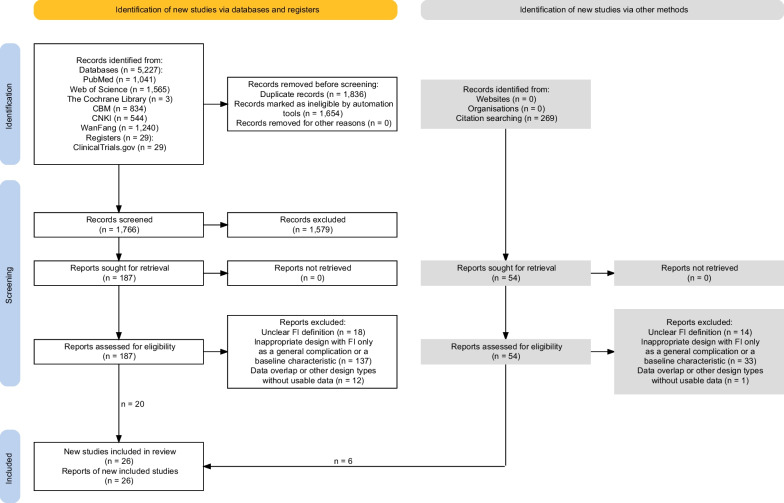
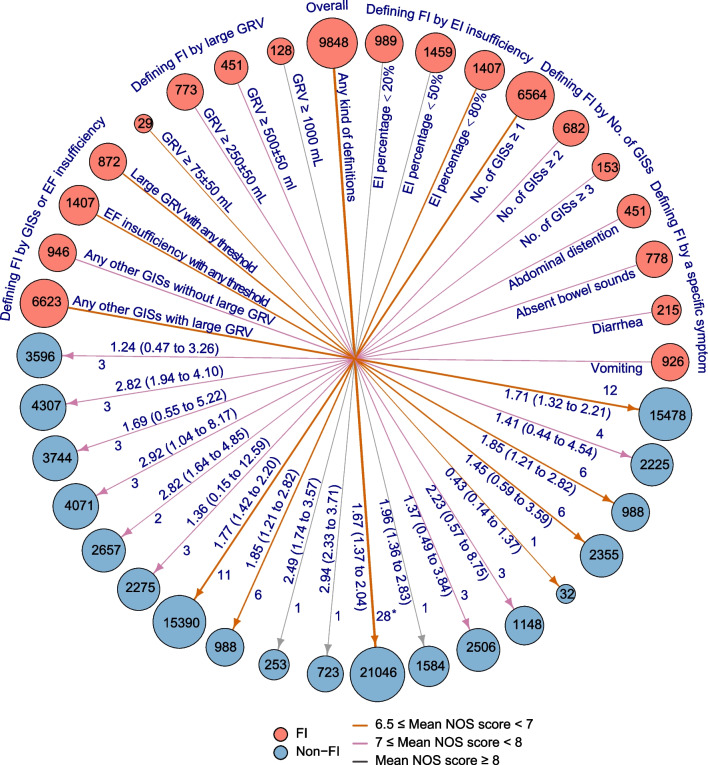
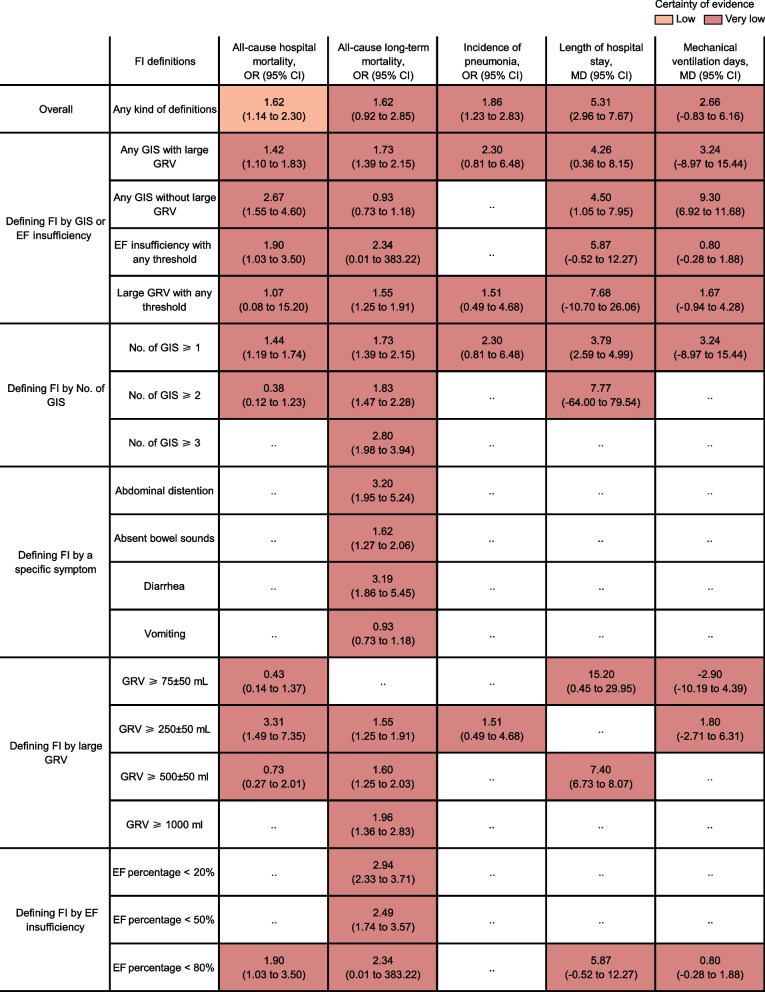
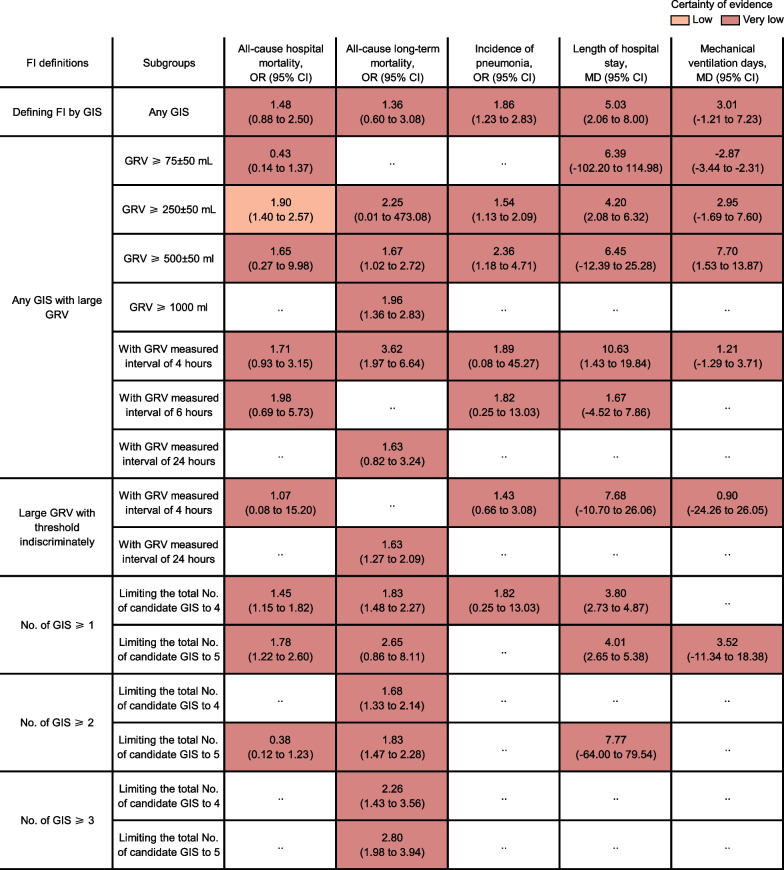
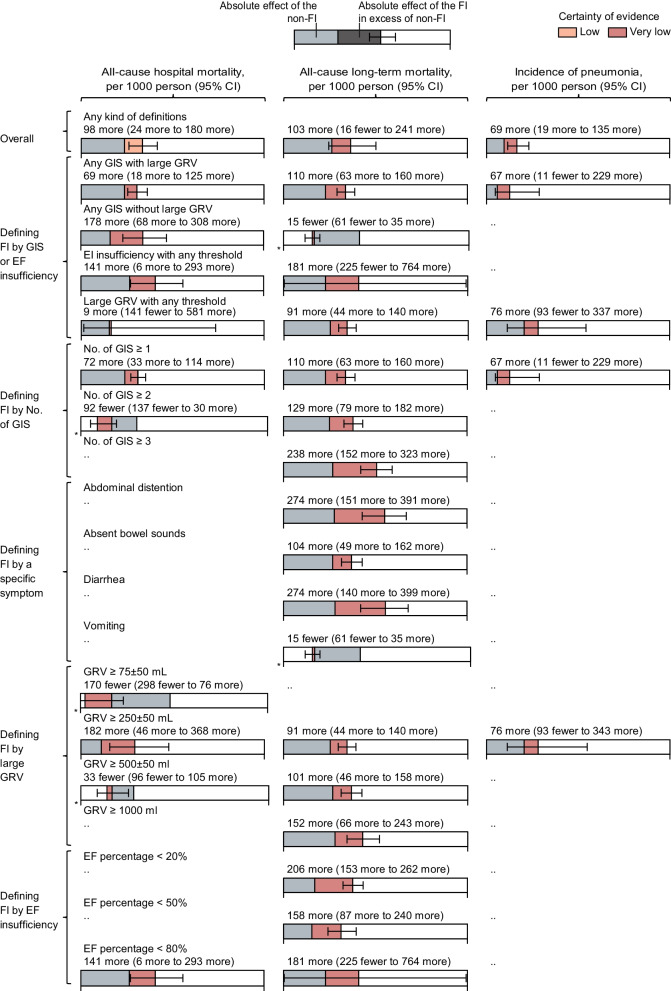
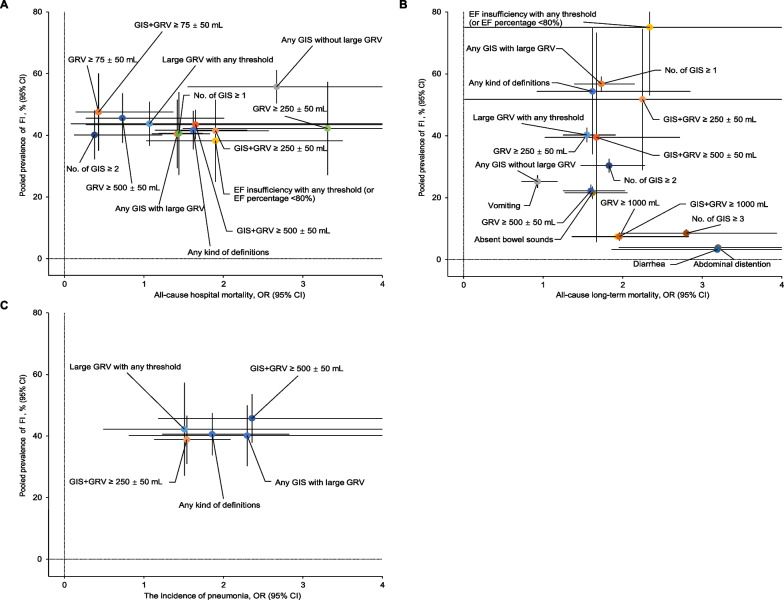
Background: A unified clinical definition of feeding intolerance (FI) is urged for better management of enteral nutrition (EN) in critically ill patients. We aimed to identify optimum clinical FI definitions based on reported evidence. Methods: We searched clinical studies comparing FI with non-FI with a clear definition, summarized the evidence by random-effect meta-analyses, and rated the certainty of evidence by the Grading of Recommendations Assessment, Development and Evaluation frameworks. Results: Five thousand five hundred twenty-five records were identified, of which 26 eligible studies enrolled 25,189 adult patients. Most patient-centered outcomes were associated with FI overall. Low to very low certainty evidence established FI defined as large gastric residual volume (GRV) ≥ 250 ± 50 mL combined with any other gastrointestinal symptoms (GIS) had a significant association with high mortalities in particular all-cause hospital mortality (odds ratio [OR] 1.90, 95% confidence interval [CI] 1.40–2.57), the incidence of pneumonia (OR 1.54, 95% CI 1.13–2.09) and prolonged length of hospital stay (mean difference 4.20, 95% CI 2.08–6.32), with a moderate hospital prevalence (41.49%, 95% CI 31.61–51.38%). 3-day enteral feeding (EF) delivered percentage < 80% had a moderate hospital prevalence (38.23%, 95% CI 24.88–51.58) but a marginally significant association with all-cause hospital mortality (OR 1.90, 95% CI 1.03–3.50). Conclusions: In critically ill adult patients receiving EN, the large-GRV-centered GIS to define FI seemed to be superior to 3-day EF-insufficiency in terms of both close associations with all-cause hospital mortality and acceptable hospital prevalence (Registered PROSPERO: CRD42022326273). Trial registration : The protocol for this review and meta-analysis was registered with PROSPERO: CRD42022326273. Registered 10 May 2022.
Overview
The claims and statistics of this paper haven’t been checked yet.
Free: it reads the open-access text and checks the first 5 claims that cite a source we can check. Create a free account to check every claim.
Integrity signals
Registry
Cites
Statistics
Figures
Verification
Claims the paper makes
The claims and statistics of this paper haven’t been checked yet.
Free: it reads the open-access text and checks the first 5 claims that cite a source we can check. Create a free account to check every claim.
Claims other papers make about this one
Each is checked against this paper’s own text: does it say what the citing paper says it does?
The source backs part of the claim, not all of it — or backs it for a different population, condition or comparison.
In the citing paper
“Previous studies have shown that EFI is closely associated with worse clinical outcomes, such as inadequate nutrition, fewer ventilator-free days, longer ICU and hospital stays, and higher mortality, emphasizing the importance of carefully monitoring EFI during EN feeding in critically ill patients [9-11].”
From The impact of enteral feeding intolerance on the prognosis of patients with septic shock in South Korea (2025) · cites this paper as [11]
Experimental — accuracy not yet measured
Self-check
Percentages, sums and reported differences re-computed from the paper’s own numbers.
The self-check needs the paper’s full text.
Citations
Cites
The PRISMA 2020 statement: An updated guideline for reporting systematic reviews
Page, M. J., McKenzie, J. E., Bossuyt, P. M., Boutron, I., Hoffmann, T. C., Mulrow, C. D., Shamseer, L., Tetzlaff, J. M., Akl, E. A., Brennan, S. E., et al. (2021) · BMJ · doi:10.1136/bmj.n71 · Cited by 108,283
Quantifying heterogeneity in a meta‐analysis
Higgins, J. P. T., & Thompson, S. G. (2002) · Statistics in Medicine · doi:10.1002/sim.1186 · Cited by 36,763 · cited 1×
“The percentage of variability in the effect sizes was evaluated by Higgin’s and Thompson’s I2, according to which heterogeneity was divided into low (less than 25%), moderate (25–75%), and substantial (more than 75%) [18].”
MethodDermyshi, E., Wang, Y., Yan, C., Hong, W., Qiu, G., Gong, X., & Zhang, T. (2017) · Neonatology · doi:10.1159/000454668 · Cited by 24,451
von Elm, E., Altman, D. G., Egger, M., Pocock, S. J., Gøtzsche, P. C., & Vandenbroucke, J. P. (2007) · The Lancet · doi:10.1016/s0140-6736(07)61602-x · Cited by 21,320
Meta-analysis of Observational Studies in Epidemiology<SUBTITLE>A Proposal for Reporting</SUBTITLE>
Stroup, D. F. (2000) · JAMA · doi:10.1001/jama.283.15.2008 · Cited by 20,623
CONSORT 2010 Statement: updated guidelines for reporting parallel group randomised trials
the CONSORT Group, Schulz, K. F., Altman, D. G., & Moher, D. (2010) · BMC Medicine · doi:10.1186/1741-7015-8-18 · Cited by 13,371
CONSORT 2010 Statement: updated guidelines for reporting parallel group randomised trials
Schulz, K. F., Altman, D. G., Moher, D., & for the CONSORT Group (2010) · BMJ · doi:10.1136/bmj.c332 · Cited by 9,329
GRADE guidelines: 3. Rating the quality of evidence
Balshem, H., Helfand, M., Schünemann, H. J., Oxman, A. D., Kunz, R., Brozek, J., Vist, G. E., Falck-Ytter, Y., Meerpohl, J., & Norris, S. (2011) · Journal of Clinical Epidemiology · doi:10.1016/j.jclinepi.2010.07.015 · Cited by 8,285 · cited 10×
“According to the Grading of Recommendations Assessment, Development, and Evaluation (GRADE) [22], the certainty of the evidence of each comparison across FI definitions was rated as high, moderate, low, or very low.”
MethodInfluentialMcClave, S. A., Taylor, B. E., Martindale, R. G., Warren, M. M., Johnson, D. R., Braunschweig, C., McCarthy, M. S., Davanos, E., Rice, T. W., Cresci, G. A., et al. (2016) · Journal of Parenteral and Enteral Nutrition · doi:10.1177/0148607115621863 · Cited by 3,982
Haddaway, N. R., Page, M. J., Pritchard, C. C., & McGuinness, L. A. (2022) · Campbell Systematic Reviews · doi:10.1002/cl2.1230 · Cited by 3,486 · cited 2×
“Haddaway NR, Page MJ, Pritchard CC, McGuinness LA. PRISMA2020: an R package and Shiny app for producing PRISMA 2020-compliant flow diagrams, with interactivity for optimised digital transparency and Open Synthesis.”
Method
Research works printed but not linked: 1
- 32. Bangchuan Hu, Sun Renhua Wu, Aiping NY, Jingquan L, Lijun Y, et al. The association between feeding intolerance and clinical outcome in critically ill patients admitted to ICU:a multi-center prospective, observational study. Chin J Emerg Med. 2017;26:434-40.
Cited by
Reignier, J., Roux, B. G., Dequin, P. F., Maluf, V. A. B., Bohé, J., Casaer, M. P., Delbove, A., Dupuis, C., Fontaine, E. M., Gamon, P., et al. (2025) · Annals of Intensive Care · doi:10.1186/s13613-025-01509-0 · Cited by 64
Peng, F., Wang, H., Li, J., Ma, M., Jiang, X., Run, H., Qingting, L., Leng, J., Xiao, L., & Tang, L. (2023) · Journal of Clinical Nursing · doi:10.1111/jocn.16934 · Cited by 46
Self-citationZhou, Z., Zhang, J., Fan, C., Wei, Z., Wang, Q., & Liu, C. (2025) · Frontiers in Nutrition · doi:10.3389/fnut.2025.1662409 · Cited by 34
Guan, X., Chen, D., & Xu, Y. (2024) · Journal of Intensive Medicine · doi:10.1016/j.jointm.2023.12.002 · Cited by 28
Self-citationChen, H., Han, J. H., Li, J., Xiong, J., Wang, D., Han, M., Shen, Y., & Lu, W. (2025) · Frontiers in Nutrition · doi:10.3389/fnut.2024.1522911 · Cited by 18
Self-citationCognitive influencing factors of ICU nurses on enteral nutrition interruption: a mixed methods study
Pan, H.-L. W., Zhang, C., Yang, R., Tian, P., Song, J., & Zhang, Z. (2024) · BMC Nursing · doi:10.1186/s12912-024-02098-2 · Cited by 12
“Currently, the threshold for GRV is not uniform in clinical settings, with 200–500 mL being the most common [32, 33].”
BackgroundFeeding Intolerance—A Key Factor in the Management of Acute Pancreatitis: A Review
Górski, P., & Swidnicka-Siergiejko, A. K. (2024) · Journal of Clinical Medicine · doi:10.3390/jcm13216361 · Cited by 12
Nutritional therapy for the prevention of post-intensive care syndrome
Oshima, T., & Hatakeyama, J. (2024) · Journal of Intensive Care · doi:10.1186/s40560-024-00734-2 · Cited by 16
“While early enteral nutrition is universally recommended in this population unless the enteral route is contraindicated, enteral feeding intolerance frequently prevents sufficient nutrition intake, although the consensus for the definition of feeding intolerance has not been established [54].”
BackgroundImpact of nutritional screening on mortality and intensive care unit length of stay
Chavarro, B. C. D., Romero‐Saldaña, M., Reveiz, J. K. A., & Molina‐Recio, G. (2025) · Frontiers in Nutrition · doi:10.3389/fnut.2025.1474039 · Cited by 11
Assessment for Enteral Feeding Intolerance by Critical Care Nurses: A National Survey
Powers, J., Bourgault, A. M., & Simmons, J. S. C. (2025) · Dimensions of Critical Care Nursing · doi:10.1097/dcc.0000000000000685 · Cited by 7
Risk prediction model for adult intolerance to enteral nutrition feeding – A literature review
Yang, H., Liu, J., & Sun, H. (2024) · The American Journal of the Medical Sciences · doi:10.1016/j.amjms.2024.11.012 · Cited by 8
Hu, P., Wu, H., Zhang, K., Li, A., & Chen, Q. (2025) · Frontiers in Nutrition · doi:10.3389/fnut.2025.1667836 · Cited by 5
Zheng, H., Cai, L., Wang, P., Zheng, L., Lin, J., Sun, T., Li, J., Zuo, J., Liu, Y., Ye, X., et al. (2025) · Nursing in Critical Care · doi:10.1111/nicc.70006 · Cited by 5
Self-citationCrone, V., Møller, M. H., Alhazzani, W. A., Grønningsæter, L., Al-Fares, A. A., Hästbacka, J., Ostermann, M., Pfortmueller, C. A., Ferrer, R., Blaser, A. R., et al. (2025) · Acta Anaesthesiologica Scandinavica · doi:10.1111/aas.70045 · Cited by 4
Park, H.-J., Ahn, Y. H., Lee, H. Y., Lee, S.-M., & Lee, J. (2025) · Acute and Critical Care · doi:10.4266/acc.000700 · Cited by 3
“Abdominal distension was identified either through clinical suspicion or an increase in abdominal girth measured by the clinician [11].”
Zou, T., He, H., Wu, Y., Xie, X., & Yin, W. (2025) · Frontiers in Neurology · doi:10.3389/fneur.2025.1694188 · Cited by 3
Self-citationYoshida, M., Yamamoto, R., Sagawa, M., Toshima, G., Ukita, S., Higashibeppu, N., Tatsumi, H., Matsuo, Y., Yoneda, R., Ishihara, E., et al. (2026) · Clinical Nutrition ESPEN · doi:10.1016/j.clnesp.2026.103301 · Cited by 3
Saiz-Vinuesa, M. D., Rodriguez-Moreno, E., Calero-Yáñez, F., Piqueras-Carrión, A. M., Carrilero-López, C., Murcia-Sáez, I., Jiménez, M. P. C., & Molina‐Alarcón, M. (2025) · Enfermería Intensiva (English ed ) · doi:10.1016/j.enfie.2025.500561 · Cited by 5
Jia, S., Yin, Y., Wang, C., Liu, S., & Jiang, Y. (2026) · Frontiers in Nutrition · doi:10.3389/fnut.2026.1767700 · Cited by 2
Wu, Z. Y., Yao, B., & Yu, J. (2026) · Frontiers in Medicine · doi:10.3389/fmed.2026.1841517 · Cited by 2
Wu, C.-M., Zhu, W.-J., Chen, X., Liu, M., Feng, Y., & Wang, M. (2026) · World Journal of Gastrointestinal Surgery · doi:10.4240/wjgs.v18.i1.112334 · Cited by 1
Elmokadem, E. M., Fadl, D. K. A. E., Bassiouny, A. M., Samy, A. E. H., & Said, N. O. E. (2026) · Drug Design Development and Therapy · doi:10.2147/dddt.s582745 · Cited by 1
Zhang, S., Yu, S., Zhang, K., & Lin, H. (2026) · Frontiers in Nutrition · doi:10.3389/fnut.2026.1786580 · Cited by 2
Wang, M., Shi, H., Chen, Q., Su, B., Dong, X., Shi, H., & Xu, S. (2026) · Supportive Care in Cancer · doi:10.1007/s00520-026-10610-4 · Cited by 1
Use of Prokinetic Agents in Adult ICU Patients: An International Inception Cohort Study ( PATIENCE )
Crone, V., Møller, M. H., Granholm, A., Perner, A., Alhazzani, W. A., Krogsgaard, L. R., Al-Fares, A. A., Hästbacka, J., Ostermann, M., Pfortmueller, C. A., et al. (2026) · Acta Anaesthesiologica Scandinavica · doi:10.1111/aas.70290 · Cited by 1
Tian, P., Fan, M., & Huang, C. (2026) · Frontiers in Nutrition · doi:10.3389/fnut.2026.1859625 · Cited by 1
“Feeding intolerance literature shows that inconsistent definitions make it difficult to compare prevalence, consequences, and intervention effects across studies (13–15).”
InfluentialPengukuran Tekanan Intra Abdominal Sebagai Penanda Toleransi Nutrisi Enteral pada Pasien ICU
Sany, P. R., & Dahlia, D. (2024) · Journal of Telenursing (JOTING) · doi:10.31539/joting.v6i1.9525
“Pemantauan intoleransi nutrisi penting untuk memastikan keberhasilan nutrisi pasien kritis (Li et al., 2023).”
BackgroundXiao, Y., Liu, Q., Zheng, Y., Wang, K., & Zhong, J. (2024) · Nutrición Hospitalaria · doi:10.20960/nh.05399
Cai, Y., Bao, J., Yin, X., Yang, X., Yang, X., & Liu, A. (2026) · Journal of Parenteral and Enteral Nutrition · doi:10.1002/jpen.70140
Hernández-Domínguez, E., Alba-Cuevas, S. I., Novoa-Santander, N. L., López-Rodríguez, C., Garduño-López, J., & Gutiérrez, M. A. A. (2024) · Medicina Crítica · doi:10.35366/119231
Saiz-Vinuesa, M. D., Rodriguez-Moreno, E., Calero-Yáñez, F., Piqueras-Carrión, A. M., Carrilero-López, C., Murcia-Sáez, I., Jiménez, M. P. C., & Molina‐Alarcón, M. (2025) · Enfermería Intensiva · doi:10.1016/j.enfi.2025.500561
Madany, N. P., Setiyarini, S., & Widhiastuti, S. (2025) · Jurnal Keperawatan Klinis dan Komunitas (Clinical and Community Nursing Journal) · doi:10.22146/jkkk.104934
Enteral and Parenteral Nutrition in the ICU
Weimann, A., & de Heer, G. (2025) · Springer eBooks · doi:10.1007/978-3-032-00818-3_7
From Catabolism to Recovery: Optimizing Nutrition in Critically Ill Adults
González, M. C., Roibal, R. S., & Rodríguez, D. C. (2025) · Salud Integral y Comunitaria · doi:10.62486/sic2026272
Wei, Y., Su, J., Tie, X., & Yin, W. (2025) · Frontiers in Medicine · doi:10.3389/fmed.2025.1665870
Self-citationPan, H., Zhang, C., Yang, R., Tian, P., Song, J., & Zhang, Z. (2024) · Figshare · doi:10.6084/m9.figshare.26103864
Pan, H., Zhang, C., Yang, R., Tian, P., Song, J., & Zhang, Z. (2024) · Figshare · doi:10.6084/m9.figshare.26103725
XAVIER, T. C. P. (2024) · LA Referencia (Red Federada de Repositorios Institucionales de Publicaciones Científicas)
Wang, Y. X., Li, M., Zhao, W., He, X., & Xiao, S. (2026) · Frontiers in Medicine · doi:10.3389/fmed.2026.1738036
“Gastrointestinal intolerance encompasses elevated gastric residual volume ( ≥ 250 ± 50 mL) vomiting, absent bowel sounds, abdominal distension, or diarrhea (7).”
dos Santos, B. V. P., Albuquerque, C. C., Fernandes, A. G., & Mendonça, S. S. (2026) · Revista JRG de Estudos Acadêmicos · doi:10.55892/jrg.v9i20.2864 · Cited by 1
Bourgault, A. M., Simmons, J. S. C., Powers, J., Aguirre, L., & Sole, M. L. (2026) · Critical Care Nurse · doi:10.4037/ccn2026884
Qin-chen, X., Fu, W., Zhang, R., Liu, C., & Wang, M.-J. (2026) · Nutrition · doi:10.1016/j.nut.2026.113147
GLP-1–gut microbiotal axis and enteral feeding intolerance in critically ill neurological patients
Li, W., Zhang, J., Pu, J., Pan, Q., Chen, L., Sui, H., Du, J., & Li, Z. (2026) · Frontiers in Medicine · doi:10.3389/fmed.2026.1807813
Wang, Y., He, Q., Xia, M., Ni, W., & Zhu, S. (2026) · Frontiers in Nutrition · doi:10.3389/fnut.2026.1803903
“Moreover, insufficient adjustment for key confounding factors such as disease severity and concomitant medications, particularly antibiotics that may disrupt the gut microbiota and increase the risk of diarrhea further limits the interpretability of existing findings (17–19).”
Predictors of enteral nutrition intolerance in severe acute pancreatitis: a meta-analysis
Liao, R.-C., Yang, Y.-L., Qin, F.-L., Fu, Z.-Y., Huang, Z.-W., & Lu, Y.-G. (2026) · BMC Nutrition · doi:10.1186/s40795-026-01332-1
“While some studies define it based on gastric residual volume, others use composite clinical criteria such as vomiting, abdominal distension, diarrhea, or elevated intra-abdominal pressure [6, 7].”
Jia, B., Wen, Y., Deng, B., He, G., Ren, J., Li, G., Zheng, X., Wu, X., & Yang, S. (2026) · Frontiers in Nutrition · doi:10.3389/fnut.2026.1815516
Retrospective analysis of intestinal flora alterations in adults with acute gastrointestinal injury
Jiang, Z., Tang, A., Zhao, M., Long, Y., & Cai, Y. (2026) · Frontiers in Cellular and Infection Microbiology · doi:10.3389/fcimb.2026.1776653
Hao, Y., Yan, M., Bai, R., Li, C., Qu, C., Yu, Z., Yu, W., Liu, N., Gao, T., & Xu, Y. (2026) · Journal of Clinical Medicine · doi:10.3390/jcm15124820
“In this study, it is defined as the occurrence of any of the following events leading to reduction or interruption of EN [17–19]: (1) Vomiting or obvious regurgitation; (2) abdominal distension (increase in abdominal circumference > 3 cm or intra-abdominal pressure > 20 mmHg); (3) diarrhea (>3…”
Self-citationEnteral nutrition responsiveness in critically ill patients: An expert commentary
Patel, J. J., Taylor, B., Gibbs, K. W., Martindale, R. G., Nagrebetsky, A., Rice, T. W., & McClave, S. A. (2026) · Journal of Parenteral and Enteral Nutrition · doi:10.1002/jpen.70128
van Zanten, A. R. H., Kohout, P., Waele, E. D., & Keller, H. (2026) · Expert Review of Gastroenterology & Hepatology · doi:10.1080/17474124.2026.2703204
Deimplementation of Tradition-Based Enteral Feeding Practices to Improve Clinical Outcomes
Bourgault, A. M., & Powers, J. (2026) · Critical Care Nursing Clinics of North America · doi:10.1016/j.cnc.2026.07.003
Enteral Nutrition in Traumatic Patients: Essential for Achieving Optimal Recovery Outcomes
Khongsakool, P., & Akaraborworn, O. (2026) · PSU Medical Journal · doi:10.31584/psumj.2026283062
Valenzuela, J., Haines, K., Sachdev, G., White, C., Schroeppel, T. J., Anand, T., Castle, S. L., & Napolitano, L. M. (2026) · The Journal of Trauma: Injury, Infection, and Critical Care · doi:10.1097/ta.0000000000005160 · Cited by 1
“70 Although some nutrition guidelines recommend not monitoring GRV based on studies in nontrauma ICU patients, definitive trauma trials are lacking, and a personalized approach may be optimal.”
Xie, Y., Li, C., Wu, X., & Wang, C. (2026) · Frontiers in Public Health · doi:10.3389/fpubh.2026.1900308
“Therefore, outcome assessment may be influenced by institutional practices, including the frequency of GRV monitoring, thresholds for feeding interruption, and local enteral nutrition protocols (61, 63, 64).”
Wang, Q., Jin, K., Chen, Y., Xu, H., Wu, D., Ke, L., 梁凤鸣, Chen, Y., & for the Chinese Critical Care Nutrition Trials Group (CCCNTG) (2026) · Journal of Intensive Care · doi:10.1186/s40560-026-00942-y
“Increased nutritional exposure may therefore lead to more frequent gastrointestinal symptoms and interruptions of enteral feeding, which may reduce effective nutrient delivery and attenuate the potential benefits of nutritional therapy on organ recovery [24].”
Lei, H., Wang, M., & Ke, P. (2026) · Medicine · doi:10.1097/md.0000000000050864
“[13] A systematic review by Li et al suggested that such multidomain evaluation may improve the accuracy of identifying feeding intolerance.”
Irshad, S., Khawaja, A. A., Rauf, W., Khan, M., & Bukhari, S. A. F. (2026) · Pakistan Journal of Medical Sciences · doi:10.12669/pjms.42.11.21111
Metadata
- Authors
- Li, J., Wang, L., Zhang, H., Zou, T., Kang, Y., He, W., Xu, Y., & Yin, W.
- Affiliations
- West China Hospital of Sichuan University (CN)
- Beijing Tongren Hospital (CN)
- Beijing Tsinghua Chang Gung Hospital (CN)
- Corresponding author
- Xu, Yuan
- Yin, Wanhong
- Venue
- Journal of Intensive Care
- Published
- 2023-07-05
- Volume
- 11
- Issue
- 1
- Pages
- 29-29
- ISSN
- 2052-0492 (ISSN-L)
- PMC
- PMC10320932
- OpenAlex
- W4383224314
- Semantic Scholar
- e1df69ac83a0fd3c822e9d25ec701723d60aa40a
- Cited by
- 49
- References
- 51
- Citations by year
- 2026: 24 · 2025: 14 · 2024: 10 · 2023: 1
- FWCI
- 1.77
- Type
- journal article
- Language
- en
- Open access
- gold
- doi.org
- Licence
- cc-by
- creativecommons.org/licenses/by/4.0 (tdm)
- creativecommons.org/licenses/by/4.0 (vor)
- Locations
- Journal of Intensive Care (publishedVersion, cc-by)
- PubMed Central (publishedVersion, cc-by)
- PubMed (publishedVersion)
- DOAJ (DOAJ: Directory of Open Access Journals) (submittedVersion, cc-by-sa)
- Funders
- Sichuan Province Science and Technology Department Project (2021YJ0448)
- Post Doctoral Research Fund, West China Hospital, Sichuan University (2020HXBH181)
- Chinese Foundation for Hepatitis Prevention and Control-TianQing Liver Disease Research Fund Subject (TQGB20210186)
- Topics
- Health Sciences › Nursing › Nutrition and Dietetics › Clinical Nutrition and Gastroenterology
- Health Sciences › Medicine › Surgery › Enhanced Recovery After Surgery
- Health Sciences › Medicine › Critical Care and Intensive Care Medicine › Nosocomial Infections in ICU
- Keywords
- feeding intolerance, enteral nutrition, critically ill adults, gastric residual volume, gastrointestinal symptoms, all-cause mortality, pneumonia, length of hospital stay, clinical definition
About these checks
Registry, retraction, Cites and statistics results are computed, not judged, with one exception: a printed reference that no index lists is read once by a model before it counts as a citation error. Claims are extracted by a model and kept only when their quote appears verbatim in the text; each cited source is then checked, with a model’s help, for whether it says what the claim relies on. Those verdicts can be wrong — read the claim’s quote and the cited source before relying on one.
Statistics and arithmetic are recomputed, not judged.
Confidence bands are shown only for fields calibrated on our annotated test set. None is calibrated yet, so no band is shown.
What counts as a claim ›How we measure confidence ›How we check this ›
Are you an author, or do you see a problem with this page? Request a review
Data sources
Bibliographic data: Semantic Scholar, OpenAlex, Crossref.
Contains information from the Semantic Scholar Academic Graph Datasets, made available under the ODC Attribution License (ODC-BY 1.0).
Semantic Scholar’s data is described in: Kinney, R., et al. (2023). The Semantic Scholar Open Data Platform. arXiv:2301.10140.
