

Scientific production and thematic breakthroughs in smart learning environments: a bibliometric analysis
Open accessThe DOI matches its Crossref record; 49 of the 49 references it cites were found in a registry or an index.
Abstract
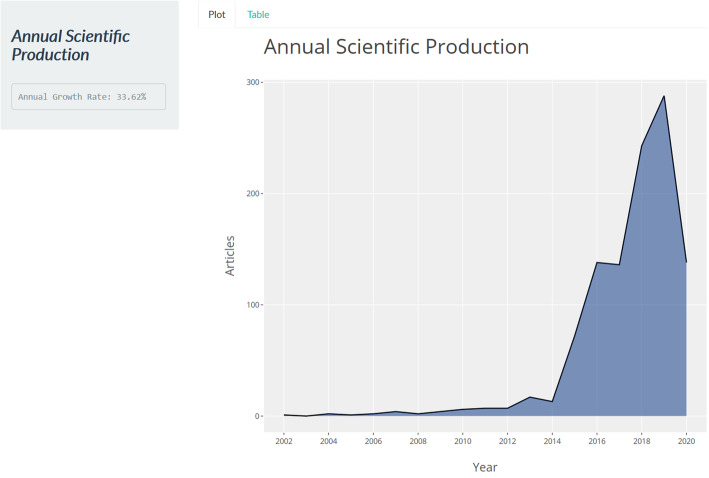
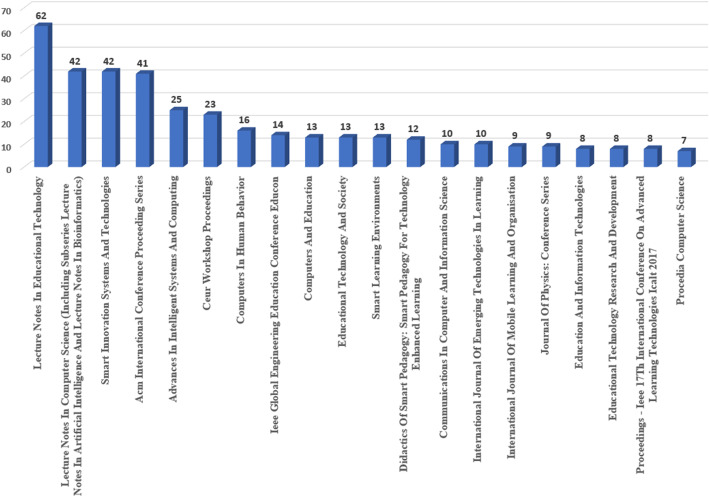
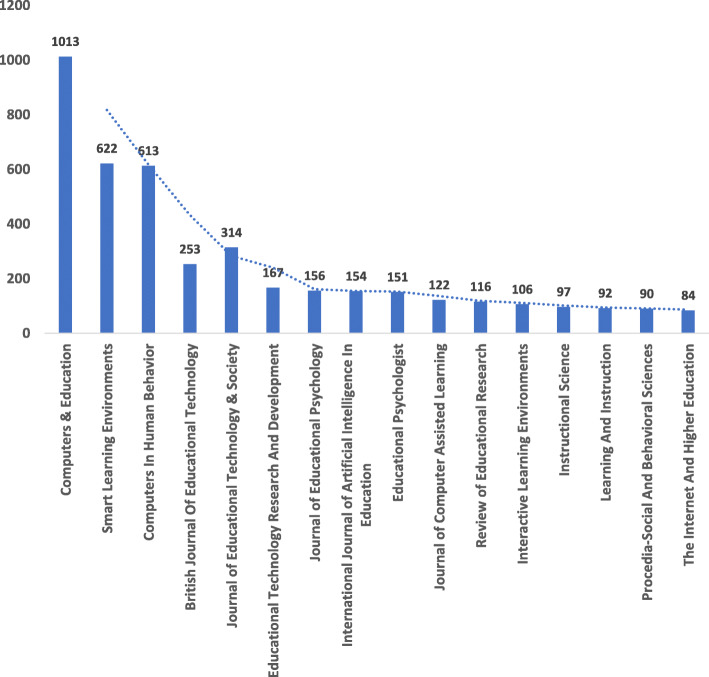
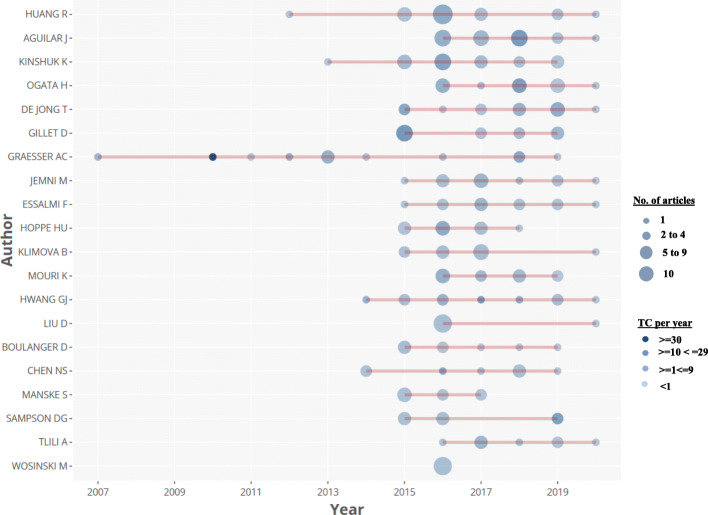
This study examines the research landscape of smart learning environments by conducting a comprehensive bibliometric analysis of the field over the years. The study focused on the research trends, scholar’s productivity, and thematic focus of scientific publications in the field of smart learning environments. A total of 1081 data consisting of peer-reviewed articles were retrieved from the Scopus database. A bibliometric approach was applied to analyse the data for a comprehensive overview of the trend, thematic focus, and scientific production in the field of smart learning environments. The result from this bibliometric analysis indicates that the first paper on smart learning environments was published in 2002; implying the beginning of the field. Among other sources, “Computers & Education,” “Smart Learning Environments,” and “Computers in Human Behaviour” are the most relevant outlets publishing articles associated with smart learning environments. The work of Kinshuk et al., published in 2016, stands out as the most cited work among the analysed documents. The United States has the highest number of scientific productions and remained the most relevant country in the smart learning environment field. Besides, the results also showed names of prolific scholars and most relevant institutions in the field. Keywords such as “learning analytics,” “adaptive learning,” “personalized learning,” “blockchain,” and “deep learning” remain the trending keywords. Furthermore, thematic analysis shows that “digital storytelling” and its associated components such as “virtual reality,” “critical thinking,” and “serious games” are the emerging themes of the smart learning environments but need to be further developed to establish more ties with “smart learning”. The study provides useful contribution to the field by clearly presenting a comprehensive overview and research hotspots, thematic focus, and future direction of the field. These findings can guide scholars, especially the young ones in field of smart learning environments in defining their research focus and what aspect of smart leaning can be explored.
Overview
The claims and statistics of this paper haven’t been checked yet.
Free: it reads the open-access text and checks the first 5 claims that cite a source we can check. Create a free account to check every claim.
Integrity signals
Registry
Cites
Statistics
Figures
Verification
Claims the paper makes
The claims and statistics of this paper haven’t been checked yet.
Free: it reads the open-access text and checks the first 5 claims that cite a source we can check. Create a free account to check every claim.
Claims other papers make about this one
Each is checked against this paper’s own text: does it say what the citing paper says it does?
The source backs part of the claim, not all of it — or backs it for a different population, condition or comparison.
In the citing paper
“Scopus also covers almost all relevant conferences and journals for this study [17]”
From Virtual Reality for Addressing Depression and Anxiety: A Bibliometric Analysis (2023) · cites this paper as [17]
Experimental — accuracy not yet measured
Self-check
Percentages, sums and reported differences re-computed from the paper’s own numbers.
The self-check needs the paper’s full text.
Citations
Cites
bibliometrix: An R-tool for comprehensive science mapping analysis
Aria, M., & Cuccurullo, C. (2017) · Journal of Informetrics · doi:10.1016/j.joi.2017.08.007 · Cited by 16,064
Bibliometric Methods in Management and Organization
Zupic, I., & Čater, T. (2015) · Organizational Research Methods · doi:10.1177/1094428114562629 · Cited by 7,495
Virtual laboratories for education in science, technology, and engineering: A review
Potkonjak, V., Gardner, M., Callaghan, V., Mattila, P., Guetl, C., Petrović, V. M., & Jovanović, K. (2016) · Computers & Education · doi:10.1016/j.compedu.2016.02.002 · Cited by 1,005
Stakeholder Analysis and Social Network Analysis in Natural Resource Management
Prell, C., Hubacek, K., & Reed, M. (2009) · Society & Natural Resources · doi:10.1080/08941920802199202 · Cited by 979
Meta-Analysis of Inquiry-Based Learning: Effects of Guidance
Lazonder, A. W., & Harmsen, R. (2016) · Review of Educational Research · doi:10.3102/0034654315627366 · Cited by 967
Baker, R. S. J. D., D'Mello, S. K., Rodrigo, M. M. T., & Graesser, A. C. (2010) · International Journal of Human-Computer Studies · doi:10.1016/j.ijhcs.2009.12.003 · Cited by 936
A framework to guide an education response to the COVID-19 Pandemic of 2020
(2020) · OECD Policy Responses to Coronavirus (COVID-19) · doi:10.1787/6ae21003-en · Cited by 698 · cited 1×
“As a result of this pandemic and to prevent the spread of the disease, many countries adopted online distance learning as an alternative teaching model (Reimers & Schleicher, 2020).”
BackgroundHwang, G.-J. (2014) · Smart Learning Environments · doi:10.1186/s40561-014-0004-5 · Cited by 655 · cited 2×
“These additional keywords in the second line of the search field were selected because they are mostly used to define the characteristic features of smart learning environments (Hwang, 2014).”
BackgroundMethodVirtual and remote labs in education: A bibliometric analysis
Heradio, R., de la Torre, L., Galan, D., Cabrerizo, F. J., Herrera-Viedma, E., & Dormido, S. (2016) · Computers & Education · doi:10.1016/j.compedu.2016.03.010 · Cited by 574
Arici, F., Yildirim, P., Caliklar, Ş., & Yilmaz, R. M. (2019) · Computers & Education · doi:10.1016/j.compedu.2019.103647 · Cited by 442 · cited 2×
“Bibliometric mapping is recently gaining more grounds in different disciplines (Aria & Cuccurullo, 2017; Arici et al., 2019; Song et al., 2019).”
Background
Research works printed but not linked: 2
- 4. Aria, M., & Cuccurullo, C. (2020). Biblioshiny blibliometrix for no coders Retrieved from: https://bibliometrix.org/biblioshiny/ assets/player/KeynoteDHTMLPlayer.html#75.
- 40. Tomczyk, L., Oyelere, S. S., Puentes, A., Sanchez-Castillo, G., Muñoz, D., Simsek, B., … Demirhan, G. (2019). Flipped learning, digital storytelling as the new solutions in adult education and school pedagogy. In Adult education 2018 - transformation in the era of digitization and artificial intelligence, (pp. 69-83).
Cited by
Items 301–322 of 322
Wahyuningsih, K., Syamsu, K., Warsiki, E., Yuliana, N. D., Yuliani, S., & Hamzah, M. H. (2026) · Journal of Food Measurement & Characterization · doi:10.1007/s11694-026-04458-9
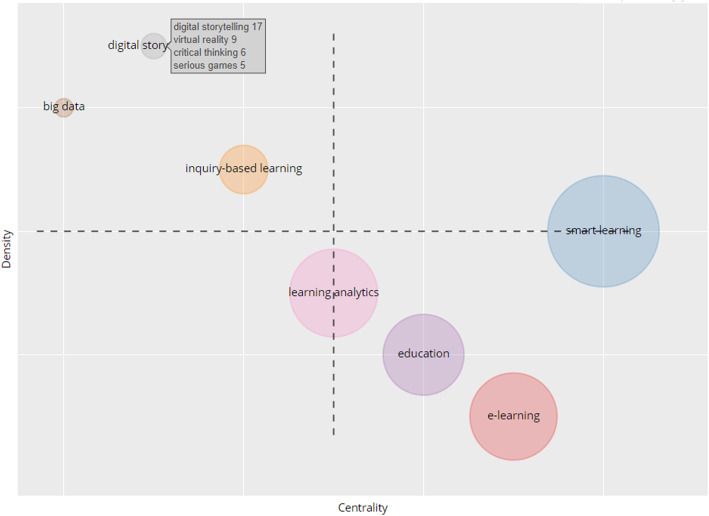
“Centrality indicates the importance of a topic in relation to others, whereas density reflects the level of internal devel - opment and continuity of a research field [ 73, 74].”
Contributing to the Sharing Economy: A Bibliometric Mapping of Fashion Rental Services
Bhalla, R., Handa, M., & Sharma, A. K. (2024) · DIAS Technology Review · doi:10.65301/dias.2023.20.2.6
“Global citations determine the number of citations that a publication receives from the whole database including other disciplines, whereas local citations consider the number of citations that a publication receives from the papers forming a part of the data under analysis (Agbo et al., 2021).”
Cui, W., Zhang, K., Zhang, Z. D., Cui, H., Lv, C., Alsudais, T. A., & Wang, X. (2026) · Behavioral Sciences · doi:10.3390/bs16050746
“Thematic evolution, on the other hand, is related to the changes in research topics (Agbo et al., 2021).”
Mapping ecolinguistics (2005–2024): A bibliometric analysis of research status and trends
Song, X., & Abas, A. (2026) · Southern African Linguistics and Applied Language Studies · doi:10.2989/16073614.2026.2660813
Nurfadilah, N., Nurlina, N., & Bancong, H. (2026) · Research Square · doi:10.21203/rs.3.rs-9514243/v1
Haq, M. I. U., & Khan, M. (2026) · Discover Sustainability · doi:10.1007/s43621-026-03780-y
“According to [40] A quadrant can have four different types of themes: underlying themes in the lower right (Q4), driving themes in the upper right (Q1), highly specific themes in the upper left (Q2), and emerging or evaporating themes in the lower left (Q3).”
Evaluation of self-directed learning in science education: A systematic literature network analysis
Wahyudi, Setiawan, A., Suhandi, A., & Samsudin, A. (2026) · AIP conference proceedings · doi:10.1063/5.0329436
Radebe, F. M. (2026) · South African journal of information management · doi:10.4102/sajim.v28i1.2177
Zhang, Y., Sima, J., Li, X., Lu, S., Chen, Y., & Dong, M. (2026) · Medicine · doi:10.1097/md.0000000000049824
“Preliminary data interpretation was facilitated through the use of the “biblioAnaly-sis()” [15] command and the “summary()” [16] function embedded within the software package.”
Abas, A., & Song, X. (2026) · Social Sciences & Humanities Open · doi:10.1016/j.ssaho.2026.103350
Mistry, M., Prajapati, V., & Dholakiya, B. Z. (2026) · Biocatalysis and Biotransformation · doi:10.1080/10242422.2026.2711791
Rueda, R. Z., Niño, Y. V., & Villamizar, Y. I. B. (2026) · SAGE Open · doi:10.1177/21582440261477485
Female entrepreneurship in the digital era: a bibliometric analysis
Machado, D., Daniel, A. D., & Braga, V. L. D. S. (2026) · International Journal of Gender and Entrepreneurship · doi:10.1108/ijge-05-2025-0168 · Cited by 1
Mishra, A. K., Dhingra, B., & Yadav, M. (2026) · Global Knowledge, Memory and Communication · doi:10.1108/gkmc-09-2024-0627
Adawiyah, W., Ismail, I., & Zabri, M. Z. M. (2026) · Eurasian economic review : · doi:10.1007/s40822-026-00387-6
ESG Investing: A Bibliometric Study
Keerthana, T. P., Senthilkumar, A., & Pandey, N. (2026) · Studies in big data · doi:10.1007/978-3-032-19498-5_33
Investor sentiment and herding behavior in financial markets: a bibliometric analysis
Batra, S., Suryavanshi, U., & Jayswal, T. (2026) · Information Discovery and Delivery · doi:10.1108/idd-09-2025-0222
Ompua, C. N., Biccari, C. D., Lavesson, N., & Corallo, A. (2026) · Journal of Cybersecurity and Privacy · doi:10.3390/jcp6050176
Management Lessons from Indian Epics: A Hybrid Review
Jaiswal, J. K., Kumari, P., Pandey, D. K., & Kushwaha, A. (2026) · Journal of Human Values · doi:10.1177/09716858261489911
Club research: A review and research agenda
Lee, S., & Choi, N.-Y. (2026) · International Journal of Hospitality Management · doi:10.1016/j.ijhm.2026.104946
Oanh, L. V. L., Dinh, T. M., NGUYEN, T. H., & Duong, T. (2026) · Spanish Journal of Marketing - ESIC · doi:10.1108/sjme-12-2024-0342
Metadata
- Authors
- Agbo, F. J., Oyelere, S. S., Suhonen, J., & Tukiainen, M.
- Affiliations
- University of Eastern Finland (FI)
- Luleå University of Technology (SE)
- Corresponding author
- Agbo, Friday Joseph
- Venue
- Smart Learning Environments
- Published
- 2021-01-15
- Volume
- 8
- Issue
- 1
- Pages
- 1-1
- ISSN
- 2196-7091 (ISSN-L)
- PMC
- PMC7810194
- OpenAlex
- W3127908559
- Cited by
- 325
- References
- 49
- Citations by year
- 2026: 36 · 2025: 65 · 2024: 103 · 2023: 66 · 2022: 39 · 2021: 16
- FWCI
- 50.64
- Type
- journal article
- Language
- en
- Open access
- gold
- doi.org
- Licence
- cc-by
- creativecommons.org/licenses/by/4.0 (tdm)
- creativecommons.org/licenses/by/4.0 (vor)
- Locations
- Smart Learning Environments (publishedVersion, cc-by)
- PubMed Central (publishedVersion, cc-by)
- PubMed (publishedVersion)
- Diva portal (Dalarna University Library) (acceptedVersion, other-oa)
- UEF eRepo (University of Eastern Finland) (submittedVersion, cc-by)
- DOAJ (DOAJ: Directory of Open Access Journals) (submittedVersion, cc-by-sa)
- Topics
- Social Sciences › Education › Educational Technology in Learning
- Physical Sciences › Computer Science › Computer Science Applications › Online Learning and Analytics
- Social Sciences › Library and Information Sciences › scientometrics and bibliometrics research
- Keywords
- research trends, learning analytics, adaptive learning, personalized learning, blockchain in education, deep learning, digital storytelling, virtual reality, serious games, critical thinking, research hotspots
About these checks
Registry, retraction, Cites and statistics results are computed, not judged, with one exception: a printed reference that no index lists is read once by a model before it counts as a citation error. Claims are extracted by a model and kept only when their quote appears verbatim in the text; each cited source is then checked, with a model’s help, for whether it says what the claim relies on. Those verdicts can be wrong — read the claim’s quote and the cited source before relying on one.
Statistics and arithmetic are recomputed, not judged.
Confidence bands are shown only for fields calibrated on our annotated test set. None is calibrated yet, so no band is shown.
What counts as a claim ›How we measure confidence ›How we check this ›
Are you an author, or do you see a problem with this page? Request a review
Data sources
Bibliographic data: Semantic Scholar, OpenAlex, Crossref.
Contains information from the Semantic Scholar Academic Graph Datasets, made available under the ODC Attribution License (ODC-BY 1.0).
Semantic Scholar’s data is described in: Kinney, R., et al. (2023). The Semantic Scholar Open Data Platform. arXiv:2301.10140.
