

Analyzing a faculty online learning community as a mechanism for supporting faculty implementation of a guided-inquiry curriculum
Open accessThe DOI matches its Crossref record; 87 of the 89 references it cites were found in a registry or an index.
Abstract
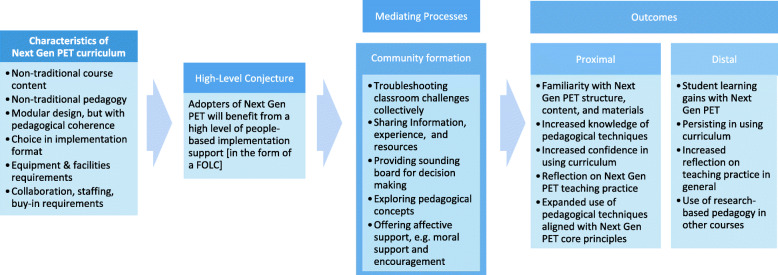
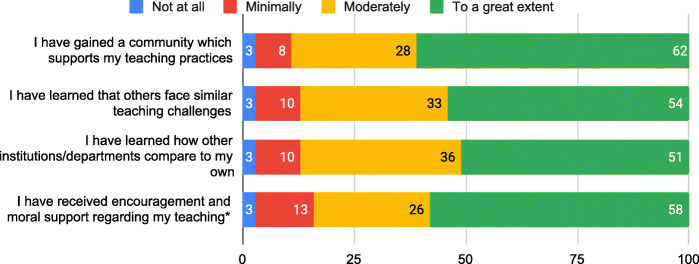
Background: Adoption and use of effective, research-based instructional strategies (RBISs) for STEM education is less widespread than hoped. To promote further use of RBISs, the propagation paradigm suggests that developers work with potential adopters during the development process, and provide ongoing support after adoption. This article investigates the impact of a faculty online learning community (FOLC) as a professional development mechanism for supporting faculty adopting a research-based curriculum. A FOLC uses video conference technology and online platforms to connect geographically dispersed faculty with similar backgrounds (e.g., physics faculty) and supports their teaching development. In the context of a specific FOLC, this article seeks to determine the outcomes the FOLC achieves, and how. Results: Analysis of a FOLC meeting identified opportunities for rich, complex social interaction centered on the research-based curriculum. By functioning as a sounding board for ideas, a space to share experiences, a source of affective support, and a venue for troubleshooting, the FOLC mediates the achievement of a range of outcomes related to implementation of the curriculum. Survey results indicate that members feel a sense of community in the FOLC and that it provides encouragement through teaching challenges. Further results indicate participants’ increased confidence in using the curriculum; familiarity with the curriculum structure and content; increased knowledge of pedagogical techniques; reflection on teaching practices in the curriculum; and use of pedagogical techniques aligned with the curriculum’s core principles. Emerging evidence supports more distal outcomes, including student learning, persistence in using the curriculum, reflection in teaching practice across courses taught, and use of research-based pedagogy in other courses. Conclusions: The propagation paradigm emphasizes the need for ongoing support for adopters of RBISs. The FOLC model provides participating faculty with ongoing support through participation in a community and is an effective support mechanism for adopters of a research-based curriculum. In this study, FOLC members are increasing their knowledge and use of pedagogical techniques in the curriculum-specific course and beyond. This is facilitated by the opportunities in the FOLC for troubleshooting, idea sharing, and receiving encouragement through challenges. This model has the potential to support adopters of additional educational innovations.
Overview
The claims and statistics of this paper haven’t been checked yet.
Free: it reads the open-access text and checks the first 5 claims that cite a source we can check. Create a free account to check every claim.
Integrity signals
Registry
Cites
Statistics
Figures


Verification
Claims the paper makes
The claims and statistics of this paper haven’t been checked yet.
Free: it reads the open-access text and checks the first 5 claims that cite a source we can check. Create a free account to check every claim.
Self-check
Percentages, sums and reported differences re-computed from the paper’s own numbers.
The self-check needs the paper’s full text.
Citations
Cites
Statistical Power Analysis for the Behavioral Sciences
Muller, K. (1989) · Technometrics · doi:10.1080/00401706.1989.10488618 · Cited by 99,167
Statistical power analysis for the behavioral sciences
(1990) · Computers, Environment and Urban Systems · doi:10.1016/0198-9715(90)90050-4 · Cited by 65,269
Situated Learning: Legitimate Peripheral Participation.
Bloch, M., Lave, J., & Wenger, E. (1994) · Man · doi:10.2307/2804509 · Cited by 39,454
Situated Learning: Legitimate Peripheral Participation
Lave, J., & Wenger, E. (1991) · Cambridge University Press eBooks · doi:10.1017/cbo9780511815355 · Cited by 35,324
Hierarchical Linear Models: Applications and Data Analysis Methods.
Longford, N. T., Bryk, A. S., & Raudenbush, S. W. (1993) · Contemporary Sociology · doi:10.2307/2075823 · Cited by 18,724 · cited 1×
“…(large effect size (Cohen, 1988)) than the scores at the retrospective pre-workshop time point (Hierarchical Linear Model, HLM, t (35) = − 10.26, p 0.05) (Raudenbush & Bryk, 2002) and on average 0.79 standard deviations higher (medium effect size) than the scores at the post-workshop time point…”
BackgroundInfluentialActive learning increases student performance in science, engineering, and mathematics
Freeman, S., Eddy, S. L., McDonough, M., Smith, M. K., Okoroafor, N., Jordt, H., & Wenderoth, M. P. (2014) · Proceedings of the National Academy of Sciences · doi:10.1073/pnas.1319030111 · Cited by 9,787
Stereotype threat and the intellectual test performance of African Americans.
Steele, C. M., & Aronson, J. (1995) · Journal of Personality and Social Psychology · doi:10.1037/0022-3514.69.5.797 · Cited by 9,020
(2013) · Cited by 6,708
Cultivating Communities of Practice: A Guide to Managing Knowledge
Wenger, É., & Snyder, W. M. (2002) · CERN Document Server (European Organization for Nuclear Research) · Cited by 5,461
Cultivating Communities of Practice: A Guide to Managing Knowledge
Cuddy, C. (2002) · The Bottom Line · doi:10.1108/bl.2002.17015bae.001 · Cited by 3,923 · cited 2×
“Because a FOLC is an example of a CoP, it is essential to establish a strong sense of community between FOLC members (Wenger et al., 2002).”
Background
Research works printed but not linked: 10
- Beach AL Cox MD The impact of faculty learning communities on teaching and learning Learning Communities Journal 2009 1 1 7 27
- Gene HE George AA Stiegelbauer SM Measuring implementation in schools: the stages of concern questionnaire 2013 Austin SEDL
- Goldberg F Robinson S Kruse R Thompson N Otero V Physical science and everyday thinking 2007 Greenwich Activate Learning
- Goldberg F Robinson S Otero V Physics and everyday thinking 2008 Greenwich Activate Learning
- Goldberg F Robinson S Price E Boyd-Harlow D Kruse R McKean M Learning physical science 2012 Greenwich Activate Learning
- Goldberg F Robinson S Price E Harlow D Andrew J McKean M Next generation physical science everyday thinking 2018 Greenwich Activate Learning
- Henderson C Cole R Froyd J Friedrichsen DG Khatri R Stanford C Designing educational innovations for sustained adoption: A how-to guide for education developers who want to increase the impact of their work 2015 Kalamazoo Increase the Impact
- Hewitt PG Conceptual Physics 2015 12 Boston Pearson
- Laursen, S., Andrews, T., Stains, M., Finelli, C. J., Borrego, M., McConnell, D., … Foote, K. (2019). Levers for change: An assessment of progress on changing STEM instruction. (D. Smith, Ed.). American Association for the Advancement of Science Retrieved from https://www.aaas.org/resources/levers-change-assessment-progress-changing-stem-instruction.
- Moog, R. S., & Spencer, J. N. (2008). POGIL: An overview (chapter 1). In Process Oriented Guided Inquiry Learning (POGIL). Washington, DC: American Chemical Society.
Cited by
A systematic review on trends in using Moodle for teaching and learning
Gamage, S. H. P. W., Ayres, J. R., & Behrend, M. B. (2022) · International Journal of STEM Education · doi:10.1186/s40594-021-00323-x · Cited by 360
“…track learning outcomes, predict achievements (for early detection of students at risk), and then use the identified information to adapt and modify teaching practices (Dominguez et al., 2016; Hempel et al., 2020; Price et al., 2021; Sergis et al., 2017; Zakaria et al., 2019; Zheng et al., 2019).”
BackgroundSurahman, E., & Wang, T. (2023) · Teaching and Teacher Education · doi:10.1016/j.tate.2023.104326 · Cited by 64
Dancy, M., Henderson, C., Apkarian, N., Johnson, E., Stains, M., Raker, J. R., & Lau, A. (2024) · Physical Review Physics Education Research · doi:10.1103/physrevphyseducres.20.010119 · Cited by 42
Self-citationMeylani, R. (2024) · Edelweiss Applied Science and Technology · doi:10.55214/25768484.v8i6.3763 · Cited by 35
“Collaboration in developing new instructional methods is crucial for their practicality and sustained integration [13].”
Stromholt, S., Wiggins, B. L., & der Mehden, B. M. V. (2023) · Journal for STEM Education Research · doi:10.1007/s41979-023-00109-6 · Cited by 25
Liu, D., Carter, L. D., & Lin, J. (2024) · Online Learning · doi:10.24059/olj.v28i2.4047 · Cited by 26
“In addition, the LMS allows educators to track education activities, predict student performance, and then modify teaching practices (Gamage et al., 2022; Price et al., 2021).”
BackgroundLau, A. C., Martin, M. M., Corrales, A., Turpen, C., Goldberg, F. M., & Price, E. (2021) · International Journal of STEM Education · doi:10.1186/s40594-021-00301-3 · Cited by 17
“There is evidence that FOLCs are effective at supporting faculty in trying and persisting in using research-based teaching strategies and materials, and in reflecting on their teaching practice (Dancy et al. 2019; Corrales et al. 2020; Price et al. 2021).”
BackgroundMethodSelf-citationIntegration of Prismatic Science and Development of Arabic Education Master Curriculum
Erlina, E., Khalid, I., & Muslim, A. B. (2022) · ARABIYATUNA Jurnal Bahasa Arab · doi:10.29240/jba.v6i2.5024 · Cited by 14
Martin, M. M., Goldberg, F. M., McKean, M., Price, E., & Turpen, C. (2022) · International Journal of STEM Education · doi:10.1186/s40594-022-00371-x · Cited by 15
“Evidence indicates that these groups help faculty to persist in using RBIS (Corrales et al., 2020; Price et al., 2021; Rundquist et al., 2015).”
BackgroundMethodInfluentialSelf-citationZhou, F. (2022) · Journal of Healthcare Engineering · doi:10.1155/2022/5776341 · Cited by 11
Prunuske, A. J., Evans‐Anderson, H. J., Furniss, K. L., Goller, C., Mirowsky, J. E., Moore, M. E., Raut, S. A., Swamy, U., Wick, S., & Wolyniak, M. J. (2022) · Discover Education · doi:10.1007/s44217-022-00023-w · Cited by 12
Motivation and needs of informal physics practitioners
El-Adawy, S., Lau, A. C., Sayre, E. C., & Fracchiolla, C. (2024) · Physical Review Physics Education Research · doi:10.1103/physrevphyseducres.20.010125 · Cited by 6
Self-citationA módszertani központok szerepe a hazai felsőoktatásban: igény vagy kényszer
Bodnár, É. (2024) · Educatio · doi:10.1556/2063.33.2024.2.9 · Cited by 6
Hatcher, C., Price, E., Smith, P. S., Turpen, C., & Brewe, E. T. (2022) · arXiv (Cornell University) · doi:10.48550/arxiv.2209.09306 · Cited by 6
Self-citationFaculty case studies on learning to teach inclusively in undergraduate STEM education
Hill, L. B., Buchanan, D., Woods, S. E. O., & Frey, R. F. (2025) · Frontiers in Education · doi:10.3389/feduc.2025.1574464 · Cited by 6
Milicevic, J., Sremčev, N., Ćosić, I., Lazarević, M., & Tasić, N. (2021) · Annals of DAAAM for ... & proceedings of the ... International DAAAM Symposium · doi:10.2507/32nd.daaam.proceedings.059 · Cited by 4
Value Creation in a Pedagogically-Focused Faculty Online Learning Community
Goldberg, F. M., Price, E., Basir, M., Escalada, L. T., Maier, S., Sahyun, S. C., Snyder, T., & Zeng, L. (2024) · The journal of college science teaching · doi:10.1080/0047231x.2024.2373018 · Cited by 4
Self-citationIsmaniati, C., Lindra, A. T., & Pratama, H. A. P. (2025) · JURNAL IQRA · doi:10.25217/ji.v10i1.5718 · Cited by 4
Raharjo, K. M., Widyaswari, M., & Dayati, U. (2022) · International Conference on Information Technology and Education (ICITE) · doi:10.1109/icite54466.2022.9759884 · Cited by 4
Rohaeni, N., Satori, D., Komariah, A., Nurdin, D., & Fadhli, R. (2022) · Cypriot Journal of Educational Sciences · doi:10.18844/cjes.v17i6.7499 · Cited by 4
“As we know, a common problem in the learning process, especially in online learning, is the lack of learning activity of students when participating in learning (Jandri ć et al., 2021; Nuryasintia & Wibowo, 2019; Price et al., 2021) .”
BackgroundMore, T., Goldberg, F. M., Basir, M., Maier, S., & Price, E. (2024) · Disciplinary and Interdisciplinary Science Education Research · doi:10.1186/s43031-024-00097-6 · Cited by 3
“FOLCs are geographically distributed, discipline-specific FLCs (Corrales et al., 2020; Dancy et al., 2019; Price et al., 2021).”
BackgroundMethodInfluentialSelf-citationDalka, R. P., Turpen, C., Sachmpazidi, D., Abdurrahman, F. N., Craig, D. A., & Corbo, J. C. (2023) · Physics Education Research Conference (PERC) · doi:10.1119/perc.2023.pr.dalka · Cited by 2
“Professional (or Faculty) Learning Communities (PLCs/FLCs) bring a group of practitioners (e.g., college faculty) to meet under the guidance of a facilitator to learn how to improve their practice (e.g., teaching), with a focus on individual growth [8, 9].”
BackgroundSelf-citationThe Implementation of the Guided Inquiry Model in Basic Chemistry Courses
Prasetya, C., Maisarah, M., & Mulyani, M. (2023) · Journal of Educational Chemistry (JEC) · doi:10.21580/jec.2023.5.1.16132 · Cited by 2
“Moog (Price et al., 2021) proposes that students employ data to investigate phenomena and develop scientific concepts in the Guided Inquiry Model of learning involving experimental methods, which can boost students' confidence in acquiring information (Iswatun et al., 2017).”
BackgroundCharacterizing faculty online learning community interactions using social network analysis
Bolger, E., Nwobi, M., & Caballero, M. D. (2025) · Physical Review Physics Education Research · doi:10.1103/n3yf-5h29 · Cited by 2
“Through the Slack workspace and in-person work-shops, PICUP creates a social network of physics instructors with similar goals of obtaining information about computing in physics, but have different levels of participation and ways of achieving those goals.”
Exploring faculty's explanations of enrollment issues: where does responsibility and control reside?
Dalka, R. P., Turpen, C., Corbo, J. C., & Craig, D. A. (2022) · Physics Education Research Conference (PERC) · doi:10.1119/perc.2022.pr.dalka · Cited by 2
“In physics, these spaces have created communities of practice, primarily centered around curriculum and instruction [2–6].”
BackgroundSelf-citationIhalas, A., & Nebria, E. L. (2023) · doi:10.7176/jep/14-26-06 · Cited by 1
Willison, J., Scanlon, E. M., & Chini, J. J. (2023) · Physics Education Research Conference (PERC) · doi:10.1119/perc.2023.pr.willison · Cited by 1
“The Next Generation Physical Science and Everyday Thinking (Next Gen PET) curriculum is a university general education science curriculum with a focus on pre-service teachers [2, 3].”
BackgroundExploring the potential role of educational developers in facilitating curriculum review processes
Thurber, D., & Bossen, K. (2024) · To improve the academy · doi:10.3998/tia.4500 · Cited by 1
Vernetzes Lernen: Chancen und Auswirkungen für die Bildung im 21. Jahrhundert
Schoenenberger, H. (2024) · Springer eBooks · doi:10.1007/978-3-658-39655-8_1 · Cited by 1
Hasniah, S., Sukarman, S., & Husain, M. S. (2025) · ETDC Indonesian Journal of Research and Educational Review · doi:10.51574/ijrer.v4i4.3563 · Cited by 2
Supporting the Shift: Professional Development for Alternative Grading Practices
Bayraktar, B., & Eriksen, J. I. (2026) · New Directions for Community Colleges · doi:10.1002/cc.70052 · Cited by 1
Development of learning videos of atomic theory concepts of Tialo language
Farhana, F., Saehana, S., & Halim, L. (2021) · Momentum Physics Education Journal · doi:10.21067/mpej.v5i2.5054 · Cited by 1
“In order to articulate the changes to current practice that will be required of stakeholders, the propagation paradigm provides guiding questions (Price et al., 2021).”
BackgroundOtero, V. K., & Alicea-Muñoz, E. (2023) · doi:10.1063/9780735425712_016 · Cited by 1
Grimes, C. M., & Walters-Sachs, W. (2023) · Advances in higher education and professional development book series · doi:10.4018/978-1-6684-8908-6.ch002 · Cited by 2
Connected Learning: Opportunities and Implications for Twenty-First-Century Education
Schoenenberger, H. (2024) · Springer eBooks · doi:10.1007/978-3-031-37813-3_1 · Cited by 1
The Effect of Guided Inquiry Learning Model on Students Learning Outcomes in Mathematics Education
Satriawan, M. A. (2025) · YASIN · doi:10.58578/yasin.v5i1.4887 · Cited by 1
Social Network Analysis of a Physics Faculty Online Learning Community
Hatcher, C., Price, E., Smith, P. S., Turpen, C., & Brewe, E. T. (2022) · Physics Education Research Conference (PERC) · doi:10.1119/perc.2022.pr.hatcher
Self-citationPrunuske, A. J., Evans‐Anderson, H. J., Furniss, K. L., Goller, C., Mirowsky, J. E., Moore, M. E., Raut, S. A., Swamy, U., Wick, S., & Wolyniak, M. J. (2022) · Research Square · doi:10.21203/rs.3.rs-2025854/v1
Bonsall, J. M., Massart, A., & Edwards, R. A. (2023) · Research Square · doi:10.21203/rs.3.rs-2335307/v1
Social network analysis of a physics faculty online learning community
Hatcher, C., & Brewe, E. T. (2023) · iDEA - Drexel University Institutional Repository · doi:10.17918/00001579
Successful Online Learning Implementation With the Focus on International Adjunct Effectiveness
Zelihic, M., Patel, S. V., Ssekamatte, D., & Deresa, C. E. (2023) · Advances in educational marketing, administration, and leadership book series · doi:10.4018/978-1-6684-7776-2.ch011
Nissenson, P. M., Wachs, F. L., Fuqua, J. L., Nguyen, C., Barrios, D. M., & Perez, N. (2024) · ASEE Annual Conference & Exposition · doi:10.18260/1-2--40439
Codding, D., Yen, A. H., Lewis, H., Johnson-Ojeda, V., Hokanson, S. C., & Goldberg, B. B. (2025) · bioRxiv (Cold Spring Harbor Laboratory) · doi:10.1101/2025.01.13.632844
Hui, S. K. F., Wei, W., & Yun, P. P. H. (2022) · International journal on e-learning · doi:10.70725/065815ivsswu
Ali, N., Ali, Z., & Kaloi, M. A. (2025) · ACADEMIA International Journal for Social Sciences · doi:10.63056/acad.004.01.0151
“(Price.”
Factors Influencing the Effectiveness of Teaching-Focused Faculty Learning Communities
Thompson, K. V., Smith, A. C., Donlan, A. E., & Marbach‐Ad, G. (2024) · Emerald Group Publishing Limited eBooks · doi:10.1108/979-8-88730-446-520251004
Dalrymple, S. E., Bose, D., & Shadle, S. E. (2024) · Emerald Group Publishing Limited eBooks · doi:10.1108/979-8-88730-446-520251002
Brame, C. J., Catania, E. H., Friedman, K. L., Johnson, H. J., Watkins, J., Badgandi, H., Claiborne, L. L., Clements, K. A., Creanza, N., Gilpin, J., et al. (2024) · Emerald Group Publishing Limited eBooks · doi:10.1108/979-8-88730-446-520251017
Gebauer, R., Brown, B. L. V., & Watterson, N. L. (2024) · Emerald Group Publishing Limited eBooks · doi:10.1108/979-8-88730-446-520251003
Barron, L. (2024) · Emerald Group Publishing Limited eBooks · doi:10.1108/979-8-88730-600-120251016
Wachs, F. L., Barrios, D. M., Fuqua, J. L., Nissenson, P. M., Nguyen, C., Jones, B., & Nguyen, H. (2024) · Emerald Group Publishing Limited eBooks · doi:10.1108/979-8-88730-600-120251010
Jiang, Y., Liu, H., Wang, Y., & Hu, X. (2025) · Behavioral Sciences · doi:10.3390/bs15121633 · Cited by 1
“Students with autism may also face difficulties in various academic areas, including reading comprehension, writing, and math (e.g., Bae et al., 2015; Bullen et al., 2020; Hil‑ vert et al., 2019; Norbury & Nation, 2011; Price et al., 2021; Solari et al., 2017).”
Shradha, T., Betsy, E., & Mary, R. (2024) · Emerald Group Publishing Limited eBooks · doi:10.1108/979-8-88730-449-620251013
Educational Psychology Instructors: Applying Theories-Informed and Evidence-Based Practices
Kim, S., Ariana, B., Cha, W., & Liu, X. (2025) · Emerald Group Publishing Limited eBooks · doi:10.1108/979-8-88730-879-120251013
Martin, M. M., Goldberg, F. M., McKean, M., Price, E., & Turpen, C. (2022) · Figshare · doi:10.6084/m9.figshare.20962429
Self-citationMartin, M. M., Goldberg, F. M., McKean, M., Price, E., & Turpen, C. (2022) · Figshare · doi:10.6084/m9.figshare.20962435
Self-citationMartin, M. M., Goldberg, F. M., McKean, M., Price, E., & Turpen, C. (2022) · Figshare · doi:10.6084/m9.figshare.20962432
Self-citationMartin, M. M., Goldberg, F. M., McKean, M., Price, E., & Turpen, C. (2022) · Figshare · doi:10.6084/m9.figshare.20962438
Self-citationLau, A. C., Martin, M. M., Corrales, A., Turpen, C., Goldberg, F. M., & Price, E. (2021) · Figshare · doi:10.6084/m9.figshare.15000080
Self-citationMartin, M. M., Goldberg, F. M., McKean, M., Price, E., & Turpen, C. (2022) · Figshare · doi:10.6084/m9.figshare.20962441
Self-citationMartin, M. M., Goldberg, F. M., McKean, M., Price, E., & Turpen, C. (2022) · Figshare · doi:10.6084/m9.figshare.20962444
Self-citationAini, Q., & Fitroh, F. (2026) · IGI Global eBooks · doi:10.4018/979-8-3373-6546-6.ch002
Qaddafi, M., Irwan, A., Anggereni, S., Umardani, A., & Harbis, D. (2026) · AL-ISHLAH Jurnal Pendidikan · doi:10.35445/alishlah.v18i1.8625
Owens, J. W. (2026) · Scholars Crossing (Liberty University)
Sachmpazidi, D., Turpen, C., Petrella, J., & Dalka, R. P. (2026) · Physical Review Physics Education Research · doi:10.1103/zbzl-dcsf
Self-citationHug, S. T., Arnett, S., & McKay, M. (2026) · Education Sciences · doi:10.3390/educsci16060867
Salendab, F. A., Asis, R. A., Elevado, L. C., & Millendez, G. J. T. (2026) · IGI Global eBooks · doi:10.4018/979-8-3373-5806-2.ch001
Tashiro, L. M., Kusnick, J., Hintz, M. M., & Cyrenne, D. M. (2026) · To improve the academy · doi:10.3998/tia.8116
The µCURE Project: Lessons Learned from Developing a Networked CURE in Analytical Chemistry
Hunter, R. A., Howard, M. E., Neiles, K. Y., Scott, D. F., & Frederick, K. A. (2026) · doi:10.1021/bk-2026-1530.ch013
Jahan, J., & Pakseresht, M. (2026) · Journal of Sociology of Education · doi:10.61838/kman.soe.655
Making Learning Matter: Course-Based Undergraduate Research for the 21st-Century Student
Makarevitch, I. (2026) · Routledge eBooks · doi:10.4324/9781003768449
Metadata
- Authors
- Price, E., Lau, A. C., Goldberg, F., Turpen, C., Smith, P. S., Dancy, M., & Robinson, S.
- Affiliations
- California State University, San Marcos (US)
- Western Michigan University (US)
- San Diego State University (US)
- University of Maryland, College Park (US)
- Horizon Research (United States) (US)
- University of Colorado Boulder (US)
- Tennessee Technological University (US)
- Corresponding author
- Price, Edward
- Venue
- International Journal of STEM Education
- Published
- 2021-02-24
- Volume
- 8
- Issue
- 1
- Pages
- 17-17
- ISSN
- 2196-7822 (ISSN-L)
- PMC
- PMC7902091
- OpenAlex
- W3135659441
- Semantic Scholar
- 1614990394b6451f37e9a1c21595ccb3731d3e2f
- Cited by
- 60
- References
- 89
- Citations by year
- 2026: 6 · 2025: 7 · 2024: 18 · 2023: 10 · 2022: 15 · 2021: 4
- FWCI
- 20.66
- Type
- journal article
- Language
- en
- Open access
- gold
- doi.org
- Licence
- cc-by
- creativecommons.org/licenses/by/4.0 (tdm)
- creativecommons.org/licenses/by/4.0 (vor)
- Locations
- International Journal of STEM Education (publishedVersion, cc-by)
- PubMed Central (publishedVersion, cc-by)
- PubMed (publishedVersion)
- DOAJ (DOAJ: Directory of Open Access Journals) (submittedVersion, cc-by-sa)
- Funders
- National Science Foundation (DUE-1626496)
- Topics
- Social Sciences › Education › Evaluation of Teaching Practices
- Social Sciences › Education › Science Education and Pedagogy
- Social Sciences › Education › Teacher Education and Leadership Studies
- Keywords
- research-based instructional strategies, faculty professional development, curriculum implementation, physics education, emotional support, teaching methods, STEM education
About these checks
Registry, retraction, Cites and statistics results are computed, not judged, with one exception: a printed reference that no index lists is read once by a model before it counts as a citation error. Claims are extracted by a model and kept only when their quote appears verbatim in the text; each cited source is then checked, with a model’s help, for whether it says what the claim relies on. Those verdicts can be wrong — read the claim’s quote and the cited source before relying on one.
Statistics and arithmetic are recomputed, not judged.
Confidence bands are shown only for fields calibrated on our annotated test set. None is calibrated yet, so no band is shown.
What counts as a claim ›How we measure confidence ›How we check this ›
Are you an author, or do you see a problem with this page? Request a review
Data sources
Bibliographic data: Semantic Scholar, OpenAlex, Crossref.
Contains information from the Semantic Scholar Academic Graph Datasets, made available under the ODC Attribution License (ODC-BY 1.0).
Semantic Scholar’s data is described in: Kinney, R., et al. (2023). The Semantic Scholar Open Data Platform. arXiv:2301.10140.
