

Analyzing a faculty online learning community as a mechanism for supporting faculty implementation of a guided-inquiry curriculum
Open accessThe DOI matches its Crossref record; 87 of the 89 references it cites were found in a registry or an index.
Abstract
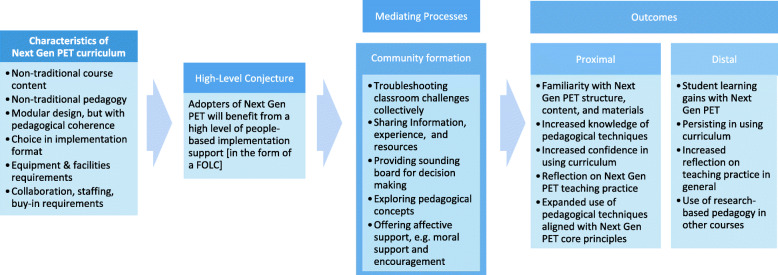
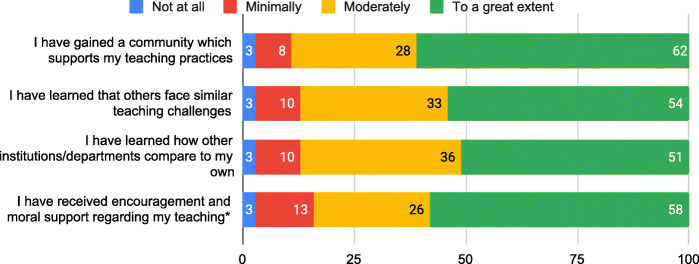
Background: Adoption and use of effective, research-based instructional strategies (RBISs) for STEM education is less widespread than hoped. To promote further use of RBISs, the propagation paradigm suggests that developers work with potential adopters during the development process, and provide ongoing support after adoption. This article investigates the impact of a faculty online learning community (FOLC) as a professional development mechanism for supporting faculty adopting a research-based curriculum. A FOLC uses video conference technology and online platforms to connect geographically dispersed faculty with similar backgrounds (e.g., physics faculty) and supports their teaching development. In the context of a specific FOLC, this article seeks to determine the outcomes the FOLC achieves, and how. Results: Analysis of a FOLC meeting identified opportunities for rich, complex social interaction centered on the research-based curriculum. By functioning as a sounding board for ideas, a space to share experiences, a source of affective support, and a venue for troubleshooting, the FOLC mediates the achievement of a range of outcomes related to implementation of the curriculum. Survey results indicate that members feel a sense of community in the FOLC and that it provides encouragement through teaching challenges. Further results indicate participants’ increased confidence in using the curriculum; familiarity with the curriculum structure and content; increased knowledge of pedagogical techniques; reflection on teaching practices in the curriculum; and use of pedagogical techniques aligned with the curriculum’s core principles. Emerging evidence supports more distal outcomes, including student learning, persistence in using the curriculum, reflection in teaching practice across courses taught, and use of research-based pedagogy in other courses. Conclusions: The propagation paradigm emphasizes the need for ongoing support for adopters of RBISs. The FOLC model provides participating faculty with ongoing support through participation in a community and is an effective support mechanism for adopters of a research-based curriculum. In this study, FOLC members are increasing their knowledge and use of pedagogical techniques in the curriculum-specific course and beyond. This is facilitated by the opportunities in the FOLC for troubleshooting, idea sharing, and receiving encouragement through challenges. This model has the potential to support adopters of additional educational innovations.
Overview
The claims and statistics of this paper haven’t been checked yet.
Free: it reads the open-access text and checks the first 5 claims that cite a source we can check. Create a free account to check every claim.
Integrity signals
Registry
Cites
Statistics
Figures


Verification
Claims the paper makes
The claims and statistics of this paper haven’t been checked yet.
Free: it reads the open-access text and checks the first 5 claims that cite a source we can check. Create a free account to check every claim.
Self-check
Percentages, sums and reported differences re-computed from the paper’s own numbers.
The self-check needs the paper’s full text.
Citations
Cites
Statistical Power Analysis for the Behavioral Sciences
Muller, K. (1989) · Technometrics · doi:10.1080/00401706.1989.10488618 · Cited by 99,167
Statistical power analysis for the behavioral sciences
(1990) · Computers, Environment and Urban Systems · doi:10.1016/0198-9715(90)90050-4 · Cited by 65,269
Situated Learning: Legitimate Peripheral Participation.
Bloch, M., Lave, J., & Wenger, E. (1994) · Man · doi:10.2307/2804509 · Cited by 39,454
Situated Learning: Legitimate Peripheral Participation
Lave, J., & Wenger, E. (1991) · Cambridge University Press eBooks · doi:10.1017/cbo9780511815355 · Cited by 35,324
Hierarchical Linear Models: Applications and Data Analysis Methods.
Longford, N. T., Bryk, A. S., & Raudenbush, S. W. (1993) · Contemporary Sociology · doi:10.2307/2075823 · Cited by 18,724 · cited 1×
“…(large effect size (Cohen, 1988)) than the scores at the retrospective pre-workshop time point (Hierarchical Linear Model, HLM, t (35) = − 10.26, p 0.05) (Raudenbush & Bryk, 2002) and on average 0.79 standard deviations higher (medium effect size) than the scores at the post-workshop time point…”
BackgroundInfluentialActive learning increases student performance in science, engineering, and mathematics
Freeman, S., Eddy, S. L., McDonough, M., Smith, M. K., Okoroafor, N., Jordt, H., & Wenderoth, M. P. (2014) · Proceedings of the National Academy of Sciences · doi:10.1073/pnas.1319030111 · Cited by 9,787
Stereotype threat and the intellectual test performance of African Americans.
Steele, C. M., & Aronson, J. (1995) · Journal of Personality and Social Psychology · doi:10.1037/0022-3514.69.5.797 · Cited by 9,020
(2013) · Cited by 6,708
Cultivating Communities of Practice: A Guide to Managing Knowledge
Wenger, É., & Snyder, W. M. (2002) · CERN Document Server (European Organization for Nuclear Research) · Cited by 5,461
Cultivating Communities of Practice: A Guide to Managing Knowledge
Cuddy, C. (2002) · The Bottom Line · doi:10.1108/bl.2002.17015bae.001 · Cited by 3,923 · cited 2×
“Because a FOLC is an example of a CoP, it is essential to establish a strong sense of community between FOLC members (Wenger et al., 2002).”
BackgroundThe Journal of College Science Teaching
(1971) · Journal of Chemical Education · doi:10.1021/ed048p284 · Cited by 3,332
Microaggressions in everyday life race, gender, and sexual orientation
Sue, D. W. (2010) · Cited by 1,394
(2010) · Encyclopedia of Curriculum Studies · doi:10.4135/9781412958806.n174 · Cited by 1,379
Next Generation Science Standards: For States, By States
(2013) · National Academies Press eBooks · doi:10.17226/18290 · Cited by 1,321
Henderson, C., Beach, A., & Finkelstein, N. (2011) · Journal of Research in Science Teaching · doi:10.1002/tea.20439 · Cited by 1,055
A general typology of research designs featuring mixed methods.
Teddlie, C. B., & Tashakkori, A. (2006) · Research in the schools · Cited by 908
Brownell, S. E., & Tanner, K. D. (2012) · CBE—Life Sciences Education · doi:10.1187/cbe.12-09-0163 · Cited by 797
Anatomy of STEM teaching in North American universities
Stains, M., Harshman, J., Barker, M. K., Chasteen, S. V., Cole, R., DeChenne-Peters, S. E., Eagan, M. K., Esson, J. M., Knight, J. K., Laski, F. A., et al. (2018) · Science · doi:10.1126/science.aap8892 · Cited by 772
Conjecture Mapping: An Approach to Systematic Educational Design Research
Sandoval, W. (2014) · Journal of the Learning Sciences · doi:10.1080/10508406.2013.778204 · Cited by 670
Introduction to faculty learning communities
Cox, M. D. (2004) · New Directions for Teaching and Learning · doi:10.1002/tl.129 · Cited by 613 · cited 2×
“Evidence shows that such FLCs increase faculty interest in teaching and learning and provide support to change longstanding instructional practices (Beach & Cox, 2009; Cox, 2004, 2016; Emerson & Mosteller, 2000; Furco & Moely, 2012; Sirum & Madigan, 2010; Thompson, Marbach-Ad, Egan, & Smith, 2016).”
BackgroundA Guided-Inquiry General Chemistry Course
Farrell, J. J., Moog, R. S., & Spencer, J. N. (1999) · Journal of Chemical Education · doi:10.1021/ed076p570 · Cited by 398
Olson, S., & Riordan, D. G. (2012) · Cited by 368
A theoretical framework for building online communities of practice with social networking tools
Gunawardena, C. N., Hermans, M. B., Sanchez, D., Richmond, C., Bohley, M., & Tuttle, R. (2009) · Educational Media International · doi:10.1080/09523980802588626 · Cited by 354
A modeling method for high school physics instruction
Wells, M., Hestenes, D., & Swackhamer, G. (1995) · American Journal of Physics · doi:10.1119/1.17849 · Cited by 353
Schmader, T., Whitehead, J., & Wysocki, V. H. (2007) · Sex Roles · doi:10.1007/s11199-007-9291-4 · Cited by 320
Rodgers, C. (2002) · Harvard Educational Review · doi:10.17763/haer.72.2.5631743606m15751 · Cited by 299 · cited 1×
“Improved teaching reflection can have long-lasting and far-reaching impact by providing a process for ongoing development (Rodgers, 2002).”
BackgroundPedagogical practices and instructional change of physics faculty
Dancy, M., & Henderson, C. (2010) · American Journal of Physics · doi:10.1119/1.3446763 · Cited by 297
Self-citationShadle, S. E., Marker, A., & Earl, B. (2017) · International Journal of STEM Education · doi:10.1186/s40594-017-0062-7 · Cited by 262 · cited 2×
“While such efforts do increase awareness of innovations, lack of adoption was linked to issues of faculty ownership of their instruction and restrictive situational factors (Dancy & Henderson, 2010; Henderson & Dancy, 2008; Lund & Stains, 2015; Shadle, Marker, & Earl, 2017).”
BackgroundLund, T. J., & Stains, M. (2015) · International Journal of STEM Education · doi:10.1186/s40594-015-0026-8 · Cited by 224
Modeling theory applied: Modeling Instruction in introductory physics
Brewe, E. (2008) · American Journal of Physics · doi:10.1119/1.2983148 · Cited by 210 · cited 1×
“For example, Modeling Instruction, an approach developed in the early 1980s at Arizona State University by Malcom Wells and David Hestenes (Brewe, 2008; Wells, Hestenes, & Swackhamer, 1995), has been widely adopted by high school and university physics instructors.”
MethodCooper, K. M., & Brownell, S. E. (2016) · CBE—Life Sciences Education · doi:10.1187/cbe.16-01-0074 · Cited by 207
Designing System Dualities: Characterizing a Web-Supported Professional Development Community
Barab, S. A., MaKinster, J. G., & Scheckler, R. (2003) · The Information Society · doi:10.1080/01972240309466 · Cited by 201
Henderson, C., & Dancy, M. H. (2008) · American Journal of Physics · doi:10.1119/1.2800352 · Cited by 200
Self-citationHorn, I. S., & Kane, B. D. (2015) · Journal of the Learning Sciences · doi:10.1080/10508406.2015.1034865 · Cited by 186
Demographics of physics education research
Kanim, S., & Cid, X. C. (2020) · Physical Review Physics Education Research · doi:10.1103/physrevphyseducres.16.020106 · Cited by 186
Brooks, C. (2010) · Innovations in Education and Teaching International · doi:10.1080/14703297.2010.498177 · Cited by 181 · cited 1×
“…can be implemented in hybrid or on-line forms, with challenges and benefits distinct from face-to-face formats (Barab, MaKinster, & Scheckler, 2003; Brooks, 2010; Gunawardena et al., 2009; Nelson, McKenna, Chavela Guerra, & Pimmel, 2016; Pimmel, McKenna, Fortenberry, Yoder, & Chavela Guerra, 2013;…”
Stains, M., & Vickrey, T. (2017) · CBE—Life Sciences Education · doi:10.1187/cbe.16-03-0113 · Cited by 177 · cited 1×
“Researchers have discussed the grain size of these modifications and their impact on the effectiveness of an RBIS (Scanlon, Zamarripa Roman, Ibadlit, & Chini, 2019; Stains & Vickrey, 2017).”
BackgroundWho Is Responsible for Preparing Science Teachers?
Otero, V. K., Pollock, S. J., McCray, R., & Finkelstein, N. D. (2006) · Science · doi:10.1126/science.1129648 · Cited by 171
Online Communities of Practice: A Catalyst for Faculty Development
Sherer, P. D., Shea, T. P., & Kristensen, E. (2003) · Innovative Higher Education · doi:10.1023/a:1022355226924 · Cited by 169
The Annual Report on the Economic Status of the Profession, 1989-90.
Strohm, P. (1990) · Cited by 163
Beyond Dissemination in College Science Teaching: An Introduction to Four Core Change Strategies
Henderson, C., Finkelstein, N. D., & Beach, A. L. (2010) · The journal of college science teaching · Cited by 162
Strengthening the research base that informs STEM instructional improvement efforts: A meta-analysis
Lynch, K., Hill, H. C., Gonzalez, K. E., & Pollard, C. (2019) · Educational Evaluation and Policy Analysis · doi:10.3102/0162373719849044 · Cited by 160
Secondary analysis of teaching methods in introductory physics: A 50 k-student study
Korff, J. V., Archibeque, B., Gomez, K. A., Heckendorf, T., McKagan, S. B., Sayre, E. C., Schenk, E. W., Shepherd, C., & Sorell, L. (2016) · American Journal of Physics · doi:10.1119/1.4964354 · Cited by 145
Borda, E. J., Schumacher, E., Hanley, D., Geary, E., Warren, S., Ipsen, C., & Stredicke, L. (2020) · International Journal of STEM Education · doi:10.1186/s40594-020-0203-2 · Cited by 143
Using Learning Communities to Build Faculty Support for Pedagogical Innovation: A Multi-Campus Study
Furco, A., & Moely, B. E. (2012) · The Journal of Higher Education · doi:10.1080/00221546.2012.11777237 · Cited by 135 · cited 1×
“Evidence shows that such FLCs increase faculty interest in teaching and learning and provide support to change longstanding instructional practices (Beach & Cox, 2009; Cox, 2004, 2016; Emerson & Mosteller, 2000; Furco & Moely, 2012; Sirum & Madigan, 2010; Thompson, Marbach-Ad, Egan, & Smith, 2016).”
BackgroundKnowledge dissemination and use in science and mathematics education: A literature review
Hutchinson, J. R., & Huberman, M. (1994) · Journal of Science Education and Technology · doi:10.1007/bf01575814 · Cited by 130
What is the best way to achieve broader reach of improved practices in higher education?
Kezar, A. (2011) · Innovative Higher Education · doi:10.1007/s10755-011-9174-z · Cited by 124 · cited 1×
“Communities of transformation hold particular promise for scaling-up STEM education reform and are more effective than change efforts targeting individual faculty (Gehrke & Kezar, 2016; Kezar, 2011).”
BackgroundThe Annual Report on the Economic Status of the Profession, 1982-83
Hansen, W. L. (1983) · Academe · doi:10.2307/40249050 · Cited by 111
Sturtevant, H., & Wheeler, L. B. (2019) · International Journal of STEM Education · doi:10.1186/s40594-019-0185-0 · Cited by 106
Disciplinary integration of digital games for science learning
Clark, D. B., Sengupta, P., Brady, C. E., Martinez-Garza, M. M., & Killingsworth, S. S. (2015) · International Journal of STEM Education · doi:10.1186/s40594-014-0014-4 · Cited by 99
Secondary analysis of teaching methods in introductory physics: A 50 k-student study
Von Korff, J., Archibeque, B., Gomez, K. A., Heckendorf, T., McKagan, S. B., Sayre, E. C., Schenk, E. W., Shepherd, C., & Sorell, L. (2016) · K-State Research Exchange (Kansas State University) · Cited by 97
Sustaining pedagogical change via faculty learning community
Tinnell, T. L., Ralston, P. A. S., Tretter, T. R., & Mills, M. E. (2019) · International Journal of STEM Education · doi:10.1186/s40594-019-0180-5 · Cited by 87
Trust, T., & Horrocks, B. (2017) · Professional Development in Education · doi:10.1080/19415257.2016.1233507 · Cited by 82
Studying technology-based strategies for enhancing motivation in mathematics
Star, J. R., Chen, J. A., Taylor, M. W., Durkin, K., Dede, C., & Chao, T. (2014) · International Journal of STEM Education · doi:10.1186/2196-7822-1-7 · Cited by 80
Diffusion of research-based instructional strategies: the case of SCALE-UP
Foote, K., Neumeyer, X., Henderson, C., Dancy, M., & Beichner, R. J. (2014) · International Journal of STEM Education · doi:10.1186/s40594-014-0010-8 · Cited by 76
Self-citationHu, H. H., Kussmaul, C., Knaeble, B., Mayfield, C., & Yadav, A. (2016) · Proceedings of the 2016 ACM Conference on Innovation and Technology in Computer Science Education · doi:10.1145/2899415.2899471 · Cited by 71
Transforming Institutions: Undergraduate STEM Education for the 21st Century
Weaver, G. C., Burgess, W., Childress, A., & Slakey, L. L. (2015) · Bibliothèque et Archives nationales du Québec (Québec government) · Cited by 67
Pelletreau, K. N., Knight, J. K., Lemons, P. P., McCourt, J. S., Merrill, J. E., Nehm, R. H., Prevost, L. B., Urban-Lurain, M., & Smith, M. K. (2018) · CBE—Life Sciences Education · doi:10.1187/cbe.17-12-0260 · Cited by 66
From Dissemination to Propagation: A New Paradigm for Education Developers
Froyd, J. E., Henderson, C., Cole, R. S., Friedrichsen, D., Khatri, R., & Stanford, C. (2017) · Change: The Magazine of Higher Learning · doi:10.1080/00091383.2017.1357098 · Cited by 65
Turpen, C., Dancy, M., & Henderson, C. (2016) · Physical Review Physics Education Research · doi:10.1103/physrevphyseducres.12.010116 · Cited by 64
Self-citationCommunities of Transformation: Creating Changes to Deeply Entrenched Issues
Kezar, A., Gehrke, S., & Bernstein-Sierra, S. (2018) · The Journal of Higher Education · doi:10.1080/00221546.2018.1441108 · Cited by 62
Design principles for effective physics instruction: A case from physics and everyday thinking
Goldberg, F. M., Otero, V. K., & Robinson, S. J. (2010) · American Journal of Physics · doi:10.1119/1.3480026 · Cited by 56
Self-citationFaculty online learning communities: A model for sustained teaching transformation
Dancy, M., Lau, A. C., Rundquist, A., & Henderson, C. (2019) · Physical Review Physics Education Research · doi:10.1103/physrevphyseducres.15.020147 · Cited by 53
Self-citationAssessing how science faculty learning communities promote scientific teaching
Sirum, K. L., & Madigan, D. (2010) · Biochemistry and Molecular Biology Education · doi:10.1002/bmb.20364 · Cited by 50
Khatri, R., Henderson, C., Cole, R., Froyd, J. E., Friedrichsen, D., & Stanford, C. (2016) · Physical Review Physics Education Research · doi:10.1103/physrevphyseducres.12.010112 · Cited by 47
Obstacles to Addressing Race and Ethnicity in the Mathematics Education Literature
Parks, A. N., & Schmeichel, M. (2012) · Journal for Research in Mathematics Education · doi:10.5951/jresematheduc.43.3.0238 · Cited by 45
Corrales, A., Goldberg, F. M., Price, E., & Turpen, C. (2020) · International Journal of STEM Education · doi:10.1186/s40594-020-00221-8 · Cited by 40
Self-citationEducational Media and Technology Yearbook
Tseng, S. S. ;. (2018) · Educational media and technology yearbook · doi:10.1007/978-3-319-67301-1 · Cited by 40
STEM Reform Outcomes Through Communities of Transformation
Gehrke, S. J., & Kezar, A. J. (2016) · Change The Magazine of Higher Learning · doi:10.1080/00091383.2016.1121084 · Cited by 37
Hayward, C. N., & Laursen, S. L. (2018) · International Journal of STEM Education · doi:10.1186/s40594-018-0120-9 · Cited by 36
Gehrke, S. J., & Kezar, A. J. (2018) · Research in Higher Education · doi:10.1007/s11162-018-9534-y · Cited by 36
Manduca, C. A. (2017) · Journal of Geoscience Education · doi:10.5408/17-281.1 · Cited by 32 · cited 1×
“…to student learning gains on a conceptual assessment of the physical science material (Engelhardt et al., 2018; Smith & Wingard, 2019), but it is important to recognize the complex, non-linear nature of the connection between curriculum, faculty implementation, and student outcomes (Manduca, 2017).”
BackgroundPaired Teaching: A Professional Development Model for Adopting Evidence-Based Practices
Holland, T., Sherman, S., & Harris, S. (2018) · College Teaching · doi:10.1080/87567555.2018.1463505 · Cited by 29
LGBT+ Inclusivity in Physics and Astronomy: A Best Practices GuidePreprint
Ackerman, N. L., Atherton, T. J., Avalani, A. R., Berven, C., Laskar, T., Neunzert, A., Parno, D. S., & Musolf, M. J. (2018) · arXiv (Cornell University) · doi:10.48550/arxiv.1804.08406 · Cited by 28 · cited 2×
“Other categories, such as sexual orientation and race, are not typically reported, but are included here in response to calls to do so (Ackerman et al., 2018; Kanim & Cid, 2020; Parks & Schmeichel, 2012).”
BackgroundDevelopment Programs for College Faculty: Preparing for the Twenty-First Century.
Emerson, J. D., & Mosteller, F. C. (2000) · Educational media and technology yearbook · Cited by 27
Enabling Informed Adaptation of Reformed Instructional Materials
Scherr, R. E., & Elby, A. (2007) · AIP conference proceedings · doi:10.1063/1.2508688 · Cited by 21 · cited 1×
“Modification is often an essential step in adoption of an innovation because faculty need to tailor the materials to their context, preferences, and student population (Foote, Neumeyer, Henderson, Dancy, & Beichner, 2014; Hutchinson & Huberman, 1994; Scanlon et al., 2019; Scherr & Elby, 2007).”
BackgroundFaculty Development Using Virtual Communities of Practice
Pimmel, R. L., McKenna, A. F., Fortenberry, N. L., Yoder, B. L., & Guerra, R. C. (2020) · ASEE Annual Conference & Exposition · doi:10.18260/1-2--19608 · Cited by 21 · cited 1×
“…and benefits distinct from face-to-face formats (Barab, MaKinster, & Scheckler, 2003; Brooks, 2010; Gunawardena et al., 2009; Nelson, McKenna, Chavela Guerra, & Pimmel, 2016; Pimmel, McKenna, Fortenberry, Yoder, & Chavela Guerra, 2013; Sherer, Shea, & Kristensen, 2003; Trust & Horrocks, 2017).”
Goldberg, F. M., Price, E., Robinson, S. J., Harlow, D. B., & McKean, M. (2012) · Physical Review Special Topics - Physics Education Research · doi:10.1103/physrevstper.8.010121 · Cited by 19
Self-citationCox, M. D. (2016) · New Directions for Teaching and Learning · doi:10.1002/tl.20212 · Cited by 17 · cited 1×
“Evidence shows that such FLCs increase faculty interest in teaching and learning and provide support to change longstanding instructional practices (Beach & Cox, 2009; Cox, 2004, 2016; Emerson & Mosteller, 2000; Furco & Moely, 2012; Sirum & Madigan, 2010; Thompson, Marbach-Ad, Egan, & Smith, 2016).”
BackgroundScanlon, E. M., Roman, B. Z., Ibadlit, E., & Chini, J. J. (2019) · International Journal of STEM Education · doi:10.1186/s40594-019-0167-2 · Cited by 15
Leone, C. J. D., Price, E., Sabella, M. S., & Duzor, A. G. V. (2019) · The journal of college science teaching · doi:10.2505/4/jcst19_048_06_20 · Cited by 15
Self-citationDeveloping a conceptual assessment for a modular curriculum
Engelhardt, P. V., Robinson, S. J., Price, E., Smith, S. J., & Goldberg, F. M. (2019) · Physics Education Research Conference (PERC) · doi:10.1119/perc.2018.pr.engelhardt · Cited by 7
Self-citationLau, A. C., Corrales, A., Goldberg, F. M., & Turpen, C. (2020) · Physics Education Research Conference (PERC) · doi:10.1119/perc.2019.pr.lau · Cited by 6
Self-citation(2018) · doi:10.1119/perc.2018.pr.corrales · Cited by 5
Self-citationTurpen, C., Goldberg, F., Corrales, A., & Price, E. (2019) · Physics Education Research Conference Proceedings · doi:10.1119/perc.2018.pr.turpen · Cited by 4
Self-citationModeling Success: Building Community for Reform
Dancy, M., Brewe, E. T., Henderson, C., Hsu, L., Henderson, C., & McCullough, L. (2007) · AIP conference proceedings · doi:10.1063/1.2820951 · Cited by 3
Self-citationCapturing the Differences Between Two Virtual Communities of Practice Models for Faculty Development
Nelson, K. G., McKenna, A. F., Guerra, R. C., & Pimmel, R. (2016) · ASEE Annual Conference & Exposition · doi:10.18260/p.26450 · Cited by 3
Research works printed but not linked: 10
- Beach AL Cox MD The impact of faculty learning communities on teaching and learning Learning Communities Journal 2009 1 1 7 27
- Gene HE George AA Stiegelbauer SM Measuring implementation in schools: the stages of concern questionnaire 2013 Austin SEDL
- Goldberg F Robinson S Kruse R Thompson N Otero V Physical science and everyday thinking 2007 Greenwich Activate Learning
- Goldberg F Robinson S Otero V Physics and everyday thinking 2008 Greenwich Activate Learning
- Goldberg F Robinson S Price E Boyd-Harlow D Kruse R McKean M Learning physical science 2012 Greenwich Activate Learning
- Goldberg F Robinson S Price E Harlow D Andrew J McKean M Next generation physical science everyday thinking 2018 Greenwich Activate Learning
- Henderson C Cole R Froyd J Friedrichsen DG Khatri R Stanford C Designing educational innovations for sustained adoption: A how-to guide for education developers who want to increase the impact of their work 2015 Kalamazoo Increase the Impact
- Hewitt PG Conceptual Physics 2015 12 Boston Pearson
- Laursen, S., Andrews, T., Stains, M., Finelli, C. J., Borrego, M., McConnell, D., … Foote, K. (2019). Levers for change: An assessment of progress on changing STEM instruction. (D. Smith, Ed.). American Association for the Advancement of Science Retrieved from https://www.aaas.org/resources/levers-change-assessment-progress-changing-stem-instruction.
- Moog, R. S., & Spencer, J. N. (2008). POGIL: An overview (chapter 1). In Process Oriented Guided Inquiry Learning (POGIL). Washington, DC: American Chemical Society.
Cited by
A systematic review on trends in using Moodle for teaching and learning
Gamage, S. H. P. W., Ayres, J. R., & Behrend, M. B. (2022) · International Journal of STEM Education · doi:10.1186/s40594-021-00323-x · Cited by 360
“…track learning outcomes, predict achievements (for early detection of students at risk), and then use the identified information to adapt and modify teaching practices (Dominguez et al., 2016; Hempel et al., 2020; Price et al., 2021; Sergis et al., 2017; Zakaria et al., 2019; Zheng et al., 2019).”
BackgroundSurahman, E., & Wang, T. (2023) · Teaching and Teacher Education · doi:10.1016/j.tate.2023.104326 · Cited by 64
Dancy, M., Henderson, C., Apkarian, N., Johnson, E., Stains, M., Raker, J. R., & Lau, A. (2024) · Physical Review Physics Education Research · doi:10.1103/physrevphyseducres.20.010119 · Cited by 42
Self-citationMeylani, R. (2024) · Edelweiss Applied Science and Technology · doi:10.55214/25768484.v8i6.3763 · Cited by 35
“Collaboration in developing new instructional methods is crucial for their practicality and sustained integration [13].”
Stromholt, S., Wiggins, B. L., & der Mehden, B. M. V. (2023) · Journal for STEM Education Research · doi:10.1007/s41979-023-00109-6 · Cited by 25
Metadata
- Authors
- Price, E., Lau, A. C., Goldberg, F., Turpen, C., Smith, P. S., Dancy, M., & Robinson, S.
- Affiliations
- California State University, San Marcos (US)
- Western Michigan University (US)
- San Diego State University (US)
- University of Maryland, College Park (US)
- Horizon Research (United States) (US)
- University of Colorado Boulder (US)
- Tennessee Technological University (US)
- Corresponding author
- Price, Edward
- Venue
- International Journal of STEM Education
- Published
- 2021-02-24
- Volume
- 8
- Issue
- 1
- Pages
- 17-17
- ISSN
- 2196-7822 (ISSN-L)
- PMC
- PMC7902091
- OpenAlex
- W3135659441
- Semantic Scholar
- 1614990394b6451f37e9a1c21595ccb3731d3e2f
- Cited by
- 60
- References
- 89
- Citations by year
- 2026: 6 · 2025: 7 · 2024: 18 · 2023: 10 · 2022: 15 · 2021: 4
- FWCI
- 20.66
- Type
- journal article
- Language
- en
- Open access
- gold
- doi.org
- Licence
- cc-by
- creativecommons.org/licenses/by/4.0 (tdm)
- creativecommons.org/licenses/by/4.0 (vor)
- Locations
- International Journal of STEM Education (publishedVersion, cc-by)
- PubMed Central (publishedVersion, cc-by)
- PubMed (publishedVersion)
- DOAJ (DOAJ: Directory of Open Access Journals) (submittedVersion, cc-by-sa)
- Funders
- National Science Foundation (DUE-1626496)
- Topics
- Social Sciences › Education › Evaluation of Teaching Practices
- Social Sciences › Education › Science Education and Pedagogy
- Social Sciences › Education › Teacher Education and Leadership Studies
- Keywords
- research-based instructional strategies, faculty professional development, curriculum implementation, physics education, emotional support, teaching methods, STEM education
About these checks
Registry, retraction, Cites and statistics results are computed, not judged, with one exception: a printed reference that no index lists is read once by a model before it counts as a citation error. Claims are extracted by a model and kept only when their quote appears verbatim in the text; each cited source is then checked, with a model’s help, for whether it says what the claim relies on. Those verdicts can be wrong — read the claim’s quote and the cited source before relying on one.
Statistics and arithmetic are recomputed, not judged.
Confidence bands are shown only for fields calibrated on our annotated test set. None is calibrated yet, so no band is shown.
What counts as a claim ›How we measure confidence ›How we check this ›
Are you an author, or do you see a problem with this page? Request a review
Data sources
Bibliographic data: Semantic Scholar, OpenAlex, Crossref.
Contains information from the Semantic Scholar Academic Graph Datasets, made available under the ODC Attribution License (ODC-BY 1.0).
Semantic Scholar’s data is described in: Kinney, R., et al. (2023). The Semantic Scholar Open Data Platform. arXiv:2301.10140.
