

The DOI matches its Crossref record; 118 of the 118 references it cites were found in a registry or an index; 14 of the 115 sources its claims cite were checked for support.
A systematic review on trends in using Moodle for teaching and learning
Open accessAbstract
BACKGROUND: The Moodle Learning Management System (LMS) is widely used in online teaching and learning, especially in STEM education. However, educational research on using Moodle is scattered throughout the literature. Therefore, this review aims to summarise this research to assist three sets of stakeholders-educators, researchers, and software developers. It identifies: (a) how and where Moodle has been adopted; (b) what the concerns, trends, and gaps are to lead future research and software development; and (c) innovative and effective methods for improving online teaching and learning.The review used the 4-step PRISMA-P process to identify 155 suitable journal articles from 104 journals in 55 countries published from January 2015 to June 2021. The database search was conducted with Scopus and Web of Science. Insights into the educational use of Moodle were determined through bibliometric analysis with Vosviewer outputs and thematic analysis. RESULTS: This review shows that Moodle is mainly used within University STEM disciplines and effectively improves student performance, satisfaction, and engagement. Moodle is increasingly being used as a platform for adaptive and collaborative learning and used to improve online assessments. The use of Moodle is developing rapidly to address academic integrity, ethics, and security issues to enhance speed and navigation, and incorporate artificial intelligence. CONCLUSION: More qualitative research is required on the use of Moodle, particularly investigating educators' perspectives. Further research is also needed on the use of Moodle in non-STEM and non-tertiary disciplines. Further studies need to incorporate educational theories when designing courses using the Moodle platform.
Overview
CoChat Summary
TL;DR
This systematic review synthesizes 155 journal articles from 104 journals across 55 countries published January 2015–June 2021 on Moodle use in teaching and learning. It finds Moodle is mainly used in university STEM disciplines and is associated with improved student performance, satisfaction, and engagement, with growing use for adaptive/collaborative learning, online assessment, academic integrity, security, and artificial intelligence.
Key findings
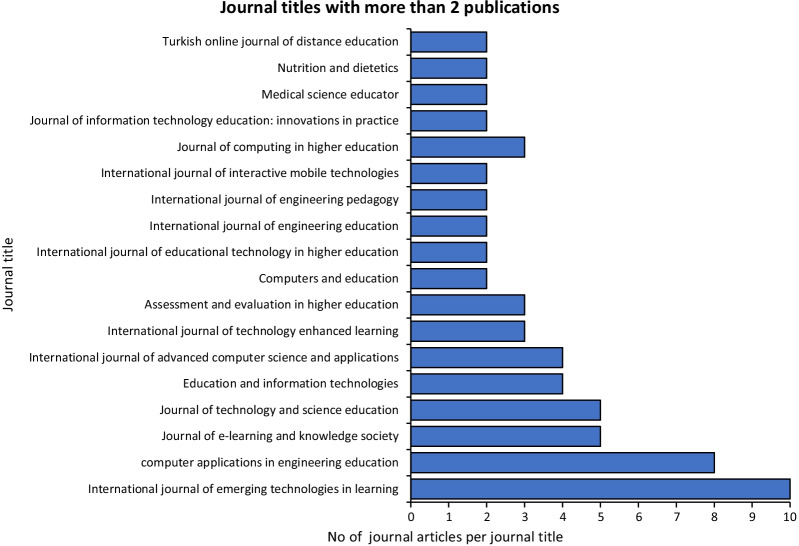
- The review included 155 articles from 104 journals in 55 countries; the combined citation count was 608, and the most cited article (71 citations) compared 17 blended courses using Moodle. Spain contributed 17 articles, the USA 14, Australia 12, the Russian Federation 10, Malaysia 8, Italy 7, and Portugal 5.
- Thematic analysis found 53% of articles addressed curriculum development, 33% assessment, 23% Moodle activities, 24% software development/adaptation, 20% adaptive/collaborative/problem-based content, 12% collaborative learning, 10% Moodle analytics, 6% academic integrity, 4% security/privacy, and 4% marking/feedback.
- Student success indicators appeared as performance in 14% of articles, engagement in 16%, and satisfaction in 8%; most literature focused on university settings (75%) and undergraduate studies (96%). Only eight of 155 articles used educational theoretical frameworks.
- Gaps identified include need for more qualitative research, especially educators’ perspectives; more research in non-STEM and non-tertiary settings; stronger theoretical underpinning; more comparison of Moodle with other LMSs; and more work on ethics and AI.
Methods
- A 4-step PRISMA-P process searched Scopus and Web of Science for “Moodle” articles published January 2015–June 2021, limited to English-language peer-reviewed journal or review articles. Initial searches identified 538 articles, reduced to 285 after screening, 211 after duplicate removal, 187 after abstract review, and 155 included after full-text review.
- Bibliometric analysis used Vosviewer Version 1.6.15 to create co-occurrence maps of keywords, citations, journals, and countries. Thematic analysis followed Braun and Clarke’s six-phase method to construct eight themes relevant to teaching and learning.
Limitations
- The paper states that only Scopus and Web of Science were used, so papers not covered by either database are excluded; it also notes the review is based only on published articles, meaning more Moodle applications may be occurring, particularly in developing countries.
- The search was limited to January 2015–June 2021, English-language, peer-reviewed journal/review articles, excluding conference papers, book chapters, and letters.
- Evident from the text: the review relies on published, indexed literature and may miss non-indexed, non-English, or non-peer-reviewed Moodle implementations; it also reports that only 5% of studies considered educational theories, limiting theoretical synthesis.
Model-written summary. Check it against the paper before relying on it.
Integrity signals
Registry
Cites
Statistics
Figures



Verification
Claims the paper makes
9 Valid · 3 Not valid · 51 Not checked · 69 Own results and interpretations
The cited sources support only part of this claim — read each source’s verdict below.
In the paper
“In studies that have used peer assessments to allow students to grade their peers, some students reported the peer assessment method as “unfair and “unprofessional” (Divjak & Maretić, 2017; Dolezal et al., 2018; Wilson et al., 2015).”
§ A systematic review on trends in using Moodle for teaching and learning > Results and discussion > Thematic analysis (TA)
What the sources say
- Partly supportedcites Divjak & Maretić, 2017 sourceExperimental — accuracy not yet measured
Our copy does report students' negative perceptions of peer-assessment in their own Moodle Workshop study (Section 5 / Table 2 'Pros Cons', and Conclusion, p. n/a): under 'Accountability' students wrote 'I don't want to take responsibility for the grades of other students', 'We (the students) don't have the necessary competencies for assessment', 'I think that teachers must read all of the assignments and have a final say', and 'Assessment is teacher's job, not students'!', and under 'Reliability' 'I find it hard to remain objective when I'm assessing the work of someone very close to me'. That supports the general point that some students judged peer assessment negatively (incompetence/responsibility, bias risk). However, the quoted descriptors the claim puts in students' mouths — 'unfair' and 'unprofessional' — appear nowhere in our copy; the closest notions are 'hard to remain objective' and 'consider themselves incompetent', so the specific wording and the fairness complaint are not attributable to this source. (LLM, conf=0.70)
- Partly supportedcites Dolezal et al., 2018 sourceExperimental — accuracy not yet measured
Our copy supports the 'unfair' half of the claim: the results section (Fig. 1/Fig. 5 discussion) attributes a drop in satisfaction in class B to 'the frustration of some students due to reported unfair assessment', and Recommendation 6 in Section 5 advises listening to students 'when they experienced an unfair grading'. However, the word 'unprofessional' appears nowhere in our copy; the nearest content is Section 5's note that 'some students and teachers raised the objection that students may not be qualified to assess the assignments of others', which is a different formulation (and is attributed jointly to students and teachers, not students alone). Also, the paper's overall tenor is positive ('the overall feedback on the peer review exercises was very positive', Section 8), so the quoted-word framing overstates what this source reports. (LLM, conf=0.72)
- Not checked — no full text of the sourcecites Wilson et al., 2015 source
plain- Asserted: passes — The authors put it forward as true.
- Checkable: passes — It can be checked against evidence.
- Load-bearing: unclear — It is unclear whether the paper’s conclusions depend on it.
- Based: passes — The paper gives a reason why it holds.
- Partly supported
The cited sources support only part of this claim — read each source’s verdict below.
In the paper
“However, only 4% of papers analyse the teachers’ perspectives of using Moodle (Babo & Suhonen, 2018; Badia et al., 2019; García-Martín & García-Sánchez, 2020; Jackson, 2017; Marczak et al., 2016; Valero & Cárdenas, 2017).”
§ A systematic review on trends in using Moodle for teaching and learning > Results and discussion > Thematic analysis (TA)
What the sources say
- Partly supportedcites Babo & Suhonen, 2018 sourceExperimental — accuracy not yet measured
Babo & Suhonen (2018) support the substance of the point qualitatively: their literature review of e-assessment with MCQ in Moodle LMS (Section 2.2, §2.2 'Literature insights') concludes that 'Regardless of the extent of the literature, there is little research about teacher perceptions on this matter', and the Discussion (Section 6) adds that 'no other author truly considered or measured teachers' opinions about MCQ in LMS'. However, our copy nowhere gives the specific 4% figure: the review scope (Section 2.1) describes the databases, period (2004-2016) and inclusion/exclusion criteria but reports no percentage of teacher-perspective papers (searched: '4%', 'percent', 'percentage of articles', 'number of studies'). The precise magnitude in the citing sentence is therefore not attributable to this source, and the review's frame is MCQ e-assessment in Moodle/LMS rather than Moodle use generally. (LLM, conf=0.75)
- Not checked — no full text of the sourcecites Badia et al., 2019 source
- Could not verifycites García-Martín & García-Sánchez, 2020 sourceExperimental — accuracy not yet measured
Our copy of García-Martín & García-Sánchez (2020) contains no statistic about the proportion of papers analysing teachers' perspectives of using Moodle; searches on 'Moodle teachers' perspectives', '4% of the studies analysed', 'percentage of studies focused on students rather than instructors' returned nothing of the kind. Moodle appears only as the platform on which this MOOC was built (Instructional approaches; Procedure, where the course is 'designed on the Universidad de León's external Moodle (Ariadna)') and in the 'Gaps of literature review about MOOCs' section, which says MOOC platforms have meant 'previously used virtual learning environments such as Moodle seem to have been forgotten' — a qualitative remark, not a percentage, and about MOOCs rather than Moodle research. The paper is also not a review of Moodle studies, so it reports no such figure to support or contradict; nothing in our copy makes a contrary point either. (LLM, conf=0.70)
plain- Asserted: passes — The authors put it forward as true.
- Checkable: passes — It can be checked against evidence.
- Load-bearing: unclear — It is unclear whether the paper’s conclusions depend on it.
- Based: passes — The paper gives a reason why it holds.
- Partly supported
The cited sources support only part of this claim — read each source’s verdict below.
In the paper
“However, qualitative studies show that students and staff have divided opinions regarding the “workshop” tool for peer assessment (Divjak & Maretić, 2017; Dolezal et al., 2018; Wilson et al., 2015).”
§ A systematic review on trends in using Moodle for teaching and learning > Results and discussion > Thematic analysis (TA)
What the sources say
- Partly supportedcites Divjak & Maretić, 2017 sourceExperimental — accuracy not yet measured
Our copy supports the students' side: section 3.2 (Case Study) states that in the Project Management course 'we used the Moodle package Workshop ... for assessment support and data collection' and analysed students' comments, and Table 2 / section 7 (Conclusion) systematises those comments into advantages (Logistical, Pedagogical, Metacognitive, Affective, Empowering) and disadvantages (Logistical, Reliability, Equalizing, Metacognitive, Accountability) — e.g. 'peer-assessment is very useful' alongside 'I don't want to take responsibility for the grades of other students', i.e. divided views among students about peer assessment carried out with Workshop. What our copy does not support is the attribution of divided opinions to staff: no passage reports teaching staff's/lecturers' opinions about the Workshop tool (the only teacher-related entry is 'Equalizing — Observed by teacher (span of grades given by students vs span of grades given by teachers)', an observation of grade spread, not an opinion on the tool), and the comments concern peer-assessment as a practice rather than the Workshop plug-in as such, which section 6.1 describes only technically and in terms of its missing reliability check. (LLM, conf=0.72)
- Partly supportedcites Dolezal et al., 2018 sourceExperimental — accuracy not yet measured
Our copy does contain mixed reactions gathered partly through qualitative open questions about peer assessment run via the Moodle workshop activity: Section 5 (Recommendations) states 'Some students and teachers raised the objection that students may not be qualified to assess the assignments of others', and the Fig. 1/Fig. 2 discussion reports 'the frustration of some students due to reported unfair assessment' and three students who disagreed because of 'an unfair deduction of points'. However, the divided opinions the paper records are about the peer-review method and the fairness/fit of particular exercises and grading, not about the 'workshop' tool as such; the paper's design is explicitly quantitative (anonymous semantic-differential questionnaire, Section 2.3) with qualitative items alongside, and its Section 8 Conclusion states 'the overall feedback on the peer review exercises was very positive'. So the source supports divided student/staff views on peer assessment via the workshop, but not the framing of a qualitative study of opinions on the tool itself. (LLM, conf=0.72)
- Not checked — no full text of the sourcecites Wilson et al., 2015 source
plain- Asserted: passes — The authors put it forward as true.
- Checkable: passes — It can be checked against evidence.
- Load-bearing: unclear — It is unclear whether the paper’s conclusions depend on it.
- Based: passes — The paper gives a reason why it holds.
- Partly supported
The cited sources support only part of this claim — read each source’s verdict below.
In the paper
“While some studies have proposed automatic detection of learning styles by analysing student's learning behaviour through mathematical models (Xiao & Rahman, 2017), other studies have developed simpler matrix systems that would allow the teacher to carry out a manual selection of tools for Moodle Learning after considering student's learning styles (Ljubimova et al., 2015; Meza-Fernández & Sepúl”
§ A systematic review on trends in using Moodle for teaching and learning > Results and discussion > Thematic analysis (TA)
What the sources say
- Partly supportedcites Ljubimova et al., 2015 sourceExperimental — accuracy not yet measured
Our copy supports the matrix and the teacher's manual selection of Moodle tools: the Abstract states 'This article contains a matrix of integration of interactive technologies in the process of independent work of students. This will allow the teacher to select the tools for Moodle Leaning Management System...', and the Conclusion (sec. 4) repeats that 'The matrix we have developed will allow the teacher to carry out the selection of tools for Moodle Learning Management System...' (see also sec. 3, where the matrix is described as developed after analysing LMS Moodle's opportunities). However, the selection criterion in Table 2 is the principles of interactive learning (comfort in training, interaction, etc.) matched to Moodle possibilities and tools — nothing in our copy frames the matrix around students' learning styles (searched 'learning styles', 'selection of tools', 'matrix of integration'); that qualifier in the claim is not supported by this source. The comparative 'simpler' is the citing authors' framing relative to Xiao & Rahman (2017) and is not stated here either. (LLM, conf=0.82)
- Partly supportedcites Meza-Fernández & Sepúlveda-Sariego, 2017 sourceExperimental — accuracy not yet measured
Our copy does contain a matrix-like construct linking learning styles to Moodle modules: the Methodology (Fig. 3, adapted from the Kolb & Kolb LSI) maps global/local tasks onto Moodle modules (M1–M8) and defines 'navigation modes according to the intersection between four tasks and four users' learning styles'. However, the paper's stated purpose is descriptive/interpretive — representing 63 navigational paths and 'a method that anticipates choices made by users' — with practical application limited to 'the elaboration of quality assessments and the identification of the needs of educational mediation' (Abstract; Results). No passage presents the model as a system enabling the teacher to manually select Moodle tools for a student, and nothing characterises it as 'simpler' than mathematical detection models; that part of the claim is unsupported by this source. (LLM, conf=0.72)
- Not checked — no full text of the sourcecites Xiao & Rahman, 2017 source
hedged- Asserted: passes — The authors put it forward as true.
- Checkable: passes — It can be checked against evidence.
- Load-bearing: unclear — It is unclear whether the paper’s conclusions depend on it.
- Based: passes — The paper gives a reason why it holds.
- Partly supported
A result the paper reports from its own data — it cites no other source for it, so there is none to check. The quote shows it is in the paper.
In the paper
“The two main disciplines throughout this publication period were STEM and HS.”
§ A systematic review on trends in using Moodle for teaching and learning > Results and discussion > Bibliometric analysis
plain- Asserted: passes — The authors put it forward as true.
- Checkable: passes — It can be checked against evidence.
- Load-bearing: unclear — It is unclear whether the paper’s conclusions depend on it.
- Based: passes — The paper gives a reason why it holds.
47 more claims
Create a free account to see all 132 claims and to verify the 36 references still open.
- Probably not a substantial claim. 40
- It may state two separate claims as one. 51
- The quote only partly states this claim. 1
Citations
Cites
Using thematic analysis in psychology
Braun, V., & Clarke, V. (2006) · Qualitative Research in Psychology · doi:10.1191/1478088706qp063oa · Cited by 194,414
PRISMA-P Group, Moher, D., Shamseer, L., Clarke, M., Ghersi, D., Liberati, A., Petticrew, M., Shekelle, P., & Stewart, L. A. (2015) · Systematic Reviews · doi:10.1186/2046-4053-4-1 · Cited by 26,223
International Standard Classification of Education (ISCED) 2011
UNESCO Institute for Statistics (2012) · doi:10.15220/978-92-9189-123-8-en · Cited by 1,129
Clarke, V., & Braun, V. (2014) · Encyclopedia of Critical Psychology · doi:10.1007/978-1-4614-5583-7_311 · Cited by 885
Raza, S. A., Qazi, W., Khan, K. A., & Salam, J. (2021) · Journal of Educational Computing Research · doi:10.1177/0735633120960421 · Cited by 510
Research and trends in STEM education: a systematic review of journal publications
Li, Y., Wang, K., Xiao, Y., & Froyd, J. E. (2020) · International Journal of STEM Education · doi:10.1186/s40594-020-00207-6 · Cited by 494
Predicting Student Performance from LMS Data: A Comparison of 17 Blended Courses Using Moodle LMS
Conijn, R., Snijders, C., Kleingeld, A., & Matzat, U. (2017) · IEEE Transactions on Learning Technologies · doi:10.1109/tlt.2016.2616312 · Cited by 371
Reviewing and exploring innovative ubiquitous learning tools in higher education
Aljawarneh, S. A. (2020) · Journal of Computing in Higher Education · doi:10.1007/s12528-019-09207-0 · Cited by 333
Floating treatment wetlands: A review and bibliometric analysis
Colares, G. S., Dell'Osbel, N., Wiesel, P. G., Oliveira, G. A., Lemos, P. H. Z., da Silva, F. P., Lutterbeck, C. A., Kist, L. T., & Machado, Ê. L. (2020) · Science of The Total Environment · doi:10.1016/j.scitotenv.2020.136776 · Cited by 301 · cited 2×
“Identification Scopus and Web of Science (WOS) were used to perform the literature search due to their comprehensive journal coverage, ease of keyword searching, accessibility within academia, and popularity within multiple disciplines (Colares et al., 2020; Souza et al., 2019).”
MethodDevelopment of a problem-based learning model via a virtual learning environment
Phungsuk, R., Viriyavejakul, C., & Ratanaolarn, T. (2017) · Kasetsart Journal of Social Sciences · doi:10.1016/j.kjss.2017.01.001 · Cited by 246 · cited 1×
““Forums” allowed students to maintain much more direct contact when they were not in the class and made it easier for students to meet and work on their projects even though they were in different places (Marti et al., 2015; Phungsuk et al., 2017).”
Background
Cited by
Artificial intelligence-enabled adaptive learning platforms: A review
Tan, L. Y., Hu, S., Yeo, D. J., & Cheong, K. H. (2025) · Computers and Education: Artificial Intelligence · doi:10.1016/j.caeai.2025.100429 · Cited by 207
Kerimbayev, N., Umirzakova, Z., Shadiev, R., & Jotsov, V. (2023) · Smart Learning Environments · doi:10.1186/s40561-023-00280-8 · Cited by 176
Artificial intelligence: threat or asset to academic integrity? A bibliometric analysis
Rodrigues, M. M. M., Silva, R., Borges, A. P., Franco, M., & Oliveira, C. (2024) · Kybernetes · doi:10.1108/k-09-2023-1666 · Cited by 169
A Personalized Learning Service Compatible with Moodle E-Learning Management System
Chang, Y.-C., Li, J.-W., & Huang, D.-Y. (2022) · Applied Sciences · doi:10.3390/app12073562 · Cited by 70
Metadata
- Authors
- Gamage, S. H. P. W., Ayres, J. R., & Behrend, M. B.
- Affiliations
- University of South Australia (AU)
- Corresponding author
- Gamage, Sithara H. P. W.
- Venue
- International Journal of STEM Education
- Published
- 2022-01-25
- Volume
- 9
- Issue
- 1
- Pages
- 9-9
- ISSN
- 2196-7822 (ISSN-L)
- PMC
- PMC8787740
- OpenAlex
- W4210507373
- Cited by
- 360
- References
- 117
- Citations by year
- 2026: 60 · 2025: 69 · 2024: 85 · 2023: 100 · 2022: 46
- FWCI
- 9.46
- Type
- journal article
- Language
- en
- Open access
- gold
- doi.org
- Licence
- cc-by
- creativecommons.org/licenses/by/4.0 (tdm)
- creativecommons.org/licenses/by/4.0 (vor)
- Locations
- International Journal of STEM Education (publishedVersion, cc-by)
- PubMed Central (publishedVersion, cc-by)
- PubMed (publishedVersion)
- UniSA Research Outputs Repository (University of South Australia) (acceptedVersion, cc-by)
- Adelaide Research & Scholarship (AR&S) (University of Adelaide) (submittedVersion, cc-by)
- DOAJ (DOAJ: Directory of Open Access Journals) (submittedVersion, cc-by-sa)
- Funders
- University of South Australia
- Topics
- Physical Sciences › Computer Science › Information Systems › Educational Technology and E-Learning
- Social Sciences › Education › Online and Blended Learning
- Social Sciences › Education › Technology-Enhanced Education Studies
- Keywords
- Moodle, virtual learning environments, online teaching and learning, STEM education, higher education, student engagement, student performance, online assessment, adaptive learning, cooperative learning, academic integrity, artificial intelligence in education, educational technology adoption
About these checks
Registry, retraction, Cites and statistics results are computed, not judged, with one exception: a printed reference that no index lists is read once by a model before it counts as a citation error. Claims are extracted by a model and kept only when their quote appears verbatim in the text; each cited source is then checked, with a model’s help, for whether it says what the claim relies on. Those verdicts can be wrong — read the claim’s quote and the cited source before relying on one.
The claim verdicts this report counts are experimental: their accuracy is not yet measured.
A language model drew the claims from the paper on 2026-10-10, under version 3 of the claim definition (model deepseek-v4.1-flash, prompt extract-v3).
A second model labelled each claim on 2026-10-10 (model jev-1.13-20260917, definition revision gold-guideline-v0.2).
Cited sources are checked with a language model’s help (qwen3.8-omni-flash).
Statistics and arithmetic are recomputed, not judged.
Confidence bands are shown only for fields calibrated on our annotated test set. None is calibrated yet, so no band is shown.
What counts as a claim ›How we measure confidence ›How we check this ›
Are you an author, or do you see a problem with this page? Request a review
How to cite
Cite CoChat for the checks on this page, and the paper for its own findings.
- This page
- CoChat. (2026). Citation check: A systematic review on trends in using Moodle for teaching and learning. https://app.cochat.ai/papers/10.1186/s40594-021-00323-x
- The paper
- Gamage, S. H. P. W., Ayres, J. R., & Behrend, M. B. (2022). A systematic review on trends in using Moodle for teaching and learning. International Journal of STEM Education. https://doi.org/10.1186/s40594-021-00323-x
Data sources
Bibliographic data: Semantic Scholar, OpenAlex, Crossref.
Contains information from the Semantic Scholar Academic Graph Datasets, made available under the ODC Attribution License (ODC-BY 1.0).
Semantic Scholar’s data is described in: Kinney, R., et al. (2023). The Semantic Scholar Open Data Platform. arXiv:2301.10140.
