

Effects of digital game-based STEM education on students’ learning achievement: a meta-analysis
Open accessThe DOI matches its Crossref record; 79 of the 83 references it cites were found in a registry or an index; 3 of the 12 sources its claims cite were checked for support.
Abstract
Many researchers have explored the impact of digital games on learning effects in different STEM subjects. The purpose of this meta-analysis is to examine the effect of digital game-based STEM education on the learning achievement of K-12 or higher education students. The analysis results of effect sizes from 33 studies ( N = 3894) published from 2010 to 2020 showed that digital games contributed to a moderate overall effect size (ES = 0.667, 95% CI [0.520–0.814], p < 0.001) when compared with other instructional methods. Furthermore, the study explored multiple moderator variables and their potential impacts on learning outcomes such as control treatment, subject discipline, educational level, game type, gaming platform, and intervention duration. The findings suggest that digital games are a promising pedagogical method in STEM education that effectively improves learning gains. Additionally, the study concludes with three recommendations for future research and practices on digital games in STEM education.
Overview
CoChat Summary
TL;DR
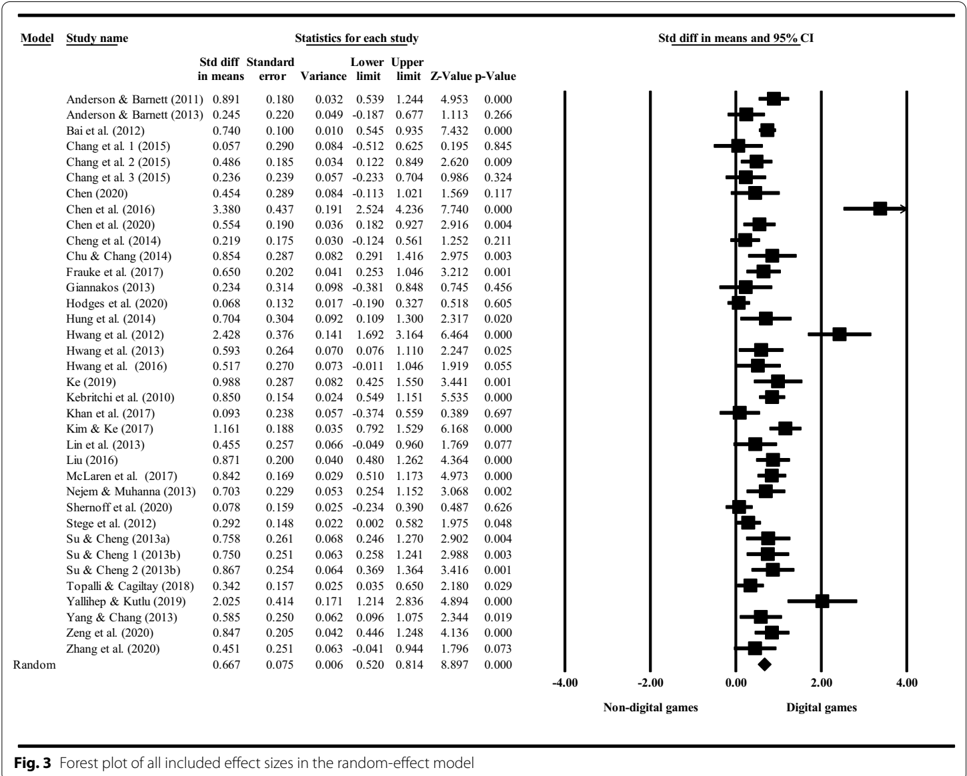
This meta-analysis found that digital game-based STEM education had a moderate, significant positive effect on students’ learning achievement versus other instructional methods. Across 33 studies (36 effect sizes; N = 3,894), the overall effect size was ES = 0.667 (95% CI [0.520–0.814], p < 0.001).
Key findings
- Overall, digital game-based STEM instruction produced a moderate positive effect on learning achievement: ES = 0.667, 95% CI [0.520–0.814], p < 0.001.
- Compared with control treatments, digital game-based instruction outperformed both multimedia (ES = 0.848, p < 0.001) and traditional instruction (ES = 0.558, p < 0.001).
- By subject, effects were positive across science (ES = 0.750, p < 0.001), mathematics (ES = 0.629, p < 0.001), and technology/engineering (ES = 0.367, p = 0.140), with no significant difference among disciplines (Qb = 2.188, p = 0.335).
- By education level, primary education showed the largest effect (ES = 0.835, p < 0.001), compared with secondary (ES = 0.487, p < 0.001) and higher education (ES = 0.492, p < 0.05); the subgroup difference was not significant (Qb = 5.184, p = 0.075).
- By game type, board games had the largest effect (ES = 1.455, p < 0.001), followed by tutorial games (ES = 0.593, p < 0.001) and immersive games (ES = 0.583, p < 0.001); subgroup differences were significant (Qb = 11.126, p < 0.01).
- By platform, computers (ES = 0.625, p < 0.001) and mobile devices (ES = 0.768, p < 0.001) both improved achievement, with no significant difference between them (Qb = 0.752, p = 0.386).
Methods
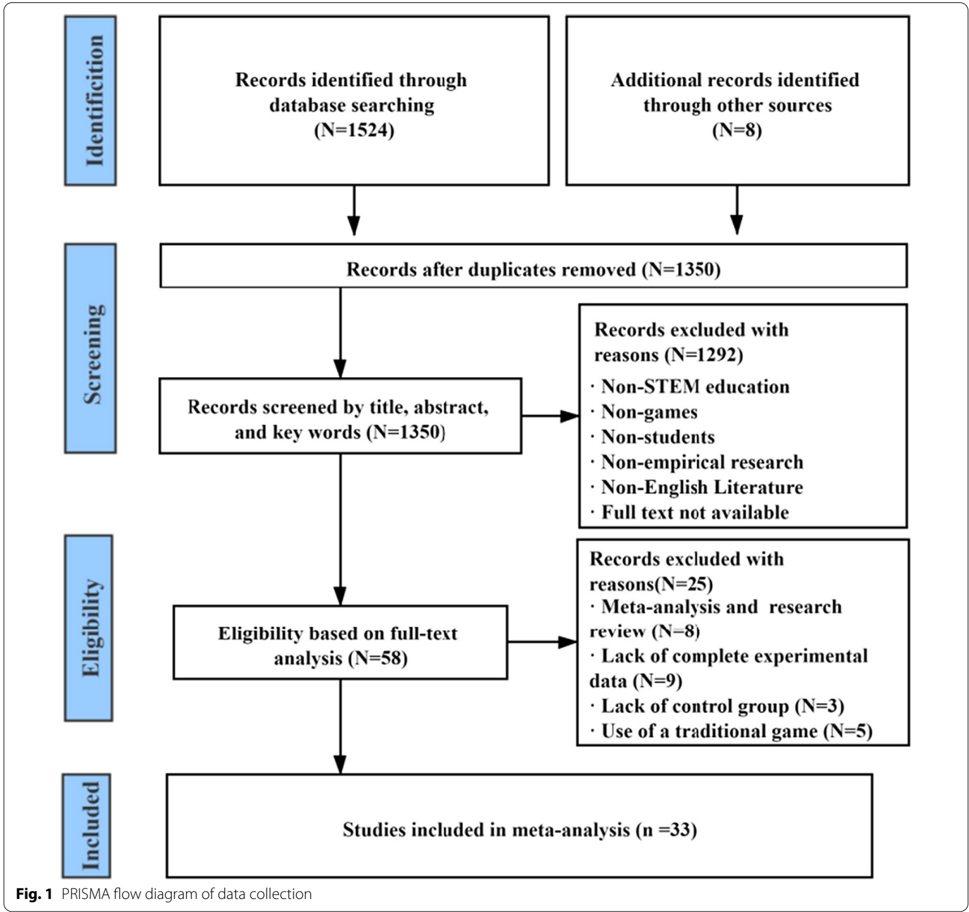
- Meta-analysis conducted under a PRISMA-guided search of six databases: Web of Science Core Collection, ERIC, ProQuest, Springer, Scopus, and Wiley.
- Included studies were English-language peer-reviewed journal articles published from 2010 to 2020, focused on K-12 or higher education STEM settings, used an intervention with a digital game treatment and a comparison group, and reported sufficient data for effect-size calculation.
- The final sample was 33 studies with 36 effect sizes and 3,894 participants; analyses used standardized mean difference, heterogeneity tests (Q and I2), random-effects models, and moderator analyses for control treatment, subject discipline, education level, game type, gaming platform, and intervention duration.
Limitations
- The paper states that the meta-analysis included only 33 empirical studies and 36 effect sizes, and that relevant studies may have been missed.
- The paper states that it used a random-effects model rather than a fixed-effects model, and that the review was not fully inclusive but aimed to provide a systematic overview; it also notes a paucity of studies on other outcomes such as cognitive skills and affective influences.
- Evident from the text: some moderator subgroups were small, especially board games (only four studies; 11.11%), so those estimates may be less stable.
Model-written summary. Check it against the paper before relying on it.
Integrity signals
Registry
Cites
Statistics
Figures
Verification
Claims the paper makes
3 Valid · 0 Not valid · 5 Not checked · 32 Own results and interpretations
Every source the paper cites for this claim was checked and supports it.
In the paper
“Consistent with previous discussions, short-term interventions have been associated with better learning achievement than long-term interventions (Riopel et al., 2019).”
What the sources say
- Supportedcites Riopel et al., 2019 matched to “Impact of serious games on science learning achievement compared with more conventional instruction: an overview and a meta-analysis” (2019) source
The Moderators section states that hypothesis H6 was accepted: 'a shorter duration of instruction with serious games yields higher learning achievement outcomes than a median duration, which itself yields higher learning achievement outcomes than a longer duration,' attributed to novelty-effect dissipation. The Results section backs this with significant pairwise differences (Δd = 0.12, p = .026 for <1 week vs 1–4 weeks; Δd = 0.13, p = .020 for 1–4 weeks vs >4 weeks, F[3,61] = 4.227, p = .022). The source also situates this within the wider CAI/serious-game literature (Dekkers & Donatti 1981; Bayraktar 2001; Kulik & Kulik), matching the citing sentence's 'consistent with previous discussions'. Our copy does note conflicting two-level findings in Wouters et al. (2013) and Clark et al. (2015), but explains them away as coding limitations, so the attribution stands. (LLM, conf=0.90)
plainstates an association- Asserted: passes — The authors put it forward as true.
- Checkable: passes — It can be checked against evidence.
- Load-bearing: unclear — It is unclear whether the paper’s conclusions depend on it.
- Based: passes — The paper gives a reason why it holds.
- Supported
The cited sources support only part of this claim — read each source’s verdict below.
In the paper
“First, they did not comprehensively analyze the subject disciplines of STEM, but only analyzed a particular subject, such as science or mathematics.”
What the sources say
- Partly supportedcites Riopel et al., 2019 matched to “Impact of serious games on science learning achievement compared with more conventional instruction: an overview and a meta-analysis” (2019) sourceExperimental — accuracy not yet measured
The overview ('Previous Meta-Analyses on Serious Games'; 'Moderators') does support the gist that past syntheses left the natural-science/STEM disciplines insufficiently examined: the main limitation is 'the lack of sufficient examination of the effect of serious games in the domain of natural sciences', with broad reviews (Clark et al. 2015; Sitzmann & Ely 2011; Vogel et al. 2006) pooling several knowledge domains 'as a single whole, thus precluding a precise conclusion with regard to the domain of science'. But the claim's second half — that they 'only analyzed a particular subject such as science or mathematics' — is not what our copy says of those meta-analyses; it states the opposite, e.g. Vogel et al. 'did not focus on a particular subject area, and included studies from various knowledge domains'. Our copy does note subject-specific metasyntheses (Rutten et al. 2012; Young et al. 2012; Brinson et al. 2015; Ma & Nickerson 2006), yet frames the gap as science (and its internal disciplines), never as a comprehensive STEM analysis. (LLM, conf=0.72)
- Not checked — no full text of the sourcecites Tokac et al., 2019 matched to “Effects of game‐based learning on students' mathematics achievement: A meta‐analysis” (2019) source
- Not checked — no full text of the sourcecites Tsai & Tsai, 2020 matched to “A meta‐analysis of research on digital game‐based science learning” (2020) source
plain- Asserted: passes — The authors put it forward as true.
- Checkable: passes — It can be checked against evidence.
- Load-bearing: passes — The paper’s conclusions depend on it.
- Based: passes — The paper gives a reason why it holds.
- Partly supported
The sources with a verdict support this claim; the rest weren’t checked yet, have no full text we could read, or their verdicts aren’t rated yet.
In the paper
“However, these studies have reached no uniform conclusions regarding the effects of digital games on students' STEM learning gains.”
What the sources say
- Supportedcites Hung et al. (2014) matched to “Effects of digital game-based learning on students’ self-efficacy, motivation, anxiety, and achievements in learning mathematics” (2014) source
The Discussion and conclusions section states that the positive achievement result 'is not obvious, since some previous studies have reported unfavorable results or negative effects of DGBL on students' learning performance (Charsky and Ressler 2011; Pierfy 1977; Randel et al. 1992)', i.e. the paper explicitly treats prior evidence on games' effects on learning performance as non-uniform. Alongside this, the Background and motivation and Literature review sections marshal the opposite line of findings (educational computer games promoting motivation and achievement: Burguillo 2010; Liu and Chu 2010; Kuo 2007; Sung and Hwang 2013; Hwang et al. 2013c in natural science; Wang and Chen 2010 in programming), so the mixed-result picture spans STEM subjects rather than mathematics alone. The cited sentence is a broad background characterization, and our copy clearly treats the topic that way. (LLM, conf=0.80)
- Not checked — no full text of the sourcecites Neimeyer (2006)
- Not matchedcites Giannakos, 2013; Khan et al., 2017
A range of references, not one source.
plain- Asserted: passes — The authors put it forward as true.
- Checkable: passes — It can be checked against evidence.
- Load-bearing: passes — The paper’s conclusions depend on it.
- Based: passes — The paper gives a reason why it holds.
- Supported
A result the paper reports from its own data — it cites no other source for it, so there is none to check. The quote shows it is in the paper.
In the paper
“The effect size of digital game-based instruction compared to multimedia is 0.848 (p < 0.001).”
plainstates a cause- Asserted: passes — The authors put it forward as true.
- Checkable: passes — It can be checked against evidence.
- Load-bearing: passes — The paper’s conclusions depend on it.
- Based: passes — The paper gives a reason why it holds.
A result the paper reports from its own data — it cites no other source for it, so there is none to check. The quote shows it is in the paper.
In the paper
“Regarding education levels, results in Table 2 suggest no significant difference in the effect sizes for the different education levels (Qb = 5.184, p = 0.075).”
hedged- Asserted: passes — The authors put it forward as true.
- Checkable: passes — It can be checked against evidence.
- Load-bearing: passes — The paper’s conclusions depend on it.
- Based: passes — The paper gives a reason why it holds.
17 more claims
Create a free account to see all 40 claims and every source verdict.
- The quote only partly states this claim. 3
- It may state two separate claims as one. 9
- Probably not a substantial claim. 6
Citations
Cites
Statistical Power Analysis for the Behavioral Sciences
Muller, K. (1989) · Technometrics · doi:10.1080/00401706.1989.10488618 · Cited by 99,167
Measuring inconsistency in meta-analyses
Higgins, J. P. T., Thompson, S. G., Deeks, J. J., & Altman, D. G. (2003) · BMJ · doi:10.1136/bmj.327.7414.557 · Cited by 63,139 · cited 1×
“The I 2 test supplements the Q -test, where 0%–25% indicates that heterogeneity is considered low, 25%–75% indicates moderate heterogeneity, and 75%– 100% indicates substantial heterogeneity (Higgins et al., 2003).”
Bias in meta-analysis detected by a simple, graphical test
Egger, M., Smith, G. D., Schneider, M., & Minder, C. (1997) · BMJ · doi:10.1136/bmj.315.7109.629 · Cited by 56,722 · cited 2×
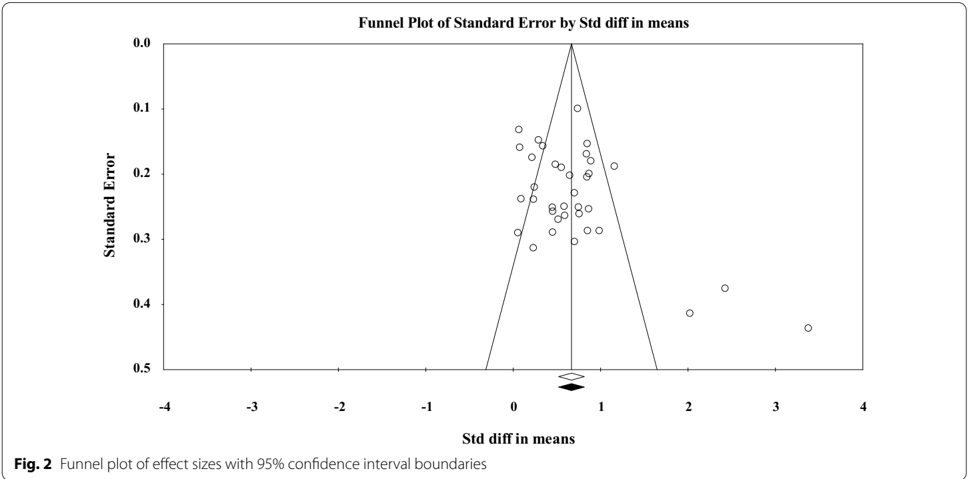
“Publication bias from multiple sources may affect the results of meta-analysis studies (Egger et al., 1997).”
BackgroundPRISMA-P Group, Moher, D., Shamseer, L., Clarke, M., Ghersi, D., Liberati, A., Petticrew, M., Shekelle, P., & Stewart, L. A. (2015) · Systematic Reviews · doi:10.1186/2046-4053-4-1 · Cited by 26,223 · cited 1×
“Studies were searched for using the Preferred Reporting Items for Systematic Reviews and Meta-Analysis (PRISMA) method (Moher et al., 2010, 2015).”
MethodOperating characteristics of a rank correlation test for publication bias
Begg, C. B., & Mazumdar, M. (1994) · Biometrics · doi:10.2307/2533446 · Cited by 16,955 · cited 1×
“In the Begg and Mazumdar rank correlation (Kendall’s Tau with a continuity correction), the results ( Z = 1.457 < 1.96, p = 0.145 > 0.05) indicate that there is insignificant publication bias (Begg & Mazumdar, 1994).”
ResultInfluentialBorenstein, M., Hedges, L. V., Higgins, J. P. T., & Rothstein, H. R. (2009) · doi:10.1002/9780470743386 · Cited by 14,225 · cited 1×
“When only positive study results are published, it leads to publication bias (Borenstein et al., 2009).”
BackgroundPreferred reporting items for systematic reviews and meta-analyses: The PRISMA statement
Moher, D., Liberati, A., Tetzlaff, J., & Altman, D. G. (2010) · International Journal of Surgery · doi:10.1016/j.ijsu.2010.02.007 · Cited by 12,156 · cited 1×
“Studies were searched for using the Preferred Reporting Items for Systematic Reviews and Meta-Analysis (PRISMA) method (Moher et al., 2010, 2015).”
Method(2000) · Cited by 9,198
The file drawer problem and tolerance for null results.
Rosenthal, R. (1979) · Psychological Bulletin · doi:10.1037/0033-2909.86.3.638 · Cited by 9,068 · cited 1×
“The classic fail-safe N test is a procedure to evaluate whether publication bias can be ignored (Rosenthal, 1979).”
BackgroundA basic introduction to fixed-effect and random-effects models for meta-analysis
Borenstein, M., Hedges, L. V., Higgins, J. P. T., & Rothstein, H. R. (2010) · Research Synthesis Methods · doi:10.1002/jrsm.12 · Cited by 6,793 · cited 1×
“Thus, the random-effects model was more appropriate (Borenstein et al., 2010), and showed that analysis of the moderator variables was necessary.”
Method
Research works printed but not linked: 1
- Stege, L., Lankveld, G. V., & Spronck, P. (2012). Teaching high school physics with a serious game. International Journal of Computer Science in Sport, 11(1).
Cited by
Items 101–200 of 309
An Integrative Review with Word Cloud Analysis of STEM Education
Su, W., & Chang, C. (2024) · Journal of Science Education and Technology · doi:10.1007/s10956-024-10134-8 · Cited by 9
“These accomplishments showed that educational researchers are working hard to conduct empirical research related to STEM education (Wang et al., 2022a, b).”
Beyond Play: Researching the Transformative Power of Digital Gaming in Deeply Mediatized Societies
Schwarzenegger, C., Koenen, E., Radde-Antweiler, K., & Wolf, K. D. (2025) · Media and Communication · doi:10.17645/mac.8800 · Cited by 10
“Occasionally, beneficial consequences are noted, particularly in the context of informal learning and education (Clark et al., 2016; Ito et al., 2009; L.‐H. Wang et al., 2022; Wolf & Wudarski, 2018).”
Arias‐Herguedas, S., Marrón, A. M. P., Vivaracho‐Pascual, C., Ortega‐Arranz, A., & Jiménez, L. I. (2025) · Computer Applications in Engineering Education · doi:10.1002/cae.70000 · Cited by 7
Çer, E. (2025) · STEM Education · doi:10.3934/steme.2025018 · Cited by 10
Reserving Cultural Heritage Through Traditional Filipino Games
Charlize, S., Semilla, G. R. A., & Hossain, M. E. (2025) · Multidisciplinary Journal of Tourism, Hospitality, Sport and Physical Education · doi:10.37251/jthpe.v2i1.1915 · Cited by 4
“One of the most notable initiatives is the Larong Pinoy Program developed by Magna Kultura Foundation, which organizes Sports Training Play Camps ( Eskwe-Laro© ) and corporate mini-Olympics to reintroduce these games to both children and adults [12], [13].”
The Impact of a Digital Game on Spatial Reasoning for Elementary School Students
Liu, D., Yi, L., & Kang, R. (2025) · Journal of Computer Assisted Learning · doi:10.1111/jcal.70138 · Cited by 8
Sivrikaya, S. Ö., Çalık, M., & Kurt, S. (2026) · Journal of Chemical Education · doi:10.1021/acs.jchemed.5c00870 · Cited by 4
Nas, S. E., & Yaman, H. (2023) · Malaysian Online Journal of Educational Technology · doi:10.52380/mojet.2023.11.4.497 · Cited by 6
“This situation has led to various literature reviews and meta-analysis studies on the use of different types of educational games in science education in recent years (Arztman et al. , 2022; Cheng et al., 2015; Cop & Kab lan, 2018; Riopel et al., 2019; Tsai & Tsai, 2020; Wang et al., 2022).”
BackgroundTechnology and Digital Learning Tools: Technology Education and Educational Technology
Doyle, A. (2024) · Contemporary issues in technology education · doi:10.1007/978-981-97-1995-2_4 · Cited by 3
Jere, S., & Mpeta, M. (2024) · International Journal of Learning Teaching and Educational Research · doi:10.26803/ijlter.23.7.3 · Cited by 6
Let’s climb the ladders of digital game-based learning experience: a means-end chain perspective
Veselinović, L., Činjarević, M., Turulja, L., & Torlaković, A. (2025) · Interactive Technology and Smart Education · doi:10.1108/itse-09-2024-0210 · Cited by 5
STEM DERS PLANI HAZIRLAMA BECERİLERİNİN VE STEM UYGULAMALARINA İLİŞKİN FEN ÖĞRETMENLERİNİN GÖRÜŞLERİ
Benzer, S., & Kurt, M. (2022) · Sosyal Bilimler Elektronik Dergisi Electronic Journal of Social Sciences · doi:10.29228/sbe.62516 · Cited by 3
Is more comfortable reading possible with collaborative digital games? An experimental study
Şanal, S. Ö. (2023) · Journal of Educational Technology and Online Learning · doi:10.31681/jetol.1153660 · Cited by 3
GeoExplorer and Gender Identity: The Impact of Gender in a Game-Based Learning Environment
Mutha, S., Deeter, A., Sundstrom, J. L., Zastavker, Y. V., Harteveld, C., Bennett, V. G., & Abdoun, T. H. (2023) · IEEE Frontiers in Education Conference (FIE) · doi:10.1109/fie58773.2023.10342928 · Cited by 4
“Game-based learning has been shown to improve learning outcomes and students’ engagement in the learning process as well as provide a source of motivation [2][3][4].”
BackgroundMethodÖner, Y. D. N., & Güneş, T. (2024) · Uluslararası Türk Eğitim Bilimleri Dergisi · doi:10.46778/goputeb.1413068 · Cited by 3
“Wang et al. (2022) conducted a meta-analysis study to investigate the effect of digital game-based education on students' learning achievement.”
BackgroundLeveling up Learning: Serious Games for Computing Education - Long-Term Opportunities and Risks
Wuensche, B. C., Hooper, S., Whalley, J. L., Straand, I. J., Denny, P. C., Crow, T. V. H., Lange-Nawka, D. C., Luxton-Reilly, A., & Thompson, S. E. R. (2025) · Australasian Computing Education Conference · doi:10.1145/3716640.3716655 · Cited by 5
AI integration in higher education: Exploring practical implications and perspectives
Shavanthappa, S. K., Khan, A. K., & Shinde, S. (2025) · Statistical Journal of the IAOS · doi:10.1177/18747655251342648 · Cited by 8
Guo, W. W., & Li, W. (2022) · Online Journal of Communication and Media Technologies · doi:10.30935/ojcmt/12237 · Cited by 5
Morata, J. A. H. (2024) · Journal of interdisciplinary perspectives · doi:10.69569/jip.2024.0581 · Cited by 2
The Effect of STEM Applications on Mathematics Achievement: A Meta-Analysis Study
Gündüz, S., & Sütçü, N. D. (2025) · Bartın University Journal of Faculty of Education · doi:10.14686/buefad.1649805 · Cited by 2
A Conceptual Model for Designing Anxiety-Reducing Digital Games in Mathematics Education
Matić, L. J., Palha, S., & Huhtasalo, J. (2025) · Education Sciences · doi:10.3390/educsci16010034 · Cited by 6
“Moreover, they can help counter perceptions of mathematics as abstract, difficult, or disconnected from real life (Hussein et al., 2022; Fadda et al., 2022; Gao et al., 2020; Gui et al., 2023; L. H. Wang et al., 2022).”
InfluentialPhytoFlow: A Board Game for Enhancing Learning in Undergraduate Biochemistry Classes
Handee, W. (2026) · Journal of Chemical Education · doi:10.1021/acs.jchemed.5c00487 · Cited by 2
Exploring Parent and Teacher Perceptions of Multimodal Educational Games for Engaging Girls in STEM
Kewalramani, S., Richards, G., Speldewinde, C., Aranda, G., Hobbs, L., & Xu, L. (2026) · Education Sciences · doi:10.3390/educsci16030379 · Cited by 2
“Strategies that incorporate game-based learning as part of a digital instructional model, particularly where science, mathematics and language are a focus, have been observed to have a significant positive impact on student academic performance (Behnamnia et al., 2024; Wang et al., 2022).”
Digital Games in Education for Sustainable Development
Paul, J. (2026) · Sustainability · doi:10.3390/su18125930 · Cited by 7
Experimentelle Escape Games im Lehr-Lern-Labor Ex3-Lab des Fachbereichs Chemie
Rubner, I., & Lukas, S. (2023) · Edition Fachdidaktiken · doi:10.1007/978-3-658-40109-2_18 · Cited by 2
Student’s Engagement and Perception of Gamification in Mathematics
Solekhah, H., Kutni, I. D., & Pamungkas, A. B. (2023) · Education Policy and Development · doi:10.31098/epd.v1i2.1779 · Cited by 10
The Language of Life: A Game-Based Workshop for Introducing Protein Biosynthesis
Chiarello, F., Fioretti, D. P., Antognozzi, T., Bertani, F. R., Bilancini, E., Bisanti, M., Boncinelli, L., Businaro, L., Paolo, R. D., Gerardino, A., et al. (2023) · European Conference on Games Based Learning · doi:10.34190/ecgbl.17.1.1587 · Cited by 2
“A few meta-analyses have been conducted, showing that digital games are a promising pedagogical method in STEM education (Wang 2022, Vu 2017).”
BackgroundCiRA-Core: The Connector for Developer Teachers and User Teachers to Artificial Intelligence
Jomtarak, R., Faikhamta, C., Prasoplarb, T., et al. (2023) · Communications in computer and information science · doi:10.1007/978-981-99-8255-4_2 · Cited by 2
Lee, S., Mott, B., Vandenberg, J. L., Spires, H. A., & Lester, J. C. (2023) · IEEE Conference on Games (CoG) · doi:10.1109/cog57401.2023.10333202 · Cited by 2
“Digital games in STEM subjects have been shown to support students’ problem-solving abilities and learning outcomes [23] and make learning more motivating, engaging, and student-centered [24], thus making them more effective for educational use [25].”
BackgroundRochmawati, L., Sylvia, T., Kusumayati, L. D., & Silvia, M. A. (2024) · Journal of Foreign Languange Teaching and Learning · doi:10.18196/ftl.v9i1.20789 · Cited by 7
SYSTEMATIC LITERATURE REVIEW (SLR) OF TECHNOLOGY IN MATHEMATICS LEARNING DURING THE LAST DECADE
Kurniati, R., Sugiarto, S., & Lestari, L. (2023) · MaPan · doi:10.24252/10.24252/mapan.2023v11n2a12 · Cited by 3
Enhancing English Vocabulary through Game-Based Learning: A Case Study of the Scramword Application
Palandi, J. F., Pudyastuti, Z. E., & Molewe, K. (2024) · International Journal in Information Technology in Governance Education and Business · doi:10.32664/ijitgeb.v6i1.141 · Cited by 10
“(Wang et al., 2022).”
Construction of teaching game evaluation model based on ISSA-BPNN
Feng, B., Zhang, L., Yin, J. H., & Wang, R. (2024) · Entertainment Computing · doi:10.1016/j.entcom.2024.100831 · Cited by 4
Macea-Anaya, M., Jumbo, J. J. C., & Baena-Navarro, R. (2024) · Seminars in Medical Writing and Education · doi:10.56294/mw202485 · Cited by 12
Teaching Motion Concepts through Pokemon Unite: Students’ Acceptance and Experiences
Sanchez, J. M. P. (2024) · Schrödinger Journal of Physics Education · doi:10.37251/sjpe.v5i3.1076 · Cited by 3
“…game's content is thought to relate to learning objectives, the resources and support that are available for integrating the game, the degree of digital literacy possessed by both teachers and students and among others as revealed in the systematic reviews of Wang et al. [2] and Ullah et al. [36].”
BackgroundMethodtOOwer Defenders: Um Jogo para Auxiliar no Aprendizado de Programação Orientada a Objetos
Martins, L. D. S., & de Mello, A. V. (2024) · doi:10.5753/sbie.2024.242551 · Cited by 2
“Al´em disso, alguns desses jogos ainda requerem codificac¸˜ao, o que pode diminuir o apelo l ´ udico e dificultar a experi ˆ encia de aprendizado para alguns estudantes [Videnovik et al. 2023, Wang et al. 2022].”
The Effect of STEM-Based Interventions on Learning Outcomes in High School: A Meta-Analysis
Fadillah, M. A., Hirahmah, A., Asrizal, A., & Usmeldi (2024) · Journal of Innovative Physics Teaching · doi:10.24036/jipt/vol2-iss2/53 · Cited by 5
López-Caudana, E. O., Parra, J. C. V., George-Reyes, C. E., & González, G. C. V. (2025) · Journal of Latinos and Education · doi:10.1080/15348431.2024.2444938 · Cited by 5
“…a robust grounding in STEM disciplines is underscored by the fact that much of the innovation and the hurdles encountered in the digital era are deeply rooted in science, technology, engineering, and mathematics (Maass et al., 2019), making STEM education crucial for progress (Wang et al., 2022).”
Maulana, M. R., Sukitman, T., & Astuti, Y. P. (2025) · Journal Evaluation in Education (JEE) · doi:10.37251/jee.v6i2.1650 · Cited by 2
“Therefore, this study's findings could encourage positive changes in how elementary education is carried out, emphasizing experience-based learning and social interaction, which are more relevant to students’ developmental needs in the modern era [26].”
Enhancing Student Knowledge Confidence Through Digital Gamification in Engineering
Elizondo-Noriega, A., Tapia-Tlatelpa, T., Alcántar-Nieblas, C., Felix-Herran, L. C., Díaz, F. S., Lozano-Taba, L. A., Forte-Celaya, M. R., Linde, A. G. S., Castorena, D. G., Ramírez-Montoya, M. S., et al. (2025) · IEEE Global Engineering Education Conference (EDUCON) · doi:10.1109/educon62633.2025.11016296 · Cited by 3
“The review also found that incorporating video games into education can increase students’ motivation to learn STEM subjects [15, 16].”
Chen, C., & Chen, C.-H. (2025) · Research in Science & Technological Education · doi:10.1080/02635143.2025.2561992 · Cited by 6
“Wang et al. (2022) conducted a meta-analysis comparing game-based learning to traditional classroom instruction in STEM education and found that digital educational games had a moderate overall effect size (d = 0.677).”
InfluentialFlores-Nicolás, M., & Reyes, M. M. (2023) · Advances in business information systems and analytics book series · doi:10.4018/978-1-6684-8639-9.ch010 · Cited by 2
Setiawaty, S., Imanda, R., & Putra, R. (2023) · Jurnal Penelitian Pendidikan IPA · doi:10.29303/jppipa.v9i9.2607 · Cited by 2
Kyriacou, R. P., Costa, C. D., Maxey, F., Molyneux, T., Mineo, R., Keens, J., & Kwa, F. A. A. (2024) · Australasian Journal of Educational Technology · doi:10.14742/ajet.8815 · Cited by 2
“It has been reported that gamified virtual environments provide benefits in medical and science, technology, engineering and mathematics education via enhancing student engagement (Krishnamurthy et al., 2022; Wang et al., 2022).”
BackgroundUsing the gaming chatbot to develop algorithmic and logical thinking skills
Varnavsky, A. N. (2024) · Informatics and Education · doi:10.32517/0234-0453-2024-39-2-48-58 · Cited by 2
Chuang, L.-M., & Liu, H.-H. (2023) · Advances in management and applied economics · doi:10.47260/amae/1421 · Cited by 1
-, A. S. A. (2024) · International Journal For Multidisciplinary Research · doi:10.36948/ijfmr.2024.v06i03.23615 · Cited by 6
Xue, X., Zou, Y., Huang, X., Wu, Y., & Li, Y. (2024) · International Journal of Science Education · doi:10.1080/09500693.2024.2439086 · Cited by 1
“Previous studies have recognised the significance of the interest of STEM educational activities and explored ways to enhance the interest of STEM educational activities to increase students’ STEM career aspirations (Taskinen et al., 2013; Wang et al., 2022; Zeng et al., 2020).”
Liu, J., Zhang, Y., Luo, H., Zhang, X., & Li, W. (2024) · Sustainability · doi:10.3390/su162411110 · Cited by 3
WIP: Investigating Students' Emotions and Motivations in a Game-Based Learning Environment
Deeter, A., Goodall, G., Pham, K., Sundstrom, J. L., Qazilbash, A., Zastavker, Y. V., Harteveld, C., Bennett, V. G., & Abdoun, T. H. (2024) · IEEE Frontiers in Education Conference (FIE) · doi:10.1109/fie61694.2024.10893019 · Cited by 2
“Specific to the STEM field, Wang et. al (2022) found that “digital game-based learning had a moderately significant effect on students’ STEM learning achievement” with “no significant difference” in benefit “between the studies for science, mathematics, and technology/engineering” [5].”
WIP: For the Love of the Game: Exploring Student Motivation in Game-Based Learning Environments
Deeter, A., Pham, K., Sundstrom, J. L., Goodall, G., Qazilbash, A., Zastavker, Y. V., Harteveld, C., Bennett, V. G., & Abdoun, T. H. (2024) · IEEE Frontiers in Education Conference (FIE) · doi:10.1109/fie61694.2024.10893400 · Cited by 1
“Wang et al. (2022), in their investigation of students’ learning achievement in STEM, found that “digital games are a promising pedagogical method in STEM education that effectively improves learning gains” across “different STEM subjects” [6].”
Exploration Ethnomathematics in Traditional Games of Mancala in Africa and Congklak in Indonesia
Suharti, R., Bhatt, K. P., Tolulope, O. Y., & Sambo, Y. A. (2025) · Interval Indonesian Journal of Mathematical Education · doi:10.37251/ijome.v3i1.1594 · Cited by 1
Nurhaningtyas, A., Suwono, H., Muksar, M., et al. (2025) · Salud Ciencia y Tecnología · doi:10.56294/saludcyt20251907 · Cited by 1
A STEM-Based Skill Acquisition Module for Drone Soccer: A Survey on Training Preference
Noor, M. A., Noraini, Faziehan, A., et al. (2025) · International STEM Education Conference (iSTEM-Ed) · doi:10.1109/istem-ed65612.2025.11129280 · Cited by 1
“STEM education has been widely recognized as a transfor-mative approach to enhancing technical competency, problem-solving, and critical thinking skills [3].”
Ovsiienko, L., Kulyk, О., Kardash, L. V., Makarchuk, O., & Boyko, S. (2025) · Metaverse Basic and Applied Research · doi:10.56294/mr2025180 · Cited by 1
The effect of digital music education on non-cognitive abilities: Empirical evidence from China
Shan, X., Wang, Y., & Luo, L. (2025) · Acta Psychologica · doi:10.1016/j.actpsy.2025.105564 · Cited by 3
Self-citationExploring the impact of interactive digital tools on learning outcomes in higher education
Zhang, Y. (2025) · International Journal of Inclusive Education · doi:10.1080/13603116.2025.2540821 · Cited by 6
“This ongoing feed-back mechanism plays a vital role in reinforcing knowledge and boosting academic success (Wang et al. 2022).”
Enhancing Education Through Game-Based Learning: Benefits and Future Directions
Sulaiman, N. S., Zulkifli, N. S. A., & Kadir, T. A. A. (2025) · IEEE International Conference on Industrial Technology & Computer Engineering (ICITCE) · doi:10.1109/icitce65255.2025.11210766 · Cited by 6
“It aims to fill the gap towards advanced research in GBL for engineering and other STEM areas [12].”
Lieberoth, A., Nielsen, S. M., Kat, C. R.-D., Rotaru, C., Niazyan, L., Parandzem, P., Craig, B. J., Karstad, O. M., Demişcan, D., Paraschiv, A., et al. (2025) · Frontiers in Education · doi:10.3389/feduc.2025.1472018 · Cited by 2
Video games and key competencies’ development in STEM areas: A systematic review
Ramírez-Segado, A., Benarroch, A. B., Carrillo-Rosúa, J., & Aguilera, D. (2025) · European Journal of Science and Mathematics Education · doi:10.30935/scimath/17409 · Cited by 2
Game design as a STEM pedagogy
Fouilloux, C. A., Compton, J. S., Naing, N., Anderson, M., & Hite, J. L. (2025) · Journal of Microbiology and Biology Education · doi:10.1128/jmbe.00173-25 · Cited by 9
Dogaru, M., Negreanu, M., Pisică, O., & Pîrvu, A. F. (2026) · Frontiers in Education · doi:10.3389/feduc.2025.1652584 · Cited by 4
Hasan, S. H., Mulyati, Y., Winarni, N. D. A., Larasati, D., Yuanvanelli, Y. D., Hamimi, E., Roini, C., & Istiqomah, I. (2026) · Multidisciplinary Science Journal · doi:10.31893/multiscience.2026453 · Cited by 2
“This finding is also supported by Wang et al. (2022) and Turgut & Temur (2017).”
Jahanadan, S., & Musa, M. (2025) · International Journal of Modern Education · doi:10.35631/ijmoe.728044 · Cited by 2
Luckay, M. B., & Johns, L. A. (2026) · Springer eBooks · doi:10.1007/978-3-032-15610-5_6 · Cited by 1
Lee, Y. (2026) · Thinking Skills and Creativity · doi:10.1016/j.tsc.2026.102261 · Cited by 1
L2T: An Algorithm to Support The Generation of 2D Texture from LaTeX Math Equations
dos Santos, A. A., de Camargo, E. T., Scheffel, R. M., et al. (2022) · Brazilian Symposium on Computer Games and Digital Entertainment (SBGames) · doi:10.1109/sbgames56371.2022.9961118 · Cited by 1
“They promote cognitive development and provide an entertaining and engaging means of learning activity [1]–[3].”
BackgroundStump, G., Verlage, E., Marshall, A., Rayyan, S., Agarwal, A., Fay, I., Eberhardt, R., Saini, S., Morrisey, T., Gabbianelli, C., et al. (2023) · Education and Training in Optics and Photonics · doi:10.1117/12.2670774 · Cited by 2
“15,16 Games have been successfully used for a wide variety of teaching, including introductions to electromagnetism, 17 demonstrate the intricacies of supply chain management, 18 and to encourage underrepresented youth to pursue careers in STEM fields by creating identity-building narratives.”
MethodAlmario, J. I. F., Castro, R. L. G., Castro, R. L. G., Pabustan, C. J. S., David, C. J. P., Macabali, A. J., Tolentino, J. C. G., & Valenzuela, L. R. (2023) · International Journal of Multidisciplinary Applied Business and Education Research · doi:10.11594/ijmaber.04.09.24 · Cited by 4
Dondio, P., Almo, A., Amaral, M., Mekonnen, E. T., Rocha, M., & Brennan, A. (2023) · Lecture notes in computer science · doi:10.1007/978-3-031-49065-1_18 · Cited by 2
Siswati, B. H., Prihatin, J., & Aloysius, D. C. (2024) · Jurnal Penelitian Pendidikan IPA · doi:10.29303/jppipa.v10i1.5890 · Cited by 9
Aldemita Ariane Joy, A., Capusi Micaela, D., Martinez Jayson, S., Mendez Yannie, D., & Zotomayor Jhon Jhon, P. (2024) · International Journal of Science and Research Archive · doi:10.30574/ijsra.2024.11.2.0541 · Cited by 3
INTEGRATING TECHNOLOGY WITH SCIENCE IN STEM EDUCATION FOR K-12 STUDENTS
Siddiqui, A., Khowaja, K., Ghulamani, S., & Shah, A. (2023) · Journal of Information Systems and Digital Technologies · doi:10.31436/jisdt.v5i2.386 · Cited by 1
“The results denoted that students were more driven to digital-game-based methods which also improved their academic performance (Wang et al., 2022).”
BackgroundResultCuabo, F. M. P., Jagonia, F. S., & Baluyos, G. R. (2024) · International Journal of Innovative Science and Research Technology (IJISRT) · doi:10.38124/ijisrt/ijisrt24sep532 · Cited by 3
“It has been discovered that game-based learning effectively enhances learner performance and attitudes toward learning (Wang et al., 2022).”
BackgroundSEGA: Gamified approach to STEAM education for early childhood education utilizing digital resources
Bratitsis, T., Tsapara, M., Koliakou, I. G., & Ziouzios, D. (2024) · AIP conference proceedings · doi:10.1063/5.0235447 · Cited by 3
Deep Learning Model to Analyze Psychological Effects on Gamers
Younas, R., & Haq, H. B. U. (2024) · Spectrum of Decision Making and Applications. · doi:10.31181/sdmap2120254 · Cited by 1
Enhancing Educational Games: Addressing Design Challenges and Improving Effectiveness
Permata, N. A., Lubis, M., Perdana, I., Kurniawan, A., & Sembiring, A. (2024) · International Conference on Cyber and IT Service Management (CITSM) · doi:10.1109/citsm64103.2024.10775684 · Cited by 8
“Moreover, the growing use of virtual reality (VR) in educational games offers a more immersive learning experience, although challenges such as accessibility and potential side effects remain [7].”
Entornos inmersivos y rehabilitación motriz: Un enfoque con realidad virtual y gamificación
Chuquitarco-Aguayo, A. (2024) · Social & Educational Lens · doi:10.56931/sel.2024.e3 · Cited by 1
User Satisfaction Forecasting in Game-Based Educational Technology through Transformer Models
Kang, C., & Kim, J. H. (2025) · International Conference on Ubiquitous Information Management and Communication (IMCOM) · doi:10.1109/imcom64595.2025.10857533 · Cited by 1
Towards Blended Learning in Primary STEM in Latvia: Four Teaching Profiles
Čakāne, I., Greitāns, K., Burgmanis, Ģ., & Namsone, D. (2025) · Education Sciences · doi:10.3390/educsci15030295 · Cited by 4
“…recent decades, BL has gained increased attention among primary education researchers—research meta-analysis signals that in comparison with F2F learning, BL approaches can increase student learning outcomes, motivation, and efficiency of learning (Li et al., 2024; Li & Wang, 2022; Ma & Lee, 2021).”
Kaur, D. P., & Kumar, A. (2024) · International Conference on Emerging Trends in Engineering and Medical Sciences (ICETEMS) · doi:10.1109/icetems64039.2024.10964981 · Cited by 2
Swathi, N. N. S., Jufri, A. W., Sukarso, A., Artayasa, I. P., & Rokhmat, J. (2025) · Jurnal Penelitian dan Pengembangan Pendidikan · doi:10.23887/jppp.v9i1.90707 · Cited by 1
Sikhosana, H. N., Malatji, H., Munyoro, A. T., & Nkomo, T. S. (2025) · Education Sciences · doi:10.3390/educsci15060758 · Cited by 1
A Meta-Analysis of the Effects of Functional Games on Students' Academic Achievement.
ChunYang, G. U., TingYang, W. A. N. G., Jie, H. A. O., Kim, D., & Heo, G. (2025) · Journal of Fisheries and Marine Sciences Education · doi:10.13000/jfmse.2025.6.37.3.567 · Cited by 1
Sholeha, S., Rahayu, E. S., Yuniastuti, A., & Rusilowati, A. (2024) · Unnes Science Education Journal · doi:10.15294/usej.v13i2.9363 · Cited by 3
Sivenas, T., Koutromanos, G., & Larios, N. (2025) · Communications in computer and information science · doi:10.1007/978-3-032-02675-0_24 · Cited by 1
Strategies to Promote Stakeholders’ Autonomy While Creating Educational Digital Games
Dairel, J. G. D. M., Gasparini, I., & Araújo, R. D. (2023) · Communications in computer and information science · doi:10.1007/978-3-031-27639-2_12 · Cited by 1
Nurgaziev, Y., & Abdykadyrov, A. (2023) · World Journal on Educational Technology Current Issues · doi:10.18844/wjet.v15i4.8820 · Cited by 2
Pandya, J. D., & Prajapati, B. G. (2025) · Wiley eBooks · doi:10.1002/9781394242474.ch6 · Cited by 1
3D COMPUTER GRAPHICS IN THE DEVELOPMENT OF KNOWLEDGE CONTROL SYSTEM IN THE DGBL APPROACH
Haitan, О. М., & Kolesnyk, D. D. (2022) · Scientific notes of Taurida National V I Vernadsky University Series Technical Sciences · doi:10.32782/2663-5941/2022.6/14
Spatial Mnemonics for L2 Vocabulary Recall. Customized Training for 21st Century Students
Costuchen, A. L. (2023) · RiuNet (Universitat Politècnica de València) · doi:10.4995/thesis/10251/195731 · Cited by 1
A Meta-Analysis of the Effectiveness of Digital Technology-Assisted STEM EducationPreprint
ÖZTOP, F. (2023) · doi:10.31235/osf.io/jmekz
Wekerle, C., Daumiller, M. H., Janke, S., Dickhäuser, O., Dresel, M., & Kollar, I. (2023) · doi:10.31234/osf.io/gh29v
Công nghệ ứng dụng trong xây dựng và triển khai nội dung giáo dục, đào tạo trực tuyến và trực tiếp
An, N. N. T., & Bão, L. H. H. B. L. H. H. (2023) · TẠP CHÍ KHOA HỌC TRƯỜNG ĐẠI HỌC QUỐC TẾ HỒNG BÀNG · doi:10.59294/hiujs.25.2023.518
The Application of International Models for Standards-Based STEM Education in Taiwan: A Case Study
Ku, C., & Lin, K. (2023) · Contemporary issues in technology education · doi:10.1007/978-981-99-5704-0_13
Game Asset Design As A Culture Conservation Effort Through New Media
Rezaldi, M. Y., & Alhafizi, I. (2023) · Jurnal Bahasa Rupa · doi:10.31598/bahasarupa.v6i3.1393
Extending Educational Games Across Product Lines
Castro, D., Werner, C., & Xexeo, G. B. (2024) · Communications in computer and information science · doi:10.1007/978-3-031-51452-4_10
Garcia, M. B., Adao, R., Pempina, E. B., et al. (2024) · SSRN Electronic Journal · doi:10.2139/ssrn.4657358
A Systematic Review of Caribbean Digital Serious Games for Education
Walcott, P. A. (2023) · IEEE Gaming, Entertainment, and Media Conference (GEM) · doi:10.1109/gem59776.2023.10390137
“These results concur with [17] who surmised that”
BackgroundResultSaltanova, G. A., & Syrymova, D. S. (2023) · МАТЕМАТИКАНЫ ФИЗИКАНЫ ЖӘНЕ ИНФОРМАТИКАНЫ ОҚЫТУДЫҢ ӨЗЕКТІ МӘСЕЛЕЛЕРІ · doi:10.52081/mpimet.2023.v04.i4.026
Metadata
- Authors
- Wang, L.-H., Chen, B., Hwang, G.-J., Guan, J.-Q., & Wang, Y.-Q.
- Affiliations
- Zhejiang Normal University (CN)
- National Taiwan University of Science and Technology (TW)
- Corresponding author
- Wang, Liang-Hui
- ORCID
- Wang, Liang-Hui
- Venue
- International Journal of STEM Education
- Published
- 2022-03-17
- Volume
- 9
- Issue
- 1
- ISSN
- 2196-7822 (ISSN-L)
- OpenAlex
- W4220750697
- Semantic Scholar
- 0542eaf59a9b5c949fbd23ad6ef15d7343492a37
- Cited by
- 316
- References
- 83
- Citations by year
- 2026: 63 · 2025: 82 · 2024: 90 · 2023: 67 · 2022: 11
- FWCI
- 12.61
- Type
- journal article
- Language
- en
- Open access
- gold
- doi.org
- Licence
- cc-by
- creativecommons.org/licenses/by/4.0 (tdm)
- creativecommons.org/licenses/by/4.0 (vor)
- Locations
- International Journal of STEM Education (publishedVersion, cc-by)
- DOAJ (DOAJ: Directory of Open Access Journals) (submittedVersion, cc-by-sa)
- Funders
- Philosophy and Social Science Planning of Zhejiang Province (19NDJC252YB)
- National Education Science “13th Five-Year” Planning Key Project of Ministry of Education in China (DCA160262)
- Topics
- Social Sciences › Psychology › Developmental and Educational Psychology › Educational Games and Gamification
- Social Sciences › Education › Education and Learning Interventions
- Physical Sciences › Computer Science › Information Systems › Mobile Learning in Education
- Keywords
- game-based learning, video games, STEM education, academic performance, K-12 students, university students, game types, game platforms
About these checks
Registry, retraction, Cites and statistics results are computed, not judged, with one exception: a printed reference that no index lists is read once by a model before it counts as a citation error. Claims are extracted by a model and kept only when their quote appears verbatim in the text; each cited source is then checked, with a model’s help, for whether it says what the claim relies on. Those verdicts can be wrong — read the claim’s quote and the cited source before relying on one.
The claim verdicts this report counts are experimental: their accuracy is not yet measured.
A language model drew the claims from the paper on 2026-10-10, under version 3 of the claim definition (model deepseek-v4.1-flash, prompt extract-v3).
A second model labelled each claim on 2026-10-10 (model jev-1.13-20260917, definition revision gold-guideline-v0.2).
Cited sources are checked with a language model’s help (qwen3.8-omni-flash).
Statistics and arithmetic are recomputed, not judged.
Confidence bands are shown only for fields calibrated on our annotated test set. None is calibrated yet, so no band is shown.
What counts as a claim ›How we measure confidence ›How we check this ›
Are you an author, or do you see a problem with this page? Request a review
Data sources
Bibliographic data: Semantic Scholar, OpenAlex, Crossref.
Contains information from the Semantic Scholar Academic Graph Datasets, made available under the ODC Attribution License (ODC-BY 1.0).
Semantic Scholar’s data is described in: Kinney, R., et al. (2023). The Semantic Scholar Open Data Platform. arXiv:2301.10140.
