

Effects of digital game-based STEM education on students’ learning achievement: a meta-analysis
Open accessThe DOI matches its Crossref record; 79 of the 83 references it cites were found in a registry or an index; 3 of the 12 sources its claims cite were checked for support.
Abstract
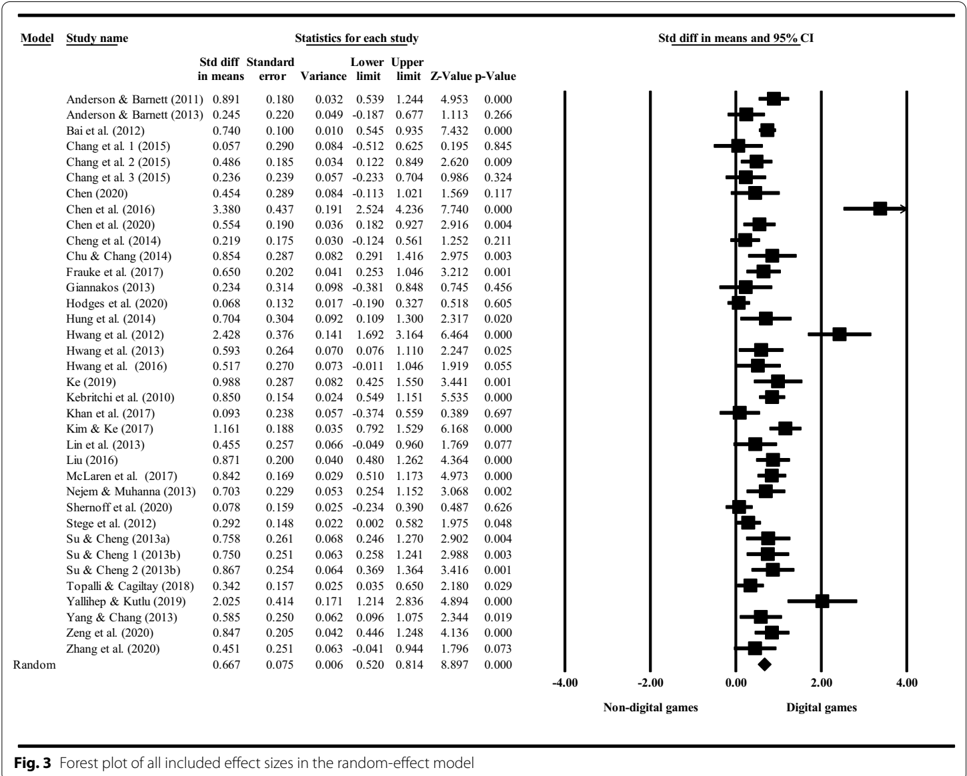
Many researchers have explored the impact of digital games on learning effects in different STEM subjects. The purpose of this meta-analysis is to examine the effect of digital game-based STEM education on the learning achievement of K-12 or higher education students. The analysis results of effect sizes from 33 studies ( N = 3894) published from 2010 to 2020 showed that digital games contributed to a moderate overall effect size (ES = 0.667, 95% CI [0.520–0.814], p < 0.001) when compared with other instructional methods. Furthermore, the study explored multiple moderator variables and their potential impacts on learning outcomes such as control treatment, subject discipline, educational level, game type, gaming platform, and intervention duration. The findings suggest that digital games are a promising pedagogical method in STEM education that effectively improves learning gains. Additionally, the study concludes with three recommendations for future research and practices on digital games in STEM education.
Overview
CoChat Summary
TL;DR
This meta-analysis found that digital game-based STEM education had a moderate, significant positive effect on students’ learning achievement versus other instructional methods. Across 33 studies (36 effect sizes; N = 3,894), the overall effect size was ES = 0.667 (95% CI [0.520–0.814], p < 0.001).
Key findings
- Overall, digital game-based STEM instruction produced a moderate positive effect on learning achievement: ES = 0.667, 95% CI [0.520–0.814], p < 0.001.
- Compared with control treatments, digital game-based instruction outperformed both multimedia (ES = 0.848, p < 0.001) and traditional instruction (ES = 0.558, p < 0.001).
- By subject, effects were positive across science (ES = 0.750, p < 0.001), mathematics (ES = 0.629, p < 0.001), and technology/engineering (ES = 0.367, p = 0.140), with no significant difference among disciplines (Qb = 2.188, p = 0.335).
- By education level, primary education showed the largest effect (ES = 0.835, p < 0.001), compared with secondary (ES = 0.487, p < 0.001) and higher education (ES = 0.492, p < 0.05); the subgroup difference was not significant (Qb = 5.184, p = 0.075).
- By game type, board games had the largest effect (ES = 1.455, p < 0.001), followed by tutorial games (ES = 0.593, p < 0.001) and immersive games (ES = 0.583, p < 0.001); subgroup differences were significant (Qb = 11.126, p < 0.01).
- By platform, computers (ES = 0.625, p < 0.001) and mobile devices (ES = 0.768, p < 0.001) both improved achievement, with no significant difference between them (Qb = 0.752, p = 0.386).
Methods
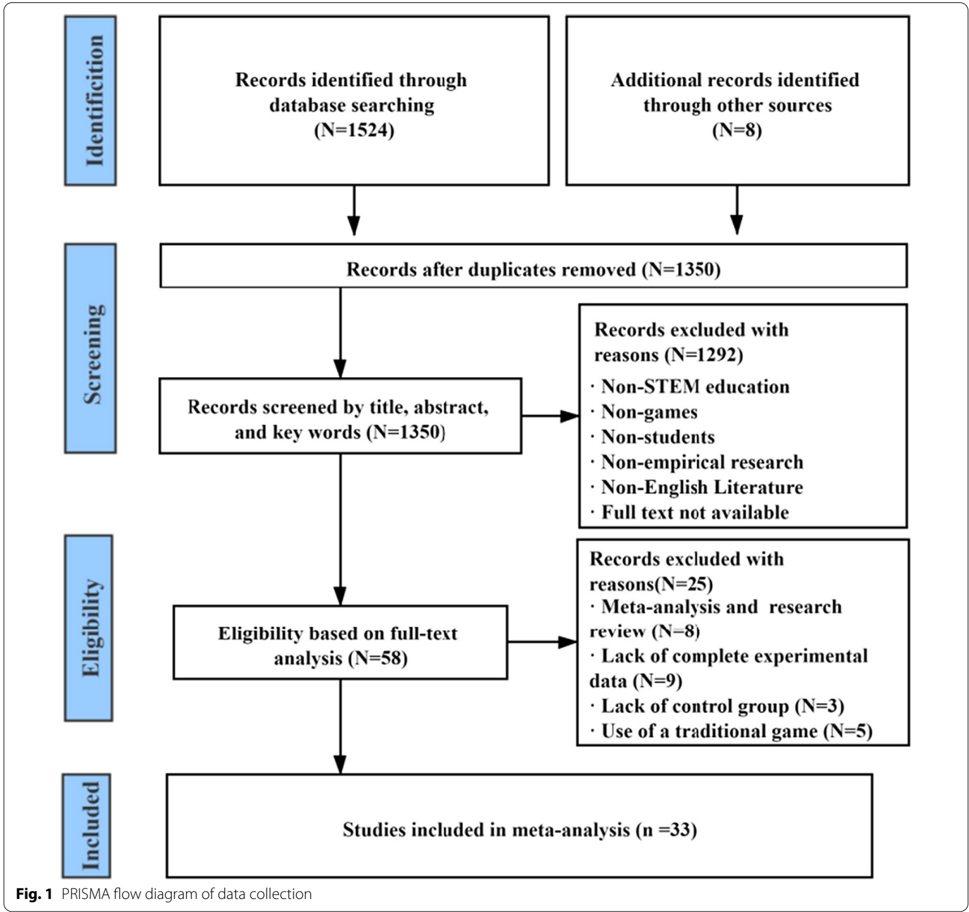
- Meta-analysis conducted under a PRISMA-guided search of six databases: Web of Science Core Collection, ERIC, ProQuest, Springer, Scopus, and Wiley.
- Included studies were English-language peer-reviewed journal articles published from 2010 to 2020, focused on K-12 or higher education STEM settings, used an intervention with a digital game treatment and a comparison group, and reported sufficient data for effect-size calculation.
- The final sample was 33 studies with 36 effect sizes and 3,894 participants; analyses used standardized mean difference, heterogeneity tests (Q and I2), random-effects models, and moderator analyses for control treatment, subject discipline, education level, game type, gaming platform, and intervention duration.
Limitations
- The paper states that the meta-analysis included only 33 empirical studies and 36 effect sizes, and that relevant studies may have been missed.
- The paper states that it used a random-effects model rather than a fixed-effects model, and that the review was not fully inclusive but aimed to provide a systematic overview; it also notes a paucity of studies on other outcomes such as cognitive skills and affective influences.
- Evident from the text: some moderator subgroups were small, especially board games (only four studies; 11.11%), so those estimates may be less stable.
Model-written summary. Check it against the paper before relying on it.
Integrity signals
Registry
Cites
Statistics
Figures
Verification
Claims the paper makes
3 Valid · 0 Not valid · 5 Not checked · 32 Own results and interpretations
Every source the paper cites for this claim was checked and supports it.
In the paper
“Consistent with previous discussions, short-term interventions have been associated with better learning achievement than long-term interventions (Riopel et al., 2019).”
What the sources say
- Supportedcites Riopel et al., 2019 matched to “Impact of serious games on science learning achievement compared with more conventional instruction: an overview and a meta-analysis” (2019) source
The Moderators section states that hypothesis H6 was accepted: 'a shorter duration of instruction with serious games yields higher learning achievement outcomes than a median duration, which itself yields higher learning achievement outcomes than a longer duration,' attributed to novelty-effect dissipation. The Results section backs this with significant pairwise differences (Δd = 0.12, p = .026 for <1 week vs 1–4 weeks; Δd = 0.13, p = .020 for 1–4 weeks vs >4 weeks, F[3,61] = 4.227, p = .022). The source also situates this within the wider CAI/serious-game literature (Dekkers & Donatti 1981; Bayraktar 2001; Kulik & Kulik), matching the citing sentence's 'consistent with previous discussions'. Our copy does note conflicting two-level findings in Wouters et al. (2013) and Clark et al. (2015), but explains them away as coding limitations, so the attribution stands. (LLM, conf=0.90)
plainstates an association- Asserted: passes — The authors put it forward as true.
- Checkable: passes — It can be checked against evidence.
- Load-bearing: unclear — It is unclear whether the paper’s conclusions depend on it.
- Based: passes — The paper gives a reason why it holds.
- Supported
The cited sources support only part of this claim — read each source’s verdict below.
In the paper
“First, they did not comprehensively analyze the subject disciplines of STEM, but only analyzed a particular subject, such as science or mathematics.”
What the sources say
- Partly supportedcites Riopel et al., 2019 matched to “Impact of serious games on science learning achievement compared with more conventional instruction: an overview and a meta-analysis” (2019) sourceExperimental — accuracy not yet measured
The overview ('Previous Meta-Analyses on Serious Games'; 'Moderators') does support the gist that past syntheses left the natural-science/STEM disciplines insufficiently examined: the main limitation is 'the lack of sufficient examination of the effect of serious games in the domain of natural sciences', with broad reviews (Clark et al. 2015; Sitzmann & Ely 2011; Vogel et al. 2006) pooling several knowledge domains 'as a single whole, thus precluding a precise conclusion with regard to the domain of science'. But the claim's second half — that they 'only analyzed a particular subject such as science or mathematics' — is not what our copy says of those meta-analyses; it states the opposite, e.g. Vogel et al. 'did not focus on a particular subject area, and included studies from various knowledge domains'. Our copy does note subject-specific metasyntheses (Rutten et al. 2012; Young et al. 2012; Brinson et al. 2015; Ma & Nickerson 2006), yet frames the gap as science (and its internal disciplines), never as a comprehensive STEM analysis. (LLM, conf=0.72)
- Not checked — no full text of the sourcecites Tokac et al., 2019 matched to “Effects of game‐based learning on students' mathematics achievement: A meta‐analysis” (2019) source
- Not checked — no full text of the sourcecites Tsai & Tsai, 2020 matched to “A meta‐analysis of research on digital game‐based science learning” (2020) source
plain- Asserted: passes — The authors put it forward as true.
- Checkable: passes — It can be checked against evidence.
- Load-bearing: passes — The paper’s conclusions depend on it.
- Based: passes — The paper gives a reason why it holds.
- Partly supported
The sources with a verdict support this claim; the rest weren’t checked yet, have no full text we could read, or their verdicts aren’t rated yet.
In the paper
“However, these studies have reached no uniform conclusions regarding the effects of digital games on students' STEM learning gains.”
What the sources say
- Supportedcites Hung et al. (2014) matched to “Effects of digital game-based learning on students’ self-efficacy, motivation, anxiety, and achievements in learning mathematics” (2014) source
The Discussion and conclusions section states that the positive achievement result 'is not obvious, since some previous studies have reported unfavorable results or negative effects of DGBL on students' learning performance (Charsky and Ressler 2011; Pierfy 1977; Randel et al. 1992)', i.e. the paper explicitly treats prior evidence on games' effects on learning performance as non-uniform. Alongside this, the Background and motivation and Literature review sections marshal the opposite line of findings (educational computer games promoting motivation and achievement: Burguillo 2010; Liu and Chu 2010; Kuo 2007; Sung and Hwang 2013; Hwang et al. 2013c in natural science; Wang and Chen 2010 in programming), so the mixed-result picture spans STEM subjects rather than mathematics alone. The cited sentence is a broad background characterization, and our copy clearly treats the topic that way. (LLM, conf=0.80)
- Not checked — no full text of the sourcecites Neimeyer (2006)
- Not matchedcites Giannakos, 2013; Khan et al., 2017
A range of references, not one source.
plain- Asserted: passes — The authors put it forward as true.
- Checkable: passes — It can be checked against evidence.
- Load-bearing: passes — The paper’s conclusions depend on it.
- Based: passes — The paper gives a reason why it holds.
- Supported
A result the paper reports from its own data — it cites no other source for it, so there is none to check. The quote shows it is in the paper.
In the paper
“The effect size of digital game-based instruction compared to multimedia is 0.848 (p < 0.001).”
plainstates a cause- Asserted: passes — The authors put it forward as true.
- Checkable: passes — It can be checked against evidence.
- Load-bearing: passes — The paper’s conclusions depend on it.
- Based: passes — The paper gives a reason why it holds.
A result the paper reports from its own data — it cites no other source for it, so there is none to check. The quote shows it is in the paper.
In the paper
“Regarding education levels, results in Table 2 suggest no significant difference in the effect sizes for the different education levels (Qb = 5.184, p = 0.075).”
hedged- Asserted: passes — The authors put it forward as true.
- Checkable: passes — It can be checked against evidence.
- Load-bearing: passes — The paper’s conclusions depend on it.
- Based: passes — The paper gives a reason why it holds.
17 more claims
Create a free account to see all 40 claims and every source verdict.
- The quote only partly states this claim. 3
- It may state two separate claims as one. 9
- Probably not a substantial claim. 6
Citations
Cites
Statistical Power Analysis for the Behavioral Sciences
Muller, K. (1989) · Technometrics · doi:10.1080/00401706.1989.10488618 · Cited by 99,167
Measuring inconsistency in meta-analyses
Higgins, J. P. T., Thompson, S. G., Deeks, J. J., & Altman, D. G. (2003) · BMJ · doi:10.1136/bmj.327.7414.557 · Cited by 63,139 · cited 1×
“The I 2 test supplements the Q -test, where 0%–25% indicates that heterogeneity is considered low, 25%–75% indicates moderate heterogeneity, and 75%– 100% indicates substantial heterogeneity (Higgins et al., 2003).”
Bias in meta-analysis detected by a simple, graphical test
Egger, M., Smith, G. D., Schneider, M., & Minder, C. (1997) · BMJ · doi:10.1136/bmj.315.7109.629 · Cited by 56,722 · cited 2×
“Publication bias from multiple sources may affect the results of meta-analysis studies (Egger et al., 1997).”
BackgroundPRISMA-P Group, Moher, D., Shamseer, L., Clarke, M., Ghersi, D., Liberati, A., Petticrew, M., Shekelle, P., & Stewart, L. A. (2015) · Systematic Reviews · doi:10.1186/2046-4053-4-1 · Cited by 26,223 · cited 1×
“Studies were searched for using the Preferred Reporting Items for Systematic Reviews and Meta-Analysis (PRISMA) method (Moher et al., 2010, 2015).”
MethodOperating characteristics of a rank correlation test for publication bias
Begg, C. B., & Mazumdar, M. (1994) · Biometrics · doi:10.2307/2533446 · Cited by 16,955 · cited 1×
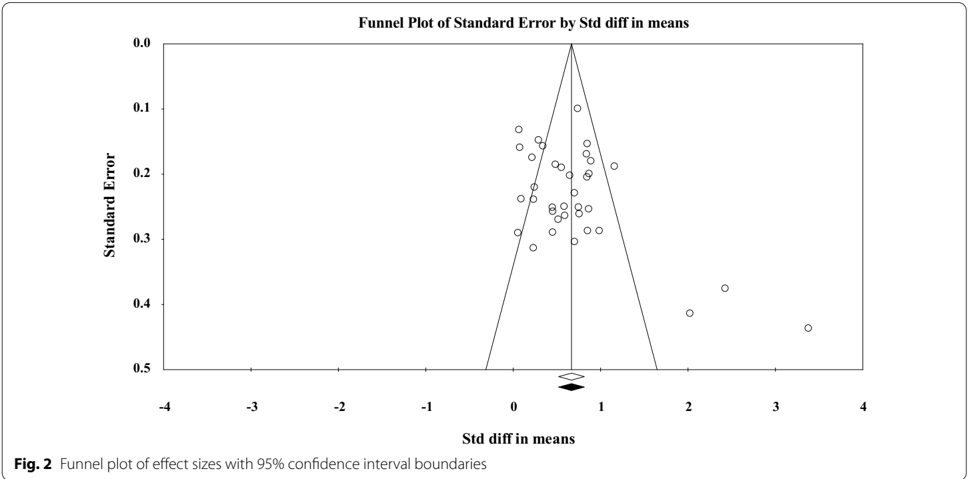
“In the Begg and Mazumdar rank correlation (Kendall’s Tau with a continuity correction), the results ( Z = 1.457 < 1.96, p = 0.145 > 0.05) indicate that there is insignificant publication bias (Begg & Mazumdar, 1994).”
ResultInfluentialBorenstein, M., Hedges, L. V., Higgins, J. P. T., & Rothstein, H. R. (2009) · doi:10.1002/9780470743386 · Cited by 14,225 · cited 1×
“When only positive study results are published, it leads to publication bias (Borenstein et al., 2009).”
BackgroundPreferred reporting items for systematic reviews and meta-analyses: The PRISMA statement
Moher, D., Liberati, A., Tetzlaff, J., & Altman, D. G. (2010) · International Journal of Surgery · doi:10.1016/j.ijsu.2010.02.007 · Cited by 12,156 · cited 1×
“Studies were searched for using the Preferred Reporting Items for Systematic Reviews and Meta-Analysis (PRISMA) method (Moher et al., 2010, 2015).”
Method(2000) · Cited by 9,198
The file drawer problem and tolerance for null results.
Rosenthal, R. (1979) · Psychological Bulletin · doi:10.1037/0033-2909.86.3.638 · Cited by 9,068 · cited 1×
“The classic fail-safe N test is a procedure to evaluate whether publication bias can be ignored (Rosenthal, 1979).”
BackgroundA basic introduction to fixed-effect and random-effects models for meta-analysis
Borenstein, M., Hedges, L. V., Higgins, J. P. T., & Rothstein, H. R. (2010) · Research Synthesis Methods · doi:10.1002/jrsm.12 · Cited by 6,793 · cited 1×
“Thus, the random-effects model was more appropriate (Borenstein et al., 2010), and showed that analysis of the moderator variables was necessary.”
Method
Research works printed but not linked: 1
- Stege, L., Lankveld, G. V., & Spronck, P. (2012). Teaching high school physics with a serious game. International Journal of Computer Science in Sport, 11(1).
Cited by
Items 201–300 of 309
METHODOLOGY FOR TEACHING LABORATORY CLASSES IN PHYSICS THROUGH THE STEM METHOD
Sarybayeva, A. K., Zharylgapova, D. M., & Shektibayev, N. (2023) · МАТЕМАТИКАНЫ ФИЗИКАНЫ ЖӘНЕ ИНФОРМАТИКАНЫ ОҚЫТУДЫҢ ӨЗЕКТІ МӘСЕЛЕЛЕРІ · doi:10.52081/mpimet.2023.v04.i4.025
Kudaibergenova, Z. А. (2023) · МАТЕМАТИКАНЫ ФИЗИКАНЫ ЖӘНЕ ИНФОРМАТИКАНЫ ОҚЫТУДЫҢ ӨЗЕКТІ МӘСЕЛЕЛЕРІ · doi:10.52081/mpimet.2023.v04.i4.023
Ashirbayev, N., & Sherniyazova, E. K. (2023) · МАТЕМАТИКАНЫ ФИЗИКАНЫ ЖӘНЕ ИНФОРМАТИКАНЫ ОҚЫТУДЫҢ ӨЗЕКТІ МӘСЕЛЕЛЕРІ · doi:10.52081/mpimet.2023.v04.i4.027
Mary, T. S., & Raja, B. W. D. (2024) · Indian Journal of Science and Technology · doi:10.17485/ijst/v17i10.2439 · Cited by 1
Boosting Year 4 Science Education: A Dynamic Blend of Paper-Based and Computerized Board Games
Sim, K. C., & Othman, M. K. (2024) · Journal of Cognitive Sciences and Human Development · doi:10.33736/jcshd.6761.2024 · Cited by 4
Torrico, B. C. H., Arandia-Tavera, C. A., & Cueto-Daza, M. A. (2024) · CSR, sustainability, ethics & governance · doi:10.1007/978-3-031-49353-9_21
Spatial Cognition Through Gestural Interfaces: Embodied Play and Learning with Minecraft
Issa, J., Kumar, V., & Worsley, M. B. (2024) · Lecture notes in computer science · doi:10.1007/978-3-031-61685-3_4
الغول, أ. م. د. ر. م. أ. (2024) · مجلة دراسات وبحوث التربية النوعية · doi:10.21608/jsezu.2024.358911
Tareque, M. H., Deutekom, S., Anvik, J., et al. (2024) · doi:10.1145/3660650.3660671
İletişim Bağlamında Güncel Dijital Oyun Araştırmaları: Lisansüstü Tezler Üzerine Bir İçerik Analizi
AĞCA, M. E. (2024) · Yeni Medya Dergisi · doi:10.55609/yenimedya.1362659
Chiang, Y.-H., Su, Y. C., & Huang, T. (2024) · Lecture notes in computer science · doi:10.1007/978-3-031-65884-6_11
Using Role Models and Game-Based Learning to Attract Adolescent Girls to STEM
Vekiri, I., Meletiou-Mavrotheris, Μ., & Mannay, O. (2024) · Education Sciences · doi:10.3390/educsci14080836 · Cited by 5
DESIGN OF A LESSON PLAN IN THE CONTEXT OF STEM EDUCATION FOR PROSPECTIVE PRIMARY SCHOOL TEACHERS
Yesnazar, A., Zhorabekova, A., URUSTENBEKOVA, G., et al. (2024) · Pedagogy and Psychology · doi:10.51889/2960-1649.2024.59.2.005
Varnavsky, A. N. (2024) · Informatics and Education · doi:10.32517/0234-0453-2024-39-4-41-50 · Cited by 1
Anggoro, B. S., Dewantara, A. H., Suherman, S., Muhammad, R. R., & Saraswati, S. (2024) · Revista de Psicodidáctica · doi:10.1016/j.psicod.2024.500158 · Cited by 9
English Education Method Influence Mechanism Analysis
Xu, X., & Guihen, L. (2024) · Journal of Education Teaching and Social Studies · doi:10.22158/jetss.v6n4p178
CyberEdPlay-An IQ Calculator for Predicting Mental Health
Kumaran, U. S., Gurupriya, M., Vardhan.A, A., Sree, C. B., & Geethika, G. S. (2024) · Odisha International Conference on Electrical Power Engineering, Communication and Computing Technology (ODICON) · doi:10.1109/odicon62106.2024.10797468 · Cited by 1
Tangkui, R. (2024) · UNION Jurnal Ilmiah Pendidikan Matematika · doi:10.30738/union.v12i3.18281
Realidad Virtual en el aprendizaje de algoritmos de búsqueda en estudiantes de ingeniería
Vásquez, G. S., Mayhuasca, J., & Briceño, I. E. S. (2024) · Revista peruana de computación y sistemas · doi:10.15381/rpcs.v6i2.28651 · Cited by 1
Yu, Z., & Lyu, E. (2024) · International Conference on Education Technology and Computer · doi:10.1145/3702163.3702412
“Previous studies have covered various subjects including English learning [25], STEM education [7] or even Music learning [26].”
Title Constructive Play on Early Childhood Mathematics Skills in Indonesia: A Meta-Analysis
Wangguway, Y., Abineno, F. O., & Yeuw, F. F. (2024) · Jurnal Ilmiah Pendidikan Profesi Guru · doi:10.23887/jippg.v7i3.84017 · Cited by 1
Şahin, E. Ö., & SÜMEN, Ö. Ö. (2025) · The Journal of Educational Research · doi:10.1080/00220671.2025.2508718 · Cited by 4
“…(Chuang & Chen, 2007; Hawlitschek & Joeckel, 2017; Heintz and Law, 2018; Yavuzkan, 2019), meta-analyses (Cai et al., 2022; Clark et al., 2016; Wang et al., 2022), and systematic reviews (Jensen & Skott, 2022; Yu et al., 2021) have shown that the incorporation of digital games into…”
InfluentialФормирование функциональной грамотности школьников в условиях цифровизации образования
Ай, Х. (2025) · Management of Education · doi:10.25726/l1686-2309-5129-a
The Perceptions of Teachers in Using Game-Based Strategy in Teaching English
Sarias, C. A., Sajulan, E. M., & Pukunum, S. (2025) · doi:10.38124/ijisrt/25jun692 · Cited by 2
“Wang et al. (2022) found that incorporating digital game-based learning into STEM education significantly boosts students' academic performance, with positive effects across different educational stages and subjects.”
ЖОҒАРЫ СЫНЫП ОҚУШЫЛАРЫНА МАТЕМАТИКА ПӘНІН ОҚЫТУДА STEM ТЕХНОЛОГИЯЛАРЫН ҚОЛДАНУДЫҢМӘНІ МЕН МАҢЫЗЫ
Кадирбаева, Р. И., & Жотабай, Н. М. (2025) · Журнал серии «Педагогические науки» · doi:10.48371/peds.2025.77.2.039
Fu, X., & Zhan, Q. (2025) · Research in Science & Technological Education · doi:10.1080/02635143.2025.2527603 · Cited by 5
“Although longer interventions theoretically allow for more comprehensive skill development, learning outcomes are shaped by additional factors such as teacher engagement (Kusmawan et al. 2025), student concentration (Villena-Taranilla et al. 2022), and instructional novelty (Wang et al. 2022).”
Promoting Scientific-Technological Appropriation in Women Through Entrepreneurship
Parra, J. C. V., Palomino-Gámez, S., Suárez-Brito, P., & Carlos-Arroyo, M. (2025) · Lecture notes in educational technology · doi:10.1007/978-981-96-5658-5_49
A Case Study for Video Game Usability Research with Fortnite Creative
Cremaschi, M., Chieregato, D., & Nocco, S. (2025) · Communications in computer and information science · doi:10.1007/978-3-031-94002-6_21
Chamizo, V. D. (2025) · Virtual Worlds · doi:10.3390/virtualworlds4030036
“Many works have shown that a wide range of games (mainly 3D games presented in any format) can reduce gender differences in spatial cognition (for reviews, see [13,14]).”
In’am, A., Ezugwu, U. J., & Setiawan, R. E. (2024) · Delta-Phi Jurnal Pendidikan Matematika · doi:10.61650/dpjpm.v2i3.100 · Cited by 1
Game-Based Learning in a Manufacturing Setting to Teach Statistical Process Control
Verlage, E., Gabbianelli, C., Studer, K., Dhakal, A., Zhao, Z., Thompson, M., & Liu, J. (2025) · ASEE Annual Conference & Exposition · doi:10.18260/1-2--56633 · Cited by 1
Gonce, A., Tran, A., Bhattacharya, A., et al. (2025) · ASEE Annual Conference & Exposition · doi:10.18260/1-2--55570
Anselmo, C. T., Opeña, J. L., Delima, P. C., et al. (2025) · International Journal of Multidisciplinary Applied Business and Education Research · doi:10.11594/ijmaber.06.08.13
Florese, C. A. (2025) · Psychology and Education A Multidisciplinary Journal · doi:10.70838/pemj.450809 · Cited by 6
From In-Game Behaviors to Learning Gains: Constructing Bayesian Networks for Stealth Assessment
Lu, W., Griffin, J., Laffey, J. M., Sadler, T. D., & Goggins, S. P. (2025) · Proceedings of the ACM on Human-Computer Interaction · doi:10.1145/3748615 · Cited by 4
The effect of STEM practices on students' attitudes and achievements: A meta-analysis study
Kurt, A., & Akıncı, M. (2025) · International Journal of Assessment Tools in Education · doi:10.21449/ijate.1459076 · Cited by 1
“Other studies, on the other hand, employ experimental research methods to analyze more complex data and examine the impact of STEM education on student attitudes and achievement levels (Baran et al ., 2019; McClain, 2015; Tolliver, 2016; Wang et al ., 2022).”
THE "LEGO SERIOUS PLAY" METHOD IN UNIVERSITY TEACHING
Poladyan, A. A. (2025) · Scientific bulletin · doi:10.24234/scientific.v2i49.218
Dewi, N. P. D. U. (2025) · Jurnal Ilmiah Pendidikan Profesi Guru · doi:10.23887/jippg.v8i2.102789
El Uso de Videojuegos en la Educación: Una Revisión de Experiencias Didácticas Innovadoras
Reyes-Fuentes, M., Márquez, M. N., & Arana-Llanes, J. Y. (2025) · Multidisciplinary Journal of Sciences Discoveries and Society · doi:10.71068/cnt37232
Implementing STEM-FLIP in A Science Course: A Case Study
Kurtel, E., & Nacaroğlu, O. (2025) · Bartın University Journal of Faculty of Education · doi:10.14686/buefad.1457403
Michalsky, T., & Klein, S. S. (2025) · Computers in Human Behavior Reports · doi:10.1016/j.chbr.2025.100849
Vásquez, L. F. O., Ochoa, B. G. A., Urgiles, C. A. A., Cedeño, C. R. P., & Nazareno, L. I. M. (2025) · Perspectiva XXI · doi:10.70577/f0r0cg90
Digital Play in the Lab: How Pre-service Teachers View Game-transformed Inquiry Laboratory Learning
Adita, A., & Srisawasdi, N. (2025) · Journal of Education · doi:10.1177/00220574251398831
Key Characteristics of Educational Video Games for STEM Education - a Literature Review
Ivanov, S., Nikolova, N., Yordanov, B., & Bontchev, B. (2025) · International Conference on Cybersecurity and AI-Based Systems (Cyber-AI) · doi:10.1109/cyber-ai66431.2025.11233282 · Cited by 1
“Predominant was the computer as a platform for games in education [13, 14, 18, 21, 22].”
InfluentialMurillo, J. P. P., Vera, V. D. C. P., Torres, K. R. C., & Montoya, Z. M. O. (2025) · Perspectiva XXI · doi:10.70577/9mz40818 · Cited by 3
Sánchez-Guerrero, J. U., Haro, E. A. T., Garzòn, G. A. V., & Alava, D. J. H. (2026) · Smart innovation, systems and technologies · doi:10.1007/978-3-032-10947-7_12 · Cited by 1
Optimization of Contemporary STEM Learning Methods in a Technology-Rich Environment
Trichkova-Kashamova, E., & Paunova-Hubenova, E. (2026) · Information · doi:10.3390/info17010074
Developing and Assessing an Esports-Infused Course Module
Kornegay, M. A., Zhang, J., & Atay, M. (2025) · 2022 IEEE Frontiers in Education Conference (FIE) · doi:10.1109/fie63693.2025.11328192
New Approach for Training College Students in Game Development Competitions
Bershadskii, A., Ilyinskaya, E., & Epp, V. (2026) · Communications in computer and information science · doi:10.1007/978-3-032-14674-8_44
Yolal, T. T., & Ersoy, A. (2026) · Yaşadıkça Eğitim · doi:10.33308/26674874.2026401950
Zhao, Z., Lee, C. K., Wang, H. B., et al. (2025) · doi:10.1109/ieem63636.2025.11357789
“In recent years, game-based learning (GBL) has emerged as a widely recognized solution to address the issues of low student engagement and difficulty i n k nowledge g ain in science, technology, engineering, and mathematics (STEM) higher education [2]–[4].”
Bajaña, N. F. R., Sánchez, P. M. P., Palma, L. M. G., Amán, E. J. C., & Nazareno, L. I. M. (2026) · ASCE MAGAZINE · doi:10.70577/asce.v5i1.630
Setiyawan, A., & Iman, M. S. N. (2026) · International Journal of Mechanical Engineering Education · doi:10.1177/03064190261420832 · Cited by 4
Rodliyah, I., Rahmawati, N. D., Sa'adah, N., et al. (2026) · Studies in Learning and Teaching · doi:10.46627/silet.v6i3.749
“Another study found that the STEM approach made the learning process interesting and enjoyable, improving student learning outcomes (Afifah et al., 2021, Wang et al., 2022).”
A Visualized Bibliometric Analysis of Game-Based Learning in Education
Xiao, X., Chen, N., & Ren, Y. (2025) · International Conference on Educational Technology (ICET) · doi:10.1109/icet67421.2025.11380550
“Researchers observed that complex educational concepts often proved challenging for students to grasp thoroughly, potentially leading to waning engagement, negative attitudes, and even course abandonment [13].”
Panata, M. J. S., & Solórzano, M. (2026) · ASCE MAGAZINE · doi:10.70577/asce.v5i1.699
Almugren, I., Singhal, A., Attri, R., Szabó-Szentgróti, G., & Papa, A. (2026) · Journal of Global Information Management · doi:10.4018/jgim.402747
Digital information technologies and the use of computer programs in STEAM education
Назиховна, Г. Ю., Khusanov, K., Abdullayeva, S., Zokirova, N., Satimboyeva, Z., Hojiyeva, M., & Tursunova, S. (2026) · AIP conference proceedings · doi:10.1063/5.0327988 · Cited by 4
Game-based learning for health literacy: Lessons from who's Immune Patrol
Kohlhepp, D., Reynen-de, K., Poels, K., van, D., & Nielsen, S. M. (2026) · Glasnik javnog zdravlja · doi:10.5937/serbjph2601113k
Integration of a digital serious video game into an online first-year post-secondary biology course
Shaw, R., Bong, J. Y., Spérano, I., & Andruchow, R. (2026) · Heliyon · doi:10.1016/j.heliyon.2026.e44709 · Cited by 1
Besa, K.-S., Biehl, A., Kleinert, S. I., Zinner, S., & Verständig, D. (2026) · Frontiers in Psychology · doi:10.3389/fpsyg.2026.1658293 · Cited by 1
“In STEM education in particular, the potential of new digital applications is discussed with respect to increasing students’ interest in STEM subjects (Khalid et al., 2025; Wang et al., 2022).”
Pala, F. (2026) · Turkish History Education Journal · doi:10.17497/tuhed.1784672
Safitri, R., Efendi, H., Darni, R., Waskito, W., & Kurniadi, D. (2025) · Jurnal Ilmiah Pendidikan Profesi Guru · doi:10.23887/jippg.v8i3.105487 · Cited by 1
Auliya, A. F. S., Fashlah, A. G., Umuri, N. S. A., Rino, W. J. F., & Sari, I. A. (2025) · Jurnal Ilmiah Pendidikan Profesi Guru · doi:10.23887/jippg.v8i3.104139
Bhattacharya, A., & Sinha, R. K. (2026) · International Conference on Image Processing and Capsule Networks (ICIPCN) · doi:10.1109/icipcn67432.2026.11438480
Rocuts, S., & Forment, M. A. (2026) · Journal of Applied Research in Higher Education · doi:10.1108/jarhe-10-2025-0842
The Gamifying Learning: The Power of Edu-Monopoly to Spark Students’ Interest - a Meta-Analysis
Almunawwarah, A. S., & Firmansyah (2025) · Jurnal Ilmiah Sekolah Dasar · doi:10.23887/jisd.v9i4.104463
Polysyncretic composing in play: youth virtual reality gaming for STEM learning
Burger, L., Schneider, J. J., & KING, J. R. (2026) · English Teaching Practice & Critique · doi:10.1108/etpc-09-2025-0221 · Cited by 1
Cai, J., Zhu, J., Tang, X., & Li, G. (2026) · Frontiers in Psychology · doi:10.3389/fpsyg.2026.1744690 · Cited by 1
Effects of Stem-Game-Based Learning on Genetics Achievement Among Northern Matriculation Students
Hussaini, H. M. (2026) · EDUCATUM Journal of Social Sciences · doi:10.37134/ejoss.vol12.sp2.20.2026
Wang, W., Shen, Z., Li, L., & Hsiao, M. S. (2026) · ACM SIGCPR Conference on Computer Personnel Research (SIGCPR) · doi:10.1145/3768310.3807795
Tikhonova, E. A., & Raitskaya, L. (2026) · Journal of language and Education · doi:10.17323/jle.2026.33523
Kim, J. S., Yu Jung, H. A. N., Park, J., Kim, S. M., & Han, D. H. (2026) · The Journal of Educational Research · doi:10.1080/00220671.2026.2675477
Rizki, I. A., & Yates, A. (2026) · Educational Media International · doi:10.1080/09523987.2026.2683334
“Such short-term implementations can lead to high levels of participation and enthusiasm among high school learners (Riopel et al., 2019; L.-H. Wang et al., 2022).”
Sari, Y. N., Elizar, & Apriza, B. (2026) · International Journal of Elementary Education · doi:10.23887/ijee.v10i1.111379 · Cited by 4
Díaz-Martínez, J.-G., Gutiérrez-Carmona, I., Kojima, H., et al. (2026) · doi:10.1109/edunine62390.2026.11546746
“Recent systematic reviews indicate that digital simulation environments — especially those incorporating serious game mechanics or gamification — significantly enhance academic performance, knowledge retention, and engagement in STEM education [7,8].”
Siregar, T. (2026) · Research Square · doi:10.21203/rs.3.rs-9978219/v1 · Cited by 1
Playing with Chemistry: Developing Observation and Classification through Daily Mix-Up
Warisson, T., Charoenkitamorn, K., & Handee, W. (2026) · Journal of Chemical Education · doi:10.1021/acs.jchemed.5c01770
Enhancing sustainability-related self-efficacy through serious games
Hollweck, S., Borgstede, M., Muenz, T., & Paul, J. (2026) · Frontiers in Education · doi:10.3389/feduc.2026.1813464
Designing Digital Immersive Chemistry Education: An Educational Game on Catalytic CO 2 Valorization
Hartman, T., Hut, M. F. P., Weel, M. S. P., Wind, T. J., Matimba, H. E. K., van Joolingen, W., & Weckhuysen, B. M. (2026) · Journal of Chemical Education · doi:10.1021/acs.jchemed.5c01182
Rustam, Harjono, H. S., Priyanto, et al. (2026) · Journal for Lesson and Learning Studies · doi:10.23887/jlls.v9i1.107004
Tips and Tricks to Treat Dental and Mouth: Improving Knowledge and Practice of Oral Hygiene
Ferawati, E., Nasihin, & Sucipto, C. D. (2026) · International Journal of Community Service Learning · doi:10.23887/ijcsl.v10i1.93316
Maheshwary, P., Karumbaiah, S., Maravi, A., & Haiman, A. (2026) · Lecture notes in computer science · doi:10.1007/978-3-032-29773-0_38
Truong, T. D., & Tran, Q. G. (2026) · Smart innovation, systems and technologies · doi:10.1007/978-3-032-23104-8_21
Coello, J. F. H., & Salinas, L. D. R. S. (2026) · Revista Científica Multidisciplinar G-nerando · doi:10.66473/rcmg.v7i1.1255
Li, Y., Qi, Z., Zhang, T., Liu, K., & Huang, C. (2026) · Journal of International Students · doi:10.32674/jdgvhq96
Designing an Educational Video Game for Science and Technology Students: A Validation Study
Salazar, H., Baldeón, J., & Vega, V. (2026) · Lecture notes in computer science · doi:10.1007/978-3-032-30408-7_6
Rafi, A., Heidari, M., Behbahani, S. M. S., Bostan, H., Tamimi, A., Ahmadi, M., & Naeimi, S. (2026) · BMC Medical Education · doi:10.1186/s12909-026-09923-z
Elementary educators’ integration of universal Design for learning in data science instruction
Hirsch, S. E., Herro, D. C., Kelley, M. H., Madison, M. J., & Taylor, J. (2026) · The Journal of Educational Research · doi:10.1080/00220671.2026.2695045
Smart Gamified Mobile Learning Apps with MDA
Benouda, H., & Beqqal, M. E. (2026) · Lecture notes in networks and systems · doi:10.1007/978-3-032-18860-1_31
Adiyaksa, H. H., Alfarisa, F., & Robiansyah, F. (2026) · Didaktika · doi:10.17509/didaktika.v6i1.51
Lanes, J. R., & Tampon, G. P. (2026) · International Conference on e-Education, e-Business, e-Management and e-Learning · doi:10.1109/ic4e69618.2026.11631377
“While numerous meta-analyses report positive effects of DGBL on STEM learning outcomes [3], [9], [10], other studies highlight inconsistent empirical evidence and implementation barriers.”
InfluentialHardianti, T., Rangkuti, M. A., & Simanjuntak, Y. L. P. (2026) · Jurnal Penelitian dan Pengembangan Pendidikan · doi:10.23887/jppp.v10i1.96701
The effectiveness of video games as a teaching resource in mathematics learning: A comparative study
Soto-Ardila, L. M., & Carrasco, A. C. (2026) · Social Sciences & Humanities Open · doi:10.1016/j.ssaho.2026.103283
Rai, S., & Tripathi, L. (2026) · The Voice of Creative Research · doi:10.53032/tvcr/2026.v8n3.13
Sanchiz, M. (2026) · Psychologie Française · doi:10.1016/j.psfr.2026.07.002
Jia, R., Yin, X., & Chu, S. (2026) · Frontiers in Psychology · doi:10.3389/fpsyg.2026.1828786
AR-GenSTEAM: Generation of STEAM-Based Serious Games with Augmented Reality
Contreras-Zaragoza, V., Alor‐Hernández, G., Marín‐Vega, H., Bustos-López, M., Hernández‐Chaparro, N. L., & Sánchez-Morales, L. N. (2026) · Education Sciences · doi:10.3390/educsci16091383
Metadata
- Authors
- Wang, L.-H., Chen, B., Hwang, G.-J., Guan, J.-Q., & Wang, Y.-Q.
- Affiliations
- Zhejiang Normal University (CN)
- National Taiwan University of Science and Technology (TW)
- Corresponding author
- Wang, Liang-Hui
- ORCID
- Wang, Liang-Hui
- Venue
- International Journal of STEM Education
- Published
- 2022-03-17
- Volume
- 9
- Issue
- 1
- ISSN
- 2196-7822 (ISSN-L)
- OpenAlex
- W4220750697
- Semantic Scholar
- 0542eaf59a9b5c949fbd23ad6ef15d7343492a37
- Cited by
- 316
- References
- 83
- Citations by year
- 2026: 63 · 2025: 82 · 2024: 90 · 2023: 67 · 2022: 11
- FWCI
- 12.61
- Type
- journal article
- Language
- en
- Open access
- gold
- doi.org
- Licence
- cc-by
- creativecommons.org/licenses/by/4.0 (tdm)
- creativecommons.org/licenses/by/4.0 (vor)
- Locations
- International Journal of STEM Education (publishedVersion, cc-by)
- DOAJ (DOAJ: Directory of Open Access Journals) (submittedVersion, cc-by-sa)
- Funders
- Philosophy and Social Science Planning of Zhejiang Province (19NDJC252YB)
- National Education Science “13th Five-Year” Planning Key Project of Ministry of Education in China (DCA160262)
- Topics
- Social Sciences › Psychology › Developmental and Educational Psychology › Educational Games and Gamification
- Social Sciences › Education › Education and Learning Interventions
- Physical Sciences › Computer Science › Information Systems › Mobile Learning in Education
- Keywords
- game-based learning, video games, STEM education, academic performance, K-12 students, university students, game types, game platforms
About these checks
Registry, retraction, Cites and statistics results are computed, not judged, with one exception: a printed reference that no index lists is read once by a model before it counts as a citation error. Claims are extracted by a model and kept only when their quote appears verbatim in the text; each cited source is then checked, with a model’s help, for whether it says what the claim relies on. Those verdicts can be wrong — read the claim’s quote and the cited source before relying on one.
The claim verdicts this report counts are experimental: their accuracy is not yet measured.
A language model drew the claims from the paper on 2026-10-10, under version 3 of the claim definition (model deepseek-v4.1-flash, prompt extract-v3).
A second model labelled each claim on 2026-10-10 (model jev-1.13-20260917, definition revision gold-guideline-v0.2).
Cited sources are checked with a language model’s help (qwen3.8-omni-flash).
Statistics and arithmetic are recomputed, not judged.
Confidence bands are shown only for fields calibrated on our annotated test set. None is calibrated yet, so no band is shown.
What counts as a claim ›How we measure confidence ›How we check this ›
Are you an author, or do you see a problem with this page? Request a review
Data sources
Bibliographic data: Semantic Scholar, OpenAlex, Crossref.
Contains information from the Semantic Scholar Academic Graph Datasets, made available under the ODC Attribution License (ODC-BY 1.0).
Semantic Scholar’s data is described in: Kinney, R., et al. (2023). The Semantic Scholar Open Data Platform. arXiv:2301.10140.
