

Effects of digital game-based STEM education on students’ learning achievement: a meta-analysis
Open accessThe DOI matches its Crossref record; 79 of the 83 references it cites were found in a registry or an index; 3 of the 12 sources its claims cite were checked for support.
Abstract
Many researchers have explored the impact of digital games on learning effects in different STEM subjects. The purpose of this meta-analysis is to examine the effect of digital game-based STEM education on the learning achievement of K-12 or higher education students. The analysis results of effect sizes from 33 studies ( N = 3894) published from 2010 to 2020 showed that digital games contributed to a moderate overall effect size (ES = 0.667, 95% CI [0.520–0.814], p < 0.001) when compared with other instructional methods. Furthermore, the study explored multiple moderator variables and their potential impacts on learning outcomes such as control treatment, subject discipline, educational level, game type, gaming platform, and intervention duration. The findings suggest that digital games are a promising pedagogical method in STEM education that effectively improves learning gains. Additionally, the study concludes with three recommendations for future research and practices on digital games in STEM education.
Overview
CoChat Summary
TL;DR
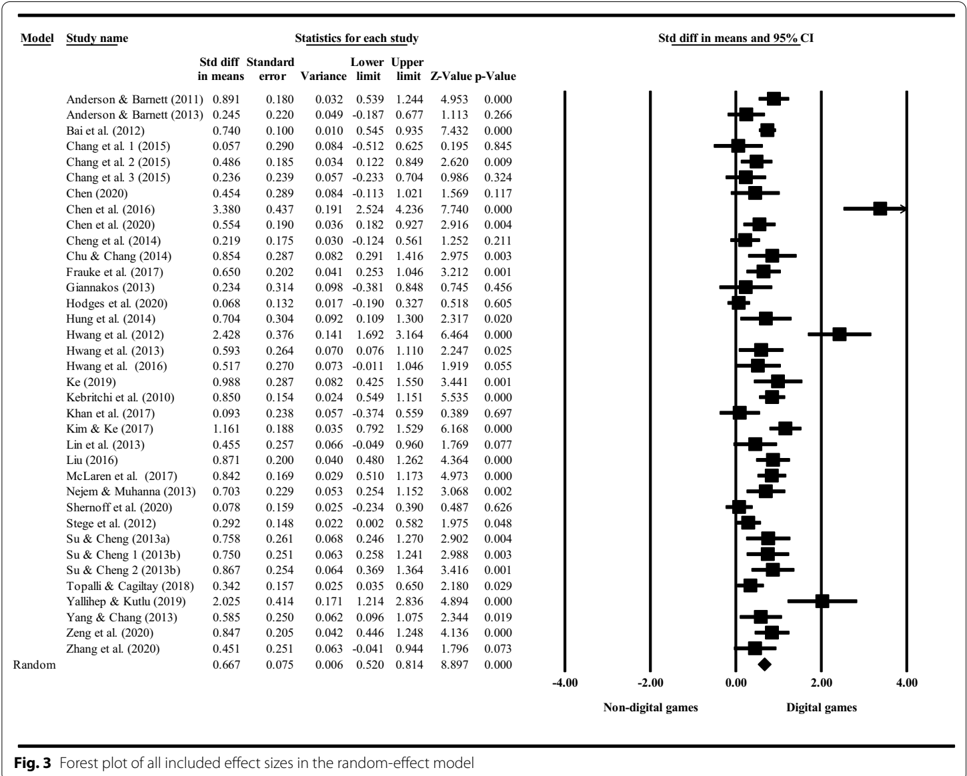
This meta-analysis found that digital game-based STEM education had a moderate, significant positive effect on students’ learning achievement versus other instructional methods. Across 33 studies (36 effect sizes; N = 3,894), the overall effect size was ES = 0.667 (95% CI [0.520–0.814], p < 0.001).
Key findings
- Overall, digital game-based STEM instruction produced a moderate positive effect on learning achievement: ES = 0.667, 95% CI [0.520–0.814], p < 0.001.
- Compared with control treatments, digital game-based instruction outperformed both multimedia (ES = 0.848, p < 0.001) and traditional instruction (ES = 0.558, p < 0.001).
- By subject, effects were positive across science (ES = 0.750, p < 0.001), mathematics (ES = 0.629, p < 0.001), and technology/engineering (ES = 0.367, p = 0.140), with no significant difference among disciplines (Qb = 2.188, p = 0.335).
- By education level, primary education showed the largest effect (ES = 0.835, p < 0.001), compared with secondary (ES = 0.487, p < 0.001) and higher education (ES = 0.492, p < 0.05); the subgroup difference was not significant (Qb = 5.184, p = 0.075).
- By game type, board games had the largest effect (ES = 1.455, p < 0.001), followed by tutorial games (ES = 0.593, p < 0.001) and immersive games (ES = 0.583, p < 0.001); subgroup differences were significant (Qb = 11.126, p < 0.01).
- By platform, computers (ES = 0.625, p < 0.001) and mobile devices (ES = 0.768, p < 0.001) both improved achievement, with no significant difference between them (Qb = 0.752, p = 0.386).
Methods
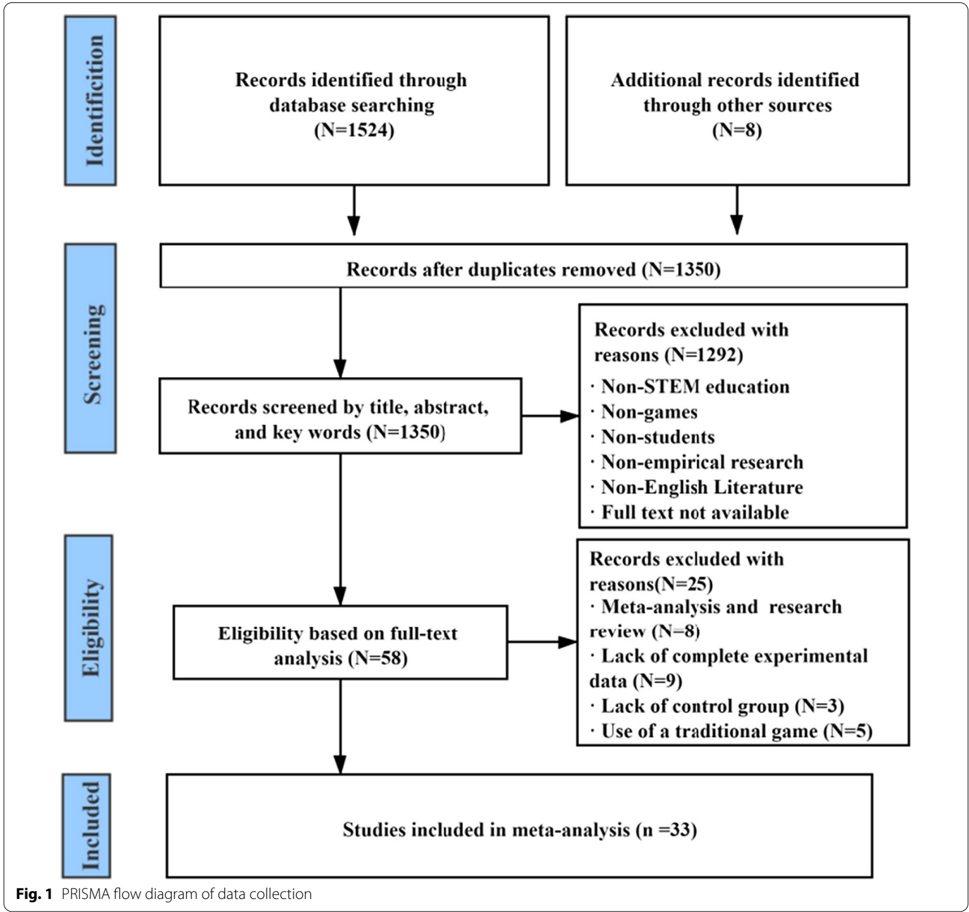
- Meta-analysis conducted under a PRISMA-guided search of six databases: Web of Science Core Collection, ERIC, ProQuest, Springer, Scopus, and Wiley.
- Included studies were English-language peer-reviewed journal articles published from 2010 to 2020, focused on K-12 or higher education STEM settings, used an intervention with a digital game treatment and a comparison group, and reported sufficient data for effect-size calculation.
- The final sample was 33 studies with 36 effect sizes and 3,894 participants; analyses used standardized mean difference, heterogeneity tests (Q and I2), random-effects models, and moderator analyses for control treatment, subject discipline, education level, game type, gaming platform, and intervention duration.
Limitations
- The paper states that the meta-analysis included only 33 empirical studies and 36 effect sizes, and that relevant studies may have been missed.
- The paper states that it used a random-effects model rather than a fixed-effects model, and that the review was not fully inclusive but aimed to provide a systematic overview; it also notes a paucity of studies on other outcomes such as cognitive skills and affective influences.
- Evident from the text: some moderator subgroups were small, especially board games (only four studies; 11.11%), so those estimates may be less stable.
Model-written summary. Check it against the paper before relying on it.
Integrity signals
Registry
Cites
Statistics
Figures
Verification
Claims the paper makes
3 Valid · 0 Not valid · 5 Not checked · 32 Own results and interpretations
Every source the paper cites for this claim was checked and supports it.
In the paper
“Consistent with previous discussions, short-term interventions have been associated with better learning achievement than long-term interventions (Riopel et al., 2019).”
What the sources say
- Supportedcites Riopel et al., 2019 matched to “Impact of serious games on science learning achievement compared with more conventional instruction: an overview and a meta-analysis” (2019) source
The Moderators section states that hypothesis H6 was accepted: 'a shorter duration of instruction with serious games yields higher learning achievement outcomes than a median duration, which itself yields higher learning achievement outcomes than a longer duration,' attributed to novelty-effect dissipation. The Results section backs this with significant pairwise differences (Δd = 0.12, p = .026 for <1 week vs 1–4 weeks; Δd = 0.13, p = .020 for 1–4 weeks vs >4 weeks, F[3,61] = 4.227, p = .022). The source also situates this within the wider CAI/serious-game literature (Dekkers & Donatti 1981; Bayraktar 2001; Kulik & Kulik), matching the citing sentence's 'consistent with previous discussions'. Our copy does note conflicting two-level findings in Wouters et al. (2013) and Clark et al. (2015), but explains them away as coding limitations, so the attribution stands. (LLM, conf=0.90)
plainstates an association- Asserted: passes — The authors put it forward as true.
- Checkable: passes — It can be checked against evidence.
- Load-bearing: unclear — It is unclear whether the paper’s conclusions depend on it.
- Based: passes — The paper gives a reason why it holds.
- Supported
The cited sources support only part of this claim — read each source’s verdict below.
In the paper
“First, they did not comprehensively analyze the subject disciplines of STEM, but only analyzed a particular subject, such as science or mathematics.”
What the sources say
- Partly supportedcites Riopel et al., 2019 matched to “Impact of serious games on science learning achievement compared with more conventional instruction: an overview and a meta-analysis” (2019) sourceExperimental — accuracy not yet measured
The overview ('Previous Meta-Analyses on Serious Games'; 'Moderators') does support the gist that past syntheses left the natural-science/STEM disciplines insufficiently examined: the main limitation is 'the lack of sufficient examination of the effect of serious games in the domain of natural sciences', with broad reviews (Clark et al. 2015; Sitzmann & Ely 2011; Vogel et al. 2006) pooling several knowledge domains 'as a single whole, thus precluding a precise conclusion with regard to the domain of science'. But the claim's second half — that they 'only analyzed a particular subject such as science or mathematics' — is not what our copy says of those meta-analyses; it states the opposite, e.g. Vogel et al. 'did not focus on a particular subject area, and included studies from various knowledge domains'. Our copy does note subject-specific metasyntheses (Rutten et al. 2012; Young et al. 2012; Brinson et al. 2015; Ma & Nickerson 2006), yet frames the gap as science (and its internal disciplines), never as a comprehensive STEM analysis. (LLM, conf=0.72)
- Not checked — no full text of the sourcecites Tokac et al., 2019 matched to “Effects of game‐based learning on students' mathematics achievement: A meta‐analysis” (2019) source
- Not checked — no full text of the sourcecites Tsai & Tsai, 2020 matched to “A meta‐analysis of research on digital game‐based science learning” (2020) source
plain- Asserted: passes — The authors put it forward as true.
- Checkable: passes — It can be checked against evidence.
- Load-bearing: passes — The paper’s conclusions depend on it.
- Based: passes — The paper gives a reason why it holds.
- Partly supported
The sources with a verdict support this claim; the rest weren’t checked yet, have no full text we could read, or their verdicts aren’t rated yet.
In the paper
“However, these studies have reached no uniform conclusions regarding the effects of digital games on students' STEM learning gains.”
What the sources say
- Supportedcites Hung et al. (2014) matched to “Effects of digital game-based learning on students’ self-efficacy, motivation, anxiety, and achievements in learning mathematics” (2014) source
The Discussion and conclusions section states that the positive achievement result 'is not obvious, since some previous studies have reported unfavorable results or negative effects of DGBL on students' learning performance (Charsky and Ressler 2011; Pierfy 1977; Randel et al. 1992)', i.e. the paper explicitly treats prior evidence on games' effects on learning performance as non-uniform. Alongside this, the Background and motivation and Literature review sections marshal the opposite line of findings (educational computer games promoting motivation and achievement: Burguillo 2010; Liu and Chu 2010; Kuo 2007; Sung and Hwang 2013; Hwang et al. 2013c in natural science; Wang and Chen 2010 in programming), so the mixed-result picture spans STEM subjects rather than mathematics alone. The cited sentence is a broad background characterization, and our copy clearly treats the topic that way. (LLM, conf=0.80)
- Not checked — no full text of the sourcecites Neimeyer (2006)
- Not matchedcites Giannakos, 2013; Khan et al., 2017
A range of references, not one source.
plain- Asserted: passes — The authors put it forward as true.
- Checkable: passes — It can be checked against evidence.
- Load-bearing: passes — The paper’s conclusions depend on it.
- Based: passes — The paper gives a reason why it holds.
- Supported
A result the paper reports from its own data — it cites no other source for it, so there is none to check. The quote shows it is in the paper.
In the paper
“The effect size of digital game-based instruction compared to multimedia is 0.848 (p < 0.001).”
plainstates a cause- Asserted: passes — The authors put it forward as true.
- Checkable: passes — It can be checked against evidence.
- Load-bearing: passes — The paper’s conclusions depend on it.
- Based: passes — The paper gives a reason why it holds.
A result the paper reports from its own data — it cites no other source for it, so there is none to check. The quote shows it is in the paper.
In the paper
“Regarding education levels, results in Table 2 suggest no significant difference in the effect sizes for the different education levels (Qb = 5.184, p = 0.075).”
hedged- Asserted: passes — The authors put it forward as true.
- Checkable: passes — It can be checked against evidence.
- Load-bearing: passes — The paper’s conclusions depend on it.
- Based: passes — The paper gives a reason why it holds.
17 more claims
Create a free account to see all 40 claims and every source verdict.
- The quote only partly states this claim. 3
- It may state two separate claims as one. 9
- Probably not a substantial claim. 6
Citations
Cites
Statistical Power Analysis for the Behavioral Sciences
Muller, K. (1989) · Technometrics · doi:10.1080/00401706.1989.10488618 · Cited by 99,167
Measuring inconsistency in meta-analyses
Higgins, J. P. T., Thompson, S. G., Deeks, J. J., & Altman, D. G. (2003) · BMJ · doi:10.1136/bmj.327.7414.557 · Cited by 63,139 · cited 1×
“The I 2 test supplements the Q -test, where 0%–25% indicates that heterogeneity is considered low, 25%–75% indicates moderate heterogeneity, and 75%– 100% indicates substantial heterogeneity (Higgins et al., 2003).”
Bias in meta-analysis detected by a simple, graphical test
Egger, M., Smith, G. D., Schneider, M., & Minder, C. (1997) · BMJ · doi:10.1136/bmj.315.7109.629 · Cited by 56,722 · cited 2×
“Publication bias from multiple sources may affect the results of meta-analysis studies (Egger et al., 1997).”
BackgroundPRISMA-P Group, Moher, D., Shamseer, L., Clarke, M., Ghersi, D., Liberati, A., Petticrew, M., Shekelle, P., & Stewart, L. A. (2015) · Systematic Reviews · doi:10.1186/2046-4053-4-1 · Cited by 26,223 · cited 1×
“Studies were searched for using the Preferred Reporting Items for Systematic Reviews and Meta-Analysis (PRISMA) method (Moher et al., 2010, 2015).”
MethodOperating characteristics of a rank correlation test for publication bias
Begg, C. B., & Mazumdar, M. (1994) · Biometrics · doi:10.2307/2533446 · Cited by 16,955 · cited 1×
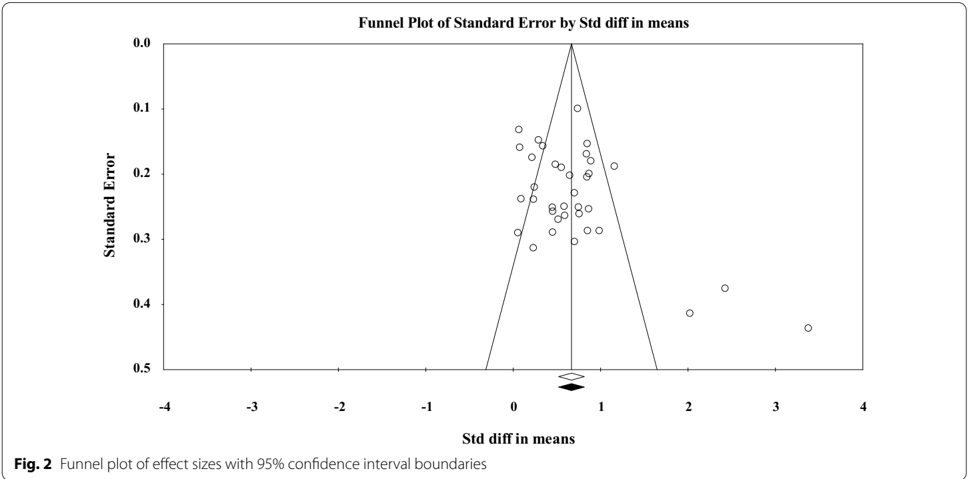
“In the Begg and Mazumdar rank correlation (Kendall’s Tau with a continuity correction), the results ( Z = 1.457 < 1.96, p = 0.145 > 0.05) indicate that there is insignificant publication bias (Begg & Mazumdar, 1994).”
ResultInfluentialBorenstein, M., Hedges, L. V., Higgins, J. P. T., & Rothstein, H. R. (2009) · doi:10.1002/9780470743386 · Cited by 14,225 · cited 1×
“When only positive study results are published, it leads to publication bias (Borenstein et al., 2009).”
BackgroundPreferred reporting items for systematic reviews and meta-analyses: The PRISMA statement
Moher, D., Liberati, A., Tetzlaff, J., & Altman, D. G. (2010) · International Journal of Surgery · doi:10.1016/j.ijsu.2010.02.007 · Cited by 12,156 · cited 1×
“Studies were searched for using the Preferred Reporting Items for Systematic Reviews and Meta-Analysis (PRISMA) method (Moher et al., 2010, 2015).”
Method(2000) · Cited by 9,198
The file drawer problem and tolerance for null results.
Rosenthal, R. (1979) · Psychological Bulletin · doi:10.1037/0033-2909.86.3.638 · Cited by 9,068 · cited 1×
“The classic fail-safe N test is a procedure to evaluate whether publication bias can be ignored (Rosenthal, 1979).”
BackgroundA basic introduction to fixed-effect and random-effects models for meta-analysis
Borenstein, M., Hedges, L. V., Higgins, J. P. T., & Rothstein, H. R. (2010) · Research Synthesis Methods · doi:10.1002/jrsm.12 · Cited by 6,793 · cited 1×
“Thus, the random-effects model was more appropriate (Borenstein et al., 2010), and showed that analysis of the moderator variables was necessary.”
Method
Research works printed but not linked: 1
- Stege, L., Lankveld, G. V., & Spronck, P. (2012). Teaching high school physics with a serious game. International Journal of Computer Science in Sport, 11(1).
Cited by
Timotheou, S., Miliou, O., Dimitriadis, Y., Sobrino, S. V., Giannoutsou, N., Cachia, R., Monés, A. M., & Ioannou, A. (2023) · Education and Information Technologies · doi:10.1007/s10639-022-11431-8 · Cited by 816
“Integration of digital games in teaching was also found as a promising pedagogical practice in STEM education that could lead to increased learning gains (Martinez et al., 2022; Wang et al., 2022).”
BackgroundEffectiveness of digital educational game and game design in STEM learning: a meta-analytic review
Gui, Y., Cai, Z., Yang, Y., Kong, L., Fan, X., & Tai, R. H. (2023) · International Journal of STEM Education · doi:10.1186/s40594-023-00424-9 · Cited by 301
“…examined the effects of game-based science learning (Riopel et al., 2019; Tsai & Tsai, 2020), examined the effectiveness of game-based math learning (Byun & Joung, 2018; Tokac et al., 2019), or examined the effects of digital game-based STEM education on student knowledge gains (Wang et al., 2022).”
BackgroundGame-based learning in computer science education: a scoping literature review
Videnovik, M., Vold, T., Kiønig, L. V., Bogdanova, A. M., & Trajkovik, V. (2023) · International Journal of STEM Education · doi:10.1186/s40594-023-00447-2 · Cited by 277
“When digital game-based learning is implemented, including key game design elements (collaboration, choice, feedback), there is typically a positive impact on student engagement (Serrano, 2019; Wang et al., 2022).”
BackgroundMethodYang, C., Zhang, J., Hu, Y., Yang, X., Chen, M. H., Shan, M., & Li, L. (2024) · International Journal of STEM Education · doi:10.1186/s40594-024-00487-2 · Cited by 187
“Wang et al. (2022) conducted a systematic review of integrating STEM education into K-12 curricula, providing valuable insights into this educational approach.”
BackgroundPatiño, A., Soledad, M., & Fernández, M. B. (2023) · Smart Learning Environments · doi:10.1186/s40561-023-00229-x · Cited by 153
Wu, T.-T., Lee, H.-Y., Wang, W.-S., Lin, C.-J., & Huang, Y.-M. (2023) · International Journal of Educational Technology in Higher Education · doi:10.1186/s41239-023-00422-5 · Cited by 82
“First, STEM education emphasizes experimental and inquiry-based learning to foster learners’ understanding and application of scientific concepts (Wang et al., 2022).”
BackgroundInfluentialHebebci, M. T., & Usta, E. (2022) · Participatory Educational Research · doi:10.17275/per.22.143.9.6 · Cited by 204
“The literature review suggests that the number of studies on STEM education has gradually increased (Chine & Larwin, 2022; Marco-Bujosa, 2021; Punzalan, 2022; Razi & Zhou, 2022; Reynders et al., 2020; Talan, 2021; Turner et al. al., 2022; Wang et al., 2022).”
BackgroundLearning on the Move: A Pedagogical Framework for State-of-the-Art Mobile Learning
Alam, A., & Mohanty, A. (2023) · Lecture notes in networks and systems · doi:10.1007/978-981-99-1414-2_52 · Cited by 82
Do games reduce maths anxiety? A meta-analysis
Dondio, P., Gusev, V., & Rocha, M. (2022) · Computers & Education · doi:10.1016/j.compedu.2022.104650 · Cited by 120
Lee, M.-J., Shin, S., Lee, M., & Hong, E. (2024) · BMC Medical Education · doi:10.1186/s12909-024-06464-1 · Cited by 95
Lee, H.-Y., Wu, T.-T., Lin, C.-J., Wang, W.-S., & Huang, Y.-M. (2024) · Journal of Educational Computing Research · doi:10.1177/07356331231211916 · Cited by 52
“It requires well-articulated guiding principles to provide a structured learning process, making intricate STEM concepts accessible to learners (Schaper et al., 2022; Wang et al., 2022a).”
BackgroundGhanbaripour, A. N., Talebian, N., Miller, D., Tumpa, R. J., Zhang, W., Golmoradi, M., & Skitmore, M. (2024) · Buildings · doi:10.3390/buildings14092769 · Cited by 128
Navigating the AI-Enhanced STEM education landscape: a decade of insights, trends, and opportunities
Yang, Y., Sun, W., Sun, D., & Salas‐Pilco, S. Z. (2024) · Research in Science & Technological Education · doi:10.1080/02635143.2024.2370764 · Cited by 85
“As articulated by Wang (2022), these integrations aimed to optimize academic performance, nurture creative design abilities, deepen cognitive engagement, and enhance overall student engagement, ultimately elevating educational outcomes and quality.”
InfluentialLarkin, K., & Lowrie, T. J. (2023) · International Journal of Science and Mathematics Education · doi:10.1007/s10763-023-10362-1 · Cited by 100
Garcia, M. B. (2023) · International Journal of Human-Computer Interaction · doi:10.1080/10447318.2022.2163565 · Cited by 43
“For instance, Dele-Ajayi et al. (2019) investigated teachers ’ intention to use digital games in the classroom following the growing intersection of gaming and learning (e.g., Abdul Jabbar & Felicia, 2015; Garcia, 2020b; Wang et al., 2022).”
BackgroundStanney, K. M., Skinner, A. D., & Hughes, C. L. (2023) · International Journal of Human-Computer Interaction · doi:10.1080/10447318.2023.2188529 · Cited by 46
“For example, e-learning, gamification, serious games, and interactive learning environments have all seen significant growth in utilization in recent years (Bennani et al., 2022; Squires, 2019; Wang et al., 2022).”
BackgroundIlić, J., Ivanović, M. D., & Klašnja‐Milićević, A. (2024) · Journal of Baltic Science Education · doi:10.33225/jbse/24.23.20 · Cited by 59
Zeng, J. (2023) · Heliyon · doi:10.1016/j.heliyon.2023.e15806 · Cited by 84
“Put differently, student learning achievement has to do with how well individual students have mastered the learning content [4, 5].”
BackgroundUsing Minecraft to cultivate student interest in STEM
Tablatin, C. L. S., Casano, J. D. L., & Rodrigo, M. M. T. (2023) · Frontiers in Education · doi:10.3389/feduc.2023.1127984 · Cited by 54
Chen, D., Zhang, Y., Luo, H., Zhu, Z., Ma, J., & Lin, Y. (2024) · International Journal of Computer-Supported Collaborative Learning · doi:10.1007/s11412-024-09418-3 · Cited by 38
“In meta-analysis, disciplinary domain and intervention duration were the most common moderator variables associated with the research context (Wang et al., 2022).”
Koç, A., & Kanadlı, S. (2025) · Journal of Science Education and Technology · doi:10.1007/s10956-025-10202-7 · Cited by 89
“Moreover, as evidenced by previous meta-analyses (Coban et al., 2022; Kalemkus & Kalemkus, 2023; Lin et al., 2024; Wang et al., 2022; Wu et al., 2020; Xu et al., 2022), the effective implementation of these technologies requires the appropriate integration of instructional strategies tailored to…”
InfluentialThe Effects of Integrated STEM Education on K12 Students’ Achievements: A Meta-Analysis
Chen, B., Chen, J., Wang, M., Tsai, C., & Kirschner, P. A. (2025) · Review of Educational Research · doi:10.3102/00346543251318297 · Cited by 54
“These applications can facilitate student learning by providing rich and authentic contexts with interaction opportunities for exploring real-world problems (Ibáñez & Delgado-Kloos, 2018; Pellas et al., 2017; Wang et al., 2018b; Wang et al., 2022a).”
Self-citationBridging Stories and Science: An fNIRS-based hyperscanning investigation into child learning in STEM
Zhang, J., Wang, Y., Leong, C., Mao, Y., & Yuan, Z. (2023) · NeuroImage · doi:10.1016/j.neuroimage.2023.120486 · Cited by 33
Self-citationA meta-analysis of AI-enabled personalized STEM education in schools
Li, S., Zeng, C., Liu, H., Jia, J., Liang, M., Cha, Y., Lim, C. P., & Wu, X. (2025) · International Journal of STEM Education · doi:10.1186/s40594-025-00566-y · Cited by 61
“Firstly, future research could explore the impact of other potential moderating variables, such as intervention duration examined by Wang et al. (2022b) and study design investigated by Kim (2020).”
InfluentialBarriers and solutions to the adoption of translational tools for computational psychiatry
Benrimoh, D. A., Fisher, V., Mourgues, C., Sheldon, A. D., Smith, R. S., & Powers, A. R. (2023) · Molecular Psychiatry · doi:10.1038/s41380-023-02114-y · Cited by 28
“One way to improve tolerability and increase engagement would be to incorporate these tasks into the structure of a game, a strategy used in other disciplines, such as education [47].”
BackgroundLearn biology using digital game-based learning: A systematic literature review
Situmorang, R. P., Suwono, H., Munzil, M., Susanto, H., Chang, C., & Liu, S.-Y. (2024) · Eurasia Journal of Mathematics Science and Technology Education · doi:10.29333/ejmste/14658 · Cited by 58
Wekerle, C., Daumiller, M. H., Janke, S., Dickhäuser, O., Dresel, M., & Kollar, I. (2024) · Scientific Reports · doi:10.1038/s41598-024-66069-y · Cited by 39
Digital Game-Based Inquiry Learning to Improve Eighth Graders’ Inquiry Skills in Biology
Bónus, L., Antal, E., & Korom, E. (2024) · Journal of Science Education and Technology · doi:10.1007/s10956-024-10096-x · Cited by 42
“…have highlighted that suitable learning strategies must be integrated into digital game-based learning to effectively enhance learning achievement and that gameplay design and game mechanisms must be strengthened (Abdul Jabbar & Felicia, 2015; Hsu & Wang, 2018; Wang et al., 2022; Yang & Lu, 2021).”
Alrwaished, N. (2024) · Cogent Education · doi:10.1080/2331186x.2024.2320467 · Cited by 30
“Drawing from a selection of research literature, multiple studies have affirmed STEM ’ s favorable influence on academic accomplishment (Kong & Mohd Matore, 2021; Wang et al., 2022; Zhao et al., 2022).”
Estaiteyeh, M., & DeCoito, I. (2023) · Interactive Learning Environments · doi:10.1080/10494820.2023.2190360 · Cited by 19
“In line with this fi nding, L.-H. Wang et al. (2022) performed a meta-analysis of 33 studies to explore the e ff ect of digital games on the learning achievement of K-12 or higher education students in STEM education.”
Using Gamification in Teaching Physical Education: A survey review
Ferraz, R. M. P., Ribeiro, D., Alves, A. R., Teixeira, J. E., Forte, P. M., & Branquinho, L. (2024) · Montenegrin Journal of Sports Science and Medicine · doi:10.26773/mjssm.240304 · Cited by 57
Rehman, N., Huang, X., Mahmood, A., Abbasi, M. S., Qin, J., & Wu, W. (2025) · Humanities and Social Sciences Communications · doi:10.1057/s41599-025-05584-3 · Cited by 44
“Likewise, China has adopted national policies prioritizing STEM education to ensure that its workforce is equipped with the necessary technical and analytical skills to lead in emerging technologies (Fan et al. 2021; Wang et al. 2022).”
Erdoğmuş, Y. K., & Kurt, A. A. (2023) · Education and Information Technologies · doi:10.1007/s10639-023-12368-2 · Cited by 34
“DGBL has advantages over other learning environments in that it promotes better learning achievement (Chang et al., 2018; Wang et al., 2022).”
Wang, X.-M., Yu, D.-D., Yu, X.-H., Hwang, G.-J., & Li, F. (2024) · Education and Information Technologies · doi:10.1007/s10639-024-12641-y · Cited by 17
“Based on the classification of existing studies (Chang et al., 2022; Wang et al., 2022), the subjects in this study were classified into science (physics, chemistry, biology, astronomy), mathematics, technology/ engineering,”
Self-citationIntegrating human resources principles in STEM education: A review
Hamad, N. M. A., Adewusi, O. E., Unachukwu, C. C., Osawaru, B., & Chisom, O. N. (2024) · World Journal of Advanced Research and Reviews · doi:10.30574/wjarr.2024.21.1.0116 · Cited by 18
Tokuhama‐Espinosa, T., Simmers, K., Batchelor, D., Nelson, A. D., & Borja, C. (2023) · Frontiers in Psychology · doi:10.3389/fpsyg.2023.1220664 · Cited by 28
Effect of game-based learning on students’ mathematics high order thinking skills: A meta-analysis
Anggoro, B. S., Dewantara, A. H., Suherman, S., Muhammad, R. R., & Saraswati, S. (2024) · Revista de Psicodidáctica (English ed ) · doi:10.1016/j.psicoe.2024.500158 · Cited by 63
Yang, K., & Chen, C.-Y. (2023) · Education and Information Technologies · doi:10.1007/s10639-023-12096-7 · Cited by 15
“…both digital and non-digital game-based learning have been recom - mended as an effective approach to promote students’ learning and engagement, particularly during the pandemic, more studies focused on the design and effects of digital games (e.g. Jensen and Skott, 2022; Wang et al., 2022).”
Garcia, M. B., Adao, R. T., Pempina, E. B., Quejado, C. K., & Maranan, C. R. B. (2023) · International Conference on Education and Multimedia Technology (ICEMT) · doi:10.1145/3625704.3625729 · Cited by 22
Rahman, A. A., Suharyat, Y., Ilwandri, I., et al. (2023) · INNOVATIVE Journal Of Social Science Research · doi:10.31004/innovative.v3i2.545 · Cited by 15
“Analisis untuk menghitung homogenitas berupa statistik Q dan I. Selanjutnya, untuk mengidentifikasikan homogenitas masing-masing studi (Wang et al., 2022; Belland et al., 2017).”
BackgroundSun, Y. L., Gheisari, M., & Jeelani, I. (2024) · Journal of Construction Engineering and Management · doi:10.1061/jcemd4.coeng-14779 · Cited by 19
Xu, Z., Zdravković, A., Moreno, M. V., & Woodruff, E. (2022) · Computers and Education Open · doi:10.1016/j.caeo.2022.100117 · Cited by 26
Mohammed, I. A., Falode, O. C., Kuta, I. I., & Bello, A. (2024) · Education and Information Technologies · doi:10.1007/s10639-024-12593-3 · Cited by 22
“A meta-analysis of 33 studies in STEM revealed that the use of digital game learning improved students’ performance by reporting a high effect-size of 0.848 (Wang et al., 2022).”
InfluentialWang, X.-M., Wang, J.-L., Xu, S.-Y., & Xu, S.-J. (2025) · International Journal of STEM Education · doi:10.1186/s40594-025-00554-2 · Cited by 14
“STEM education encompasses the four core disciplines of science, technology, engineering, and mathematics, as well as interdisciplinary combinations of these subjects (Li et al., 2020; Wang et al., 2022).”
Xia, X., & Qi, W. (2024) · Education and Information Technologies · doi:10.1007/s10639-024-12653-8 · Cited by 13
“Effective online measures have enabled learning outcomes, such as the application of digital games (Wang et al., 2022), where learners learn relevant knowledge and form relevant networks through joint participation in the game, greatly improving learning outcomes.”
Fante, C., Ravicchio, F., & Manganello, F. (2024) · Education Sciences · doi:10.3390/educsci14060662 · Cited by 31
A Systematic Review of Experimental Studies on STEM Education
Hebebci, M. T. (2023) · Journal of Education in Science Environment and Health · doi:10.55549/jeseh.1239074 · Cited by 19
High School Students’ Motivation to Learn Climate Change Science through Educational Computer Games
Beşaltı, M., & Smith, G. (2024) · Simulation & Gaming · doi:10.1177/10468781241235754 · Cited by 14
Liu, J., Shadiev, R., & Cao, M. (2025) · Education and Information Technologies · doi:10.1007/s10639-025-13399-7 · Cited by 24
Qupcakery: A Puzzle Game that Introduces Quantum Gates to Young Learners
Liu, T., Gonzalez-Maldonado, D., Harlow, D., Edwards, E., & Franklin, D. (2023) · Technical Symposium on Computer Science Education · doi:10.1145/3545945.3569837 · Cited by 17
“Grounded in motivation theory, well-designed game-based learning experiences are promising for improving learning outcomes [8, 18].”
BackgroundHunt, J. H., Taub, M., Marino, M. T., Duarte, A., Bentley, B., Holman, K., & Kuhlman, A. (2023) · Education Sciences · doi:10.3390/educsci13070646 · Cited by 19
Play by Design: Developing Artificial Intelligence Literacy through Game-based Learning
Du, X., & Xi, W. (2023) · Journal of Computer Science Research · doi:10.30564/jcsr.v5i4.5999 · Cited by 22
The Impact of Using Educational and Digital Games on Middle School Students Science Achievement
Ivgin, A. B., & Akçay, H. (2024) · International Journal of Technology in Education · doi:10.46328/ijte.781 · Cited by 27
Trends, Challenges, Opportunities, and Innovations in STEM Education
Terzieva, V. T., Paunova-Hubenova, E., & Slavcheva, S. (2024) · IFAC-PapersOnLine · doi:10.1016/j.ifacol.2024.07.134 · Cited by 23
Behnamnia, N., Kamsin, A., & Hayati, S. A. (2024) · Innoeduca International Journal of Technology and Educational Innovation · doi:10.24310/ijtei.102.2024.19694 · Cited by 36
“Developing STEM education is vital for unlocking students’ career prospects (Oguguo et al., 2023; Wang et al., 2022).”
Behnamnia, N., Kamsin, A., Ismail, M. A., & Hayati, S. A. (2025) · Thinking Skills and Creativity · doi:10.1016/j.tsc.2025.101816 · Cited by 32
Educational Games and the Potential of AI to Transform Writing Across the Curriculum
Evmenova, A. S., Regan, K. S., Mergen, R. L., & Nawash, R. H. (2025) · Education Sciences · doi:10.3390/educsci15050567 · Cited by 33
“A moderate significant positive effect size has been reported for digital games as compared to other instructional methods (both traditional and multimedia), suggesting the effectiveness of digital games in improving students’ academic performance in STEM education (Wang et al., 2022).”
Development of STEM Learning based Android to Improving Students’ Logical Thinking Skills
Setiawaty, S., Imanda, R., Lukman, I. R., & Pasaribu, A. I. (2022) · Jurnal Penelitian Pendidikan IPA · doi:10.29303/jppipa.v8i6.2179 · Cited by 16
Moya, C., García, M., Vila, C., Álvarez‐Alonso, M. J., Álvarez, C. D. L. P., & Scott, R. S. (2024) · Teaching and Teacher Education · doi:10.1016/j.tate.2024.104564 · Cited by 23
Dökme, Ï., & Hancıoğlu, Z. Ş. (2025) · Education and Information Technologies · doi:10.1007/s10639-025-13318-w · Cited by 25
“For instance, children’s cognitive strain during the science learning process is reduced when games support science education because they enjoy the gaming part of the educational process (Wang et al., 2022).”
Lu, J., Si, H., Xu, J., & Xu, T.-G. (2025) · Educational Research Review · doi:10.1016/j.edurev.2025.100712 · Cited by 18
Environmental Teaching Supported by Web 2.0-Based Digital Games for a Sustainable Life
Arslan, K., & KARAKUŞ, N. (2024) · Sustainability · doi:10.3390/su16229691 · Cited by 25
Dhiyaneshwari, R. P., & Renuga Devi, C. (2023) · Journal of Applied Engineering and Technological Science (JAETS) · doi:10.37385/jaets.v5i1.1657 · Cited by 22
“…language, money concepts, self-direction, responsibility, self-esteem, gullibility, understanding and following rules, daily living activities, and occupational skills are some adaptive behavior skills (Wang et al., 2022) that people with intellectual disabilities may be behind in or lacking.”
BackgroundPlayful Approaches to Leadership Development: Three Innovative Uses of Games in the Classroom
Schrier, K. “., Zahradnik, A. G., & Shaenfield, D. E. (2023) · Organizational Behavior Teaching Review · doi:10.1177/10525629231215065 · Cited by 21
“…have been used in civics education (Schrier, 2021); science, technology, engineering and mathematics (STEM) learning (Portnoy & Schrier, 2019; Wang et al., 2022; Wronowski et al., 2019); social and emotional learning (Farber, 2021; Schrier & Farber, 2019; Schrier, 2020); and literacy and…”
Developing a New Model for Achieving Flow State in STEAM Education: A Mixed-Method Investigation
Hamash, M., Mohamed, H., & Tiernan, P. (2024) · Sains Humanika · doi:10.11113/sh.v16n3.2163 · Cited by 9
Communication technologies in STEM education: A systematic review
Tasilova, N., Shashayeva, G. K., Yernazarova, Z. S., Akhmetova, A. I., Arynov, Z., & Karimova, Z. K. (2025) · Eurasia Journal of Mathematics Science and Technology Education · doi:10.29333/ejmste/17178 · Cited by 16
“…every part of teaching and learning can now be done with digital tools like cloud collaboration suites, synchronous video conferencing, mobile apps, learning management systems (LMS), and immersive media like augmented reality (AR) or virtual reality (VR) (Haleem et al., 2022; Wang et al., 2022).”
InfluentialWood, R., & Malik, M. (2022) · Annual Conference of the European Society for Engineering Education (SEFI) · doi:10.5821/conference-9788412322262.1164 · Cited by 9
Promoting math learning in educational games with virtual companions providing learning supports
Guo, X., Liu, S., Gong, S., Cao, Y., Wang, J., & Fang, Y. (2024) · Education and Information Technologies · doi:10.1007/s10639-024-12741-9 · Cited by 9
“Meanwhile, educational games are more effective for primary and second - ary school students, than for older students, such as college students, influenced by the learners’ cognitive development and interest in game elements (Lei et al., 2022 ; Wang et al., 2022).”
How Can Game-Based Learning Affect Engineering Students’ Confidence?
Perez, R. F., Chung, S., Zastavker, Y. V., Bennett, V. G., Abdoun, T. H., & Harteveld, C. (2022) · IEEE Frontiers in Education Conference (FIE) · doi:10.1109/fie56618.2022.9962463 · Cited by 9
Sumandal, A. H. (2023) · American Journal of Education and Technology · doi:10.54536/ajet.v1i4.1089 · Cited by 15
A Meta-Analysis of the Effectiveness of Digital Technology-Assisted STEM Education
ÖZTOP, F. (2023) · Journal of Science Learning · doi:10.17509/jsl.v6i2.52316 · Cited by 28
“In other studies (D'Angelo et al., 2014; Wang, Chen, Hwang, Guan & Wang, 2022), it has been concluded that STEM education using digital technology has positive effects on learning outcomes.”
BackgroundVnucko, G., Kralova, Z., & Tirpakova, A. (2024) · Heliyon · doi:10.1016/j.heliyon.2024.e33301 · Cited by 7
“While they revealed more or less positive effects of digital games on academic achievement [26,27], the research in humanities and social sciences yielded less clear-cut results [28 – 30].”
ResultLi, C.-T., & Hou, H. (2024) · Journal of Science Education and Technology · doi:10.1007/s10956-024-10118-8 · Cited by 14
“Regarding the learning performance in the synchronous activity, numerous studies have pointed out that DGBL is an effective way to facilitate student learning (e.g., Hussein et al., 2022; Wang et al., 2022).”
Boussaha, K., Drissi, S., Rahab, A., Touhami, K. K., & Boudraa, C. E. A. T. (2025) · Entertainment Computing · doi:10.1016/j.entcom.2025.100927 · Cited by 12
Shofiyah, N., Jatmiko, B., Suprapto, N., Prahanı, B. K., & Anggraeni, D. M. (2025) · Social Sciences & Humanities Open · doi:10.1016/j.ssaho.2025.101534 · Cited by 25
The impact of STEAM project design on higher-order thinking: a meta-analysis
Xu, T.-G., Ge, X., Gao, Q., & Lu, J. (2025) · Research in Science & Technological Education · doi:10.1080/02635143.2025.2533194 · Cited by 17
“Some scholars have found that STEM education based on digital games has a positive impact on the performance of students in different disciplines, but the degree of impact varies significantly (L. H. Wang et al. 2022).”
Elementary Teachers’ Perceptions and Enactment of Supplemental, Game-Enhanced Fraction Intervention
Hunt, J. H., Taub, M., Duarte, A., Bentley, B., Womack-Adams, K., Marino, M. T., Holman, K., & Kuhlman, A. (2023) · Education Sciences · doi:10.3390/educsci13111071 · Cited by 13
Tlili, A., Adarkwah, M. A., Salha, S. H., Garzón, J., Kinshuk, K., & Burgos, D. (2024) · Interactive Learning Environments · doi:10.1080/10494820.2024.2310135 · Cited by 19
“Wang et al. (2022) highlighted the importance of considering the games ’ internal mechanics (de fi ned by their genre) to better understand their e ff ects in education.”
InfluentialGames in education: a systematic review of studies in international and Iranian contexts
Bakhtiari, R., Seraji, F., Farrokhnia, M., Habibzadeh, Z., & Noroozi, O. (2024) · Educational Technology Research and Development · doi:10.1007/s11423-024-10426-1 · Cited by 12
“This widespread interest in playing games can be attributed to their immersive, enjoyable, and exciting nature (Wang et al., 2022), which often causes players to "lose track of real-world time” (Chen & Hsu, 2020).”
Gamification in the STEM Domain Subject: The Prospective Method to Strengthen Teaching and Learning
Arlinwibowo, J., Ishartono, N., Linguistika, Y., Purwoko, D., & Suprapto, S. (2023) · Jurnal Pendidikan IPA Indonesia · doi:10.15294/jpii.v12i4.48388 · Cited by 27
Eliza, D., Mulyeni, T., Budayawan, K., Hartati, S., & Khairiah, F. (2024) · JOIV International Journal on Informatics Visualization · doi:10.62527/joiv.8.1.2234 · Cited by 22
Lee, S., Mott, B., Vandenberg, J. L., Spires, H. A., & Lester, J. C. (2024) · IEEE Transactions on Games · doi:10.1109/tg.2024.3424689 · Cited by 9
“Digital games in K-12 STEM subjects have been shown to support students’ problem-solving abilities and learning outcomes [21] and make learning more motivating, engaging, and student-centered [22], thus making them more effective for educational use [23].”
Let’s play! Transforming STEM education with board games
Khuyên, N. T. T., Ngo, T. P. A., Pham, A. T. V., Dat, N. D., Cheng, P.-H., & Biên, N. V. (2024) · Eurasia Journal of Mathematics Science and Technology Education · doi:10.29333/ejmste/14920 · Cited by 22
“Wang et al. (2022) conducted a meta-analysis on the use of games in STEM education from 33 studies published between 2010 and 2020.”
BackgroundChiang, Y.-H., Su, Y.-C., Wang, W., & Huang, T. (2025) · Journal of Educational Computing Research · doi:10.1177/07356331251323484 · Cited by 11
“STEM education has emerged as a critical training model that fosters students ’ ability to integrate knowledge and skills from multiple disciplines when addressing complex problems (Wang et al., 2022).”
Learning in the Metaverse: Reflections on Potential Benefits, Possibilities and Challenges
da Silva, M. M. O., Teixeira, J. M., Peres, F. F. F., & Maurício, C. R. M. (2025) · Digital Society · doi:10.1007/s44206-025-00217-3 · Cited by 12
“62 ) relative to traditional methods, but also high heterogeneity: design features that promote reflection, formative feedback and disci - plinary authenticity predicted far stronger outcomes than raw immersion alone (Wang et al., 2022 ).”
Fitriyah, I. J., Erlangga, S. Y., Muqoyyidin, A. W., & Aprilia, S. (2025) · Discover Education · doi:10.1007/s44217-025-00756-4 · Cited by 19
“L. H. Wang, [29] further emphasizes that digital games enhance student motivation, particularly when integrated with inquiry-based or project-based learning models, which strengthen critical thinking and problem-solving skills.”
InfluentialLiu, X., Hussein, B., Barany, A., Baker, R. S., & Chen, B. (2023) · Communications in computer and information science · doi:10.1007/978-3-031-47014-1_3 · Cited by 10
Self-citationDecimal Point: A Decade of Learning Science Findings with a Digital Learning Game
McLaren, B. M. (2024) · Intelligent systems reference library · doi:10.1007/978-3-031-71232-6_9 · Cited by 8
Pengembangan Multimedia Interaktif Berbasis Android Pada Materi Kimia Sistem Koloid
Setiawaty, S., Imanda, R., Rahmi, A., et al. (2023) · Jurnal Penelitian Pendidikan IPA · doi:10.29303/jppipa.v9i6.2304 · Cited by 6
Gamification of Statistics and Probability Education: A Mobile Courseware Approach
Magat, R. J. B. (2023) · Journal of Information Technology Education Innovations in Practice · doi:10.28945/5179 · Cited by 11
“According to Wang et al. (2022), using courseware in mathematics education has positively affected students ’ learning outcomes, particularly in enhancing their problem-solving skills and understanding of mathematical concepts.”
BackgroundWhat Do Students Think of Mobile Chemistry Games?
Garcia, M. B., & Barrientos, R. C. (2023) · International Journal of Game-Based Learning · doi:10.4018/ijgbl.327450 · Cited by 8
“Similar findings have been observed in other fields (Vlachopoulos & Makri, 2017; Wang et al., 2022) where students have displayed high interest and positive attitudes when digital games are integrated into the learning process (Revano & Garcia, 2021; Vahldick et al.”
ResultUsing an Alternative Model in Social Studies Course: Harezmi Education Model
TOKMAK, A., Yılmaz, A., & Şeker, M. (2023) · Sakarya University Journal of Education · doi:10.19126/suje.1268001 · Cited by 6
Advancing STEM education as a dynamic and distinct academic field
Li, Y. (2025) · International Journal of STEM Education · doi:10.1186/s40594-025-00584-w · Cited by 20
“Overall, seven of the 11 articles on the list (due to a tie for the 10th position) address topics related to educational technologies (Casal-Otero et al., 2023; Darmawan-sah et al., 2023; Gamage et al., 2022; Nam & Bai, 2023; Park et al., 2023; Wang et al., 2022; Xu & Ouyang, 2022).”
Design and evaluation of a problem-based learning VR module for apparel fit correction training
Galada, A., & Baytar, F. (2025) · PLoS ONE · doi:10.1371/journal.pone.0311587 · Cited by 7
“This supports previous research that indicates apparel design training improves apparel spatial visualization skills of the learners [53] as well as studies that suggest problem-based education improves learning outcomes [65].”
Mukhasheva, M., Ыбыраимжанов, К., Naubaeva, K., Mamekova, A., & Almukhambetova, B. (2023) · European Journal of Educational Research · doi:10.12973/eu-jer.12.4.1683 · Cited by 15
“Methodology A meta-analysis is a statistical analysis technique that implies amalgamating multiple findings from empirical studies on a particular topic to engender a combined effect measure, which can enable researchers to address specific questions, reconcile disagreements that may arise from discrepant evidence, an…”
Career Choice With the Serious Game Like2be
Keller, C., Makarova, E., & Döring, A. K. (2023) · International Journal of Game-Based Learning · doi:10.4018/ijgbl.327788 · Cited by 6
“Various meta-analyses mention that serious games can be used to enhance learning in school STEM subject areas (Hodges et al., 2020; Tsai & Tsai, 2020; Wang et al., 2022) and language acquisition (Dixon et al.”
BackgroundGunčaga, J., Koreňová, L., Záhorec, J., & Ostradický, P. (2024) · Education Sciences · doi:10.3390/educsci14070682 · Cited by 10
The level of digital literacy ability of elementary school students
Sajidan, S., Atmojo, I. R. W., Desstya, A., et al. (2023) · World Journal on Educational Technology Current Issues · doi:10.18844/wjet.v15i1.8192 · Cited by 4
Rahmadi, I. F., Lavicza, Z., Kocadere, S. A., Houghton, T., & Spector, J. M. (2024) · Educational Technology Research and Development · doi:10.1007/s11423-024-10359-9 · Cited by 12
“Wang et al. (2022) further disclose that serious gaming also contributes to the betterment of students’ learning achievement in science, technology, engineering and mathematics (STEM) education.”
The Impact of Digital Game-Based Learning on Children's Self-Efficacy and Reading Success
Mahayanti, N. W. S., Kusuma, I. P. I., Ashadi, A., & Rachman, D. (2024) · Voices of English Language Education Society · doi:10.29408/veles.v8i1.25325 · Cited by 11
“Additionally, a meta-analysis of studies on digital game-based STEM education revealed that DGBL positively affects students' learning achievement (Wang et al., 2022).”
Background
Metadata
- Authors
- Wang, L.-H., Chen, B., Hwang, G.-J., Guan, J.-Q., & Wang, Y.-Q.
- Affiliations
- Zhejiang Normal University (CN)
- National Taiwan University of Science and Technology (TW)
- Corresponding author
- Wang, Liang-Hui
- ORCID
- Wang, Liang-Hui
- Venue
- International Journal of STEM Education
- Published
- 2022-03-17
- Volume
- 9
- Issue
- 1
- ISSN
- 2196-7822 (ISSN-L)
- OpenAlex
- W4220750697
- Cited by
- 316
- References
- 83
- Citations by year
- 2026: 63 · 2025: 82 · 2024: 90 · 2023: 67 · 2022: 11
- FWCI
- 12.61
- Type
- journal article
- Language
- en
- Open access
- gold
- doi.org
- Licence
- cc-by
- creativecommons.org/licenses/by/4.0 (tdm)
- creativecommons.org/licenses/by/4.0 (vor)
- Locations
- International Journal of STEM Education (publishedVersion, cc-by)
- DOAJ (DOAJ: Directory of Open Access Journals) (submittedVersion, cc-by-sa)
- Funders
- Philosophy and Social Science Planning of Zhejiang Province (19NDJC252YB)
- National Education Science “13th Five-Year” Planning Key Project of Ministry of Education in China (DCA160262)
- Topics
- Social Sciences › Psychology › Developmental and Educational Psychology › Educational Games and Gamification
- Social Sciences › Education › Education and Learning Interventions
- Physical Sciences › Computer Science › Information Systems › Mobile Learning in Education
- Keywords
- game-based learning, video games, STEM education, academic performance, K-12 students, university students, game types, game platforms
About these checks
Registry, retraction, Cites and statistics results are computed, not judged, with one exception: a printed reference that no index lists is read once by a model before it counts as a citation error. Claims are extracted by a model and kept only when their quote appears verbatim in the text; each cited source is then checked, with a model’s help, for whether it says what the claim relies on. Those verdicts can be wrong — read the claim’s quote and the cited source before relying on one.
The claim verdicts this report counts are experimental: their accuracy is not yet measured.
A language model drew the claims from the paper on 2026-10-10, under version 3 of the claim definition (model deepseek-v4.1-flash, prompt extract-v3).
A second model labelled each claim on 2026-10-10 (model jev-1.13-20260917, definition revision gold-guideline-v0.2).
Cited sources are checked with a language model’s help (qwen3.8-omni-flash).
Statistics and arithmetic are recomputed, not judged.
Confidence bands are shown only for fields calibrated on our annotated test set. None is calibrated yet, so no band is shown.
What counts as a claim ›How we measure confidence ›How we check this ›
Are you an author, or do you see a problem with this page? Request a review
Data sources
Bibliographic data: Semantic Scholar, OpenAlex, Crossref.
Contains information from the Semantic Scholar Academic Graph Datasets, made available under the ODC Attribution License (ODC-BY 1.0).
Semantic Scholar’s data is described in: Kinney, R., et al. (2023). The Semantic Scholar Open Data Platform. arXiv:2301.10140.
