

Effects of digital game-based STEM education on students’ learning achievement: a meta-analysis
Open accessThe DOI matches its Crossref record; 79 of the 83 references it cites were found in a registry or an index; 3 of the 12 sources its claims cite were checked for support.
Abstract
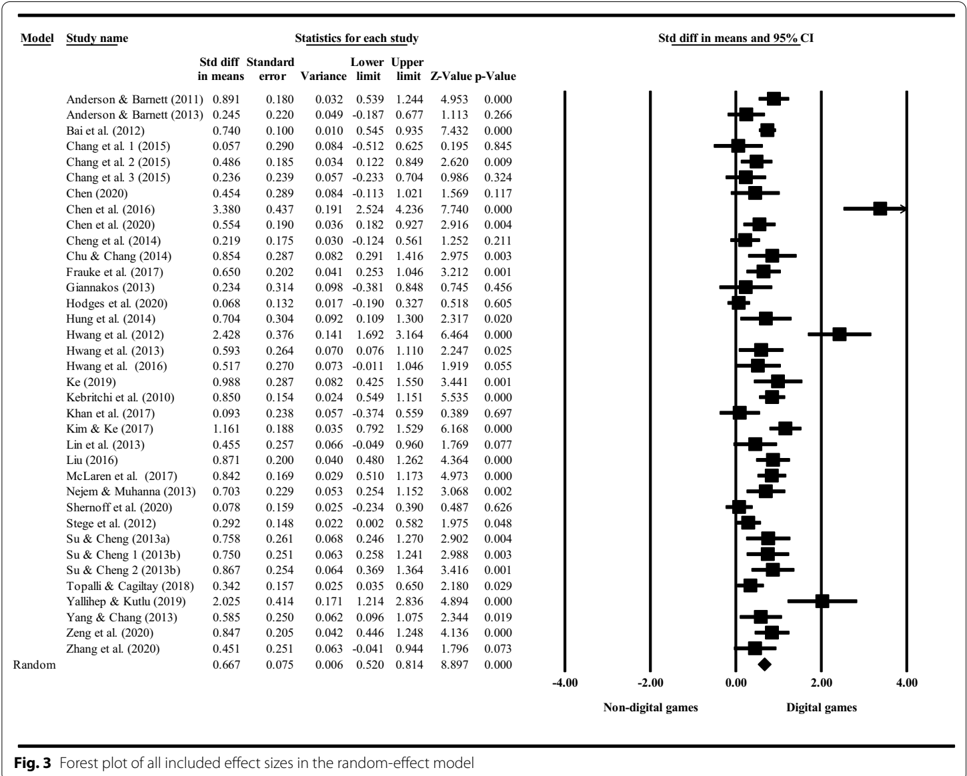
Many researchers have explored the impact of digital games on learning effects in different STEM subjects. The purpose of this meta-analysis is to examine the effect of digital game-based STEM education on the learning achievement of K-12 or higher education students. The analysis results of effect sizes from 33 studies ( N = 3894) published from 2010 to 2020 showed that digital games contributed to a moderate overall effect size (ES = 0.667, 95% CI [0.520–0.814], p < 0.001) when compared with other instructional methods. Furthermore, the study explored multiple moderator variables and their potential impacts on learning outcomes such as control treatment, subject discipline, educational level, game type, gaming platform, and intervention duration. The findings suggest that digital games are a promising pedagogical method in STEM education that effectively improves learning gains. Additionally, the study concludes with three recommendations for future research and practices on digital games in STEM education.
Overview
CoChat Summary
TL;DR
This meta-analysis found that digital game-based STEM education had a moderate, significant positive effect on students’ learning achievement versus other instructional methods. Across 33 studies (36 effect sizes; N = 3,894), the overall effect size was ES = 0.667 (95% CI [0.520–0.814], p < 0.001).
Key findings
- Overall, digital game-based STEM instruction produced a moderate positive effect on learning achievement: ES = 0.667, 95% CI [0.520–0.814], p < 0.001.
- Compared with control treatments, digital game-based instruction outperformed both multimedia (ES = 0.848, p < 0.001) and traditional instruction (ES = 0.558, p < 0.001).
- By subject, effects were positive across science (ES = 0.750, p < 0.001), mathematics (ES = 0.629, p < 0.001), and technology/engineering (ES = 0.367, p = 0.140), with no significant difference among disciplines (Qb = 2.188, p = 0.335).
- By education level, primary education showed the largest effect (ES = 0.835, p < 0.001), compared with secondary (ES = 0.487, p < 0.001) and higher education (ES = 0.492, p < 0.05); the subgroup difference was not significant (Qb = 5.184, p = 0.075).
- By game type, board games had the largest effect (ES = 1.455, p < 0.001), followed by tutorial games (ES = 0.593, p < 0.001) and immersive games (ES = 0.583, p < 0.001); subgroup differences were significant (Qb = 11.126, p < 0.01).
- By platform, computers (ES = 0.625, p < 0.001) and mobile devices (ES = 0.768, p < 0.001) both improved achievement, with no significant difference between them (Qb = 0.752, p = 0.386).
Methods
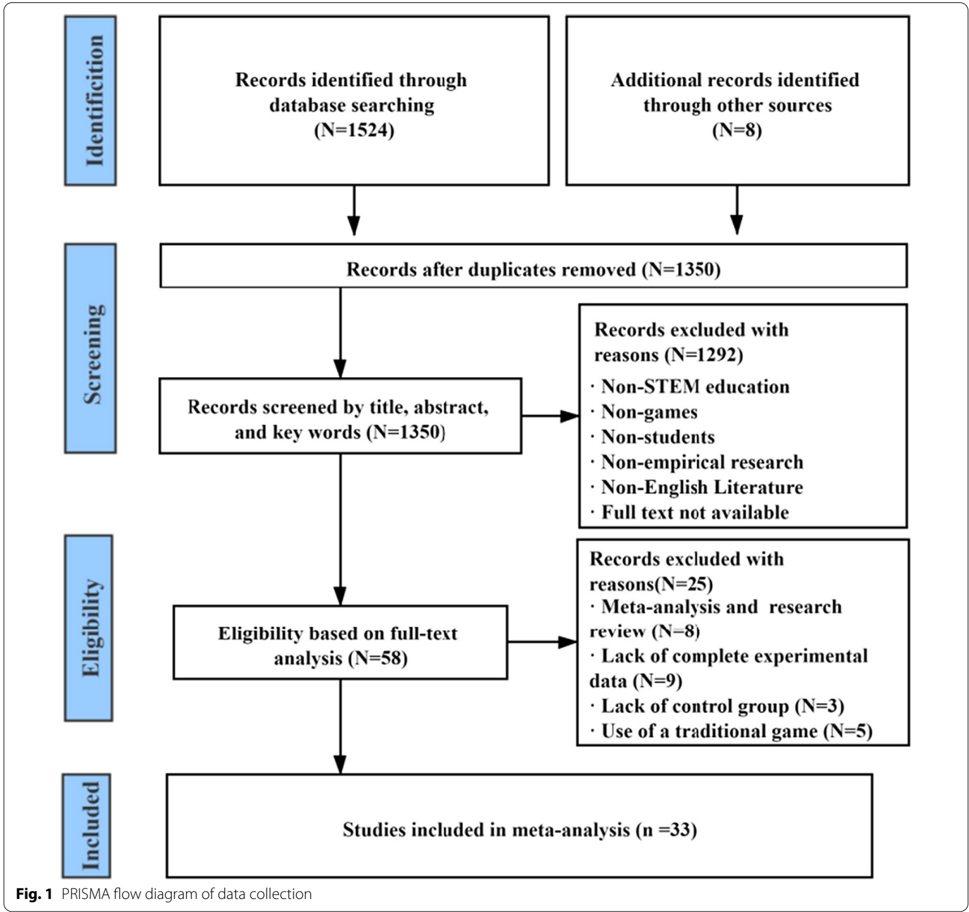
- Meta-analysis conducted under a PRISMA-guided search of six databases: Web of Science Core Collection, ERIC, ProQuest, Springer, Scopus, and Wiley.
- Included studies were English-language peer-reviewed journal articles published from 2010 to 2020, focused on K-12 or higher education STEM settings, used an intervention with a digital game treatment and a comparison group, and reported sufficient data for effect-size calculation.
- The final sample was 33 studies with 36 effect sizes and 3,894 participants; analyses used standardized mean difference, heterogeneity tests (Q and I2), random-effects models, and moderator analyses for control treatment, subject discipline, education level, game type, gaming platform, and intervention duration.
Limitations
- The paper states that the meta-analysis included only 33 empirical studies and 36 effect sizes, and that relevant studies may have been missed.
- The paper states that it used a random-effects model rather than a fixed-effects model, and that the review was not fully inclusive but aimed to provide a systematic overview; it also notes a paucity of studies on other outcomes such as cognitive skills and affective influences.
- Evident from the text: some moderator subgroups were small, especially board games (only four studies; 11.11%), so those estimates may be less stable.
Model-written summary. Check it against the paper before relying on it.
Integrity signals
Registry
Cites
Statistics
Figures
Verification
Claims the paper makes
3 Valid · 0 Not valid · 5 Not checked · 32 Own results and interpretations
Every source the paper cites for this claim was checked and supports it.
In the paper
“Consistent with previous discussions, short-term interventions have been associated with better learning achievement than long-term interventions (Riopel et al., 2019).”
What the sources say
- Supportedcites Riopel et al., 2019 matched to “Impact of serious games on science learning achievement compared with more conventional instruction: an overview and a meta-analysis” (2019) source
The Moderators section states that hypothesis H6 was accepted: 'a shorter duration of instruction with serious games yields higher learning achievement outcomes than a median duration, which itself yields higher learning achievement outcomes than a longer duration,' attributed to novelty-effect dissipation. The Results section backs this with significant pairwise differences (Δd = 0.12, p = .026 for <1 week vs 1–4 weeks; Δd = 0.13, p = .020 for 1–4 weeks vs >4 weeks, F[3,61] = 4.227, p = .022). The source also situates this within the wider CAI/serious-game literature (Dekkers & Donatti 1981; Bayraktar 2001; Kulik & Kulik), matching the citing sentence's 'consistent with previous discussions'. Our copy does note conflicting two-level findings in Wouters et al. (2013) and Clark et al. (2015), but explains them away as coding limitations, so the attribution stands. (LLM, conf=0.90)
plainstates an association- Asserted: passes — The authors put it forward as true.
- Checkable: passes — It can be checked against evidence.
- Load-bearing: unclear — It is unclear whether the paper’s conclusions depend on it.
- Based: passes — The paper gives a reason why it holds.
- Supported
The cited sources support only part of this claim — read each source’s verdict below.
In the paper
“First, they did not comprehensively analyze the subject disciplines of STEM, but only analyzed a particular subject, such as science or mathematics.”
What the sources say
- Partly supportedcites Riopel et al., 2019 matched to “Impact of serious games on science learning achievement compared with more conventional instruction: an overview and a meta-analysis” (2019) sourceExperimental — accuracy not yet measured
The overview ('Previous Meta-Analyses on Serious Games'; 'Moderators') does support the gist that past syntheses left the natural-science/STEM disciplines insufficiently examined: the main limitation is 'the lack of sufficient examination of the effect of serious games in the domain of natural sciences', with broad reviews (Clark et al. 2015; Sitzmann & Ely 2011; Vogel et al. 2006) pooling several knowledge domains 'as a single whole, thus precluding a precise conclusion with regard to the domain of science'. But the claim's second half — that they 'only analyzed a particular subject such as science or mathematics' — is not what our copy says of those meta-analyses; it states the opposite, e.g. Vogel et al. 'did not focus on a particular subject area, and included studies from various knowledge domains'. Our copy does note subject-specific metasyntheses (Rutten et al. 2012; Young et al. 2012; Brinson et al. 2015; Ma & Nickerson 2006), yet frames the gap as science (and its internal disciplines), never as a comprehensive STEM analysis. (LLM, conf=0.72)
- Not checked — no full text of the sourcecites Tokac et al., 2019 matched to “Effects of game‐based learning on students' mathematics achievement: A meta‐analysis” (2019) source
- Not checked — no full text of the sourcecites Tsai & Tsai, 2020 matched to “A meta‐analysis of research on digital game‐based science learning” (2020) source
plain- Asserted: passes — The authors put it forward as true.
- Checkable: passes — It can be checked against evidence.
- Load-bearing: passes — The paper’s conclusions depend on it.
- Based: passes — The paper gives a reason why it holds.
- Partly supported
The sources with a verdict support this claim; the rest weren’t checked yet, have no full text we could read, or their verdicts aren’t rated yet.
In the paper
“However, these studies have reached no uniform conclusions regarding the effects of digital games on students' STEM learning gains.”
What the sources say
- Supportedcites Hung et al. (2014) matched to “Effects of digital game-based learning on students’ self-efficacy, motivation, anxiety, and achievements in learning mathematics” (2014) source
The Discussion and conclusions section states that the positive achievement result 'is not obvious, since some previous studies have reported unfavorable results or negative effects of DGBL on students' learning performance (Charsky and Ressler 2011; Pierfy 1977; Randel et al. 1992)', i.e. the paper explicitly treats prior evidence on games' effects on learning performance as non-uniform. Alongside this, the Background and motivation and Literature review sections marshal the opposite line of findings (educational computer games promoting motivation and achievement: Burguillo 2010; Liu and Chu 2010; Kuo 2007; Sung and Hwang 2013; Hwang et al. 2013c in natural science; Wang and Chen 2010 in programming), so the mixed-result picture spans STEM subjects rather than mathematics alone. The cited sentence is a broad background characterization, and our copy clearly treats the topic that way. (LLM, conf=0.80)
- Not checked — no full text of the sourcecites Neimeyer (2006)
- Not matchedcites Giannakos, 2013; Khan et al., 2017
A range of references, not one source.
plain- Asserted: passes — The authors put it forward as true.
- Checkable: passes — It can be checked against evidence.
- Load-bearing: passes — The paper’s conclusions depend on it.
- Based: passes — The paper gives a reason why it holds.
- Supported
A result the paper reports from its own data — it cites no other source for it, so there is none to check. The quote shows it is in the paper.
In the paper
“The effect size of digital game-based instruction compared to multimedia is 0.848 (p < 0.001).”
plainstates a cause- Asserted: passes — The authors put it forward as true.
- Checkable: passes — It can be checked against evidence.
- Load-bearing: passes — The paper’s conclusions depend on it.
- Based: passes — The paper gives a reason why it holds.
A result the paper reports from its own data — it cites no other source for it, so there is none to check. The quote shows it is in the paper.
In the paper
“Regarding education levels, results in Table 2 suggest no significant difference in the effect sizes for the different education levels (Qb = 5.184, p = 0.075).”
hedged- Asserted: passes — The authors put it forward as true.
- Checkable: passes — It can be checked against evidence.
- Load-bearing: passes — The paper’s conclusions depend on it.
- Based: passes — The paper gives a reason why it holds.
17 more claims
Create a free account to see all 40 claims and every source verdict.
- The quote only partly states this claim. 3
- It may state two separate claims as one. 9
- Probably not a substantial claim. 6
Citations
Cites
Statistical Power Analysis for the Behavioral Sciences
Muller, K. (1989) · Technometrics · doi:10.1080/00401706.1989.10488618 · Cited by 99,167
Measuring inconsistency in meta-analyses
Higgins, J. P. T., Thompson, S. G., Deeks, J. J., & Altman, D. G. (2003) · BMJ · doi:10.1136/bmj.327.7414.557 · Cited by 63,139 · cited 1×
“The I 2 test supplements the Q -test, where 0%–25% indicates that heterogeneity is considered low, 25%–75% indicates moderate heterogeneity, and 75%– 100% indicates substantial heterogeneity (Higgins et al., 2003).”
Bias in meta-analysis detected by a simple, graphical test
Egger, M., Smith, G. D., Schneider, M., & Minder, C. (1997) · BMJ · doi:10.1136/bmj.315.7109.629 · Cited by 56,722 · cited 2×
“Publication bias from multiple sources may affect the results of meta-analysis studies (Egger et al., 1997).”
BackgroundPRISMA-P Group, Moher, D., Shamseer, L., Clarke, M., Ghersi, D., Liberati, A., Petticrew, M., Shekelle, P., & Stewart, L. A. (2015) · Systematic Reviews · doi:10.1186/2046-4053-4-1 · Cited by 26,223 · cited 1×
“Studies were searched for using the Preferred Reporting Items for Systematic Reviews and Meta-Analysis (PRISMA) method (Moher et al., 2010, 2015).”
MethodOperating characteristics of a rank correlation test for publication bias
Begg, C. B., & Mazumdar, M. (1994) · Biometrics · doi:10.2307/2533446 · Cited by 16,955 · cited 1×
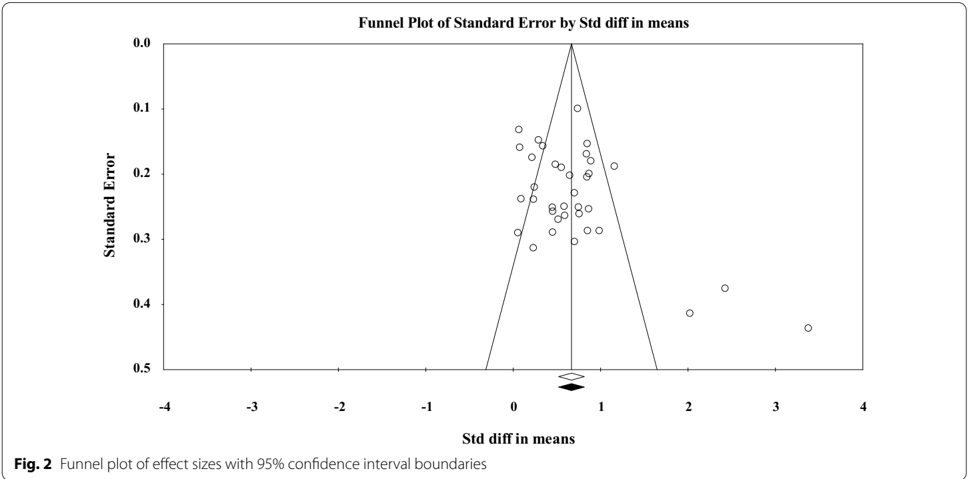
“In the Begg and Mazumdar rank correlation (Kendall’s Tau with a continuity correction), the results ( Z = 1.457 < 1.96, p = 0.145 > 0.05) indicate that there is insignificant publication bias (Begg & Mazumdar, 1994).”
ResultInfluentialBorenstein, M., Hedges, L. V., Higgins, J. P. T., & Rothstein, H. R. (2009) · doi:10.1002/9780470743386 · Cited by 14,225 · cited 1×
“When only positive study results are published, it leads to publication bias (Borenstein et al., 2009).”
BackgroundPreferred reporting items for systematic reviews and meta-analyses: The PRISMA statement
Moher, D., Liberati, A., Tetzlaff, J., & Altman, D. G. (2010) · International Journal of Surgery · doi:10.1016/j.ijsu.2010.02.007 · Cited by 12,156 · cited 1×
“Studies were searched for using the Preferred Reporting Items for Systematic Reviews and Meta-Analysis (PRISMA) method (Moher et al., 2010, 2015).”
Method(2000) · Cited by 9,198
The file drawer problem and tolerance for null results.
Rosenthal, R. (1979) · Psychological Bulletin · doi:10.1037/0033-2909.86.3.638 · Cited by 9,068 · cited 1×
“The classic fail-safe N test is a procedure to evaluate whether publication bias can be ignored (Rosenthal, 1979).”
BackgroundA basic introduction to fixed-effect and random-effects models for meta-analysis
Borenstein, M., Hedges, L. V., Higgins, J. P. T., & Rothstein, H. R. (2010) · Research Synthesis Methods · doi:10.1002/jrsm.12 · Cited by 6,793 · cited 1×
“Thus, the random-effects model was more appropriate (Borenstein et al., 2010), and showed that analysis of the moderator variables was necessary.”
MethodPlay, Dreams And Imitation In Childhood
Piaget, J. (2013) · Routledge eBooks · doi:10.4324/9781315009698 · Cited by 5,360
Primary, Secondary, and Meta-Analysis of Research
GLASS, G. V. (1976) · Educational Researcher · doi:10.3102/0013189x005010003 · Cited by 4,890
Merchant, Z., Goetz, E. T., Cifuentes, L., Keeney-Kennicutt, W., & Davis, T. J. (2014) · Computers & Education · doi:10.1016/j.compedu.2013.07.033 · Cited by 2,109 · cited 1×
“Previous studies considered “con-trol treatment” as a moderator variable to compare the experimental treatments with the different control treatments (Garzón & Acevedo, 2019; Merchant et al., 2014; Sitzmann, 2011; Wouters et al., 2013).”
MethodSynthesizing information systems knowledge: A typology of literature reviews
Paré, G., Trudel, M.-C., Jaana, M., & Kitsiou, S. (2015) · Information & Management · doi:10.1016/j.im.2014.08.008 · Cited by 1,987 · cited 1×
“It may allow researchers to resolve disputes arising from conflicting empirical studies and draw more meaningful inferences (Paré et al., 2015).”
BackgroundA meta-analysis of the cognitive and motivational effects of serious games.
Wouters, P., van Nimwegen, C., van Oostendorp, H., & van der Spek, E. D. (2013) · Journal of Educational Psychology · doi:10.1037/a0031311 · Cited by 1,864 · cited 2×
“Previous studies considered “con-trol treatment” as a moderator variable to compare the experimental treatments with the different control treatments (Garzón & Acevedo, 2019; Merchant et al., 2014; Sitzmann, 2011; Wouters et al., 2013).”
MethodPapastergiou, M. (2009) · Computers & Education · doi:10.1016/j.compedu.2008.06.004 · Cited by 1,689 · cited 1×
““Games” perform an essential function of promoting cognitive development (Piaget, 1999), are an immersive, enjoyable, and exciting activity (Papastergiou, 2009), and are widely used in educational contexts (Chu & Chang, 2014; Gunter et al., 2008).”
BackgroundSung, Y.-T., Chang, K.-E., & Liu, T.-C. (2016) · Computers & Education · doi:10.1016/j.compedu.2015.11.008 · Cited by 1,574 · cited 1×
“In addition, given the rapid increase in mobile technology use (Sung et al., 2016), mobile games have become more popular.”
BackgroundEstimation of effect size from a series of independent experiments.
Hedges, L. V. (1982) · Psychological Bulletin · doi:10.1037//0033-2909.92.2.490 · Cited by 1,062 · cited 1×
“The ES(d) was calculated by using the following formula (Hedges, 1982): where M E and M C are the estimated means of the experimental and control groups, respectively, with N E and N C being the sample sizes of both groups, and S 2 E and S 2 C the respective standard deviations.”
MethodBai, S., Hew, K. F., & Huang, B. (2020) · Educational Research Review · doi:10.1016/j.edurev.2020.100322 · Cited by 994 · cited 3×
“We referred to the search strategies used in previous meta-analyses (Bai et al., 2020; Gao et al., 2020; Hung et al., 2018; Tsai & Tsai, 2020).”
MethodResultA META‐ANALYTIC EXAMINATION OF THE INSTRUCTIONAL EFFECTIVENESS OF COMPUTER‐BASED SIMULATION GAMES
SITZMANN, T. (2011) · Personnel Psychology · doi:10.1111/j.1744-6570.2011.01190.x · Cited by 882 · cited 1×
“Previous studies considered “con-trol treatment” as a moderator variable to compare the experimental treatments with the different control treatments (Garzón & Acevedo, 2019; Merchant et al., 2014; Sitzmann, 2011; Wouters et al., 2013).”
MethodFu, R., Gartlehner, G., Grant, M., Shamliyan, T., Sedrakyan, A., Wilt, T. J., Griffith, L., Oremus, M., Raina, P., Ismaila, A., et al. (2011) · Journal of Clinical Epidemiology · doi:10.1016/j.jclinepi.2010.08.010 · Cited by 730 · cited 1×
“Students with different knowledge levels would affect the experiment’s results, leading to effect size heterogeneity (Fu et al., 2011).”
BackgroundThe effects of modern mathematics computer games on mathematics achievement and class motivation
Kebritchi, M., Hirumi, A., & Bai, H. (2010) · Computers & Education · doi:10.1016/j.compedu.2010.02.007 · Cited by 647
Brinson, J. R. (2015) · Computers & Education · doi:10.1016/j.compedu.2015.07.003 · Cited by 617 · cited 1×
“Brinson (2015) believed that it was crucial to better understand the effectiveness of serious games related to students’ grade levels and cognitive or psychological development.”
BackgroundResearch and trends in STEM education: a systematic review of journal publications
Li, Y., Wang, K., Xiao, Y., & Froyd, J. E. (2020) · International Journal of STEM Education · doi:10.1186/s40594-020-00207-6 · Cited by 494 · cited 1×
“On the other hand, STEM education also refers to interdisciplinary combinations of the individual STEM subjects (Li, 2014; Li et al., 2020).”
BackgroundMeta-analysis of the impact of Augmented Reality on students’ learning gains
Garzón, J., & Acevedo, J. (2019) · Educational Research Review · doi:10.1016/j.edurev.2019.04.001 · Cited by 491 · cited 1×
“Previous studies considered “con-trol treatment” as a moderator variable to compare the experimental treatments with the different control treatments (Garzón & Acevedo, 2019; Merchant et al., 2014; Sitzmann, 2011; Wouters et al., 2013).”
MethodChen, J., Wang, M., Kirschner, P. A., & Tsai, C.-C. (2018) · Review of Educational Research · doi:10.3102/0034654318791584 · Cited by 450 · cited 2×
“These moderator variables were used in previous research to examine what could contribute to the heterogeneity of effect size differences (Chen et al., 2018; Hung et al., 2018; Thompson & Gillern, 2020; Zheng et al., 2016).”
MethodGame-Based Learning in Science Education: A Review of Relevant Research
Li, M.-C., & Tsai, C.-C. (2013) · Journal of Science Education and Technology · doi:10.1007/s10956-013-9436-x · Cited by 391 · cited 1×
“In the existing literature review, Li and Tsai (2013) divided the games into two types: without a role-play mechanism and with a role-play mechanism.”
BackgroundMayer, R. E. (2019) · Annual Review of Psychology · doi:10.1146/annurev-psych-010418-102744 · Cited by 386 · cited 2×
“Mayer (2019) suggested that media comparison research must establish adequate control groups and the potential for publication bias favoring significant media effects.”
BackgroundEffects of game‐based learning on students' mathematics achievement: A meta‐analysis
Tokac, U., Novak, E., & Thompson, C. G. (2019) · Journal of Computer Assisted Learning · doi:10.1111/jcal.12347 · Cited by 366 · cited 4×
“The results are consistent with Tsai and Tsai (2020) and Tokac et al. (2019).”
BackgroundMethodResultInfluentialGunter, G. A., Kenny, R. F., & Vick, E. H. (2008) · Educational Technology Research and Development · doi:10.1007/s11423-007-9073-2 · Cited by 354
Lamb, R. L., Annetta, L., Firestone, J., & Etopio, E. (2018) · Computers in Human Behavior · doi:10.1016/j.chb.2017.10.040 · Cited by 351 · cited 1×
“Lamb et al. (2018) found that different game types increased students’ achievement, cognition, and affect.”
BackgroundHwang, G.-J., Wu, P.-H., & Chen, C.-C. (2012) · Computers & Education · doi:10.1016/j.compedu.2012.05.009 · Cited by 338 · cited 1×
“Furthermore, researchers have noted that digital games can achieve diversified STEM learning goals that enhance students’ learning motivation, improve their understanding of knowledge concepts, and cultivate their problem-solving abilities (Hwang et al., 2012).”
BackgroundSelf-citationA scoping review of research on digital game-based language learning
Hung, H.-T., Yang, J. C., Hwang, G.-J., Chu, H.-C., & Wang, C.-C. (2018) · Computers & Education · doi:10.1016/j.compedu.2018.07.001 · Cited by 319 · cited 6×
“Previous literature reviews and meta-analyses have examined the field of gaming platforms (Hung et al., 2018; Thompson & Gillern, 2020).”
BackgroundMethodInfluentialSelf-citationLearning in One-to-One Laptop Environments: A Meta-Analysis and Research Synthesis
Zheng, B., Warschauer, M., Lin, C.-H., & Chang, C. (2016) · Review of Educational Research · doi:10.3102/0034654316628645 · Cited by 312 · cited 1×
“These moderator variables were used in previous research to examine what could contribute to the heterogeneity of effect size differences (Chen et al., 2018; Hung et al., 2018; Thompson & Gillern, 2020; Zheng et al., 2016).”
MethodEvidence of STEM Enactment Effectiveness in Asian Student Learning Outcomes
Wahono, B., Lin, P.-L., & Chang, C.-Y. (2020) · International Journal of STEM Education · doi:10.1186/s40594-020-00236-1 · Cited by 286 · cited 2×
“The definition of “subject” was the name of a discipline or a class in which the STEM enactment occurred (Wahono et al., 2020).”
BackgroundMethodHwang, G.-J., Wu, P.-H., Chen, C.-C., & Tu, N.-T. (2016) · Interactive Learning Environments · doi:10.1080/10494820.2015.1057747 · Cited by 283 · cited 2×
“The growth of the Internet and various emerging technologies (e.g., mobile technology, AR/VR, and 3D) provides students with personalized learning support opportunities in their education (Hou et al., 2014; Hwang et al., 2016; Su & Cheng, 2013a).”
BackgroundMethodSelf-citationHung, C.-M., Huang, I., & Hwang, G.-J. (2014) · Journal of Computers in Education · doi:10.1007/s40692-014-0008-8 · Cited by 253 · cited 1×
“For example, Hung et al. (2014) developed a mathematical digital game to help children reduce their anxiety, and indicated that it improved their motivation to learn mathematics and their achievement in the subject.”
BackgroundSelf-citationEnjoy and learn with educational games: Examining factors affecting learning performance
Giannakos, M. N. (2013) · Computers & Education · doi:10.1016/j.compedu.2013.06.005 · Cited by 234 · cited 1×
“Additionally, no significant effect on student learning was determined by other researchers (Giannakos, 2013; Khan et al., 2017).”
BackgroundPersonality-targeted Gamification: A Survey Study on Personality Traits and Motivational Affordances
Jia, Y., Xu, B., Karanam, Y., & Voida, S. (2016) · Proceedings of the 2016 CHI Conference on Human Factors in Computing Systems · doi:10.1145/2858036.2858515 · Cited by 231 · cited 1×
“Additionally, personality traits significantly impact the game learning system’s design (Jia et al., 2016).”
BackgroundThe effects of competition in digital game-based learning (DGBL): a meta-analysis
Chen, C., Shih, C.-C., & Law, V. (2020) · Educational Technology Research and Development · doi:10.1007/s11423-020-09794-1 · Cited by 226 · cited 1×
“Studies by Bai et al. (2020), Chen et al. (2020b), Chen, Huang, et al. (2020a)), and Tsai and Tsai (2020) showed that game-play and game mechanisms, competition strategies, and gaming platforms significantly increase students’ learning achievement, consistent with our research results.”
ResultTopalli, D., & Cagiltay, N. E. (2018) · Computers & Education · doi:10.1016/j.compedu.2018.01.011 · Cited by 223
Khan, A., Ahmad, F. H., & Malik, M. M. (2017) · Education and Information Technologies · doi:10.1007/s10639-017-9622-1 · Cited by 216 · cited 2×
“Additionally, no significant effect on student learning was determined by other researchers (Giannakos, 2013; Khan et al., 2017).”
BackgroundCarolyn Yang, Y.-T., & Chang, C.-H. (2013) · Computers & Education · doi:10.1016/j.compedu.2013.05.023 · Cited by 193
A systematic review of mobile game-based learning in STEM education
Gao, F., Li, L., & Sun, Y. (2020) · Educational Technology Research and Development · doi:10.1007/s11423-020-09787-0 · Cited by 187 · cited 3×
“Gao et al. (2020) comprehensively analyzed 30 studies published between 2010 and 2019 on mobile games in STEM education.”
BackgroundMethodA Computer-Based Game that Promotes Mathematics Learning More than a Conventional Approach
McLaren, B. M., Adams, D. M., Mayer, R. E., & Forlizzi, J. (2017) · International Journal of Game-Based Learning · doi:10.4018/ijgbl.2017010103 · Cited by 173
Chen, C. (2020) · Educational Technology Research and Development · doi:10.1007/s11423-020-09834-w · Cited by 173
Li, Y. (2014) · International Journal of STEM Education · doi:10.1186/2196-7822-1-1 · Cited by 133 · cited 1×
“On the other hand, STEM education also refers to interdisciplinary combinations of the individual STEM subjects (Li, 2014; Li et al., 2020).”
BackgroundOn the effects of 3D virtual worlds in language learning – a meta-analysis
Wang, C.-P., Lan, Y.-J., Tseng, W.-T., Lin, Y.-T. R., & Gupta, K. C.-L. (2020) · Computer Assisted Language Learning · doi:10.1080/09588221.2019.1598444 · Cited by 132 · cited 1×
“When there is significant heterogeneity, using a random-effects model would better address the differences between research effect sizes (Wang et al., 2019).”
MethodLearning Physics with Digital Game Simulations in Middle School Science
Anderson, J., & Barnett, M. (2013) · Journal of Science Education and Technology · doi:10.1007/s10956-013-9438-8 · Cited by 130
Riopel, M., Nenciovici, L., Potvin, P., Chastenay, P., Charland, P., Sarrasin, J. B., & Masson, S. (2019) · Studies in Science Education · doi:10.1080/03057267.2019.1722420 · Cited by 127 · cited 3×
“Riopel et al. (2019) conducted a meta-analysis of 79 studies on serious games (i.e., digital software explicitly designed for learning purposes) in science education.”
BackgroundMethodA Mobile Game-based Insect Learning System for Improving the Learning Achievements
Su, C.-H., & Cheng, C.-H. (2013) · Procedia - Social and Behavioral Sciences · doi:10.1016/j.sbspro.2013.10.305 · Cited by 123 · cited 3×
“The growth of the Internet and various emerging technologies (e.g., mobile technology, AR/VR, and 3D) provides students with personalized learning support opportunities in their education (Hou et al., 2014; Hwang et al., 2016; Su & Cheng, 2013a).”
BackgroundMethodBai, H., Pan, W., Hirumi, A., & Kebritchi, M. (2012) · British Journal of Educational Technology · doi:10.1111/j.1467-8535.2011.01269.x · Cited by 113
Game-Based Remedial Instruction in Mastery Learning for Upper-Primary School Students
Lin, C. H., Liu, E. Z. F., Chen, Y.-L., Liou, P., Chang, M., Wu, C. H., & Yuan, S. (2011) · Cited by 112
A meta‐analysis of research on digital game‐based science learning
Tsai, Y., & Tsai, C. (2020) · Journal of Computer Assisted Learning · doi:10.1111/jcal.12430 · Cited by 112 · cited 6×
“Tsai and Tsai (2020) analyzed the effectiveness of game-based science learning.”
BackgroundMethodResultInfluentialMeta-analysis: Methods, strengths, weaknesses, and political uses
Noble, J. H. (2006) · Journal of Laboratory and Clinical Medicine · doi:10.1016/j.lab.2005.08.006 · Cited by 101 · cited 1×
“It has more stringent literature screening mechanisms and standards (Noble, 2006).”
BackgroundChen, C., Liu, G., & Hwang, G. (2016) · British Journal of Educational Technology · doi:10.1111/bjet.12270 · Cited by 99
Self-citationHwang, G., Sung, H., Hung, C., Yang, L., & Huang, I. (2013) · British Journal of Educational Technology · doi:10.1111/j.1467-8535.2012.01285.x · Cited by 96 · cited 1×
“Furthermore, researchers have noted that digital games can achieve diversified STEM learning goals that enhance students’ learning motivation, improve their understanding of knowledge concepts, and cultivate their problem-solving abilities (Hwang et al., 2012).”
BackgroundSelf-citationThompson, C. G., & von Gillern, S. (2020) · Educational Research Review · doi:10.1016/j.edurev.2020.100332 · Cited by 89 · cited 5×
“Previous literature reviews and meta-analyses have examined the field of gaming platforms (Hung et al., 2018; Thompson & Gillern, 2020).”
BackgroundMethodInfluentialUsing Video Games to Support Pre-Service Elementary Teachers Learning of Basic Physics Principles
Anderson, J., & Barnett, M. (2010) · Journal of Science Education and Technology · doi:10.1007/s10956-010-9257-0 · Cited by 88
(2008) · Journal of Computers in Mathematics and Science Teaching · Cited by 83
Supporting primary students' learning of fraction conceptual knowledge through digital games
Zhang, L., Shang, J., Pelton, T. W., & Pelton, L. F. (2020) · Journal of Computer Assisted Learning · doi:10.1111/jcal.12422 · Cited by 81
An educational game for learning human immunology: What do students learn and how do they perceive?
Cheng, M., Su, T., Huang, W., & Chen, J. (2014) · British Journal of Educational Technology · doi:10.1111/bjet.12098 · Cited by 79
Mathematical problem solving and learning in an architecture-themed epistemic game
Ke, F. (2019) · Educational Technology Research and Development · doi:10.1007/s11423-018-09643-2 · Cited by 74
Kim, H., & Ke, F. (2017) · Interactive Learning Environments · doi:10.1080/10494820.2016.1167744 · Cited by 70
EVALUATION OF INTERACTIVE GAME-BASED LEARNING IN PHYSICS DOMAIN
Zeng, H., Zhou, S., Hong, G.-R., Li, Q.-Y., & Xu, S. (2020) · Journal of Baltic Science Education · doi:10.33225/jbse/20.19.484 · Cited by 69
Seeing Change in Time: Video Games to Teach about Temporal Change in Scientific Phenomena
Corredor, J., Gaydos, M., & Squire, K. (2014) · Journal of Science Education and Technology · doi:10.1007/s10956-013-9466-4 · Cited by 67 · cited 1×
“However, learning these disciplines has been considered to have various difficulties and challenges due to the subject’s complex, abstract, and multi-dimensional nature (Corredor et al., 2014; Sedig, 2008).”
BackgroundEffects of a tablet game intervention on simple addition and subtraction fluency in first graders
van der Ven, F., Segers, E., Takashima, A., & Verhoeven, L. T. W. (2017) · Computers in Human Behavior · doi:10.1016/j.chb.2017.02.031 · Cited by 61
A Blended Mobile Learning Environment for Museum Learning
Hou, H., Wu, S. Y., Lin, P., Sung, Y., Lin, J. W., & Chang, K.-E. (2014) · Educational Technology & Society · Cited by 55
Chu, H., & Chang, S. (2013) · Educational Technology Research and Development · doi:10.1007/s11423-013-9323-4 · Cited by 54 · cited 2×
“Studies conducted by Chu and Chang (2014), Hwang et al. (2013); (2016) supported this conclusion.”
BackgroundResultDifferential effects of learning games on mathematics proficiency
Chang, M., Evans, M. A., Kim, S., Norton, A., & Samur, Y. (2015) · Educational Media International · doi:10.1080/09523987.2015.1005427 · Cited by 46 · cited 1×
“From these 33 studies, we extracted 36 effect sizes; one study (Su & Cheng, 2013b) included one group for two comparisons, and another study (Chang et al., 2015) compared three different grades, thus contributing five effect sizes.”
MethodYallihep, M., & Kutlu, B. (2019) · Education and Information Technologies · doi:10.1007/s10639-019-10008-2 · Cited by 42
MATHEMATICS ACHIEVEMENT WITH DIGITAL GAME-BASED LEARNING IN HIGH SCHOOL ALGEBRA 1 CLASSES
Ferguson, T. L. K. (2014) · Digital Commons (Liberty University) · Cited by 41
3D Game-Based Learning System for Improving Learning Achievement in Software Engineering Curriculum
Su, C.-H., & Cheng, C. (2013) · The Turkish Online Journal of Educational Technology · Cited by 40
Hodges, G. W., Flanagan, K., Lee, J., Cohen, A. S., Krishnan, S., & Ward, C. (2020) · Journal of Research in Science Teaching · doi:10.1002/tea.21661 · Cited by 40
Liu, T.-Y. (2016) · Interactive Learning Environments · doi:10.1080/10494820.2014.917109 · Cited by 37
Chen, C.-Y., Huang, H.-J., Lien, C.-J., & Lu, Y.-L. (2020) · IEEE Access · doi:10.1109/access.2020.3000659 · Cited by 31 · cited 1×
“Studies by Bai et al. (2020), Chen et al. (2020b), Chen, Huang, et al. (2020a)), and Tsai and Tsai (2020) showed that game-play and game mechanisms, competition strategies, and gaming platforms significantly increase students’ learning achievement, consistent with our research results.”
ResultShernoff, D. J., Ryu, J.-C., Ruzek, E. A., Coller, B., & Prantil, V. C. (2020) · Sustainability · doi:10.3390/su12176986 · Cited by 29
Nejem, K. M., & Muhanna, W. (2013) · Educational Research Review · doi:10.5897/err012.143 · Cited by 13
(2006) · Cited by 6
Research works printed but not linked: 1
- Stege, L., Lankveld, G. V., & Spronck, P. (2012). Teaching high school physics with a serious game. International Journal of Computer Science in Sport, 11(1).
Cited by
Timotheou, S., Miliou, O., Dimitriadis, Y., Sobrino, S. V., Giannoutsou, N., Cachia, R., Monés, A. M., & Ioannou, A. (2023) · Education and Information Technologies · doi:10.1007/s10639-022-11431-8 · Cited by 816
“Integration of digital games in teaching was also found as a promising pedagogical practice in STEM education that could lead to increased learning gains (Martinez et al., 2022; Wang et al., 2022).”
BackgroundEffectiveness of digital educational game and game design in STEM learning: a meta-analytic review
Gui, Y., Cai, Z., Yang, Y., Kong, L., Fan, X., & Tai, R. H. (2023) · International Journal of STEM Education · doi:10.1186/s40594-023-00424-9 · Cited by 298
“…examined the effects of game-based science learning (Riopel et al., 2019; Tsai & Tsai, 2020), examined the effectiveness of game-based math learning (Byun & Joung, 2018; Tokac et al., 2019), or examined the effects of digital game-based STEM education on student knowledge gains (Wang et al., 2022).”
BackgroundGame-based learning in computer science education: a scoping literature review
Videnovik, M., Vold, T., Kiønig, L. V., Bogdanova, A. M., & Trajkovik, V. (2023) · International Journal of STEM Education · doi:10.1186/s40594-023-00447-2 · Cited by 274
“When digital game-based learning is implemented, including key game design elements (collaboration, choice, feedback), there is typically a positive impact on student engagement (Serrano, 2019; Wang et al., 2022).”
BackgroundMethodYang, C., Zhang, J., Hu, Y., Yang, X., Chen, M. H., Shan, M., & Li, L. (2024) · International Journal of STEM Education · doi:10.1186/s40594-024-00487-2 · Cited by 187
“Wang et al. (2022) conducted a systematic review of integrating STEM education into K-12 curricula, providing valuable insights into this educational approach.”
BackgroundPatiño, A., Soledad, M., & Fernández, M. B. (2023) · Smart Learning Environments · doi:10.1186/s40561-023-00229-x · Cited by 153
Metadata
- Authors
- Wang, L.-H., Chen, B., Hwang, G.-J., Guan, J.-Q., & Wang, Y.-Q.
- Affiliations
- Zhejiang Normal University (CN)
- National Taiwan University of Science and Technology (TW)
- Corresponding author
- Wang, Liang-Hui
- ORCID
- Wang, Liang-Hui
- Venue
- International Journal of STEM Education
- Published
- 2022-03-17
- Volume
- 9
- Issue
- 1
- ISSN
- 2196-7822 (ISSN-L)
- OpenAlex
- W4220750697
- Cited by
- 316
- References
- 83
- Citations by year
- 2026: 63 · 2025: 82 · 2024: 90 · 2023: 67 · 2022: 11
- FWCI
- 12.61
- Type
- journal article
- Language
- en
- Open access
- gold
- doi.org
- Licence
- cc-by
- creativecommons.org/licenses/by/4.0 (tdm)
- creativecommons.org/licenses/by/4.0 (vor)
- Locations
- International Journal of STEM Education (publishedVersion, cc-by)
- DOAJ (DOAJ: Directory of Open Access Journals) (submittedVersion, cc-by-sa)
- Funders
- Philosophy and Social Science Planning of Zhejiang Province (19NDJC252YB)
- National Education Science “13th Five-Year” Planning Key Project of Ministry of Education in China (DCA160262)
- Topics
- Social Sciences › Psychology › Developmental and Educational Psychology › Educational Games and Gamification
- Social Sciences › Education › Education and Learning Interventions
- Physical Sciences › Computer Science › Information Systems › Mobile Learning in Education
- Keywords
- game-based learning, video games, STEM education, academic performance, K-12 students, university students, game types, game platforms
About these checks
Registry, retraction, Cites and statistics results are computed, not judged, with one exception: a printed reference that no index lists is read once by a model before it counts as a citation error. Claims are extracted by a model and kept only when their quote appears verbatim in the text; each cited source is then checked, with a model’s help, for whether it says what the claim relies on. Those verdicts can be wrong — read the claim’s quote and the cited source before relying on one.
The claim verdicts this report counts are experimental: their accuracy is not yet measured.
A language model drew the claims from the paper on 2026-10-10, under version 3 of the claim definition (model deepseek-v4.1-flash, prompt extract-v3).
A second model labelled each claim on 2026-10-10 (model jev-1.13-20260917, definition revision gold-guideline-v0.2).
Cited sources are checked with a language model’s help (qwen3.8-omni-flash).
Statistics and arithmetic are recomputed, not judged.
Confidence bands are shown only for fields calibrated on our annotated test set. None is calibrated yet, so no band is shown.
What counts as a claim ›How we measure confidence ›How we check this ›
Are you an author, or do you see a problem with this page? Request a review
Data sources
Bibliographic data: Semantic Scholar, OpenAlex, Crossref.
Contains information from the Semantic Scholar Academic Graph Datasets, made available under the ODC Attribution License (ODC-BY 1.0).
Semantic Scholar’s data is described in: Kinney, R., et al. (2023). The Semantic Scholar Open Data Platform. arXiv:2301.10140.
