

The DOI matches its Crossref record; 239 of the 239 references it cites were found in a registry or an index.
Running economy: measurement, norms, and determining factors
Open accessAbstract
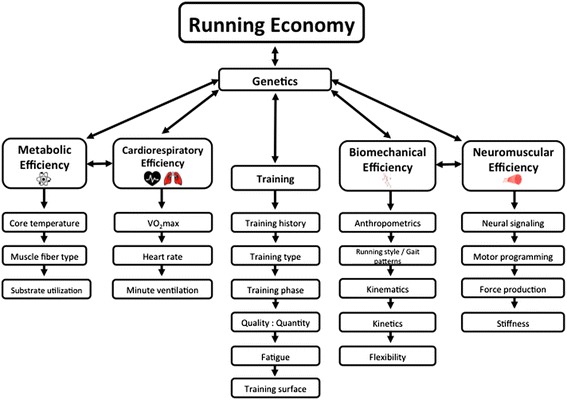
Running economy (RE) is considered an important physiological measure for endurance athletes, especially distance runners. This review considers 1) how RE is defined and measured and 2) physiological and biomechanical factors that determine or influence RE. It is difficult to accurately ascertain what is good, average, and poor RE between athletes and studies due to variation in protocols, gas-analysis systems, and data averaging techniques. However, representative RE values for different caliber of male and female runners can be identified from existing literature with mostly clear delineations in oxygen uptake across a range of speeds in moderately and highly trained and elite runners. Despite being simple to measure and acceptably reliable, it is evident that RE is a complex, multifactorial concept that reflects the integrated composite of a variety of metabolic, cardiorespiratory, biomechanical and neuromuscular characteristics that are unique to the individual. Metabolic efficiency refers to the utilization of available energy to facilitate optimal performance, whereas cardiopulmonary efficiency refers to a reduced work output for the processes related to oxygen transport and utilization. Biomechanical and neuromuscular characteristics refer to the interaction between the neural and musculoskeletal systems and their ability to convert power output into translocation and therefore performance. Of the numerous metabolic, cardiopulmonary, biomechanical and neuromuscular characteristics contributing to RE, many of these are able to adapt through training or other interventions resulting in improved RE.
Overview
The claims and statistics of this paper haven’t been checked yet.
Run the check — free, no account needed. It reads the open-access text and checks the sources it cites.
Integrity signals
Registry
Cites
Statistics
Figures
Verification
Claims the paper makes
The claims and statistics of this paper haven’t been checked yet.
Run the check — free, no account needed. It reads the open-access text and checks the sources it cites.
Claims other papers make about this one
Each is checked against this paper’s own text: does it say what the citing paper says it does?
In the citing paper
“this metric is reliant on the measurement of steady state oxygen consumption using various types of manual (i.e., Douglas bag method) or automated (i.e., commercial breath-by-breath analysers) gas-analysis systems [75].”
From Neither beetroot juice supplementation nor increased carbohydrate oxidation enhance economy of prolonged exercise in elite race walkers (2021) · cites this paper as [75]
Self-check
Percentages, sums and reported differences re-computed from the paper’s own numbers.
The self-check needs the paper’s full text.
Citations
Cites
Progressive Statistics for Studies in Sports Medicine and Exercise Science
HOPKINS, W. G., MARSHALL, S. W., BATTERHAM, A. M., & HANIN, J. (2009) · Medicine & Science in Sports & Exercise · doi:10.1249/mss.0b013e31818cb278 · Cited by 9,128
Measures of Reliability in Sports Medicine and Science
Hopkins, W. G. (2000) · Sports Medicine · doi:10.2165/00007256-200030010-00001 · Cited by 4,635
Textbook of Work Physiology: Physiological Bases of Exercise
(2004) · Physiotherapy Theory and Practice · doi:10.1080/09593980490425012 · Cited by 1,864
A 1% treadmill grade most accurately reflects the energetic cost of outdoor running
JONES, A. M., & Doust, J. H. (1996) · Journal of Sports Sciences · doi:10.1080/02640419608727717 · Cited by 977
Factors affecting running economy in trained distance runners
Saunders, P. U., Pyne, D. B., Telford, R. D., & Hawley, J. A. (2004) · Sports Medicine · doi:10.2165/00007256-200434070-00005 · Cited by 975
Reliability of Power in Physical Performance Tests
Hopkins, W. G., Schabort, E. J., & Hawley, J. A. (2001) · Sports Medicine · doi:10.2165/00007256-200131030-00005 · Cited by 827
Energetics of running: a new perspective
Kram, R., & Taylor, C. R. (1990) · Nature · doi:10.1038/346265a0 · Cited by 821
The spring in the arch of the human foot
Ker, R. F., Bennett, M. B., Bibby, S., Kester, R. C., & Alexander, R. M. (1987) · Nature · doi:10.1038/325147a0 · Cited by 780
Explosive-strength training improves 5-km running time by improving running economy and muscle power
Paavolainen, L. M., Häkkinen, K., Hämäläinen, I., Nummela, A. T., & Rusko, H. K. (1999) · Journal of Applied Physiology · doi:10.1152/jappl.1999.86.5.1527 · Cited by 694
Margaria, R., Cerretelli, P., Aghemo, P., & Sassi, G. (1963) · Journal of Applied Physiology · doi:10.1152/jappl.1963.18.2.367 · Cited by 666
Research works printed but not linked: 12
- Thomas DQ, Fernhall B, Granat H. Changes in running economy during a 5-km run in trained men and women runners. J Strength Cond Res. 1999;13(2):162–7.
- MacDougall J. The anaerobic threshold: its significance for the endurance athlete. Can J Appl Sport Sci. 1977;2:137–40.
- Daniels JT, Scardina N, Hayes J, Foley P. Elite and subelite female middle- and long-distance runners. In: Landers DM, editor. The 1984 Olympic Scientific Conference Proceedings. Champaign, IL: Human Kinetics; 1986. p. 57–72.
- Daniels JT, Gilbert J. Oxygen Power: Performance Tables for Distance Runners. Tempe, AZ: Daniels and Gilbert, POB 26287; 1979.
- Daniels JT. Running with Jim Ryun: a five-year study. PhysicianSportsmed. 1974;2(September):62–7.
- Daniels JT, Foster C, Daniels S, Krahenbuhl G. Altitude and human performance with special consideration of the aerobic demands of running. Orlando, Florida: Proceedings of the NCPEAM/NAPECW National Conference; 1977. p. 61–7.
- Thomas D, Fernhall B, Blanpied P. Changes in running economy and mechanics during a 5 km run. J Strength Cond Res. 1995;9:170–5.
- Poole DC. Role of exercising muscle in slow component of VO2. Med Sci Sports Exerc. 1994;26(11):1335–40.
- Johnston R, Quinn T, Kertzer R, Vroman N. Strength training in female distance runners: impact on running economy. J Strength Cond Res. 1997;11(4):224–9.
- Williams K, Cavanagh PR. Biomechanical correlates with running economy in elite distance runners. Montreal: Proceedings of the North American Congress on Biomechanics; 1986. p. 287–8.
- Catlin M. Effect of shoe weight on energy cost of running [abstract]. Med Sci Sports Exerc. 1979;11:80.
- Daniels JT, Scardina N, Foley P. VO2max during five modes of exercise. In: Bachl N, Prokop L, Suckert R, editors. Proceedings of the World Congress on Sports Medicine. Vienna: Urban & Schwartzenberg; 1984. p. 604–15.
Cited by
Sorted by citations
No Benefit of Ingestion of a Ketone Monoester Supplement on 10-km Running Performance
EVANS, M., MCSWINEY, F. T., BRADY, A. J., & EGAN, B. (2019) · Medicine & Science in Sports & Exercise · doi:10.1249/mss.0000000000002065 · Cited by 82
The promises and pitfalls of applying computational models to neurological and psychiatric disorders
Teufel, C., & Fletcher, P. C. (2016) · Brain · doi:10.1093/brain/aww209 · Cited by 64
Physiological factors determining downhill vs uphill running endurance performance
Lemire, M., Hureau, T. J., Favret, F., Geny, B., Kouassi, B. Y. L., Boukhari, M., Lonsdorfer, E., Remetter, R., & Dufour, S. P. (2021) · Journal of Science and Medicine in Sport · doi:10.1016/j.jsams.2020.06.004 · Cited by 46
Jardine, W. T., Aisbett, B., Kelly, M. K., Burke, L. M., Ross, M. L., Condo, D., Périard, J. D., & Carr, A. J. (2023) · Sports Medicine · doi:10.1007/s40279-023-01885-2 · Cited by 32
Burke, L. M., Hall, R., Heikura, I. A., Ross, M. L., Tee, N., Kent, G. L., Whitfield, J., Forbes, S. F., Sharma, A. P., Jones, A. M., et al. (2021) · Nutrients · doi:10.3390/nu13082767 · Cited by 15
Management of suspected fluid balance issues in participants of wilderness endurance events
Hoffman, M. D., Joslin, J., & Rogers, I. R. (2017) · Current Sports Medicine Reports · doi:10.1249/jsr.0000000000000344 · Cited by 14
Prochilo, G. A., Costa, R. J. S., Hassed, C., Chambers, R., & Molenberghs, P. (2021) · Pilot and Feasibility Studies · doi:10.1186/s40814-020-00751-6 · Cited by 12
Metadata
- Authors
- Barnes, K. R., & Kilding, A. E.
- Affiliations
- Auckland University of Technology (NZ)
- Corresponding author
- Barnes, Kyle R
- Venue
- Sports Medicine - Open
- Published
- 2015-03-27
- Volume
- 1
- Issue
- 1
- Pages
- 8-8
- ISSN
- 2198-9761 (ISSN-L)
- 2199-1170
- PMC
- PMC4555089
- OpenAlex
- W2166690729
- Cited by
- 465
- References
- 239
- Citations by year
- 2026: 60 · 2025: 75 · 2024: 53 · 2023: 31 · 2022: 46 · 2021: 47 · 2020: 43 · 2019: 36 · 2018: 39 · 2017: 19 · 2016: 13 · 2015: 2
- FWCI
- 25.05
- Type
- journal article
- Language
- en
- Open access
- gold
- doi.org
- Locations
- Sports Medicine - Open (publishedVersion, cc-by)
- Europe PMC (PubMed Central) (publishedVersion, cc-by)
- PubMed Central (publishedVersion, cc-by)
- PubMed (publishedVersion)
- Topics
- Health Sciences › Medicine › Orthopedics and Sports Medicine › Sports Performance and Training
- Health Sciences › Medicine › Physiology (medical) › Cardiovascular and exercise physiology
- Physical Sciences › Engineering › Biomedical Engineering › Lower Extremity Biomechanics and Pathologies
- Keywords
- running economy, oxygen consumption, endurance athletes, long-distance running, metabolic efficiency, biomechanical factors, neuromuscular factors, training effects
About these checks
Registry, retraction, Cites and statistics results are computed, not judged, with one exception: a printed reference that no index lists is read once by a model before it counts as a citation error. Claims are extracted by a model and kept only when their quote appears verbatim in the text; each cited source is then checked, with a model’s help, for whether it says what the claim relies on. Those verdicts can be wrong — read the claim’s quote and the cited source before relying on one.
Statistics and arithmetic are recomputed, not judged.
Confidence bands are shown only for fields calibrated on our annotated test set. None is calibrated yet, so no band is shown.
What counts as a claim ›How we measure confidence ›How we check this ›
Are you an author, or do you see a problem with this page? Request a review
