

The DOI matches its Crossref record; 239 of the 239 references it cites were found in a registry or an index.
Running economy: measurement, norms, and determining factors
Open accessAbstract
Running economy (RE) is considered an important physiological measure for endurance athletes, especially distance runners. This review considers 1) how RE is defined and measured and 2) physiological and biomechanical factors that determine or influence RE. It is difficult to accurately ascertain what is good, average, and poor RE between athletes and studies due to variation in protocols, gas-analysis systems, and data averaging techniques. However, representative RE values for different caliber of male and female runners can be identified from existing literature with mostly clear delineations in oxygen uptake across a range of speeds in moderately and highly trained and elite runners. Despite being simple to measure and acceptably reliable, it is evident that RE is a complex, multifactorial concept that reflects the integrated composite of a variety of metabolic, cardiorespiratory, biomechanical and neuromuscular characteristics that are unique to the individual. Metabolic efficiency refers to the utilization of available energy to facilitate optimal performance, whereas cardiopulmonary efficiency refers to a reduced work output for the processes related to oxygen transport and utilization. Biomechanical and neuromuscular characteristics refer to the interaction between the neural and musculoskeletal systems and their ability to convert power output into translocation and therefore performance. Of the numerous metabolic, cardiopulmonary, biomechanical and neuromuscular characteristics contributing to RE, many of these are able to adapt through training or other interventions resulting in improved RE.
Overview
The claims and statistics of this paper haven’t been checked yet.
Run the check — free, no account needed. It reads the open-access text and checks the sources it cites.
Integrity signals
Registry
Cites
Statistics
Figures
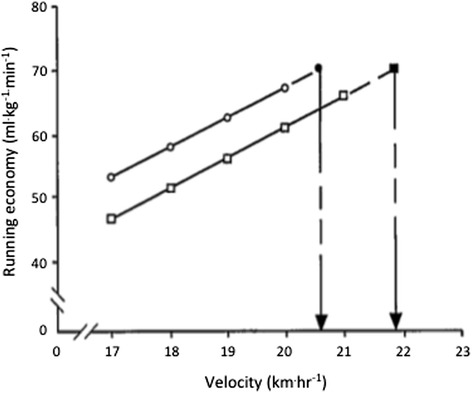
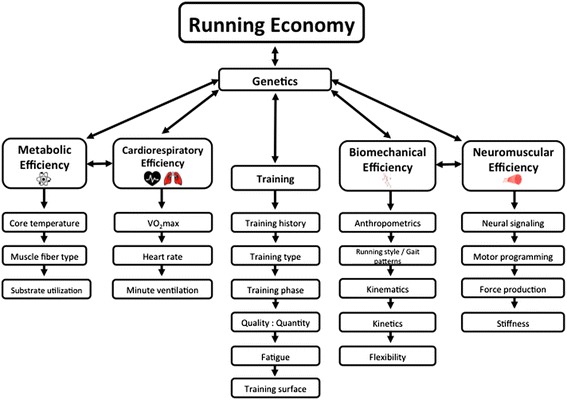
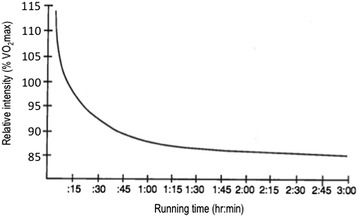
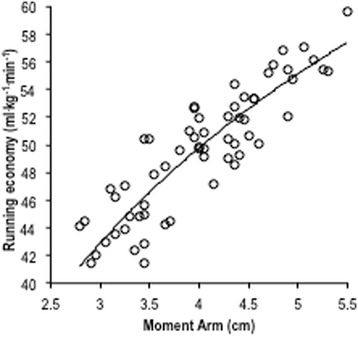
Verification
Claims the paper makes
The claims and statistics of this paper haven’t been checked yet.
Run the check — free, no account needed. It reads the open-access text and checks the sources it cites.
Claims other papers make about this one
Each is checked against this paper’s own text: does it say what the citing paper says it does?
In the citing paper
“this metric is reliant on the measurement of steady state oxygen consumption using various types of manual (i.e., Douglas bag method) or automated (i.e., commercial breath-by-breath analysers) gas-analysis systems [75].”
From Neither beetroot juice supplementation nor increased carbohydrate oxidation enhance economy of prolonged exercise in elite race walkers (2021) · cites this paper as [75]
Self-check
Percentages, sums and reported differences re-computed from the paper’s own numbers.
The self-check needs the paper’s full text.
Citations
Cites
Progressive Statistics for Studies in Sports Medicine and Exercise Science
HOPKINS, W. G., MARSHALL, S. W., BATTERHAM, A. M., & HANIN, J. (2009) · Medicine & Science in Sports & Exercise · doi:10.1249/mss.0b013e31818cb278 · Cited by 9,128
Measures of Reliability in Sports Medicine and Science
Hopkins, W. G. (2000) · Sports Medicine · doi:10.2165/00007256-200030010-00001 · Cited by 4,635
Textbook of Work Physiology: Physiological Bases of Exercise
(2004) · Physiotherapy Theory and Practice · doi:10.1080/09593980490425012 · Cited by 1,864
A 1% treadmill grade most accurately reflects the energetic cost of outdoor running
JONES, A. M., & Doust, J. H. (1996) · Journal of Sports Sciences · doi:10.1080/02640419608727717 · Cited by 977
Factors affecting running economy in trained distance runners
Saunders, P. U., Pyne, D. B., Telford, R. D., & Hawley, J. A. (2004) · Sports Medicine · doi:10.2165/00007256-200434070-00005 · Cited by 975
Reliability of Power in Physical Performance Tests
Hopkins, W. G., Schabort, E. J., & Hawley, J. A. (2001) · Sports Medicine · doi:10.2165/00007256-200131030-00005 · Cited by 827
Energetics of running: a new perspective
Kram, R., & Taylor, C. R. (1990) · Nature · doi:10.1038/346265a0 · Cited by 821
The spring in the arch of the human foot
Ker, R. F., Bennett, M. B., Bibby, S., Kester, R. C., & Alexander, R. M. (1987) · Nature · doi:10.1038/325147a0 · Cited by 780
Explosive-strength training improves 5-km running time by improving running economy and muscle power
Paavolainen, L. M., Häkkinen, K., Hämäläinen, I., Nummela, A. T., & Rusko, H. K. (1999) · Journal of Applied Physiology · doi:10.1152/jappl.1999.86.5.1527 · Cited by 694
Margaria, R., Cerretelli, P., Aghemo, P., & Sassi, G. (1963) · Journal of Applied Physiology · doi:10.1152/jappl.1963.18.2.367 · Cited by 666
Mechanical work and efficiency in level walking and running
Cavagna, G. A., & Kaneko, M. (1977) · The Journal of Physiology · doi:10.1113/jphysiol.1977.sp011866 · Cited by 664
Taylor, C. R., Heglund, N. C., & Maloiy, G. M. O. (1982) · Journal of Experimental Biology · doi:10.1242/jeb.97.1.1 · Cited by 650
Cavagna, G., Saibene, F., & Margaria, R. (1964) · Journal of Applied Physiology · doi:10.1152/jappl.1964.19.2.249 · Cited by 634
Energetics and Mechanics of Terrestrial Locomotion
Taylor, C. R., & Heglund, N. C. (1982) · Annual Review of Physiology · doi:10.1146/annurev.ph.44.030182.000525 · Cited by 606
Running economy and distance running performance of highly trained athletes
Conley, D. L., & Krahenbuhl, G. S. (1980) · Medicine & Science in Sports & Exercise · doi:10.1249/00005768-198012050-00010 · Cited by 595
Elastic mechanisms in animal movement
Evans, E. J. (1989) · Choice Reviews Online · doi:10.5860/choice.26-5074 · Cited by 593
Hemodynamic correlates of myocardial oxygen consumption during upright exercise
Kitamura, K., Jorgensen, C. R., Gobel, F. L., Taylor, H. L., & Wang, Y. (1972) · Journal of Applied Physiology · doi:10.1152/jappl.1972.32.4.516 · Cited by 575
Physiological tests for elite athletes
Gore, C. J. (2000) · Cited by 524
Relationship between distance running mechanics, running economy, and performance
Williams, K. R., & Cavanagh, P. R. (1987) · Journal of Applied Physiology · doi:10.1152/jappl.1987.63.3.1236 · Cited by 522
The effect of stride length variation on oxygen uptake during distance running
Cavanagh, P. R., & Williams, K. R. (1982) · Medicine & Science in Sports & Exercise · doi:10.1249/00005768-198201000-00006 · Cited by 515
Running economy and distance running performance of highly trained athletes
Conley, D. L., & Krahenbuhl, G. S. (1980) · Medicine & Science in Sports & Exercise · doi:10.1249/00005768-198025000-00010 · Cited by 490
The effect of plyometric training on distance running performance
Spurrs, R. W., Murphy, A. J., & Watsford, M. L. (2003) · European Journal of Applied Physiology · doi:10.1007/s00421-002-0741-y · Cited by 474
Electromyographic correlates of learning an internal model of reaching movements
Thoroughman, K. A., & Shadmehr, R. (1999) · The Journal of Neuroscience · doi:10.1523/jneurosci.19-19-08573.1999 · Cited by 467
Fractional utilization of the aerobic capacity during distance running
COSTILL, D. L., THOMASON, H., & ROBERTS, E. (1973) · Medicine & Science in Sports & Exercise · doi:10.1249/00005768-197300540-00007 · Cited by 458
McMahon, T. A., Valiant, G., & Frederick, E. C. (1987) · Journal of Applied Physiology · doi:10.1152/jappl.1987.62.6.2326 · Cited by 453
Nicol, C., Avela, J., & Komi, P. V. (2006) · Sports Medicine · doi:10.2165/00007256-200636110-00004 · Cited by 446
Mechanics and energetics of animal locomotion
Alexander, R. M., & Goldspink, G. (1977) · Medical Entomology and Zoology · Cited by 418
Squadrone, R., & Gallozzi, C. (2009) · PubMed · Cited by 397
Textbook of work physiology : physiological bases of exercise
Åstrand, P. (2003) · Cited by 392
Osu, R., Franklin, D. W., Kato, H., Gomi, H., Domen, K., Yoshioka, T., & Kawato, M. (2002) · Journal of Neurophysiology · doi:10.1152/jn.2002.88.2.991 · Cited by 380
Oxygen cost of exercise hyperpnea: implications for performance
Aaron, E. A., Seow, K. C., Johnson, B. D., & Dempsey, J. A. (1992) · Journal of Applied Physiology · doi:10.1152/jappl.1992.72.5.1818 · Cited by 377
The Ether Soluble Porphyrins Found in the Urine of Normal Man and Rabbit
Eriksen, L., Eriksen, N., & Haavaldsen, S. (1962) · Scandinavian Journal of Clinical and Laboratory Investigation · doi:10.1080/00365516209075148 · Cited by 358
Modeling: optimal marathon performance on the basis of physiological factors
Joyner, M. J. (1991) · Journal of Applied Physiology · doi:10.1152/jappl.1991.70.2.683 · Cited by 348
Running economy of elite male and elite female runners
DANIELS, J., & DANIELS, N. (1992) · Medicine & Science in Sports & Exercise · doi:10.1249/00005768-199204000-00015 · Cited by 345 · cited 4×
“mlkgmin or mlkgmin) has also been reported in order to compare RE between individuals and animals with varying body mass [22,33-47].”
BackgroundResultInfluentialImplications of exercise testing for prediction of athletic performance: a contemporary perspective
Noakes, T. D. (1988) · Medicine & Science in Sports & Exercise · doi:10.1249/00005768-198808000-00001 · Cited by 339
Effects of Footwear and Strike Type on Running Economy
Perl, D. P., Daoud, A. I., & Lieberman, D. E. (2012) · Medicine & Science in Sports & Exercise · doi:10.1249/mss.0b013e318247989e · Cited by 337
A physiologist??s view of running economy
Daniels, J. (1985) · Medicine & Science in Sports & Exercise · doi:10.1249/00005768-198506000-00006 · Cited by 336
Energetic Cost of Generating Muscular Force During Running
Taylor, C. R., Heglund, N. C., McMahon, T. A., & Looney, T. R. (1980) · Journal of Experimental Biology · doi:10.1242/jeb.86.1.9 · Cited by 328
Maximal Strength Training Improves Running Economy in Distance Runners
Støren, Ø., Helgerud, J., Støa, E. M., & Hoff, J. (2008) · Medicine & Science in Sports & Exercise · doi:10.1249/mss.0b013e318168da2f · Cited by 322
Biomechanical factors affecting running economy
Kyröläinen, H., Belli, A., & Komi, P. V. (2001) · Medicine & Science in Sports & Exercise · doi:10.1097/00005768-200108000-00014 · Cited by 320
Biomechanics and Running Economy
Anderson, T. (1996) · Sports Medicine · doi:10.2165/00007256-199622020-00003 · Cited by 311
Biomechanics of distance running
(1990) · Choice Reviews Online · doi:10.5860/choice.28-2199 · Cited by 308
Economy of running: beyond the measurement of oxygen uptake
Fletcher, J. R., Esau, S. P., & MacIntosh, B. R. (2009) · Journal of Applied Physiology · doi:10.1152/japplphysiol.00307.2009 · Cited by 299
The spring-mass model and the energy cost of treadmill running
Dalleau, G., Belli, A., BOURDIN, M., & Lacour, J. R. (1998) · European Journal of Applied Physiology · doi:10.1007/s004210050330 · Cited by 293
Energetics of Bipedal Running: I. Metabolic Cost of Generating Force
Roberts, T. J., Kram, R., Weyand, P. G., & Taylor, C. R. (1998) · Journal of Experimental Biology · doi:10.1242/jeb.201.19.2745 · Cited by 293
Factors Related to Top Running Speed and Economy
Nummela, A. T., Keränen, T., & Mikkelsson, L. (2007) · International Journal of Sports Medicine · doi:10.1055/s-2007-964896 · Cited by 267
Energy cost of loads carried on the head, hands, or feet.
Soule, R. G., & Goldman, R. F. (1969) · Journal of Applied Physiology · doi:10.1152/jappl.1969.27.5.687 · Cited by 263
Temperature, skeletal muscle mitochondrial functions, and oxygen debt
Brooks, G., Hittelman, K., Faulkner, J., & Beyer, R. (1971) · American Journal of Physiology-Legacy Content · doi:10.1152/ajplegacy.1971.220.4.1053 · Cited by 261
The Physiology of the World Record Holder for the Women's Marathon
JONES, A. M. (2006) · International Journal of Sports Science & Coaching · doi:10.1260/174795406777641258 · Cited by 256
Saltin, B., Larsen, H., Terrados, N., Bangsbo, J., Bak, T. S., Kim, C. K., Svedenhag, J., & Rolf, C. (1995) · Scandinavian Journal of Medicine and Science in Sports · doi:10.1111/j.1600-0838.1995.tb00037.x · Cited by 256
Effects of metabolic hyperthermia on performance during heavy prolonged exercise
MacDOUGALL, J. D., Reddan, W. G., Layton, C., & Dempsey, J. A. (1974) · Journal of Applied Physiology · doi:10.1152/jappl.1974.36.5.538 · Cited by 255
Wang, K., McCarter, R., Wright, J., Beverly, J., & Ramirez-Mitchell, R. (1993) · Biophysical Journal · doi:10.1016/s0006-3495(93)81482-6 · Cited by 254
Influence of the muscle-tendon unit's mechanical and morphological properties on running economy
Arampatzis, A., Monte, G. D., Karamanidis, K., et al. (2006) · Journal of Experimental Biology · doi:10.1242/jeb.02340 · Cited by 253
Factors Affecting Running Economy
Morgan, D. W., Martin, P. E., & Krahenbuhl, G. S. (1989) · Sports Medicine · doi:10.2165/00007256-198907050-00003 · Cited by 246
Stride length in distance running: velocity, body dimensions, and added mass effects.
Cavanagh, P. R., & Kram, R. (1989) · PubMed · Cited by 241
Physiological characteristics of the best Eritrean runners—exceptional running economy
Lucía, A., Esteve-Lanao, J., Oliván, J., Gómez‐Gallego, F., Juan, A. F. S., Santiago, C., Pérez, M., Chamorro-Viña, C., & Foster, C. (2006) · Applied Physiology Nutrition and Metabolism · doi:10.1139/h06-029 · Cited by 241
Ten kilometer performance and predicted velocity at V02max among well-trained male runners
Morgan, D. W., Baldini, F. D., Martin, P. E., & Kohrt, W. M. (1989) · Medicine & Science in Sports & Exercise · doi:10.1249/00005768-198902000-00014 · Cited by 240
Foster, C., & Lucía, A. (2007) · Sports Medicine · doi:10.2165/00007256-200737040-00011 · Cited by 233
Saunders, P. U., Telford, R. D., Pyne, D. B., Peltola, E. M., Cunningham, R. B., Gore, C. J., & Hawley, J. A. (2006) · The Journal of Strength and Conditioning Research · doi:10.1519/r-18235.1 · Cited by 231
Effect of Limb Mass and its Distribution on the Energetic Cost of Running
Myers, M. J., & Steudel, K. L. (1985) · Journal of Experimental Biology · doi:10.1242/jeb.116.1.363 · Cited by 228
Reliability and Variability of Running Economy in Elite Distance Runners
SAUNDERS, P. U., PYNE, D. B., TELFORD, R. D., & HAWLEY, J. A. (2004) · Medicine & Science in Sports & Exercise · doi:10.1249/01.mss.0000145468.17329.9f · Cited by 227
Apparent Efficiency and Storage of Elastic Energy in Human Muscles during Exercise
Asmussen, E., & Bonde‐Petersen, F. (1974) · Acta Physiologica Scandinavica · doi:10.1111/j.1748-1716.1974.tb05776.x · Cited by 226
Kenyan dominance in distance running
Larsen, H. B. (2003) · Comparative Biochemistry and Physiology Part A: Molecular & Integrative Physiology · doi:10.1016/s1095-6433(03)00227-7 · Cited by 224
Aerobic performance of female marathon and male ultramarathon athletes
Davies, C. T. M., & Thompson, M. W. (1979) · European Journal of Applied Physiology · doi:10.1007/bf00429740 · Cited by 218
The relationship between body mass and oxygen uptake during running in humans
Bergh, U., din, B. S., FORSBERG, A., & Svedenhag, J. (1991) · Medicine & Science in Sports & Exercise · doi:10.1249/00005768-199102000-00010 · Cited by 217
Barefoot-Shod Running Differences: Shoe or Mass Effect?
Divert, C., Mornieux, G., Freychat, P., et al. (2008) · International Journal of Sports Medicine · doi:10.1055/s-2007-989233 · Cited by 214
Pollock, M. L. (1977) · Annals of the New York Academy of Sciences · doi:10.1111/j.1749-6632.1977.tb38209.x · Cited by 214
Circulatory response to submaximal and maximal exercise after thermal dehydration
Saltin, B. (1964) · Journal of Applied Physiology · doi:10.1152/jappl.1964.19.6.1125 · Cited by 206
Franklin, D. W., Burdet, E., Osu, R., Kawato, M., & Milner, T. E. (2003) · Experimental Brain Research · doi:10.1007/s00221-003-1443-3 · Cited by 189
Energetics of walking and running: insights from simulated reduced-gravity experiments
Farley, C. T., & McMahon, T. A. (1992) · Journal of Applied Physiology · doi:10.1152/jappl.1992.73.6.2709 · Cited by 189
The Relationship Between Running Economy and Biomechanical Variables in Distance Runners
Tartaruga, M. P., Brisswalter, J., Peyré‐Tartaruga, L. A., Ávila, A. O. V., Alberton, C. L., Coertjens, M., Cadore, E. L., Tiggemann, C. L., da Silva, E. M., & Kruel, L. F. M. (2012) · Research Quarterly for Exercise and Sport · doi:10.1080/02701367.2012.10599870 · Cited by 185
Scaling peak ??VO2 for differences in body size
Welsman, J. R., Armstrong, N., Nevill, A. M., Winter, E., & KIRBY, B. J. (1996) · Medicine & Science in Sports & Exercise · doi:10.1097/00005768-199602000-00016 · Cited by 183
Cavagna, G., & Citterio, G. (1974) · The Journal of Physiology · doi:10.1113/jphysiol.1974.sp010552 · Cited by 180
Mechanical and physiological responses to lower extremity loading during running
Martin, P. E. (1985) · Medicine & Science in Sports & Exercise · doi:10.1249/00005768-198508000-00004 · Cited by 177
Helgerud, J. (1994) · European Journal of Applied Physiology · doi:10.1007/bf00244029 · Cited by 175
Albracht, K., & Arampatzis, A. (2013) · European Journal of Applied Physiology · doi:10.1007/s00421-012-2585-4 · Cited by 173
Patterns of leg muscle recruitment vary between novice and highly trained cyclists.
Chapman, A., Vicenzino, B., Blanch, P., & Hodges, P. (2008) · Journal of Electromyography & Kinesiology · doi:10.1016/j.jelekin.2005.12.007 · Cited by 171
A model for the calculation of mechanical power during distance running
Williams, K. R., & Cavanagh, P. R. (1983) · Journal of Biomechanics · doi:10.1016/0021-9290(83)90035-0 · Cited by 169
Maximal Strength Training Improves Cycling Economy in Competitive Cyclists
Sunde, A., Støren, Ø., Bjerkaas, M., Larsen, M. H., Hoff, J., & Helgerud, J. (2010) · The Journal of Strength and Conditioning Research · doi:10.1519/jsc.0b013e3181aeb16a · Cited by 168
Metabolic cost of generating horizontal forces during human running
Chang, Y., & Kram, R. (1999) · Journal of Applied Physiology · doi:10.1152/jappl.1999.86.5.1657 · Cited by 164
Oxygen cost of running in trained and untrained men and women
BRANSFORD, D. R., & Howley, E. T. (1977) · Medicine & Science in Sports & Exercise · doi:10.1249/00005768-197721000-00007 · Cited by 163
Kenyan and Ethiopian distance runners: what makes them so good?
Wilber, R. L., & Pitsiladis, Y. P. (2012) · International Journal of Sports Physiology and Performance · doi:10.1123/ijspp.7.2.92 · Cited by 163
The efficiency of human movement???a statement of the problem
Cavanagh, P. R., & Kram, R. (1985) · Medicine & Science in Sports & Exercise · doi:10.1249/00005768-198506000-00002 · Cited by 159
Changes in tendon stiffness and running economy in highly trained distance runners
Fletcher, J. R., Esau, S. P., & MacIntosh, B. R. (2010) · European Journal of Applied Physiology · doi:10.1007/s00421-010-1582-8 · Cited by 158
Adaptability in frequency and amplitude of leg movements during human locomotion at different speeds
NILSSON, J., & Thorstensson, A. (1987) · Acta Physiologica Scandinavica · doi:10.1111/j.1748-1716.1987.tb08045.x · Cited by 157
Avela, J., & Komi, P. V. (1998) · European Journal of Applied Physiology · doi:10.1007/s004210050438 · Cited by 154
Improved running economy following intensified training correlates with reduced ventilatory demands
Franch, J., Madsen, K., Djurhuus, M. S., & Pedersen, P. K. (1998) · Medicine & Science in Sports & Exercise · doi:10.1097/00005768-199808000-00011 · Cited by 154
Manipulating Resistance Training Program Variables to Optimize Maximum Strength in Men: A Review
TAN, B. (1999) · Journal of Strength and Conditioning Research · doi:10.1519/00124278-199908000-00019 · Cited by 154
Raichlen, D. A., Armstrong, H., & Lieberman, D. E. (2011) · Journal of Human Evolution · doi:10.1016/j.jhevol.2010.11.002 · Cited by 153
Relating mechanics and energetics during exercise.
Cr, T. (1994) · PubMed · Cited by 152
A BIOMECHANICAL COMPARISON OF ELITE AND GOOD DISTANCE RUNNERS
Cavanagh, P. R., Pollock, M. L., & Landa, J. (1977) · Annals of the New York Academy of Sciences · doi:10.1111/j.1749-6632.1977.tb38211.x · Cited by 151
Running biomechanics: shorter heels, better economy
Scholz, M. N., Bobbert, M. F., van Soest, A. J., et al. (2008) · Journal of Experimental Biology · doi:10.1242/jeb.018812 · Cited by 149
Gollhofer, A., & Kyröläinen, H. (1991) · International Journal of Sports Medicine · doi:10.1055/s-2007-1024652 · Cited by 142
Physiological aspects of running economy
Morgan, D. W., & Craib, M. W. (1992) · Medicine & Science in Sports & Exercise · doi:10.1249/00005768-199204000-00011 · Cited by 140
Mechanical and muscular factors affecting the efficiency of human movement
Cavanagh, P. R., & Kram, R. (1985) · Medicine & Science in Sports & Exercise · doi:10.1249/00005768-198506000-00005 · Cited by 140
Physiological and ergonomics factors in running shoe design
Frederick, E. C. (1984) · Applied Ergonomics · doi:10.1016/0003-6870(84)90199-6 · Cited by 140
Neuromuscular Characteristics and Fatigue During 10 km Running
Paavolainen, Nummela, Rusko, & Häkkinen (1999) · International Journal of Sports Medicine · doi:10.1055/s-1999-8837 · Cited by 138
Variation in the aerobic demand of running among trained and untrained subjects
Morgan, D. W., BRANSFORD, D. R., COSTILL, D. L., Daniels, J., Howley, E. T., & Krahenbuhl, G. S. (1995) · Medicine & Science in Sports & Exercise · doi:10.1249/00005768-199503000-00017 · Cited by 138
Neuromuscular characteristics and muscle power as determinants of 5-km running performance
Paavolainen, L. M., Nummela, A. T., & Rusko, H. K. (1999) · Medicine & Science in Sports & Exercise · doi:10.1097/00005768-199901000-00020 · Cited by 138
Effects of Prior Exercise on Metabolic and Gas Exchange Responses to Exercise
JONES, A. M., Koppo, K., & Burnley, M. (2003) · Sports Medicine · doi:10.2165/00007256-200333130-00002 · Cited by 135
Energetics Of Bipedal Running II. Limb Design and Running Mechanics
Roberts, T. J., Chen, M., & Taylor, C. R. (1998) · Journal of Experimental Biology · doi:10.1242/jeb.201.19.2753 · Cited by 134
Sex differences in performance-matched marathon runners
Helgerud, J., Ingjer, F., & Str�mme, S. B. (1990) · European Journal of Applied Physiology · doi:10.1007/bf00236064 · Cited by 131
Oxygen consumption during constant-load exercise
Hagberg, J. M., Mullin, J. P., & NAGLE, F. J. (1978) · Journal of Applied Physiology · doi:10.1152/jappl.1978.45.3.381 · Cited by 130
Kinematics and Kinetics of Gait: From Lab to Clinic
Dicharry, J. M. (2010) · Clinics in Sports Medicine · doi:10.1016/j.csm.2010.03.013 · Cited by 128
Effects of Single vs. Multiple Sets of Weight Training: Impact of Volume, Intensity, and Variation
Kramer, J. B., Stone, M. H., OʼBryant, H. S., Conley, M. S., Johnson, R. L., Nieman, D. C., Honeycutt, D. R., & Hoke, T. P. (1997) · The Journal of Strength and Conditioning Research · doi:10.1519/1533-4287(1997)011 · Cited by 127
Assessing Dynamic Performance: A Comparison of Rate of Force Development Tests
Wilson, G. J., Lyttle, A. D., Ostrowski, K. J., & Murphy, A. J. (1995) · The Journal of Strength and Conditioning Research · doi:10.1519/1533-4287(1995)009 · Cited by 124
Relationship between the efficiency of muscular work during jumping and the energetics of running
Bosco, C., Montanari, G., Ribacchi, R., Giovenali, P., Latteri, F., Iachelli, G., Faina, M., COLLI, R., Monte, A. D., Rosa, M. L., et al. (1987) · European Journal of Applied Physiology · doi:10.1007/bf00640636 · Cited by 124
How do stride length and stride frequency influence the energy-output during running?
HOGBERG, P. (1952) · PubMed · Cited by 121
Jones, B. H., Toner, M. M., DANIELS, W. L., & Knapik, J. J. (1984) · Ergonomics · doi:10.1080/00140138408963563 · Cited by 120
The relationship between mechanical and physiological energy estimates
Williams, K. R. (1985) · Medicine & Science in Sports & Exercise · doi:10.1249/00005768-198506000-00004 · Cited by 119
Economy and rate of carbohydrate oxidation during running with rearfoot and forefoot strike patterns
Gruber, A. H., Umberger, B. R., Braun, B., & Hamill, J. (2013) · Journal of Applied Physiology · doi:10.1152/japplphysiol.01437.2012 · Cited by 119
Gross Energy Cost of Horizontal Treadmill and Track Running
Léger, L., & Mercier, D. (1984) · Sports Medicine · doi:10.2165/00007256-198401040-00003 · Cited by 119
Physiological, anthropometric, and training correlates of running economy
Pate, R. R., Macera, C. A., Bailey, S. P., Bartoli, W. P., & Powell, K. E. (1992) · Medicine & Science in Sports & Exercise · doi:10.1249/00005768-199210000-00010 · Cited by 118
Mechanisms for Improved Running Economy in Beginner Runners
Moore, I. S., JONES, A. M., & Dixon, S. (2012) · Medicine & Science in Sports & Exercise · doi:10.1249/mss.0b013e318255a727 · Cited by 117
Are variations in running economy in humans associated with ground reaction force characteristics?
Heise, G. D., & Martin, P. E. (2001) · European Journal of Applied Physiology · doi:10.1007/s004210100394 · Cited by 116
Denadai, B. S., Ortiz, M. J., Greco, C. C., & de Mello, M. T. (2006) · Applied Physiology, Nutrition, and Metabolism · doi:10.1139/h06-080 · Cited by 116
Biomechanical Studies of Elite Female Distance Runners*
Williams, K. R., Cavanagh, P. R., & Ziff, J. L. (1987) · International Journal of Sports Medicine · doi:10.1055/s-2008-1025715 · Cited by 114
Perception of effort during different types of exercise and under different environmental conditions
Skinner, J. S., HUTSLER, R., Bergsteinova, V., et al. (1973) · Medicine & Science in Sports & Exercise · doi:10.1249/00005768-197300520-00021 · Cited by 114
Strength Training in Endurance Runners
Taipale, R. S., Mikkola, J., Nummela, A. T., Vesterinen, V., Capostagno, B., Walker, S., Gitonga, D., Kraemer, W. J., & Häkkinen, K. (2010) · International Journal of Sports Medicine · doi:10.1055/s-0029-1243639 · Cited by 114
Partitioning the Metabolic Cost of Human Running: A Task-by-Task Approach
Arellano, C. J., & Kram, R. (2014) · Integrative and Comparative Biology · doi:10.1093/icb/icu033 · Cited by 110
Cureton, K. J., Sparling, P. B., Evans, B. W., Johnson, S. M., Kong, U. D., & PURVIS, J. W. (1978) · PubMed · Cited by 110
Variability in running economy and mechanics among trained male runners
Morgan, D. W., Martin, P. E., Krahenbuhl, G. S., & Baldini, F. D. (1991) · Medicine & Science in Sports & Exercise · doi:10.1249/00005768-199103000-00018 · Cited by 109
Oxygen Cost of Running Barefoot vs. Running Shod
Hanson, N., Berg, K. E., Deka, P., et al. (2011) · International Journal of Sports Medicine · doi:10.1055/s-0030-1265203 · Cited by 109
Scaling for the VO2-to-body size relationship among children and adults
Rogers, D. M., Olson, B. L., & Wilmore, J. H. (1995) · Journal of Applied Physiology · doi:10.1152/jappl.1995.79.3.958 · Cited by 107
EMG activities and ground reaction forces during fatigued and nonfatigued sprinting
Nummela, A. T., Rusko, H. K., & Mero, A. A. (1994) · Medicine & Science in Sports & Exercise · doi:10.1249/00005768-199405000-00013 · Cited by 107
The two power limits conditioning step frequency in human running.
Cavagna, G., Willems, P. A., Franzetti, P., & Detrembleur, C. (1991) · The Journal of Physiology · doi:10.1113/jphysiol.1991.sp018586 · Cited by 105
Changes in oxygen consumption of young boys during growth and running training
Daniels, J., & Oldridge, N. (1971) · Medicine & Science in Sports & Exercise · doi:10.1249/00005768-197100340-00004 · Cited by 104
Lower-Body Determinants of Running Economy in Male and Female Distance Runners
Barnes, K. R., McGuigan, M. R., & Kilding, A. E. (2013) · The Journal of Strength and Conditioning Research · doi:10.1519/jsc.0000000000000267 · Cited by 102
Self-citationNeuromuscular Adaptations to Training, Injury and Passive Interventions
Bonacci, J., Chapman, A., BLANCH, P. D., & Vicenzino, B. (2009) · Sports Medicine · doi:10.2165/11317850-000000000-00000 · Cited by 101
The concurrent effects of strike pattern and ground-contact time on running economy
Michele, R. D., & Merni, F. (2013) · Journal of science and medicine in sport · doi:10.1016/j.jsams.2013.05.012 · Cited by 98
Effects of Strength Training on Running Economy
Guglielmo, L., Greco, C., & Denadai, B. (2009) · International Journal of Sports Medicine · doi:10.1055/s-2008-1038792 · Cited by 96
Taipale, R. S., Mikkola, J., Vesterinen, V., Nummela, A. T., & Häkkinen, K. (2012) · European Journal of Applied Physiology · doi:10.1007/s00421-012-2440-7 · Cited by 96
Effect of Plyometric vs. Dynamic Weight Training on the Energy Cost of Running
Berryman, N., Maurel, D. B., & Bosquet, L. (2010) · The Journal of Strength and Conditioning Research · doi:10.1519/jsc.0b013e3181def1f5 · Cited by 96
Are there differences in running economy at different velocities for well-trained distance runners?
Helgerud, J., Støren, Ø., & Hoff, J. (2009) · European Journal of Applied Physiology · doi:10.1007/s00421-009-1218-z · Cited by 94
Svedenhag, J., & Sjödin, B. (1984) · International Journal of Sports Medicine · doi:10.1055/s-2008-1025916 · Cited by 94
Ferrauti, A., Bergermann, M., & Fernández-Fernández, J. (2010) · The Journal of Strength and Conditioning Research · doi:10.1519/jsc.0b013e3181d64e9c · Cited by 92
Warne, J. P., & Warrington, G. D. (2012) · Scandinavian Journal of Medicine and Science in Sports · doi:10.1111/sms.12032 · Cited by 92
The forces and couples in the human trunk during level walking
Cappozzo, A. (1983) · Journal of Biomechanics · doi:10.1016/0021-9290(83)90134-3 · Cited by 92
Maximal aerobic power: neuromuscular and metabolic considerations.
Green, H. J., & Patla, A. E. (1992) · PubMed · Cited by 89
Effect of slope and footwear on running economy and kinematics
Lussiana, T., Fabre, N., Hébert‐Losier, K., & Mourot, L. (2013) · Scandinavian Journal of Medicine and Science in Sports · doi:10.1111/sms.12057 · Cited by 88
Mikkola, J., Vesterinen, V., Taipale, R., Capostagno, B., Häkkinen, K., & Nummela, A. (2011) · Journal of Sports Sciences · doi:10.1080/02640414.2011.589467 · Cited by 86
Race Diet of Finishers and Non-Finishers in a 100 Mile (161 km) Mountain Footrace
Stuempfle, K. J., Hoffman, M. D., Weschler, L. B., Rogers, I. R., & Hew-Butler, T. (2011) · Journal of the American College of Nutrition · doi:10.1080/07315724.2011.10719999 · Cited by 86
Human metabolic responses to hyperthermia during mild to maximal exercise.
Rowell, L. B., Brengelmann, G. L., Murray, J., Kraning, K. K., & Kusumi, F. (1969) · Journal of Applied Physiology · doi:10.1152/jappl.1969.26.4.395 · Cited by 84
Mechanical efficiency of positive work in running at different speeds
Ito, A., Komi, P. V., Sjödin, B., et al. (1983) · Medicine & Science in Sports & Exercise · doi:10.1249/00005768-198315040-00009 · Cited by 79
Fatigue during a 5-km Running Time Trial
Nummela, A. T., Heath, K., Paavolainen, L. M., et al. (2008) · International Journal of Sports Medicine · doi:10.1055/s-2007-989404 · Cited by 79
Differences and changes in VO2 among young runners 10 to 18 years of age.
Daniels, J., Oldridge, N., NAGLE, F. J., & White, B. (1978) · PubMed · Cited by 79
The energy cost of walking and running with and without a backpack load
Keren, G., Epstein, Y., Magazanik, A., & SOHAR, E. (1981) · European Journal of Applied Physiology · doi:10.1007/bf00423407 · Cited by 78
Effects of shoes and foot orthotics on VO2 and selected frontal plane knee kinematics.
Burkett, L. N., Kohrt, W. M., & BUCHBINDER, R. (1985) · PubMed · Cited by 76
The energy cost of women walking and running in shoes and boots∗
Jones, B. H., Knapik, J. J., DANIELS, W. L., & Toner, M. M. (1986) · Ergonomics · doi:10.1080/00140138608968277 · Cited by 76
Mechanics and energetics in running with special reference to efficiency
Kaneko, M. (1990) · Journal of Biomechanics · doi:10.1016/0021-9290(90)90041-z · Cited by 76
Effect of step length optimization on the aerobic demand of running
Morgan, D., Martin, P. E., Craib, M. W., et al. (1994) · Journal of Applied Physiology · doi:10.1152/jappl.1994.77.1.245 · Cited by 75
Running Stride Peak Forces Inversely Determine Running Economy in Elite Runners
Støren, Ø., Helgerud, J., & Hoff, J. (2010) · The Journal of Strength and Conditioning Research · doi:10.1519/jsc.0b013e3181b62c8a · Cited by 74
Sarcomeric Myosin Isoforms: Fine Tuning of a Molecular Motor
Reggiani, C., Bottinelli, R., & Stienen, G. J. M. (2000) · Physiology · doi:10.1152/physiologyonline.2000.15.1.26 · Cited by 74
Aura, O., & Komi, P. V. (1986) · European Journal of Applied Physiology · doi:10.1007/bf00422890 · Cited by 73
Aura, O., & Komi, P. V. (1986) · International Journal of Sports Medicine · doi:10.1055/s-2008-1025734 · Cited by 71
Physiologic Responses to Treadmill Running in Adult and Prepubertal Males
Rowland, T., Auchinachie, J., Keenan, T., et al. (1987) · International Journal of Sports Medicine · doi:10.1055/s-2008-1025672 · Cited by 70
Oxygen uptake during running as related to body mass in circumpubertal boys: a longitudinal study
din, B. S., & Svedenhag, J. (1992) · European Journal of Applied Physiology · doi:10.1007/bf00705073 · Cited by 70
Effects of load on oxygen intake in trained boys and men during treadmill running
Cooke, C. B., McDonagh, M. J. N., Nevill, A. M., & Davies, C. T. M. (1991) · Journal of Applied Physiology · doi:10.1152/jappl.1991.71.4.1237 · Cited by 70
Interrelationships between Muscle Structure, Muscle Strength, and Running Economy
Kyröläinen, H., Kivelä, R., Koskinen, S., McBride, J. M., Andersen, J. L., Takala, T., Sipilä, S., & Komi, P. V. (2003) · Medicine & Science in Sports & Exercise · doi:10.1097/00005768-200301000-00008 · Cited by 69
Chapman, A., Vicenzino, B., BLANCH, P. D., et al. (2008) · Journal of science and medicine in sport · doi:10.1016/j.jsams.2007.08.012 · Cited by 67
AEROBIC RESPONSES OF FEMALE DISTANCE RUNNERS TO SUBMAXIMAL AND MAXIMAL EXERCISE *
Daniels, J., Krahenbuhl, G. S., Foster, C., Gilbert, J. H., & Daniels, S. R. (1977) · Annals of the New York Academy of Sciences · doi:10.1111/j.1749-6632.1977.tb38242.x · Cited by 67
Hyponatremia in the 2009 161-km Western States Endurance Run
Hoffman, M. D., Stuempfle, K. J., Rogers, I. R., Weschler, L. B., & Hew-Butler, T. (2012) · International Journal of Sports Physiology and Performance · doi:10.1123/ijspp.7.1.6 · Cited by 67
Effects of shoes and foot orthotics on &OV0312;O2 and selected frontal plane knee kinematics
Burkett, L. N., Kohrt, W. M., & BUCHBINDER, R. (1985) · Medicine & Science in Sports & Exercise · doi:10.1249/00005768-198502000-00026 · Cited by 66
Role of exercising muscle in slow component of &OV0312;O2
Poole, D. C. (1994) · Medicine & Science in Sports & Exercise · doi:10.1249/00005768-199411000-00007 · Cited by 65
Relationship Between VO2max and the Aerobic Demand of Running in Elite Distance Runners
Morgan, D., & Daniels, J. (1994) · International Journal of Sports Medicine · doi:10.1055/s-2007-1021082 · Cited by 65
Feasibility of Improving Running Economy
Bailey, S. P., & Pate, R. R. (1991) · Sports Medicine · doi:10.2165/00007256-199112040-00002 · Cited by 65
MacDOUGALL, J. D., Roche, P., Bar-Or, O., et al. (1983) · International Journal of Sports Medicine · doi:10.1055/s-2008-1026034 · Cited by 63
Effects of Resistance Training on Running Economy and Cross-country Performance
Barnes, K. R., Hopkins, W. G., McGuigan, M. R., Northuis, M. E., & Kilding, A. E. (2013) · Medicine & Science in Sports & Exercise · doi:10.1249/mss.0b013e31829af603 · Cited by 63
Self-citationKnuttgen, H. G. (1961) · Acta Physiologica Scandinavica · doi:10.1111/j.1748-1716.1961.tb02232.x · Cited by 61
Effects of Different Uphill Interval-Training Programs on Running Economy and Performance
Barnes, K. R., Hopkins, W. G., McGuigan, M. R., & Kilding, A. E. (2013) · International Journal of Sports Physiology and Performance · doi:10.1123/ijspp.8.6.639 · Cited by 61
Self-citationOxygen uptake measurements during competitive marathon running
Maron, M. B., Horvath, S. M., WILKERSON, J. E., et al. (1976) · Journal of Applied Physiology · doi:10.1152/jappl.1976.40.5.836 · Cited by 61
Olney, R., & McMillan, S. (2015) · Sports Medicine - Open · doi:10.1186/s40798-014-0001-9 · Cited by 58
Shaw, A. J., Ingham, S. A., Fudge, B. W., & Folland, J. P. (2013) · Applied Physiology, Nutrition, and Metabolism · doi:10.1139/apnm-2013-0055 · Cited by 55
Body mass scaling of peak oxygen uptake in 20- to 79-yr-old adults
Heil, D. P. (1997) · Medicine & Science in Sports & Exercise · doi:10.1097/00005768-199712000-00009 · Cited by 55
Effect of an increase in gravity on the power output and the rebound of the body in human running
Cavagna, G., Heglund, N. C., & Willems, P. A. (2005) · Journal of Experimental Biology · doi:10.1242/jeb.01661 · Cited by 55
Physique of female track and field athletes
Malina, R. M., HARPER, A. E., Avent, H. H., & CAMPBELL, D. E. (1971) · Medicine & Science in Sports & Exercise · doi:10.1249/00005768-197100310-00006 · Cited by 54
Brisswalter, J., & Legros, P. (1994) · International Journal of Sports Medicine · doi:10.1055/s-2007-1021053 · Cited by 54
The key to top-level endurance running performance: a unique example: Table 1
Lucía, A., Oliván, J., Bravo, J., et al. (2007) · British Journal of Sports Medicine · doi:10.1136/bjsm.2007.040725 · Cited by 53
The genetic basis for elite running performance
Tucker, R., Santos‐Concejero, J., & Collins, M. (2013) · British Journal of Sports Medicine · doi:10.1136/bjsports-2013-092408 · Cited by 52
NRF2 Genotype Improves Endurance Capacity in Response to Training
He, Z.-H., Hu, Y., Feng, L., et al. (2007) · International Journal of Sports Medicine · doi:10.1055/s-2007-964913 · Cited by 49
Energy cost of running and Achilles tendon stiffness in man and woman trained runners
Fletcher, J. R., Pfister, T. R., & MacIntosh, B. R. (2013) · Physiological Reports · doi:10.1002/phy2.178 · Cited by 49
Chapman, A., Vicenzino, B., BLANCH, P. D., & Hodges, P. W. (2007) · Experimental Brain Research · doi:10.1007/s00221-007-0949-5 · Cited by 49
Davies, C. T. M. (1980) · European Journal of Applied Physiology · doi:10.1007/bf00421316 · Cited by 48
Effects of Load and Gradient on Energy Cost of Running
Abe, D., Fukuoka, Y., Muraki, S., et al. (2011) · Journal of PHYSIOLOGICAL ANTHROPOLOGY · doi:10.2114/jpa2.30.153 · Cited by 48
Intraindividual Variation of Running Economy in Highly Trained and Moderately Trained Males
Pereira, M. A., & Freedson, P. S. (1997) · International Journal of Sports Medicine · doi:10.1055/s-2007-972606 · Cited by 47
Acute Effects of Reducing Vertical Displacement and Step Frequency on Running Economy
Halvorsen, K., Eriksson, M., & Gullstrand, L. (2011) · The Journal of Strength and Conditioning Research · doi:10.1519/jsc.0b013e318239f87f · Cited by 47
Tendon Length and Joint Flexibility Are Related to Running Economy
Hunter, G. R., Katsoulis, K., McCarthy, J. P., Ogard, W. K., Bamman, M. M., WOOD, D. S., den Hollander, J. A., Blaudeau, T. E., & Newcomer, B. R. (2011) · Medicine & Science in Sports & Exercise · doi:10.1249/mss.0b013e318210464a · Cited by 47
Mechanical work of breathing during exercise in trained and untrained subjects
Milic-Emili, G., Petit, J., & Deroanne, R. (1962) · Journal of Applied Physiology · doi:10.1152/jappl.1962.17.1.43 · Cited by 46
Physiological Characteristics of Champion Male Athletes
Daniels, J. (1974) · Research Quarterly for Exercise and Sport · doi:10.1080/10671315.1974.10615282 · Cited by 45
Maximal and submaximal oxygen uptake during running: how should body mass be accounted for?
Svedenhag, J. (1995) · Scandinavian Journal of Medicine and Science in Sports · doi:10.1111/j.1600-0838.1995.tb00033.x · Cited by 44
Effects of a prolonged maximal run on running economy and running mechanics
Morgan, D. W., Martin, P. E., Baldini, F. D., et al. (1990) · Medicine & Science in Sports & Exercise · doi:10.1249/00005768-199012000-00016 · Cited by 43
Body-Mass-Modified Running Economy and Step Length in Elite Male Middle- and Long-Distance Runners
Svedenhag, J., & Sjödin, B. (1994) · International Journal of Sports Medicine · doi:10.1055/s-2007-1021065 · Cited by 42
Daily variation in running economy of moderately trained male runners
WILLIAMS, T. J., Krahenbuhl, G. S., & Morgan, D. W. (1991) · Medicine & Science in Sports & Exercise · doi:10.1249/00005768-199108000-00010 · Cited by 42
Exercise in man during pyrogen-induced fever.
Grimby, G. (1962) · PubMed · Cited by 40
Influence of training, sex, age and body mass on the energy cost of running
BOURDIN, M., Pastene, J., Germain, M., et al. (1993) · European Journal of Applied Physiology · doi:10.1007/bf00599618 · Cited by 40
Truijens, M. J., Rodríguez, F. A., Townsend, N., Stray‐Gundersen, J., Gore, C. J., & Levine, B. D. (2007) · Journal of Applied Physiology · doi:10.1152/japplphysiol.01324.2006 · Cited by 40
Changes in EMG characteristics and metabolic energy cost during 90-min prolonged running
Abe, D., Muraki, S., Yanagawa, K., et al. (2007) · Gait & Posture · doi:10.1016/j.gaitpost.2006.12.014 · Cited by 39
Thorstensson, A. (1986) · European Journal of Applied Physiology · doi:10.1007/bf00423198 · Cited by 39
Rocker shoe, minimalist shoe, and standard running shoe: A comparison of running economy
Sobhani, S., Bredeweg, S. W., Dekker, R., et al. (2013) · Journal of science and medicine in sport · doi:10.1016/j.jsams.2013.04.015 · Cited by 39
Calculation and interpretation of mechanical energy of movement.
Winter, D. A. (1978) · PubMed · Cited by 39
Research works printed but not linked: 12
- Thomas DQ, Fernhall B, Granat H. Changes in running economy during a 5-km run in trained men and women runners. J Strength Cond Res. 1999;13(2):162–7.
- MacDougall J. The anaerobic threshold: its significance for the endurance athlete. Can J Appl Sport Sci. 1977;2:137–40.
- Daniels JT, Scardina N, Hayes J, Foley P. Elite and subelite female middle- and long-distance runners. In: Landers DM, editor. The 1984 Olympic Scientific Conference Proceedings. Champaign, IL: Human Kinetics; 1986. p. 57–72.
- Daniels JT, Gilbert J. Oxygen Power: Performance Tables for Distance Runners. Tempe, AZ: Daniels and Gilbert, POB 26287; 1979.
- Daniels JT. Running with Jim Ryun: a five-year study. PhysicianSportsmed. 1974;2(September):62–7.
- Daniels JT, Foster C, Daniels S, Krahenbuhl G. Altitude and human performance with special consideration of the aerobic demands of running. Orlando, Florida: Proceedings of the NCPEAM/NAPECW National Conference; 1977. p. 61–7.
- Thomas D, Fernhall B, Blanpied P. Changes in running economy and mechanics during a 5 km run. J Strength Cond Res. 1995;9:170–5.
- Poole DC. Role of exercising muscle in slow component of VO2. Med Sci Sports Exerc. 1994;26(11):1335–40.
- Johnston R, Quinn T, Kertzer R, Vroman N. Strength training in female distance runners: impact on running economy. J Strength Cond Res. 1997;11(4):224–9.
- Williams K, Cavanagh PR. Biomechanical correlates with running economy in elite distance runners. Montreal: Proceedings of the North American Congress on Biomechanics; 1986. p. 287–8.
- Catlin M. Effect of shoe weight on energy cost of running [abstract]. Med Sci Sports Exerc. 1979;11:80.
- Daniels JT, Scardina N, Foley P. VO2max during five modes of exercise. In: Bachl N, Prokop L, Suckert R, editors. Proceedings of the World Congress on Sports Medicine. Vienna: Urban & Schwartzenberg; 1984. p. 604–15.
Cited by
Sorted by citations
No Benefit of Ingestion of a Ketone Monoester Supplement on 10-km Running Performance
EVANS, M., MCSWINEY, F. T., BRADY, A. J., & EGAN, B. (2019) · Medicine & Science in Sports & Exercise · doi:10.1249/mss.0000000000002065 · Cited by 82
The promises and pitfalls of applying computational models to neurological and psychiatric disorders
Teufel, C., & Fletcher, P. C. (2016) · Brain · doi:10.1093/brain/aww209 · Cited by 64
Physiological factors determining downhill vs uphill running endurance performance
Lemire, M., Hureau, T. J., Favret, F., Geny, B., Kouassi, B. Y. L., Boukhari, M., Lonsdorfer, E., Remetter, R., & Dufour, S. P. (2021) · Journal of Science and Medicine in Sport · doi:10.1016/j.jsams.2020.06.004 · Cited by 46
Jardine, W. T., Aisbett, B., Kelly, M. K., Burke, L. M., Ross, M. L., Condo, D., Périard, J. D., & Carr, A. J. (2023) · Sports Medicine · doi:10.1007/s40279-023-01885-2 · Cited by 32
Burke, L. M., Hall, R., Heikura, I. A., Ross, M. L., Tee, N., Kent, G. L., Whitfield, J., Forbes, S. F., Sharma, A. P., Jones, A. M., et al. (2021) · Nutrients · doi:10.3390/nu13082767 · Cited by 15
Metadata
- Authors
- Barnes, K. R., & Kilding, A. E.
- Affiliations
- Auckland University of Technology (NZ)
- Corresponding author
- Barnes, Kyle R
- Venue
- Sports Medicine - Open
- Published
- 2015-03-27
- Volume
- 1
- Issue
- 1
- Pages
- 8-8
- ISSN
- 2198-9761 (ISSN-L)
- 2199-1170
- PMC
- PMC4555089
- OpenAlex
- W2166690729
- Cited by
- 465
- References
- 239
- Citations by year
- 2026: 60 · 2025: 75 · 2024: 53 · 2023: 31 · 2022: 46 · 2021: 47 · 2020: 43 · 2019: 36 · 2018: 39 · 2017: 19 · 2016: 13 · 2015: 2
- FWCI
- 25.05
- Type
- journal article
- Language
- en
- Open access
- gold
- doi.org
- Locations
- Sports Medicine - Open (publishedVersion, cc-by)
- Europe PMC (PubMed Central) (publishedVersion, cc-by)
- PubMed Central (publishedVersion, cc-by)
- PubMed (publishedVersion)
- Topics
- Health Sciences › Medicine › Orthopedics and Sports Medicine › Sports Performance and Training
- Health Sciences › Medicine › Physiology (medical) › Cardiovascular and exercise physiology
- Physical Sciences › Engineering › Biomedical Engineering › Lower Extremity Biomechanics and Pathologies
- Keywords
- running economy, oxygen consumption, endurance athletes, long-distance running, metabolic efficiency, biomechanical factors, neuromuscular factors, training effects
About these checks
Registry, retraction, Cites and statistics results are computed, not judged, with one exception: a printed reference that no index lists is read once by a model before it counts as a citation error. Claims are extracted by a model and kept only when their quote appears verbatim in the text; each cited source is then checked, with a model’s help, for whether it says what the claim relies on. Those verdicts can be wrong — read the claim’s quote and the cited source before relying on one.
Statistics and arithmetic are recomputed, not judged.
Confidence bands are shown only for fields calibrated on our annotated test set. None is calibrated yet, so no band is shown.
What counts as a claim ›How we measure confidence ›How we check this ›
Are you an author, or do you see a problem with this page? Request a review
