

A reflection on economic uncertainty and fertility in Europe: The Narrative Framework
Open accessThe DOI matches its Crossref record; 162 of the 174 references it cites were found in a registry or an index; 1 of the 91 sources its claims cite were checked for support.
Abstract
The generalized and relatively homogeneous fertility decline across European countries in the aftermath of the Great Recession poses serious challenges to our knowledge of contemporary low fertility patterns. In this paper, we argue that fertility decisions are not a mere “statistical shadow of the past”, and advance the Narrative Framework, a new approach to the relationship between economic uncertainty and fertility. This framework proffers that individuals act according to or despite uncertainty based on their “narrative of the future” – imagined futures embedded in social elements and their interactions. We also posit that personal narratives of the future are shaped by the “shared narratives” produced by socialization agents, including parents and peers, as well as by the narratives produced by the media and other powerful opinion formers. Finally, within this framework, we propose several empirical strategies, from both a qualitative and a quantitative perspective, including an experimental approach, for assessing the role of narratives of the future in fertility decisions.
Overview
CoChat Summary
## TL;DR
This is a theoretical reflection arguing that European fertility declines cannot be explained well by objective economic uncertainty alone, and that researchers should incorporate “personal narratives of the future” shaped by parents, peers, and media. The paper proposes the Narrative Framework and outlines qualitative, survey, and experimental ways to study how uncertainty and imagined futures affect fertility intentions.
## Key findings
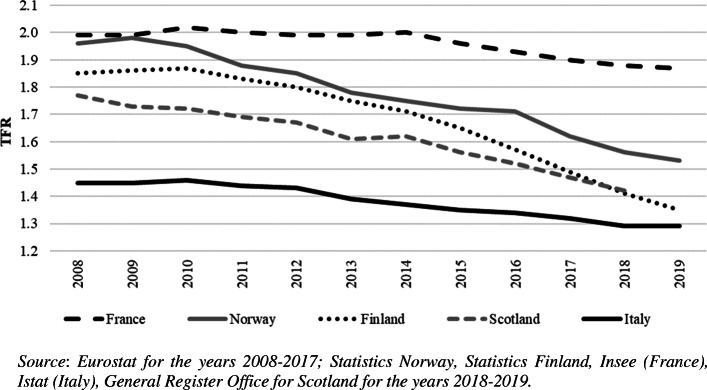
- The paper argues that recent fertility declines are occurring across diverse European contexts: Norway’s TFR fell from “almost two children per woman in 2009” to 1.53 in 2019; Finland reached 1.35 in 2019; Italy fell to 1.29 in 2019; and Scotland lost approximately 0.30 TFR points in the last decade.
- The authors contend that traditional objective indicators of economic uncertainty do not explain all of the post-2008 fertility decline in Europe and the US, and that perceived uncertainty helps explain part of the unexplained drop after the Great Recession.
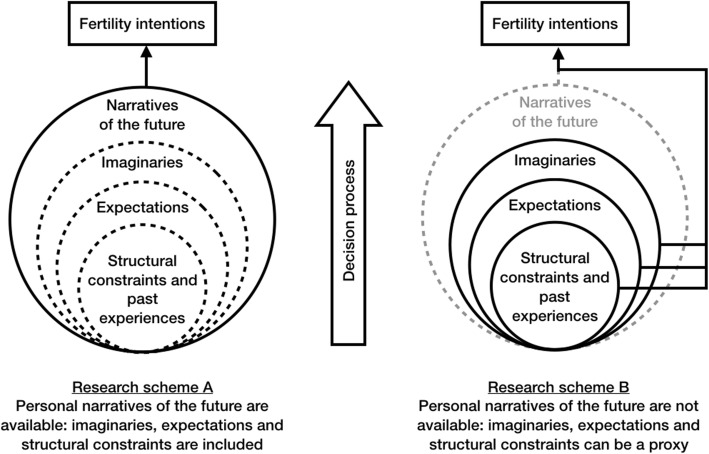
- The proposed Narrative Framework says fertility decisions are shaped by structural constraints, expectations, and imaginaries, with personal narratives of the future performing four functions: selection, interpretation, causal modeling, and action support.
- The paper highlights that shared narratives from parents, peers, and media may matter differently across contexts; for example, it notes that high labor instability did not strongly depress fertility in the UK historically, while flexibilization reforms were linked to strong postponement of first childbirth in Germany and Southern Europe.
## Methods
- Conceptual/theoretical reflection rather than an empirical study; the paper explicitly states, “No dataset was used to write this paper.”
- Synthesizes prior demographic, sociological, and economic-sociological literature on uncertainty, fertility intentions, and decision-making.
- Proposes a research agenda with three approaches: qualitative interviews, quantitative surveys, and experiments; it also discusses existing surveys and the EU-FER project as examples of how the framework could be studied.
## Limitations
- The paper states that it is a reflection and theoretical framework paper, not an empirical test of its claims; it offers “empirical directions for future research” rather than direct evidence.
- It explicitly notes that data availability is a major constraint: there are “very few surveys” with both forward-looking uncertainty measures and fertility questions, and measures of imaginaries/shared narratives are usually unavailable.
- Evident from the text: many claims are argued from prior studies and illustrative cross-national patterns rather than from new analyses in this paper, so the framework’s causal implications remain untested here.
Model-written summary. Check it against the paper before relying on it.
Integrity signals
Registry
Cites
Statistics
Figures
Verification
Claims the paper makes
1 Valid · 5 Not valid · 63 Not checked · 90 Own results and interpretations
A result the paper states — it cites no source for it, so there is none to check. The quote shows it is in the paper.
In the paper
“However, their TFR decreased after 2009-2010, in a similar fashion to Southern European countries.”
plainstates an association- Asserted: passes — The authors put it forward as true.
- Checkable: passes — It can be checked against evidence.
- Load-bearing: passes — The paper’s conclusions depend on it.
- Based: passes — The paper gives a reason why it holds.
None of the sources cited for this claim have been checked yet.
In the paper
“recent flexibilization reforms carried out both in the German and in Southern European labor markets have been linked to a strong postponement of first childbirth (Schmitt 2012 ; Barbieri et al. 2016 ).”
What the sources say
- Not checked yetcites Schmitt 2012
- Not checked yetcites Barbieri et al. 2016
boostedstates an association- Asserted: passes — The authors put it forward as true.
- Checkable: passes — It can be checked against evidence.
- Load-bearing: passes — The paper’s conclusions depend on it.
- Based: passes — The paper gives a reason why it holds.
In the paper
“although certainly worth taking into account, their (negative) impact on fertility has been shown not to be of overwhelming importance (Alderotti et al. 2019 ).”
What the sources say
- Not checked yetcites Alderotti et al. 2019
plain- Asserted: passes — The authors put it forward as true.
- Checkable: passes — It can be checked against evidence.
- Load-bearing: passes — The paper’s conclusions depend on it.
- Based: passes — The paper gives a reason why it holds.
A conclusion the paper draws from its own results — it cites no other source for it, so there is none to check. The quote shows it is in the paper.
In the paper
“This generates a potent additional source of economic uncertainty, which, we argue, represents a game-changer in contemporary fertility dynamics.”
boostedstates a cause- Asserted: passes — The authors put it forward as true.
- Checkable: passes — It can be checked against evidence.
- Load-bearing: passes — The paper’s conclusions depend on it.
- Based: passes — The paper gives a reason why it holds.
None of the sources cited for this claim have been checked yet.
In the paper
“The empirical demographic tradition operationalized the forces of economic uncertainty through objective indicators of individuals’ labor market situation, such as holding a temporary contract or being unemployed”
What the sources say
- Not checked yetcites Kreyenfeld 2010
- Not checked yetcites Kreyenfeld, Andersson, and Pailhé 2012
- Not checked yetcites Vignoli, Drefahl, and De Santis 2012
plain- Asserted: passes — The authors put it forward as true.
- Checkable: passes — It can be checked against evidence.
- Load-bearing: passes — The paper’s conclusions depend on it.
- Based: passes — The paper gives a reason why it holds.
46 more claims
Create a free account to see all 159 claims and to verify the 90 references still open.
- Probably not a substantial claim. 85
- It may state two separate claims as one. 40
- The quote only partly states this claim. 1
Self-check
Percentages, sums and reported differences re-computed from the paper’s own numbers.
Each contradiction between two passages listed here was confirmed by an independent check.
Rated minor: it would not touch a result — a value no result rests on, a p-value that stays on the same side of the significance level, or a conflict that is clerical, resolved elsewhere in the paper, or outside its own findings.
In the paper
“In this reflection, we dispute that the central explanation for this new state of affairs is the rise of economic uncertainty.”
“This generates a potent additional source of economic uncertainty, which, we argue, represents a game-changer in contemporary fertility dynamics.”
Citations
Cites
The theory of planned behavior
Ajzen, I. (1991) · Organizational Behavior and Human Decision Processes · doi:10.1016/0749-5978(91)90020-t · Cited by 134,657
The Discovery of Grounded Theory: Strategies for Qualitative Research.
Wagner, H. R., Glaser, B. G., & Strauss, A. L. (1968) · Social Forces · doi:10.2307/2575405 · Cited by 46,361
The Discovery of Grounded Theory; Strategies for Qualitative Research
Glaser, B. G., Strauss, A. L., & Strutzel, E. (1968) · Nursing Research · doi:10.1097/00006199-196807000-00014 · Cited by 39,449
Basics of Qualitative Research: Grounded Theory Procedures and Techniques.
Ellis, C., Strauss, A., & Corbin, J. (1992) · Contemporary Sociology · doi:10.2307/2074814 · Cited by 29,249
Basics of Qualitative Research: Grounded Theory Procedures and Techniques
Long, D. R., Strauss, A., & Corbin, J. (1993) · The Modern Language Journal · doi:10.2307/328955 · Cited by 17,576
The three worlds of welfare capitalism
(1990) · Choice Reviews Online · doi:10.5860/choice.28-1046 · Cited by 16,528
Advances in prospect theory: Cumulative representation of uncertainty
Tversky, A., & Kahneman, D. (1992) · Journal of Risk and Uncertainty · doi:10.1007/bf00122574 · Cited by 15,467
Becker, G. S. (1991) · doi:10.4159/9780674020665 · Cited by 10,565
Becker, G. S. (1983) · Cited by 6,708
Social Foundations of Postindustrial Economies
Esping-Andersen, G. (1999) · doi:10.1093/0198742002.001.0001 · Cited by 6,253
Research works printed but not linked: 4
- Billari, F. C., & Dalla Zuanna, G. (2008). La rivoluzione nella culla. Il declino che non c’è. Milano: Università Bocconi Editore.
- Cepernich, C. (2012). Storie di subprime, downgrading, spread e default. La narrazione della grande crisi tra informazione e popolarizzazione. Comunicazione politica, 3, 409–440.
- Keynes, J. M. (1936). The general theory of interest, employment and money. London: MacMillan.
- Miettinen, A., Rotkirch, A., Szalma, I., Donno, A., & Tanturri, M.-L. (2015). Increasing childlessness in Europe: Time trends and country differences. Family and Societies WP Series, 33, 68.
Cited by
Items 101–200 of 333
Detecting economic insecurity in Italy: a latent transition modelling approach
Giambona, F., Grassini, L., & Vignoli, D. (2022) · Statistical Methods & Applications · doi:10.1007/s10260-021-00609-y · Cited by 8
Self-citationThe evolution of fertility in Greece since the 1960s: a joinpoint regression analysis
Zafeiris, K. Ν., Kontogiannis, G., & Kotzamanis, B. (2024) · Journal of Population Research · doi:10.1007/s12546-024-09343-0 · Cited by 5
Fertility preferences adjusted: reimagining parenthood in response to the uncertainty of infertility
Lazzari, E. (2025) · Genus · doi:10.1186/s41118-025-00248-1 · Cited by 8
Vanella, P., Greil, A. L., & Deschermeier, P. (2023) · Comparative Population Studies · doi:10.12765/cpos-2023-02 · Cited by 6
Introduction: the relevance of studying fertility across time and space
Sobotka, T. (2020) · Vienna Yearbook of Population Research · doi:10.1553/populationyearbook2020.int01 · Cited by 6
Periods of high uncertainty: How fertility intentions in Russia changed during 2022–2023
Вакуленко, Е. С., Gorskiy, D. I., Kondrateva, V., & Trofimenko, I. A. (2025) · Demographic Research · doi:10.4054/demres.2025.52.29 · Cited by 9
Du, S., & Chan, C.-H. (2023) · Population Research and Policy Review · doi:10.1007/s11113-023-09843-6 · Cited by 5
The effect of pandemic crises on fertility
Furceri, D., Pizzuto, P., & Yarveisi, K. (2024) · Journal of Population Economics · doi:10.1007/s00148-024-00983-3 · Cited by 6
First Union Formation in Italy: The Role of Micro- and Macro-Level Economic Conditions
Meggiolaro, S., Ongaro, F., & Pirani, E. (2024) · European Journal of Population / Revue européenne de Démographie · doi:10.1007/s10680-024-09712-8 · Cited by 4
Self-citationVignoli, D., Guetto, R., & Bellani, D. (2024) · Family Relations · doi:10.1111/fare.13127 · Cited by 5
Self-citationDeclining Fertility, Human Capital Investment, and Economic Sustainability
Myrskylä, M., Hellstrand, J., Lappo, S., Lorenti, A., Nisén, J., Rao, Z., & Tikanmäki, H. (2025) · Demography · doi:10.1215/00703370-11858484 · Cited by 11
Oláh, L. S., Richter, R., & Kotowska, I. E. (2023) · Demographic Research · doi:10.4054/demres.2023.48.29 · Cited by 8
Bueno, X., Lozano, M., & Adserà, A. (2023) · Demographic Research · doi:10.4054/demres.2023.49.22 · Cited by 6
Changes in maximum parental leave payment in Iceland and total fertility rates
Einarsdóttir, K. (2021) · Scandinavian Journal of Public Health · doi:10.1177/14034948211029059 · Cited by 4
Campisi, N., Kulu, H., Mikolai, J., Klüsener, S., & Myrskylä, M. (2020) · doi:10.4054/mpidr-wp-2020-036 · Cited by 7
Educational field, economic uncertainty, and fertility decline in Finland in 2010–2019Preprint
Hellstrand, J., Nisén, J., & Myrskylä, M. (2022) · doi:10.31235/osf.io/kcq4g · Cited by 4
Torres, A. F. C., & Ruiz-Ramos, C. (2026) · Revista Española de Sociología · doi:10.31235/osf.io/7wzxb · Cited by 4
Ni, S. (2025) · Journal of Biosocial Science · doi:10.1017/s0021932025000197 · Cited by 8
Łyszczarz, B., & Wojtasik, J. (2025) · Population Health Metrics · doi:10.1186/s12963-025-00400-1 · Cited by 3
Trends in fertility preferences among Italian young adults
Luppi, F., Bellani, D., & Rosina, A. (2025) · Population Studies · doi:10.1080/00324728.2025.2542833 · Cited by 8
Ramos, V. J., Kreyenfeld, M. R., Alonso-Pérez, E., Gellert, P. R., Heisig, J. P., & O’Sullivan, J. L. (2025) · Population Research and Policy Review · doi:10.1007/s11113-025-09969-9 · Cited by 5
Lindström, O. (2025) · Demographic Research · doi:10.4054/demres.2025.53.31 · Cited by 6
Lappegård, T., Kristensen, A. P., & Dommermuth, L. (2025) · Genus · doi:10.1186/s41118-025-00278-9 · Cited by 5
The Impact of Objective and Subjective Factors on Fertility in Times of Uncertainty
Kurylo, I., & AKSYONOVA, S. Y. (2023) · Demography and social economy · doi:10.15407/dse2023.02.021 · Cited by 3
Erfani, A., & Pilon, L. (2024) · Journal of Family Issues · doi:10.1177/0192513x241299419 · Cited by 9
Projecting Spanish fertility at regional level: A hierarchical Bayesian approach
Caro-Barrera, J. R., García, M. D. L. B. G.-M., & Pérez-Priego, M. A. (2022) · PLoS ONE · doi:10.1371/journal.pone.0275492 · Cited by 7
Fertility Decline in Iceland, 2013-2022: Trends and Structures
Jónsson, A. K. (2024) · Comparative Population Studies · doi:10.12765/cpos-2024-07 · Cited by 8
Xu, X., Gauthier, A. H., Stulp, G., & van den Bosch, A. P. J. (2024) · Social Science Computer Review · doi:10.1177/08944393241269406 · Cited by 3
Krapf, S., Buber‐Ennser, I., & Bujard, M. (2023) · Comparative Population Studies · doi:10.12765/cpos-2023-22 · Cited by 6
Vienna Yearbook of Population Research 2020
Sobotka, T., Jasilioniene, A., Zeman, K., & Fariñas, D. R. (2020) · Vienna Yearbook of Population Research · doi:10.1553/populationyearbook2020 · Cited by 3
Educational field, economic uncertainty, and fertility decline in Finland in 2010–2019
Hellstrand, J., Nisén, J., & Myrskylä, M. (2022) · doi:10.4054/mpidr-wp-2022-022 · Cited by 5
Climate change worries and fertility intentions. Insights from three EU countries.Preprint
Bastianelli, E. (2024) · doi:10.31235/osf.io/pv7mz · Cited by 3
Future‐Proofing the ICPD PoA: Reproductive Rights in a Low‐Fertility World
Wilkins, E., Herrmann, M., Boydell, V., Light, B., & Idele, P. (2025) · Studies in Family Planning · doi:10.1111/sifp.70009 · Cited by 3
Societal pessimism and trajectories of fertility expectations among Dutch non-parents
Ivanova, K. (2025) · Genus · doi:10.1186/s41118-025-00246-3 · Cited by 3
Guzzo, K. B., VanBergen, A. M., Manning, W. D., & Dush, C. M. K. (2025) · Genus · doi:10.1186/s41118-025-00257-0 · Cited by 2
Yang, Y., & Kao, G. (2025) · Demographic Research · doi:10.4054/demres.2025.53.3 · Cited by 3
Fasfous, M. W., Abdel-Fattah, M. N., & Ibrahim, S. A. (2025) · International Journal of Environmental Research and Public Health · doi:10.3390/ijerph22081228 · Cited by 4
Fertility and women unemployment: new evidence from Türkiye
Tanış, Z. S., Öztaşçı, D. D., & Özmen, İ. (2025) · Economic Change and Restructuring · doi:10.1007/s10644-025-09934-8 · Cited by 3
Migrants’ and Natives’ Childbearing Intentions in Sweden During the COVID-19 Pandemic
Mussino, E., & Comolli, C. L. (2025) · SAGE Open · doi:10.1177/21582440251389549 · Cited by 3
Parenthood and self-fulfilment: does having children matter to Italian young-adults?
Luppi, F., Rosina, A., & Testa, M. R. (2025) · Genus · doi:10.1186/s41118-025-00272-1 · Cited by 3
Piani, L. L., Esposito, G., Reschini, M., Donnez, J., Parazzini, F., & Somigliana, E. (2025) · Human Reproduction · doi:10.1093/humrep/deaf239 · Cited by 2
Fertility behaviour under geopolitical uncertainty: Evidence from Ukraine
Saha, J. (2026) · Economics & Human Biology · doi:10.1016/j.ehb.2026.101594 · Cited by 2
Popovych, A., Perelli‐Harris, B., & Gerber, T. P. (2026) · Population and Development Review · doi:10.1111/padr.70076 · Cited by 2
COVID‐19 and Childlessness among Women in the United States
Hummer, H. (2023) · Population and Development Review · doi:10.1111/padr.12545 · Cited by 5
Leaving the parental home during the COVID-19 pandemic: the case of Southern Europe
Ferraretto, V., Vitali, A., & Billari, F. C. (2024) · Advances in Life Course Research · doi:10.1016/j.alcr.2024.100594 · Cited by 4
Zhang, M., Tian, Y., & Khan, M. K. (2024) · Natural Resources Forum · doi:10.1111/1477-8947.12473 · Cited by 4
Fertility Decline in Canada Since the Great Recession
Teng, Y., & Margolis, R. (2024) · Canadian Studies in Population · doi:10.1007/s42650-024-00085-1 · Cited by 5
Fertility dynamics through historical pandemics and COVID-19 in Switzerland, 1871–2022
Matthes, K. L., Vu, M. L., & Staub, K. (2025) · Population Studies · doi:10.1080/00324728.2025.2462291 · Cited by 4
Ahmed, K. J., Tasneem, N., Saha, B., & Haq, S. M. A. (2023) · Climate change management · doi:10.1007/978-3-031-26592-1_7 · Cited by 2
Singh, P., Gemmill, A., & Bruckner, T. A. (2023) · Economics & Human Biology · doi:10.1016/j.ehb.2023.101315 · Cited by 3
OECD (2024) · Society at a glance · doi:10.1787/006fe2b8-en · Cited by 2
Partnership dynamics and entry into parenthood: Comparison of Finnish birth cohorts 1969–2000Preprint
Rahnu, L., & Jalovaara, M. (2022) · doi:10.31235/osf.io/2djh7 · Cited by 2
Changes in fertility in the wake of the homicide surge in MexicoPreprint
Floridi, G., Gargiulo, M., & Aburto, J. M. (2023) · SocArXiv (OSF Preprints) · doi:10.31235/osf.io/mf9eb · Cited by 4
Socioeconomic resources and family formation among young Finnish adults
Miettinen, A. (2023) · Finnish Yearbook of Population Research · doi:10.23979/fypr.130512 · Cited by 4
Campisi, N., Kulu, H., Mikolai, J., Klüsener, S., & Myrskylä, M. (2024) · European Journal of Population / Revue européenne de Démographie · doi:10.1007/s10680-024-09725-3 · Cited by 5
Fertility intentions in rural Malawi after Cyclone Idai
Grant, M. J., & Curtis, K. J. (2025) · Population and Environment · doi:10.1007/s11111-025-00487-6 · Cited by 4
The good parent: Emerging themes and gender convergence in narrating fertility choices
Minello, A., & Russo, C. (2025) · Family Relations · doi:10.1111/fare.13185 · Cited by 1
Self-citationEmployment Trajectories in Early Adulthood and Later Fertility
Meggiolaro, S., Ongaro, F., & Tosi, M. (2025) · Social Indicators Research · doi:10.1007/s11205-025-03665-z · Cited by 1
Szczęśniak, M., Falewicz, A., Chmiel, M., & Kroplewski, Z. (2025) · PLoS ONE · doi:10.1371/journal.pone.0329404 · Cited by 3
Laß, I., Mooi‐Reci, I., Bujard, M., & Wooden, M. (2025) · Demography · doi:10.1215/00703370-12234731 · Cited by 2
Türkiye’de Doğurganlığın Toplam Doğurganlık Hızına Göre Mekânsal Analizi (2014-2024)
Kılıç, R. N., & KÖSE, M. (2025) · Afyon Kocatepe Üniversitesi Sosyal Bilimler Dergisi · doi:10.32709/akusosbil.1727699 · Cited by 1
Austerity as reproductive injustice: did local government spending cuts unequally impact births?
Sochas, L., & Chanfreau, J. (2025) · Social Forces · doi:10.1093/sf/soaf198 · Cited by 4
Comolli, C. L., & Albertini, M. (2025) · Genus · doi:10.1186/s41118-025-00277-w · Cited by 2
Job loss and births. A couple-level study of Norwegian plant closures
Tyagi, R., Brini, E., & Vignoli, D. (2026) · Social Science Research · doi:10.1016/j.ssresearch.2026.103358 · Cited by 1
Self-citationSubjective Well-Being of Children with a Migrant Background in Italy
Paparusso, A. (2021) · Human well-being research and policy making · doi:10.1007/978-3-030-78505-5_7 · Cited by 1
Baimurzina, G. R., & Бурханова, Ф. Б. (2022) · Bulletin of the South-Russian state technical University (NPI) Series Socio-economic Sciences · doi:10.17213/2075-2067-2022-4-41-51 · Cited by 3
OECD (2024) · Society at a glance · doi:10.1787/15025af7-en · Cited by 1
Expected years after labour market exit
OECD (2024) · Society at a glance · doi:10.1787/bb2c49e5-en · Cited by 1
OECD (2024) · Society at a glance · doi:10.1787/bd399581-en · Cited by 2
Initial labor market conditions and subsequent fertility behavior
Ramos, V. J. (2024) · Genus · doi:10.1186/s41118-024-00233-0 · Cited by 2
Bol, Z. Ö. (2025) · Fiscaoeconomia · doi:10.25295/fsecon.1489729 · Cited by 3
Subjective Evaluations of Personal and Public Well-Being and Expected Future Childbearing
Guzzo, K. B., & Hayford, S. R. (2025) · Contemporary perspectives on family research · doi:10.1108/s1530-353520250000030006 · Cited by 2
Subjective Well-Being and Fertility Uncertainty During the Pandemic
Guzzo, K. B., Juteau, G., Manning, W. D., & Dush, C. M. K. (2025) · The Springer series on demographic methods and population analysis · doi:10.1007/978-3-031-89737-5_12 · Cited by 1
Shamsoddini, M. (2024) · Journal of Money and Economy · doi:10.61882/jme.19.1.73 · Cited by 1
Problem ubóstwa w krajach Grupy Wyszehradzkiej w latach 2004–2019. Analiza porównawcza
Miś, Ł. (2022) · Wydawnictwo Uniwersytetu Łódzkiego eBooks · doi:10.18778/8220-767-5.09 · Cited by 1
Szarfenberg, R., Kantowicz, E., Kotowska, I., Starosta, P., Nóżka, M., Miś, Ł., Warzywoda-Kruszyńska, W., Kruszyński, K., Ornacka, K., Szukalski, P., et al. (2022) · Wydawnictwo Uniwersytetu Łódzkiego eBooks · doi:10.18778/8220-767-5 · Cited by 6
Personal and social worries associated with the likelihood of having childrenPreprint
Golovina, K., & Jokela, M. M. (2023) · doi:10.31235/osf.io/83e4m · Cited by 1
Declining fertility, human capital investment, and economic sustainability
Myrskylä, M., Hellstrand, J., Lappo, S., Lorenti, A., Nisén, J., Rao, Z., & Tikanmäki, H. (2024) · doi:10.4054/mpidr-wp-2024-002 · Cited by 3
An Overview on Low Fertility Motivations among Italian Young-AdultsPreprint
Luppi, F., Rosina, A., & Testa, M. R. (2024) · SocArXiv (OSF Preprints) · doi:10.31235/osf.io/hf78t · Cited by 3
Suicide rates have been falling on average, but country trends can differ markedly
OECD (2024) · Society at a glance · doi:10.1787/3a69e5d9-en · Cited by 1
The mean age of women at first birth has risen by 3 years within two decades
OECD (2024) · Society at a glance · doi:10.1787/1a2cc4ab-en · Cited by 1
Suicide rates are between two and eight times higher for men than for women across OECD countries
OECD (2024) · Society at a glance · doi:10.1787/89962214-en · Cited by 1
Hellstrand, J., Nisén, J., & Myrskylä, M. (2025) · doi:10.4054/mpidr-wp-2025-001 · Cited by 2
Paparusso, A. (2021) · Genus · doi:10.1186/s41118-021-00114-w
“Citizens and policymakers should bear in mind that reforms are generally ineffective if behaviours and institutions do not adjust in the long-term (e.g. Vignoli et al. 2020).”
BackgroundŁódzkie enklawy biedy – (nie)swoje sąsiedztwa
Nóżka, M. (2022) · Wydawnictwo Uniwersytetu Łódzkiego eBooks · doi:10.18778/8220-767-5.08 · Cited by 1
Kotowska, I. E. (2022) · Wydawnictwo Uniwersytetu Łódzkiego eBooks · doi:10.18778/8220-767-5.06 · Cited by 1
Dündar, Ö. (2022) · Uluslararası Ekonomi İşletme ve Politika Dergisi · doi:10.29216/ueip.1152770
Hogyan hatott a Covid19-pandémia a reprodukciós döntésekre Magyarországon?
Szalma, I., & Takács, J. (2022) · Szociológiai szemle · doi:10.51624/szocszemle.2022.3.4 · Cited by 6
Singh, P., Gemmill, A., & Bruckner, T. A. (2023) · SSRN Electronic Journal · doi:10.2139/ssrn.4521010
Declining Fertility, Human Capital Investment, and Economic SustainabilityPreprint
Myrskylä, M., Hellstrand, J., Lappo, S., Lorenti, A., Nisén, J., Rao, Z., & Tikanmäki, H. (2024) · doi:10.31235/osf.io/tbv3c
Rouvroye, L. (2024) · University of Groningen research database (University of Groningen / Centre for Information Technology) · doi:10.33612/diss.939088418
Childlessness increased markedly in many countries among younger cohorts of women
OECD (2024) · Society at a glance · doi:10.1787/5d7082a7-en
Levels and trends of life satisfaction vary considerably across countries
OECD (2024) · Society at a glance · doi:10.1787/5e988e06-en
Wealth is more concentrated at the top than income
OECD (2024) · Society at a glance · doi:10.1787/3c0833e8-en
Few respondents feel that they could access public benefits in times of need
OECD (2024) · Society at a glance · doi:10.1787/50fd1503-en
Inflation outpaced household income growth in most countries in 2022
OECD (2024) · Society at a glance · doi:10.1787/ca597f34-en
Unemployment rates remain low across the OECD countries
OECD (2024) · Society at a glance · doi:10.1787/736c20ad-en
Low-income dwellers face a significant housing cost burden
OECD (2024) · Society at a glance · doi:10.1787/ce0b9f3f-en
Metadata
- Authors
- Vignoli, D., Guetto, R., Bazzani, G., Pirani, E., & Minello, A.
- Affiliations
- University of Florence (IT)
- Corresponding author
- Vignoli, Daniele
- Venue
- Genus
- Published
- 2020-09-09
- Volume
- 76
- Issue
- 1
- Pages
- 28-28
- ISSN
- 0016-6987 (ISSN-L)
- 2035-5556
- PMC
- PMC7480209
- OpenAlex
- W3084501145
- Cited by
- 332
- References
- 174
- Citations by year
- 2026: 37 · 2025: 53 · 2024: 143 · 2023: 33 · 2022: 40 · 2021: 20 · 2020: 6
- FWCI
- 37.24
- Type
- journal article
- Language
- en
- Open access
- gold
- doi.org
- Licence
- cc-by
- creativecommons.org/licenses/by/4.0 (tdm)
- creativecommons.org/licenses/by/4.0 (vor)
- Locations
- Genus (publishedVersion, cc-by)
- PubMed Central (publishedVersion, cc-by)
- PubMed (publishedVersion)
- Florence Research (University of Florence) (submittedVersion, cc-by)
- DOAJ (DOAJ: Directory of Open Access Journals) (submittedVersion, cc-by-sa)
- Padua Research Archive (University of Padova) (submittedVersion, cc-by)
- Funders
- H2020 European Research Council (725961)
- Topics
- Social Sciences › Demography › Family Dynamics and Relationships
- Social Sciences › Gender Studies › Gender, Labor, and Family Dynamics
- Health Sciences › Medicine › Reproductive Medicine › Reproductive Health and Technologies
- Keywords
- economic uncertainty, fertility decline, low fertility, narrative framework, future narratives, shared narratives, socialization agents, media influence, reproductive decision-making, Great Recession, Europe
About these checks
Registry, retraction, Cites and statistics results are computed, not judged, with one exception: a printed reference that no index lists is read once by a model before it counts as a citation error. Claims are extracted by a model and kept only when their quote appears verbatim in the text; each cited source is then checked, with a model’s help, for whether it says what the claim relies on. Those verdicts can be wrong — read the claim’s quote and the cited source before relying on one.
A language model drew the claims from the paper on 2026-10-11, under version 3 of the claim definition (model deepseek-v4.1-flash, prompt extract-v3).
A second model labelled each claim on 2026-10-11 (model jev-1.13-20260917, definition revision gold-guideline-v0.2).
Statistics and arithmetic are recomputed, not judged.
Confidence bands are shown only for fields calibrated on our annotated test set. None is calibrated yet, so no band is shown.
What counts as a claim ›How we measure confidence ›How we check this ›
Are you an author, or do you see a problem with this page? Request a review
Data sources
Bibliographic data: Semantic Scholar, OpenAlex, Crossref.
Contains information from the Semantic Scholar Academic Graph Datasets, made available under the ODC Attribution License (ODC-BY 1.0).
Semantic Scholar’s data is described in: Kinney, R., et al. (2023). The Semantic Scholar Open Data Platform. arXiv:2301.10140.
