

A reflection on economic uncertainty and fertility in Europe: The Narrative Framework
Open accessThe DOI matches its Crossref record; 162 of the 174 references it cites were found in a registry or an index; 1 of the 91 sources its claims cite were checked for support.
Abstract
The generalized and relatively homogeneous fertility decline across European countries in the aftermath of the Great Recession poses serious challenges to our knowledge of contemporary low fertility patterns. In this paper, we argue that fertility decisions are not a mere “statistical shadow of the past”, and advance the Narrative Framework, a new approach to the relationship between economic uncertainty and fertility. This framework proffers that individuals act according to or despite uncertainty based on their “narrative of the future” – imagined futures embedded in social elements and their interactions. We also posit that personal narratives of the future are shaped by the “shared narratives” produced by socialization agents, including parents and peers, as well as by the narratives produced by the media and other powerful opinion formers. Finally, within this framework, we propose several empirical strategies, from both a qualitative and a quantitative perspective, including an experimental approach, for assessing the role of narratives of the future in fertility decisions.
Overview
CoChat Summary
## TL;DR
This is a theoretical reflection arguing that European fertility declines cannot be explained well by objective economic uncertainty alone, and that researchers should incorporate “personal narratives of the future” shaped by parents, peers, and media. The paper proposes the Narrative Framework and outlines qualitative, survey, and experimental ways to study how uncertainty and imagined futures affect fertility intentions.
## Key findings
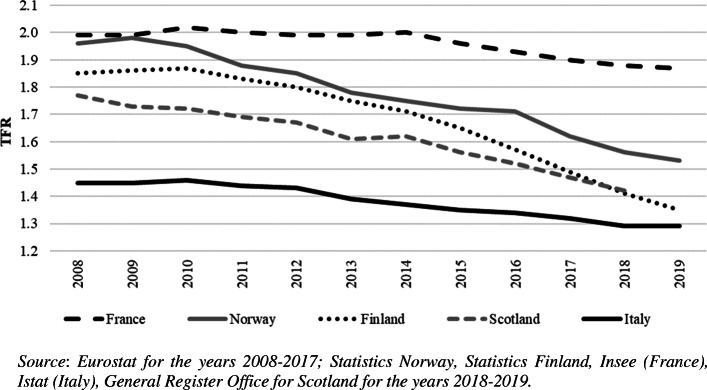
- The paper argues that recent fertility declines are occurring across diverse European contexts: Norway’s TFR fell from “almost two children per woman in 2009” to 1.53 in 2019; Finland reached 1.35 in 2019; Italy fell to 1.29 in 2019; and Scotland lost approximately 0.30 TFR points in the last decade.
- The authors contend that traditional objective indicators of economic uncertainty do not explain all of the post-2008 fertility decline in Europe and the US, and that perceived uncertainty helps explain part of the unexplained drop after the Great Recession.
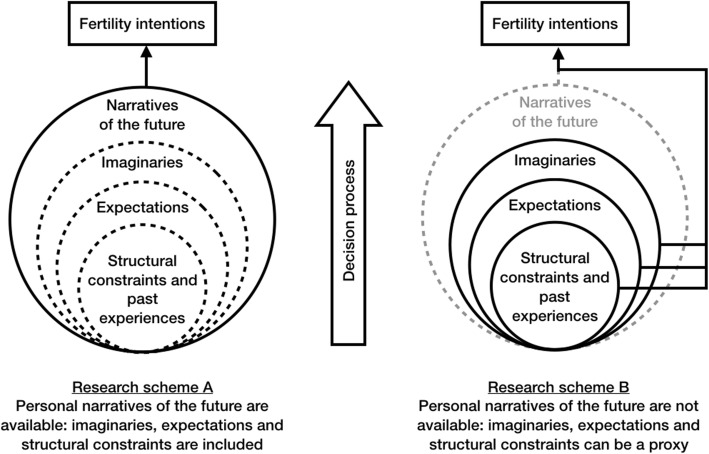
- The proposed Narrative Framework says fertility decisions are shaped by structural constraints, expectations, and imaginaries, with personal narratives of the future performing four functions: selection, interpretation, causal modeling, and action support.
- The paper highlights that shared narratives from parents, peers, and media may matter differently across contexts; for example, it notes that high labor instability did not strongly depress fertility in the UK historically, while flexibilization reforms were linked to strong postponement of first childbirth in Germany and Southern Europe.
## Methods
- Conceptual/theoretical reflection rather than an empirical study; the paper explicitly states, “No dataset was used to write this paper.”
- Synthesizes prior demographic, sociological, and economic-sociological literature on uncertainty, fertility intentions, and decision-making.
- Proposes a research agenda with three approaches: qualitative interviews, quantitative surveys, and experiments; it also discusses existing surveys and the EU-FER project as examples of how the framework could be studied.
## Limitations
- The paper states that it is a reflection and theoretical framework paper, not an empirical test of its claims; it offers “empirical directions for future research” rather than direct evidence.
- It explicitly notes that data availability is a major constraint: there are “very few surveys” with both forward-looking uncertainty measures and fertility questions, and measures of imaginaries/shared narratives are usually unavailable.
- Evident from the text: many claims are argued from prior studies and illustrative cross-national patterns rather than from new analyses in this paper, so the framework’s causal implications remain untested here.
Model-written summary. Check it against the paper before relying on it.
Integrity signals
Registry
Cites
Statistics
Figures
Verification
Claims the paper makes
1 Valid · 5 Not valid · 63 Not checked · 90 Own results and interpretations
A result the paper states — it cites no source for it, so there is none to check. The quote shows it is in the paper.
In the paper
“However, their TFR decreased after 2009-2010, in a similar fashion to Southern European countries.”
plainstates an association- Asserted: passes — The authors put it forward as true.
- Checkable: passes — It can be checked against evidence.
- Load-bearing: passes — The paper’s conclusions depend on it.
- Based: passes — The paper gives a reason why it holds.
None of the sources cited for this claim have been checked yet.
In the paper
“recent flexibilization reforms carried out both in the German and in Southern European labor markets have been linked to a strong postponement of first childbirth (Schmitt 2012 ; Barbieri et al. 2016 ).”
What the sources say
- Not checked yetcites Schmitt 2012
- Not checked yetcites Barbieri et al. 2016
boostedstates an association- Asserted: passes — The authors put it forward as true.
- Checkable: passes — It can be checked against evidence.
- Load-bearing: passes — The paper’s conclusions depend on it.
- Based: passes — The paper gives a reason why it holds.
In the paper
“although certainly worth taking into account, their (negative) impact on fertility has been shown not to be of overwhelming importance (Alderotti et al. 2019 ).”
What the sources say
- Not checked yetcites Alderotti et al. 2019
plain- Asserted: passes — The authors put it forward as true.
- Checkable: passes — It can be checked against evidence.
- Load-bearing: passes — The paper’s conclusions depend on it.
- Based: passes — The paper gives a reason why it holds.
A conclusion the paper draws from its own results — it cites no other source for it, so there is none to check. The quote shows it is in the paper.
In the paper
“This generates a potent additional source of economic uncertainty, which, we argue, represents a game-changer in contemporary fertility dynamics.”
boostedstates a cause- Asserted: passes — The authors put it forward as true.
- Checkable: passes — It can be checked against evidence.
- Load-bearing: passes — The paper’s conclusions depend on it.
- Based: passes — The paper gives a reason why it holds.
None of the sources cited for this claim have been checked yet.
In the paper
“The empirical demographic tradition operationalized the forces of economic uncertainty through objective indicators of individuals’ labor market situation, such as holding a temporary contract or being unemployed”
What the sources say
- Not checked yetcites Kreyenfeld 2010
- Not checked yetcites Kreyenfeld, Andersson, and Pailhé 2012
- Not checked yetcites Vignoli, Drefahl, and De Santis 2012
plain- Asserted: passes — The authors put it forward as true.
- Checkable: passes — It can be checked against evidence.
- Load-bearing: passes — The paper’s conclusions depend on it.
- Based: passes — The paper gives a reason why it holds.
46 more claims
Create a free account to see all 159 claims and to verify the 90 references still open.
- Probably not a substantial claim. 85
- It may state two separate claims as one. 40
- The quote only partly states this claim. 1
Self-check
Percentages, sums and reported differences re-computed from the paper’s own numbers.
Each contradiction between two passages listed here was confirmed by an independent check.
Rated minor: it would not touch a result — a value no result rests on, a p-value that stays on the same side of the significance level, or a conflict that is clerical, resolved elsewhere in the paper, or outside its own findings.
In the paper
“In this reflection, we dispute that the central explanation for this new state of affairs is the rise of economic uncertainty.”
“This generates a potent additional source of economic uncertainty, which, we argue, represents a game-changer in contemporary fertility dynamics.”
Citations
Cites
The theory of planned behavior
Ajzen, I. (1991) · Organizational Behavior and Human Decision Processes · doi:10.1016/0749-5978(91)90020-t · Cited by 134,657
The Discovery of Grounded Theory: Strategies for Qualitative Research.
Wagner, H. R., Glaser, B. G., & Strauss, A. L. (1968) · Social Forces · doi:10.2307/2575405 · Cited by 46,361
The Discovery of Grounded Theory; Strategies for Qualitative Research
Glaser, B. G., Strauss, A. L., & Strutzel, E. (1968) · Nursing Research · doi:10.1097/00006199-196807000-00014 · Cited by 39,449
Basics of Qualitative Research: Grounded Theory Procedures and Techniques.
Ellis, C., Strauss, A., & Corbin, J. (1992) · Contemporary Sociology · doi:10.2307/2074814 · Cited by 29,249
Basics of Qualitative Research: Grounded Theory Procedures and Techniques
Long, D. R., Strauss, A., & Corbin, J. (1993) · The Modern Language Journal · doi:10.2307/328955 · Cited by 17,576
The three worlds of welfare capitalism
(1990) · Choice Reviews Online · doi:10.5860/choice.28-1046 · Cited by 16,528
Advances in prospect theory: Cumulative representation of uncertainty
Tversky, A., & Kahneman, D. (1992) · Journal of Risk and Uncertainty · doi:10.1007/bf00122574 · Cited by 15,467
Becker, G. S. (1991) · doi:10.4159/9780674020665 · Cited by 10,565
Becker, G. S. (1983) · Cited by 6,708
Social Foundations of Postindustrial Economies
Esping-Andersen, G. (1999) · doi:10.1093/0198742002.001.0001 · Cited by 6,253
Risk Aversion and Incentive Effects
Holt, C. A., & Laury, S. K. (2002) · American Economic Review · doi:10.1257/000282802762024700 · Cited by 5,939
(1990) · Cited by 5,210
The Theory of Planned Behaviour
Conner, M. T., & McMillan, B. (2004) · Research Explorer (The University of Manchester) · Cited by 4,463
INDIVIDUAL RISK ATTITUDES: MEASUREMENT, DETERMINANTS, AND BEHAVIORAL CONSEQUENCES
Dohmen, T., Falk, A., Huffman, D., Sunde, U., Schupp, J., & Wagner, G. G. (2011) · Journal of the European Economic Association · doi:10.1111/j.1542-4774.2011.01015.x · Cited by 3,896
Dowdall, G. W., Singleton, R., Straits, B. C., Straits, M. N., & McAllister, R. J. (1989) · Teaching Sociology · doi:10.2307/1317936 · Cited by 2,821
Narratives in Social Science Research
Czarniawska, B. (2004) · SAGE Publications Ltd eBooks · doi:10.4135/9781849209502 · Cited by 2,575
17 From Human Nature and Conduct (1922)
(2025) · John Dewey · doi:10.1515/9798855801415-021 · Cited by 2,262
8 The Precariat The New Dangerous Class?
(2025) · Precarity in Western European Cinema · doi:10.1515/9789048560660-009 · Cited by 2,105
Developments in Non-Expected Utility Theory: The Hunt for a Descriptive Theory of Choice under Risk
Starmer, C. (2000) · Journal of Economic Literature · doi:10.1257/jel.38.2.332 · Cited by 1,899
The precariat: the new dangerous class
Allen, M., & Ainley, P. (2011) · International Studies in Sociology of Education · doi:10.1080/09620214.2011.616348 · Cited by 1,814
The Unfolding Story of the Second Demographic Transition
Lesthaeghe, R. (2010) · Population and Development Review · doi:10.1111/j.1728-4457.2010.00328.x · Cited by 1,794 · cited 1×
“In an updated version of his thesis, Lesthaeghe (2010) recognized that some of the cultural components of the Second Demographic Transition (SDT) – such as self-actualization and consumption/leisure aspirations – cause a postponement in fertility.”
BackgroundAmerican Economic Journal: Applied Economics
(2017) · American Economic Journal Applied Economics · doi:10.1257/app · Cited by 1,625
Fox, J. R., & Levi-Strauss, C. (1965) · The British Journal of Sociology · doi:10.2307/588755 · Cited by 1,580
Soap Operas and Fertility: Evidence from Brazil
Ferrara, E. L., Chong, A., & Duryea, S. (2012) · American Economic Journal: Applied Economics · doi:10.1257/app.4.4.1 · Cited by 1,453
The Emergence of Lowest‐Low Fertility in Europe During the 1990s
Kohler, H., Billari, F. C., & Ortega, J. A. (2002) · Population and Development Review · doi:10.1111/j.1728-4457.2002.00641.x · Cited by 1,451
Animal spirits: how human psychology drives the economy, and why it matters for global capitalism
(2009) · Choice Reviews Online · doi:10.5860/choice.46-6301 · Cited by 1,447
Family Ties in Western Europe: Persistent Contrasts
Reher, D. S. (1998) · Population and Development Review · doi:10.2307/2807972 · Cited by 1,356
Imagined Futures: Fictional Expectations and Capitalist Dynamics
Beckert, J. (2016) · Harvard University Press eBooks · doi:10.4159/9780674545878 · Cited by 1,253
The Gender Revolution: A Framework for Understanding Changing Family and Demographic Behavior
Goldscheider, F., Bernhardt, E., & Lappegård, T. (2015) · Population and Development Review · doi:10.1111/j.1728-4457.2015.00045.x · Cited by 1,209
Gender Equity in Theories of Fertility Transition
McDonald, P. (2000) · Population and Development Review · doi:10.1111/j.1728-4457.2000.00427.x · Cited by 1,154
The Vignette Technique in Survey Research
Finch, J. (1987) · Sociology · doi:10.1177/0038038587021001008 · Cited by 1,126
Using Narrative in Social Research
Elliott, J. (2005) · SAGE Publications Ltd eBooks · doi:10.4135/9780857020246 · Cited by 1,113
Attitudinal and normative variables as predictors of specific behavior.
Ajzen, I., & Fishbein, M. (1973) · Journal of Personality and Social Psychology · doi:10.1037/h0034440 · Cited by 933
Andrews, M., Squire, C., & Tamboukou, M. (2008) · SAGE Publications Ltd eBooks · doi:10.4135/9780857024992 · Cited by 903
Economic Recession and Fertility in the Developed World
Sobotka, T., Skirbekk, V., & Philipov, D. (2011) · Population and Development Review · doi:10.1111/j.1728-4457.2011.00411.x · Cited by 863
(1998) · Duke University Press eBooks · doi:10.1215/9780822378426 · Cited by 834
Divided We Stand: Why Inequality Keeps Rising
OECD (2011) · OECD eBooks · doi:10.1787/9789264119536-en · Cited by 824
Guillén, M. F. (2001) · Annual Review of Sociology · doi:10.1146/annurev.soc.27.1.235 · Cited by 823
Dissecting the Social: On the Principles of Analytical Sociology
Hedstrom, P. (2005) · doi:10.1017/cbo9780511488801 · Cited by 816 · cited 1×
“Personal narratives perform four main functions, providing reasons for action (Hedström 2005; Uebel 2012).”
BackgroundThe Power of TV: Cable Television and Women's Status in India *
Jensen, R., & Oster, E. (2009) · Quarterly Journal of Economics · doi:10.1162/qjec.2009.124.3.1057 · Cited by 792
Re‐theorizing Family Demographics
Esping‐Andersen, G., & Billari, F. C. (2015) · Population and Development Review · doi:10.1111/j.1728-4457.2015.00024.x · Cited by 763
Self‐Referencing and Persuasion: Narrative Transportation versus Analytical Elaboration
Escalas, J. E. (2007) · Journal of Consumer Research · doi:10.1086/510216 · Cited by 724
Family Policies in OECD Countries: A Comparative Analysis
Thévenon, O. (2011) · Population and Development Review · doi:10.1111/j.1728-4457.2011.00390.x · Cited by 663
Balbo, N., Billari, F. C., & Mills, M. (2013) · European Journal of Population / Revue européenne de Démographie · doi:10.1007/s10680-012-9277-y · Cited by 623
Cambridge Handbook of Experimental Political Science
(2011) · Cambridge University Press eBooks · doi:10.1017/cbo9780511921452 · Cited by 611
Attitudinal and normative variables as predictors of specific behaviors.
Ajzen, I., & Fishbein, M. (1973) · Cited by 599
Do Fertility Intentions Affect Fertility Behavior?
Schoen, R., Astone, N. M., Kim, Y. J., Nathanson, C. A., & Fields, J. M. (1999) · Journal of Marriage and the Family · doi:10.2307/353578 · Cited by 543
Soap Operas and Fertility: Evidence from Brazil
Ferrara, E. L., Chong, A., & Duryea, S. (2008) · SSRN Electronic Journal · doi:10.2139/ssrn.1820921 · Cited by 506
Narrative Economics: How Stories Go Viral and Drive Major Economic Events
Shiller, R. J. (2019) · Project Muse (Johns Hopkins University) · Cited by 478
Predicting health behaviors with an experimental measure of risk preference
Anderson, L. R., & Mellor, J. M. (2008) · Journal of Health Economics · doi:10.1016/j.jhealeco.2008.05.011 · Cited by 462
The life course cube: A tool for studying lives
Bernardi, L., Huinink, J., & Settersten, R. A. (2019) · Advances in Life Course Research · doi:10.1016/j.alcr.2018.11.004 · Cited by 432
Populist online communication: introduction to the special issue
Engesser, S., Fawzi, N., & Larsson, A. O. (2017) · Information, Communication & Society · doi:10.1080/1369118x.2017.1328525 · Cited by 429
The Great Risk Shift: The New Economic Insecurity and the Decline of the American Dream
Hacker, J. S. (2006) · OUP Catalogue · Cited by 425
Moberly, W., & de Selincourt, O. (2024) · Reflections on Life and Religion · doi:10.4324/9781003512103-2 · Cited by 411
The construction and interpretation of vignettes in social research
Hughes, R., & Huby, M. (2004) · Social Work and Social Sciences Review · doi:10.1921/17466105.11.1.36 · Cited by 409
A Theory of the Value of Children
Friedman, D., Hechter, M., & Kanazawa, S. (1994) · Demography · doi:10.2307/2061749 · Cited by 409
Fertility intentions: An approach based on the theory of planned behavior
Ajzen, I., & Klobas, J. (2013) · Demographic Research · doi:10.4054/demres.2013.29.8 · Cited by 403
A theory of the value of children.
Friedman, D., Hechter, M., & Satoshi Kanazawa, A. (1994) · PubMed · Cited by 390
Grusky, D. B., Western, B., & Wimer, C. (2011) · Russell Sage Foundation eBooks · Cited by 374
Imagined Futures: Fictional Expectations and Capitalist Dynamics
Beckert, J. (2016) · Cited by 361
Uncertainties in Female Employment Careers and the Postponement of Parenthood in Germany
Kreyenfeld, M. (2010) · European Sociological Review · doi:10.1093/esr/jcp026 · Cited by 359
Using vignettes in awareness and attitudinal research
Schoenberg, N. E., & Ravdal, H. (2000) · International Journal of Social Research Methodology · doi:10.1080/136455700294932 · Cited by 339
Comolli, C. L. (2017) · Demographic Research · doi:10.4054/demres.2017.36.51 · Cited by 316
The Predictive Validity of Reproductive Intentions
Westoff, C. F., & Ryder, N. B. (1977) · Demography · doi:10.2307/2060589 · Cited by 314
Lesthaeghe, R. (2020) · Genus · doi:10.1186/s41118-020-00077-4 · Cited by 283
Fertility Reactions to the "Great Recession" in Europe: Recent Evidence from Order-Specific Data
Goldstein, J. R., Kreyenfeld, M., Jasilioniene, A., & Karaman Örsal, D. D. (2013) · Demographic Research · doi:10.4054/demres.2013.29.4 · Cited by 272
Attitudes, Norms and Perceived Behavioural Control: Explaining Fertility Intentions in Bulgaria
Billari, F. C., Philipov, D., & Testa, M. R. (2009) · European Journal of Population / Revue européenne de Démographie · doi:10.1007/s10680-009-9187-9 · Cited by 265
Rindfuss, R. R., Morgan, S. P., & Swicegood, G. (1988) · University of California Press eBooks · doi:10.1525/9780520332508 · Cited by 265
Animal Spirits: How Human Psychology Drives the Economy, and Why It Matters for Global Capitalism
Akerlof, G. A., & Shiller, R. J. (2010) · Cited by 260
Childbearing motivations, desires, and intentions: a theoretical framework.
Miller, W. B. (1994) · PubMed · Cited by 250
Beyond the Economic Gaze: Childbearing During and After Recessions in the Nordic Countries
Comolli, C. L., Neyer, G., Andersson, G., Dommermuth, L., Fallesen, P., Jalovaara, M., Jónsson, A. K., Kolk, M., & Lappegård, T. (2021) · European Journal of Population · doi:10.1007/s10680-020-09570-0 · Cited by 246
Fertility and Women’s Employment: A Meta-analysis: Fécondité et travail des femmes: une méta-analyse
Matysiak, A., & Vignoli, D. (2008) · European Journal of Population / Revue européenne de Démographie · doi:10.1007/s10680-007-9146-2 · Cited by 245
Self-citationFirst Births in America: Changes in the Timing of Parenthood.
Bongaarts], [., Rindfuss, R. R., Morgan, S. P., & Swicegood, G. (1988) · Population and Development Review · doi:10.2307/1973641 · Cited by 242
The Great Recession and Fertility in Europe: A Sub-national Analysis
Matysiak, A., Sobotka, T., & Vignoli, D. (2021) · European Journal of Population · doi:10.1007/s10680-020-09556-y · Cited by 242
Self-citationANIMAL SPIRITS: HOW HUMAN PSYCHOLOGY DRIVES THE ECONOMY, AND WHY IT MATTERS FOR GLOBAL CAPITALISM
Castro, D. F. (2010) · Revista de Economía Institucional · Cited by 237
FAMILY VALUES AND THE REGULATION OF LABOR
Alesina, A., Algan, Y., Cahuc, P., & Giuliano, P. (2015) · Journal of the European Economic Association · doi:10.1111/jeea.12121 · Cited by 237
Perceptions of Economic Insecurity: Evidence From the Survey of Economic Expectations
Dominitz, J., & Manski, C. F. (1997) · Public Opinion Quarterly · doi:10.1086/297795 · Cited by 236
Becoming an Adult in Europe: A Macro(/Micro)-Demographic Perspective
Billari, F. (2004) · Demographic Research · doi:10.4054/demres.2004.s3.2 · Cited by 229
The Conflict between Aspirations and Resources
Easterlin, R. A. (1976) · Population and Development Review · doi:10.2307/1971619 · Cited by 220
Economic Uncertainty and Family Dynamics in Europe: Introduction
Kreyenfeld, M., Andersson, G., & Pailhé, A. (2012) · Demographic Research · doi:10.4054/demres.2012.27.28 · Cited by 218
Tuckett, D. (2011) · Palgrave Macmillan UK eBooks · doi:10.1057/9780230307827 · Cited by 213
Manski, C. F., & Straub, J. D. (2000) · The Journal of Human Resources · doi:10.2307/146388 · Cited by 210
Understanding Family Change and Variation: Toward a Theory of Conjunctural Action
Johnson-Hanks, J. A., Bachrach, C. A., Morgan, S. P., & Kohler, H.-P. (2011) · Springer eBooks · doi:10.1007/978-94-007-1945-3 · Cited by 204
Scherer, S. (2005) · European Sociological Review · doi:10.1093/esr/jci029 · Cited by 203
The impact of job uncertainty on first-birth postponement
Vignoli, D., Tocchioni, V., & Mattei, A. (2020) · Advances in Life Course Research · doi:10.1016/j.alcr.2019.100308 · Cited by 202
Self-citationThe impact of individual and aggregate unemployment on fertility in Norway
Kravdal, Ø. (2002) · Demographic Research · doi:10.4054/demres.2002.6.10 · Cited by 199
The Great Recession, Fertility, and Uncertainty: Evidence From the United States
Schneider, D. (2015) · Journal of Marriage and Family · doi:10.1111/jomf.12212 · Cited by 198
(2018) · Oxford Scholarship Online · doi:10.1093/oso/9780198820802.001.0001 · Cited by 194
Whose job instability affects the likelihood of becoming a parent in Italy? A tale of two partners
Vignoli, D., Drefahl, S., & De Santis, G. (2012) · Demographic Research · doi:10.4054/demres.2012.26.2 · Cited by 193
Self-citationGlobalization, Uncertainty and Men’s Careers: An International Comparison
Blossfeld, H., Mills, M. C., & Bernardi, F. (2006) · Cited by 180
Temporary Contracts and Labour Market Segmentation in Spain: An Employment-Rent Approach
Polavieja, J. G. (2003) · European Sociological Review · doi:10.1093/esr/19.5.501 · Cited by 177
Mills, M. C., & Blossfeld, H. (2012) · Life course research and social policies · doi:10.1007/978-90-481-8912-0_2 · Cited by 173
Story-Based Learning: The Impact of Narrative on Learning Experiences and Outcomes
McQuiggan, S. W., Rowe, J. P., Lee, S., & Lester, J. C. (2008) · Lecture Notes in Computer Science · doi:10.1007/978-3-540-69132-7_56 · Cited by 172
Employment uncertainty and fertility intentions: Stability or resilience?
Gatta, A., Mattioli, F., Mencarini, L., & Vignoli, D. (2022) · Population Studies · doi:10.1080/00324728.2021.1939406 · Cited by 170
Self-citationThe Principles of Experimental Design and Their Application in Sociology
Jackson, M., & Cox, D. R. (2013) · Annual Review of Sociology · doi:10.1146/annurev-soc-071811-145443 · Cited by 169
Uncertainty and Narratives of the Future: A Theoretical Framework for Contemporary Fertility
Vignoli, D., Bazzani, G., Guetto, R., Minello, A., & Pirani, E. (2020) · The Springer Series on Demographic Methods and Population Analysis · doi:10.1007/978-3-030-48519-1_3 · Cited by 166
Self-citationUncertain futures imaginaries, narratives, and calculation in the economy
Beckert, J., & Bronk, R. (2018) · Cited by 154
Miller, W. B. (2012) · Vienna Yearbook of Population Research · doi:10.1553/populationyearbook2011s75 · Cited by 143
A Home to Plan the First Child? Fertility Intentions and Housing Conditions in Italy
Vignoli, D., Rinesi, F., & Mussino, E. (2013) · Population, Space and Place · doi:10.1002/psp.1716 · Cited by 140
Self-citationLowest-Low Fertility in Europe: Exploring the Causes and Finding Some Surprises
Billari, F. C. (2008) · Archivio istituzionale della Ricerca - Bocconi · Cited by 136
Bernardi, L., Klärner, A., & von der Lippe, H. (2008) · European Journal of Population / Revue européenne de Démographie · doi:10.1007/s10680-007-9127-5 · Cited by 134
Manski, C. F., & Straub, J. D. (1999) · National Bureau of Economic Research · doi:10.3386/w6908 · Cited by 132
Risk preferences and the timing of marriage and childbearing
Schmidt, L. (2008) · Demography · doi:10.1353/dem.0.0005 · Cited by 129
Diverse paths into childlessness over the life course
Mynarska, M. A., Matysiak, A., Rybińska, A., Tocchioni, V., & Vignoli, D. (2015) · Advances in Life Course Research · doi:10.1016/j.alcr.2015.05.003 · Cited by 126
Self-citationMore news from the Euro front: How the press has been framing the Euro crisis in five EU countries
Joris, W., Puustinen, L., & d’Haenens, L. (2018) · International Communication Gazette · doi:10.1177/1748048518754375 · Cited by 125
The role of conviction and narrative in decision-making under radical uncertainty
Tuckett, D., & Nikolic, M. (2017) · Theory & Psychology · doi:10.1177/0959354317713158 · Cited by 125
Perceived Economic Uncertainty and Fertility: Evidence From a Labor Market Reform
Hofmann, B., & Hohmeyer, K. (2013) · Journal of Marriage and Family · doi:10.1111/jomf.12011 · Cited by 124
Fertility Intentions and Obstacles to their Realization in France and Italy
Régnier-Loilier, A., Vignoli, D., & Dutreuilh, C. (2011) · Population (english edition) · doi:10.3917/pope.1102.0361 · Cited by 118
Self-citationCulture and Demography: From Reluctant Bedfellows to Committed Partners
Bachrach, C. A. (2013) · Demography · doi:10.1007/s13524-013-0257-6 · Cited by 116
Is the effect of job uncertainty on fertility intentions channeled by subjective well-being?
Vignoli, D., Mencarini, L., & Alderotti, G. (2020) · Advances in Life Course Research · doi:10.1016/j.alcr.2020.100343 · Cited by 107
Self-citationLabour market integration, occupational uncertainty, and fertility choices in Germany and the UK
Schmitt, C. (2012) · Demographic Research · doi:10.4054/demres.2012.26.12 · Cited by 105
Diverse Effects of Women’s Employment on Fertility: Insights From Italy and Poland
Matysiak, A., & Vignoli, D. (2013) · European Journal of Population / Revue européenne de Démographie · doi:10.1007/s10680-013-9287-4 · Cited by 105
Self-citationIntergenerational family ties and the diffusion of cohabitation in Italy
Giulio, P. D., & Rosina, A. (2007) · Demographic Research · doi:10.4054/demres.2007.16.14 · Cited by 104
Barbieri, P., Bozzon, R., Scherer, S., Grotti, R., & Lugo, M. (2015) · European Societies · doi:10.1080/14616696.2015.1064147 · Cited by 103
Economic uncertainty and first-birth intentions in Europe
Fahlén, S., & Oláh, L. S. (2018) · Demographic Research · doi:10.4054/demres.2018.39.28 · Cited by 96
Persistent joblessness and fertility intentions
Busetta, A., Mendola, D., & Vignoli, D. (2019) · Demographic Research · doi:10.4054/demres.2019.40.8 · Cited by 95
Self-citationDeadline for Parenthood: Fertility Postponement and Age Norms in Poland
Mynarska, M. A. (2009) · European Journal of Population / Revue européenne de Démographie · doi:10.1007/s10680-009-9194-x · Cited by 94
Raab, M., Ruland, M., Schönberger, B., et al. (2008) · International Sociology · doi:10.1177/0268580908090729 · Cited by 93
Uncertain, Changing and Situated Fertility Intentions: A Qualitative Analysis
Bernardi, L., Mynarska, M. A., & Rossier, C. (2014) · Springer eBooks · doi:10.1007/978-94-017-9401-5_5 · Cited by 91
The Romantic Economist: Imagination in Economics
Bronk, R. (2009) · Cambridge University Press eBooks · doi:10.1017/cbo9781139166805 · Cited by 90
Qualitative data in demography: The sound of silence and other problems
Randall, S., & Koppenhaver, T. (2004) · Demographic Research · doi:10.4054/demres.2004.11.3 · Cited by 89
Hanappi, D., Ryser, V.-A., Bernardi, L., & Le Goff, J.-M. (2017) · European Journal of Population · doi:10.1007/s10680-016-9408-y · Cited by 86
Bayesian Forecasting of Cohort Fertility
Schmertmann, C. P., Zagheni, E., Goldstein, J. R., & Myrskylä, M. (2014) · Journal of the American Statistical Association · doi:10.1080/01621459.2014.881738 · Cited by 82
Barbieri, P., & Bozzon, R. (2016) · Journal of European Social Policy · doi:10.1177/0958928716633044 · Cited by 82
Hellstrand, J., Nisén, J., & Myrskylä, M. (2020) · Population Studies · doi:10.1080/00324728.2020.1750677 · Cited by 81
Barbieri, P. (2011) · Palgrave Macmillan UK eBooks · doi:10.1057/9780230319882_5 · Cited by 79
Employment Contracts and Well-Being among European Workers
Cuyper, N. D., & Isaksson, K. (2017) · Routledge eBooks · doi:10.4324/9781315256573 · Cited by 77
Unemployment, Nonstandard Employment, and Fertility: Insights From Japan’s “Lost 20 Years”
Raymo, J. M., & Shibata, A. (2017) · Demography · doi:10.1007/s13524-017-0614-y · Cited by 74
Women and Families: An Oral History, 1940-1970.
McBride, T., & Roberts, E. (1996) · The American Historical Review · doi:10.2307/2170223 · Cited by 73
Thomson, E., & Brandreth, Y. (1995) · Demography · doi:10.2307/2061898 · Cited by 72
Differences between fertility desires and intentions: implications for theory, research and policy 1
Miller, W. B. (2011) · Cited by 71
The Romantic Economist: Imagination in Economics
Bronk, R. (2009) · London School of Economics and Political Science Research Online (London School of Economics and Political Science) · Cited by 70
Guetto, R., Luijkx, R., & Scherer, S. (2015) · Acta Sociologica · doi:10.1177/0001699315573335 · Cited by 69
Self-citationEconomic Uncertainty and Fertility
Kreyenfeld, M. R. (2015) · KZfSS Kölner Zeitschrift für Soziologie und Sozialpsychologie · doi:10.1007/s11577-015-0325-6 · Cited by 67
Uncertain lives: Insights into the role of job precariousness in union formation in Italy
Vignoli, D., Tocchioni, V., & Salvini, S. (2016) · Demographic Research · doi:10.4054/demres.2016.35.10 · Cited by 66
Self-citationRésumé of the Indianapolis study of social and psychological factors affecting fertility
Kiser, C. V., & Whelpton, P. K. (1953) · Population Studies · doi:10.1080/00324728.1953.10415298 · Cited by 65
Cutuli, G., & Guetto, R. (2012) · European Sociological Review · doi:10.1093/esr/jcs011 · Cited by 64
Self-citationPagnini, D. L., & Morgan, S. P. (1996) · American Journal of Sociology · doi:10.1086/230871 · Cited by 59
Marital and Reproductive Behavior in Italy After 1995: Bridging the Gap with Western Europe?
Castiglioni, M., & Zuanna, G. D. (2008) · European Journal of Population / Revue européenne de Démographie · doi:10.1007/s10680-008-9155-9 · Cited by 56
An Introduction to Uncertain Futures
Beckert, J., & Bronk, R. (2018) · Oxford University Press eBooks · doi:10.1093/oso/9780198820802.003.0001 · Cited by 52
Hogan, D. P. (1988) · Science · doi:10.1126/science.242.4876.305 · Cited by 51
Real options and demographic decisions: empirical evidence from East and West Germany
Bhaumik, S. K., & Nugent, J. B. (2010) · Applied Economics · doi:10.1080/00036840903373287 · Cited by 51
Expectations for family transitions in young adulthood among the UK second generation
Berrington, A. M. (2018) · Journal of Ethnic and Migration Studies · doi:10.1080/1369183x.2018.1539276 · Cited by 49
The euro crisis in metaphors and frames: Focus on the press in the Low Countries
Joris, W., d’Haenens, L., & Gorp, B. V. (2014) · European Journal of Communication · doi:10.1177/0267323114538852 · Cited by 48
Experiments on Decisions under Uncertainty: A Theoretical Framework
Shmaya, E., & Yariv, L. (2016) · American Economic Review · doi:10.1257/aer.20120978 · Cited by 46
Job Displacement and First Birth Over the Business Cycle
Hofmann, B., Kreyenfeld, M., & Uhlendorff, A. (2017) · Demography · doi:10.1007/s13524-017-0580-4 · Cited by 45
The Spreading of Cohabitation as a Diffusion Process: Evidence from Italy
Guetto, R., Mancosu, M., Scherer, S., & Torricelli, G. (2016) · European Journal of Population / Revue européenne de Démographie · doi:10.1007/s10680-016-9380-6 · Cited by 42
Self-citationHöge, T., Strecker, C., Häusler, M., Huber, A., & Höfer, S. (2019) · Applied Research in Quality of Life · doi:10.1007/s11482-018-9697-x · Cited by 41
The Theory of Conjunctural Action
Johnson-Hanks, J. A., Bachrach, C. A., Morgan, S. P., & Kohler, H. (2011) · Springer eBooks · doi:10.1007/978-94-007-1945-3_1 · Cited by 40
Bueno, X., & Brinton, M. C. (2019) · Population Studies · doi:10.1080/00324728.2019.1604979 · Cited by 40
On the Relation Between Fertility, Natality, and Nuptiality
Prskawetz, A., Mamolo, M., & Engelhardt, H. (2009) · European Sociological Review · doi:10.1093/esr/jcp044 · Cited by 29
Bueno, X. (2019) · The History of the Family · doi:10.1080/1081602x.2019.1686049 · Cited by 26
Caltabiano, M., Dreassi, E., Rocco, E., et al. (2019) · Population Space and Place · doi:10.1002/psp.2237 · Cited by 25
Self-citationExpectations, Narratives, and Socio-Economic Regimes
Boyer, R. (2018) · Oxford University Press eBooks · doi:10.1093/oso/9780198820802.003.0002 · Cited by 21
All-time low period fertility in Finland: drivers, tempo effects, and cohort implications
Hellstrand, J., Nisén, J., & Myrskylä, M. (2019) · doi:10.4054/mpidr-wp-2019-006 · Cited by 17
Conviction Narrative Theory and Understanding Decision-Making in Economics and Finance
Tuckett, D. (2018) · Oxford University Press eBooks · doi:10.1093/oso/9780198820802.003.0003 · Cited by 14
Globalization, uncertainty and women's careers an international comparison
Blossfeld, H.-P. 1. (2006) · Cited by 13
Employment Uncertainty and Fertility: A Network Meta-Analysis of European Research Findings
Alderotti, G., Vignoli, D., Baccini, M., & Matysiak, A. (2019) · RePEc: Research Papers in Economics · Cited by 12
Self-citationNarratives and Action Explanation
Uebel, T. (2011) · Philosophy of the Social Sciences · doi:10.1177/0048393111426401 · Cited by 11
Davidson, P. J. (2010) · Palgrave Macmillan US eBooks · doi:10.1057/9780230105690_2 · Cited by 7
Lab experiments in demographic fieldwork: Understanding gender dynamics in Africa
Dodoo, F., Horne, C., & Dodoo, N. D. (2014) · Demographic Research · doi:10.4054/demres.2014.31.47 · Cited by 4
Trustlab Italy: a New Dataset for the study of Trust, Family Demography and PersonalityPreprint
Aassve, A., Mencarini, L., Chiocchio, F., et al. (2018) · RePEc: Research Papers in Economics · Cited by 2
Research works printed but not linked: 4
- Billari, F. C., & Dalla Zuanna, G. (2008). La rivoluzione nella culla. Il declino che non c’è. Milano: Università Bocconi Editore.
- Cepernich, C. (2012). Storie di subprime, downgrading, spread e default. La narrazione della grande crisi tra informazione e popolarizzazione. Comunicazione politica, 3, 409–440.
- Keynes, J. M. (1936). The general theory of interest, employment and money. London: MacMillan.
- Miettinen, A., Rotkirch, A., Szalma, I., Donno, A., & Tanturri, M.-L. (2015). Increasing childlessness in Europe: Time trends and country differences. Family and Societies WP Series, 33, 68.
Cited by
Employment Instability and Fertility in Europe: A Meta-Analysis
Alderotti, G., Vignoli, D., Baccini, M., & Matysiak, A. (2021) · Demography · doi:10.1215/00703370-9164737 · Cited by 277
Self-citationCan Policies Stall the Fertility Fall? A Systematic Review of the (Quasi‐) Experimental Literature
Bergsvik, J., Fauske, A., & Hart, R. K. (2021) · Population and Development Review · doi:10.1111/padr.12431 · Cited by 259
Beyond the Economic Gaze: Childbearing During and After Recessions in the Nordic Countries
Comolli, C. L., Neyer, G., Andersson, G., Dommermuth, L., Fallesen, P., Jalovaara, M., Jónsson, A. K., Kolk, M., & Lappegård, T. (2021) · European Journal of Population · doi:10.1007/s10680-020-09570-0 · Cited by 246
The impact of COVID-19 on fertility plans in Italy, Germany, France, Spain, and the United Kingdom
Luppi, F., Arpino, B., & Rosina, A. (2020) · Demographic Research · doi:10.4054/demres.2020.43.47 · Cited by 188
“As for economic crises, an overall economic downturn and the loss of jobs create a climate of great uncertainty, which depresses family projects (Adsera 2011; Goldstein et al. 2013; Matysiak, Vignoli, and Sobotka 2018; Vignoli et al. 2020).”
BackgroundSpreading Uncertainty, Shrinking Birth Rates: A Natural Experiment for Italy
Comolli, C. L., & Vignoli, D. (2021) · European Sociological Review · doi:10.1093/esr/jcab001 · Cited by 172
Self-citation
Metadata
- Authors
- Vignoli, D., Guetto, R., Bazzani, G., Pirani, E., & Minello, A.
- Affiliations
- University of Florence (IT)
- Corresponding author
- Vignoli, Daniele
- Venue
- Genus
- Published
- 2020-09-09
- Volume
- 76
- Issue
- 1
- Pages
- 28-28
- ISSN
- 0016-6987 (ISSN-L)
- 2035-5556
- PMC
- PMC7480209
- OpenAlex
- W3084501145
- Cited by
- 332
- References
- 174
- Citations by year
- 2026: 37 · 2025: 53 · 2024: 143 · 2023: 33 · 2022: 40 · 2021: 20 · 2020: 6
- FWCI
- 37.24
- Type
- journal article
- Language
- en
- Open access
- gold
- doi.org
- Licence
- cc-by
- creativecommons.org/licenses/by/4.0 (tdm)
- creativecommons.org/licenses/by/4.0 (vor)
- Locations
- Genus (publishedVersion, cc-by)
- PubMed Central (publishedVersion, cc-by)
- PubMed (publishedVersion)
- Florence Research (University of Florence) (submittedVersion, cc-by)
- DOAJ (DOAJ: Directory of Open Access Journals) (submittedVersion, cc-by-sa)
- Padua Research Archive (University of Padova) (submittedVersion, cc-by)
- Funders
- H2020 European Research Council (725961)
- Topics
- Social Sciences › Demography › Family Dynamics and Relationships
- Social Sciences › Gender Studies › Gender, Labor, and Family Dynamics
- Health Sciences › Medicine › Reproductive Medicine › Reproductive Health and Technologies
- Keywords
- economic uncertainty, fertility decline, low fertility, narrative framework, future narratives, shared narratives, socialization agents, media influence, reproductive decision-making, Great Recession, Europe
About these checks
Registry, retraction, Cites and statistics results are computed, not judged, with one exception: a printed reference that no index lists is read once by a model before it counts as a citation error. Claims are extracted by a model and kept only when their quote appears verbatim in the text; each cited source is then checked, with a model’s help, for whether it says what the claim relies on. Those verdicts can be wrong — read the claim’s quote and the cited source before relying on one.
A language model drew the claims from the paper on 2026-10-11, under version 3 of the claim definition (model deepseek-v4.1-flash, prompt extract-v3).
A second model labelled each claim on 2026-10-11 (model jev-1.13-20260917, definition revision gold-guideline-v0.2).
Statistics and arithmetic are recomputed, not judged.
Confidence bands are shown only for fields calibrated on our annotated test set. None is calibrated yet, so no band is shown.
What counts as a claim ›How we measure confidence ›How we check this ›
Are you an author, or do you see a problem with this page? Request a review
Data sources
Bibliographic data: Semantic Scholar, OpenAlex, Crossref.
Contains information from the Semantic Scholar Academic Graph Datasets, made available under the ODC Attribution License (ODC-BY 1.0).
Semantic Scholar’s data is described in: Kinney, R., et al. (2023). The Semantic Scholar Open Data Platform. arXiv:2301.10140.
