

In the lab and in the wild: How distraction and mind wandering affect attention and memory
Open accessThe DOI matches its Crossref record; 35 of the 35 references it cites were found in a registry or an index; 1 of the 28 sources its claims cite were checked for support.
Abstract
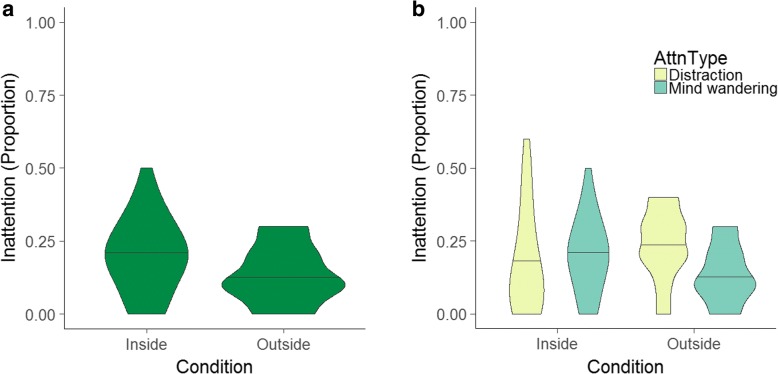
The present study examined the impact that the environment has on the ability to remain attentive and retain information. Participants listened to an audiobook in either a controlled lab setting or in an uncontrolled natural setting. While listening to the audiobook, participants were randomly prompted to report their current attentional status (focused, mind wandering, or distracted). Participants performed a memory test on audiobook content at the end. Inattention (mind wandering and distraction) did not differ between the two settings. However, there was a setting by attentional state interaction: distraction rates were higher than mind wandering rates outside the lab, while inattention rates did not differ inside the lab. Memory test performance was poorer outside the lab, suggesting that increased distraction may compromise memory more than mind wandering. Collectively, the data suggest that mind wandering and distraction are distinct types of attentional failures and that past controlled lab investigations may have overestimated the role of mind wandering and underestimated the role of distraction in everyday cognition.
Overview
CoChat Summary
TL;DR
In a 14-min audiobook listening task, overall inattention did not differ between a controlled lab setting and an uncontrolled natural setting, but the form of inattention did: outside the lab distraction exceeded mind wandering, while inside the lab they were equivalent. Memory was poorer outside the lab, suggesting distraction may harm memory more than mind wandering and that lab studies may overestimate mind wandering’s everyday role.
Key findings
- Overall inattention did not differ between Inside and Outside conditions, \(F(1, 63) = 0.003, p = 0.96\); mean overall inattention was 0.38 Inside and 0.37 Outside.
- There was a setting by attentional-state interaction, \(F(1, 63) = 6.75, p = 0.012\): Inside, mind wandering and distraction rates did not differ, \(t(33) = 0.57, p = 0.57, d = 0.099\); Outside, distraction was significantly greater than mind wandering, \(t(30) = 4.41, p < 0.001, d = 0.81\). Mean distraction/mind-wandering rates were 0.18/0.20 Inside and 0.24/0.14 Outside.
- Memory test performance was significantly better Inside than Outside, \(t(59.33) = 2.78, p = 0.007, d = 0.69\); mean memory scores were 0.62 Inside and 0.50 Outside.
- Interest, motivation, and boredom ratings did not differ by condition (all \(p > 0.28\)). Exploratory correlations showed Inside distraction was negatively correlated with memory (\(r = -0.44, p < 0.01\)) and interest (\(r = -0.41, p < 0.05\)), and Inside mind wandering was negatively correlated with motivation (\(r = -0.39, p < 0.05\)); no Outside correlations reached significance.
Methods
- Participants were randomly assigned to listen to a 14-min audiobook excerpt either Inside a laboratory testing room or Outside, where they could move freely. Ten audio tones prompted them to report whether they were focused, distracted by sights/sounds, or mind wandering; a memory test of nine multiple-choice and one short-answer question followed.
- Seventy-three University of British Columbia students participated (12 men, 61 women; age 18–42 years, \(M = 21.32, SD = 3.57\)). Eight were dropped for missing probe responses, leaving 34 Inside and 31 Outside. Sample size was based on a power analysis targeting 90% power to detect \(d = 0.78\) from Robison and Unsworth (2015).
- Analyses included a 2 × 2 between-within ANOVA on attention ratings, follow-up paired t-tests, an independent-samples t-test for memory, and correlations; two-tailed p values were used, with adjusted degrees of freedom when Levene’s test indicated non-homogeneity.
Limitations
- The paper states that it is unclear to what extent the outside-lab behavior truly represents real-life behavior; many audiobook users reported the task did not completely reflect their normal listening because they would usually do a secondary task (e.g., driving, chores) while listening.
- The paper states that the correlation samples were relatively small and the correlations should be viewed as exploratory and suggestive; it also notes that the question about time spent outside could not be assessed further because responses were not clearly identified as outside the laboratory or outside the building.
- Evident from the text: the Outside condition allowed free movement, but participants who returned with time remaining on the audiobook were taken to the testing room to finish listening, which may have diluted the uncontrolled setting; attention was also measured by self-report probes rather than objective behavioral indices.
Model-written summary. Check it against the paper before relying on it.
Integrity signals
Registry
Cites
Statistics
Figures
Verification
Claims the paper makes
1 Valid · 0 Not valid · 17 Not checked · 29 Own results and interpretations
The sources with a verdict support this claim; the rest weren’t checked yet, have no full text we could read, or their verdicts aren’t rated yet.
In the paper
“When students are asked to watch video recordings of lectures in the laboratory, mind wandering rates typically increase as the lecture progresses (Farley, Risko, & Kingstone, 2013; Risko, Anderson, Sarwal, Engelhardt, & Kingstone, 2012; Wammes & Smilek, 2017).”
§ In the lab and in the wild: How distraction and mind wandering affect attention and memory > Background
What the sources say
- Supportedcites Farley et al., 2013 matched to “Everyday attention and lecture retention: the effects of time, fidgeting, and mind wandering” (2013) source
The Abstract states that 'Recent research has found that when individuals view a lecture, mind wandering increases as a function of time,' and the paper's own 40-min lecture-video study reproduces this: Results > Influence of time on task (block) reports 'As block increased attention rating decreased, β = −0.18, SE = 0.03, t = −6.16,' with a significant linear trend in the exploratory analysis, and the Abstract concludes 'attention to, and retention of, lecture material declined as a function of time on task.' The Time on task section likewise treats attention rating as a mind-wandering measure ('the ability to sustain attention in a lecture (as measured via mind wandering frequency)') and summarizes Risko et al. (2012a, 2013a) as showing mind wandering rose from early to late periods. The only qualification is that Farley et al.'s measure was periodic self-ratings of attentiveness over the preceding 5 min rather than probe-caught mind wandering, and their Discussion notes non-linear trends; the hedged 'typically' in the claim accommodates this. (LLM, conf=0.88)
- Not checked yetcites Risko et al., 2012 matched to “Everyday Attention: Variation in Mind Wandering and Memory in a Lecture” (2012) source
- Not checked yetcites Wammes & Smilek, 2017 matched to “Examining the influence of lecture format on degree of mind wandering.” (2017) source
plainstates a cause- Asserted: passes — The authors put it forward as true.
- Checkable: passes — It can be checked against evidence.
- Load-bearing: unclear — It is unclear whether the paper’s conclusions depend on it.
- Based: passes — The paper gives a reason why it holds.
- Supported
A result the paper reports from its own data — it cites no other source for it, so there is none to check. The quote shows it is in the paper.
In the paper
“distraction rates were higher than mind wandering rates outside the lab”
- Also stated in: § Attention ratings · plain
“participants Outside reported significantly more inattention due to distraction than mind wandering, t(30) = 4.41, p < 0.001, d = 0.81.”
- Also stated in: § Discussion · plain
“participants outside reported more distraction than mind wandering”
§ In the lab and in the wild: How distraction and mind wandering affect attention and memory > Abstract
plain- Asserted: passes — The authors put it forward as true.
- Checkable: passes — It can be checked against evidence.
- Load-bearing: passes — The paper’s conclusions depend on it.
- Based: passes — The paper gives a reason why it holds.
- Also stated in: § Attention ratings · plain
A result the paper reports from its own data — it cites no other source for it, so there is none to check. The quote shows it is in the paper.
In the paper
“Inattention (mind wandering and distraction) did not differ between the two settings.”
- Also stated in: § Attention ratings · hedged
“As indicated in Fig. 1a, the between-subjects test indicated that overall inattention did not differ when Inside versus Outside, F(1, 63) = 0.003, p = 0.96.”
- Also stated in: § Significance · plain
“We found that while overall inattention did not differ when inside versus outside the lab, the distribution of inattention was impacted by setting.”
§ In the lab and in the wild: How distraction and mind wandering affect attention and memory > Abstract
plain- Asserted: passes — The authors put it forward as true.
- Checkable: passes — It can be checked against evidence.
- Load-bearing: passes — The paper’s conclusions depend on it.
- Based: passes — The paper gives a reason why it holds.
- Also stated in: § Attention ratings · hedged
A result the paper reports from its own data — it cites no other source for it, so there is none to check. The quote shows it is in the paper.
In the paper
“However, there was a setting by attentional state interaction: distraction rates were higher than mind wandering rates outside the lab, while inattention rates did not differ inside the lab.”
- Also stated in: § Attention ratings · plain
“However, an interaction revealed that differences between specific inattention rates (i.e. distraction or mind wandering) varied with condition, F(1, 63) = 6.75, p = 0.012.”
§ In the lab and in the wild: How distraction and mind wandering affect attention and memory > Abstract
plainstates an association- Asserted: passes — The authors put it forward as true.
- Checkable: passes — It can be checked against evidence.
- Load-bearing: passes — The paper’s conclusions depend on it.
- Based: passes — The paper gives a reason why it holds.
- Also stated in: § Attention ratings · plain
A result the paper reports from its own data — it cites no other source for it, so there is none to check. The quote shows it is in the paper.
In the paper
“Mind wandering rates while Inside were negatively correlated with motivation ratings, suggesting that lower motivation is associated with more frequent mind wandering reports.”
§ In the lab and in the wild: How distraction and mind wandering affect attention and memory > Results > Correlations
hedgedstates an associationn = 34 ·- Asserted: passes — The authors put it forward as true.
- Checkable: passes — It can be checked against evidence.
- Load-bearing: unclear — It is unclear whether the paper’s conclusions depend on it.
- Based: passes — The paper gives a reason why it holds.
20 more claims
Create a free account to see all 47 claims and to verify the 27 references still open.
- It may state two separate claims as one. 15
- Probably not a substantial claim. 12
Claims other papers make about this one
Each is checked against this paper’s own text: does it say what the citing paper says it does?
In the citing paper
“Like mind wandering, external distraction reflects a general lapse of attention and accordingly can also impede performance, learning, and memory (Stawarczyk et al., 2011; Varao-Sousa et al., 2018).”
From Listen up, kids! How mind wandering affects immediate and delayed memory in children (2024) · cites this paper as Varao-Sousa et al., 2018
In the citing paper
“Regardless of their origin, off-task thoughts can impact instantaneous memory recall to varying degrees, indicating that, like mind wandering, other types of inattention can attenuate the learning process”
From Listen up, kids! How mind wandering affects immediate and delayed memory in children (2024) · cites this paper as Varao-Sousa et al., 2018
Statistics that don’t add up
Each reported p-value recomputed from its test statistic and degrees of freedom, each partial η² from its F, and each ratio, mean difference or B printed with a p checked against its own confidence interval.
Rated minor: it would not touch a result — a value no result rests on, a p-value that stays on the same side of the significance level, or a conflict that is clerical, resolved elsewhere in the paper, or outside its own findings.
In the paper
“F(1, 63) = 2.30, p = 0.14”
§ In the lab and in the wild: How distraction and mind wandering affect attention and memory > Results > Attention ratings
Reported p = .14 · recomputed p = .134
Statistics recomputed
Every reported test result, recomputed from its test statistic and degrees of freedom. A result shows as not adding up only once an independent check has confirmed it.
- Doesn’t add upF(1, 63) = 2.3reported p = .14 · recomputed p = .134
“F(1, 63) = 2.30, p = .14”
- ConsistentF(1, 63) = 0.003reported p = .96 · recomputed p = .956
“F(1, 63) = 0.003, p = .96”
- ConsistentF(1, 63) = 6.75reported p = .012 · recomputed p = .012
“F(1, 63) = 6.75, p = .012”
- Consistentt(33) = 0.57reported p = .57 · recomputed p = .573
“t(33) = 0.57, p = .57”
- Consistentt(30) = 4.41reported p < .001 · recomputed p < .001
“t(30) = 4.41, p < .001”
1 more recomputed test
Create a free account to see every test the Stats check recomputed.
Self-check
Percentages, sums and reported differences re-computed from the paper’s own numbers.
Self-check results appear here once an independent check has confirmed them.
Citations
Cites
Faul, F., Erdfelder, E., Lang, A.-G., & Buchner, A. (2007) · Behavior Research Methods · doi:10.3758/bf03193146 · Cited by 65,971
(2016) · Cited by 2,334
Driver crash risk factors and prevalence evaluation using naturalistic driving data
Dingus, T. A., Guo, F., Lee, S., Antin, J. F., Perez, M., Buchanan-King, M., & Hankey, J. (2016) · Proceedings of the National Academy of Sciences · doi:10.1073/pnas.1513271113 · Cited by 1,048 · cited 2×
“Although prior research has examined inattention in the context of complex tasks such as driving and real-world learning settings (e.g., Cowley, 2013; Dingus et al., 2016; Unsworth & McMillan, 2017; Yanko & Spalek, 2013), these studies have not examined the distinct roles of mind wandering and distraction.”
Kane, M. J., Brown, L. H., McVay, J. C., Silvia, P. J., Myin-Germeys, I., & Kwapil, T. R. (2007) · Psychological Science · doi:10.1111/j.1467-9280.2007.01948.x · Cited by 979
McVay, J. C., & Kane, M. J. (2009) · Journal of Experimental Psychology: Learning, Memory, and Cognition · doi:10.1037/a0014104 · Cited by 769
Simmons, J. P., Nelson, L. D., & Simonsohn, U. (2012) · doi:10.2139/ssrn.2160588 · Cited by 680
How robust is the language architecture? The case of mood
Van Berkum, J. J. A., De Goede, D., Van Alphen, P. M., Mulder, E. R., & Kerstholt, J. H. (2013) · Frontiers in Psychology · doi:10.3389/fpsyg.2013.00505 · Cited by 555
Mind-wandering: Phenomenology and function as assessed with a novel experience sampling method
Stawarczyk, D., Majerus, S., Maj, M., Van der Linden, M., & D'Argembeau, A. (2011) · Acta Psychologica · doi:10.1016/j.actpsy.2011.01.002 · Cited by 505
Absent-mindedness: Lapses of conscious awareness and everyday cognitive failures
Cheyne, J. A., Carriere, J. S. A., & Smilek, D. (2006) · Consciousness and Cognition · doi:10.1016/j.concog.2005.11.009 · Cited by 470
Self-citationWhen attention matters: The curious incident of the wandering mind
Smallwood, J., McSpadden, M., & Schooler, J. W. (2008) · Memory & Cognition · doi:10.3758/mc.36.6.1144 · Cited by 458
Everyday Attention: Variation in Mind Wandering and Memory in a Lecture
Risko, E. F., Anderson, N., Sarwal, A., Engelhardt, M., & Kingstone, A. (2012) · Applied Cognitive Psychology · doi:10.1002/acp.1814 · Cited by 445
Self-citationA Short Boredom Proneness Scale: Development and Psychometric Properties
Struk, A. A., Carriere, J. S. A., Cheyne, J. A., & Danckert, J. (2017) · Assessment · doi:10.1177/1073191115609996 · Cited by 359
Cognitive Ethology: A new approach for studying human cognition
Kingstone, A., Smilek, D., & Eastwood, J. D. (2008) · British Journal of Psychology · doi:10.1348/000712607x251243 · Cited by 311
Self-citationThe Beneficial Effect of Concurrent Task-Irrelevant Mental Activity on Temporal Attention
Olivers, C. N. L., & Nieuwenhuis, S. (2005) · Psychological Science · doi:10.1111/j.0956-7976.2005.01526.x · Cited by 292
Disruption of office‐related tasks by speech and office noise
Banbury, S., & Berry, D. C. (1998) · British Journal of Psychology · doi:10.1111/j.2044-8295.1998.tb02699.x · Cited by 270
Harnessing the wandering mind: The role of perceptual load
Forster, S., & Lavie, N. (2009) · Cognition · doi:10.1016/j.cognition.2009.02.006 · Cited by 251
Everyday attention and lecture retention: the effects of time, fidgeting, and mind wandering
Farley, J., Risko, E. F., & Kingstone, A. (2013) · Frontiers in Psychology · doi:10.3389/fpsyg.2013.00619 · Cited by 241
Self-citationFor Whom the Mind Wanders, and When, Varies Across Laboratory and Daily-Life Settings
Kane, M. J., Gross, G. M., Chun, C. A., Smeekens, B. A., Meier, M. E., Silvia, P. J., & Kwapil, T. R. (2017) · Psychological Science · doi:10.1177/0956797617706086 · Cited by 230
Unsworth, N., & McMillan, B. D. (2014) · Acta Psychologica · doi:10.1016/j.actpsy.2014.04.001 · Cited by 188
Route familiarity breeds inattention: A driving simulator study
Yanko, M. R., & Spalek, T. M. (2013) · Accident Analysis & Prevention · doi:10.1016/j.aap.2013.04.003 · Cited by 175
High Perceptual Load Makes Everybody Equal
Forster, S., & Lavie, N. (2007) · Psychological Science · doi:10.1111/j.1467-9280.2007.01908.x · Cited by 175
Unsworth, N., Brewer, G. A., & Spillers, G. J. (2012) · Journal of Memory and Language · doi:10.1016/j.jml.2011.12.005 · Cited by 162
Everyday attention failures: An individual differences investigation.
Unsworth, N., McMillan, B. D., Brewer, G. A., & Spillers, G. J. (2012) · Journal of Experimental Psychology: Learning, Memory, and Cognition · doi:10.1037/a0028075 · Cited by 161
Cognitive Ethology and exploring attention in real-world scenes
Smilek, D., Birmingham, E., Cameron, D. S., Bischof, W. F., & Kingstone, A. F. (2006) · Brain Research · doi:10.1016/j.brainres.2005.12.090 · Cited by 159
Self-citationThe Impact of Background Radio and Television on High School Students' Homework Performance
Pool, M. M. (2003) · Journal of Communication · doi:10.1093/joc/53.1.74 · Cited by 143
Examining the influence of lecture format on degree of mind wandering.
Wammes, J. D., & Smilek, D. (2017) · Journal of Applied Research in Memory and Cognition · doi:10.1037/h0101808 · Cited by 103
Self-citationThe way we encounter reading material influences how frequently we mind wander
Varao Sousa, T. L., Carriere, J. S. A., & Smilek, D. (2013) · Frontiers in Psychology · doi:10.3389/fpsyg.2013.00892 · Cited by 77 · cited 2×
“We chose an audiobook task for two reasons: (1) mind wandering occurs frequently and reliably in this setting (Kopp & D’Mello, 2015; Varao Sousa et al., 2013); and (2) an audiobook allows one to move freely while still completing the primary task of listening.”
Self-citationReinten, J., Braat-Eggen, P. E., Hornikx, M., Kort, H. S. M., & Kohlrausch, A. (2017) · Building and Environment · doi:10.1016/j.buildenv.2017.07.005 · Cited by 71
Robison, M. K., & Unsworth, N. (2015) · Applied Cognitive Psychology · doi:10.1002/acp.3150 · Cited by 68
Mind wandering during lectures I: Changes in rates across an entire semester.
Wammes, J. D., Boucher, P. O., Seli, P., Cheyne, J. A., & Smilek, D. (2016) · Scholarship of Teaching and Learning in Psychology · doi:10.1037/stl0000053 · Cited by 47
Self-citationUnsworth, N., & McMillan, B. D. (2017) · Cognitive Research: Principles and Implications · doi:10.1186/s41235-017-0070-7 · Cited by 24
Cognitive ethology: giving real life to attention research
Kingstone, A. F., Smilek, D., Birmingham, E., Cameron, D., & Bischof, W. F. (2005) · Oxford University Press eBooks · doi:10.1093/acprof:oso/9780198566427.003.0014 · Cited by 20
Self-citationThe Impact of Modality on Mind Wandering during Comprehension
Kopp, K., & D'Mello, S. (2016) · Applied Cognitive Psychology · doi:10.1002/acp.3163 · Cited by 17
Mind wandering in text comprehension under dual-task conditions
Dixon, P., & Li, H. (2013) · Frontiers in Psychology · doi:10.3389/fpsyg.2013.00682 · Cited by 13
Off Task Thinking Types and Performance Decrements During Simulated Automobile Driving
Cowley, J. A. (2013) · Proceedings of the Human Factors and Ergonomics Society Annual Meeting · doi:10.1177/1541931213571270 · Cited by 7
Cited by
Automation in the Life Science Research Laboratory
Holland, I., & Davies, J. A. (2020) · Frontiers in Bioengineering and Biotechnology · doi:10.3389/fbioe.2020.571777 · Cited by 200
Mind wandering and depression: A status report
Chaieb, L., Hoppe, C., & Fell, J. (2021) · Neuroscience & Biobehavioral Reviews · doi:10.1016/j.neubiorev.2021.12.028 · Cited by 68
Listening Ears or Reading Eyes: A Meta-Analysis of Reading and Listening Comprehension Comparisons
Clinton‐Lisell, V. (2021) · Review of Educational Research · doi:10.3102/00346543211060871 · Cited by 67
Wong, A. Y., Smith, S. L., McGrath, C. A., Flynn, L. E., & Mills, C. (2022) · Contemporary Educational Psychology · doi:10.1016/j.cedpsych.2022.102098 · Cited by 42
Longitudinal Trajectories of Sustained Attention Development in Children and Adolescents with ADHD
Thomson, P., Vijayakumar, N., Johnson, K. A., Malpas, C. B., Sciberras, E., Efron, D., Hazell, P., & Silk, T. J. (2020) · Research on Child and Adolescent Psychopathology · doi:10.1007/s10802-020-00698-5 · Cited by 39
Metadata
- Authors
- Varao-Sousa, T. L., Smilek, D., & Kingstone, A.
- Affiliations
- University of British Columbia (CA)
- University of Waterloo (CA)
- Corresponding author
- Varao-Sousa, Trish L.
- Venue
- Cognitive Research: Principles and Implications
- Published
- 2018-11-21
- Volume
- 3
- Issue
- 1
- Pages
- 42-42
- ISSN
- 2365-7464 (ISSN-L)
- PMC
- PMC6246756
- OpenAlex
- W2899734636
- Cited by
- 63
- References
- 35
- Citations by year
- 2026: 9 · 2025: 11 · 2024: 12 · 2023: 12 · 2022: 7 · 2021: 6 · 2020: 3 · 2019: 3
- FWCI
- 1.40
- Type
- journal article
- Language
- en
- Open access
- gold
- doi.org
- Licence
- cc-by
- creativecommons.org/licenses/by/4.0 (tdm)
- Locations
- Cognitive Research Principles and Implications (publishedVersion, cc-by)
- Europe PMC (PubMed Central) (publishedVersion, other-oa)
- PubMed (publishedVersion)
- PubMed Central (publishedVersion, cc-by)
- cIRcle (University of British Columbia) (submittedVersion, cc-by)
- DOAJ (DOAJ: Directory of Open Access Journals) (submittedVersion, cc-by-sa)
- Open Collections
- Funders
- Natural Sciences and Engineering Research Council of Canada (2016-04319)
- Social Sciences and Humanities Research Council of Canada (435-2013-2200)
- Topics
- Life Sciences › Neuroscience › Cognitive Neuroscience › Mind wandering and attention
- Social Sciences › Psychology › Experimental and Cognitive Psychology › Cognitive Functions and Memory
- Life Sciences › Neuroscience › Cognitive Neuroscience › Memory Processes and Influences
- Keywords
- mind wandering, distraction, attention, memory, inattention, naturalistic settings, audiobook listening, attentional failures, memory retention
About these checks
Registry, retraction, Cites and statistics results are computed, not judged, with one exception: a printed reference that no index lists is read once by a model before it counts as a citation error. Claims are extracted by a model and kept only when their quote appears verbatim in the text; each cited source is then checked, with a model’s help, for whether it says what the claim relies on. Those verdicts can be wrong — read the claim’s quote and the cited source before relying on one.
A language model drew the claims from the paper on 2026-11-19, under version 3 of the claim definition (model deepseek-v4.1-flash, prompt extract-v3).
A second model labelled each claim on 2026-11-19 (model jev-1.13-20260917, definition revision gold-guideline-v0.2).
Cited sources are checked with a language model’s help (qwen3.8-omni-flash).
Statistics and arithmetic are recomputed, not judged.
Confidence bands are shown only for fields calibrated on our annotated test set. None is calibrated yet, so no band is shown.
What counts as a claim ›How we measure confidence ›How we check this ›
Are you an author, or do you see a problem with this page? Request a review
Data sources
Bibliographic data: Semantic Scholar, OpenAlex, Crossref.
Contains information from the Semantic Scholar Academic Graph Datasets, made available under the ODC Attribution License (ODC-BY 1.0).
Semantic Scholar’s data is described in: Kinney, R., et al. (2023). The Semantic Scholar Open Data Platform. arXiv:2301.10140.
