

The DOI matches its Crossref record; 82 of the 83 references it cites were found in a registry or an index.
Humans versus AI: whether and why we prefer human-created compared to AI-created artwork
Open accessAbstract
With the recent proliferation of advanced artificial intelligence (AI) models capable of mimicking human artworks, AI creations might soon replace products of human creativity, although skeptics argue that this outcome is unlikely. One possible reason this may be unlikely is that, independent of the physical properties of art, we place great value on the imbuement of the human experience in art. An interesting question, then, is whether and why people might prefer human-compared to AI-created artworks. To explore these questions, we manipulated the purported creator of pieces of art by randomly assigning a “Human-created” or “AI-created” label to paintings actually created by AI, and then assessed participants’ judgements of the artworks across four rating criteria (Liking, Beauty, Profundity, and Worth). Study 1 found increased positive judgements for human- compared to AI-labelled art across all criteria. Study 2 aimed to replicate and extend Study 1 with additional ratings (Emotion, Story, Meaningful, Effort, and Time to create) intended to elucidate why people more-positively appraise Human-labelled artworks. The main findings from Study 1 were replicated, with narrativity (Story) and perceived effort behind artworks (Effort) moderating the label effects (“Human-created” vs. “AI-created”), but only for the sensory-level judgements (Liking, Beauty). Positive personal attitudes toward AI moderated label effects for more-communicative judgements (Profundity, Worth). These studies demonstrate that people tend to be negatively biased against AI-created artworks relative to purportedly human-created artwork, and suggest that knowledge of human engagement in the artistic process contributes positively to appraisals of art.
Overview
The claims and statistics of this paper haven’t been checked yet.
Run the check — free, no account needed. It reads the open-access text and checks the sources it cites.
Integrity signals
Registry
Cites
Statistics
Figures
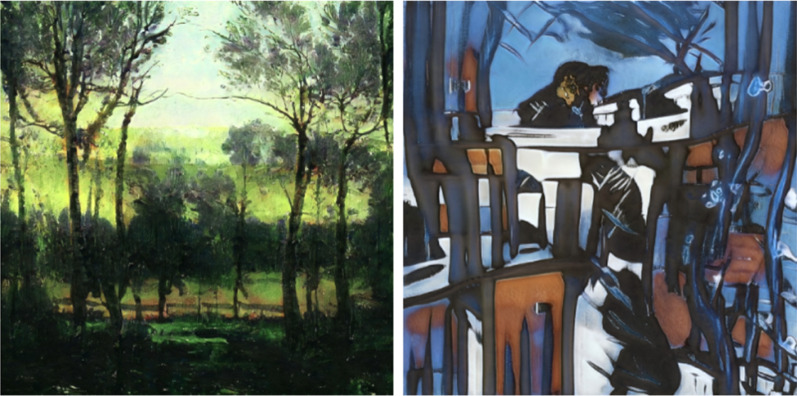
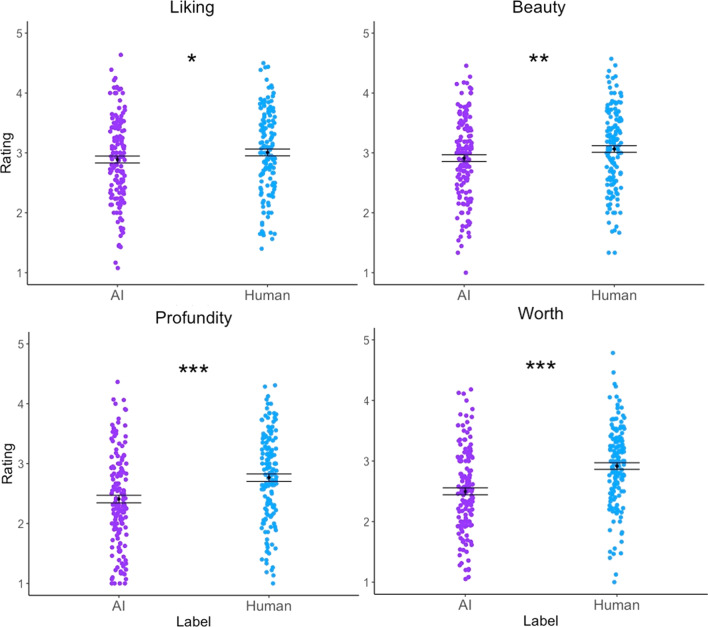
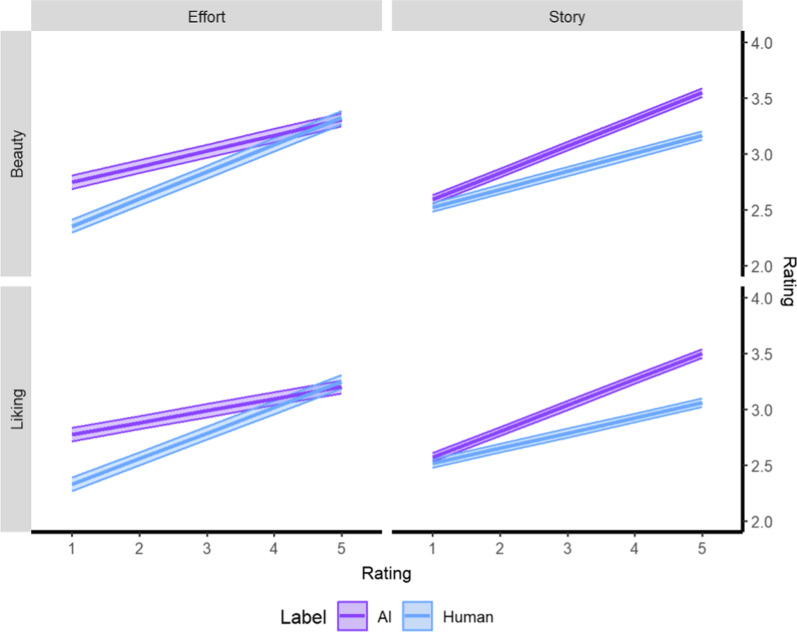
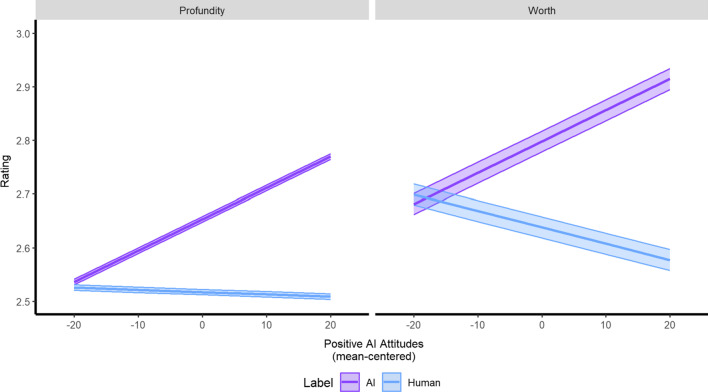
Verification
Claims the paper makes
The claims and statistics of this paper haven’t been checked yet.
Run the check — free, no account needed. It reads the open-access text and checks the sources it cites.
Self-check
Percentages, sums and reported differences re-computed from the paper’s own numbers.
The self-check needs the paper’s full text.
Citations
Cites
Fitting Linear Mixed-Effects Models Using lme4
Bates, D., Mächler, M., Bolker, B., & Walker, S. (2015) · Journal of Statistical Software · doi:10.18637/jss.v067.i01 · Cited by 86,835 · cited 1×
“Linear mixed-effects models using maximum likelihood estimation were estimated in R (version 4.2.0; R Core Team, 2022) using the {lme4} package (version 1.1.33; Bates et al., 2015).”
MethodInfluentialConflict, arousal, and curiosity.
Berlyne, D. E. (1960) · McGraw-Hill Book Company · doi:10.1037/11164-000 · Cited by 6,018 · cited 1×
“…cascade of evaluations, implicating more-complex and elaborative processes in judgements of art that seek to understand meaning and communication through the piece (Berlyne, 1960, 1971; Chatterjee & Vartanian, 2016; Cupchik & Berlyn, 1979; Graf & Landwehr, 2015; Leder et al., 2004; Silvia, 2005).”
BackgroundCognitive Reflection and Decision Making
Frederick, S. (2005) · Journal of Economic Perspectives · doi:10.1257/089533005775196732 · Cited by 5,256
Guilford, J. P. (1950) · American Psychologist · doi:10.1037/h0063487 · Cited by 3,588
Social psychology of creativity: A consensual assessment technique.
Amabile, T. M. (1982) · Journal of Personality and Social Psychology · doi:10.1037/0022-3514.43.5.997 · Cited by 2,278 · cited 2×
“Though contention ensues over whether artificial programs are capable of producing “creative” products (in line with the computer science principle known as the Lovelace Objection; Natale & Henrickson, 2022), it is nonetheless critical to understand how audiences perceive such art given that contemporary psychological…”
BackgroundA model of aesthetic appreciation and aesthetic judgments
Leder, H., Belke, B., Oeberst, A., & Augustin, D. (2004) · British Journal of Psychology · doi:10.1348/0007126042369811 · Cited by 1,968 · cited 4×
“…e.g., Margulis et al., 2019; McAuley et al., 2021), the act of deriving meaning from artwork that is often posited in models of aesthetics (e.g., Leder et al., 2004; Pelowski et al., 2017), and that effort and time involved in creation of a product is often a heuristic for quality (Kruger…”
BackgroundResultInfluentialNeural Correlates of Behavioral Preference for Culturally Familiar Drinks
McClure, S. M., Li, J., Tomlin, D., Cypert, K. S., Montague, L. M., & Montague, P. R. (2004) · Neuron · doi:10.1016/j.neuron.2004.09.019 · Cited by 1,413 · cited 2×
“…the extant literature on the role of labels in subjective evaluations—both in aesthetics and other domains of preferences (e.g., Kirk et al., 2009; McClure et al., 2004; Newman & Bloom, 2012; Plassmann et al., 2008; Turpin et al., 2019)—our findings demonstrate that labels significantly…”
BackgroundResultMotion, emotion and empathy in esthetic experience
Freedberg, D., & Gallese, V. (2007) · Trends in Cognitive Sciences · doi:10.1016/j.tics.2007.02.003 · Cited by 1,334
The Cambridge Handbook of Creativity
(2010) · doi:10.1017/cbo9780511763205 · Cited by 1,291
Spreng*, R. N., McKinnon*, M. C., Mar, R. A., & Levine, B. (2009) · Journal of Personality Assessment · doi:10.1080/00223890802484381 · Cited by 1,161
Marketing actions can modulate neural representations of experienced pleasantness
Plassmann, H., O'Doherty, J., Shiv, B., & Rangel, A. (2008) · Proceedings of the National Academy of Sciences · doi:10.1073/pnas.0706929105 · Cited by 1,122 · cited 1×
“…in subjective evaluations—both in aesthetics and other domains of preferences (e.g., Kirk et al., 2009; McClure et al., 2004; Newman & Bloom, 2012; Plassmann et al., 2008; Turpin et al., 2019)—our findings demonstrate that labels significantly influence people’s judgements of visual artworks.”
BackgroundAssessing miserly information processing: An expansion of the Cognitive Reflection Test
Toplak, M. E., West, R. F., & Stanovich, K. E. (2014) · Thinking & Reasoning · doi:10.1080/13546783.2013.844729 · Cited by 864 · cited 1×
“Before rating the images, participants were asked to complete the 7-item cognitive reflection test (CRT; Frederick, 2005; Toplak et al., 2014).”
MethodInitial validation of the general attitudes towards Artificial Intelligence Scale
Schepman, A., & Rodway, P. (2020) · Computers in Human Behavior Reports · doi:10.1016/j.chbr.2020.100014 · Cited by 785 · cited 1×
“Participants also completed the General Attitudes toward Artificial Intelligence Scale (GAAIS) to assess positive and negative sentiments of AI in general (Schepman & Rodway, 2020).”
MethodVisual Aesthetics and Human Preference
Palmer, S. E., Schloss, K. B., & Sammartino, J. (2011) · Annual Review of Psychology · doi:10.1146/annurev-psych-120710-100504 · Cited by 744
On the reception and detection of pseudo-profound bullshit
Pennycook, G., Allan Cheyne, J., Barr, N., Koehler, D. J., & Fugelsang, J. A. (2015) · Judgment and Decision Making · doi:10.1017/s1930297500006999 · Cited by 536 · cited 1×
“Past work with the CRT has found negative relationships between CRT scores and perceived profundity of randomly generated statements (Pennycook et al., 2015), implying a relationship between cognitive reflection traits and subjective judgements of profundity that could extend to aesthetics.”
BackgroundSelf-citationGardner, H., & Berlyne, D. E. (1974) · Curriculum Theory Network · doi:10.2307/1179240 · Cited by 512
Schepman, A., & Rodway, P. (2023) · International Journal of Human–Computer Interaction · doi:10.1080/10447318.2022.2085400 · Cited by 503 · cited 1×
“The 20-item GAAIS has been fully validated and found to report a consistent positive subscale (⍺ = 0.88) and negative subscale (⍺ = 0.82), with strong convergent validity with other AI-related measures (Schepman & Rodway, 2022).”
ResultInfluentialCreative mindsets: Measurement, correlates, consequences.
Karwowski, M. (2013) · Psychology of Aesthetics Creativity and the Arts · doi:10.1037/a0034898 · Cited by 498 · cited 6×
“Other personality traits explored in aesthetics and creativity research include empathy and embodied cognitions (Freedberg & Gallese, 2007; Rusu, 2017), and beliefs of creative mindsets (Hass et al., 2016; Karwowski, 2014).”
BackgroundMethodInfluentialArt, Creativity, and the Potential of Artificial Intelligence
Mazzone, M., & Elgammal, A. (2019) · Arts · doi:10.3390/arts8010026 · Cited by 494 · cited 2×
“…that can produce, as purely physical stimuli, high-quality artworks that are indiscernible from human-created artworks (Gangadharbatla, 2022; Johnson, 1997; Mazzone & Elgammal, 2019), the Computer Age in which we live has afforded considerable experimental control over these two conceptions of art.”
BackgroundPelowski, M. J., Markey, P. S., Forster, M., Gerger, G., & Leder, H. (2017) · Physics of Life Reviews · doi:10.1016/j.plrev.2017.02.003 · Cited by 492 · cited 1×
“…et al., 2019; McAuley et al., 2021), the act of deriving meaning from artwork that is often posited in models of aesthetics (e.g., Leder et al., 2004; Pelowski et al., 2017), and that effort and time involved in creation of a product is often a heuristic for quality (Kruger et al., 2004).”
BackgroundKruger, J., Wirtz, D., Leaf Van Boven, A., & Altermatt, T. W. (2003) · Journal of Experimental Social Psychology · doi:10.1016/s0022-1031(03)00065-9 · Cited by 480 · cited 1×
“(2004), people use effort as a metric to inform their judgements of the quality of a product (e.g., poems, paintings, suits of armor; Kruger et al., 2004).”
BackgroundKöbis, N., & Mossink, L. D. (2021) · Computers in Human Behavior · doi:10.1016/j.chb.2020.106553 · Cited by 406 · cited 1×
“In fact, several recent studies have reported similar anti-AI findings in music (Shank et al., 2022), creative writing (Raj et al., 2023), dance (Darda & Cross, 2023), poetry (Köbis & Mossink, 2020), and non-art texts (Darda et al., 2023).”
Modulation of aesthetic value by semantic context: An fMRI study
Kirk, U., Skov, M., Hulme, O., Christensen, M. S., & Zeki, S. (2009) · NeuroImage · doi:10.1016/j.neuroimage.2008.10.009 · Cited by 381 · cited 1×
“In line with the extant literature on the role of labels in subjective evaluations—both in aesthetics and other domains of preferences (e.g., Kirk et al., 2009; McClure et al., 2004; Newman & Bloom, 2012; Plassmann et al., 2008; Turpin et al., 2019)—our findings demonstrate that labels…”
ResultChatterjee, A. K., & Vartanian, O. A. (2016) · Annals of the New York Academy of Sciences · doi:10.1111/nyas.13035 · Cited by 379
Aesthetic Chills as a Universal Marker of Openness to Experience
McCrae, R. R. (2007) · Motivation and Emotion · doi:10.1007/s11031-007-9053-1 · Cited by 370 · cited 4×
“…can also assess Consciousness, Extraversion, Agreeableness, and Neuroticism, we chose to implement only the Openness subset given its previous specific involvement in aesthetic encounters (Kaufman, 2013; McCrae, 2007; McCrae & Greenberg, 2014; Silvia et al., 2015), and to reduce study length.”
BackgroundMethodInfluentialA Dual-Process Perspective on Fluency-Based Aesthetics
Graf, L. K. M., & Landwehr, J. R. (2015) · Personality and Social Psychology Review · doi:10.1177/1088868315574978 · Cited by 349 · cited 6×
“These latter criteria require higher cognitive elaboration to determine communicative properties of art, as discussed in Graf and Landwehr (2015) and Sherman and Morrissey (2017).”
BackgroundMethodResultInfluentialThe Rise of Storytelling as the New Marketing
Pulizzi, J. (2012) · Publishing Research Quarterly · doi:10.1007/s12109-012-9264-5 · Cited by 346 · cited 1×
“…for marketing and product branding, as it is reminiscent of the mass production advertising practices in the early twentieth century where consumers were overall hesitant to purchase goods from multinational conglomerates until narratives were paired with the product (Freeman, 2014; Pulizzi, 2012).”
BackgroundSilvia, P. J., Fayn, K., Nusbaum, E. C., & Beaty, R. E. (2015) · Psychology of Aesthetics Creativity and the Arts · doi:10.1037/aca0000028 · Cited by 334 · cited 2×
“…can also assess Consciousness, Extraversion, Agreeableness, and Neuroticism, we chose to implement only the Openness subset given its previous specific involvement in aesthetic encounters (Kaufman, 2013; McCrae, 2007; McCrae & Greenberg, 2014; Silvia et al., 2015), and to reduce study length.”
BackgroundMethodArt and authenticity: The importance of originals in judgments of value.
Newman, G. E., & Bloom, P. (2012) · Journal of Experimental Psychology: General · doi:10.1037/a0026035 · Cited by 314
McCrae, R., & Greenberg, D. (2014) · Encyclopedia of Evolutionary Psychological Science · doi:10.1002/9781118367377.ch12 · Cited by 303 · cited 3×
“…can also assess Consciousness, Extraversion, Agreeableness, and Neuroticism, we chose to implement only the Openness subset given its previous specific involvement in aesthetic encounters (Kaufman, 2013; McCrae, 2007; McCrae & Greenberg, 2014; Silvia et al., 2015), and to reduce study length.”
BackgroundMethodDoes the cognitive reflection test measure cognitive reflection? A mathematical modeling approach
Campitelli, G., & Gerrans, P. (2013) · Memory & Cognition · doi:10.3758/s13421-013-0367-9 · Cited by 260
Appraisals cause experienced emotions: Experimental evidence
Roseman, I. J., & Evdokas, A. (2003) · Cognition & Emotion · doi:10.1080/02699930244000390 · Cited by 257 · cited 1×
“Third, given that aesthetic appraisals are personal and subjective (Chatterjee, 2014; Roseman & Evdokas, 2004), also imperative in their investigation is consideration of individual differences that might reliably predict these judgements.”
BackgroundCognitive Appraisals and Interest in Visual Art: Exploring an Appraisal Theory of Aesthetic Emotions
Silvia, P. J. (2005) · Empirical Studies of the Arts · doi:10.2190/12av-ah2p-mceh-289e · Cited by 240 · cited 5×
“Other emerging models have since provided more nuance to Berlyne’s traditional behaviorist approach (see Berlyne, 1975; Silvia, 2005), including more cognitive principles, and an increased understanding of the processes people utilize to engage with art.”
BackgroundMethodInfluentialKaufman, S. B. (2013) · The Journal of Creative Behavior · doi:10.1002/jocb.33 · Cited by 229 · cited 6×
“…to empathize with other agents, including AI, perhaps explaining AI-art judgements), openness to experience (given its role in aesthetic encounters; Kaufman, 2013; McCrae, 2007; McCrae & Greenberg, 2014; Silvia et al., 2015), personal attitudes toward AI (which we hypothesized could predict…”
BackgroundMethodInfluentialPutting the art in artificial: Aesthetic responses to computer-generated art.
Chamberlain, R., Mullin, C., Scheerlinck, B., & Wagemans, J. (2018) · Psychology of Aesthetics, Creativity, and the Arts · doi:10.1037/aca0000136 · Cited by 225 · cited 4×
“, those that were false in cases wherein the labels indicated that the artworks were created by a human), although we can nevertheless minimize these concerns (at least to some extent) by considering the past literature showing participants’ inability to discriminate between AI- and human-created paintings (Chamberlai…”
BackgroundMethodResultInfluentialHong, J.-W., & Curran, N. M. (2019) · ACM Transactions on Multimedia Computing, Communications, and Applications · doi:10.1145/3326337 · Cited by 217 · cited 1×
“Critically, however, other studies have yielded results that are at odds with those from the aforementioned studies, finding little-to-no differences in evaluations of human- and AI-created artworks (Hong & Curran, 2019; Israfilzade, 2020; Xu et al., 2020).”
ResultOpenness to Experience, Non-Conformity, and the Preference for Abstract Art
Feist, G. J., & Brady, T. R. (2004) · Empirical Studies of the Arts · doi:10.2190/y7ca-tby6-v7lr-76gk · Cited by 190 · cited 1×
“In addition, openness has been shown to influence judgements of art depending on painting type, such that people who are more open to experience tend to have an increased appreciation for abstract art compared to less-open participants (Feist & Brady, 2004).”
BackgroundQualities of color vision in infancy
Bornstein, M. H. (1975) · Journal of Experimental Child Psychology · doi:10.1016/0022-0965(75)90070-3 · Cited by 185 · cited 1×
“…nevertheless emerged across peoples’ aesthetic judgements of such artworks (e.g., blue is the most preferred color, whereas yellow is most disliked [Bornstein, 1975; Komar & Melamid, 1999; Palmer et al., 2013]; and representational art is enjoyed over abstract art [Heinrichs & Cupchik, 1985;…”
BackgroundInvented Worlds: The Psychology of the Arts
Doyle, C. L., & Winner, E. (1983) · Journal of Aesthetic Education · doi:10.2307/3332417 · Cited by 178 · cited 2×
“In other words, people consider non-sensory aspects of art, like context and background, in their judgements and evaluations of art (Blank et al., 1984; Chatterjee & Vartanian, 2016; Winner, 1982).”
BackgroundCseh, G. M., & Jeffries, K. K. (2019) · Psychology of Aesthetics Creativity and the Arts · doi:10.1037/aca0000220 · Cited by 171 · cited 1×
“…considers creativity to be not an absolute construct, but a consequence of changing interactions between subjective criteria and socio-cultural factors like technology (i.e., “in the eye of the beholder”; Amabile, 1982; Cseh & Jeffries, 2019; Hennessey et al., 2011; Kaufman & Sternberg, 2010).”
BackgroundThe Aesthetic Brain: How We Evolved to Desire Beauty and Enjoy Art
Ione, A. (2014) · Leonardo · doi:10.1162/leon_r_00948 · Cited by 170 · cited 2×
“It can encapsulate and communicate our emotions, be used to express our individualistic and communal experiences, and serve as a social commentary on these experiences, all of which are elements that are commonly thought to be human-specific (Chatterjee, 2014).”
BackgroundHass, R. W., Katz-Buonincontro, J. L., & Reiter‐Palmon, R. (2016) · Psychology of Aesthetics Creativity and the Arts · doi:10.1037/aca0000081 · Cited by 155 · cited 1×
“Other personality traits explored in aesthetics and creativity research include empathy and embodied cognitions (Freedberg & Gallese, 2007; Rusu, 2017), and beliefs of creative mindsets (Hass et al., 2016; Karwowski, 2014).”
BackgroundArt in an age of artificial intelligence
Chatterjee, A. K. (2022) · Frontiers in Psychology · doi:10.3389/fpsyg.2022.1024449 · Cited by 151 · cited 1×
“Art created by AI has been met with both success and controversy (see Chatterjee, 2022); and, very recently, these creative products have permeated into mainstream culture like museums and artistic industries (Diaz, 2022; Kaleagasi, 2017; Kinsella, 2018; Zulić, 2019).”
BackgroundPainting by Numbers: Komar and Melamid's Scientific Guide to Art
Wypijewski, J. (1999) · Journal of Aesthetics and Art Criticism · doi:10.2307/432083 · Cited by 143 · cited 1×
“…across peoples’ aesthetic judgements of such artworks (e.g., blue is the most preferred color, whereas yellow is most disliked [Bornstein, 1975; Komar & Melamid, 1999; Palmer et al., 2013]; and representational art is enjoyed over abstract art [Heinrichs & Cupchik, 1985; Kettlewell et al.,…”
BackgroundMikalonytė, E. S., & Kneer, M. (2022) · ACM Transactions on Human-Robot Interaction · doi:10.1145/3530875 · Cited by 138
The Role of AI Attribution Knowledge in the Evaluation of Artwork
Gangadharbatla, H. (2022) · Empirical Studies of the Arts · doi:10.1177/0276237421994697 · Cited by 132 · cited 4×
“, those that were false in cases wherein the labels indicated that the artworks were created by a human), although we can nevertheless minimize these concerns (at least to some extent) by considering the past literature showing participants’ inability to discriminate between AI- and human-created paintings (Chamberlai…”
BackgroundResultInfluentialAffect and Artificial Intelligence
Wilson, E. (2011) · University of Washington Press eBooks · doi:10.1515/9780295800004 · Cited by 125
Hennessey, B. A., Amabile, T. M., & Mueller, J. (2011) · Elsevier eBooks · doi:10.1016/b978-0-12-375038-9.00046-7 · Cited by 116
The Aesthetic Brain: How We Evolved to Desire Beauty and Enjoy Art
Chatterjee, A. K. (2013) · Cited by 114
Chiarella, S. G., Torromino, G., Gagliardi, D. M., Rossi, D., Babiloni, F., & Cartocci, G. (2022) · Computers in Human Behavior · doi:10.1016/j.chb.2022.107406 · Cited by 112 · cited 3×
“Similar findings emerged in a more-recent study in which participants were shown, and asked to provide judgements of, two abstract paintings (Chiarella et al., 2022).”
BackgroundMethodResultWu, Y., Mou, Y., Li, Z., & Xu, K. (2019) · Computers in Human Behavior · doi:10.1016/j.chb.2019.106186 · Cited by 99
Will AI Console Me when I Lose my Pet? Understanding Perceptions of AI-Mediated Email Writing
Liu, Y., Mittal, A., Yang, D., & Bruckman, A. (2022) · CHI Conference on Human Factors in Computing Systems · doi:10.1145/3491102.3517731 · Cited by 92
What Is Art Good For? The Socio-Epistemic Value of Art
Sherman, A., & Morrissey, C. (2017) · Frontiers in Human Neuroscience · doi:10.3389/fnhum.2017.00411 · Cited by 85 · cited 2×
“This is supported, in part, by the growing discussion of art not only as a bottom-up appraisal of only visual features that induces liking or judgements of beauty, but a device for communication and socio-epistemic value (see Sherman & Morrissey, 2017).”
BackgroundHong, J.-W., Fischer, K., Ha, Y., & Zeng, Y. (2022) · Computers in Human Behavior · doi:10.1016/j.chb.2022.107239 · Cited by 82
The perception of collative properties in visual stimuli
Cupchik, G. C., & Berlyne, D. E. (1979) · Scandinavian Journal of Psychology · doi:10.1111/j.1467-9450.1979.tb00688.x · Cited by 81
What the music said: narrative listening across cultures
Margulis, E. H., Wong, P. C. M., Simchy-Gross, R., & McAuley, J. D. (2019) · Humanities and Social Sciences Communications · doi:10.1057/s41599-019-0363-1 · Cited by 75 · cited 1×
“Such work (e.g., Margulis et al., 2019; McAuley et al., 2021) finds interesting cross-cultural differences, implicating the role of media in our consumption of art and underlying associations (see Wu et al., 2020 for a cross-cultural study that finds higher appreciation for AI products of art…”
BackgroundThe Lovelace effect: Perceptions of creativity in machines
Natale, S., & Henrickson, L. (2022) · New Media & Society · doi:10.1177/14614448221077278 · Cited by 72 · cited 2×
“…whether artificial programs are capable of producing “creative” products (in line with the computer science principle known as the Lovelace Objection; Natale & Henrickson, 2022), it is nonetheless critical to understand how audiences perceive such art given that contemporary psychological…”
BackgroundExploring creative mindsets: Variable and person-centered approaches.
Karwowski, M., Royston, R. P., & Reiter‐Palmon, R. (2018) · Psychology of Aesthetics Creativity and the Arts · doi:10.1037/aca0000170 · Cited by 69
AI composer bias: Listeners like music less when they think it was composed by an AI.
Shank, D. B., Stefanik, C., Stuhlsatz, C., Kacirek, K., & Belfi, A. M. (2022) · Journal of Experimental Psychology Applied · doi:10.1037/xap0000447 · Cited by 67 · cited 1×
“In fact, several recent studies have reported similar anti-AI findings in music (Shank et al., 2022), creative writing (Raj et al., 2023), dance (Darda & Cross, 2023), poetry (Köbis & Mossink, 2020), and non-art texts (Darda et al., 2023).”
The automatic aesthetic evaluation of different art and architectural styles.
Mastandrea, S., Bartoli, G., & Carrus, G. (2010) · Psychology of Aesthetics Creativity and the Arts · doi:10.1037/a0021126 · Cited by 66 · cited 1×
“…(e.g., blue is the most preferred color, whereas yellow is most disliked [Bornstein, 1975; Komar & Melamid, 1999; Palmer et al., 2013]; and representational art is enjoyed over abstract art [Heinrichs & Cupchik, 1985; Kettlewell et al., 1990; Knapp & Wulff, 1963; Mastandrea et al., 2011, 2021]).”
BackgroundHow AI can Change/Improve/Influence Music Composition, Performance and Education: Three Case Studies
Zulić, H. (2019) · INSAM Journal of Contemporary Music Art and Technology · doi:10.51191/issn.2637-1898.2019.2.2.100 · Cited by 62 · cited 1×
“Art created by AI has been met with both success and controversy (see Chatterjee, 2022); and, very recently, these creative products have permeated into mainstream culture like museums and artistic industries (Diaz, 2022; Kaleagasi, 2017; Kinsella, 2018; Zulić, 2019).”
BackgroundPerceiving What Paintings Express
Blank, P., Massey, C. M., Gardner, H., et al. (1984) · Advances in psychology · doi:10.1016/s0166-4115(08)62349-3 · Cited by 59 · cited 1×
“In other words, people consider non-sensory aspects of art, like context and background, in their judgements and evaluations of art (Blank et al., 1984; Chatterjee & Vartanian, 2016; Winner, 1982).”
BackgroundArt-ificial Intelligence: The Effect of AI Disclosure on Evaluations of Creative ContentPreprint
Raj, M., Berg, J. M., & Seamans, R. (2023) · SSRN Electronic Journal · doi:10.2139/ssrn.4369818 · Cited by 49 · cited 2×
“In fact, several recent studies have reported similar anti-AI findings in music (Shank et al., 2022), creative writing (Raj et al., 2023), dance (Darda & Cross, 2023), poetry (Köbis & Mossink, 2020), and non-art texts (Darda et al., 2023).”
BackgroundBehaviourism? Cognitive theory? Humanistic psychology? To Hull with them all.
Berlyne, D. E. (1975) · Canadian Psychological Review/Psychologie canadienne · doi:10.1037/h0081798 · Cited by 47 · cited 1×
“Other emerging models have since provided more nuance to Berlyne’s traditional behaviorist approach (see Berlyne, 1975; Silvia, 2005), including more cognitive principles, and an increased understanding of the processes people utilize to engage with art.”
BackgroundIs This Art? An Experimental Study on Visitors’ Judgement of Contemporary Art
Tröndle, M., Kirchberg, V., & Tschacher, W. (2014) · Cultural Sociology · doi:10.1177/1749975513507243 · Cited by 46
Preferences for Abstract and Representational Art
Knapp, R. H., & Wulff, A. (1963) · The Journal of Social Psychology · doi:10.1080/00224545.1963.9922196 · Cited by 45 · cited 2×
“…(e.g., blue is the most preferred color, whereas yellow is most disliked [Bornstein, 1975; Komar & Melamid, 1999; Palmer et al., 2013]; and representational art is enjoyed over abstract art [Heinrichs & Cupchik, 1985; Kettlewell et al., 1990; Knapp & Wulff, 1963; Mastandrea et al., 2011, 2021]).”
BackgroundResultDarda, K. M., & Cross, E. S. (2022) · Heliyon · doi:10.1016/j.heliyon.2022.e12750 · Cited by 44 · cited 2×
“In fact, several recent studies have reported similar anti-AI findings in music (Shank et al., 2022), creative writing (Raj et al., 2023), dance (Darda & Cross, 2023), poetry (Köbis & Mossink, 2020), and non-art texts (Darda et al., 2023).”
BackgroundIndividual differences as predictors of preference in visual art
Heinrichs, R. W., & Cupchik, G. C. (1985) · Journal of Personality · doi:10.1111/j.1467-6494.1985.tb00379.x · Cited by 41 · cited 2×
“…(e.g., blue is the most preferred color, whereas yellow is most disliked [Bornstein, 1975; Komar & Melamid, 1999; Palmer et al., 2013]; and representational art is enjoyed over abstract art [Heinrichs & Cupchik, 1985; Kettlewell et al., 1990; Knapp & Wulff, 1963; Mastandrea et al., 2011, 2021]).”
BackgroundResultWhat Drives Narrative Engagement With Music?
McAuley, J. D., Wong, P. C. M., Bellaiche, L., & Margulis, E. H. (2021) · Music Perception An Interdisciplinary Journal · doi:10.1525/mp.2021.38.5.509 · Cited by 38 · cited 1×
“Such work (e.g., Margulis et al., 2019; McAuley et al., 2021) finds interesting cross-cultural differences, implicating the role of media in our consumption of art and underlying associations (see Wu et al., 2020 for a cross-cultural study that finds higher appreciation for AI products of art…”
BackgroundSelf-citationValue attributed to text-based archives generated by artificial intelligence
Darda, K., Carre, M., & Cross, E. (2023) · Royal Society Open Science · doi:10.1098/rsos.220915 · Cited by 37 · cited 1×
“, 2023), dance (Darda & Cross, 2023), poetry (Köbis & Mossink, 2020), and non-art texts (Darda et al., 2023).”
Liking for abstract and representational art: National identity as an art appreciation heuristic.
Mastandrea, S., Wagoner, J. A., & Hogg, M. A. (2019) · Psychology of Aesthetics Creativity and the Arts · doi:10.1037/aca0000272 · Cited by 36 · cited 1×
“…(e.g., blue is the most preferred color, whereas yellow is most disliked [Bornstein, 1975; Komar & Melamid, 1999; Palmer et al., 2013]; and representational art is enjoyed over abstract art [Heinrichs & Cupchik, 1985; Kettlewell et al., 1990; Knapp & Wulff, 1963; Mastandrea et al., 2011, 2021]).”
BackgroundBullshit makes the art grow profounder
Turpin, M. H., Walker, A. C., Kara-Yakoubian, M., Gabert, N. N., Fugelsang, J. A., & Stolz, J. A. (2019) · Judgment and Decision Making · doi:10.1017/s1930297500005386 · Cited by 36
Self-citationXu, K., Liu, F., Mou, Y., Wu, Y., Zeng, J., & Schäfer, M. S. (2020) · Journal of Broadcasting & Electronic Media · doi:10.1080/08838151.2020.1835136 · Cited by 34 · cited 1×
“Critically, however, other studies have yielded results that are at odds with those from the aforementioned studies, finding little-to-no differences in evaluations of human- and AI-created artworks (Hong & Curran, 2019; Israfilzade, 2020; Xu et al., 2020).”
ResultThe Effect of Subject Matter and Degree of Realism on Aesthetic Preferences for Paintings
Kettlewell, N. M., Lipscomb, S., Evans, L., et al. (1990) · Empirical Studies of the Arts · doi:10.2190/y8ja-3gur-m08c-bpec · Cited by 27 · cited 2×
“…(e.g., blue is the most preferred color, whereas yellow is most disliked [Bornstein, 1975; Komar & Melamid, 1999; Palmer et al., 2013]; and representational art is enjoyed over abstract art [Heinrichs & Cupchik, 1985; Kettlewell et al., 1990; Knapp & Wulff, 1963; Mastandrea et al., 2011, 2021]).”
BackgroundResultAffect and Artificial Intelligence
Krzywoszynska, A. (2012) · Emotion, space and society · doi:10.1016/j.emospa.2012.05.002 · Cited by 26
2. Empathy and Communication through Art
Rusu, M. (2017) · Review of Artistic Education · doi:10.1515/rae-2017-0018 · Cited by 22 · cited 1×
“Other personality traits explored in aesthetics and creativity research include empathy and embodied cognitions (Freedberg & Gallese, 2007; Rusu, 2017), and beliefs of creative mindsets (Hass et al., 2016; Karwowski, 2014).”
BackgroundChatterjee, A., & Cardillo, E. R. (2021) · doi:10.1093/oso/9780197513620.001.0001 · Cited by 21
WHAT S IN A NAME EXPERIMENT ON THE AESTHETIC JUDGMENTS OF ART PRODUCED BY ARTIFICIAL INTELLIGENCE
Israfilzade, K. (2020) · JOURNAL OF ARTS · doi:10.31566/arts.3.011 · Cited by 20 · cited 4×
“Research on AI-art perceptions has primarily used abstract paintings as stimuli, which could limit our understanding of the true role of painting type in aesthetic judgements (Chiarella et al., 2022; Israfilzade, 2020).”
BackgroundResultInfluentialLundy, D. E., & Smith, J. L. (2016) · Empirical Studies of the Arts · doi:10.1177/0276237416661989 · Cited by 18 · cited 2×
“However, for experts to have a harsher anti-AI bias than non-experts also goes against claims that “novices are… more non-aesthetically biased in their aesthetic judgments compared with experts,” which suggests that experts are more resistant to label effects (Lundy & Smith, 2017, p. 140).”
BackgroundThe development of aesthetic experience and judgement
Mockros, C. A. (1993) · Poetics · doi:10.1016/0304-422x(93)90003-y · Cited by 14 · cited 1×
“Specifically, Mockros (1993) reported that general aesthetic judgements were rated higher by novice professional adults than novice undergraduates.”
BackgroundINSAM Journal of Contemporary Music, Art and Technology
(2020) · INSAM Journal of Contemporary Music Art and Technology · doi:10.51191/issn.2637-1898 · Cited by 5
Freeman, M. (2014) · International journal of communication · Cited by 4
Research works printed but not linked: 1
- Moffat, D., & Kelly, M. G. (2006). An investigation into people’s bias against computational creativity in music composition. Assessment, 13(11), 1–8.
Cited by
Sorted by citations
Artificial muses: Generative artificial intelligence chatbots have risen to human-level creativity
Haase, J., & Hanel, P. H. P. (2023) · Journal of Creativity · doi:10.1016/j.yjoc.2023.100066 · Cited by 233
Hubert, K. F., Awa, K. N., & Zabelina, D. L. (2024) · Scientific Reports · doi:10.1038/s41598-024-53303-w · Cited by 292
AI and Its Impact on Creativity and Diversity: An Empirical Study of LLM-Generated Product Ideas
Terwiesch, C., Meincke, L., Girotra, K., Mollick, E. R., Nave, G., & Ulrich, K. T. (2023) · doi:10.2139/ssrn.4526071 · Cited by 174
The Paradox of Artificial Creativity: Challenges and Opportunities of Generative AI Artistry
Garcia, M. (2024) · Creativity Research Journal · doi:10.1080/10400419.2024.2354622 · Cited by 139
“Various studies have examined the differences in perception and valuation between human-created and AI-generated artwork (Bellaiche et al., 2023; Chiarella et al., 2022).”
InfluentialAI-generated poetry is indistinguishable from human-written poetry and is rated more favorably
Porter, B., & Machery, E. (2024) · Scientific Reports · doi:10.1038/s41598-024-76900-1 · Cited by 133
“…by AI than when told the poem is written by a human poet (two-sided Welch’s t (4571.552) = –17.398, p 0.0001, p Bonf 0.0001, Mean difference = –0.814, Cohen’s d = -0.508, 99.5% CI –0.945 to –0.683), confirming earlier findings that participants are biased against AI authorship 2,7,15 .”
Influential
Metadata
- Authors
- Bellaiche, L., Shahi, R., Turpin, M. H., Ragnhildstveit, A., Sprockett, S., Barr, N., Christensen, A., & Seli, P.
- Affiliations
- Duke University (US)
- University of Waterloo (CA)
- University of Cambridge (GB)
- California College of the Arts (US)
- Sheridan College (US)
- Vanderbilt University (US)
- Corresponding author
- Bellaiche, Lucas
- ORCID
- Venue
- Cognitive Research: Principles and Implications
- Published
- 2023-07-04
- Volume
- 8
- Issue
- 1
- Pages
- 42-42
- ISSN
- 2365-7464 (ISSN-L)
- PMC
- PMC10319694
- OpenAlex
- W4383058345
- Cited by
- 233
- References
- 83
- Citations by year
- 2026: 82 · 2025: 98 · 2024: 48 · 2023: 4
- FWCI
- 34.66
- Type
- journal article
- Language
- en
- Open access
- gold
- doi.org
- Locations
- Cognitive Research Principles and Implications (publishedVersion, cc-by)
- PubMed Central (publishedVersion, cc-by)
- PubMed (publishedVersion)
- Apollo (University of Cambridge) (submittedVersion, cc-by)
- DOAJ (DOAJ: Directory of Open Access Journals) (submittedVersion, cc-by-sa)
- SOURCE Sheridan's Institutional Repository (Sheridan College) (submittedVersion, cc-by)
- Funders
- National Science Foundation
- Topics
- Life Sciences › Neuroscience › Cognitive Neuroscience › Aesthetic Perception and Analysis
- Social Sciences › Arts and Humanities › Visual Arts and Performing Arts › Art, Technology, and Culture
- Physical Sciences › Computer Science › Computer Graphics and Computer-Aided Design › Digital Media and Visual Art
- Keywords
- AI-generated art, art evaluation, aesthetic judgment, narrativity, perceived effort, attitudes toward AI
- MeSH terms
- Artificial Intelligence, Beauty, Emotions, Humans, Judgment, Paintings
About these checks
Registry, retraction, Cites and statistics results are computed, not judged, with one exception: a printed reference that no index lists is read once by a model before it counts as a citation error. Claims are extracted by a model and kept only when their quote appears verbatim in the text; each cited source is then checked, with a model’s help, for whether it says what the claim relies on. Those verdicts can be wrong — read the claim’s quote and the cited source before relying on one.
Statistics and arithmetic are recomputed, not judged.
Confidence bands are shown only for fields calibrated on our annotated test set. None is calibrated yet, so no band is shown.
What counts as a claim ›How we measure confidence ›How we check this ›
Are you an author, or do you see a problem with this page? Request a review
