

The DOI matches its Crossref record; 82 of the 83 references it cites were found in a registry or an index.
Humans versus AI: whether and why we prefer human-created compared to AI-created artwork
Open accessAbstract
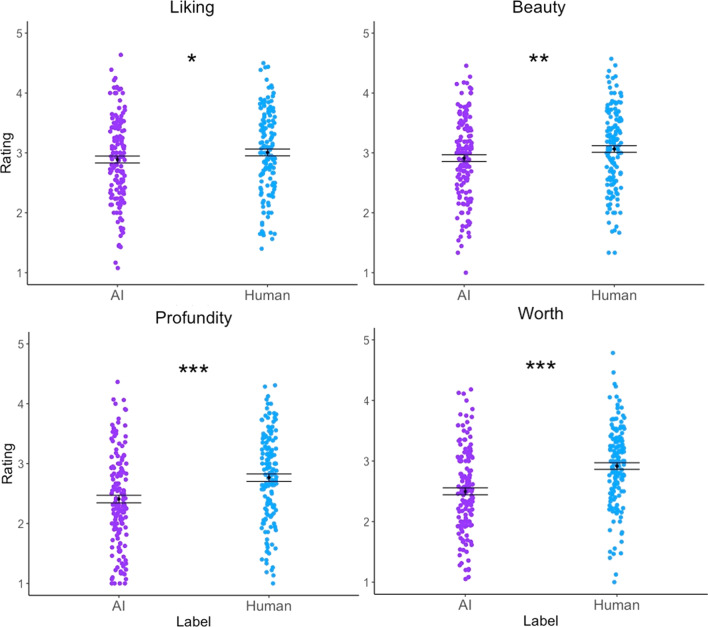
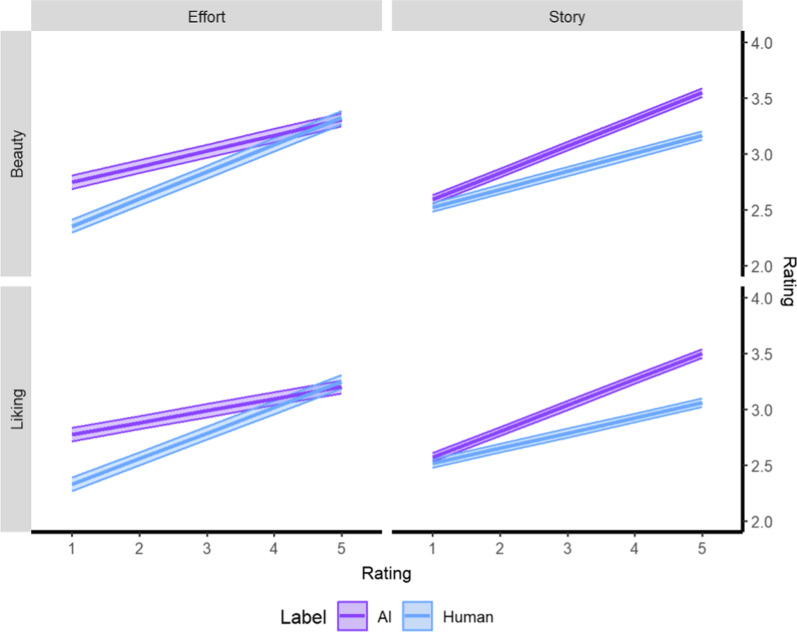
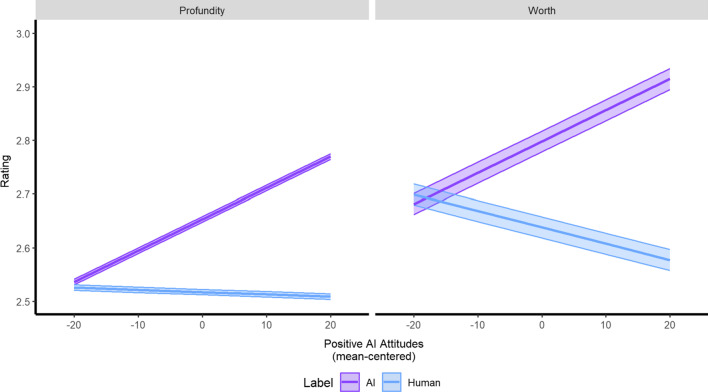
With the recent proliferation of advanced artificial intelligence (AI) models capable of mimicking human artworks, AI creations might soon replace products of human creativity, although skeptics argue that this outcome is unlikely. One possible reason this may be unlikely is that, independent of the physical properties of art, we place great value on the imbuement of the human experience in art. An interesting question, then, is whether and why people might prefer human-compared to AI-created artworks. To explore these questions, we manipulated the purported creator of pieces of art by randomly assigning a “Human-created” or “AI-created” label to paintings actually created by AI, and then assessed participants’ judgements of the artworks across four rating criteria (Liking, Beauty, Profundity, and Worth). Study 1 found increased positive judgements for human- compared to AI-labelled art across all criteria. Study 2 aimed to replicate and extend Study 1 with additional ratings (Emotion, Story, Meaningful, Effort, and Time to create) intended to elucidate why people more-positively appraise Human-labelled artworks. The main findings from Study 1 were replicated, with narrativity (Story) and perceived effort behind artworks (Effort) moderating the label effects (“Human-created” vs. “AI-created”), but only for the sensory-level judgements (Liking, Beauty). Positive personal attitudes toward AI moderated label effects for more-communicative judgements (Profundity, Worth). These studies demonstrate that people tend to be negatively biased against AI-created artworks relative to purportedly human-created artwork, and suggest that knowledge of human engagement in the artistic process contributes positively to appraisals of art.
Overview
The claims and statistics of this paper haven’t been checked yet.
Run the check — free, no account needed. It reads the open-access text and checks the sources it cites.
Integrity signals
Registry
Cites
Statistics
Figures
Verification
Claims the paper makes
The claims and statistics of this paper haven’t been checked yet.
Run the check — free, no account needed. It reads the open-access text and checks the sources it cites.
Self-check
Percentages, sums and reported differences re-computed from the paper’s own numbers.
The self-check needs the paper’s full text.
Citations
Cites
Fitting Linear Mixed-Effects Models Using lme4
Bates, D., Mächler, M., Bolker, B., & Walker, S. (2015) · Journal of Statistical Software · doi:10.18637/jss.v067.i01 · Cited by 86,835 · cited 1×
“Linear mixed-effects models using maximum likelihood estimation were estimated in R (version 4.2.0; R Core Team, 2022) using the {lme4} package (version 1.1.33; Bates et al., 2015).”
MethodInfluentialConflict, arousal, and curiosity.
Berlyne, D. E. (1960) · McGraw-Hill Book Company · doi:10.1037/11164-000 · Cited by 6,018 · cited 1×
“…cascade of evaluations, implicating more-complex and elaborative processes in judgements of art that seek to understand meaning and communication through the piece (Berlyne, 1960, 1971; Chatterjee & Vartanian, 2016; Cupchik & Berlyn, 1979; Graf & Landwehr, 2015; Leder et al., 2004; Silvia, 2005).”
BackgroundCognitive Reflection and Decision Making
Frederick, S. (2005) · Journal of Economic Perspectives · doi:10.1257/089533005775196732 · Cited by 5,256
Guilford, J. P. (1950) · American Psychologist · doi:10.1037/h0063487 · Cited by 3,588
Social psychology of creativity: A consensual assessment technique.
Amabile, T. M. (1982) · Journal of Personality and Social Psychology · doi:10.1037/0022-3514.43.5.997 · Cited by 2,278 · cited 2×
“Though contention ensues over whether artificial programs are capable of producing “creative” products (in line with the computer science principle known as the Lovelace Objection; Natale & Henrickson, 2022), it is nonetheless critical to understand how audiences perceive such art given that contemporary psychological…”
BackgroundA model of aesthetic appreciation and aesthetic judgments
Leder, H., Belke, B., Oeberst, A., & Augustin, D. (2004) · British Journal of Psychology · doi:10.1348/0007126042369811 · Cited by 1,968 · cited 4×
“…e.g., Margulis et al., 2019; McAuley et al., 2021), the act of deriving meaning from artwork that is often posited in models of aesthetics (e.g., Leder et al., 2004; Pelowski et al., 2017), and that effort and time involved in creation of a product is often a heuristic for quality (Kruger…”
BackgroundResultInfluentialNeural Correlates of Behavioral Preference for Culturally Familiar Drinks
McClure, S. M., Li, J., Tomlin, D., Cypert, K. S., Montague, L. M., & Montague, P. R. (2004) · Neuron · doi:10.1016/j.neuron.2004.09.019 · Cited by 1,413 · cited 2×
“…the extant literature on the role of labels in subjective evaluations—both in aesthetics and other domains of preferences (e.g., Kirk et al., 2009; McClure et al., 2004; Newman & Bloom, 2012; Plassmann et al., 2008; Turpin et al., 2019)—our findings demonstrate that labels significantly…”
BackgroundResultMotion, emotion and empathy in esthetic experience
Freedberg, D., & Gallese, V. (2007) · Trends in Cognitive Sciences · doi:10.1016/j.tics.2007.02.003 · Cited by 1,334
The Cambridge Handbook of Creativity
(2010) · doi:10.1017/cbo9780511763205 · Cited by 1,291
Spreng*, R. N., McKinnon*, M. C., Mar, R. A., & Levine, B. (2009) · Journal of Personality Assessment · doi:10.1080/00223890802484381 · Cited by 1,161
Research works printed but not linked: 1
- Moffat, D., & Kelly, M. G. (2006). An investigation into people’s bias against computational creativity in music composition. Assessment, 13(11), 1–8.
Cited by
Sorted by citations
Artificial muses: Generative artificial intelligence chatbots have risen to human-level creativity
Haase, J., & Hanel, P. H. P. (2023) · Journal of Creativity · doi:10.1016/j.yjoc.2023.100066 · Cited by 233
Hubert, K. F., Awa, K. N., & Zabelina, D. L. (2024) · Scientific Reports · doi:10.1038/s41598-024-53303-w · Cited by 292
AI and Its Impact on Creativity and Diversity: An Empirical Study of LLM-Generated Product Ideas
Terwiesch, C., Meincke, L., Girotra, K., Mollick, E. R., Nave, G., & Ulrich, K. T. (2023) · doi:10.2139/ssrn.4526071 · Cited by 174
The Paradox of Artificial Creativity: Challenges and Opportunities of Generative AI Artistry
Garcia, M. (2024) · Creativity Research Journal · doi:10.1080/10400419.2024.2354622 · Cited by 139
“Various studies have examined the differences in perception and valuation between human-created and AI-generated artwork (Bellaiche et al., 2023; Chiarella et al., 2022).”
InfluentialAI-generated poetry is indistinguishable from human-written poetry and is rated more favorably
Porter, B., & Machery, E. (2024) · Scientific Reports · doi:10.1038/s41598-024-76900-1 · Cited by 133
“…by AI than when told the poem is written by a human poet (two-sided Welch’s t (4571.552) = –17.398, p 0.0001, p Bonf 0.0001, Mean difference = –0.814, Cohen’s d = -0.508, 99.5% CI –0.945 to –0.683), confirming earlier findings that participants are biased against AI authorship 2,7,15 .”
InfluentialThe effect of source disclosure on evaluation of AI-generated messages
Lim, S., & Schmälzle, R. (2024) · Computers in Human Behavior Artificial Humans · doi:10.1016/j.chbah.2024.100058 · Cited by 113
AI as an Artist? A Two-Wave Survey Study on Attitudes Toward Using Artificial Intelligence in Art
Latikka, R., Bergdahl, J., Savela, N., & Oksanen, A. (2023) · Poetics · doi:10.1016/j.poetic.2023.101839 · Cited by 108
Heigl, R. M. (2025) · Management Review Quarterly · doi:10.1007/s11301-025-00494-9 · Cited by 92
“While most studies indicate a bias against GenAI-generated art (Bellaiche et al. 2023; Magni et al. 2024; Millet et al. 2023), Hong and Cur-ran (2019) observed that participants’ evaluations of art were generally unaffected by whether they knew the work was GenAI-generated.”
The language of creativity: Evidence from humans and large language models
Orwig, W., Edenbaum, E. R., Greene, J. D., & Schacter, D. L. (2024) · The Journal of Creative Behavior · doi:10.1002/jocb.636 · Cited by 56
Tan, K. P.-S., Liu, Y. V., & Litvin, S. W. (2024) · Tourism Management · doi:10.1016/j.tourman.2024.105057 · Cited by 62
When AI Doesn’t Sell Prada: Why Using AI-Generated Advertisements Backfires for Luxury Brands
To, R. N., Wu, Y.-C., Kianian, P., & Zhang, Z. (2025) · Journal of Advertising Research · doi:10.1080/00218499.2025.2454120 · Cited by 50
Koning, B., & Voorveld, H. A. M. (2025) · Journal of Interactive Advertising · doi:10.1080/15252019.2025.2554149 · Cited by 70
“Also, in studies conducted on AI disclosures and evaluations of various types of content, most results showed a negative effect (Bellaiche et al. 2023; Jakesch et al. 2019; Lim and Schmälzle 2024; Shank et al. 2023; Toff and Simon 2023; Wang and Huang 2024).”
Generative Artificial Intelligence as a Catalyst for Change in Higher Education Art Study Programs
Ansone, A., Zālīte-Supe, Z., & Daniela, L. (2025) · Computers · doi:10.3390/computers14040154 · Cited by 50
Artificial Intelligence Disclosure in Cause-Related Marketing: A Persuasion Knowledge Perspective
Qiu, X., Wang, Y., Zeng, Y., & Cong, R. (2025) · Journal of Theoretical and Applied Electronic Commerce Research · doi:10.3390/jtaer20030193 · Cited by 35
Reflecting on cultural labour in the time of AI
Lee, H.-K. (2024) · Media Culture & Society · doi:10.1177/01634437241254320 · Cited by 34
Tang, Y., Zhang, N., Ciancia, M., & Wang, Z. (2024) · Companion Publication of the 2024 Conference on Computer-Supported Cooperative Work and Social Computing · doi:10.1145/3678884.3681890 · Cited by 31
AI: An Active and Innovative Tool for Artistic Creation
Avlonitou, C. C., & Papadaki, E. (2025) · Arts · doi:10.3390/arts14030052 · Cited by 38
Yang, Y., & Kim, M.-Y. (2024) · Sustainability · doi:10.3390/su17010125 · Cited by 33
Human bias in evaluating AI product creativity
Hattori, E. A., Yamakawa, M., & Miwa, K. (2024) · Journal of Creativity · doi:10.1016/j.yjoc.2024.100087 · Cited by 37
Neef, N. E., Zabel, S., Papoli, M., & Otto, S. (2024) · AI & Society · doi:10.1007/s00146-024-02020-z · Cited by 36
“Bellaiche et al. (2023) examined whether participants' judgments might be explained by their ability to empathize with other agents, including AI.”
InfluentialTrusting AI: does uncertainty visualization affect decision-making?
Reyes, J., Batmaz, A. U., & Kersten-Oertel, M. (2025) · Frontiers in Computer Science · doi:10.3389/fcomp.2025.1464348 · Cited by 27
Data Ownership in the AI-Powered Integrative Health Care Landscape
Liu, S., & Guo, L. (2024) · JMIR Medical Informatics · doi:10.2196/57754 · Cited by 29
A Discussion of Artificial Intelligence in Visual Art Education
Black, J., & Chaput, T. (2024) · Journal of Computer and Communications · doi:10.4236/jcc.2024.125005 · Cited by 26
AI Performer Bias: Listeners Like Music Less When They Think it was Performed by an AI
Ansani, A., Koehler, F., Giombini, L., Hämäläinen, M., Chen, M., Marini, M., & Saarikallio, S. H. (2025) · Empirical Studies of the Arts · doi:10.1177/02762374241308807 · Cited by 33
“More in general, it underscores the importance of considering individual differences in future research examining anti-AI bias regarding music and arts (Bellaiche et al., 2023), such as trust in technology or personal experience with AI as well as personality traits or cognitive fl exibility.”
InfluentialAI contextual information shapes moral and aesthetic judgments of AI-generated visual art
Bara, I., Ramsey, R., & Cross, E. S. (2025) · Cognition · doi:10.1016/j.cognition.2025.106063 · Cited by 28
The Value of Creativity: Human Produced Art vs. AI-Generated Art
Hall, J., & Schofield, D. (2025) · Art and Design Review · doi:10.4236/adr.2025.131005 · Cited by 22
“Critics argue that while AI can emulate the technical aspects of art, it lacks the subjective experience and emotional depth that characterize human-driven creativity (Bellaiche et al., 2023).”
Understanding model power in social AI
Brandtzæg, P. B., Skjuve, M. B., & Følstad, A. (2024) · AI & Society · doi:10.1007/s00146-024-02053-4 · Cited by 25
“Research on AI aversion in Social AI like Chat-GPT has found some evidence of a similar resistance (Böhm et al. 2023; Lim and Schmälzle 2024), for example, in creative domains (Bauer et al. 2024; Bellaiche et al. 2023; Shank et al. 2023).”
Sikhondze, B., Ye, H. J., Wang, W., Zhan, X., & Santhanam, R. (2025) · Journal of Management Information Systems · doi:10.1080/07421222.2025.2487314 · Cited by 18
“Information about human authorship in creative domains such as art, literature, and music has been shown to enhance perceived authenticity and quality [13, 55].”
Turós, M., Nagy, R., & Szűts, Z. (2025) · Computers and Education Artificial Intelligence · doi:10.1016/j.caeai.2025.100394 · Cited by 32
Bianchi, I., Branchini, E., Uricchio, T., & Bongelli, R. (2025) · Frontiers in Psychology · doi:10.3389/fpsyg.2025.1648480 · Cited by 40
Rong, W., Xiao, M., Zhao, L., & Zhou, X. (2025) · Information · doi:10.3390/info16121070 · Cited by 28
The Evolutionary Impact of Artificial Intelligence on Contemporary Artistic Practices
Chi, J. (2024) · Communications in Humanities Research · doi:10.54254/2753-7064/35/20240006 · Cited by 19
Generative AI and Perceptual Harms: Who's Suspected of using LLMs?
Kadoma, K., Metaxa, D., & Naaman, M. (2025) · Proceedings of the 2025 CHI Conference on Human Factors in Computing Systems · doi:10.1145/3706598.3713897 · Cited by 14
“These results suggest that stereotypes about technological savviness may cause perceptual harms, in the form of AI suspicion, against groups seen as likely to uptake these new technologies, including groups like White men who usually stand to benefit from social biases.”
Cyber-Creativity: A Decalogue of Research Challenges
Corazza, G. E., Agnoli, S., Jorge Artigau, A., Beghetto, R. A., Bonnardel, N., Coletto, I., Faiella, A., Gerardini, K., Gilhooly, K., Glăveanu, V. P., et al. (2025) · Journal of Intelligence · doi:10.3390/jintelligence13080103 · Cited by 14
Şahin, M. G., & Yıldırım, Y. (2024) · International Journal of Assessment Tools in Education · doi:10.21449/ijate.1369023 · Cited by 21
Artificial Intelligence in Digital Art: A Comparative Analysis on Impacts to Artists
Cajulis, R. C. J., Tuazon, J. A., & Cabauatan, R. R. (2025) · International Journal of Arts Recreation and Sports · doi:10.47941/ijars.2444 · Cited by 15
Vision Transformers (ViTs) for Feature Extraction and Classification of AI-Generated Visual Designs
Yun, Q. (2025) · IEEE Access · doi:10.1109/access.2025.3562130 · Cited by 13
“A longitudinal approach allows it to make the distinction between AI generated and human generated art based on deep historical insights [32].”
Chen, C., Zhang, D., Zhu, L., & Zhang, F. (2025) · International Journal of Consumer Studies · doi:10.1111/ijcs.70121 · Cited by 15
Wu, Z., Weber, T., & Müller, F. (2025) · ACM International Conference on Intelligent User Interfaces (IUI) · doi:10.1145/3708359.3712094 · Cited by 12
Perspectives on AI artists in generating artwork in advertising industry
Promsombut, P., Rungpanya, V., Chumworratayee, K., & Kerdvibulvech, C. (2024) · International Journal of Information Technology · doi:10.1007/s41870-024-01878-y · Cited by 13
“This aligns with research [6] discussing biases when viewers are aware that a piece of art is AI-generated, impacting their interpretation and emotional connection.”
InfluentialAI is not careful: approach to the stock market and preference for AI advisor
Koo, J. (2024) · International Journal of Bank Marketing · doi:10.1108/ijbm-10-2023-0568 · Cited by 11
Holyoak, K. J. (2024) · Journal of Cognitive Psychology · doi:10.1080/20445911.2024.2395573 · Cited by 12
Making AI-Enhanced Videos: Analyzing Generative AI Use Cases in YouTube Content Creation
Anderson, T., & Niu, S. (2025) · CHI Conference Extended Abstracts on Human Factors in Computing Systems (CHI EA) · doi:10.1145/3706599.3719991 · Cited by 19
More-than-Human Storytelling: Designing Longitudinal Narrative Engagements with Generative AI
Fabre, É., Seaborn, K., Koiwai, S., Watanabe, M., & Riesch, P. (2025) · CHI Conference Extended Abstracts on Human Factors in Computing Systems (CHI EA) · doi:10.1145/3706599.3720135 · Cited by 15
“When comparing AI artwork with human artwork, even with labels swapped (i.e., a human artwork labelled as AI-generated), raters tend to disparage the AI art more often than not [3].”
Biswas, S., Erlei, A., & Gadiraju, U. (2025) · CHI Conference on Human Factors in Computing Systems · doi:10.1145/3706598.3713201 · Cited by 17
The AI Genie in the Bottle: Charting AI Evolution and Aversion in Advertising
Feng, Y. (2025) · Journal of Interactive Advertising · doi:10.1080/15252019.2025.2537019 · Cited by 14
“For example, Bellaiche et al. (2023) highlighted that disclosure significantly affects individuals’ evaluations, with the “AI” label frequently associated with negative perceptions.”
Generative AI and the Perceived Quality of User-Generated Content: Evidence from Online ReviewsPreprint
Knight, S., Bart, Y., & Yang, M. (2023) · SSRN Electronic Journal · doi:10.2139/ssrn.4621982 · Cited by 12
From humans to AI: understanding why AI is perceived as the preferred co-creation partner
Liu, Y., Yang, Y., & Xu, H. (2025) · Frontiers in Psychology · doi:10.3389/fpsyg.2025.1695532 · Cited by 10
Hubert, K. F., Awa, K. N., & Zabelina, D. L. (2023) · doi:10.31234/osf.io/6py2m · Cited by 10
Wang, J., Yuan, X., Hu, S., & Lu, Z. (2025) · International Journal of Human-Computer Interaction · doi:10.1080/10447318.2025.2531284 · Cited by 13
“Additionally, to identify prominent reasons for negative comments, topic modeling was adopted to analyze the 42199 comments for AIGP and 39763 comments for human paintings, respectively.”
The Measurement of Attitudes Towards Artificial Intelligence: An Overview and Recommendations
Schepman, A., & Rodway, P. (2024) · Studies in neuroscience, psychology and behavioral economics · doi:10.1007/978-3-031-70355-3_2 · Cited by 8
The rise of AI art: A look through digital artists' eyes
Zhang, L., Wilson, K., & Amos, C. (2025) · First Monday · doi:10.5210/fm.v30i4.13809 · Cited by 10
Beyond AI automation: Redesigning organizations for human-AI synergy
Krotov, V. (2025) · Business Horizons · doi:10.1016/j.bushor.2025.06.007 · Cited by 9
Bao, S. (2025) · Sustainable Futures · doi:10.1016/j.sftr.2025.100929 · Cited by 12
Zhang, X., Zhu, S., Zhao, Y., Jia, M., & Zhu, Q. (2024) · Information Research · doi:10.47989/ir292856 · Cited by 8
AI Art Perceptions with GenFrame – an Image Generating Picture Frame
Kun, P., Freiberger, M., Løvlie, A. S., & Risi, S. (2024) · Proceedings of DRS · doi:10.21606/drs.2024.997 · Cited by 8
“However, people have a more favorable judgment of AI-generated art when a human is engaged in the making process (Bellaiche et al., 2023).”
BackgroundHow Disclosing Generative AI Use Impacts Human Creative Involvement in Human-GenAI CollaborationPreprint
Bauer, K., Jussupow, E., Heigl, R. M., Vogt, B., & Hinz, O. F. (2024) · SSRN Electronic Journal · doi:10.2139/ssrn.4782554 · Cited by 7
Lämmchen, R. (2025) · RaumFragen: Stadt - Region - Landschaft · doi:10.1007/978-3-031-75416-6_24 · Cited by 6
Page, R., & See, J. S. (2025) · CHI Conference on Human Factors in Computing Systems · doi:10.1145/3706598.3713529 · Cited by 6
Małecki, W., Messingschlager, T. V., & Appel, M. (2025) · New Media & Society · doi:10.1177/14614448251344590 · Cited by 6
“…the experience of AI-attributed artworks, with those artworks being appreciated less than their human-attributed counterparts (Agudo et al., 2022; Bellaiche et al., 2023; Chamberlain et al., 2018; Gangadharbatla, 2022; Hong and Curran, 2019; Millet et al., 2023; Ragot et al., 2020; Wu et al.,…”
Glavas, D., Grolleau, G., & Mzoughi, N. (2025) · Sustainable Futures · doi:10.1016/j.sftr.2025.101153 · Cited by 6
Can You Spot the AI-Generated Images? Distinguishing Fake Images Using Signal Detection Theory
Park, H., Kim, G., Lee, D., & Kim, H. K. (2024) · Lecture notes in computer science · doi:10.1007/978-3-031-60913-8_21 · Cited by 7
Embracing Generative AI in Design: Practical Implementations
Chellakkannu, S. (2024) · Lecture notes in networks and systems · doi:10.1007/978-3-031-71429-0_15 · Cited by 6
Bradford, B., Kyprianides, A., Andrews, W., Aston, E., Clayton, E., O’Neill, M., & Wells, H. (2025) · Policing & Society · doi:10.1080/10439463.2025.2453437 · Cited by 9
“Bellaiche et al. (2023), for instance, found that people preferred works of art they thought were produced by a human over those produced by an AI, even though they were the same works , seemingly because they thought the human work more morally authentic – that is, produced by an entity capable of…”
Ortega, J. H. J. C., & Repollo, J. A. (2025) · International Symposium on Educational Technology · doi:10.1109/iset65607.2025.00033 · Cited by 6
Beyond the Brush: Human Versus AI Creativity in the Realm of Generative ArtPreprint
Seli, P., Ragnhildstveit, A., Orwig, W., Bellaiche, L., Spooner, S., & Barr, N. (2024) · doi:10.31234/osf.io/vgzhj · Cited by 6
Self-citationCan generative artificial intelligence help or hinder sustainable marketing?
McCarthy, B. (2024) · Journal of Resilient Economies (ISSN 2653-1917) · doi:10.25120/jre.4.2.2024.4153 · Cited by 2
Unlimited Editions: Documenting Human Style in AI Art Generation
Leitch, A., & Chen, C. (2025) · CHI Conference Extended Abstracts on Human Factors in Computing Systems (CHI EA) · doi:10.1145/3706599.3716214 · Cited by 6
Jora, O.-D., Iacob, M. D., Roșca, V. I., Nedelcu, M.-R., Preda, A.-F., & Nedef, M.-Ș. (2024) · Amfiteatru Economic · doi:10.24818/ea/2024/66/630 · Cited by 5
Simister, S. K., Huish, E. G., Tsai, E. Y., et al. (2024) · Journal of the American Academy of Orthopaedic Surgeons · doi:10.5435/jaaos-d-24-00438 · Cited by 5
The Exploration of Emotional Aspects of Artificial Intelligence (AI) in Artistic Design
Zhao, W., & Sun, Y. (2024) · International Journal of Interdisciplinary Studies in Social Science · doi:10.62309/bk757m16 · Cited by 8
“The aesthetic acceptance of AI art by humans is an area worth exploring (Bellaiche et al., 2023).”
BackgroundThe Impact of Pseudo-Profound Bullshit Titles on Memory for Artist-Created and AI-Generated Art
Hupbach, A., & Janger, A. (2025) · Empirical Studies of the Arts · doi:10.1177/02762374251314402 · Cited by 5
“Similarly, when AI-generated paintings were labeled as AI-generated, they received lower ratings of Liking, Beauty, Profundity, and Worth than when the same paintings were labeled as human-created (Bellaiche et al., 2023).”
Validation of the Short General Attitudes Towards Artificial Intelligence Scale: The Short GAAIS-10
Schepman, A., & Rodway, P. (2026) · International Journal of Human-Computer Interaction · doi:10.1080/10447318.2025.2610446 · Cited by 5
“The empirical evidence suggests that capturing AI attitudes that are deemed “general” has predictive value across a variety of contexts (e.g., Alruwaili et al., 2024; Bellaiche et al., 2023).”
Yinghua, W., Linyan, L., Wenjuan, M., & Yunzhe, Z. (2026) · Scientific Reports · doi:10.1038/s41598-025-29229-2 · Cited by 4
Acceptance of AI design tools in fashion education - Evidence from technology acceptance model -
Lim, S. (2025) · The Research Journal of the Costume Culture · doi:10.29049/rjcc.2025.33.5.662 · Cited by 4
Shi, M., Guo, Q., Li, H., & Lee, K. (2026) · Scientific Reports · doi:10.1038/s41598-026-36224-8 · Cited by 9
“In the broader AI-art context, Horton et al. 81 and Bellaiche et al. 82 show that people often display a systematic bias in favour of human authorship: human-created artworks are preferred over AI-created ones, and the presence of AI output can even lead observers to upgrade their evaluations of human creativity.”
Nobel, S. K., Lim, R. E., & Kim, S. (2026) · International Journal of Advertising · doi:10.1080/02650487.2026.2634490 · Cited by 5
Chen, Z., & He, Y. (2026) · Digital Scholarship in the Humanities · doi:10.1093/llc/fqag035 · Cited by 12
Unveiling the Transformative Potential of AI-Generated Imagery in Enriching Mental Health Research
Milasan, L. H. (2024) · Qualitative Health Research · doi:10.1177/10497323241274767 · Cited by 5
“Furthermore, the evidence on the potential negative bias people may have against AI-generated artwork compared to human-created art (Bellaiche et al., 2023) adds another level of complexity to this debate.”
Navigating Copyright Law in the Age of AI
Ali, S. M., & Ghose, A. (2024) · Advances in human and social aspects of technology book series · doi:10.4018/979-8-3693-7235-7.ch014 · Cited by 4
Creative Paradigms, Generative AI, and Copyright Law
Ghose, A., Ali, S. M., & Deshmukh, S. B. (2024) · Advances in electronic government, digital divide, and regional development book series · doi:10.4018/979-8-3693-7205-0.ch006 · Cited by 3
Anti-AI Bias Toward Couple Images and Couple Counseling: Findings from Two Experiments
Döring, N. M., & Mohseni, M. R. (2025) · Archives of Sexual Behavior · doi:10.1007/s10508-025-03318-9 · Cited by 7
Gökşen, F., Demirel, B. B. C., & Ayçam, İ. (2025) · Black Sea Journal of Engineering and Science · doi:10.34248/bsengineering.1761624 · Cited by 3
Beauty Lost in AI: Diminished Aesthetic Judgments of AI Paintings Among Chinese Viewers
Lin, H., Leng, X., Li, Y., & Wang, Y. (2026) · International Journal of Human-Computer Interaction · doi:10.1080/10447318.2026.2621277 · Cited by 3
“Following Bellaiche (2023), the Aesthetic Judgment Scale was used to evaluate participants’ aesthetic judgments across four dimensions: liking, beauty, profundity and worth.”
InfluentialSeeger, F., Wessel, M., & Lehrer, C. (2026) · Electronic Markets · doi:10.1007/s12525-026-00883-2 · Cited by 7
Henrickson, L. (2024) · Poetics Today · doi:10.1215/03335372-11092924 · Cited by 3
The Nature Technology Political Spectrum
Steyn, B. (2025) · Philosophy & Technology · doi:10.1007/s13347-025-00852-1 · Cited by 3
Battisti, D. (2025) · The American Journal of Bioethics · doi:10.1080/15265161.2024.2441761 · Cited by 3
“Moreover, in the specific art domain, a study demonstrated that people prefer labeled human-created art over AI-created art, particularly when it is perceived as conveying deeper meanings (Bellaiche et al. 2023).”
Importance of Human Judgment in Artificial Intelligence: A Panoramic Overview
Bahadure, N. B., Khomane, R. B., Shafaq, Pathan, S., Sharma, A., & Satokar, P. (2025) · Advances in Science, Technology & Innovation/Advances in science, technology & innovation · doi:10.1007/978-3-031-72747-4_34 · Cited by 3
Consumer Response to the Use of AI in Value Co‐Creation in Online Communities—The Case of Nexus Mods
Wieczerzycki, M. (2025) · Journal of Consumer Behaviour · doi:10.1002/cb.2509 · Cited by 2
Den samtida receptionen och värderingen av AI-genererad litteratur i sverige
Helsing, D., Forslid, T., & Ohlsson, A. (2025) · Tidskrift för litteraturvetenskap · doi:10.54797/tfl.v55i1.55919 · Cited by 3
Ortega, J. H. J. C. (2025) · IEEE Control and System Graduate Research Colloquium (ICSGRC) · doi:10.1109/icsgrc65918.2025.11159801 · Cited by 2
“In recent developments, core marketing activities such as segment targeting, content customization, and customer interaction have been redefined by AI’s capacity to process complex data sets and anticipate user behavior patterns [2][3].”
Ortega, J. H. J. C. (2025) · IEEE Control and System Graduate Research Colloquium (ICSGRC) · doi:10.1109/icsgrc65918.2025.11159803 · Cited by 2
An eye for AI: quantitative insights into viewer ability to identify AI-generated artworks
Cunningham, J. (2025) · Journal of Information Communication and Ethics in Society · doi:10.1108/jices-05-2025-0105 · Cited by 2
Beyond the Responsibility Gap: Distributed Non-anthropocentric Responsibility in the AI Era
Noh, H. (2025) · Topoi · doi:10.1007/s11245-025-10302-4 · Cited by 5
Luokuan, Z., & Zhang, H. (2025) · International Journal of Human-Computer Interaction · doi:10.1080/10447318.2025.2580546 · Cited by 3
“While AI can imitate esthetic qualities, it will struggle to replicate the deeper emotional and narrative elements provided by human creativity, which consumers value highly in art products (Bellaiche et al., 2023).”
Ortega, J. H. J. (2026) · Smart innovation, systems and technologies · doi:10.1007/978-981-95-1357-4_11 · Cited by 2
Rehman, S. U., & Fareed, M. (2025) · Contemporary Economics · doi:10.5709/ce.1897-9254.576 · Cited by 3
Is there a “mind” behind the music? Attributing music to AI can suppress narrative meaning-making
Wu, S., & Holmes, K. J. (2026) · Cognitive Research Principles and Implications · doi:10.1186/s41235-026-00715-z · Cited by 2
“This may explain why AI-generated art is often evaluated less favorably than human works (Bellaiche et al., 2023; Shank et al., 2023), even when nearly indistinguishable from them (Chamberlain et al., 2018; Hong et al., 2022).”
Mechanism of public behavioral intention to use generative AI for folk story image co-creation
Kong, X., Liu, Y., Shi, Y., Xu, J., & Liu, M. (2026) · npj Heritage Science · doi:10.1038/s40494-025-02285-7 · Cited by 3
Metadata
- Authors
- Bellaiche, L., Shahi, R., Turpin, M. H., Ragnhildstveit, A., Sprockett, S., Barr, N., Christensen, A., & Seli, P.
- Affiliations
- Duke University (US)
- University of Waterloo (CA)
- University of Cambridge (GB)
- California College of the Arts (US)
- Sheridan College (US)
- Vanderbilt University (US)
- Corresponding author
- Bellaiche, Lucas
- ORCID
- Venue
- Cognitive Research: Principles and Implications
- Published
- 2023-07-04
- Volume
- 8
- Issue
- 1
- Pages
- 42-42
- ISSN
- 2365-7464 (ISSN-L)
- PMC
- PMC10319694
- OpenAlex
- W4383058345
- Cited by
- 233
- References
- 83
- Citations by year
- 2026: 82 · 2025: 98 · 2024: 48 · 2023: 4
- FWCI
- 34.66
- Type
- journal article
- Language
- en
- Open access
- gold
- doi.org
- Locations
- Cognitive Research Principles and Implications (publishedVersion, cc-by)
- PubMed Central (publishedVersion, cc-by)
- PubMed (publishedVersion)
- Apollo (University of Cambridge) (submittedVersion, cc-by)
- DOAJ (DOAJ: Directory of Open Access Journals) (submittedVersion, cc-by-sa)
- SOURCE Sheridan's Institutional Repository (Sheridan College) (submittedVersion, cc-by)
- Funders
- National Science Foundation
- Topics
- Life Sciences › Neuroscience › Cognitive Neuroscience › Aesthetic Perception and Analysis
- Social Sciences › Arts and Humanities › Visual Arts and Performing Arts › Art, Technology, and Culture
- Physical Sciences › Computer Science › Computer Graphics and Computer-Aided Design › Digital Media and Visual Art
- Keywords
- AI-generated art, art evaluation, aesthetic judgment, narrativity, perceived effort, attitudes toward AI
- MeSH terms
- Artificial Intelligence, Beauty, Emotions, Humans, Judgment, Paintings
About these checks
Registry, retraction, Cites and statistics results are computed, not judged, with one exception: a printed reference that no index lists is read once by a model before it counts as a citation error. Claims are extracted by a model and kept only when their quote appears verbatim in the text; each cited source is then checked, with a model’s help, for whether it says what the claim relies on. Those verdicts can be wrong — read the claim’s quote and the cited source before relying on one.
Statistics and arithmetic are recomputed, not judged.
Confidence bands are shown only for fields calibrated on our annotated test set. None is calibrated yet, so no band is shown.
What counts as a claim ›How we measure confidence ›How we check this ›
Are you an author, or do you see a problem with this page? Request a review
