

The DOI matches its Crossref record; 147 of the 152 references it cites were found in a registry or an index.
The effect of games and simulations on higher education: a systematic literature review
Open accessAbstract
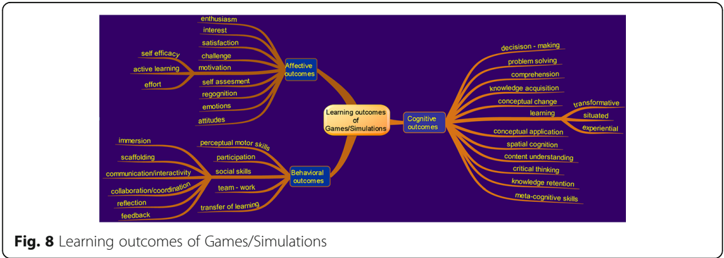
The focus of higher education institutions is the preparation of future professionals. To achieve this aim, innovative teaching methods are often deployed, including games and simulations, which form the subject of this paper. As the field of digital games and simulations is ever maturing, this paper attempts to systematically review the literature relevant to games and simulation pedagogy in higher education. Two researchers collaborate to apply a qualitative method, coding and synthesizing the results using multiple criteria. The main objective is to study the impact of games and simulations with regard to achieving specific learning objectives. On balance, results indicate that games and/or simulations have a positive impact on learning goals. The researchers identify three learning outcomes when integrating games into the learning process: cognitive, behavioural, and affective. As a final step, the authors consolidate evidence for the benefit of academics and practitioners in higher education interested in the efficient use of games and simulations for pedagogical purposes. Such evidence also provides potential options and pathways for future research.
Overview
The claims and statistics of this paper haven’t been checked yet.
Run the check — free, no account needed. It reads the open-access text and checks the sources it cites.
Integrity signals
Registry
Cites
Statistics
Figures
Verification
Claims the paper makes
The claims and statistics of this paper haven’t been checked yet.
Run the check — free, no account needed. It reads the open-access text and checks the sources it cites.
Claims other papers make about this one
Each is checked against this paper’s own text: does it say what the citing paper says it does?
In the citing paper
“Beyond the Longevity Games, practical simulations benefit students by preparing students for practical experiences (17–19).”
From Using generative AI for interview simulations to enhance student research skills in biology education (2025) · cites this paper as [18]
Self-check
Percentages, sums and reported differences re-computed from the paper’s own numbers.
The self-check needs the paper’s full text.
Citations
Cites
Rules of Play: Game Design Fundamentals
Salen, K., & Zimmerman, E. (2003) · Medical Entomology and Zoology · Cited by 5,438
A systematic literature review of empirical evidence on computer games and serious games
Connolly, T. M., Boyle, E. A., MacArthur, E., Hainey, T., & Boyle, J. M. (2012) · Computers & Education · doi:10.1016/j.compedu.2012.03.004 · Cited by 2,890
Merchant, Z., Goetz, E. T., Cifuentes, L., Keeney-Kennicutt, W., & Davis, T. J. (2014) · Computers & Education · doi:10.1016/j.compedu.2013.07.033 · Cited by 2,109
From visual simulation to virtual reality to games
Zyda, M. (2005) · Computer · doi:10.1109/mc.2005.297 · Cited by 2,077
A meta-analysis of the cognitive and motivational effects of serious games.
Wouters, P., van Nimwegen, C., van Oostendorp, H., & van der Spek, E. D. (2013) · Journal of Educational Psychology · doi:10.1037/a0031311 · Cited by 1,864
Digital Games, Design, and Learning: A Systematic Review and Meta-Analysis
Clark, D. B., Tanner-Smith, E. E., & Killingsworth, S. S. (2016) · Review of Educational Research · doi:10.3102/0034654315582065 · Cited by 1,274
The learning effects of computer simulations in science education
Rutten, N., van Joolingen, W., & van der Veen, J. T. (2011) · Computers & Education · doi:10.1016/j.compedu.2011.07.017 · Cited by 1,079
A META‐ANALYTIC EXAMINATION OF THE INSTRUCTIONAL EFFECTIVENESS OF COMPUTER‐BASED SIMULATION GAMES
SITZMANN, T. (2011) · Personnel Psychology · doi:10.1111/j.1744-6570.2011.01190.x · Cited by 882
Serious games as new educational tools: how effective are they? A meta‐analysis of recent studies
Girard, C., Écalle, J., & Magnan, A. (2012) · Journal of Computer Assisted Learning · doi:10.1111/j.1365-2729.2012.00489.x · Cited by 738
Our Princess Is in Another Castle
Young, M. F., Slota, S. T., Cutter, A. B., Jalette, G., Mullin, G., Lai, B., Simeoni, Z., Tran, M. T., & Yukhymenko–Lescroart, M. A. (2012) · Review of Educational Research · doi:10.3102/0034654312436980 · Cited by 737
Smetana, L. K., & Bell, R. L. (2012) · International Journal of Science Education · doi:10.1080/09500693.2011.605182 · Cited by 702
Erhel, S., & Jamet, É. (2013) · Computers & Education · doi:10.1016/j.compedu.2013.02.019 · Cited by 691
Salvat, B. M. G. (2007) · Journal of Research on Technology in Education · doi:10.1080/15391523.2007.10782494 · Cited by 682
Assessment in and of Serious Games: An Overview
Bellotti, F., Kapralos, B., Lee, K., Pablo Moreno-ger, A., & Berta, R. (2013) · Advances in Human-Computer Interaction · doi:10.1155/2013/136864 · Cited by 662
(2020) · Issues in Information Systems · doi:10.48009/iis · Cited by 653
Active Video Games to Promote Physical Activity in Children and Youth: A Systematic Review
Biddiss, E., & Irwin, J. (2010) · Archives of Pediatrics & Adolescent Medicine · doi:10.1001/archpediatrics.2010.104 · Cited by 562
International Proceedings of Economics Development and Research
Sek, Y. W., Che Pee, A. N., Hasan Basri, A. S., Lau, S. H., Hisham, S., & Law, C. Y. (2012) · International Proceedings of Economics Development and Research · doi:10.7763/ipedr · Cited by 554
Effectiveness of patient simulation in nursing education: Meta-analysis
Shin, S., Park, J.-H., & Kim, J.-H. (2015) · Nurse Education Today · doi:10.1016/j.nedt.2014.09.009 · Cited by 543 · cited 6×
“interaction and feedback, findings that are in line with past reviews (Shin et al., 2015; Carenys & Moya, 2016).”
BackgroundResultInfluentialGame-Based Learning in Science Education: A Review of Relevant Research
Li, M.-C., & Tsai, C. (2013) · Journal of Science Education and Technology · doi:10.1007/s10956-013-9436-x · Cited by 406
A meta-analytic review of the role of instructional support in game-based learning
Wouters, P., & van Oostendorp, H. (2013) · Computers & Education · doi:10.1016/j.compedu.2012.07.018 · Cited by 381
Physical versus virtual manipulative experimentation in physics learning
Zacharia, Z. C., & Olympiou, G. (2010) · Learning and Instruction · doi:10.1016/j.learninstruc.2010.03.001 · Cited by 368
(2008) · Cited by 365
Mueller, F., Agamanolis, S., & Picard, R. W. (2003) · ACM SIGCHI Conference on Human Factors in Computing Systems (CHI) · doi:10.1145/642611.642709 · Cited by 359
Wang, L., & Chen, M. (2010) · Innovations in Education and Teaching International · doi:10.1080/14703290903525838 · Cited by 338
Lameras, P., Arnab, S., Dunwell, I., Stewart, C. D., Clarke, S., & Petridis, P. (2016) · British Journal of Educational Technology · doi:10.1111/bjet.12467 · Cited by 320
Davies, B. S., Rafique, J., Vincent, T. R., Fairclough, J., Packer, M. H., Vincent, R., & Haq, I. (2012) · BMC Medical Education · doi:10.1186/1472-6920-12-1 · Cited by 307
The effect of simulation games on the learning of computational problem solving
Liu, C., Cheng, Y., & Huang, C.-W. (2011) · Computers & Education · doi:10.1016/j.compedu.2011.04.002 · Cited by 298
The impact of a simulation game on operations management education
Pasin, F., & Giroux, H. (2011) · Computers & Education · doi:10.1016/j.compedu.2010.12.006 · Cited by 278
Backlund, P., & Hendrix, M. (2013) · International Conference on Games and Virtual Worlds for Serious Applications · doi:10.1109/vs-games.2013.6624226 · Cited by 275
Huang, W. D., Huang, W.-Y., & Tschopp, J. (2010) · Computers & Education · doi:10.1016/j.compedu.2010.03.011 · Cited by 265
Warren, J. N., Luctkar‐Flude, M., Godfrey, C. M., & Lukewich, J. (2016) · Nurse Education Today · doi:10.1016/j.nedt.2016.08.023 · Cited by 246
Gutiérrez, R. C., & López, J. M. S. (2016) · International Journal of Educational Technology in Higher Education · doi:10.1186/s41239-016-0003-4 · Cited by 235
Game‐based learning engagement: A theory‐ and data‐driven exploration
Ke, F., Xie, K., & Xie, Y. (2015) · British Journal of Educational Technology · doi:10.1111/bjet.12314 · Cited by 226
Making patient safety the focus: Crisis Resource Management in the undergraduate curriculum
Flanagan, B. T., Nestel, D., & Joseph, M. (2004) · Medical Education · doi:10.1111/j.1365-2923.2004.01701.x · Cited by 225
Yang, J. C., Chen, C., & Jeng, M. C. (2010) · Computers & Education · doi:10.1016/j.compedu.2010.06.005 · Cited by 220
An application of games‐based learning within software engineering
Connolly, T. M., Stansfield, M., & Hainey, T. (2007) · British Journal of Educational Technology · doi:10.1111/j.1467-8535.2007.00706.x · Cited by 205
Willoughby, T. (2008) · Developmental Psychology · doi:10.1037/0012-1649.44.1.195 · Cited by 205
Boeker, M., Andel, P. M., Vach, W., & Frankenschmidt, A. (2013) · PLoS ONE · doi:10.1371/journal.pone.0082328 · Cited by 200
Peterson, M. (2009) · Simulation & Gaming · doi:10.1177/1046878109355684 · Cited by 200
Hou, H. (2015) · Computers in Human Behavior · doi:10.1016/j.chb.2015.02.010 · Cited by 194
Yang, Y., & Chang, C.-H. (2013) · Computers & Education · doi:10.1016/j.compedu.2013.05.023 · Cited by 193
Hainey, T., Connolly, T. M., Stansfield, M., & Boyle, E. A. (2010) · Computers & Education · doi:10.1016/j.compedu.2010.09.008 · Cited by 185
Distinguishing between games and simulations: A systematic review
Sauvé, L., Rénaud, L., Kaufman, D. M., & Marquis, J.-S. (2007) · Cited by 179
Digital simulation‐based training: A meta‐analysis
Gegenfurtner, A., Quesada‐Pallarès, C., & Knogler, M. (2014) · British Journal of Educational Technology · doi:10.1111/bjet.12188 · Cited by 173
Tsekleves, E., Cosmas, J., & Aggoun, A. (2014) · British Journal of Educational Technology · doi:10.1111/bjet.12223 · Cited by 165
A Proof-of-Concept Study of Game-Based Learning in Higher Education
Crocco, F., Offenholley, K. H., & Hernandez, C. (2016) · Simulation & Gaming · doi:10.1177/1046878116632484 · Cited by 165
Woo, J.-C. (2014) · Cited by 157
Operation ARA: A computerized learning game that teaches critical thinking and scientific reasoning
Halpern, D. F., Millis, K., Graesser, A. C., Butler, H. A., Forsyth, C. M., & Cai, Z. (2012) · Thinking Skills and Creativity · doi:10.1016/j.tsc.2012.03.006 · Cited by 152
Journal of information and organizational sciences
(2018) · Journal of information and organizational sciences · doi:10.31341/jios · Cited by 151
Dankbaar, M. E. W., Alsma, J., Jansen, E. E. H., van Merrienboer, J. J. G., van Saase, J. L. C. M., & Schuit, S. C. E. (2016) · Advances in Health Sciences Education · doi:10.1007/s10459-015-9641-x · Cited by 147
Evaluating multiple aspects of a digital educational problem-solving-based adventure game
Hou, H., & Li, M.-C. (2013) · Computers in Human Behavior · doi:10.1016/j.chb.2013.07.052 · Cited by 141
Simulation-Based Crisis Team Training for Multidisciplinary Obstetric Providers
Robertson, B., Schumacher, L., Gosman, G. G., Kanfer, R., Kelley, M. A., & DeVita, M. A. (2009) · Simulation in Healthcare The Journal of the Society for Simulation in Healthcare · doi:10.1097/sih.0b013e31819171cd · Cited by 138
Digital game-based learning in accounting and business education
Carenys, J., & Gutiérrez, S. M. (2016) · Accounting Education · doi:10.1080/09639284.2016.1241951 · Cited by 137
Evaluating the educational effectiveness of simulation games: A value generation model
Ranchhod, A., Gurǎu, C., Loukis, E. N., & Trivedi, R. H. (2013) · Information Sciences · doi:10.1016/j.ins.2013.09.008 · Cited by 129
Effectiveness of Learning Through Experience and Reflection in a Project Management Simulation
Geithner, S., & Menzel, D. (2016) · Simulation & Gaming · doi:10.1177/1046878115624312 · Cited by 129
Watkins, M., & Beckem, J. M. (2012) · Online Learning · doi:10.24059/olj.v16i5.287 · Cited by 114
Chen, C., Wang, K.-C., & Lin, Y.-H. (2015) · Educational Technology & Society · Cited by 112
Divjak, B., & Tomić, D. (2011) · University of Zagreb University Computing Centre (SRCE) · Cited by 111
Hummel, H. G. K., van Houcke, J., Nadolski, R. J., van der Hiele, T., Kurvers, H., & Löhr, A. (2010) · British Journal of Educational Technology · doi:10.1111/j.1467-8535.2010.01122.x · Cited by 109
Reviewing the need for gaming in education to accommodate the net generation
Bekebrede, G., Warmelink, H., & Mayer, I. S. (2011) · Computers & Education · doi:10.1016/j.compedu.2011.02.010 · Cited by 102
Serious Games in Cultural Heritage
Anderson, E. F., McLoughlin, L., Liarokapis, F., Peters, C., Petridis, P., & de Freitas, S. (2009) · Murdoch University Research Portal · Cited by 102
Serious game‐based and nongame‐based online courses: Learning experiences and outcomes
Hess, T., & Gunter, G. A. (2013) · British Journal of Educational Technology · doi:10.1111/bjet.12024 · Cited by 96
Marketing simulation games: student and lecturer perspectives
Vos, L., & Brennan, R. (2010) · Marketing Intelligence & Planning · doi:10.1108/02634501011086472 · Cited by 94
Advances in human-computer interaction.
Bellamy, R. (1988) · International Journal of Information Management · doi:10.1016/0268-4012(88)90025-4 · Cited by 91
Simulation as a pedagogical tool: Measurement of impact on perceived effective learning
Tiwari, S. R., Nafees, L., & Krishnan, O. (2014) · The International Journal of Management Education · doi:10.1016/j.ijme.2014.06.006 · Cited by 91
Riemer, V., & Schrader, C. (2015) · Computers & Education · doi:10.1016/j.compedu.2015.05.003 · Cited by 88
DELIVER! – An educational game for teaching Earned Value Management in computing courses
von Wangenheim, C. G., Savi, R., & Borgatto, A. F. (2011) · Information and Software Technology · doi:10.1016/j.infsof.2011.10.005 · Cited by 87
A DIGITAL GAME-BASED LEARNING SYSTEM FOR ENERGY EDUCATION: AN ENERGY CONSERVATION PET
Yang, J. C., Chien, K. H., & Liu, T. C. (2015) · Cited by 80
eMedOffice: A web-based collaborative serious game for teaching optimal design of a medical practice
Hannig, A., Kuth, N., Özman, M., Jonas, S., & Spreckelsen, C. (2012) · BMC Medical Education · doi:10.1186/1472-6920-12-104 · Cited by 79
Chang, Y.-C., Peng, H. Y., & Chao, H.-C. (2009) · Interactive Learning Environments · doi:10.1080/10494820802574270 · Cited by 74
Çankaya, S., & Karamete, A. (2009) · Procedia - Social and Behavioral Sciences · doi:10.1016/j.sbspro.2009.01.027 · Cited by 74
Learning leadership skills in a simulated business environment
Siewiorek, A., Saarinen, E., Lainema, T., & Lehtinen, E. (2011) · Computers & Education · doi:10.1016/j.compedu.2011.08.016 · Cited by 74
Evaluating Game-based Learning Effectiveness in Higher Education
Ariffin, M. M., Oxley, A., & Sulaiman, S. B. (2014) · Procedia - Social and Behavioral Sciences · doi:10.1016/j.sbspro.2014.01.1393 · Cited by 69
Li, Z., Cheng, Y., & Liu, C. (2012) · British Journal of Educational Technology · doi:10.1111/j.1467-8535.2012.01305.x · Cited by 66
Simulation-based learning in management education
Lu, J., Hallinger, P., & Showanasai, P. (2014) · Journal of Management Development · doi:10.1108/jmd-11-2011-0115 · Cited by 65
the effects of active learning environments: how simulations trigger affective learning
jones, R., & Bursens, P. (2015) · European Political Science · doi:10.1057/eps.2015.22 · Cited by 65
The values of college students in business simulation game: A means-end chain approach
Lin, Y.-L., & Tu, Y.-Z. (2011) · Computers & Education · doi:10.1016/j.compedu.2011.12.005 · Cited by 64
Serious gaming in women’s health care
de Wit-Zuurendonk, L. D., & Oei, S. G. (2011) · BJOG An International Journal of Obstetrics & Gynaecology · doi:10.1111/j.1471-0528.2011.03176.x · Cited by 62
Helle, L., Nivala, M., Kronqvist, P., Gegenfurtner, A., Björk, P., & Säljö, R. (2011) · Diagnostic Pathology · doi:10.1186/1746-1596-6-s1-s8 · Cited by 62
The Impact of Simulations on Higher-Level Learning
Silvia, C. (2012) · Journal of Public Affairs Education · doi:10.1080/15236803.2012.12001690 · Cited by 61
Using Games-Based eLearning Technologiesin Overcoming Difficulties in Teaching Information Systems
Connolly, T. M., & Stansfield, M. (2006) · Journal of Information Technology Education Research · doi:10.28945/259 · Cited by 61
Seng, W. Y., & Yatim, M. H. M. (2014) · Procedia - Social and Behavioral Sciences · doi:10.1016/j.sbspro.2014.01.1417 · Cited by 59
Student Perceptions of a Role-Playing Simulation in an Introductory International Relations Course
Giovanello, S. P., Kirk, J. A., & Kromer, M. K. (2013) · Journal of Political Science Education · doi:10.1080/15512169.2013.770989 · Cited by 58
‘The Ward’: A simulation game for nursing students
Stanley, D. J., & Latimer, K. (2010) · Nurse Education in Practice · doi:10.1016/j.nepr.2010.05.010 · Cited by 55
Expression of Plakophilins (PKP1, PKP2, and PKP3) in Gastric Cancers
Demirağ, G., Süllü, Y., Gurgenyatagi, D., Okumuş, N. Ö., & Yücel, İ. (2011) · Diagnostic Pathology · doi:10.1186/1746-1596-6-1 · Cited by 54
Japanese Students’ Perceptions of Digital Game Use for English-Language Learning in Higher Education
Bolliger, D. U., Mills, D. J., White, J. S., & Kohyama, M. (2015) · Journal of Educational Computing Research · doi:10.1177/0735633115600806 · Cited by 53
Virtual Worlds, Simulations, and Games for Education: A Unifying View
Aldrich, C. (2009) · NSUWorks (Nova Southeastern University) · Cited by 52
The effects of computer‐simulation game training on participants' opinions on leadership styles
Siewiorek, A., Gegenfurtner, A., Lainema, T., Saarinen, E., & Lehtinen, E. (2013) · British Journal of Educational Technology · doi:10.1111/bjet.12084 · Cited by 52
Using Virtual Worlds to Simulate Real-World Audit Procedures
Buckless, F. A., Krawczyk, K. A., & Showalter, D. S. (2014) · Issues in Accounting Education · doi:10.2308/iace-50785 · Cited by 51
Sarabia‐Cobo, C., Alconero‐Camarero, A. R., Lavín-Alconero, L., & Ibáñez-Rementería, I. (2016) · Nurse Education Today · doi:10.1016/j.nedt.2016.08.014 · Cited by 51
Factors Affecting Students’ Continued Usage Intention Toward Business Simulation Games
Liao, Y., Huang, Y., & Wang, Y. (2015) · Journal of Educational Computing Research · doi:10.1177/0735633115598751 · Cited by 51
Klabbers, J. H. G. (2008) · Simulation & Gaming · doi:10.1177/1046878108325500 · Cited by 49
Learning in a game-based virtual environment: a comparative evaluation in higher education
Mayer, I. S., Warmelink, H., & Bekebrede, G. (2012) · European Journal of Engineering Education · doi:10.1080/03043797.2012.742872 · Cited by 48
Transformative Learning through Virtual Patient Simulations: Predicting Critical Student Reflections
Kleinheksel, A. J. (2014) · Clinical Simulation in Nursing · doi:10.1016/j.ecns.2014.02.001 · Cited by 48
de Smale, S., Overmans, T., Jeuring, J. T., & van de Grint, L. (2016) · Lecture notes in computer science · doi:10.1007/978-3-319-40216-1_55 · Cited by 47
Yin, C., Song, Y., Tabata, Y., Ogata, H., & Hwang, G. J. (2013) · Cited by 47
Simulating the European Union: Reflections on Module Design
Elias, A. (2013) · International Studies Perspectives · doi:10.1111/insp.12009 · Cited by 47
Serious Game Simulation as a Teaching Strategy in Pharmacology
Lancaster, R. J. (2013) · Clinical Simulation in Nursing · doi:10.1016/j.ecns.2013.10.005 · Cited by 45
Comparison of Selected Teaching Strategies Incorporating Simulation and Student Outcomes
Swanson, E. A., Nicholson, A., Boese, T. A., Cram, E., Stineman, A., & Tew, K. (2010) · Clinical Simulation in Nursing · doi:10.1016/j.ecns.2009.12.011 · Cited by 44
Experimental Evaluation of a Serious Game for Teaching Software Process Modeling
Chaves, R. O., von Wangenheim, C. G., Furtado, J. C. C., Oliveira, S. R. B., dos Santos, A. P., & Favero, E. L. (2015) · IEEE Transactions on Education · doi:10.1109/te.2015.2411573 · Cited by 43
Using Simulation Games to Increase Student and Instructor Engagement
Auman, C. (2011) · College Teaching · doi:10.1080/87567555.2011.602134 · Cited by 43
Hannig, A., Lemos, M., Spreckelsen, C., Ohnesorge-Radtke, U., & Rafai, N. (2013) · Journal of Educational Computing Research · doi:10.2190/ec.48.3.c · Cited by 38
Integration of the Pedagogical Models “Simulation” and “Flipped Classroom” in Teacher Instruction
Angelini, M. L. (2016) · SAGE Open · doi:10.1177/2158244016636430 · Cited by 38
Microgames for Situated Learning
Lukosch, H. K., Kurapati, S., Groen, D., & Verbraeck, A. (2016) · Simulation & Gaming · doi:10.1177/1046878116635468 · Cited by 37
Student Participation and Achievement in a Large Lecture Course With Game-Based Learning
Nadolny, L., & Halabi, A. L. (2015) · Simulation & Gaming · doi:10.1177/1046878115620388 · Cited by 36
Evaluating the Cognitive Consequences of Playing Portal for a Short Duration
Adams, D. M., Pilegard, C., & Mayer, R. E. (2015) · Journal of Educational Computing Research · doi:10.1177/0735633115620431 · Cited by 35
(2017) · doi:10.24250/2.2016.jpe · Cited by 34
Business Simulation Games: Effective Teaching Tools Or Window Dressing?
Tanner, J. R., Stewart, G. T., Totaro, M. W., & Hargrave, M. (2012) · American Journal of Business Education (AJBE) · doi:10.19030/ajbe.v5i2.6814 · Cited by 33
Dzeng, R., Lin, K., & Wang, P. R. (2014) · British Journal of Educational Technology · doi:10.1111/bjet.12189 · Cited by 27
The impact of implementing Technology-Enabled Active Learning (TEAL) in university physics in Taiwan
Shieh, R. S., Chang, W., & Tang, J.-L. (2010) · The Asia-Pacific Education Researcher · doi:10.3860/taper.v19i3.1850 · Cited by 27
Beuk, F. (2015) · Journal of Marketing Education · doi:10.1177/0273475315604686 · Cited by 27
Fu, K., Hainey, T., & Baxter, G. J. (2016) · Cited by 27
Evaluation of software for introducing protein structure
White, B. F., Kahriman, A., Luberice, L., & Idleh, F. (2010) · Biochemistry and Molecular Biology Education · doi:10.1002/bmb.20410 · Cited by 26
Hämäläinen, R., & Oksanen, K. (2013) · Technology Pedagogy and Education · doi:10.1080/1475939x.2013.838451 · Cited by 25
Poikela, P., Ruokamo, H., & Teräs, M. (2014) · Nurse Education Today · doi:10.1016/j.nedt.2014.10.009 · Cited by 25
Kikot, T., da Costa, G. J. M., Magalhães, R., & Fernandes, S. (2013) · Procedia Technology · doi:10.1016/j.protcy.2013.12.002 · Cited by 24
Perception of Young Adults on Online Games: Implications for Higher Education.
Chen, L., Chen, T., & Liu, H.-K. J. (2010) · Cited by 24
Towards an understanding of real-time continuous feedback from simulation games
Nkhoma, M. Z., Calbeto, J., Sriratanaviriyakul, N., Muang, T., Tran, Q. H., & Cao, T. K. (2014) · Interactive Technology and Smart Education · doi:10.1108/itse-03-2013-0005 · Cited by 22
Utilizing Virtual Worlds for Game Based Learning: Grafica, a 3D Educational Game in Second Life
Terzidou, T., Tsiatsos, Τ., Dae, A., Samaras, O., & Chasanidou, A. (2012) · IEEE International Conference on Advanced Learning Technologies (ICALT) · doi:10.1109/icalt.2012.55 · Cited by 22
Developing self-management and teamwork using digital games in 3D simulations
Cela-Ranilla, J. M., Esteve‐Mon, F. M., González, V. E., & Cervera, M. G. (2014) · Australasian Journal of Educational Technology · doi:10.14742/ajet.754 · Cited by 21
From the research: Myths worth dispelling: Seriously, the game is up
Farrington, J. (2011) · Performance Improvement Quarterly · doi:10.1002/piq.20114 · Cited by 20
The design and evaluation of a multiplayer serious game for pharmacy students
Dudzinski, M., Greenhill, D. R., Kayyali, R., Nabhani‐Gebara, S., Philip, N. Y., Caton, H., Ishtiaq, S., & Gatsinzi, F. (2013) · Research Repository (Kingston University London) · Cited by 20
Simulations as Scaffolds in Science Education
Renken, M. D., Peffer, M. E., Otrel-Cass, K., Girault, I., & Chiocarriello, A. (2015) · Springer briefs in educational communications and technology · doi:10.1007/978-3-319-24615-4 · Cited by 20
A synthesis on digital games in education: What the research literature says from 2000 to 2010
Ritzhaupt, A. D., Poling, N., Frey, C., & Johnson, M. C. (2014) · The Journal of Interactive Learning Research · Cited by 19
The Value of Team-Based Mixed-Reality (TBMR) Games in Higher Education
Denholm, J. A., Protopsaltis, A., & de Freitas, S. (2013) · International Journal of Game-Based Learning · doi:10.4018/ijgbl.2013010102 · Cited by 17
Wang, C., Huang, C., Lin, S., & Chen, J. (2016) · BMJ Open · doi:10.1136/bmjopen-2016-012195 · Cited by 15
STUDENT PERCEPTIONS OF EDUCATIONAL GAMES IN HIGHER EDUCATION: AN EMPIRICAL STUDY
Ibrahim, R., Wahab, S., Yusoff, R. C. M., Khalil, K., & Jaafar, A. (2011) · Issues in Information Systems · doi:10.48009/1_iis_2011_120-133 · Cited by 14
Serious Games for use in a Higher Education Environment.
Liarokapis, F., Anderson, E. F., & Οικονόμου, Α. (2010) · Bournemouth University Research Online (Bournemouth University) · Cited by 13
Computer Simulation Training in Health Care Education
Söderström, T., Häll, L. O., Nilsson, T. A., & Ahlqvist, J. B. (2014) · Simulation & Gaming · doi:10.1177/1046878115574027 · Cited by 13
Collaboration and Team Composition in Applied Game Creation Processes
van Roessel, L., & van Mastrigt-Ide, J. (2011) · doi:10.26503/dl.v2011i1.599 · Cited by 13
Virtual simulations and serious games in a laptop‐based university
Kapralos, B., Hogan, M., Pribetic, A. I., & Dubrowski, A. (2011) · Interactive Technology and Smart Education · doi:10.1108/17415651111141821 · Cited by 12
Ljungkvist, P., & Mozelius, P. (2012) · Cited by 11
Investigación empírica del aprendizaje con simulación telemática
García-Carbonell, A., & Watts, F. (2012) · Revista Iberoamericana de Educación · doi:10.35362/rie5931377 · Cited by 11
Acceptability of RPG Simulators for Foreign Language Training in Japanese Higher Education
Franciosi, S. J. (2015) · Simulation & Gaming · doi:10.1177/1046878115608621 · Cited by 11
Serious Games to Improve Student Learning in Engineering Classes
Rajan, P., Raju, P. K., & Sankar, C. S. (2020) · ASEE Annual Conference & Exposition · doi:10.18260/1-2--22448 · Cited by 9
Estudio cuantitativo discreto sobre la simulación telemática en el aprendizaje del inglés
Angelini, M. L., García-Carbonell, A., & Alzamora, N. M. (2015) · Revista Iberoamericana de Educación · doi:10.35362/rie692137 · Cited by 9
Why use-centered game-based learning in higher education? the case of cesim simbrand
Kikot, T., da Costa, G. J. M., Fernandes, S., & Águas, P. (2014) · Journal of Tourism, Sustainability and Well-being · Cited by 7
Utilizing a Simulation within an Online School Technology Leadership Course
Strycker, J. (2016) · Online Learning · doi:10.24059/olj.v20i1.607 · Cited by 6
Gold, S. C. (2016) · Developments in Business Simulation and Experiential Learning: Proceedings of the Annual ABSEL conference · Cited by 6
Differences among Different DGBLs Learners
Lin, Y.-L. (2015) · International Journal of Business and Management · doi:10.5539/ijbm.v11n1p181 · Cited by 5
Kovalik, C. L., & Kuo, C.-L. (2012) · Simulation & Gaming · doi:10.1177/1046878112444577 · Cited by 5
ENGLISH CLASSES AND EFFECTIVENESS OF GAMES IN HIGHER EDUCATION
Badea, M. (2015) · Journal Plus Education · Cited by 3
Computer Simulations on a Multidimensional Continuum: A Definition and Examples
Girault, I., Peffer, M. E., Chiocarriello, A., Renken, M. D., & Otrel-Cass, K. (2015) · Springer briefs in educational communications and technology · doi:10.1007/978-3-319-24615-4_2 · Cited by 3
Launching New Doctoral Students: Embracing the Hero 's Journey
DePorres, D., & Livingston, R. E. (2016) · Developments in Business Simulation and Experiential Learning · Cited by 3
Ciencias sociales y "gamificación", ¿una pareja con futuro?
Gómez, M. C. M. (2014) · Dialnet (Universidad de la Rioja) · Cited by 3
Jiménez-Munguía, M.-T., & Luna‐Reyes, L. F. (2012) · International Conference on Electronics, Communications, and Computers · doi:10.1109/conielecomp.2012.6189873 · Cited by 2
Assessing how Game-Based Learning is Perceived in Irish Education
Felicia, P. (2011) · Cited by 1
Research works printed but not linked: 11
- Ahmad, S. M. S., Fauzi, N. F. M., Hashim, A. A., & Zainon, W. M. N. W. (2013). A study on the effectiveness of computer games in teaching and learning. International Journal of Advanced Studies in Computers, Science and Engineering, 2(1), 1.
- Andreu Andrés, M. A., & García Casas, M. (2011). Perceptions of gaming as experiential learning by engineering students. International Journal of Engineering Education, 27(4), 795–804.
- Arias Aranda, D., Haro Domiguez, C., & Romerosa Martinez, M. M. (2010). An innovative approach to the learning process in management: The use of simulators in higher education. REVISTA DE EDUCACION, 353, 333–334.
- Bausch, L., Beran, J., Cahanes, S., & Krug, L. (2008). Physiological responses while playing Nintendo Wii sports. Journal of Undergraduate Kinesiology Research, 3, 19–25.
- Chiang, Y. T., Lin, S. S. J., Cheng, C. Y., & Liu, E. Z. F. (2011). Exploring online game players’ flow experiences and positive affect. The Turkish Online Journal of Educational Technology, 10(1), 106–114.
- Cvetić, B., Vasiljević, D., & Danilović, M. (2013). DRP game: New tool to enhance teaching and learning in logistics and supply chain management. In 1st Logistics International Conference (pp. 299-303).
- Hsu, Y.-C., Ho, H. N. J., Tsai, C.-C., Hwang, G.-J., Chu, H.-C., Wang, C.-Y., & Chen, N.-S. (2012). Research trends in technology-based learning from 2000 to 2009: A content analysis of publications in selected journals. Educational Technology & Society, 15(2), 354–370.
- Liao, Y.-W., & Wang, Y.-S. (2011). Investigating the factors affecting students’ continuance intention to use business simulation games in the context of digital learning. In International Conference on Innovation, Management and Service (pp. 119-124).
- Pløhn, T. (2013). Nuclear mayhem-a pervasive game designed to support learning. In European Conference on Games Based Learning (p. 475). Academic Conferences international limited.
- Sawyer, B. (2002). Serious games: Improving public policy through game-based learning and simulation. USA: Woodrow Wilson International Center for Scholars.
- Tao, Y. H., Yeh, C. C. R., & Hung, K. C. (2015). Validating the learning cycle models of business simulation games via student perceived gains in skills and knowledge. Educational Technology & Society, 18(1), 77–90.
Cited by
Sorted by citations
Krath, J., Schürmann, L., & von Korflesch, H. F. O. (2021) · Computers in Human Behavior · doi:10.1016/j.chb.2021.106963 · Cited by 1,324
García‐Martínez, I., Fernández‐Batanero, J. M., Cerero, J. F., & León, S. P. (2023) · Journal of New Approaches in Educational Research · doi:10.7821/naer.2023.1.1240 · Cited by 386
Barriers to student active learning in higher education
Børte, K., Nesje, K., & Lillejord, S. (2020) · Teaching in Higher Education · doi:10.1080/13562517.2020.1839746 · Cited by 442
Digital Escape Rooms as Innovative Pedagogical Tools in Education: A Systematic Literature Review
Makri, A., Vlachopoulos, D., & Martina, R. (2021) · Sustainability · doi:10.3390/su13084587 · Cited by 340
Self-citationThe Role of Serious Games, Gamification and Industry 4.0 Tools in the Education 4.0 Paradigm
Almeida, F. L., & Simões, J. M. D. A. P. (2019) · Contemporary Educational Technology · doi:10.30935/cet.554469 · Cited by 336
Metadata
- Authors
- Vlachopoulos, D., & Makri, A.
- Affiliations
- European University Cyprus (CY)
- Corresponding author
- Vlachopoulos, Dimitrios
- Venue
- International Journal of Educational Technology in Higher Education
- Published
- 2017-07-10
- Volume
- 14
- Issue
- 1
- ISSN
- 2365-9440 (ISSN-L)
- OpenAlex
- W2626812977
- Cited by
- 776
- References
- 152
- Citations by year
- 2026: 70 · 2025: 107 · 2024: 123 · 2023: 144 · 2022: 99 · 2021: 112 · 2020: 76 · 2019: 35 · 2018: 10
- FWCI
- 6.35
- Type
- journal article
- Language
- en
- Open access
- diamond
- doi.org
- Locations
- International Journal of Educational Technology in Higher Education (publishedVersion, cc-by)
- DOAJ (DOAJ: Directory of Open Access Journals) (submittedVersion, cc-by-sa)
- Redalyc (Universidad Autónoma del Estado de México) (submittedVersion)
- Funders
- Laureate Education Inc. (David Wilson Award of Excellence in Teaching and Learning)
- Topics
- Social Sciences › Psychology › Developmental and Educational Psychology › Educational Games and Gamification
- Social Sciences › Education › Innovative Teaching Methodologies in Social Sciences
- Social Sciences › Education › Management and Marketing Education
- Keywords
- game-based learning, simulation, simulation-based training, university teaching, learning outcomes, cognitive outcomes, behavioural outcomes, affective learning outcomes, professional training
About these checks
Registry, retraction, Cites and statistics results are computed, not judged, with one exception: a printed reference that no index lists is read once by a model before it counts as a citation error. Claims are extracted by a model and kept only when their quote appears verbatim in the text; each cited source is then checked, with a model’s help, for whether it says what the claim relies on. Those verdicts can be wrong — read the claim’s quote and the cited source before relying on one.
Statistics and arithmetic are recomputed, not judged.
Confidence bands are shown only for fields calibrated on our annotated test set. None is calibrated yet, so no band is shown.
What counts as a claim ›How we measure confidence ›How we check this ›
Are you an author, or do you see a problem with this page? Request a review
