

Online teaching in response to student protests and campus shutdowns: academics’ perspectives
Open accessThe DOI matches its Crossref record; 22 of the 22 references it cites were found in a registry or an index.
Abstract
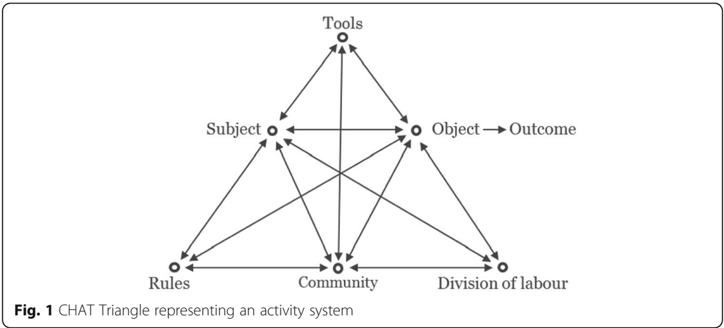
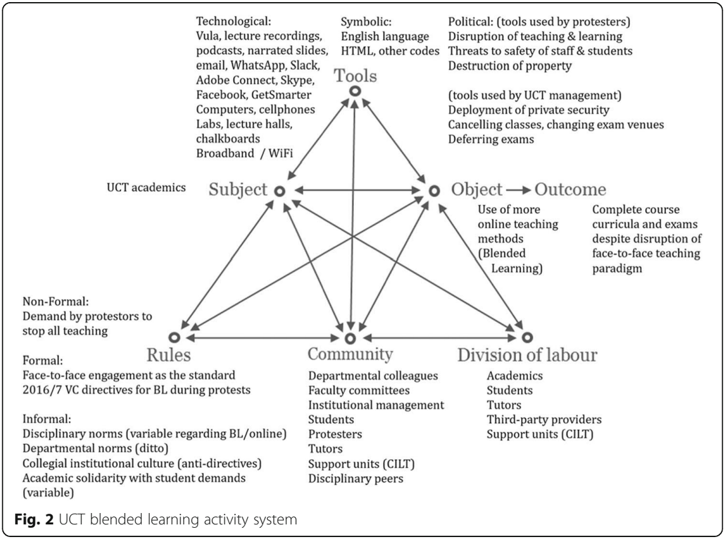
During the period 2015–2017, student protests and university shutdowns rocked the higher education sector in South Africa, with key issues being raised regarding student exclusion based on financial, epistemological and cultural grounds. In this highly politicised and contested environment, some universities decided to use blended and online delivery as a strategy to enable the academic year to be completed and all curriculum to be covered, despite the disruptions. This was a controversial decision politically and a challenging one practically. From the perspective of the academics at the University of Cape Town (UCT), this paper draws on interviews with educators in three broad disciplinary areas to explore their views, practices, and experiences regarding the use of online materials in these unique circumstances. Activity Theory provides a framework to consider the issues systemically and to identify the tensions and contradictions in the system.
Overview
The claims and statistics of this paper haven’t been checked yet.
Free: it reads the open-access text and checks the first 5 claims that cite a source we can check. Create a free account to check every claim.
Integrity signals
Registry
Cites
Statistics
Figures
Verification
Claims the paper makes
The claims and statistics of this paper haven’t been checked yet.
Free: it reads the open-access text and checks the first 5 claims that cite a source we can check. Create a free account to check every claim.
Claims other papers make about this one
Each is checked against this paper’s own text: does it say what the citing paper says it does?
The cited source says what the claim attributes to it.
In the citing paper
“Similarly, Czerniewicz et al. (2019) used CHAT to study online teaching during student protests and campus closures in South Africa, emphasizing the institutional and political dimensions of online teaching in addressing challenges posed by student activism.”
From Transforming Online Teacher Training Through Expansive Learning: A Case Study Applying Cultural-Historical Activity Theory and the Change Laboratory Method (2025) · cites this paper as Czerniewicz et al., 2019
Self-check
Percentages, sums and reported differences re-computed from the paper’s own numbers.
The self-check needs the paper’s full text.
Citations
Cites
Learning by Expanding: An Activity-Theoretical Approach to Developmental Research
Engeström, Y. (2014) · Cambridge University Press eBooks · doi:10.1017/cbo9781139814744 · Cited by 4,991
Twitter activism and youth in South Africa: the case of #RhodesMustFall
Bosch, T. (2017) · Information, Communication & Society · doi:10.1080/1369118x.2016.1162829 · Cited by 293 · cited 1×
“While there has been an academic interest in the role of social media and the student protests (e.g. Bosch, 2016), research has not focused on the nature and implications of online education to deal with the impact of institutional disruptions.”
BackgroundAs by Fire: The End of the South African University
Jansen, J. D. (2017) · Cited by 275
As by Fire: The End of the South African University
Neethling, T. (2018) · Politikon · doi:10.1080/02589346.2018.1390057 · Cited by 182 · cited 4×
“intensity, and, in the course of time, violence” (Jansen, 2017).”
BackgroundInfluentialCzerniewicz, L., & Brown, C. (2009) · Computers & Education · doi:10.1016/j.compedu.2009.01.006 · Cited by 176
Self-citationHodes, R. (2016) · African Affairs · doi:10.1093/afraf/adw072 · Cited by 122 · cited 1×
“Their studies and employment had been influenced by protest actions and by institutional responses” (Hodes, 2016).”
BackgroundAdam, T. (2019) · Learning, Media and Technology · doi:10.1080/17439884.2019.1640740 · Cited by 113 · cited 1×
“In South Africa, there is also scholarship theorising how new technologies are implicated in new forms of digital neocolonialism linking colonial pasts and neoliberal futures (Adam, 2019).”
BackgroundA call for promoting ownership, equity, and agency in faculty development via connected learning
Bali, M., & Caines, A. (2018) · International Journal of Educational Technology in Higher Education · doi:10.1186/s41239-018-0128-8 · Cited by 107 · cited 1×
“…the digital sphere and online pedagogy, in order to “cultivate connected, participatory educational development that crosses institutional and national boundaries, and which takes equity, social justice and power differences into consideration, promoting educator agency” (Bali & Caines, 2018).”
BackgroundBlended Learning for Academic Resilience in Times of Disaster or Crisis
Mackey, J., Gilmore, F., Dabner, N., Breeze, D., & Buckley, P. (2012) · UC Research Repository (University of Canterbury) · Cited by 100
Fees Must Fall: Student revolt, decolonisation and governance in South Africa
Booysen, S., Godsell, G., Chikane, R., Mpofu-Walsh, S., Ntshingila, O., & Lepere, R. (2010) · Cited by 98
Research works printed but not linked: 3
- Habib, A. (2019). Rebels and rage: Reflecting on #FeesMustFall. Johannesburg: Jonathan Ball.
- Ray, M. (2016). Free fall: Why south African universities are in a race against time. Johannesburg: Bookstorm.
- Tauson, M. & Stannard, L. (2018). EdTech for learning in emergencies and displaced settings: A rigorous review and narrative synthesis. London: Save the Children. Available at https://resourcecentre.savethechildren.net/sites/default/files/ documents/edtech-learning.pdf.
Cited by
Items 101–172 of 172
Student Experiences and Perceptions of Emergency Remote Education during the COVID-19 pandemic
Al‐Maskari, A., Riyami, T. K. A., & Kunjumuhammed, S. K. (2022) · American Scientific Research Journal for Engineering, Technology, and Sciences · Cited by 2
Reflections of an ACS Affiliated Liaison during Covid-19: A University and AP Chemistry AACT Team
Ealy, J. B., & Stauffer, J. (2020) · Journal of Chemical Education · doi:10.1021/acs.jchemed.0c00744 · Cited by 2
Mashonganyika, D., & Muyambo, T. (2022) · South African Journal of Higher Education · doi:10.20853/36-4-5240 · Cited by 2
Michelow, P. M., Fainman, G. M., & Nudelman, G. (2023) · International Journal of African Higher Education · doi:10.6017/ijahe.v10i1.17193 · Cited by 3
“Czerniewicz, Trotter and Haupt (2019) observe that “technology is never neutral”, requiring educators to delve into the connection between the IT domain and online education to ensure that all actors are able to partake in novel technologies, thus avoiding injustice and inequality.”
BackgroundKarassellos, L. T. (2024) · Oxford University Research Archive (ORA) (University of Oxford) · doi:10.5287/ora-g20mrzyqo · Cited by 2
Tali, F., Loubère, L., Charalampopoulou, C., Desbıens, J.-F., Abel, M., & Céci, J.-F. (2024) · L’Orientation scolaire et professionnelle · doi:10.4000/11ulw · Cited by 1
Sujiatmoko, A. H., Setyowati, L., Elvira Rosyida, M. R., Ubaidillah, M. F., & Namaziandost, E. (2024) · Linguists Journal of Linguistics and Language Teaching · doi:10.29300/ling.v10i1.4197 · Cited by 1
“In detail, many teachers, students, schools, or institutions need more preparation to carry out online learning and assessing activities (Czerniewicz et al., 2019).”
BackgroundThe Role of Innovative Technologies in Advancing Inclusive Internationalization in Higher Education
Dhingra, D., Sinha, N., & Joshi, K. (2024) · Emerald Group Publishing Limited eBooks · doi:10.1108/978-1-83608-424-220241006 · Cited by 1
Co-teaching and co-research in contexts of inequality [PDF, E-Book]
Ivala, E., Gachago, D., & Shangase, P. Z. (2023) · Vernon Press eBooks · doi:10.54094/b-b48695f648 · Cited by 1
Yeboah, A. K., Kim, Y., & Amponsah, S. K. (2024) · Open Learning The Journal of Open Distance and e-Learning · doi:10.1080/02680513.2024.2443089 · Cited by 1
Episodes of Student Vandalism in Higher Education Institutions in South Africa
Mzenzi, A., & Kang’ethe, S. M. (2025) · Research in Social Sciences and Technology · doi:10.46303/ressat.2025.16 · Cited by 1
Factors Influencing EFL Students' Motivation in Online Learning in Public Colleges of Nepal
Paudel, P. (2025) · Mextesol journal. · doi:10.61871/mj.v49n1-7 · Cited by 1
“Similarly, Czerniewicz et al. (2019) in a study conducted in South Africa, found that the blended mode of learning, rather than only the online mode of learning, became more important in maintaining students' awareness of learning.”
Volpone, S. D., Decker, M., Reed, R. S., & Sevilla, M. (2025) · Palgrave studies in equity, diversity, inclusion, and indigenization in business · doi:10.1007/978-3-031-89384-1_4 · Cited by 1
Asfaw, Z., Ferede, B., Santure, A., Jimma, W., & Alemneh, D. G. (2025) · International Journal of Information and Education Technology · doi:10.18178/ijiet.2025.15.11.2444 · Cited by 1
“The study by Bervell & Umar [58] reports that most African educators have little knowledge of or interest in using LMSs.”
The role of teaching advancement units in times of emergency as perceived by unit staff members
Linder, I., & Weissblueth, E. (2026) · Israel Affairs · doi:10.1080/13537121.2025.2502768 · Cited by 1
Assessing contextual best fitting ePedagogies for communal Zambia
Sichone, B. C. (2026) · doi:10.7176/jep/17-1-04 · Cited by 1
Salcedo, M. D. C. N. (2026) · Discover Education · doi:10.1007/s44217-026-01513-x · Cited by 1
“While blended learning offers flexible, multimodal participation, it can also reinforce digital privilege and marginalization if not critically designed [2, 13].”
Παπάζογλου, Θ., & Κώστας, Α. (2022) · European Journal of Open Education and E-learning Studies · doi:10.46827/ejoe.v7i1.4144 · Cited by 1
Morales-Arsenal, R., & Pinar-Pérez, J. M. (2022) · Lecture notes on data engineering and communications technologies · doi:10.1007/978-3-031-10385-8_55 · Cited by 1
Kandiero, A., & Chizwina, S. (2023) · Advances in educational technologies and instructional design book series · doi:10.4018/978-1-6684-8292-6.ch019 · Cited by 1
TRANSLATION AS A PEDAGOGY IN THE DEVELOPMENT OF ENGLISH SECOND LANGUAGE IN A RURAL UNIVERSITY
Masala, P. (2024) · Journal of Social Sciences · doi:10.52326/jss.utm.2023.6(4).06 · Cited by 1
Παπάζογλου, Θ. (2021) · Συνέδρια της Ελληνικής Επιστημονικής Ένωσης Τεχνολογιών Πληροφορίας & Επικοινωνιών στην Εκπαίδευση · doi:10.26215/heal.uoa.775 · Cited by 1
Mufeti, T. K. (2023) · The International Journal of Education and Development using Information and Communication Technology (The University of the West Indies) · Cited by 1
Gunatevan Elumalai, A. S. (2024) · Journal of Propulsion Technology · Cited by 1
Student protests and the brand image of a university of technology
Abdool, S. (2023) · DUT Open Scholar (Durban University of Technology) · doi:10.51415/10321/4818 · Cited by 1
Student perceptions of emergency remote teaching and learning at a South African university
(2024) · UpSpace Institutional Repository (University of Pretoria) · doi:10.25403/upresearchdata.25112045 · Cited by 1
Harrison, N. (2019) · Liverpool University Press eBooks · doi:10.3828/liverpool/9781786941763.003.0004
The Impact of Distance Learning Media on the Educational Process of Learners During the Pandemic
Sabarofek, M. S., Imanita, M., Saleh, F., & Rihardi, E. L. (2022) · ijd-demos · doi:10.37950/ijd.v4i1.232
Rice, M. F. (2022) · Online Learning · doi:10.24059/olj.v26i2.3442
Rajasekar, D., & Aithal, P. S. (2022) · International Journal of Case Studies in Business IT and Education · doi:10.47992/ijcsbe.2581.6942.0216
Rajasekar, D. (2023) · Zenodo (CERN European Organization for Nuclear Research) · doi:10.5281/zenodo.7578695
Fieldwork practice for social work students during the COVID-19 pandemic
Kollege, H., Johannisen, J., Bredell, S., & Kollege, H. (2022) · HTS religion & society series · doi:10.4102/aosis.2022.bk354.07
Reflecting on remote teaching and learning practices during a pandemic
Siegelaar, M. C. (2022) · HTS religion & society series · doi:10.4102/aosis.2022.bk354.08
Key Insights From Emergency Remote Teaching (ERT) and Beyond: Looking to the Future
Luongo, N., & Case, K. (2023) · Advances in educational technologies and instructional design book series · doi:10.4018/978-1-6684-8292-6.ch018
VIRAL AND ECONOMIC PROBLEMS OF EDUCATION IN THE CONTEXT OF WORLD TRANSFORMATIONS
Дмитрук, Б., & CHUDAIEVA, I. (2022) · Social Economics · doi:10.26565/2524-2547-2022-63-03
(2022) · Social Economics · doi:10.26565/2524-2547-2022-63
Omodan, B. I., & Tsotetsi, C. T. (2023) · Zenodo (CERN European Organization for Nuclear Research) · doi:10.5281/zenodo.8146784
8. A meditation on global further education, in haiku form
Auerbach, J. (2023) · Open Book Publishers · doi:10.11647/obp.0363.08
Alternative Work Scheme: The Relationship to the Personal and Professional Life
Barlis, J. M., Fajardo, J. D., Generales, L. J., & Vicente, J. A. (2023) · SAGE Open · doi:10.1177/21582440231201442
“Czerniewicz et al. (2019) revealed that the majority of faculty members recognized blended and online methods as feasible decisions during the closure of university, though face-to-face teaching methodology is considered the more effective and preferred method of instruction by students and faculty…”
MethodIntegrating Outcome-Based Education into Cinematography: Strategies for Effective Implementation
Guo, X., & Della, C. (2023) · Educational Administration Theory and Practice journal · doi:10.52152/kuey.v30i2.1015
Lengwadi, T. E., Molise, H. V., & Segooa, M. Y. (2024) · Research in Social Sciences and Technology · doi:10.46303/ressat.2024.33
Fraud-Related Case Method: an Evidence from Professional Ethics Course
Silalahi, S. A., Zainal, A., Herliani, R., & Sagala, G. H. (2024) · International Conference of Science Education in Industrial Revolution 4.0 (ICONSEIR) · doi:10.4108/eai.30-11-2023.2346945
Repositioning the oral health professions post-COVID-19
Adam, R. Z., Gordon, N. A., Maart, R. D., Holmes, H. K., & Khan, S. (2025) · doi:10.4102/aosis.2025.bk488.07
Socio-ecological-economic reflections on the impacts of COVID-19 in Africa
Chinyamurindi, W., John-Nsa, C. A., Ned, L. Y., Mathibe, M. S., Mpungose, A., Myeni, S. L., Padayachee, A., Munien, S., Bob, U., Adam, R. Z., et al. (2025) · doi:10.4102/aosis.2025.bk488
The Significance of Student Activism to Democratic Governance in South African University Campuses
Maela, K. D., & Takalani, H. (2025) · Advances in higher education and professional development book series · doi:10.4018/979-8-3693-5683-8.ch011
Hubahib, F. G., & Oliveros, J. (2025) · Psychology and Education A Multidisciplinary Journal · doi:10.70838/pemj.430110
Olowo, O. O., & Adenigba, I. E. (2025) · Pedagogik Jurnal Pendidikan · doi:10.33084/pedagogik.v20i2.10557
Virtual Escape Rooms as a Game-based Learning Strategy through the Lens of the ARCS Model
(2025) · African perspectives of research in teaching and learning. · doi:10.70875/v9i6article11
First-Year Engineering Students’ Use of Digital Technology for Learning: The Role of Agency
Ganduri, L., Shaw, C., & Collier-Reed, B. I. (2025) · Proceedings from the International Research Symposium on Problem-Based Learning (IRSPBL) · doi:10.54337/irspbl-11066
“In addition, the challenges posed by the ‘ fees must fall ’ protests between 2015 and 2017 (Czerniewicz, 2020; Czerniewicz et al., 2019) as well as the COVID-19 pandemic (Lazar, 2021) accelerated the need for first-year engineering students to engage with digital technologies for online or blended…”
Mazzola-Randles, C. (2024) · Lancaster EPrints (Lancaster University) · doi:10.17635/lancaster/thesis/2370
The experiences of academics working remotely during the Covid-19 Pandemic in South Africa
Zwelibanzi, T. (2022) · Open University of Cape Town (University of Cape Town)
EXPERIENCES OF TEACHING ENGLISH TEACHER EDUCATION ONLINE IN THE TIME OF COVID-19
Wu, X. (2023) · UWM Digital Commons (University of Wisconsin–Milwaukee)
Hardie, G. (2023) · Research Online (University of Wollongong)
Amedome, S. N. (2024) · Repository at Universitas Pendidikan Indonesia (Universitas Pendidikan Indonesia)
Causes of Students Unrest at University Level
Kayani, D. S., Kiyani, T., & Saba, M. (2024) · Journal for social science archives · doi:10.59075/jssa.v2i2.308
Tshuma, L., Ndlovu, N. S., Theledi, K. A., & Mamvura, I. (2026) · African Journal of Teacher Education · doi:10.21083/ajote.v15i1.8860
(2025) · African perspectives of research in teaching and learning. · doi:10.70875/v9i8article8
The impact of remote teaching and learning on engineering students at University of KwaZulu-Natal.
Oliver, S. H. (2022) · ResearchSpace (University of KwaZulu-Natal)
Sokotshe, M. (2022) · ResearchSpace (University of KwaZulu-Natal)
Ochoa, E. D. Q., Romero, I. R. C., & Sepa, J. L. C. (2026) · Multidisciplinary Collaborative Journal · doi:10.70881/mcj/v4/n1/142
Lin, S., & Li, N. (2026) · Education and Information Technologies · doi:10.1007/s10639-026-14009-w
“These findings support the integrated teach - ing framework proposed by Czerniewicz et al. (2019 ) and extend understanding of multimedia learning principles (Mayer, 2021).”
Giugni, L., & Recano, L. (2026) · Educational governance research · doi:10.1007/978-3-032-29276-6_7
Arogunjo, R. O., Omotayo, O. A., & Atoyebi, R. F. (2026) · The Paris Conference on Education, official conference proceedings · doi:10.22492/issn.2758-0962.2026.6
Ajani, O. A., & Govender, S. (2026) · Cogent Education · doi:10.1080/2331186x.2026.2658277
du Plessis, R., Breshears, D., & Naudé, L. (2026) · Journal of Communication Pedagogy · doi:10.31446/jcp.2026.1.05
Banda, M. J. (2026) · International Journal of Research and Innovation in Applied Science · doi:10.51584/ijrias.2026.11080179
Maqungo, A. (2021) · Nelson Mandela University Research Repository
Noveve, Q. (2025) · Nelson Mandela University Research Repository
A process model for secure coding education and training
Mdunyelwa, V. S. (2026) · Nelson Mandela University Research Repository
Omodan, B. (2026) · Boloka Institutional Repository (North-west University)
Guidelines for developing human-computer interaction students as reflective practitioners
Tlale-Mkhize, M. C. (2024) · Boloka Institutional Repository (North-west University)
Metadata
- Authors
- Czerniewicz, L., Trotter, H., & Haupt, G.
- Affiliations
- University of Cape Town (ZA)
- Corresponding author
- Czerniewicz, Laura
- Venue
- International Journal of Educational Technology in Higher Education
- Published
- 2019-12
- Volume
- 16
- Issue
- 1
- ISSN
- 2365-9440 (ISSN-L)
- OpenAlex
- W2995450334
- Cited by
- 127
- References
- 22
- Citations by year
- 2026: 8 · 2025: 11 · 2024: 18 · 2023: 13 · 2022: 33 · 2021: 24 · 2020: 19 · 2019: 1
- FWCI
- 51.94
- Type
- journal article
- Language
- en
- Open access
- diamond
- doi.org
- Licence
- cc-by
- creativecommons.org/licenses/by/4.0 (tdm)
- creativecommons.org/licenses/by/4.0 (vor, 19 d)
- Locations
- International Journal of Educational Technology in Higher Education (publishedVersion, cc-by)
- DOAJ (DOAJ: Directory of Open Access Journals) (submittedVersion, cc-by-sa)
- Open University of Cape Town (University of Cape Town) (submittedVersion)
- Funders
- Carnegie Corporation of New York (tbc)
- Topics
- Social Sciences › Education › Online and Blended Learning
- Social Sciences › Education › Education during COVID-19 pandemic
- Social Sciences › Education › Digital Transformation of Higher Education
- Keywords
- online learning, student protest, higher education disruption, blended learning, online learning materials, school exclusion, financial exclusion, cultural exclusion, University of Cape Town, activity theory, South Africa
About these checks
Registry, retraction, Cites and statistics results are computed, not judged, with one exception: a printed reference that no index lists is read once by a model before it counts as a citation error. Claims are extracted by a model and kept only when their quote appears verbatim in the text; each cited source is then checked, with a model’s help, for whether it says what the claim relies on. Those verdicts can be wrong — read the claim’s quote and the cited source before relying on one.
Statistics and arithmetic are recomputed, not judged.
Confidence bands are shown only for fields calibrated on our annotated test set. None is calibrated yet, so no band is shown.
What counts as a claim ›How we measure confidence ›How we check this ›
Are you an author, or do you see a problem with this page? Request a review
Data sources
Bibliographic data: Semantic Scholar, OpenAlex, Crossref.
Contains information from the Semantic Scholar Academic Graph Datasets, made available under the ODC Attribution License (ODC-BY 1.0).
Semantic Scholar’s data is described in: Kinney, R., et al. (2023). The Semantic Scholar Open Data Platform. arXiv:2301.10140.
