

The DOI matches its Crossref record; 67 of the 67 references it cites were found in a registry or an index.
Learning analytics in higher education: a preponderance of analytics but very little learning?
Open accessAbstract
In a context where learning mediated by technology has gained prominence in higher education, learning analytics has become a powerful tool to collect and analyse data with the aim of improving students’ learning. However, learning analytics is part of a young community and its developments deserve further exploration. Some critical stances claim that learning analytics tends to underplay the complexity of teaching-learning processes. By means of both a bibliometric and a content analysis, this paper examines the publication patterns on learning analytics in higher education and their main challenges. 385 papers that were published in WoScc and SciELO indexes between 2013 and 2019 were identified and analysed. Learning analytics is a vibrant and fast-developing community. However, it continues to face multiple and complex challenges, especially regarding students’ learning and their implications. The paper concludes by distinguishing between a practice-based and management-oriented community of learning analytics and an academic-oriented community. Within both communities, though, it seems that the focus is more on analytics than on learning.
Overview
The claims and statistics of this paper haven’t been checked yet.
Run the check — free, no account needed. It reads the open-access text and checks the sources it cites.
Integrity signals
Registry
Cites
Statistics
Figures
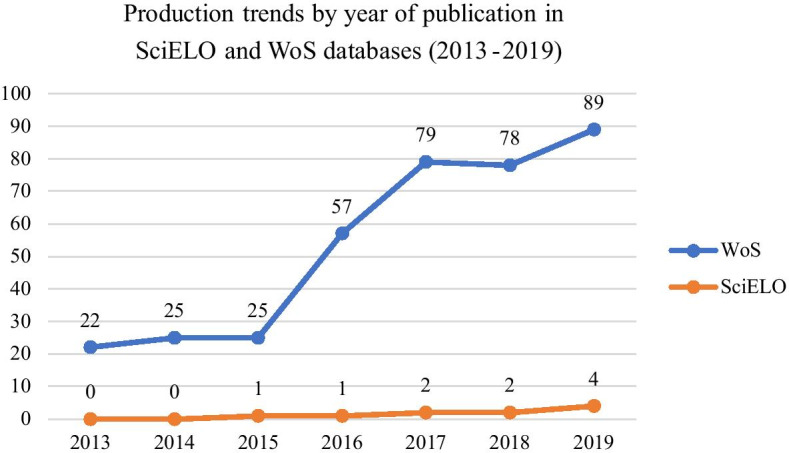
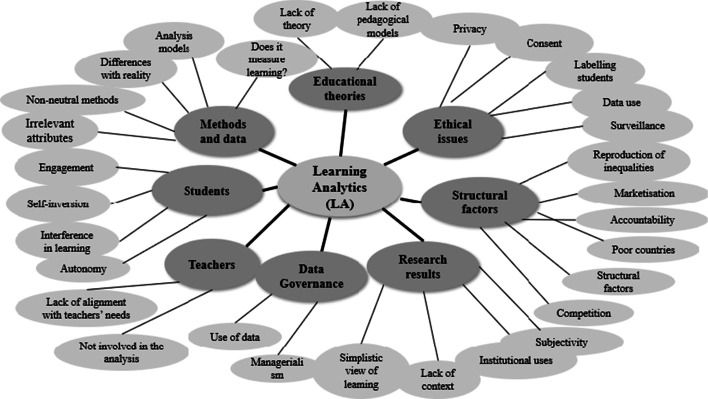
Verification
Claims the paper makes
The claims and statistics of this paper haven’t been checked yet.
Run the check — free, no account needed. It reads the open-access text and checks the sources it cites.
Claims other papers make about this one
Each is checked against this paper’s own text: does it say what the citing paper says it does?
The cited source says what the claim attributes to it.
In the citing paper
“They critiqued the prevailing focus on analytics over substantive learning improvements, advocating for a balanced approach that equally values pedagogical effectiveness alongside technological advancements (Drugova et al., 2024).”
From Unpacking student engagement in higher education learning analytics: a systematic review (2024) · cites this paper as Guzmán-Valenzuela et al. (2021)
Self-check
Percentages, sums and reported differences re-computed from the paper’s own numbers.
The self-check needs the paper’s full text.
Citations
Cites
Zawacki-Richter, O., Marín, V. I., Bond, M., & Gouverneur, F. (2019) · International Journal of Educational Technology in Higher Education · doi:10.1186/s41239-019-0171-0 · Cited by 7,242
The SAGE encyclopedia of qualitative research methods
Brodsky, A. (2011) · Choice Reviews Online · doi:10.5860/choice.46-4214 · Cited by 3,347
Bornmann, L., & Mutz, R. (2015) · Journal of the Association for Information Science and Technology · doi:10.1002/asi.23329 · Cited by 1,576
Learning analytics: drivers, developments and challenges
Ferguson, R. (2012) · International Journal of Technology Enhanced Learning · doi:10.1504/ijtel.2012.051816 · Cited by 1,357 · cited 9×
“In tracing back the developments of LA, the literature shows that educational data mining (EDM) has had an important role especially in North America, Western Europe and Australia/New Zealand (Ferguson 2012).”
BackgroundMethodInfluentialLearning Analytics: Ethical Issues and Dilemmas
Slade, S., & Prinsloo, P. (2013) · American Behavioral Scientist · doi:10.1177/0002764213479366 · Cited by 1,078
Utilising learning analytics to support study success in higher education: a systematic review
Ifenthaler, D., & Yau, J. Y.-K. (2020) · Educational Technology Research and Development · doi:10.1007/s11423-020-09788-z · Cited by 1,063
Romero, C., & Ventura, S. (2013) · WIREs Data Mining and Knowledge Discovery · doi:10.1002/widm.1075 · Cited by 869
Gašević, D., Dawson, S., Rogers, T., & Gašević, D. (2015) · The Internet and Higher Education · doi:10.1016/j.iheduc.2015.10.002 · Cited by 767
The current landscape of learning analytics in higher education
Viberg, O., Hatakka, M., Bälter, O., & Mavroudi, A. (2018) · Computers in Human Behavior · doi:10.1016/j.chb.2018.07.027 · Cited by 766
Big Data and analytics in higher education: Opportunities and challenges
Daniel, B. (2015) · British Journal of Educational Technology · doi:10.1111/bjet.12230 · Cited by 610 · cited 8×
“Significantly, the practical community of LA also includes intervention strategies for students identified as at risk (Daniel 2015; Fynn 2016; Wong 2019).”
BackgroundMethodInfluential
Cited by
Sorted by citations
Items 101–130 of 130
Data-Informed instruction: pedagogical responses and obstacles in using learning analytics
Wu, C., Zipf, S. T., Li, N., & Hellar, D. B. (2025) · ASEE Annual Conference & Exposition · doi:10.18260/1-2--56206
Ishaq, I., Saleng, S., & Bancong, H. (2025) · Journal Evaluation in Education (JEE) · doi:10.37251/jee.v6i4.2099
“However, recent critiques caution that the growing dominance of analytical approaches sometimes overshadows pedagogical depth in learning design [49].”
Enhancing Student Skill Development Through Behavioral Analytics in Business Simulations
Martins, H. F. (2025) · Advances in computational intelligence and robotics book series · doi:10.4018/979-8-3373-7523-6.ch009
Gabbi, E., Baiata, C., & Ranieri, M. (2026) · EXCELLENCE AND INNOVATION IN LEARNING AND TEACHING · doi:10.3280/exioa2-2025oa21745
Shingade, S. D., Mudhalwadkar, R. P., & Masal, K. M. (2025) · International Conference for Advancement in Technology (ICONAT) · doi:10.1109/iconat66879.2025.11362721
Aprendizajes con calidad y flexibilidad en la Educación Superior
Duart, J. M. (2026) · Rastros Rostros · doi:10.16925/2382-4921.2026.01.03
Geography Teachers' Understanding of Geographical Concepts to Enhance Students’ Geographic Literacy
Rana, Ahyuni, Hermon, D., & Wijayanto, B. (2025) · Jurnal Pendidikan dan Pengajaran · doi:10.23887/jpp.v58i3.97465
Developing a Mobile Application for Student Learning and Time Management
Selani, K., Mwansa, G., & Ngandu, M. R. (2026) · EAI/Springer Innovations in Communication and Computing · doi:10.1007/978-3-032-10310-9_17
Montaño, M. L. A., Canchingre, E. T., Hernández, S. S. M., Guerrero, R. J. R., & Montaño, K. G. P. (2026) · ASCE MAGAZINE · doi:10.70577/asce.v5i1.682
Hernández-Campos, M., Hilliger, I., Prado-Calderón, J. E., Abad, F. M., & García‐Peñalvo, F. J. (2026) · Computers in Human Behavior Reports · doi:10.1016/j.chbr.2026.100981 · Cited by 3
Ayhan, İ. (2026) · Journal of Higher Education Policy and Management · doi:10.1080/1360080x.2026.2643372
“However, most of these studies focus on the technical aspect of these models and have not provided much insight into the ways in which these models might be interpreted for the classroom (Guzmán-Valenzuela et al., 2021).”
Asy-Syafi'i, M. I. M. A.-S., Romadhon, M. F., Natia, N., Sitorus, I. R., & Afrillia, Z. (2026) · Priviet Social Sciences Journal · doi:10.55942/pssj.v6i3.1686
La importancia de las prácticas profesionales en la formación del futuro ingeniero
Acosta, R. C., Zaragoza, Y. A., & López, M. H. (2025) · El Ágora USB · doi:10.21500/16578031.6758
“Siguiendo la línea, Guzmán-Valenzuela et al. (2021) argumentan que las prácticas profesionales son una vía crucial para que los estudiantes universitarios se inserten en el mercado laboral.”
The role of evidence-based data and analytics in medical education management
Baimagambetova, A., Dossanova, A., Sergebaeva, A., Abdrakhmanova, A., Zhunussova, A., & Koishibayev, Z. M. (2026) · Cogent Education · doi:10.1080/2331186x.2026.2644699 · Cited by 1
Advanced student management system: Leveraging AI for advanced students dashboard
Kasturiwale, H., Kaur, R., Sanap, H., & Mishra, V. (2026) · AIP conference proceedings · doi:10.1063/12.0043807
Learning Analytics for personalizing learning in virtual higher education environments
Segura, V. T. V., Segura, E. A. V., Segura, J. A. V., & Seisdedos, L. F. (2026) · doi:10.63804/libroseuc.6
Kermanian, F., Safiyari, P., Hassanzadeh, G., Mojtahedzadeh, R., & Mohammadi, A. (2026) · BMC Medical Education · doi:10.1186/s12909-026-09854-9
Smart hybrid models for personalized learning in higher education
Segura, E. A. V., Segura, V. T. V., Segura, J. A. V., & Fierro-Saltos, W. (2026) · doi:10.63804/libroseuc.5
Sreelatha, P., & Deepa, C. K. (2026) · International Journal of Information Technology Research Studies (IJITRS) · doi:10.63090/ijitrs/3139.3209.0029
Using Open Science Infrastructure in Contemporary Analytical Education
Chmyr, О. S. (2026) · University Scientific Notes · doi:10.37491/unz.111.9
A Data-Mining Method for Teaching-Process Monitoring and Teaching-Effect Prediction
Sun, M., Zhao, Y., & Liu, C. (2026) · Guangdong-Hong Kong-Macao Greater Bay Area International Conference on Digital Economy and Artificial Intelligence (DEAI) · doi:10.1145/3837873.3838056
“Learning analytics research has shown that higher education has accumulated substantial volumes of behavioural, assessment, and platform data, but much of this work still prioritizes technical analytics over actionable pedagogical improvement [2].”
Andrini, V. S., Hidayati, U., Etika, E. D., Yusuf, I., & Ulfa, S. U. (2026) · Cogent Education · doi:10.1080/2331186x.2026.2724181
AI-Enabled Learning Analytics and Digital Pedagogy for Sustainable Higher Education Decision-Making
Dudin, B., Taqi, M., & Vemavarapu, K. R. (2026) · Advances in computational intelligence and robotics book series · doi:10.4018/979-8-3373-8352-1.ch003
Mera, L. E. R., Ruiz, K. L. C., Lasso, Y. D. R. M., Lasso, A. G. M., & Bergara, O. S. T. (2026) · Reincisol · doi:10.65835/reincisol.v6(10)1860
Ali, S. M., Ikonnikov, O., Kuzmich, R. I., Slinitsyna, O., Nikulushkin, A., & Muracova, N. (2026) · Lecture notes in networks and systems · doi:10.1007/978-3-032-38809-4_21
Singh, M. (2026) · Frontiers in Education · doi:10.3389/feduc.2026.1942897
Porras, L. (2026) · Star of Sciences Multidisciplinary Journal · doi:10.63969/hw5sbz05
Yaghi, S., & Baraka, R. S. (2026) · Research Square · doi:10.21203/rs.3.rs-11412985/v1
ANISULOWO, B. O., & SHAIBU, L. (2026) · Federal University Gusau Faculty of Education Journal · doi:10.64348/zije.2026632
“…(Gašević et al., 2015, p. 70), and that institutions must be wary of collecting data without a clear implication of an improvement in learning (Guzmán-Valenzuela et al., 2021, p. 25). m. Adaptive Learning Systems Adaptive learning systems are computerised learning systems that adapt…”
Metadata
- Authors
- Guzmán-Valenzuela, C., Gómez-González, C., Rojas-Murphy Tagle, A., & Lorca-Vyhmeister, A.
- Affiliations
- University of Tarapacá (CL)
- University of Valparaíso (CL)
- Corresponding author
- Guzmán-Valenzuela, Carolina
- Venue
- International Journal of Educational Technology in Higher Education
- Published
- 2021-05-04
- Volume
- 18
- Issue
- 1
- Pages
- 23-23
- ISSN
- 2365-9440 (ISSN-L)
- PMC
- PMC8092999
- OpenAlex
- W3163777542
- Cited by
- 131
- References
- 67
- Citations by year
- 2026: 35 · 2025: 31 · 2024: 22 · 2023: 24 · 2022: 14 · 2021: 5
- FWCI
- 2.80
- Type
- journal article
- Language
- en
- Open access
- diamond
- doi.org
- Locations
- International Journal of Educational Technology in Higher Education (publishedVersion, cc-by)
- PubMed Central (publishedVersion, cc-by)
- PubMed (publishedVersion)
- DOAJ (DOAJ: Directory of Open Access Journals) (submittedVersion, cc-by-sa)
- Funders
- FONDECYT (1200633, 1161413)
- Topics
- Physical Sciences › Computer Science › Computer Science Applications › Online Learning and Analytics
- Physical Sciences › Computer Science › Information Systems › Educational and Technological Research
- Social Sciences › Education › Educational Technology in Learning
- Keywords
- learning analytics, higher education, publication trends, teaching-learning process, student learning, technology-mediated learning
About these checks
Registry, retraction, Cites and statistics results are computed, not judged, with one exception: a printed reference that no index lists is read once by a model before it counts as a citation error. Claims are extracted by a model and kept only when their quote appears verbatim in the text; each cited source is then checked, with a model’s help, for whether it says what the claim relies on. Those verdicts can be wrong — read the claim’s quote and the cited source before relying on one.
Statistics and arithmetic are recomputed, not judged.
Confidence bands are shown only for fields calibrated on our annotated test set. None is calibrated yet, so no band is shown.
What counts as a claim ›How we measure confidence ›How we check this ›
Are you an author, or do you see a problem with this page? Request a review
