

The DOI matches its Crossref record; 67 of the 67 references it cites were found in a registry or an index.
Learning analytics in higher education: a preponderance of analytics but very little learning?
Open accessAbstract
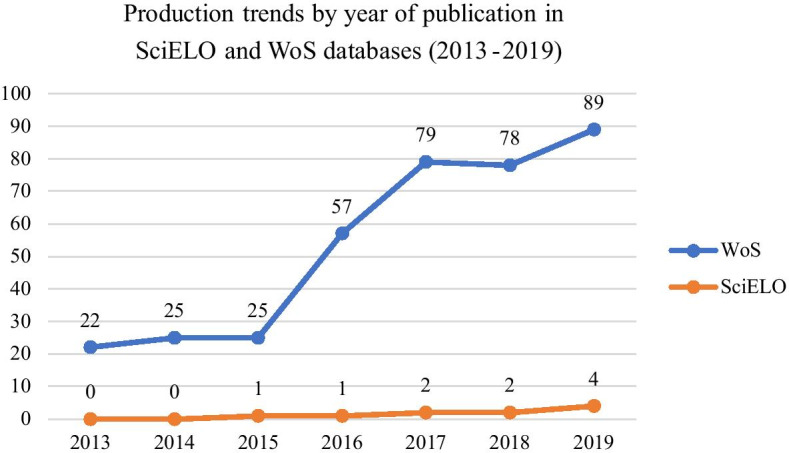
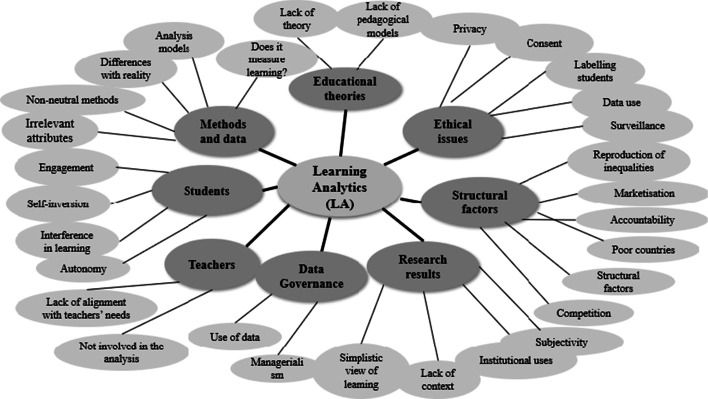
In a context where learning mediated by technology has gained prominence in higher education, learning analytics has become a powerful tool to collect and analyse data with the aim of improving students’ learning. However, learning analytics is part of a young community and its developments deserve further exploration. Some critical stances claim that learning analytics tends to underplay the complexity of teaching-learning processes. By means of both a bibliometric and a content analysis, this paper examines the publication patterns on learning analytics in higher education and their main challenges. 385 papers that were published in WoScc and SciELO indexes between 2013 and 2019 were identified and analysed. Learning analytics is a vibrant and fast-developing community. However, it continues to face multiple and complex challenges, especially regarding students’ learning and their implications. The paper concludes by distinguishing between a practice-based and management-oriented community of learning analytics and an academic-oriented community. Within both communities, though, it seems that the focus is more on analytics than on learning.
Overview
The claims and statistics of this paper haven’t been checked yet.
Run the check — free, no account needed. It reads the open-access text and checks the sources it cites.
Integrity signals
Registry
Cites
Statistics
Figures
Verification
Claims the paper makes
The claims and statistics of this paper haven’t been checked yet.
Run the check — free, no account needed. It reads the open-access text and checks the sources it cites.
Claims other papers make about this one
Each is checked against this paper’s own text: does it say what the citing paper says it does?
The cited source says what the claim attributes to it.
In the citing paper
“They critiqued the prevailing focus on analytics over substantive learning improvements, advocating for a balanced approach that equally values pedagogical effectiveness alongside technological advancements (Drugova et al., 2024).”
From Unpacking student engagement in higher education learning analytics: a systematic review (2024) · cites this paper as Guzmán-Valenzuela et al. (2021)
Self-check
Percentages, sums and reported differences re-computed from the paper’s own numbers.
The self-check needs the paper’s full text.
Citations
Cites
Zawacki-Richter, O., Marín, V. I., Bond, M., & Gouverneur, F. (2019) · International Journal of Educational Technology in Higher Education · doi:10.1186/s41239-019-0171-0 · Cited by 7,242
The SAGE encyclopedia of qualitative research methods
Brodsky, A. (2011) · Choice Reviews Online · doi:10.5860/choice.46-4214 · Cited by 3,347
Bornmann, L., & Mutz, R. (2015) · Journal of the Association for Information Science and Technology · doi:10.1002/asi.23329 · Cited by 1,576
Learning analytics: drivers, developments and challenges
Ferguson, R. (2012) · International Journal of Technology Enhanced Learning · doi:10.1504/ijtel.2012.051816 · Cited by 1,357 · cited 9×
“In tracing back the developments of LA, the literature shows that educational data mining (EDM) has had an important role especially in North America, Western Europe and Australia/New Zealand (Ferguson 2012).”
BackgroundMethodInfluentialLearning Analytics: Ethical Issues and Dilemmas
Slade, S., & Prinsloo, P. (2013) · American Behavioral Scientist · doi:10.1177/0002764213479366 · Cited by 1,078
Utilising learning analytics to support study success in higher education: a systematic review
Ifenthaler, D., & Yau, J. Y.-K. (2020) · Educational Technology Research and Development · doi:10.1007/s11423-020-09788-z · Cited by 1,063
Romero, C., & Ventura, S. (2013) · WIREs Data Mining and Knowledge Discovery · doi:10.1002/widm.1075 · Cited by 869
Gašević, D., Dawson, S., Rogers, T., & Gašević, D. (2015) · The Internet and Higher Education · doi:10.1016/j.iheduc.2015.10.002 · Cited by 767
The current landscape of learning analytics in higher education
Viberg, O., Hatakka, M., Bälter, O., & Mavroudi, A. (2018) · Computers in Human Behavior · doi:10.1016/j.chb.2018.07.027 · Cited by 766
Big Data and analytics in higher education: Opportunities and challenges
Daniel, B. (2015) · British Journal of Educational Technology · doi:10.1111/bjet.12230 · Cited by 610 · cited 8×
“Significantly, the practical community of LA also includes intervention strategies for students identified as at risk (Daniel 2015; Fynn 2016; Wong 2019).”
BackgroundMethodInfluential
Cited by
Sorted by citations
Artificial Intelligence for Assessment and Feedback to Enhance Student Success in Higher Education
Hooda, M., Rana, C., Dahiya, O., Rizwan, A., & Hossain, M. S. (2022) · Mathematical Problems in Engineering · doi:10.1155/2022/5215722 · Cited by 444
“[102] )ematic-based analysis approach Inefficient volume of data — Eclectic methodology will be applied for learning enhancement”
MethodLearning analytics dashboard: a tool for providing actionable insights to learners
Sušnjak, T., Ramaswami, G. S., & Mathrani, A. (2022) · International Journal of Educational Technology in Higher Education · doi:10.1186/s41239-021-00313-7 · Cited by 356
“Overall, evidence about whether learning analytics and LADs improve learning in practice is scarce (Ferguson & Clow, 2017; Guzmán-Valenzuela et al., 2021; Knight et al., 2020; Rets et al., 2021; Wilson et al., 2017) and has room for further investigation.”
BackgroundUnpacking student engagement in higher education learning analytics: a systematic review
Bergdahl, N., Bond, M., Sjöberg, J., Dougherty, M., & Oxley, E. (2024) · International Journal of Educational Technology in Higher Education · doi:10.1186/s41239-024-00493-y · Cited by 138
Paulsen, L., & Lindsay, E. (2024) · Education and Information Technologies · doi:10.1007/s10639-023-12401-4 · Cited by 111
“Even recent reviews, however, keep concluding that learning is missing from LA (Guzmán-Valenzuela et al., 2021).”
InfluentialOuyang, F., & Zhang, L. (2024) · Educational Research Review · doi:10.1016/j.edurev.2024.100616 · Cited by 149
Liao, C.-H., & Wu, J.-Y. (2022) · Computers & Education · doi:10.1016/j.compedu.2022.104599 · Cited by 89
Lang, C., Wise, A. F., Merceron, A., Gašević, D., & Siemens, G. (2022) · Solar eBooks · doi:10.18608/hla22.001 · Cited by 68
Privacy and E-Learning: A Pending Task
Alier, M., Guerrero, M. J. C., Amo, D., Severance, C., & Fonseca, D. (2021) · Sustainability · doi:10.3390/su13169206 · Cited by 63
“This innovation has prompted new educational practices and the rise of data-driven education management, pedagogy, and even policy making [3], even when is not clear that this data-driven approach can lead to better pedagogical results [4].”
BackgroundThe use and application of learning theory in learning analytics: a scoping review
Khalil, M., Prinsloo, P., & Slade, S. (2022) · Journal of Computing in Higher Education · doi:10.1007/s12528-022-09340-3 · Cited by 62
“The need to explore learning theories informing learning analytics appears even more important in the light of recent research by Guzmán-Valenzuela et al (2021).”
BackgroundA Current Overview of the Use of Learning Analytics Dashboards
Masiello, I., Mohseni, Z. (., Palma, F., Nordmark, S., Augustsson, H., & Rundquist, R. (2024) · Education Sciences · doi:10.3390/educsci14010082 · Cited by 59
Lessons Learnt from a Multimodal Learning Analytics Deployment In-the-Wild
Martínez‐Maldonado, R., Echeverría, V., Fernandez-Nieto, G. M., Yan, L., Zhao, L., Alfredo, R., Li, X., Dix, S., Jaggard, H., Wotherspoon, R., et al. (2023) · ACM Transactions on Computer-Human Interaction · doi:10.1145/3622784 · Cited by 65
“This way, the consenting would be just about optionally recording the data for research purposes, otherwise, deleting it immediately after the class.”
BackgroundLearning analytics in higher education – Stakeholders, strategy and scale
Gašević, D., Tsai, Y., & Drachsler, H. (2021) · The Internet and Higher Education · doi:10.1016/j.iheduc.2021.100833 · Cited by 43
Weidlich, J., Fink, A., Frey, A., Jivet, I., Gombert, S., Menzel, L., Giorgashvili, T., Yau, J. Y.-K., & Drachsler, H. (2025) · International Journal of Educational Technology in Higher Education · doi:10.1186/s41239-025-00539-9 · Cited by 70
“HIF addresses limitations such as the overemphasis on analytics over learning in learning analytics research (Gašević et al., 2015; Guzmán-Valenzuela et al., 2021).”
Untangling connections between challenges in the adoption of learning analytics in higher education
Alzahrani, A. S., Tsai, Y., Iqbal, S., Moreno-Marcos, P. M., Scheffel, M., Drachsler, H., Kloos, C. D., Aljohani, N. R., & Gašević, D. (2022) · Education and Information Technologies · doi:10.1007/s10639-022-11323-x · Cited by 39
“Despite the fact that LA was a relatively new idea to many HEIs at the time the data was collected, literature (Guzmán-Valenzuela et al., 2021) continues to show that various challenges with learning analytics (LA) have stagnated the adoption rate, and the challenges discussed in this paper remain…”
BackgroundTzimas, D. E., & Demetriadis, S. (2024) · Education Sciences · doi:10.3390/educsci14010092 · Cited by 53
Norz, L.-M., Dornauer, V., Hackl, W. O., & Ammenwerth, E. (2022) · The Internet and Higher Education · doi:10.1016/j.iheduc.2022.100894 · Cited by 48
Exploring students’ expectations of learning analytics: A person-centered approach
Viberg, O., Engström, L., Saqr, M., & Hrastinski, S. (2022) · Education and Information Technologies · doi:10.1007/s10639-022-10980-2 · Cited by 35
Using causal models to bridge the divide between big data and educational theory
Kitto, K., Hicks, B., & Shum, S. B. (2023) · British Journal of Educational Technology · doi:10.1111/bjet.13321 · Cited by 41
Is Learning Analytics the Future of Online Education?
Sahni, J. (2023) · International Journal of Emerging Technologies in Learning (iJET) · doi:10.3991/ijet.v18i02.32167 · Cited by 41
Cerezo, R., Lara, J. A., Azevedo, R., & Romero, C. (2024) · Computers in Human Behavior · doi:10.1016/j.chb.2024.108155 · Cited by 52
Fernández-Morante, C., López, B. C., Malmierca, M. J. R., & Otero, L. C. (2021) · Sustainability · doi:10.3390/su14010124 · Cited by 24
Hernández-Campos, M., González-Torres, A., & García‐Peñalvo, F. J. (2025) · SAGE Open · doi:10.1177/21582440251347374 · Cited by 22
“These observations are consistent with Guzma´n-Valenzuela et al. (2021), who found that education and learning theories must be revised in LA research.”
9. Artificial intelligence for good?
Pechenkina, E. (2023) · Open Book Publishers · doi:10.11647/obp.0363.09 · Cited by 21
Curriculum analytics in higher education institutions: a systematic literature review
Silva, L. M. H. D., Rodríguez‐Triana, M. J., Chounta, I., & Pishtari, G. (2024) · Journal of Computing in Higher Education · doi:10.1007/s12528-024-09410-8 · Cited by 32
““Curriculum components”) and previous literature (e.g., Guzmán-Valenzuela et al., 2021), only a small proportion of research papers provide evidence that CA can enhance students’ learning outcomes, knowledge acquisition, skill development, or cognitive gains.”
InfluentialData-Driven Learning Analytics and Artificial Intelligence in Higher Education: A Systematic Review
González-Pérez, L. I., García‐Peñalvo, F. J., & Argüelles-Cruz, A.-J. (2025) · IEEE Revista Iberoamericana de Tecnologias del Aprendizaje · doi:10.1109/rita.2025.3615512 · Cited by 16
“However, the absence of psychopedagogical frameworks solidly grounded in learning data limits the connection between observed interactions and expected outcomes; hence the need to advance toward integrative models that align theory, empirical evidence, and sustainable educational practices [23].”
Chen, A., Lian, J., Kuang, X., & Jia, J. (2025) · The Internet and Higher Education · doi:10.1016/j.iheduc.2025.101054 · Cited by 18
Effect of video styles on learner engagement in MOOCs
Deng, R. (2023) · Technology Pedagogy and Education · doi:10.1080/1475939x.2023.2246981 · Cited by 15
“On the other hand, learning analytics often oversimplify the learning process by equating observable behaviours with learner engagement (Guzmán-Valenzuela et al., 2021).”
BackgroundThe Mediating Role of Learning Analytics
Villalobos, E., Hilliger, I., González, C., Celis, S., Pérez‐Sanagustín, M., & Broisin, J. (2024) · Journal of Learning Analytics · doi:10.18608/jla.2024.8149 · Cited by 13
“These metrics, when processed into specific indicators, have the potential to guide actions that positively impact learners, as discussed by Guzmán-Valenzuela et al. (2021).”
BackgroundInfluentialNg, J. T.-D., Wang, Z., & Hu, X. (2022) · International Conference on Learning Analytics and Knowledge (LAK) · doi:10.1145/3506860.3506880 · Cited by 13
“As a methodological contribution to the LA literature, this study shows the importance of involving students early in the LA design process, for need assessment, requirement analysis and prototype evaluation [10][12].”
BackgroundMethodInfluentialDiversion inference model of learning effectiveness supported by differential evolution strategy
Xia, X. (2022) · Computers and Education Artificial Intelligence · doi:10.1016/j.caeai.2022.100071 · Cited by 13
Learning analytics in programming courses: Review and implications
Omer, U., Tehseen, R., Farooq, M. S., & Abid, A. (2023) · Education and Information Technologies · doi:10.1007/s10639-023-11611-0 · Cited by 12
“It also raises the concerns about mapping the numbers obtained by analyzing the programming behaviors with different levels of learning (Guzmán-Valenzuela et al., 2021).”
BackgroundCo-designing AI-powered learning analytics: bringing students and teachers together
Alfredo, R., Milesi, M. E., Echeverría, V., Gašević, D., Shum, S. B., Zhao, L., Yan, L., Jin, Y., Fan, J. X., Pammer‐Schindler, V., et al. (2025) · International Journal of Educational Technology in Higher Education · doi:10.1186/s41239-025-00572-8 · Cited by 16
“By bringing students and teachers together, our co-design process addresses Guzmán-Valenzuela et al. (2021) and Alfredo et al. (2024) concerns that these key stakeholders are rarely involved in creating the LA systems they use.”
Li, S., Chen, J., & Liu, S. (2024) · Journal of Computer Assisted Learning · doi:10.1111/jcal.13059 · Cited by 14
Kittichotsatsawat, Y., Rauch, E., & Tippayawong, K. Y. (2024) · Results in Engineering · doi:10.1016/j.rineng.2024.103443 · Cited by 10
Kerres, M., Buntins, K., Buchner, J., Drachsler, H., & Zawacki‐Richter, O. (2023) · Springer eBooks · doi:10.1007/978-3-658-40079-8_6 · Cited by 10
HELA-CMM: capability maturity model for adoption of learning analytics in higher education
Šimić, D., Ređep, N. B., Rako, S., Kadoić, N., Petegem, W. V., Rienties, B., Lanzo, N. C., Eichhorn, M., Ortiz, L. G., Softić, S. K., et al. (2025) · International Journal of Educational Technology in Higher Education · doi:10.1186/s41239-025-00509-1 · Cited by 9
“Guzman-Valenzuela et al. (2021) emphasize the need to focus on the educational aspects of LA and to revisit question of “governance and management of data at institutional and national levels and their connection with educational policies”.”
Didaktische Perspektiven auf Learning Analytics in der Hochschulbildung
Leschke, J., & Salden, P. (2024) · Doing higher education · doi:10.1007/978-3-658-42993-5_11 · Cited by 8
KI-gestützte Learning Analytics: Geschenk oder Falle für die Hochschulbildung? Ein ethischer Exkurs
Simis, C., & Weydner-Volkmann, S. (2024) · Doing higher education · doi:10.1007/978-3-658-42993-5_8 · Cited by 8
Vanermen, L., Vlieghe, J., & Decuypere, M. (2024) · Discourse Studies in the Cultural Politics of Education · doi:10.1080/01596306.2024.2389071 · Cited by 8
Tzimas, D. E., & Demetriadis, S. (2025) · TechTrends · doi:10.1007/s11528-025-01045-5 · Cited by 10
“It is a type of intelligent data use that translates data into knowledge, providing students with learning insights and educators with evidence-based interventions (Guzmán-Valenzuela et al., 2021).”
Optimising Data Analytics to Enhance Postgraduate Student Academic Achievement: A Systematic Review
Ncube, M. M., & Ngulube, P. (2024) · Education Sciences · doi:10.3390/educsci14111263 · Cited by 7
Papadimas, C., Ragazou, V., Karasavvidis, I., & Kollias, V. (2025) · Knowledge and Information Systems · doi:10.1007/s10115-024-02293-2 · Cited by 7
Oduro, C., Geng, Y., Dalu, T., Okrah, A., Kyei–Nuamah, D., Khan, S., Chen, J., Mu, H., & Wu, N. (2025) · Environmental Sciences Europe · doi:10.1186/s12302-025-01227-1 · Cited by 7
“These documents were consolidated and checked several times to fit the study’s literature search objectives [33].”
Implementing Learning Analytics in Education: Enhancing Actionability and Adoption
Tzimas, D. E., & Demetriadis, S. (2026) · Computers · doi:10.3390/computers15010056 · Cited by 6
“This stark contrast reveals a critical paradox: education invests in data tools yet fails to integrate them into practice, suggesting that many LA tools measure activity but do not generate actionable insights [3,4].”
Predictive Video Analytics in Online Courses: A Systematic Literature Review
Yürüm, O. R., Taşkaya-Temizel, T., & Yıldırım, S. (2023) · Technology, Knowledge and Learning · doi:10.1007/s10758-023-09697-z · Cited by 5
“These trends have been identified in the literature as significant indicators to gain insight into a specific field (Guzmán-Valenzuela et al., 2021; Rawat & Sood, 2021).”
Learning Analytics in Higher Education: A Decade in Systematic Literature Review
Salas-Martínez, Á., & Martinell, A. R. (2024) · Programming and Computer Software · doi:10.1134/s0361768824700701 · Cited by 5
Hautz, H., & Lipp, S. (2026) · Learning Media and Technology · doi:10.1080/17439884.2026.2618762 · Cited by 5
Analíticas de aprendizaje y su potencial para una educación de calidad sostenible
Mella-Norambuena, J., Sáez-Delgado, F., López-Angulo, Y., Sáez-Delgado, Y., & Ron, V. L. (2023) · Ciencia Latina Revista Científica Multidisciplinar · doi:10.37811/cl_rcm.v7i1.4840 · Cited by 7
Learning Analytics in Open, Distance, and Digital Education (ODDE)
Prinsloo, P. (2023) · Handbook of Open, Distance and Digital Education · doi:10.1007/978-981-19-2080-6_57 · Cited by 5
Data-driven Decisions of Higher Education Instructors in an Era of a Global Pandemic
Usher, M., & Hershkovitz, A. (2023) · Online Learning · doi:10.24059/olj.v27i2.3452 · Cited by 6
“instructors’ perspectives regarding the use of educational data is critical since they are the ones who access and interpret the data, draw conclusions, and make informed decisions (Guzmán-Valenzuela et al., 2021; Leitner et al., 2017).”
BackgroundBig data analytics in e-learning: ethical challenges and opportunities for engineering education
Dritsas, E., & Τρίγκα, Μ. (2025) · AI and Ethics · doi:10.1007/s43681-025-00866-7 · Cited by 6
“Platform providers may assert pro - prietary control over learner data collected through their systems, whereas institutions retain academic responsibility for their students’ outcomes [ 58 ].”
Staff perspectives on key dimensions of institutional learning analytics implementation
Kaveri, A., Korpi, J., Silvola, A., & Muukkonen, H. (2025) · Education and Information Technologies · doi:10.1007/s10639-025-13790-4 · Cited by 5
“We do recognize that the cur - rent study as well as multiple previous studies focus on the European HE context (Guzmán-Valenzuela et al., 2021 ) that is framed by, for example, the General Data Protection Regulations and the common framework of goals for future education and skills (OECD, 2018 ).”
Velázquez, L., Atenas, B., & Castro-Palacio, J. C. (2023) · Studies in Higher Education · doi:10.1080/03075079.2023.2238751 · Cited by 4
“At this point, we would to warn the reader that the quantitative methods proposed in this work has nothing to do with the so-called learning analytics (Guzmán-Valenzuela et al. 2021; Tak-Ming Wong 2017).”
MethodLópez, L. I. (2023) · Revista Educación · doi:10.15517/revedu.v47i2.53945 · Cited by 4
Kushwaha, P. S., Badhera, U., & Kamila, M. K. (2024) · Journal of Science and Technology Policy Management · doi:10.1108/jstpm-12-2023-0242 · Cited by 4
Profiles of intrinsic motivation and motivational learning strategies in Spanish University students
Méndez, I., Esteban, C. R., Martínez-Ramón, J. P., Garcia-Manrubia, B., & García-Fernández, J. M. (2025) · Current Psychology · doi:10.1007/s12144-025-07502-x · Cited by 4
“…new teaching models, especially due to technological advances, which allow for blended learning between digital and face-to-face education (Chen et al., 2021 ; Guzmán-Valenzuela et al., 2021 ) which is why new technologies become very important as tools to allow teaching (Heidari et al., 2020).”
Learning Analytics: Moving on?
Conde, M. Á., Hernández-García, Á., & Chaparro-Peláez, J. (2021) · Ninth International Conference on Technological Ecosystems for Enhancing Multiculturality (TEEM'21) · doi:10.1145/3486011.3486519 · Cited by 4
“The work and vision of SNOLA [6, 7, 12] was extremely helpful in targeting relevant audiences for the track.”
BackgroundAnalysis and optimization of student learning paths based on CRNN and sequential data
Deng, M., Lu, L., & Wen, S. (2025) · PLoS ONE · doi:10.1371/journal.pone.0331491 · Cited by 5
“Learning analytics is a rapidly evolving field that leverages data-driven techniques to analyze and optimize educational processes [24].”
Köklü, N. (2025) · Scientific Reports · doi:10.1038/s41598-025-27568-8 · Cited by 4
Agal, S. (2026) · Scientific Reports · doi:10.1038/s41598-026-44990-8 · Cited by 3
“Learning analytics (LA) has emerged as a distinct research domain at the intersection of educational science, data mining, and information visualization 28 .”
Students’ Perceptions of Adopting Learning Analytics
Tzimas, D. E., & Demetriadis, S. (2024) · Lecture notes in computer science · doi:10.1007/978-3-031-63028-6_30 · Cited by 3
Application of Learning Analytics in Higher Education Institutions: A Systematic Literature Review
Salas-Martínez, Á., & Martinell, A. R. (2023) · International Conference in Software Engineering Research and Innovation (CONISOFT) · doi:10.1109/conisoft58849.2023.00024 · Cited by 3
“: Based on the studies reviewed, it can be classified that the works where Learning Analytics (LA) is applied are mainly focused on the following actors [11]: teachers, students, tutors and researchers, with the latter having less presence in the research reviewed [19], [21].”
BackgroundRethinking educational gain in higher education: beyond metrics to a multi-dimensional model
Wong, B. (2025) · Journal of Higher Education Policy and Management · doi:10.1080/1360080x.2025.2545624 · Cited by 3
“That said, the power of learner analytics (and by extension, the opportunities afforded by artificial intelligence) to predict patterns based on student engagement data is typically quantified, which again reduces data on student learning to just numbers (Guzmán-Valenzuela et al., 2021).”
Student-Facing Learning Analytics Dashboard for Collaborative Virtual Reality Content Creation
Wang, Z., & Hu, X. (2025) · IEEE International Conference on Advanced Learning Technologies (ICALT) · doi:10.1109/icalt64023.2025.00041 · Cited by 2
“Leveraging the rich, continuous, and fine-grained digital trace data in online learning environments, LA provides real-time, detailed metrics of learning engagement, outcomes, and processes, to inform and support stakeholders in teaching and learning [4].”
Developing Successful Intelligence in Global Academia: A Triarchic Framework for EAP Pedagogy
Yu, Y., Xu, Y., & Wu, Y. (2025) · Journal of Intelligence · doi:10.3390/jintelligence13110134 · Cited by 5
“Furthermore, universities should formally recognize the central role EAP programs can play in developing the competencies outlined in their institutional graduate attribute frameworks (Guzmán-Valenzuela et al. 2021; Murphy et al. 2023).”
Mapping the evolution of learning analytics in education: unveiling trends and insights
Durak, G., Öncü, S., Çankaya, S., Esinbay, E., Levent, G., Yavuz, Z., & Yaman, H. E. (2026) · Quality & Quantity · doi:10.1007/s11135-025-02552-6 · Cited by 4
Postdigital Education and the GenAI-Human Relation: Orientalism, Paternalism, Extractivism
Cui, S. (. (2026) · Postdigital Science and Education · doi:10.1007/s42438-026-00653-5 · Cited by 2
Felipe-Afonso, M. I., Plasencia-Pimentel, A., García, L. A., & Sánchez, J. J. C. (2021) · Revista de Investigación en Educación · doi:10.35869/reined.v19i2.3672 · Cited by 2
“… añadido a los actuales métodos de analítica del aprendizaje (Learning Analytics) del alumnado, basados en los datos arrojados producto de la interacción de los estudiantes universitarios con los contenidos académicos de las aulas virtuales y la formación online (Guzmán-Valenzuela et al., 2021).”
BackgroundÇETİNTAV, G., ÇİL, B. D., & Yılmaz, R. (2022) · Eğitim Teknolojisi Kuram ve Uygulama · doi:10.17943/etku.950392 · Cited by 2
Diverse definitions of engagement: Personalised learning analytics to support staff and students
Thoeming, A., Baird, A., Weeks, R., Liu, D., Flitcroft, H., & Bridgeman, A. J. (2022) · ASCILITE Publications · doi:10.14742/apubs.2022.188 · Cited by 2
“Some notable criticisms include the lack of consideration of learning design or learning and teaching context and whether teachers and their pedagogical knowledge are involved in the use of learning analytics (Guzman-Valenzuela et al., 2021).”
BackgroundImplementation of eSDG Framework Involving Multi Stakeholders Matching Program Engagement
Rahmadi, A., Rohmah, M., Sari, K. P., Amaliah, N., Widiastuti, M., Sagena, U. W., Setyowati, D. L., Paramita, S., Arifin, Z., Doa, M. N., et al. (2023) · Advances in educational technologies and instructional design book series · doi:10.4018/978-1-7998-5033-5.ch008 · Cited by 2
Potentialities of Learning Analytics to Overcome Students Dropout in Distance Higher Education
Hamdane, K., Mhouti, A. E., Massar, M., & Chihab, L. (2023) · Lecture notes in networks and systems · doi:10.1007/978-3-031-29857-8_40 · Cited by 2
Emotional Learning Analytics in Education
Tychola, K. A., Vrochidou, Ε., & Papakostas, G. A. (2024) · Advances in educational technologies and instructional design book series · doi:10.4018/979-8-3693-2663-3.ch004 · Cited by 2
Learning Analytics in Open, Distance, and Digital Education (ODDE)
Prinsloo, P. (2022) · Handbook of Open, Distance and Digital Education · doi:10.1007/978-981-19-0351-9_57-1 · Cited by 2
Designing for student wellbeing: challenging assumptions about where our students learn
Holley, D., & Biggins, D. R. (2023) · Journal of Learning Development in Higher Education · doi:10.47408/jldhe.vi27.938 · Cited by 2
The Datafication Of Teaching And Learning In UK Higher Education: Towards Postdigital Pedagogies?
Elliot, M., & Pitchford, A. (2023) · Postdigital science and education · doi:10.1007/978-3-031-31875-7_14 · Cited by 2
Introduction to Learning Analytics
Durak, G., & Çankaya, S. (2023) · Advances in educational technologies and instructional design book series · doi:10.4018/978-1-6684-9527-8.ch001 · Cited by 2
Weidlich, J. (2025) · doi:10.31234/osf.io/4e3bh_v2 · Cited by 3
Eom, S. B. (2023) · Lecture notes in business information processing · doi:10.1007/978-3-031-32534-2_20 · Cited by 1
Ասատրյան, Ս., & Safaryan, N. (2025) · Main Issues Of Pedagogy And Psychology · doi:10.24234/miopap.v12i1.85 · Cited by 1
Sun, T., Hu, R., & Yang, N. (2026) · Journal of Research on Technology in Education · doi:10.1080/15391523.2026.2643165 · Cited by 1
Contemporary Step 1 Predictive Methods Across 12 US MD-Granting Medical Schools
Steciuch, C. C., Baños, J. H., Bates, T. A., Bauckman, K., Clemmons, K. R., Costin, J., Fairbrother, H., Osorio, M. E. G., Greenberg, A., Hubner, B. A., et al. (2026) · Teaching and Learning in Medicine · doi:10.1080/10401334.2026.2655826 · Cited by 1
Tzimas, D. E., & Demetriadis, S. (2026) · Education Sciences · doi:10.3390/educsci16050789 · Cited by 1
Adviento, S. V. M. G., Balintec, C. J. G., Basamot, C. M. B., Rivera, E. C. C., Salvador, R. Q., Rabang, N. T. G. S., Valendia, K. C., Franco, D. L., Tarampi, C. J. G., Gatchalian, N. D. B., et al. (2026) · Discover Education · doi:10.1007/s44217-026-01707-3 · Cited by 1
“These insights open promising directions for future research, including investigations into modality-specific instructional design [103], socio-emotional mediators such as academic self-efficacy [104, 105], and exploratory performance monitoring frameworks informed by learning analytics [105–109].”
From Prediction to Stewardship: Framing Educational Data Science in the Age of Generative AI
McNamara, D. S., & Huynh, L. (2026) · Information · doi:10.3390/info17060610 · Cited by 1
Swathi, N. N. S., Jufri, A. W., Sukarso, A., Artayasa, I. P., & Rokhmat, J. (2025) · Jurnal Penelitian dan Pengembangan Pendidikan · doi:10.23887/jppp.v9i1.90707 · Cited by 1
Weidlich, J. (2025) · doi:10.31234/osf.io/4e3bh_v1 · Cited by 1
The Benefits of ICT Application on the Successful Implementation of Formal Education
Putrajaya, G., Latif, A., Nofirman, N., Bangkara, B. M. A. S. A., & Maruf, I. R. (2022) · EDUTEC Journal of Education And Technology · doi:10.29062/edu.v6i2.486 · Cited by 4
“Fortunately, by 2022, this will turn into a significantly utilized innovation (Guzmán-Valenzuela et al., 2021).”
BackgroundTeachers’ acceptance of technology as predictors of the use of Google Classroom analytical learning
Fasiah, E. E. M., Ayub, A. F. M., & Zulkifli, N. N. (2023) · International Journal of Evaluation and Research in Education (IJERE) · doi:10.11591/ijere.v12i3.25021
“Research linked to LA at the school level needs to be expanded [11], [20]–[22] to understand and enhance circumstances and learning [4] and the recorded data will be analyzed to observe the pattern and relationship, subsequently providing feedback for an effective teaching and learning process to…”
Initial notes: datafication and data protection in the Brazilian university scenario
Alves, L. R. G., & Santos, W. D. S. (2023) · Information and Learning Sciences · doi:10.1108/ils-03-2023-0023
The Pandemic and Authentic Learning in Higher Education: A Case Study in a Postgraduate Program
Lim, T., Heng, K. S., & Chin, M. W. C. (2023) · Asian Journal of Research in Education and Social Sciences · doi:10.55057/ajress.2023.5.4.25
Using Learning Analytics to Evaluate the Clinical Education Podcast Format
Horta, L. F. B., Ho, D., & Lau, K. H. V. (2024) · Medical Science Educator · doi:10.1007/s40670-024-02011-1
“As it is a field in its infancy, experts are only now defining its application to medical education [6, 7].”
Mhlongo, L. (2023) · ResearchSpace (University of KwaZulu-Natal) · doi:10.29086/10413/22989
الفقيه, ح. ح., & فلمبان, غ. ز. ا. (2024) · المجلة العربية للمعلوماتية وأمن المعلومات · doi:10.21608/jinfo.2024.368237
A Comprehensive Bibliometric Analysis of Learning Analytics in Education Research
Yürümez, E. (2024) · International Journal on Studies in Education · doi:10.46328/ijonse.234
Zhanarstanova, M., Alimzhanov, Y., Dossymkhan, Y., & Kaldybekova, A. (2024) · IEEE International Conference on Smart Information Systems and Technologies (SIST) · doi:10.1109/sist61555.2024.10629415
Predicción de riesgo académico usando notas, asistencia a clases y clics en el LMS
Zúñiga, G., Lindín, C., & Vinuesa, T. S. (2025) · Campus Virtuales · doi:10.54988/cv.2025.1.1434
“En primer lugar, la mayoría de los modelos predictivos desarrollados son específicos del contexto en que se desarrollan, es decir, de la asignatura para la cual han sido creados y por lo tanto, su portabilidad es baja (Conijn et al., 2017; guzmán-Valenzuela et al., 2021).”
Game Theoretic Models of Intangible Learning Data
Hicks, B., & Kitto, K. (2025) · International Conference on Learning Analytics and Knowledge (LAK) · doi:10.1145/3706468.3706557
“This tension between what learning is and what artefacts of learning we can observe underpins concerns around whether the analytics we have connects to the learning we care about [9, 12], and questions about the general efficacy of Learning Analytics (LA) in improving learning outcomes [32].”
Analysing the Contributions of Edtech Startups to the Corporate Sector
Fakih, A. (2025) · Journal of contemporary business research. · doi:10.1177/3049513x251319635
Radtke, A., Serova, K., Osinski, M., Scheffel, M., & Rummel, N. (2025) · Proceedings. · doi:10.22318/icls2025.507030
“This appears to be a fundamental prerequisite for the creation of thoughtful, user-centered LA and the development of targeted features that address the genuine needs of learners and educators (Guzmán-Valenzuela et al., 2021).”
Metadata
- Authors
- Guzmán-Valenzuela, C., Gómez-González, C., Rojas-Murphy Tagle, A., & Lorca-Vyhmeister, A.
- Affiliations
- University of Tarapacá (CL)
- University of Valparaíso (CL)
- Corresponding author
- Guzmán-Valenzuela, Carolina
- Venue
- International Journal of Educational Technology in Higher Education
- Published
- 2021-05-04
- Volume
- 18
- Issue
- 1
- Pages
- 23-23
- ISSN
- 2365-9440 (ISSN-L)
- PMC
- PMC8092999
- OpenAlex
- W3163777542
- Cited by
- 131
- References
- 67
- Citations by year
- 2026: 35 · 2025: 31 · 2024: 22 · 2023: 24 · 2022: 14 · 2021: 5
- FWCI
- 2.80
- Type
- journal article
- Language
- en
- Open access
- diamond
- doi.org
- Locations
- International Journal of Educational Technology in Higher Education (publishedVersion, cc-by)
- PubMed Central (publishedVersion, cc-by)
- PubMed (publishedVersion)
- DOAJ (DOAJ: Directory of Open Access Journals) (submittedVersion, cc-by-sa)
- Funders
- FONDECYT (1200633, 1161413)
- Topics
- Physical Sciences › Computer Science › Computer Science Applications › Online Learning and Analytics
- Physical Sciences › Computer Science › Information Systems › Educational and Technological Research
- Social Sciences › Education › Educational Technology in Learning
- Keywords
- learning analytics, higher education, publication trends, teaching-learning process, student learning, technology-mediated learning
About these checks
Registry, retraction, Cites and statistics results are computed, not judged, with one exception: a printed reference that no index lists is read once by a model before it counts as a citation error. Claims are extracted by a model and kept only when their quote appears verbatim in the text; each cited source is then checked, with a model’s help, for whether it says what the claim relies on. Those verdicts can be wrong — read the claim’s quote and the cited source before relying on one.
Statistics and arithmetic are recomputed, not judged.
Confidence bands are shown only for fields calibrated on our annotated test set. None is calibrated yet, so no band is shown.
What counts as a claim ›How we measure confidence ›How we check this ›
Are you an author, or do you see a problem with this page? Request a review
