

The DOI matches its Crossref record; 67 of the 67 references it cites were found in a registry or an index.
Learning analytics in higher education: a preponderance of analytics but very little learning?
Open accessAbstract
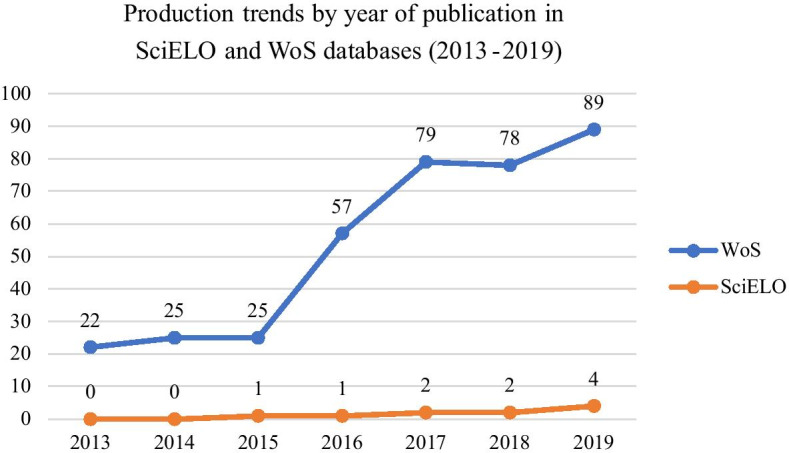
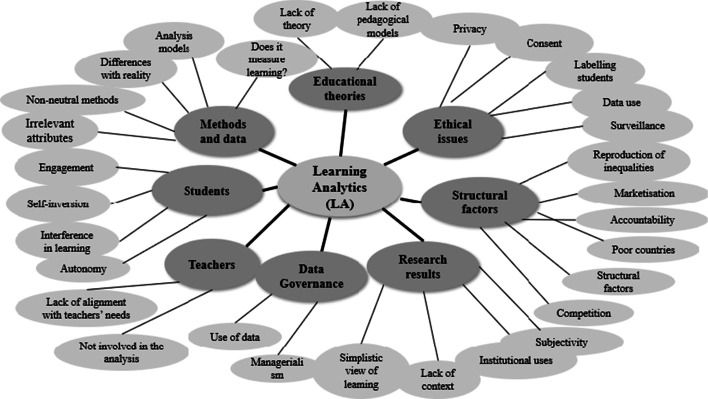
In a context where learning mediated by technology has gained prominence in higher education, learning analytics has become a powerful tool to collect and analyse data with the aim of improving students’ learning. However, learning analytics is part of a young community and its developments deserve further exploration. Some critical stances claim that learning analytics tends to underplay the complexity of teaching-learning processes. By means of both a bibliometric and a content analysis, this paper examines the publication patterns on learning analytics in higher education and their main challenges. 385 papers that were published in WoScc and SciELO indexes between 2013 and 2019 were identified and analysed. Learning analytics is a vibrant and fast-developing community. However, it continues to face multiple and complex challenges, especially regarding students’ learning and their implications. The paper concludes by distinguishing between a practice-based and management-oriented community of learning analytics and an academic-oriented community. Within both communities, though, it seems that the focus is more on analytics than on learning.
Overview
The claims and statistics of this paper haven’t been checked yet.
Run the check — free, no account needed. It reads the open-access text and checks the sources it cites.
Integrity signals
Registry
Cites
Statistics
Figures
Verification
Claims the paper makes
The claims and statistics of this paper haven’t been checked yet.
Run the check — free, no account needed. It reads the open-access text and checks the sources it cites.
Claims other papers make about this one
Each is checked against this paper’s own text: does it say what the citing paper says it does?
The cited source says what the claim attributes to it.
In the citing paper
“They critiqued the prevailing focus on analytics over substantive learning improvements, advocating for a balanced approach that equally values pedagogical effectiveness alongside technological advancements (Drugova et al., 2024).”
From Unpacking student engagement in higher education learning analytics: a systematic review (2024) · cites this paper as Guzmán-Valenzuela et al. (2021)
Self-check
Percentages, sums and reported differences re-computed from the paper’s own numbers.
The self-check needs the paper’s full text.
Citations
Cites
Zawacki-Richter, O., Marín, V. I., Bond, M., & Gouverneur, F. (2019) · International Journal of Educational Technology in Higher Education · doi:10.1186/s41239-019-0171-0 · Cited by 7,242
The SAGE encyclopedia of qualitative research methods
Brodsky, A. (2011) · Choice Reviews Online · doi:10.5860/choice.46-4214 · Cited by 3,347
Bornmann, L., & Mutz, R. (2015) · Journal of the Association for Information Science and Technology · doi:10.1002/asi.23329 · Cited by 1,576
Learning analytics: drivers, developments and challenges
Ferguson, R. (2012) · International Journal of Technology Enhanced Learning · doi:10.1504/ijtel.2012.051816 · Cited by 1,357 · cited 9×
“In tracing back the developments of LA, the literature shows that educational data mining (EDM) has had an important role especially in North America, Western Europe and Australia/New Zealand (Ferguson 2012).”
BackgroundMethodInfluentialLearning Analytics: Ethical Issues and Dilemmas
Slade, S., & Prinsloo, P. (2013) · American Behavioral Scientist · doi:10.1177/0002764213479366 · Cited by 1,078
Utilising learning analytics to support study success in higher education: a systematic review
Ifenthaler, D., & Yau, J. Y.-K. (2020) · Educational Technology Research and Development · doi:10.1007/s11423-020-09788-z · Cited by 1,063
Romero, C., & Ventura, S. (2013) · WIREs Data Mining and Knowledge Discovery · doi:10.1002/widm.1075 · Cited by 869
Gašević, D., Dawson, S., Rogers, T., & Gašević, D. (2015) · The Internet and Higher Education · doi:10.1016/j.iheduc.2015.10.002 · Cited by 767
The current landscape of learning analytics in higher education
Viberg, O., Hatakka, M., Bälter, O., & Mavroudi, A. (2018) · Computers in Human Behavior · doi:10.1016/j.chb.2018.07.027 · Cited by 766
Big Data and analytics in higher education: Opportunities and challenges
Daniel, B. (2015) · British Journal of Educational Technology · doi:10.1111/bjet.12230 · Cited by 610 · cited 8×
“Significantly, the practical community of LA also includes intervention strategies for students identified as at risk (Daniel 2015; Fynn 2016; Wong 2019).”
BackgroundMethodInfluentialEthical and privacy principles for learning analytics
Pardo, A., & Siemens, G. (2014) · British Journal of Educational Technology · doi:10.1111/bjet.12152 · Cited by 577
Aldowah, H., Al-Samarraie, H., & Fauzy, W. M. (2019) · Telematics and Informatics · doi:10.1016/j.tele.2019.01.007 · Cited by 564 · cited 2×
“Although EDM and LA share many characteristics, there are differences between these two research programmes (Aldowah et al. 2019).”
Perceiving Learning at a Glance: A Systematic Literature Review of Learning Dashboard Research
Schwendimann, B. A., Rodríguez‐Triana, M. J., Vozniuk, A., Prieto, L. P., Boroujeni, M. S., Holzer, A., Gillet, D., & Dillenbourg, P. (2016) · IEEE Transactions on Learning Technologies · doi:10.1109/tlt.2016.2599522 · Cited by 551
Academic Analytics: A New Tool for a New Era.
Campbell, J. P., DeBlois, P. B., & Oblinger, D. G. (2007) · Educational Review · Cited by 505
An overview of learning analytics
Clow, D. (2013) · Teaching in Higher Education · doi:10.1080/13562517.2013.827653 · Cited by 436 · cited 5×
“…Selwyn 2015, 2019; Timmis et al. 2016; Viberg et al. 2018; Watson et al. 2017; Wilson et al. 2017). e) LA is focused on collecting and analysing large sets of data in the light of educational and pedagogical theories (Avello and Duart 2016; Clow 2013; Perrotta and William-son 2018; Rambe and Moeti.”
BackgroundInfluentialData entry: towards the critical study of digital data and education
Selwyn, N. (2014) · Learning Media and Technology · doi:10.1080/17439884.2014.921628 · Cited by 338 · cited 13×
“…students download documents or access the LMS) (Dawson and Siemens 2014; Jones and McCoy 2019; Khalil et al. 2018; Per-rotta and Williamson 2018; Selwyn 2015, 2019; Timmis et al. 2016; Viberg et al. 2018; Watson et al. 2017; Wilson et al. 2017). e) LA is focused on collecting and analysing…”
BackgroundInfluentialStudent perceptions of privacy principles for learning analytics
Ifenthaler, D., & Schumacher, C. (2016) · Educational Technology Research and Development · doi:10.1007/s11423-016-9477-y · Cited by 314
Bodily, R., & Verbert, K. (2017) · IEEE Transactions on Learning Technologies · doi:10.1109/tlt.2017.2740172 · Cited by 306
Vessuri, H., Guédon, J., & Cetto, A. M. (2013) · Current Sociology · doi:10.1177/0011392113512839 · Cited by 279
Rethinking assessment in a digital age: opportunities, challenges and risks
Timmis, S., Broadfoot, P., Sutherland, R., & Oldfield, A. (2015) · British Educational Research Journal · doi:10.1002/berj.3215 · Cited by 266
Learning Analytics in Higher Education—A Literature Review
Leitner, P., Khalil, M., & Ebner, M. (2017) · Studies in systems, decision and control · doi:10.1007/978-3-319-52977-6_1 · Cited by 263 · cited 5×
“…central institutional units are in control of the processes of gathering and analysing the data with students and teachers being relegated to an observational role (Leitner et al. 2017; Tsai and Gasevic 2017) and having scant understandings of the LA techniques being put into use (Selwyn 2019).”
BackgroundInfluentialWhat’s the Problem with Learning Analytics?
Selwyn, N. (2019) · Journal of Learning Analytics · doi:10.18608/jla.2019.63.3 · Cited by 246 · cited 14×
“…students download documents or access the LMS) (Dawson and Siemens 2014; Jones and McCoy 2019; Khalil et al. 2018; Per-rotta and Williamson 2018; Selwyn 2015, 2019; Timmis et al. 2016; Viberg et al. 2018; Watson et al. 2017; Wilson et al. 2017). e) LA is focused on collecting and analysing…”
BackgroundInfluentialWhere is the evidence?: a call to action for learning analytics
Ferguson, R., & Clow, D. (2017) · International Conference on Learning Analytics and Knowledge · doi:10.1145/3027385.3027396 · Cited by 237 · cited 1×
“Across both communities (practical and academic communities), there is a shortage of papers devoted to developing or expanding educational theories about students’ learning (Ferguson and Clow 2017; Leitner et al. 2017; Viberg et al. 2018).”
BackgroundWilliamson, B. (2019) · British Journal of Educational Technology · doi:10.1111/bjet.12849 · Cited by 214
Tsai, Y.-S., & Gasevic, D. (2017) · Proceedings of the Seventh International Learning Analytics & Knowledge Conference · doi:10.1145/3027385.3027400 · Cited by 211 · cited 1×
“…central institutional units are in control of the processes of gathering and analysing the data with students and teachers being relegated to an observational role (Leitner et al. 2017; Tsai and Gasevic 2017) and having scant understandings of the LA techniques being put into use (Selwyn 2019).”
BackgroundJones, K. M. L. (2019) · International Journal of Educational Technology in Higher Education · doi:10.1186/s41239-019-0155-0 · Cited by 196 · cited 2×
“The use of LA has also raised concerns about privacy and vulnerability (Daniel 2015; Jones 2019; Viberg et al. 2018).”
BackgroundMor, Y., Ferguson, R., & Wasson, B. (2015) · British Journal of Educational Technology · doi:10.1111/bjet.12273 · Cited by 194
Quality Indicators for Learning Analytics.
Scheffel, M., Drachsler, H., Slavi Stoyanov, A., & Specht, M. M. (2014) · DSpace (Open University in the Netherlands) · Cited by 172
Subotzky, G., & Prinsloo, P. (2011) · Distance Education · doi:10.1080/01587919.2011.584846 · Cited by 159
Teaching and Learning Analytics to Support Teacher Inquiry: A Systematic Literature Review
Sergis, S., & Sampson, D. G. (2017) · Studies in systems, decision and control · doi:10.1007/978-3-319-52977-6_2 · Cited by 146
Perrotta, C., & Williamson, B. (2016) · Learning Media and Technology · doi:10.1080/17439884.2016.1182927 · Cited by 145
Why researchers publish in non-mainstream journals: Training, knowledge bridging, and gap filling
Chavarro, D., Tang, P., & Ràfols, I. (2017) · Research Policy · doi:10.1016/j.respol.2017.08.002 · Cited by 143
The role of social network analysis as a learning analytics tool in online problem based learning
Saqr, M., & Alamro, A. (2019) · BMC Medical Education · doi:10.1186/s12909-019-1599-6 · Cited by 134
Learning analytics: challenges and limitations
Wilson, A. N., Watson, C., Thompson, T. L., Drew, V., & Doyle, S. (2017) · Teaching in Higher Education · doi:10.1080/13562517.2017.1332026 · Cited by 116
What can moment-by-moment learning curves tell about students’ self-regulated learning?
Molenaar, I., Horvers, A., & Baker, R. S. (2019) · Learning and Instruction · doi:10.1016/j.learninstruc.2019.05.003 · Cited by 96 · cited 2×
“…with long periods of student development (typically semesters or years), LA techniques are capable of capturing learning processes moment-by-moment (Molenaar et al. 2019), for example, students completing on-line tasks, working in groups, or interacting with multiple university systems (such as…”
BackgroundEducational Theories and Learning Analytics: From Data to Knowledge
Wong, J., Baars, M., de Koning, B. B., van der Zee, T., Davis, D., Khalil, M., Houben, G., & PAAS, F. G. W. C. (2019) · Springer eBooks · doi:10.1007/978-3-319-64792-0_1 · Cited by 90
Actitudes y formación docente hacia la inclusión en Educación Secundaria Obligatoria
Palomino, M. C. P., & Ruiz, M. J. C. (2017) · Revista Electrónica de Investigación Educativa · doi:10.24320/redie.2017.19.1.765 · Cited by 87
A bibliometric perspective of learning analytics research landscape
Waheed, H., Hassan, S., Aljohani, N. R., & Wasif, M. (2018) · Behaviour and Information Technology · doi:10.1080/0144929x.2018.1467967 · Cited by 87
Rambe, P., & Moeti, M. (2016) · Educational Technology Research and Development · doi:10.1007/s11423-016-9500-3 · Cited by 84
The ethics of using learning analytics to categorize students on risk
Scholes, V. (2016) · Educational Technology Research and Development · doi:10.1007/s11423-016-9458-1 · Cited by 79 · cited 2×
“…principle of LA techniques that they identify students at risk and there are concerns in the literature that so identifying students might promote their labelling (Scholes 2016; Wintrup 2017) and act as self-fulfilling prophecies, so exacerbating on the very problems that LA is designed to reduce.”
BackgroundLearning Analytics: Fundaments, Applications, and Trends
Sergis, S., & Sampson, D. (2017) · Studies in systems, decision and control · doi:10.1007/978-3-319-52977-6 · Cited by 76
Nuevas tendencias de aprendizaje colaborativo en e-learning: Claves para su implementación efectiva
Martínez, R. A., & Duart, J. M. (2016) · Estudios pedagógicos · doi:10.4067/s0718-07052016000100017 · Cited by 75 · cited 1×
“…Selwyn 2015, 2019; Timmis et al. 2016; Viberg et al. 2018; Watson et al. 2017; Wilson et al. 2017). e) LA is focused on collecting and analysing large sets of data in the light of educational and pedagogical theories (Avello and Duart 2016; Clow 2013; Perrotta and William-son 2018; Rambe and Moeti.”
BackgroundDawson, S., & Siemens, G. (2014) · The International Review of Research in Open and Distributed Learning · doi:10.19173/irrodl.v15i4.1878 · Cited by 74
Advancing a knowledge ecology: changing patterns of higher education studies in Latin America
Guzmán-Valenzuela, C., & Gómez-González, C. (2018) · Higher Education · doi:10.1007/s10734-018-0264-z · Cited by 50
Self-citationJones, K. M. L., & McCoy, C. (2018) · Learning Media and Technology · doi:10.1080/17439884.2018.1556216 · Cited by 49 · cited 2×
“The use of LA has also raised concerns about privacy and vulnerability (Daniel 2015; Jones 2019; Viberg et al. 2018).”
BackgroundThe SAGE Handbook of E-learning Research
Haythornthwaite, C., Andrews, R., Fransman, J., & Meyers, E. (2016) · SAGE Publications Ltd eBooks · doi:10.4135/9781473955011 · Cited by 48
Using predictive modelling to identify students at risk of poor university outcomes
Jia, P., & Maloney, T. (2014) · Higher Education · doi:10.1007/s10734-014-9829-7 · Cited by 46
Kollom, K., Tammets, K., Scheffel, M., Tsai, Y., Jivet, I., Muñoz‐Merino, P. J., Moreno-Marcos, P. M., Whitelock‐Wainwright, A., Calleja, A. R., Gašević, D., et al. (2020) · The Internet and Higher Education · doi:10.1016/j.iheduc.2020.100788 · Cited by 46
Teamwork assessment in the educational web of data: A learning analytics approach towards ISO 10018
Conde, M. Á., Colomo‐Palacios, R., García‐Peñalvo, F. J., & Larrucea, X. (2017) · Telematics and Informatics · doi:10.1016/j.tele.2017.02.001 · Cited by 45
Adoption of Data Analytics in Higher Education Learning and Teaching
Blackmon, S. J., & Moore, R. L. (2020) · Advances in analytics for learning and teaching · doi:10.1007/978-3-030-47392-1 · Cited by 43 · cited 1×
“In addition, a full development of LA would lie in a combination of quantitative and qualitative analyses (Al-Mahmood 2020).”
BackgroundHigher Education’s Panopticon? Learning Analytics, Ethics and Student Engagement
Wintrup, J. (2017) · Higher Education Policy · doi:10.1057/s41307-016-0030-8 · Cited by 35 · cited 4×
“…principle of LA techniques that they identify students at risk and there are concerns in the literature that so identifying students might promote their labelling (Scholes 2016; Wintrup 2017) and act as self-fulfilling prophecies, so exacerbating on the very problems that LA is designed to reduce.”
BackgroundMethodInfluentialA social cartography of analytics in education as performative politics
Prinsloo, P. (2019) · British Journal of Educational Technology · doi:10.1111/bjet.12872 · Cited by 35
Brief Review of Educational Applications Using Data Mining and Machine Learning
Nájera, A. B. U., & de la Calleja, J. (2017) · Revista Electrónica de Investigación Educativa · doi:10.24320/redie.2017.19.4.1305 · Cited by 33
Learning Analytics. Una Revisión de la Literatura
Castro, P. (2017) · Educación y Educadores · doi:10.5294/edu.2017.20.1.6 · Cited by 31 · cited 1×
“…environments and the extent to which there is an alignment between the teaching and learning activities and the assessment tasks that count for LA (Rojas-Castro 2017; Selwyn 2015, 2019; Scheffel et al. 2014). c) Specific learning contexts (national, institutional, disciplinary contexts) where…”
BackgroundScholarly Communication Strategies in Latin America's Research- Intensive Universities
Alperín, J. P., Fischman, G. E., & Willinsky, J. M. (2011) · Cited by 30
Learning Analytics and the Imperative for Theory-Driven Research
Rogers, T., Dawson, S., & Gaevi, D. (2016) · SAGE Publications Ltd eBooks · doi:10.4135/9781473955011.n12 · Cited by 28 · cited 3×
“It is not clear, therefore, that LA are having a positive effect on learning (Gašević et al. 2016; Scheffel et al. 2014; Rogers et al. 2016; Viberg et al. 2018).”
BackgroundUser Consent in MOOCs – Micro, Meso, and Macro Perspectives
Khalil, M., Prinsloo, P., & Slade, S. (2018) · The International Review of Research in Open and Distributed Learning · doi:10.19173/irrodl.v19i5.3908 · Cited by 28
Johanes, P., & Thille, C. (2019) · British Journal of Educational Technology · doi:10.1111/bjet.12862 · Cited by 26
The Givenness of the Human Learning Experience and Its Incompatibility with Information Analytics
Lundie, D. C. (2015) · Educational Philosophy and Theory · doi:10.1080/00131857.2015.1052357 · Cited by 22 · cited 5×
“Also, according to some authors, LA underplays the complexity of teaching-learning processes (Lundie 2017; Selwyn 2015, 2019; Wilson et al. 2017).”
BackgroundInfluentialFynn, A. (2016) · The International Review of Research in Open and Distributed Learning · doi:10.19173/irrodl.v17i6.2812 · Cited by 19 · cited 3×
“Significantly, the practical community of LA also includes intervention strategies for students identified as at risk (Daniel 2015; Fynn 2016; Wong 2019).”
BackgroundA Framework to Support Interdisciplinary Engagement with Learning Analytics
Blackmon, S. J., & Moore, R. L. (2020) · Advances in analytics for learning and teaching · doi:10.1007/978-3-030-47392-1_3 · Cited by 18 · cited 1×
“…active methodologies based on problems (Saqr and Alamro 2019), decision making and interventions in the classroom (Molenaar et al. 2019), at an institutional level in relation to meta-data (Jia and Maloney 2015), or the understanding of self-regulated learning (Blackmon and Moore 2020; Wong 2019).”
MethodCorrin, L. (2021) · Educational Technology Research and Development · doi:10.1007/s11423-020-09922-x · Cited by 16
Small data, online learning and assessment practices in higher education: a case study of failure?
Watson, C., Wilson, A. N., Drew, V., & Thompson, T. L. (2016) · Assessment & Evaluation in Higher Education · doi:10.1080/02602938.2016.1223834 · Cited by 15
Structure and evaluation of a residency research program in a university hospital
Tamim, H., Zeineldine, S. M., Tabbara, F., Khoury, S. J., Akiki, Z., Khansa, S., & Taher, A. T. (2019) · BMC Medical Education · doi:10.1186/s12909-019-1858-6 · Cited by 14
A Landscape of Learning Analytics: An Exercise to Highlight the Nature of an Emergent Field
Peña‐Ayala, A., Cárdenas-Robledo, L. A., & Sossa, H. (2017) · Studies in systems, decision and control · doi:10.1007/978-3-319-52977-6_3 · Cited by 11 · cited 6×
“…a practice-based community led by institutional researchers and managers with interests in data visualisation, instructor feedback, student recommendations, student performance predictions, student mental models and detection of unwanted behaviours (Daniel 2015; Peña-Ayala et al. 2017; Wong 2019).”
BackgroundMethodInfluentialThe Politics of Learning Analytics
Al-Mahmood, R. (2020) · Advances in analytics for learning and teaching · doi:10.1007/978-3-030-47392-1_2 · Cited by 4 · cited 1×
“In addition, a full development of LA would lie in a combination of quantitative and qualitative analyses (Al-Mahmood 2020).”
BackgroundŞahin, M., & Yurdugül, H. (2020) · Advances in analytics for learning and teaching · doi:10.1007/978-3-030-47392-1_4 · Cited by 4
Cited by
Sorted by citations
Artificial Intelligence for Assessment and Feedback to Enhance Student Success in Higher Education
Hooda, M., Rana, C., Dahiya, O., Rizwan, A., & Hossain, M. S. (2022) · Mathematical Problems in Engineering · doi:10.1155/2022/5215722 · Cited by 444
“[102] )ematic-based analysis approach Inefficient volume of data — Eclectic methodology will be applied for learning enhancement”
MethodLearning analytics dashboard: a tool for providing actionable insights to learners
Sušnjak, T., Ramaswami, G. S., & Mathrani, A. (2022) · International Journal of Educational Technology in Higher Education · doi:10.1186/s41239-021-00313-7 · Cited by 356
“Overall, evidence about whether learning analytics and LADs improve learning in practice is scarce (Ferguson & Clow, 2017; Guzmán-Valenzuela et al., 2021; Knight et al., 2020; Rets et al., 2021; Wilson et al., 2017) and has room for further investigation.”
BackgroundUnpacking student engagement in higher education learning analytics: a systematic review
Bergdahl, N., Bond, M., Sjöberg, J., Dougherty, M., & Oxley, E. (2024) · International Journal of Educational Technology in Higher Education · doi:10.1186/s41239-024-00493-y · Cited by 138
Paulsen, L., & Lindsay, E. (2024) · Education and Information Technologies · doi:10.1007/s10639-023-12401-4 · Cited by 111
“Even recent reviews, however, keep concluding that learning is missing from LA (Guzmán-Valenzuela et al., 2021).”
InfluentialOuyang, F., & Zhang, L. (2024) · Educational Research Review · doi:10.1016/j.edurev.2024.100616 · Cited by 149
Metadata
- Authors
- Guzmán-Valenzuela, C., Gómez-González, C., Rojas-Murphy Tagle, A., & Lorca-Vyhmeister, A.
- Affiliations
- University of Tarapacá (CL)
- University of Valparaíso (CL)
- Corresponding author
- Guzmán-Valenzuela, Carolina
- Venue
- International Journal of Educational Technology in Higher Education
- Published
- 2021-05-04
- Volume
- 18
- Issue
- 1
- Pages
- 23-23
- ISSN
- 2365-9440 (ISSN-L)
- PMC
- PMC8092999
- OpenAlex
- W3163777542
- Cited by
- 131
- References
- 67
- Citations by year
- 2026: 35 · 2025: 31 · 2024: 22 · 2023: 24 · 2022: 14 · 2021: 5
- FWCI
- 2.80
- Type
- journal article
- Language
- en
- Open access
- diamond
- doi.org
- Locations
- International Journal of Educational Technology in Higher Education (publishedVersion, cc-by)
- PubMed Central (publishedVersion, cc-by)
- PubMed (publishedVersion)
- DOAJ (DOAJ: Directory of Open Access Journals) (submittedVersion, cc-by-sa)
- Funders
- FONDECYT (1200633, 1161413)
- Topics
- Physical Sciences › Computer Science › Computer Science Applications › Online Learning and Analytics
- Physical Sciences › Computer Science › Information Systems › Educational and Technological Research
- Social Sciences › Education › Educational Technology in Learning
- Keywords
- learning analytics, higher education, publication trends, teaching-learning process, student learning, technology-mediated learning
About these checks
Registry, retraction, Cites and statistics results are computed, not judged, with one exception: a printed reference that no index lists is read once by a model before it counts as a citation error. Claims are extracted by a model and kept only when their quote appears verbatim in the text; each cited source is then checked, with a model’s help, for whether it says what the claim relies on. Those verdicts can be wrong — read the claim’s quote and the cited source before relying on one.
Statistics and arithmetic are recomputed, not judged.
Confidence bands are shown only for fields calibrated on our annotated test set. None is calibrated yet, so no band is shown.
What counts as a claim ›How we measure confidence ›How we check this ›
Are you an author, or do you see a problem with this page? Request a review
