

Artificial intelligence applications in Latin American higher education: a systematic review
Open accessThe DOI matches its Crossref record; 67 of the 67 references it cites were found in a registry or an index; 4 of the 40 sources its claims cite were checked for support.
Abstract
Over the last decade, there has been great research interest in the application of artificial intelligence (AI) in various fields, such as medicine, finance, and law. Recently, there has been a research focus on the application of AI in education, where it has great potential. Therefore, a systematic review of the literature on AI in education is therefore necessary. This article considers its usage and applications in Latin American higher education institutions. After identifying the studies dedicated to educational innovations brought about by the application of AI techniques, this review examines AI applications in three educational processes: learning, teaching, and administration. Each study is analyzed for the AI techniques used, such as machine learning, deep learning, and natural language processing, the AI tools and algorithms that are applied, and the main education topic. The results reveal that the main AI applications in education are: predictive modelling, intelligent analytics, assistive technology, automatic content analysis, and image analytics. It is further demonstrated that AI applications help to address important education issues (e.g., detecting students at risk of dropping out) and thereby contribute to ensuring quality education. Finally, the article presents the lessons learned from the review concerning the application of AI technologies in higher education in the Latin American context.
Overview
CoChat Summary
## TL;DR
This systematic review maps 31 empirical studies on AI in Latin American higher education published from July 2016 to June 2021. It finds that AI is used mainly for predictive modelling, content analysis, chatbots, and classification, with dropout/retention and student performance among the most common problems addressed.
## Key findings
- The review included 31 published articles from 7 countries: Mexico (7), Colombia (7), Ecuador (6), Brazil (5), Peru (2), Chile (2), Argentina (1), and Bolivia (1).
- The most common AI application was predictive modelling in education with 16 studies; followed by AI computer-assisted content analysis (6), assistive technology/chatbots (5), intelligent analytics/classification (3), and image analytics/facial recognition (1).
- Machine learning was the most common technique, used in 17 studies; natural language processing appeared in 8, deep learning in 3, and ML+NLP or DL+NLP combinations were also reported.
- The most frequently used algorithms were MLP-ANN, Random Forest (RF), and Decision Tree (DT); the paper says MLP-ANN and RF reported the highest accuracy across the studies, with examples of reported accuracies including 99.38% (DT), 99.29% (KNN), 98.67% (MLP), 95.59% (NB), and 98.55% (RF) in one study.
## Methods
- The paper is a systematic literature review guided by 3 research questions about AI applications, techniques/tools/algorithms, and education topics/issues in Latin American higher education.
- Searches were run in July 2021 across Web of Science, IEEE Xplorer, Scielo, and CAPES Portal for studies published from July 2016 to June 2021 in English, Spanish, or Portuguese.
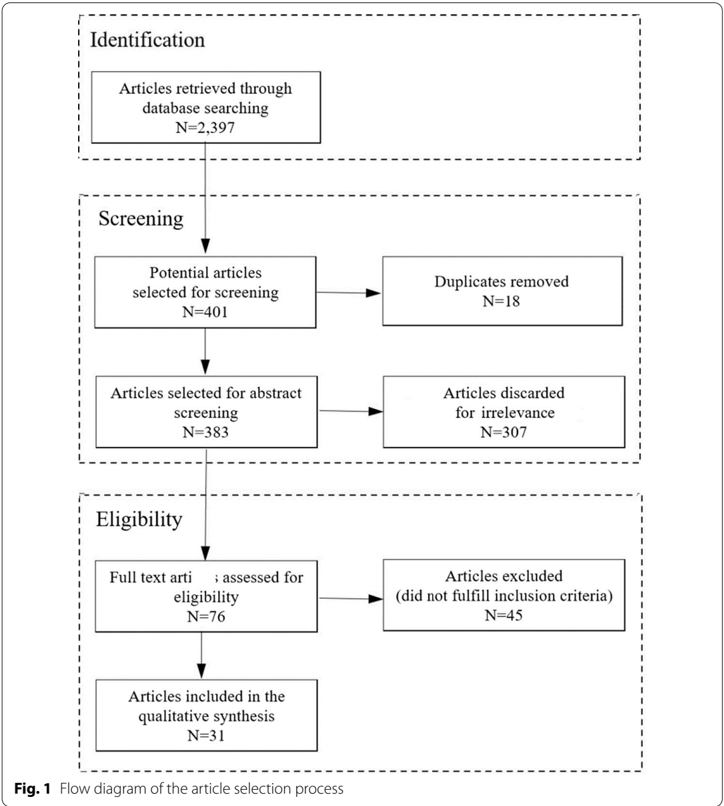
- The screening process went from 2397 articles to 401 after initial refinement, then 383 after removing 18 duplicates, then 76 after abstract screening, and finally 31 studies after full-text screening and eligibility checks.
## Limitations
- The paper states that there is “a lack of attention to ethics and data privacy” and that few reviewed studies mentioned ethical clearance; it says there is a need for protocols for personal data protection.
- It also notes that the rate of AI adoption in education is still slow compared with medicine, industry, and finance, which constrains how much evidence exists in this area.
- Evident from the text: the review is limited to 4 databases, a 5-year window, and English/Spanish/Portuguese publications, so relevant studies outside those sources, dates, or languages may have been missed.
Model-written summary. Check it against the paper before relying on it.
Integrity signals
Registry
Cites
Statistics
Figures
Verification
Claims the paper makes
4 Valid · 1 Not valid · 29 Not checked · 56 Own results and interpretations
The cited sources support only part of this claim — read each source’s verdict below.
In the paper
“AI applications can contribute to forecasting the student dropout rate and determining the factors that affect their performance”
What the sources say
- Not matchedcites Bedregal-Alpaca etal., 2020
An author–year citation the paper’s reference list doesn’t settle. We don’t search these by name.
- Not matchedcites da Fonseca Silveira etal., 2019
An author–year citation the paper’s reference list doesn’t settle. We don’t search these by name.
- Partly supportedcites Miranda & Guzmán, 2017 matched to “Análisis de la Deserción de Estudiantes Universitarios usando Técnicas de Minería de Datos” (2017) sourceExperimental — accuracy not yet measured
The Abstract reports that data-mining techniques identified variables associated with university student dropout, particularly socioeconomic circumstances and university entrance scores. The Conclusions likewise describe academic results and socioeconomic status as influencing whether students remain enrolled. These passages support identifying factors related to dropout, but not factors that affect student performance. (LLM, conf=0.83)
plainstates a cause- Asserted: passes — The authors put it forward as true.
- Checkable: passes — It can be checked against evidence.
- Load-bearing: unclear — It is unclear whether the paper’s conclusions depend on it.
- Based: passes — The paper gives a reason why it holds.
- Not matched
The cited sources support only part of this claim — read each source’s verdict below.
In the paper
“AI applications can contribute to forecasting the student dropout rate and determining the factors that affect their performance”
What the sources say
- Not matchedcites Bedregal-Alpaca etal., 2020
An author–year citation the paper’s reference list doesn’t settle. We don’t search these by name.
- Not matchedcites da Fonseca Silveira etal., 2019
An author–year citation the paper’s reference list doesn’t settle. We don’t search these by name.
- Supportedcites Miranda & Guzmán, 2017 matched to “Análisis de la Deserción de Estudiantes Universitarios usando Técnicas de Minería de Datos” (2017) source
The Methodology (p. 63) describes Bayesian-network, neural-network, and decision-tree classifiers used to predict whether students will drop out. The Abstract reports their predictive accuracy and a retention rate estimated by the decision tree, supporting the claim that these applications can help forecast dropout. (LLM, conf=0.88)
plainstates a possible cause- Asserted: passes — The authors put it forward as true.
- Checkable: passes — It can be checked against evidence.
- Load-bearing: unclear — It is unclear whether the paper’s conclusions depend on it.
- Based: passes — The paper gives a reason why it holds.
- Not matched
Every source the paper cites for this claim was checked and supports it.
In the paper
“AI applications can be used to analyze student academic results for university quality accreditation purposes”
What the sources say
- Supportedcites Delahoz-Dominguez et al., 2020 matched to “Análisis de la acreditación de calidad en programas de ingeniería industrial y los resultados en las pruebas nacionales estandarizadas, en Colombia” (2020) source
The Abstract (Resumen) states the article performs a relational analysis between university quality accreditations in industrial engineering programs and national standardized test results 'usando tecnicas de aprendizaje automatico', and the METODOLOGIA section describes PCA, decision-tree and Random Forest models used to group, classify and forecast accreditation category from Saber Pro results. RESULTS (p. 133) report Random Forest reaching 91% accuracy and 0.94 mean AUC in determining a university's accreditation category from test results, i.e. the paper demonstrates the capability the claim attributes to it. The only difference is terminology: our copy speaks of machine learning (a branch of AI) rather than 'AI applications', and its empirical setting is Colombian industrial engineering programs, which bounds a general 'can be used' statement only by example, not by contradiction. (LLM, conf=0.85)
plainstates a possible cause- Asserted: passes — The authors put it forward as true.
- Checkable: passes — It can be checked against evidence.
- Load-bearing: unclear — It is unclear whether the paper’s conclusions depend on it.
- Based: passes — The paper gives a reason why it holds.
- Supported
A result the paper reports from its own data — it cites no other source for it, so there is none to check. The quote shows it is in the paper.
In the paper
“Predictive modelling in education | [1], [2], [3], [6], [8], [13], [14], [15], [20], [23], [24], [25], [28], [29], [31] | 16”
plain- Asserted: passes — The authors put it forward as true.
- Checkable: passes — It can be checked against evidence.
- Load-bearing: unclear — It is unclear whether the paper’s conclusions depend on it.
- Based: passes — The paper gives a reason why it holds.
A result the paper reports from its own data — it cites no other source for it, so there is none to check. The quote shows it is in the paper.
In the paper
“Assistive technology (chatbots) | [5], [7], [9], [11], [17] | 5”
plain- Asserted: passes — The authors put it forward as true.
- Checkable: passes — It can be checked against evidence.
- Load-bearing: unclear — It is unclear whether the paper’s conclusions depend on it.
- Based: passes — The paper gives a reason why it holds.
49 more claims
Create a free account to see all 90 claims and to verify the 4 references still open.
- It may state two separate claims as one. 11
- Probably not a substantial claim. 30
- The quote only partly states this claim. 2
Claims other papers make about this one
Each is checked against this paper’s own text: does it say what the citing paper says it does?
The source backs part of the claim, not all of it — or backs it for a different population, condition or comparison.
In the citing paper
“Salas-Pilco y Yang (2022) realizaron una revisión sistemática de 139 artículos indexados en Scopus, identificando aplicaciones en modelado predictivo, analítica inteligente y tecnologías de asistencia, y destacando su contribución a la detección temprana del riesgo de deserción [1].”
From Avances, Retos Éticos y Perspectivas de la Inteligencia Artificial (IA) en la Educación de América Latina (2025) · cites this paper as [1]
Experimental — accuracy not yet measuredThe source backs part of the claim, not all of it — or backs it for a different population, condition or comparison.
In the citing paper
“Salas-Pilco et al. (2022) identifican aplicaciones de procesamiento de lenguaje natural que generan retroalimentación automatizada en ensayos y guías de estudio, liberando al profesor de tareas repetitivas [1].”
From Avances, Retos Éticos y Perspectivas de la Inteligencia Artificial (IA) en la Educación de América Latina (2025) · cites this paper as [1]
Experimental — accuracy not yet measuredThe source backs part of the claim, not all of it — or backs it for a different population, condition or comparison.
In the citing paper
“AI applications in education also raise ethical considerations, ranging from professional readiness to lapses in rigour, such as not adhering to ethical procedures when collecting data (e.g., Salas-Pilco & Yang, 2022), and ethical and legal issues related to using tools prematurely (Zhang et al., 2023).”
From A meta systematic review of artificial intelligence in higher education: a call for increased ethics, collaboration, and rigour (2024) · cites this paper as Salas-Pilco & Yang, 2022
Experimental — accuracy not yet measuredThe cited source says what the claim attributes to it.
In the citing paper
“The results revealed that the main AI applications in higher education in Latin America are: (1) predictive modeling, (2) intelligent analytics, (3) assistive technology, (4) automatic content analysis, and (5) image analytics.”
From Artificial intelligence in higher education: the state of the field (2023) · cites this paper as Salas-Pilco and Yang (2022)
In the citing paper
“These include the replacement of traditional instruction methods with cost-effective AI programs by administrators during budget constraints, as well as privacy and data protection challenges related to sensitive student and faculty information (Salas-Pilco & Yang, 2022;Wu et al., 2024;Zawacki-Richter et al., 2019).”
From Barriers to and Opportunities for the Adoption of Generative Artificial Intelligence in Higher Education in the Global South: Insights from Sri Lanka (2025) · cites this paper as Salas-Pilco & Yang, 2022
2 more claims about this paper
Create a free account to see every claim other papers make about this one.
Citations
Cites
Systematic Literature Reviews in Software Engineering—A Systematic Literature Review
Kitchenham, B., Pearl Brereton, O., Budgen, D., Turner, M., Bailey, J., & Linkman, S. (2009) · Information and Software Technology · doi:10.1016/j.infsof.2008.09.009 · Cited by 4,537 · cited 1×
“A systematic review explores previous studies to answer specific research questions based on an explicit, systematic, and replicable search strategy, with inclusion and exclusion criteria (Kitchenham et al., 2009; Xiao & Watson, 2019).”
BackgroundArtificial Intelligence in Education: A Review
Chen, L., Chen, P., & Lin, Z. (2020) · IEEE Access · doi:10.1109/access.2020.2988510 · Cited by 4,133 · cited 1×
“The education sector is now significantly influenced by AI research, as AI applications are being used by learners, educators, and administrators and various tools, algorithms, and applications have been developed with the capacity to transform the education field (Chen et al., 2020).”
BackgroundGuidance on Conducting a Systematic Literature Review
Xiao, Y., & Watson, M. (2019) · Journal of Planning Education and Research · doi:10.1177/0739456x17723971 · Cited by 3,467 · cited 1×
“A systematic review explores previous studies to answer specific research questions based on an explicit, systematic, and replicable search strategy, with inclusion and exclusion criteria (Kitchenham et al., 2009; Xiao & Watson, 2019).”
BackgroundExploring the impact of artificial intelligence on teaching and learning in higher education
Popenici, S. A. D., & Kerr, S. (2017) · Research and Practice in Technology Enhanced Learning · doi:10.1186/s41039-017-0062-8 · Cited by 2,019 · cited 2×
“AI is defined as “computing systems that are able to engage in human-like processes such as learning, adapting, synthesizing, self-correction and use of data for complex processing tasks” (Popenici & Kerr, 2017, para.”
BackgroundOverview of artificial intelligence in medicine
Amisha, Malik, P., Pathania, M., & Rathaur, V. K. (2019) · Journal of Family Medicine and Primary Care · doi:10.4103/jfmpc.jfmpc_440_19 · Cited by 1,106
The TESOL Encyclopedia of English Language Teaching
(2018) · Wiley eBooks · doi:10.1002/9781118784235 · Cited by 1,055
AI technologies for education: Recent research & future directions
Zhang, K., & Aslan, A. B. (2021) · Computers and Education: Artificial Intelligence · doi:10.1016/j.caeai.2021.100025 · Cited by 923
Some guidance on conducting and reporting qualitative studies
Twining, P., Heller, R. S., Nussbaum, M., & Tsai, C.-C. (2017) · Computers & Education · doi:10.1016/j.compedu.2016.12.002 · Cited by 291 · cited 1×
“Moreover, Twining et al. (2017) highlighted the importance of qualitative studies—regarding technologies applied in education—in understanding a situation or phenomenon through the identification of themes and patterns in the data.”
BackgroundBorsci, S., Malizia, A., Schmettow, M., van der Velde, F., Tariverdiyeva, G., Balaji, D., & Chamberlain, A. (2022) · Personal and Ubiquitous Computing · doi:10.1007/s00779-021-01582-9 · Cited by 266 · cited 1×
“These applications are being integrated in social networks, websites, and a variety of platforms (Borsci et al., 2021).”
BackgroundOwoc, M. L., Sawicka, A., & Weichbroth, P. (2021) · IFIP Advances in Information and Communication Technology · doi:10.1007/978-3-030-85001-2_4 · Cited by 222 · cited 1×
“Furthermore, Owoc et al. (2021) indicated that the benefits of AI in education are the following: (a) automation of repetitive and time-consuming activities such as grading or controlling student attendance, (b) use of AI facilitators to support teachers in their classroom work, (c) feedback for…”
Background
Research works printed but not linked: 3
- *García-González, D. J., & Skrita, A. (2019). Predicting academic performance based on students' family environment: Evidence for Colombia using classification trees. Psychology Society & Education, 11 (3), 299-311. https:// doi. org/ 10. 21071/ psye. v11i3. 13947. · doi:10.21071/psye.v11i3.13947
- *Mendoza Jurado, H. F. (2020). Modelos de redes neuronales artificiales, como sustento evaluativo al crecimiento pedagógico virtual en Educación Superior [Artificial neural network models, as evaluative support to virtual pedagogical growth in Higher Education]. Educación Superior, 7(2), 25–36. https://www.scielo.org.bo/pdf/escepies/v7n2/v7n2_a06.pdf.
- Torre, D., & Zapata, G. (2012). Impacto de procesos de aseguramiento de la calidad sobre las instituciones de educación superior: un estudio en siete países [Impact of quality assurance processes on higher education institutions: A study in seven countries]. In M. Lemaitre, & M. Zenteno (Eds.), Aseguramiento de la Calidad en Iberoamérica. Informe 2012 (pp. 115–157). RIL Editores.
Cited by
Items 101–200 of 324
Natural Language Processing in Teacher Training : a systematic review
Zhu, Q. (2023) · Lecture Notes in Education Psychology and Public Media · doi:10.54254/2753-7048/18/20231293 · Cited by 10
Filgueiras, F. D. B. (2023) · Reforma y democracia. · doi:10.69733/clad.ryd.n87.a3 · Cited by 44
Üniversitelerde Yapay Zekânın Kullanımı: Dönüşümler, Getiriler ve Geleceğe Hazırlık
TELLİ, S. G., & Aydın, S. (2025) · Üniversite Araştırmaları Dergisi · doi:10.32329/uad.1609305 · Cited by 16
Inteligencia artificial en educación superior: revisión integrativa de la literatura
Perdomo, B., & Martínez, Ó. G. (2025) · Cuadernos de Investigación Educativa · doi:10.18861/cied.2025.16.2.4034 · Cited by 34
Teachers in the Age of Artificial Intelligence: Preparation and Response to Challenges
Escalona-Márquez, L. N., Tapia, S. J. C., Camputaro, L. A., & Aparicio-Escalante, C. O. O. (2024) · Artificial intelligence · doi:10.5772/intechopen.1005172 · Cited by 11
Mudenda, S. (2025) · Creative Education · doi:10.4236/ce.2025.1611112 · Cited by 13
Choudhary, A., Pamidimokkala, S., Krithiga, R., & M., B. R. (2026) · Frontiers in Artificial Intelligence · doi:10.3389/frai.2025.1706369 · Cited by 13
Trends and insights of AI in mathematics education: A bibliometric analysis
Yıldız, S. G., & Körpeoğlu, S. G. (2025) · International Electronic Journal of Mathematics Education · doi:10.29333/iejme/16401 · Cited by 26
“…AI-one of the key fields of study in computer engineering-has been regarded as the engine of technological advancement (Arslan, 2020), is applied in different fields: finance, medicine, law (Salas-Pilco & Yang, 2022), astronomy, business, computer vision (Urbina Nájera & Calleja Mora, 2017).”
Hongguang Bao, H. L. (2024) · Journal of Electrical Systems · doi:10.52783/jes.1722 · Cited by 14
“Salas-Pilco and Yang (2022) conducted a systematic review focusing on AI applications in Latin American higher education, shedding light on regional perspectives and challenges.”
BackgroundMethodKatsantonis, A., & Katsantonis, I. (2024) · Preprints.org · doi:10.20944/preprints202408.1360.v1 · Cited by 6
Ali, M., Ma, M., Muneeb, M., & Wong, G. K. W. (2025) · Metrics · doi:10.3390/metrics2040023 · Cited by 6
Offor, K. J. (2025) · IEEE Global Engineering Education Conference (EDUCON) · doi:10.1109/educon62633.2025.11016557 · Cited by 5
“These findings reflect the broader trend of using GenAI for sustainability education, where simulated environments can foster interdisciplinary insights [11].”
Yang, B., & Sun, Y. (2025) · Interactive Learning Environments · doi:10.1080/10494820.2025.2569777 · Cited by 12
“While existing research has acknowledged the potential of AILAs in higher education (Chen et al., 2021; Crompton & Burke, 2023; Salas-Pilco & Yang, 2022), research investigating how these applications, characterized by analyzing individual historical interaction data, enhance student learning…”
Akanda, F., & Talukder, T. (2026) · Social Sciences & Humanities Open · doi:10.1016/j.ssaho.2026.102437 · Cited by 19
Attitudes Toward Artificial Intelligence in Higher Education: A Mixed-Methods Study
Ayçiçek, B. (2025) · Üniversite Araştırmaları Dergisi · doi:10.32329/uad.1770973 · Cited by 5
Responsible AI Integration in STEM Higher Education: Advancing Sustainable Development Goals
Althubyani, A. R. (2026) · Sustainability · doi:10.3390/su18084005 · Cited by 6
Nosova, L. S., Belousova, N. A., & Ю.В., К. (2023) · Informatics and Education · doi:10.32517/0234-0453-2023-38-2-16-25 · Cited by 5
Chatbots in Academic Literacy Exploring AI in Education
Ali, M. H., Kainat, M., Maqsood, M., Fernandez, S. F., Ali, S., & Ahmad, M. (2024) · Advances in higher education and professional development book series · doi:10.4018/979-8-3693-1666-5.ch002 · Cited by 7
Alfirević, N., Rendulić, D., Fošner, M., & Fošner, A. (2024) · Informatics · doi:10.3390/informatics11040078 · Cited by 12
AI and Organizational Transformation:Anthropological Insights into Higher Education
Molek, N. (2023) · Izzivi prihodnosti · doi:10.37886/ip.2023.007 · Cited by 15
Quelopana, A., Keith, B., & Pizarro, R. (2024) · Computer Applications in Engineering Education · doi:10.1002/cae.22767 · Cited by 7
“It aims not only to identify critical factors that contribute to reducing submission time but also to provide deeper insights into the behavior of students within the Latin American cultural context [40].”
The Effectiveness of an Interactive WhatsApp Bot on Listening Skills
Behforouz, B., & Ghaithi, A. A. (2024) · International Journal of Interactive Mobile Technologies (iJIM) · doi:10.3991/ijim.v18i02.44327 · Cited by 14
Salas, F., & Caldas, J. (2024) · Educación · doi:10.18800/educacion.202401.m003 · Cited by 13
“…by two criteria: choosing models with the best performance metrics in previous studies on predicting undergraduate academic performance in LMICs (Salas-Pilco and Yang, 2022; Sekeroglu et al., 2021; Infante & Rojas., 2021) and prioritizing models with higher prediction accuracy for smaller…”
BackgroundMethodInfluentialThe Use of AI by Undergraduate Students of Social Education in Spain and Portugal: A Case Study
Carrera, S. M., Sánchez-Martínez, C., Fernandes, S. R. G., & Lorenzo, M. D. C. R. (2025) · Education Sciences · doi:10.3390/educsci15030390 · Cited by 14
Integración de la inteligencia artificial en la enseñanza del inglés como lengua extranjera
Bermúdez, H. D. R., Medranda, Á. D. R. P., Ramírez, F. L. Z., & Muñoz, J. D. Z. (2025) · Código Científico Revista de Investigación · doi:10.55813/gaea/ccri/v6/ne1/828 · Cited by 6
Rubach, C., & Backfisch, I. (2023) · Unterrichtswissenschaft · doi:10.1007/s42010-024-00193-6 · Cited by 6
“…include the rise of digital competence among (pre-service) teachers and educators post-program (Starkey 2020), as well as the evaluation of digital transformation efforts within teacher education, i.e., results of automated administration processes in teacher education (Salas-Pilco & Yang 2022).”
ChatGPT: una mirada desde la investigación
Ruíz, E. D. A. (2023) · Revista Investigaciones Andina · doi:10.33132/01248146.2256 · Cited by 10
Cabrera-Fuentes, A., Martínez Pérez, D. Z., & Rementeria Fuentes, J. J. (2025) · Ciencia Latina Revista Científica Multidisciplinar · doi:10.37811/cl_rcm.v9i4.18603 · Cited by 4
Dipierro, A. R., Witte, K. D., & Toma, P. (2025) · International Transactions in Operational Research · doi:10.1111/itor.70070 · Cited by 10
Poznanskyy, R., Pryimak, L., Аpelt, H., Савчук, Н., & KOPCHAK, L. (2025) · Metaverse Basic and Applied Research · doi:10.56294/mr2025179 · Cited by 6
Rosario, M. D. L. Á. O. D., Caballero, R., Domínguez, M. A. M., Lescure, R., Noguera, J. C., Jaén-Ortega, A. A., & Castaño, C. (2025) · Applied Sciences · doi:10.3390/app152011056 · Cited by 11
Lara-Calle, A., Bravo, N. J. P., Barrazueta, S., & Fonte, C. D. (2025) · ASCE MAGAZINE · doi:10.70577/asce.v4i4.467 · Cited by 5
Arguijo, E., Villuendas-Rey, Y., Cruz-Jiménez, A., Mireles-Hernández, J., Camacho-Nieto, O., & Aldape-Pérez, M. (2026) · Computers · doi:10.3390/computers15030150 · Cited by 4
Pineda-Briseño, A., Oblitas, J., Sánchez, L. C., Gómez, W. A. S., & Baltazar, R. (2026) · Education Sciences · doi:10.3390/educsci16030399 · Cited by 8
Human-AI feedback in clinical interview training: evidence and lessons in physiotherapy education
Villagrán, I., Hilliger, I., Rammsy, F., Fuentes‐Cimma, J., Miranda, C., Paz-Martin, S., Varas, J., & Neyem, A. (2026) · Assessment & Evaluation in Higher Education · doi:10.1080/02602938.2026.2644511 · Cited by 4
Artificial intelligence in doctoral training: Bridging gaps, easing burdens
Rodríguez, G. A., Chiappe, A., & Durand, J. C. (2026) · Social Sciences & Humanities Open · doi:10.1016/j.ssaho.2026.102744 · Cited by 5
Ramazanova, K. (2026) · Bangladesh Journal of Multidisciplinary Scientific Research · doi:10.46281/bjmsr.v11i4.2945 · Cited by 4
Beyond the Screen: AI's Societal Footprint
Mobo, F. D., Inam, A., Joseph, S., Ahmad, M., & Chemingui, H. (2024) · Advances in business information systems and analytics book series · doi:10.4018/979-8-3693-3354-9.ch014 · Cited by 3
Bouziane, A., & Bouziane, K. (2025) · Discover Education · doi:10.1007/s44217-025-00632-1 · Cited by 4
“In Latin America, Salas-Pilco and Yang [20] conducted a systematic review of AI applications in higher education, highlighting how AI is used to tackle major educational challenges like student retention and academic success.”
Villarreal-Torres, H., Ángeles-Morales, J., Cano-Mejía, J., Mejía-Murillo, C., Reyes, G. F., Cruz-Cruz, O., Urcia-Quispe, M., Palomino-Márquez, M., Solar-Jara, M., & Escobedo-Zarzosa, R. (2023) · ICST Transactions on Scalable Information Systems · doi:10.4108/eetsis.4550 · Cited by 4
Teachers’ Perceived Value of Integrating ICT in Transposing English Language Teaching in Nepal
Bohara, D. K. (2024) · KMC Journal · doi:10.3126/kmcj.v6i1.62332 · Cited by 5
Ricieri, D. D. V., de Farias, A. M. G., Barreto, R. V. G., & de Souza, F. R. (2024) · Peer Review · doi:10.53660/prw-1986-3703 · Cited by 11
Educación superior, inteligencia artificial y transformación digital en América Latina y el Caribe
Valentini, A. (2025) · SciComm Report · doi:10.32457/scr.v5i1.2830 · Cited by 18
Singh, V. V., Kumar, N., Singh, S., et al. (2024) · Research Square · doi:10.21203/rs.3.rs-3828524/v1 · Cited by 3
Gulen, H. N., & Kucuk, S. (2026) · Education and Information Technologies · doi:10.1007/s10639-026-14020-1 · Cited by 3
Zavaleta, C. E. F. (2024) · Perfiles Educativos · doi:10.22201/iisue.24486167e.2024.185.61323 · Cited by 5
de Luna, Á. B. M., & Gómez, S. M. (2024) · VISUAL REVIEW International Visual Culture Review / Revista Internacional de Cultura Visual · doi:10.62161/revvisual.v16.5277 · Cited by 2
WIP: Implementing and Deploying Artificial Intelligence Solutions in Higher Education Institutions
Vázquez‐Villegas, P., García-Chitiva, M. D. P., Valdés-Ramírez, D., Peraza, C. I. R., de Haro, C. A., & Zavala, G. (2024) · IEEE Frontiers in Education Conference (FIE) · doi:10.1109/fie61694.2024.10893121 · Cited by 6
“It has also impacted various processes in higher education (HE), such as teaching and learning, management, and professor reskilling by automating tasks, analyzing content, and improving decision-making processes [2], [3], [4].”
Profiling and Archetyping of Higher Education Applicants Using Intelligent Data Analysis Techniques
Espinoza, C., & Carretero, J. (2025) · IEEE Revista Iberoamericana de Tecnologias del Aprendizaje · doi:10.1109/rita.2025.3583369 · Cited by 2
The impact of AI-Based educational counseling on teaching effectiveness
Alenezi, A. R., & Alenezi, A. (2025) · EDUWEB · doi:10.46502/issn.1856-7576/2025.19.02.2 · Cited by 2
Medina-Zuta, P., Becerra, G., Soloaga, P. S., Adam, M. E. A., Barrenechea, E. Y. K., & Losada, A. V. (2025) · Sociologia & Antropologia · doi:10.1590/2238-38752025v15210 · Cited by 7
Seven, E. H., & Erümit, A. K. (2025) · Uşak üniversitesi eğitim araştırmaları dergisi/Uşak Üniversitesi eğitim araştırmaları dergisi · doi:10.29065/usakead.1688918 · Cited by 6
“…ve karar verme gibi yeterlikleri makinelere kazandırmaya yönelik çalışmaları ifade eden yapay zeka; doğal dil işleme, görüntü işleme, makine öğrenimi, derin öğrenme, örüntü çıkarma, problem çözme ve karar verme gibi insana özgü birçok işlevi içermektedir (Chen vd., 2020; Salas-Pilco & Yang, 2022).”
Galasso, B. (2025) · Actualidades Investigativas en Educación · doi:10.15517/z4mcs052 · Cited by 25
Chatbots and virtual assistants in higher education: supporting academic writing and research
Terletska, L., Соболєва, С. М., Hryshchuk, M., Haidenko, Y., & Dankevych, Y. (2026) · EDUWEB · doi:10.46502/issn.1856-7576/2026.20.01.23 · Cited by 2
Artificial Intelligence and Security Challenges
Mseer, I. N., & Ahmed, S. M. (2023) · Studies in systems, decision and control · doi:10.1007/978-3-031-28314-7_5 · Cited by 2
Орел, Ю., Ходикіна, Ю., & Chernova, T. (2023) · Futurity Philosophy. · doi:10.57125/fp.2023.03.30.04 · Cited by 6
(2023) · International Journal of Advanced Technology and Engineering Exploration · doi:10.19101/ijatee.2023.10101685 · Cited by 6
Open Science in Universities: Ukrainian Experience
Drach, I. (2024) · Advances in information quality and management · doi:10.4018/979-8-3693-1726-6.ch009 · Cited by 2
Incorporating Financial Knowledge with ChatGPT to Make Informed Investment Decisions
Hameed, A. H., Al-Ruaziq, S. S. S., & Abdulhameed, G. R. (2024) · Journal of Information Systems Engineering & Management · doi:10.55267/iadt.07.14512 · Cited by 5
Universities and Artificial Intelligence
Rios-Campos, C. A., Zambrano, E. O. G., Cantos, M. F. M., Anchundia-Gómez, O., León, M. E. C., Moya, G. E. M., García, E. A. M., Batalla, E. A. P., de la Oliva, N. A. R., & Zelada, O. S. (2024) · South Florida Journal of Development · doi:10.46932/sfjdv5n6-010 · Cited by 6
PROMPT-EDU: Roteiro de comandos de ajuste fino para ChatGPT
Ricieri, D. D. V., de Farias, A. M. G., de Souza, F. R., & Barreto, R. V. G. (2024) · SCIAS Educação Comunicação e Tecnologia · doi:10.36704/sciaseducomtec.v6i1.8374 · Cited by 5
Personalized Feedback in University Contexts: Exploring the Potential of AI-Based Techniques
Gratani, F., Screpanti, L., Giannandrea, L., Scaradozzi, D., & Capolla, L. M. (2024) · Communications in computer and information science · doi:10.1007/978-3-031-67351-1_30 · Cited by 7
Future Trends in Accreditation and Quality Enhancement
Kayyali, M. (2024) · Springer eBooks · doi:10.1007/978-3-031-66623-0_10 · Cited by 2
La ruta para revisiones paraguas en ciencias sociales. explorando nuevos horizontes
Moreno, S. P. B., & Rincón, A. G. (2024) · European Public & Social Innovation Review · doi:10.31637/epsir-2025-689 · Cited by 4
How AI Tools are Accepted and Utilized in Academia: A Mixed Methods Study
Fabia, J. N., Napoles, V., Goh, J. E. E., & Borbon, M. R. (2025) · Journal of Social and Scientific Education · doi:10.58230/josse.v2i1.295 · Cited by 5
Tendencias de IA para la educación universitaria: un enfoque bibliométrico
Yucta, H. R. P., Cevallos, A. A. C., Toala, J. W. E., & Naranjo, M. D. C. V. (2025) · Esprint Investigación · doi:10.61347/ei.v4i1.102 · Cited by 4
Predicting Postgraduate Student Engagement Using Artificial Intelligence (AI)
Shafiabady, N., Koo, F. K., Din, F. U., Sattarshetty, K., Yen, M., Alazab, M., & Alsharaydeh, E. (2025) · IEEE Transactions on Artificial Intelligence · doi:10.1109/tai.2025.3548016 · Cited by 5
Dembitska, S., Kobylianskyi, O. V., Nahorniak, S., Puhach, V., & Tatarchuk, V. (2025) · Lecture notes in networks and systems · doi:10.1007/978-3-031-85652-5_21 · Cited by 2
Mahajan, P. T. (2025) · SSRN Electronic Journal · doi:10.2139/ssrn.5339873 · Cited by 3
A Systematic Review of the Role of Artificial Intelligence in Teaching and Learning
Wang, J., Xing, Q., Qian, Y., & Akbar, A. (2024) · International Conference on Educational Technology (ICET) · doi:10.1109/icet62460.2024.10868945 · Cited by 2
Abdalla, R. A., Hidaytalla, L. A., Mulla, G. S., Al-Salman, M. M., Hammad, M., & Ahmed, E. (2025) · Studies in big data · doi:10.1007/978-3-031-83915-3_31 · Cited by 2
Al-Hyasat, H., Hmoud, H., & Maqableh, M. (2025) · Emerald Group Publishing Limited eBooks · doi:10.1108/978-1-83662-518-620251008 · Cited by 2
Use of Artificial Intelligence in Academic Activities of Students in Higher Education
Pedro, C.-M., & Zambrano-Solórzano, T. (2025) · International Conference on eDemocracy & eGovernment · doi:10.1109/icedeg65568.2025.11081524 · Cited by 2
Innovación en la enseñanza de Ciencias Sociales en las instituciones educativas del Ecuador
Mosquera-Esparza, Z. A., Cherrez, H. R. R., Manjarrés, Á. G. F., & Robayo, C. D. R. S. (2024) · Revista Ciencia Innovadora · doi:10.64422/rci.v2n2.2024.26 · Cited by 2
Quishpe, D. B. A., Salazar, M. E. R., Altamirano, G. E. V., & Tisalema, D. P. G. (2023) · Revista Ciencia Innovadora · doi:10.64422/rci.v1n3.2023.13 · Cited by 3
Yang, B., & Sun, Y. (2025) · International Journal of Human-Computer Interaction · doi:10.1080/10447318.2025.2543990 · Cited by 3
“As AI application becomes more prevalent in education, developing a robust theoretical model of AI-supported learning is significant (Chen et al., 2021; Dawson et al., 2023; Salas-Pilco & Yang, 2022).”
Cavalcanti, W. M., & Tavares, E. M. (2025) · International Journal of Educational Management · doi:10.1108/ijem-12-2024-0854 · Cited by 4
Villarroel, W. O. R., Estrada, S. N. C., Zurita, H. S. L., Ronquillo, D. F. T., Hurtado, C. P. R., & Medina, E. G. L. (2025) · Salud Ciencia y Tecnología · doi:10.56294/saludcyt20252441 · Cited by 1
Carabeo, R. J., & Castro, L. A. (2025) · Avances en Interacción Humano-Computadora · doi:10.47756/aihc.y10i1.201 · Cited by 2
“In Mexico, evidence on AI applications in higher education remains scarce [31], underscoring the need for studies exploring how students perceive these technologies within local educational contexts.”
Rahman, M. S., & Alam, M. M. (2026) · Journal of International Business and Economics · doi:10.15640/jibe.v13p3
Investigating the Effects of Prompt Engineering in STEM Activities Designed with ChatGPT-4o
Güler, N. K., & Tarım, K. (2025) · Cukurova University Faculty of Education Journal · doi:10.14812/cuefd.1673406 · Cited by 1
Flores, J. L. C. (2026) · Revista Multidisciplinar Epistemología de las Ciencias · doi:10.71112/bdkjqy10 · Cited by 3
Bulut, R. (2026) · Frontiers in Psychology · doi:10.3389/fpsyg.2026.1687155 · Cited by 10
Perceptions challenges and ethical concerns of ChatGPT use in Indian higher education institutions
Singh, A., Bajpai, A., & Singh, S. (2026) · Discover Education · doi:10.1007/s44217-026-01300-8 · Cited by 4
Generative AI in the eyes of the academy: Comparative analysis of faculty and student perceptions
Miranda, F. J., & Mera, A. C. (2026) · EDUWEB · doi:10.46502/issn.1856-7576/2026.20.01.12 · Cited by 1
AI-Enhanced EFL Teaching: Evidence from an Ecuadorian Public High School
Vélez-Olvera, E. R., Jara-Barros, C. F., Piña-Roldán, V. A., & Ramos-Saltos, L. A. (2026) · Revista Científica Ciencia y Método · doi:10.55813/gaea/rcym/v4/n2/184 · Cited by 2
“This gap is particularly pronounced in Latin American and Ecuadorian contexts, where research on any AI-enhanced language development is limited (Salas-Pilco & Yang, 2022; Okoye et al., 2023).”
Palomino, W. H., Gomero, M. M. S., & POMIANO, W. P. A. (2026) · Prohominum · doi:10.47606/acven/ph0486 · Cited by 1
Suárez, L. M. C. (2025) · De Gruyter eBooks · doi:10.1515/9783112206393-007 · Cited by 2
Academic Integrity in the Age of AI: University Students’ Study Practices and Ethical Judgments
López-López, E. M., Bru-Cordero, O., & Correa-Álvarez, C. D. (2026) · Trends in Higher Education · doi:10.3390/higheredu5020049 · Cited by 3
An AI-driven learning analytics model for evaluating digital competence of vocational teachers
Qin, H., Yan, J., Liu, X., & Zhu, Z. (2026) · Array · doi:10.1016/j.array.2026.100995 · Cited by 3
The New Trends and Applications in E-Learning Environments and E-Technologies
Alfaro, L., Rivera, C., Luna-Urquizo, J., Castañeda, E., Zúñiga-Cueva, J., & Urquizo-Abril, M. (2022) · Advances in educational technologies and instructional design book series · doi:10.4018/978-1-6684-3398-0.ch011 · Cited by 3
Artificial Intelligence and Security Challenges
Mseer, I. N., & Ahmed, S. M. (2023) · Studies in systems, decision and control · doi:10.1007/978-3-031-35828-9_13 · Cited by 2
Application of Deep Learning Technology in English Practical Teaching
Shi, Y. (2024) · Journal of Electrical Systems · doi:10.52783/jes.1729 · Cited by 11
“The literature also addresses broader themes such as personalized education (Bhutoria, 2022), AI applications in Latin American higher education (Salas-Pilco & Yang, 2022), and educational applications of AI in simulation-based learning (Dai & Ke, 2022), providing a holistic view of the field.”
BackgroundTenjo–García, J. S., & Figueroa–García, J. C. (2024) · IEEE World Engineering Education Conference (EDUNINE) · doi:10.1109/edunine60625.2024.10500602 · Cited by 2
(2024) · International Journal of Educational Curriculum Management and Research · doi:10.38007/ijecmr.2024.050117 · Cited by 3
“In the teaching of logistics management majors in universities, how to effectively impart relevant knowledge and cultivate students' practical operational abilities has become an important task [2].”
BackgroundManagement trends and implementation of AI in university management
Peñaloza, J. E. G., Bohórquez, A. F., & Balaguera, P. A. S. (2025) · Data & Metadata · doi:10.56294/dm2025866 · Cited by 1
Dynamic evolution analysis of AI in education based on SciMAT
Liu, H., Huang, L., Xu, S., Zhang, F., Han, G., & Luo, W. (2024) · International Conference on Intelligent Education and Intelligent Research (IEIR) · doi:10.1109/ieir62538.2024.10959926 · Cited by 1
“AI applications help to address important education issues (e.g., detecting students at risk of dropping out) and thereby contribute to ensuring quality education[31].”
Enhancing the Continuing Education of Science Teachers with Unplugged Machine Learning Activities
Alé-Silva, J., & Araya, R. (2025) · CLEI electronic journal · doi:10.19153/cleiej.28.2.13 · Cited by 1
SoTL in Latin America: Bridging Cultures, Transforming Teaching and Learning
Yañez, O. J., Maldonado‐Mahauad, J., Schwartzman, G., Enríquez, C. R., Sandí, S. M., Alcaíno, Á. A. H., Vecchione, C. D. M., Morales, M., Pérez, W. D., de Lugo, I. M., et al. (2025) · Teaching & Learning Inquiry The ISSOTL Journal · doi:10.20343/teachlearninqu.13.31 · Cited by 2
“Nonetheless, there are opportunities to innovate teaching practices, integrate artificial intelligence in education (Salas-Pilco and Yang 2022), and utilize distance education to bridge learning gaps (Ricardo et al. 2020).”
Quintero, D. M., Osorio, M. F. J., Calderon, L. F. J., & Pipicano, Y. A. H. (2025) · Lenguaje · doi:10.25100/lenguaje.v53i1s.14387 · Cited by 6
Metadata
- Authors
- Salas-Pilco, S. Z., & Yang, Y.
- Affiliations
- Central China Normal University (CN)
- Corresponding author
- Yang, Yuqin
- Venue
- International Journal of Educational Technology in Higher Education
- Published
- 2022-04-18
- Volume
- 19
- Issue
- 1
- ISSN
- 2365-9440 (ISSN-L)
- OpenAlex
- W4223914794
- Semantic Scholar
- 559fb134eb17d97d8118a8dbfab7eae7388142b6
- Cited by
- 330
- References
- 63
- Citations by year
- 2026: 88 · 2025: 110 · 2024: 87 · 2023: 36 · 2022: 8
- FWCI
- 7.60
- Type
- journal article
- Language
- en
- Open access
- diamond
- doi.org
- Licence
- cc-by
- creativecommons.org/licenses/by/4.0 (tdm)
- creativecommons.org/licenses/by/4.0 (vor)
- Locations
- International Journal of Educational Technology in Higher Education (publishedVersion, cc-by)
- DOAJ (DOAJ: Directory of Open Access Journals) (submittedVersion, cc-by-sa)
- Funders
- Central China Normal University (Research Grant No. 1100/30106200286, ZNXBJY202108, CCNUTEIII 2021-11)
- National Natural Science Foundation of China (Grant No. 62107020)
- Ministry of Education of the People's Republic of China (Grant No. 21YJA880078)
- Topics
- Social Sciences › Education › Artificial Intelligence in Education
- Social Sciences › Education › Educational Technology and Pedagogy
- Physical Sciences › Computer Science › Computer Science Applications › Online Learning and Analytics
- Keywords
- artificial intelligence in education, higher education, Latin America, machine learning, deep learning, natural language processing, predictive modeling, intelligent analytics, assistive technology, automatic content analysis, image analytics, student dropout prediction, educational management, educational quality
About these checks
Registry, retraction, Cites and statistics results are computed, not judged, with one exception: a printed reference that no index lists is read once by a model before it counts as a citation error. Claims are extracted by a model and kept only when their quote appears verbatim in the text; each cited source is then checked, with a model’s help, for whether it says what the claim relies on. Those verdicts can be wrong — read the claim’s quote and the cited source before relying on one.
The claim verdicts this report counts are experimental: their accuracy is not yet measured.
A language model drew the claims from the paper on 2026-10-10, under version 3 of the claim definition (model deepseek-v4.1-flash, prompt extract-v3).
A second model labelled each claim on 2026-10-10 (model jev-1.13-20260917, definition revision gold-guideline-v0.2).
Cited sources are checked with a language model’s help (gpt-6-sol and qwen3.8-omni-flash).
Statistics and arithmetic are recomputed, not judged.
Confidence bands are shown only for fields calibrated on our annotated test set. None is calibrated yet, so no band is shown.
What counts as a claim ›How we measure confidence ›How we check this ›
Are you an author, or do you see a problem with this page? Request a review
Data sources
Bibliographic data: Semantic Scholar, OpenAlex, Crossref.
Contains information from the Semantic Scholar Academic Graph Datasets, made available under the ODC Attribution License (ODC-BY 1.0).
Semantic Scholar’s data is described in: Kinney, R., et al. (2023). The Semantic Scholar Open Data Platform. arXiv:2301.10140.
