

Artificial intelligence applications in Latin American higher education: a systematic review
Open accessThe DOI matches its Crossref record; 67 of the 67 references it cites were found in a registry or an index; 4 of the 40 sources its claims cite were checked for support.
Abstract
Over the last decade, there has been great research interest in the application of artificial intelligence (AI) in various fields, such as medicine, finance, and law. Recently, there has been a research focus on the application of AI in education, where it has great potential. Therefore, a systematic review of the literature on AI in education is therefore necessary. This article considers its usage and applications in Latin American higher education institutions. After identifying the studies dedicated to educational innovations brought about by the application of AI techniques, this review examines AI applications in three educational processes: learning, teaching, and administration. Each study is analyzed for the AI techniques used, such as machine learning, deep learning, and natural language processing, the AI tools and algorithms that are applied, and the main education topic. The results reveal that the main AI applications in education are: predictive modelling, intelligent analytics, assistive technology, automatic content analysis, and image analytics. It is further demonstrated that AI applications help to address important education issues (e.g., detecting students at risk of dropping out) and thereby contribute to ensuring quality education. Finally, the article presents the lessons learned from the review concerning the application of AI technologies in higher education in the Latin American context.
Overview
CoChat Summary
## TL;DR
This systematic review maps 31 empirical studies on AI in Latin American higher education published from July 2016 to June 2021. It finds that AI is used mainly for predictive modelling, content analysis, chatbots, and classification, with dropout/retention and student performance among the most common problems addressed.
## Key findings
- The review included 31 published articles from 7 countries: Mexico (7), Colombia (7), Ecuador (6), Brazil (5), Peru (2), Chile (2), Argentina (1), and Bolivia (1).
- The most common AI application was predictive modelling in education with 16 studies; followed by AI computer-assisted content analysis (6), assistive technology/chatbots (5), intelligent analytics/classification (3), and image analytics/facial recognition (1).
- Machine learning was the most common technique, used in 17 studies; natural language processing appeared in 8, deep learning in 3, and ML+NLP or DL+NLP combinations were also reported.
- The most frequently used algorithms were MLP-ANN, Random Forest (RF), and Decision Tree (DT); the paper says MLP-ANN and RF reported the highest accuracy across the studies, with examples of reported accuracies including 99.38% (DT), 99.29% (KNN), 98.67% (MLP), 95.59% (NB), and 98.55% (RF) in one study.
## Methods
- The paper is a systematic literature review guided by 3 research questions about AI applications, techniques/tools/algorithms, and education topics/issues in Latin American higher education.
- Searches were run in July 2021 across Web of Science, IEEE Xplorer, Scielo, and CAPES Portal for studies published from July 2016 to June 2021 in English, Spanish, or Portuguese.
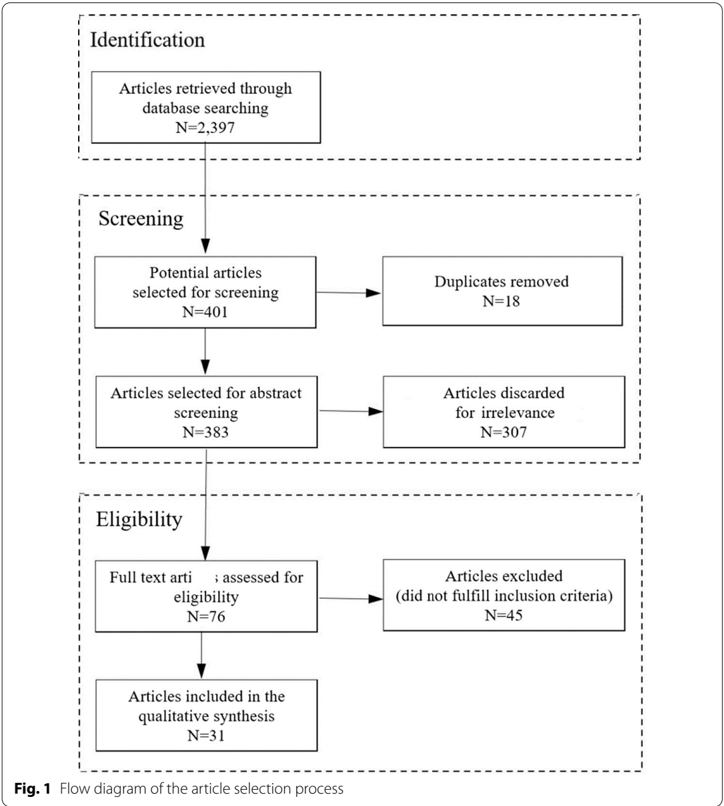
- The screening process went from 2397 articles to 401 after initial refinement, then 383 after removing 18 duplicates, then 76 after abstract screening, and finally 31 studies after full-text screening and eligibility checks.
## Limitations
- The paper states that there is “a lack of attention to ethics and data privacy” and that few reviewed studies mentioned ethical clearance; it says there is a need for protocols for personal data protection.
- It also notes that the rate of AI adoption in education is still slow compared with medicine, industry, and finance, which constrains how much evidence exists in this area.
- Evident from the text: the review is limited to 4 databases, a 5-year window, and English/Spanish/Portuguese publications, so relevant studies outside those sources, dates, or languages may have been missed.
Model-written summary. Check it against the paper before relying on it.
Integrity signals
Registry
Cites
Statistics
Figures
Verification
Claims the paper makes
4 Valid · 1 Not valid · 29 Not checked · 56 Own results and interpretations
The cited sources support only part of this claim — read each source’s verdict below.
In the paper
“AI applications can contribute to forecasting the student dropout rate and determining the factors that affect their performance”
What the sources say
- Not matchedcites Bedregal-Alpaca etal., 2020
An author–year citation the paper’s reference list doesn’t settle. We don’t search these by name.
- Not matchedcites da Fonseca Silveira etal., 2019
An author–year citation the paper’s reference list doesn’t settle. We don’t search these by name.
- Partly supportedcites Miranda & Guzmán, 2017 matched to “Análisis de la Deserción de Estudiantes Universitarios usando Técnicas de Minería de Datos” (2017) sourceExperimental — accuracy not yet measured
The Abstract reports that data-mining techniques identified variables associated with university student dropout, particularly socioeconomic circumstances and university entrance scores. The Conclusions likewise describe academic results and socioeconomic status as influencing whether students remain enrolled. These passages support identifying factors related to dropout, but not factors that affect student performance. (LLM, conf=0.83)
plainstates a cause- Asserted: passes — The authors put it forward as true.
- Checkable: passes — It can be checked against evidence.
- Load-bearing: unclear — It is unclear whether the paper’s conclusions depend on it.
- Based: passes — The paper gives a reason why it holds.
- Not matched
The cited sources support only part of this claim — read each source’s verdict below.
In the paper
“AI applications can contribute to forecasting the student dropout rate and determining the factors that affect their performance”
What the sources say
- Not matchedcites Bedregal-Alpaca etal., 2020
An author–year citation the paper’s reference list doesn’t settle. We don’t search these by name.
- Not matchedcites da Fonseca Silveira etal., 2019
An author–year citation the paper’s reference list doesn’t settle. We don’t search these by name.
- Supportedcites Miranda & Guzmán, 2017 matched to “Análisis de la Deserción de Estudiantes Universitarios usando Técnicas de Minería de Datos” (2017) source
The Methodology (p. 63) describes Bayesian-network, neural-network, and decision-tree classifiers used to predict whether students will drop out. The Abstract reports their predictive accuracy and a retention rate estimated by the decision tree, supporting the claim that these applications can help forecast dropout. (LLM, conf=0.88)
plainstates a possible cause- Asserted: passes — The authors put it forward as true.
- Checkable: passes — It can be checked against evidence.
- Load-bearing: unclear — It is unclear whether the paper’s conclusions depend on it.
- Based: passes — The paper gives a reason why it holds.
- Not matched
Every source the paper cites for this claim was checked and supports it.
In the paper
“AI applications can be used to analyze student academic results for university quality accreditation purposes”
What the sources say
- Supportedcites Delahoz-Dominguez et al., 2020 matched to “Análisis de la acreditación de calidad en programas de ingeniería industrial y los resultados en las pruebas nacionales estandarizadas, en Colombia” (2020) source
The Abstract (Resumen) states the article performs a relational analysis between university quality accreditations in industrial engineering programs and national standardized test results 'usando tecnicas de aprendizaje automatico', and the METODOLOGIA section describes PCA, decision-tree and Random Forest models used to group, classify and forecast accreditation category from Saber Pro results. RESULTS (p. 133) report Random Forest reaching 91% accuracy and 0.94 mean AUC in determining a university's accreditation category from test results, i.e. the paper demonstrates the capability the claim attributes to it. The only difference is terminology: our copy speaks of machine learning (a branch of AI) rather than 'AI applications', and its empirical setting is Colombian industrial engineering programs, which bounds a general 'can be used' statement only by example, not by contradiction. (LLM, conf=0.85)
plainstates a possible cause- Asserted: passes — The authors put it forward as true.
- Checkable: passes — It can be checked against evidence.
- Load-bearing: unclear — It is unclear whether the paper’s conclusions depend on it.
- Based: passes — The paper gives a reason why it holds.
- Supported
A result the paper reports from its own data — it cites no other source for it, so there is none to check. The quote shows it is in the paper.
In the paper
“Predictive modelling in education | [1], [2], [3], [6], [8], [13], [14], [15], [20], [23], [24], [25], [28], [29], [31] | 16”
plain- Asserted: passes — The authors put it forward as true.
- Checkable: passes — It can be checked against evidence.
- Load-bearing: unclear — It is unclear whether the paper’s conclusions depend on it.
- Based: passes — The paper gives a reason why it holds.
A result the paper reports from its own data — it cites no other source for it, so there is none to check. The quote shows it is in the paper.
In the paper
“Assistive technology (chatbots) | [5], [7], [9], [11], [17] | 5”
plain- Asserted: passes — The authors put it forward as true.
- Checkable: passes — It can be checked against evidence.
- Load-bearing: unclear — It is unclear whether the paper’s conclusions depend on it.
- Based: passes — The paper gives a reason why it holds.
49 more claims
Create a free account to see all 90 claims and to verify the 4 references still open.
- It may state two separate claims as one. 11
- Probably not a substantial claim. 30
- The quote only partly states this claim. 2
Claims other papers make about this one
Each is checked against this paper’s own text: does it say what the citing paper says it does?
The source backs part of the claim, not all of it — or backs it for a different population, condition or comparison.
In the citing paper
“Salas-Pilco y Yang (2022) realizaron una revisión sistemática de 139 artículos indexados en Scopus, identificando aplicaciones en modelado predictivo, analítica inteligente y tecnologías de asistencia, y destacando su contribución a la detección temprana del riesgo de deserción [1].”
From Avances, Retos Éticos y Perspectivas de la Inteligencia Artificial (IA) en la Educación de América Latina (2025) · cites this paper as [1]
Experimental — accuracy not yet measuredThe source backs part of the claim, not all of it — or backs it for a different population, condition or comparison.
In the citing paper
“Salas-Pilco et al. (2022) identifican aplicaciones de procesamiento de lenguaje natural que generan retroalimentación automatizada en ensayos y guías de estudio, liberando al profesor de tareas repetitivas [1].”
From Avances, Retos Éticos y Perspectivas de la Inteligencia Artificial (IA) en la Educación de América Latina (2025) · cites this paper as [1]
Experimental — accuracy not yet measuredThe source backs part of the claim, not all of it — or backs it for a different population, condition or comparison.
In the citing paper
“AI applications in education also raise ethical considerations, ranging from professional readiness to lapses in rigour, such as not adhering to ethical procedures when collecting data (e.g., Salas-Pilco & Yang, 2022), and ethical and legal issues related to using tools prematurely (Zhang et al., 2023).”
From A meta systematic review of artificial intelligence in higher education: a call for increased ethics, collaboration, and rigour (2024) · cites this paper as Salas-Pilco & Yang, 2022
Experimental — accuracy not yet measuredThe cited source says what the claim attributes to it.
In the citing paper
“The results revealed that the main AI applications in higher education in Latin America are: (1) predictive modeling, (2) intelligent analytics, (3) assistive technology, (4) automatic content analysis, and (5) image analytics.”
From Artificial intelligence in higher education: the state of the field (2023) · cites this paper as Salas-Pilco and Yang (2022)
In the citing paper
“These include the replacement of traditional instruction methods with cost-effective AI programs by administrators during budget constraints, as well as privacy and data protection challenges related to sensitive student and faculty information (Salas-Pilco & Yang, 2022;Wu et al., 2024;Zawacki-Richter et al., 2019).”
From Barriers to and Opportunities for the Adoption of Generative Artificial Intelligence in Higher Education in the Global South: Insights from Sri Lanka (2025) · cites this paper as Salas-Pilco & Yang, 2022
2 more claims about this paper
Create a free account to see every claim other papers make about this one.
Citations
Cites
Systematic Literature Reviews in Software Engineering—A Systematic Literature Review
Kitchenham, B., Pearl Brereton, O., Budgen, D., Turner, M., Bailey, J., & Linkman, S. (2009) · Information and Software Technology · doi:10.1016/j.infsof.2008.09.009 · Cited by 4,537 · cited 1×
“A systematic review explores previous studies to answer specific research questions based on an explicit, systematic, and replicable search strategy, with inclusion and exclusion criteria (Kitchenham et al., 2009; Xiao & Watson, 2019).”
BackgroundArtificial Intelligence in Education: A Review
Chen, L., Chen, P., & Lin, Z. (2020) · IEEE Access · doi:10.1109/access.2020.2988510 · Cited by 4,133 · cited 1×
“The education sector is now significantly influenced by AI research, as AI applications are being used by learners, educators, and administrators and various tools, algorithms, and applications have been developed with the capacity to transform the education field (Chen et al., 2020).”
BackgroundGuidance on Conducting a Systematic Literature Review
Xiao, Y., & Watson, M. (2019) · Journal of Planning Education and Research · doi:10.1177/0739456x17723971 · Cited by 3,467 · cited 1×
“A systematic review explores previous studies to answer specific research questions based on an explicit, systematic, and replicable search strategy, with inclusion and exclusion criteria (Kitchenham et al., 2009; Xiao & Watson, 2019).”
BackgroundExploring the impact of artificial intelligence on teaching and learning in higher education
Popenici, S. A. D., & Kerr, S. (2017) · Research and Practice in Technology Enhanced Learning · doi:10.1186/s41039-017-0062-8 · Cited by 2,019 · cited 2×
“AI is defined as “computing systems that are able to engage in human-like processes such as learning, adapting, synthesizing, self-correction and use of data for complex processing tasks” (Popenici & Kerr, 2017, para.”
BackgroundOverview of artificial intelligence in medicine
Amisha, Malik, P., Pathania, M., & Rathaur, V. K. (2019) · Journal of Family Medicine and Primary Care · doi:10.4103/jfmpc.jfmpc_440_19 · Cited by 1,106
The TESOL Encyclopedia of English Language Teaching
(2018) · Wiley eBooks · doi:10.1002/9781118784235 · Cited by 1,055
AI technologies for education: Recent research & future directions
Zhang, K., & Aslan, A. B. (2021) · Computers and Education: Artificial Intelligence · doi:10.1016/j.caeai.2021.100025 · Cited by 923
Some guidance on conducting and reporting qualitative studies
Twining, P., Heller, R. S., Nussbaum, M., & Tsai, C.-C. (2017) · Computers & Education · doi:10.1016/j.compedu.2016.12.002 · Cited by 291 · cited 1×
“Moreover, Twining et al. (2017) highlighted the importance of qualitative studies—regarding technologies applied in education—in understanding a situation or phenomenon through the identification of themes and patterns in the data.”
BackgroundBorsci, S., Malizia, A., Schmettow, M., van der Velde, F., Tariverdiyeva, G., Balaji, D., & Chamberlain, A. (2022) · Personal and Ubiquitous Computing · doi:10.1007/s00779-021-01582-9 · Cited by 266 · cited 1×
“These applications are being integrated in social networks, websites, and a variety of platforms (Borsci et al., 2021).”
BackgroundOwoc, M. L., Sawicka, A., & Weichbroth, P. (2021) · IFIP Advances in Information and Communication Technology · doi:10.1007/978-3-030-85001-2_4 · Cited by 222 · cited 1×
“Furthermore, Owoc et al. (2021) indicated that the benefits of AI in education are the following: (a) automation of repetitive and time-consuming activities such as grading or controlling student attendance, (b) use of AI facilitators to support teachers in their classroom work, (c) feedback for…”
Background
Research works printed but not linked: 3
- *García-González, D. J., & Skrita, A. (2019). Predicting academic performance based on students' family environment: Evidence for Colombia using classification trees. Psychology Society & Education, 11 (3), 299-311. https:// doi. org/ 10. 21071/ psye. v11i3. 13947. · doi:10.21071/psye.v11i3.13947
- *Mendoza Jurado, H. F. (2020). Modelos de redes neuronales artificiales, como sustento evaluativo al crecimiento pedagógico virtual en Educación Superior [Artificial neural network models, as evaluative support to virtual pedagogical growth in Higher Education]. Educación Superior, 7(2), 25–36. https://www.scielo.org.bo/pdf/escepies/v7n2/v7n2_a06.pdf.
- Torre, D., & Zapata, G. (2012). Impacto de procesos de aseguramiento de la calidad sobre las instituciones de educación superior: un estudio en siete países [Impact of quality assurance processes on higher education institutions: A study in seven countries]. In M. Lemaitre, & M. Zenteno (Eds.), Aseguramiento de la Calidad en Iberoamérica. Informe 2012 (pp. 115–157). RIL Editores.
Cited by
Items 201–300 of 324
Artificial Intelligence in Higher Education and Scientific Research: Future Development
Ananda, G. F., Rahmat, R. E., Feri, Z. O., & Latif, A. (2024) · Journal of Latinos and Education · doi:10.1080/15348431.2024.2309676 · Cited by 1
Choudhary, A., Pamidimokkala, S., & Krithiga, R. (2025) · SSRN Electronic Journal · doi:10.2139/ssrn.5402389 · Cited by 1
Subirats, L., Reina, B. N., Cuenca, M. E., & Sacha, G. M. (2025) · Research Square · doi:10.21203/rs.3.rs-7801827/v1 · Cited by 1
University Student Control Detection System Based on Machine Learning and Artificial Intelligence
Calvo-Lavado, C., Lopez-Carreño, J., & Zarate-Perez, E. (2022) · LACCEI International Multiconference on Entrepreneurship, Innovation and Regional Development (LEIRD) · doi:10.18687/leird2022.1.1.178 · Cited by 4
Chen, S. (2023) · ACM Transactions on Asian and Low-Resource Language Information Processing · doi:10.1145/3590150 · Cited by 1
“Multi-core learning approaches (MKL) have been suggested in the literature for identifying internal motion features of other people's faces by synthesising physical as well as morphological characteristics of first-level motion, which is end of extracted extreme section [12].”
BackgroundVergara, G., & Salessi, S. (2023) · Advances in human and social aspects of technology book series · doi:10.4018/979-8-3693-0802-8.ch002 · Cited by 1
Development of virtual learning systems based on artificial intelligence: International experience
Polián, P., Копотун, І., & Polián, P. (2024) · Revista Amazonia Investiga · doi:10.34069/ai/2024.73.01.1 · Cited by 2
“The study by Salas-Pilco & Yang (2022) systematically examines the use of artificial intelligence in Latin American educational institutions using a meta-analysis of various implementation cases.”
BackgroundThe Construction of Higher Education Evaluation Index System Based on Vector Analysis
Wu, Y. (2024) · Journal of Electrical Systems · doi:10.52783/jes.1312
“…analysis into higher education curricula, institutions empower students to acquire the mathematical proficiency necessary for success in their academic and professional pursuits, thereby preparing them to contribute meaningfully to society and address the complexities of the modern world [14].”
BackgroundGandhi, A., & Gani, P. H. (2024) · Ingénierie des systèmes d information · doi:10.18280/isi.290314 · Cited by 6
“Furthermore, academics (lecturers and students) can find discussion partners who help search for knowledge [2, 19] based on the availability of the AI-based software database.”
BackgroundMethodInfluentialMoreno, S. P. B., Rincón, A. G., Támara, L. G., Carmona, G. P. C., & Galindo, O. L. L. (2024) · SSRN Electronic Journal · doi:10.2139/ssrn.4888424
Tao, Z., Li, M., Xu, X., et al. (2024) · Journal of Education Teaching and Social Studies · doi:10.22158/jetss.v6n3p144
Estudio de las nuevas tendencias en inteligencia artificial aplicadas a la educación superior.
Quimbayo, Á. A. V., Patiño, C. A. C., Urrea, L. F. L., & Parra, G. E. T. (2024) · Dilemas contemporáneos Educación Política y Valores · doi:10.46377/dilemas.v12i1.4297 · Cited by 4
Prakasha, G. S., Rawat, S., Ishani, B., & Thirumalesha, S. (2024) · Pamukkale University Journal of Education · doi:10.9779/pauefd.1267071
Harnessing AI: Unveiling Educator’s Intentions and Synergy in Education
Jindal, A., Kumar, P., & Mishra, K. K. (2024) · Lecture notes in networks and systems · doi:10.1007/978-981-97-6581-2_32
Wang, S.-M., & Chuding, C. (2024) · International Conference on Information and Communication Technology Convergence (ICTC) · doi:10.1109/ictc62082.2024.10827352
Customer Relationship Management (CRM) Systems
Puthur, L. A., Karakunnel, M. T., & Menon, V. A. (2025) · Advances in public policy and administration (APPA) book series · doi:10.4018/979-8-3373-2272-8.ch006
Role of Artificial Intelligence in Education: Perceptions and Usage among Students in Afghanistan
Emran, A. (2024) · Kardan Journal of Engineering and Technology · doi:10.31841/kjet.2024.40
Voievoda, K. V. (2025) · Scientific Notes of Junior Academy of Sciences of Ukraine · doi:10.51707/2618-0529-2025-32-03
The AIMED model: Creating opportunities for AI in Higher EducationPreprint
Howard, S. K., Tondeur, J., Neubert, C., Hauck, J., & Böhme, R. (2025) · EdArXiv (OSF Preprints) · doi:10.35542/osf.io/pzk9t_v1 · Cited by 1
Técnicas de Inteligencia Artificial para el análisis de calidad de vida: Mapeo Sistemático
Caicedo, J., Cuaces, J. C. Á., Luna, R. M. R., & Ordóñez, H. (2025) · Ingeniería y Competitividad · doi:10.25100/iyc.v27i2.14764
TRANSFORMING HIGHER EDUCATION: THE IMPACT OF ARTIFICIAL INTELLIGENCE IN KERALA’S ACADEMIC LANDSCAPE
Rani, L., & Biju, S. (2024) · INTERNATIONAL JOURNAL OF MANAGEMENT · doi:10.34218/ijm_15_06_018
La evaluación de la escritura en español en la educación superior: una conversación con ChatGPT
Uribe, S. Á. (2025) · Lenguaje · doi:10.25100/lenguaje.v53i1s.14433 · Cited by 1
Gergely, O., & Székely, K. K. (2024) · Erdélyi Társadalom · doi:10.17177/77171.297 · Cited by 1
Bouziane, A., & Bouziane, K. (2025) · Communications in computer and information science · doi:10.1007/978-3-031-95627-0_17 · Cited by 2
Experiencia de aplicación de la IA en los procesos de prácticas en ciencias administrativas
Fernández, M. O. G., Almendárez, J. M. F., & Gómez, B. F. M. (2025) · Revista Practicum · doi:10.24310/rep.10.1.2025.21951
Romadhon, D. R., Lubis, A. B., Wulansari, N. F., Yudi, Y., & Masae, A. (2025) · CRC Press eBooks · doi:10.1201/9781003645542-63 · Cited by 2
Cano, C. A. G., Castillo, V. S., & Zapata, E. M. J. (2025) · REVISTA COLOMBIANA DE TECNOLOGIAS DE AVANZADA · doi:10.24054/rcta.v2i46.3743 · Cited by 6
A Systematic Review of Systematic Reviews in Teaching and Learning in Higher Education with AI
Chunhong, Z., Bakar, N. I. A., & Min, R. (2025) · International Journal of Academic Research in Progressive Education and Development · doi:10.6007/ijarped/v14-i3/25822 · Cited by 1
Research on English Literature Smart Classroom Based on AI
Zou, D. (2025) · International Journal of Cognitive Informatics and Natural Intelligence · doi:10.4018/ijcini.385733
Beyond Boundaries: AI-Powered Personalized Learning in the Educational Metaverse for Global Equity
Khalil, A., & Kazi, A. S. (2025) · Advances in computational intelligence and robotics book series · doi:10.4018/979-8-3373-2302-2.ch004
Análisis de las actividades pedagógicas para potenciar el desarrollo físico de los niños de 3 años
Villamarin, S. D. C., Miranda, E. A., Bonilla, D. A. F., & Arroba, L. D. G. (2025) · Revista Ciencia Innovadora · doi:10.64422/rci.v3n1.2025.53
Truyol, M. E., Quezada-Espinoza, M., Zavala, G., & Bascur, C. (2025) · ASEE Annual Conference & Exposition · doi:10.18260/1-2--55908 · Cited by 2
Demir, B., Adizova, G., & ENGİN, Ş. (2025) · European Archives of Social Sciences · doi:10.35365/eass.25.02.02 · Cited by 2
Lengua y literatura y el uso de recursos didácticos para la enseñanza y aprendizaje
Miniguano, A. D. E., Moyón-Coronel, E., Lescano, J. A. S., & Chito, A. L. B. (2023) · Revista Ciencia Innovadora · doi:10.64422/rci.v1n4.2023.18 · Cited by 2
Educational Use of Artificial Intelligence in Doctor of Health Sciences Programs
Zipp, G. P., Gunther, C. B., Kuperman, D. A., Moore, J. M., & Rainchuso, L. (2025) · Journal of Innovation in Health Sciences Education · doi:10.46409/003.ossd3735
Artificial Intelligence in Education: SWOT Analysis
Panja, S. K. (2025) · Bulletin of Science Technology & Society · doi:10.1177/02704676251371993 · Cited by 4
“In regional contexts, Salas-Pilco and Yang (2022) examined AI integration in Latin American higher education, high-lighting applications such as predictive modeling, assistive technology, image analytics, and dropout prediction systems.”
InfluentialMondragón, J. J. P., & Trujillo, A. E. (2025) · Cureus Journal of Computer Science. · doi:10.7759/s44389-025-07546-x
Saltos, J. L. A., Herrera, M., Chicaiza, V. A. P., et al. (2025) · ASCE MAGAZINE · doi:10.70577/asce/2206.2230/2025
Mazlomi, A., Mahmouei, H. M., & Ajam, A. (2025) · Journal of Medical Education Development · doi:10.61882/edcj.18.2.1
Artificial Intelligence (AI) Promise for Equitable Education in Emerging EconomiesPreprint
Mbithi, A., & Maina, L. (2025) · Research Square · doi:10.21203/rs.3.rs-7216045/v1 · Cited by 6
Madalı, B., Arslan, S., & Bayram, H. M. (2025) · Gümüşhane Üniversitesi Sağlık Bilimleri Dergisi · doi:10.37989/gumussagbil.1727605 · Cited by 2
Nkomo, F., & Nkomo, S. (2025) · Springer eBooks · doi:10.1007/978-3-032-01757-4_6
Ma, C., Li, J., Hu, Z., Wu, M., Chen, X., & Wu, D. (2025) · Lecture notes on data engineering and communications technologies · doi:10.1007/978-981-95-1595-0_86
Simancas, J. M. C., & Santos, R. O. Z. (2025) · Revista Científica Consultina · doi:10.63406/rcc.v3n2.2025.63
Leles, A., Cardoso, J. R., Puga, S. G., Silva, A. M. D., & Cruz, E. G. V. (2025) · World Engineering Education Forum - Global Engineering Deans Council (WEEF-GEDC) · doi:10.1109/weef-gedc66748.2025.11256471
“Artificial intelligence (AI) algorithms have been increasingly applied in descriptive and predictive models within education [16], [17].”
Collaborative AI-Integrated Model for Reviewing Educational Literature
Fernández, M. O. G., Rivas, M. R., Pérez-Torregrosa, A.-B., & Quadros-Flores, P. A. D. (2025) · Computers · doi:10.3390/computers14120562 · Cited by 2
Trends and Challenges of AI Integration in Basic Education: Insights from a Bibliometric Study
Schwarzbach, L. D. S., Vicari, R. M., Ribeiro, L. O. M., & Barwaldt, R. (2025) · doi:10.5753/eniac.2025.14169
“In Brazil, although adoption is slower, there is a growing interest in the use of AI in education [SALAS-PILCO and YANG 2022].”
AI-POWERED BEAT DETECTION AND ITS EDUCATIONAL USES
Gudadhe, M., Ahluwalia, G., Kumar, P., et al. (2025) · ShodhKosh Journal of Visual and Performing Arts · doi:10.29121/shodhkosh.v6.i1s.2025.6627
Bhunia, S., Lalrinchhana, K., Mishra, L., & Puii, L. (2025) · Research Square · doi:10.21203/rs.3.rs-7949370/v1
Generative AI–Expert Hybrid Model for Automated Curriculum Design in Higher Education
Jesudas, R., Ahmed, I. A., Mohammed, A. A., et al. (2025) · International Conference on Sustainable Communication Networks and Application (ICSCNA) · doi:10.1109/icscn67106.2025.11308620
“The model used an adaptive evolutionary algorithm to improve the convergence speed and prediction accuracy of the BP neural network, which in turn reduced the Root mean square error in simulation experiments[8].”
From Euro to Digital Euro: A Survey of Literature
Stoica, O., & Dornean, A. (2025) · Scientific Annals of Economics and Business · doi:10.47743/saeb-2025-0046
“…reliability, and validity of the reviews (Xiao and Watson, 2017) and enables a comprehensive understanding of existing research in a specific field by analyzing and synthesizing empirical evidence from previous studies to address general research questions (Salas-Pilco and Yang, 2022).”
González, M. E. F., López, J. A. D. V., Morales, E. R. H., Rico, F. S., & Machado, M. E. R. (2026) · Lecture notes in networks and systems · doi:10.1007/978-3-032-02999-7_7 · Cited by 1
Burzagli, L., Cornejo-Plaza, I., Colcelli, V., et al. (2026) · Communications in computer and information science · doi:10.1007/978-3-032-12313-8_37
Nasiri, F., & Jafari, S. (2025) · Quarterly Journal of Managing Education In Organizations · doi:10.61882/meo.14.1.103
Digital Natives, AI Strangers? Investigating AI Knowledge in University Classrooms
Ateeq, A. A., Arshad, S., Manzoor, F., Naser, H., Ibrahim, S. B., & Almuraqab, N. A. S. (2025) · IEEE International Conference on Emerging Trends in Engineering and Computing (ETECOM) · doi:10.1109/etecom66111.2025.11319117
Co-construcción e inteligencia artificial en la gestión docente: un estudio de caso en Chile
Bruna, C. E. R., & Ayala, C. C. (2025) · Gestión de la educación · doi:10.15517/3rtsn163
Rivera, D. M. S., Gama, A. M., Espinoza, N. M. G., & Ocampo, E. A. F. (2026) · Sintaxis · doi:10.36105/stx.2026n16.03 · Cited by 3
Ormeño-Arriagada, P., Herrera, B., & Queirolo, F. (2025) · International Conference of the Chilean Computer Science Society (SCCC) · doi:10.1109/sccc67219.2025.11420736 · Cited by 1
“While systematic reviews highlight both the benefits and ethical challenges of AIEd [17], [18], few existing solutions directly address equity-focused curriculum reform or inclusivity auditing.”
V., M. I. (2025) · Problems of engineer-pedagogical education · doi:10.26565/2074-8922-2025-85-01 · Cited by 1
Artificial intelligence in education: Impact on learning and assessment of university students
López, V., Enrique, V. Z. S., Basantes, S., & Cárdenas, G. O. Z. (2026) · Multidisciplinary Reviews · doi:10.31893/multirev.2026454 · Cited by 1
“Their use has shown qualitative benefits in autonomous learning and time management in university environments (Salas-Pilco & Yang, 2022).”
Guanoquiza, N. M. R., Orellana, G. C. M., Cárdenas, V. M. Q., & Pachay, J. F. Z. (2026) · ASCE MAGAZINE · doi:10.70577/asce.v5i2.690
Saputra, A., Muliadi, & Isra, H. H. (2026) · Jurnal Penelitian Pendidikan IPA · doi:10.29303/jppipa.v12i3.14494
“AI has also been applied in educational management and STEM education to support learning analytics and adaptive instruction aligned with labor market needs (Prasetya et al., 2025; Salas ‑ Pilco & Yang, 2022; Smith-Mutegi et al., 2025).”
Osei, B., Osei_Dwomoh, E., Boatemaa, A., & Forkuo, G. O. (2026) · SSRN Electronic Journal · doi:10.21203/rs.3.rs-9419902/v1
Shimray, S. R., Kaba, A., Tiwari, S., & Bharti, P. (2026) · Open Information Science · doi:10.1515/opis-2025-0032 · Cited by 1
A Review of Artificial Intelligence in Education: A Bibliometrics Analysis Using VOS Viewer
Amjad, S., & Alwi, K. K. (2024) · Pakistan Journal of Applied Social Sciences · doi:10.46568/pjass.v15i2.886
Mugara, R., Ali, E. Y., & Sari, W. (2025) · Jurnal Imiah Pendidikan dan Pembelajaran · doi:10.23887/jipp.v9i3.100960 · Cited by 1
Automated multimodal knowledge extraction for economic insights in materials
Chen, Y., & liu, J. (2026) · Solid State Communications · doi:10.1016/j.ssc.2026.116442
Educational data integration andmachine learning for academic performance prediction
Bravo, L. E. C., López, H. J. F., & Pimiento, N. N. (2025) · Ingenieria Solidaria · doi:10.16925/2357-6014.2025.02.07 · Cited by 1
Tikhonova, E. A., & Raitskaya, L. (2026) · Journal of language and Education · doi:10.17323/jle.2026.33523
Ati, M. M. (2026) · Sustainable civil infrastructures · doi:10.1007/978-3-032-17918-0_13
Reframing Agency in AI-Mediated Education: Comparative Insights From Spain, Chile, and Mexico
Suárez, L. M. C., & Rodríguez, C. C. (2026) · Advances in computational intelligence and robotics book series · doi:10.4018/979-8-3373-6471-1.ch012
Osei, B., Osei_Dwomoh, E., Boatemaa, A., & Forkuo, G. O. (2026) · Research Square · doi:10.21203/rs.3.rs-9751106/v1
Large language models in software development learning
Hernández, S. C., Cruz, M. P. T., Sánchez, J. M. E., Luna-Gómez, A. A., Orozco, A. M. P., & Medina, R. H. (2026) · Discover Education · doi:10.1007/s44217-026-01750-0 · Cited by 3
“With the growth in the use of LLMs and their derivatives, i.e., applications for specific tasks, systematic analyses on artificial intelligence in higher education have been published [28, 113].”
ENHANCING DIGITAL LITERACY IN ENGLISH TEACHERS THROUGH EDUTECHNO-PRENEURSHIP IN ELT
Maisa, Widiyana, N. A., Sukmana, M. I., Fanani, M. F., & Mahmud (2026) · FRASA English Education and Literature Journal · doi:10.47701/frasa.v7i2.5218
“Participants’ comments about workload, platform instability, and content-production pressure indicate that entrepreneurship in teaching is not purely individual but shaped by systemic conditions supporting arguments by (Salas-Pilco & Yang, 2022).”
Cumar, M. A., Muse, A. H., Abdi, M. K., Abdikarim, H., Abdi, M. A., & Ali, J. A. (2026) · International Journal of Educational Development · doi:10.1016/j.ijedudev.2026.103618 · Cited by 1
Suprihatiningrum, J., & Syaripudin, A. (2026) · Texto Livre Linguagem e Tecnologia · doi:10.1590/1983-3652.2026.61658 · Cited by 4
Psychological Impacts of Climate Change Education Among University Students
Kayusi, F., Omwenga, M. K., Mijwil, M. M., et al. (2026) · IGI Global eBooks · doi:10.4018/979-8-3373-8470-2.ch006
Schwarzbach, L. D. S., Ribeiro, L. O. M., Rodrigues, R. A., & Bärwaldt, R. (2026) · IEEE Global Engineering Education Conference (EDUCON) · doi:10.1109/educon67543.2026.11574140
“In Brazil, although the rate of adoption and speed of implementation tend to be more moderate, there is a growing and progressive interest in the use of AI in education [19].”
Optimisation of university instructors’ professional practice through AI agents: a systematic review
Doszhanov, B., Zhumadilla, B., & Zhapparbergenov, R. (2026) · Frontiers in Education · doi:10.3389/feduc.2026.1893124 · Cited by 1
Мазурок, Т. Л., Gakh, R., Oleksandrenko, K., Nikolaieva, T. M., & Солодка, А. К. (2026) · EDUWEB · doi:10.46502/issn.1856-7576/2026.20.02.17
Artificial intelligence drivers for business education: a systematic review using the ADO framework
Ramadani, V., Basher, M. A., Rahman, M. M., & Mohiuddin, M. F. (2026) · Education + Training · doi:10.1108/et-01-2026-0051
Udo, M.-A. A., Imafidon, F. I., & Godwin³, A. (2026) · Research Square · doi:10.21203/rs.3.rs-10443013/v1 · Cited by 1
Habibi, M. M., & Islami, J. M. M. (2026) · Research Square · doi:10.21203/rs.3.rs-10490075/v1
FAHMAWEE, E. A. D. A. (2026) · Systems and Soft Computing · doi:10.1016/j.sasc.2026.200581
Kigobe, J., Luwavi, E. O., & Mutalemwa, L. C. (2026) · Cogent Education · doi:10.1080/2331186x.2026.2709718 · Cited by 2
Naranjo, E. A. R., González, J. A. M., Llamuca, A. B. S., Altamirano, A. S. O., & Orozco, G. M. P. (2026) · Saber Estratégico Internacional · doi:10.70577/s.e.v4i3.34
Staggini, G. (2026) · AILA applied linguistics series · doi:10.1075/aals.23.ni
Staggini, G. (2026) · AILA applied linguistics series · doi:10.1075/aals.23.si
Staggini, G. (2026) · AILA applied linguistics series · doi:10.1075/aals.23.lof
Staggini, G. (2026) · AILA applied linguistics series · doi:10.1075/aals.23.lot
Charting the future of inclusive language learning: Emerging technologies and new perspectives
Staggini, G. (2026) · AILA applied linguistics series · doi:10.1075/aals.23.c07
Technology-enhanced learning and immersive virtual reality environments
Staggini, G. (2026) · AILA applied linguistics series · doi:10.1075/aals.23.c03
Staggini, G. (2026) · AILA applied linguistics series · doi:10.1075/aals.23.intro
Staggini, G. (2026) · AILA applied linguistics series · doi:10.1075/aals.23.prelim
Understanding dyslexia in the context of higher education
Staggini, G. (2026) · AILA applied linguistics series · doi:10.1075/aals.23.c01
The potential of VR environments for students with SpLDs’ language learning process
Staggini, G. (2026) · AILA applied linguistics series · doi:10.1075/aals.23.c04
A guide to inclusive and accessible language e-learning environments
Staggini, G. (2026) · AILA applied linguistics series · doi:10.1075/aals.23.c05
Staggini, G. (2026) · AILA applied linguistics series · doi:10.1075/aals.23.toc
Staggini, G. (2026) · AILA applied linguistics series · doi:10.1075/aals.23
Metadata
- Authors
- Salas-Pilco, S. Z., & Yang, Y.
- Affiliations
- Central China Normal University (CN)
- Corresponding author
- Yang, Yuqin
- Venue
- International Journal of Educational Technology in Higher Education
- Published
- 2022-04-18
- Volume
- 19
- Issue
- 1
- ISSN
- 2365-9440 (ISSN-L)
- OpenAlex
- W4223914794
- Semantic Scholar
- 559fb134eb17d97d8118a8dbfab7eae7388142b6
- Cited by
- 330
- References
- 63
- Citations by year
- 2026: 88 · 2025: 110 · 2024: 87 · 2023: 36 · 2022: 8
- FWCI
- 7.60
- Type
- journal article
- Language
- en
- Open access
- diamond
- doi.org
- Licence
- cc-by
- creativecommons.org/licenses/by/4.0 (tdm)
- creativecommons.org/licenses/by/4.0 (vor)
- Locations
- International Journal of Educational Technology in Higher Education (publishedVersion, cc-by)
- DOAJ (DOAJ: Directory of Open Access Journals) (submittedVersion, cc-by-sa)
- Funders
- Central China Normal University (Research Grant No. 1100/30106200286, ZNXBJY202108, CCNUTEIII 2021-11)
- National Natural Science Foundation of China (Grant No. 62107020)
- Ministry of Education of the People's Republic of China (Grant No. 21YJA880078)
- Topics
- Social Sciences › Education › Artificial Intelligence in Education
- Social Sciences › Education › Educational Technology and Pedagogy
- Physical Sciences › Computer Science › Computer Science Applications › Online Learning and Analytics
- Keywords
- artificial intelligence in education, higher education, Latin America, machine learning, deep learning, natural language processing, predictive modeling, intelligent analytics, assistive technology, automatic content analysis, image analytics, student dropout prediction, educational management, educational quality
About these checks
Registry, retraction, Cites and statistics results are computed, not judged, with one exception: a printed reference that no index lists is read once by a model before it counts as a citation error. Claims are extracted by a model and kept only when their quote appears verbatim in the text; each cited source is then checked, with a model’s help, for whether it says what the claim relies on. Those verdicts can be wrong — read the claim’s quote and the cited source before relying on one.
The claim verdicts this report counts are experimental: their accuracy is not yet measured.
A language model drew the claims from the paper on 2026-10-10, under version 3 of the claim definition (model deepseek-v4.1-flash, prompt extract-v3).
A second model labelled each claim on 2026-10-10 (model jev-1.13-20260917, definition revision gold-guideline-v0.2).
Cited sources are checked with a language model’s help (gpt-6-sol and qwen3.8-omni-flash).
Statistics and arithmetic are recomputed, not judged.
Confidence bands are shown only for fields calibrated on our annotated test set. None is calibrated yet, so no band is shown.
What counts as a claim ›How we measure confidence ›How we check this ›
Are you an author, or do you see a problem with this page? Request a review
Data sources
Bibliographic data: Semantic Scholar, OpenAlex, Crossref.
Contains information from the Semantic Scholar Academic Graph Datasets, made available under the ODC Attribution License (ODC-BY 1.0).
Semantic Scholar’s data is described in: Kinney, R., et al. (2023). The Semantic Scholar Open Data Platform. arXiv:2301.10140.
