

The DOI matches its Crossref record; 63 of the 63 references it cites were found in a registry or an index.
Students' perceptions of using ChatGPT in a physics class as a virtual tutor
Open accessAbstract
The latest development of Generative Artificial Intelligence (GenAI), particularly ChatGPT, has drawn the attention of educational researchers and practitioners. We have witnessed many innovative uses of ChatGPT in STEM classrooms. However, studies regarding students’ perceptions of ChatGPT as a virtual tutoring tool in STEM education are rare. The current study investigated undergraduate students’ perceptions of using ChatGPT in a physics class as an assistant tool for addressing physics questions. Specifically, the study examined the accuracy of ChatGPT in answering physics questions, the relationship between students’ ChatGPT trust levels and answer accuracy, and the influence of trust on students’ perceptions of ChatGPT. Our finding indicates that despite the inaccuracy of GenAI in question answering, most students trust its ability to provide correct answers. Trust in GenAI is also associated with students’ perceptions of GenAI. In addition, this study sheds light on students’ misconceptions toward GenAI and provides suggestions for future considerations in AI literacy teaching and research.
Overview
The claims and statistics of this paper haven’t been checked yet.
Run the check — free, no account needed. It reads the open-access text and checks the sources it cites.
Integrity signals
Registry
Cites
Statistics
Figures
Verification
Claims the paper makes
The claims and statistics of this paper haven’t been checked yet.
Run the check — free, no account needed. It reads the open-access text and checks the sources it cites.
Claims other papers make about this one
Each is checked against this paper’s own text: does it say what the citing paper says it does?
The source backs part of the claim, not all of it — or backs it for a different population, condition or comparison.
In the citing paper
“This underscores the impact of teaching prompt engineering, providing empirical support for calls for this type of instruction in the literature (Ding et al., 2023; Walter, 2024).”
From Artificial Intelligence for Academic Purposes (AIAP): Integrating AI literacy into an EAP module (2025) · cites this paper as Ding et al., 2023
Experimental — accuracy not yet measuredThe source backs part of the claim, not all of it — or backs it for a different population, condition or comparison.
In the citing paper
“Trust in these tools can lead to overreliance, discouraging users from exploring alternative perspectives and reducing the variability of ideas, which results in more homogeneous outputs (Ding et al., 2023;Doshi & Hauser, 2024).”
From “ ChatGPT can make mistakes. Check important info.” Epistemic beliefs and metacognitive accuracy in students' integration of ChatGPT content into academic writing (2025) · cites this paper as Ding et al., 2023
Experimental — accuracy not yet measuredThe source backs part of the claim, not all of it — or backs it for a different population, condition or comparison.
In the citing paper
“This is consistent with the findings of numerous studies that investigated student use and perceptions of ChatGPT, which found that students appreciated the technology's ability to provide personalized guidance, facilitate understanding of difficult concepts, and assist with writing tasks (Budhiraja et al. 2024;Ding et al. 2023;Li 2023;Mahapatra 2024;Malik et al. 2023;Yan 2023).”
From Fostering AI Literacy in Undergraduates: A ChatGPT Workshop Case Study (2025) · cites this paper as Ding et al. 2023
Experimental — accuracy not yet measuredThe source backs part of the claim, not all of it — or backs it for a different population, condition or comparison.
In the citing paper
“Students appreciated Chat-GPT's ability to provide personalized guidance, facilitate understanding of difficult concepts, or assist with writing tasks (Budhiraja et al. 2024;Ding et al. 2023;Li 2023;Mahapatra 2024;Malik et al. 2023;Yan 2023).”
From Fostering AI Literacy in Undergraduates: A ChatGPT Workshop Case Study (2025) · cites this paper as Ding et al. 2023
Experimental — accuracy not yet measuredThe source backs part of the claim, not all of it — or backs it for a different population, condition or comparison.
In the citing paper
“Many worried about the reliability and accuracy of ChatGPT's outputs, citing issues such as inaccuracies, inconsistencies, and the inability to handle complex subjects (Amoozadeh et al. 2024;Ding et al. 2023;Malik et al. 2023;Zhao et al. 2024).”
From Fostering AI Literacy in Undergraduates: A ChatGPT Workshop Case Study (2025) · cites this paper as Ding et al. 2023
Experimental — accuracy not yet measured
The source backs part of the claim, not all of it — or backs it for a different population, condition or comparison.
In the citing paper
“For example, Ding et al. (2023) found that higher trust in ChatGPT did not necessarily correspond with receiving more accurate answers but did lead to more positive perceptions and increased usage intentions.”
From Fostering AI Literacy in Undergraduates: A ChatGPT Workshop Case Study (2025) · cites this paper as Ding et al. (2023)
Experimental — accuracy not yet measuredThe source backs part of the claim, not all of it — or backs it for a different population, condition or comparison.
In the citing paper
“Nevertheless, it could also foster a dependency that might impede the development of HOTS.The ease of accessing information and problemsolving assistance through tools like ChatGPT could discourage students from engaging in thorough thinking or independent problem-solving (Chan & Hu, 2023;Ding et al., 2023).”
From Empowering ChatGPT with Guidance Mechanism in Blended Learning: Effect of Self-Regulated Learning, Higher-Order Thinking Skills, and Knowledge Construction (2024) · cites this paper as Ding et al., 2023
Experimental — accuracy not yet measuredThe cited source says what the claim attributes to it.
In the citing paper
“Prompt engineering is a fundamental skill for eliciting useful responses from GenAI (Ding et al., 2023; Walter, 2024).”
From Artificial Intelligence for Academic Purposes (AIAP): Integrating AI literacy into an EAP module (2025) · cites this paper as Ding et al., 2023
The cited source says what the claim attributes to it.
In the citing paper
“Without this explicit instruction, students tend to blindly trust GenAI output (Ding et al., 2023).”
From Artificial Intelligence for Academic Purposes (AIAP): Integrating AI literacy into an EAP module (2025) · cites this paper as Ding et al., 2023
The cited source says what the claim attributes to it.
In the citing paper
“This framework was conceived in response to issues we, as EAP practitioners, were encountering on the ground, such as an increase in AI-related academic misconduct, a lack of understanding from students of how to interact with or prompt these tools effectively (Walter, 2024) and a tendency to blindly trust information output from GenAI (Ding et al., 2023).”
From Artificial Intelligence for Academic Purposes (AIAP): Integrating AI literacy into an EAP module (2025) · cites this paper as Ding et al., 2023
The cited source says what the claim attributes to it.
In the citing paper
“This fi nding provides empirical evidence for Ding et al. ' s (2023), Farrelly and Baker ' s (2023) and Walter ' s (2024) suggestion that the integration of AI literacy into education should include activities which require students to analyse and assess GenAI output to foster critical thinking skills.”
From Artificial Intelligence for Academic Purposes (AIAP): Integrating AI literacy into an EAP module (2025) · cites this paper as Ding et al. (2023)
The cited source says what the claim attributes to it.
In the citing paper
“However, some students also expressed concerns about the reliability and accuracy of ChatGPT's outputs, aligning with findings from other user studies (Amoozadeh et al. 2024;Ding et al. 2023;Malik et al. 2023;Zhao et al. 2024).”
From Fostering AI Literacy in Undergraduates: A ChatGPT Workshop Case Study (2025) · cites this paper as Ding et al. 2023
The cited source says what the claim attributes to it.
In the citing paper
“In an introductory physics course, Ding et al (2023) found that nearly half of the students trusted ChatGPT's answers to physics problems regardless of their accuracy, with those expressing trust being more likely to report intentions of future ChatGPT use.”
From Scaffold or Crutch? Examining College Students' Use and Views of Generative AI Tools for STEM Education (2025) · cites this paper as Ding et al (2023)
The cited source says what the claim attributes to it.
In the citing paper
“These findings provide preliminary evidence that genAI tools, if not used effectively, can short-circuit students' learning process.”
From Scaffold or Crutch? Examining College Students' Use and Views of Generative AI Tools for STEM Education (2025) · cites this paper as Ding et al (2023)
Self-check
Percentages, sums and reported differences re-computed from the paper’s own numbers.
The self-check needs the paper’s full text.
Citations
Cites
The Measurement of Observer Agreement for Categorical Data
Landis, J. R., & Koch, G. G. (1977) · Biometrics · doi:10.2307/2529310 · Cited by 81,148
Perceived usefulness, perceived ease of use, and user acceptance of information technology
Davis, F. D. (1989) · MIS Quarterly · doi:10.2307/249008 · Cited by 68,483
Discovering Statistics Using SPSS
Field, A. P., & Miles, J. N. V. (2000) · Medical Entomology and Zoology · Cited by 28,269
Language Models are Few-Shot Learners
Brown, T. B., Mann, B., Ryder, N., Subbiah, M., Kaplan, J., Dhariwal, P., Neelakantan, A., Shyam, P., Sastry, G., Askell, A., et al. (2020) · arXiv · doi:10.48550/arxiv.2005.14165 · Cited by 23,372
Hanrahan, G. (2008) · CRC Press eBooks · doi:10.1201/9781420067972-10 · Cited by 8,196
ChatGPT for Good? On Opportunities and Challenges of Large Language Models for Education
Kasneci, E., Seßler, K., Küchemann, S., Bannert, M., Dementieva, D., Fischer, F., Gasser, U., Groh, G., Günnemann, S., Hüllermeier, E., et al. (2023) · doi:10.35542/osf.io/5er8f · Cited by 7,552
ChatGPT for good? On opportunities and challenges of large language models for education
Kasneci, E., Sessler, K., Küchemann, S., Bannert, M., Dementieva, D., Fischer, F., Gasser, U., Groh, G., Günnemann, S., Hüllermeier, E., et al. (2023) · Learning and Individual Differences · doi:10.1016/j.lindif.2023.102274 · Cited by 7,326 · cited 4×
“GenAI is a subclass of machine learning (ML) algorithms that can learn from text, images, audio, and video to produce new content based on trained data (Kasneci et al., 2023).”
BackgroundMethodInfluentialOn seeing human: A three-factor theory of anthropomorphism
Epley, N., Waytz, A., & Cacioppo, J. T. (2007) · Psychological Review · doi:10.1037/0033-295x.114.4.864 · Cited by 4,069 · cited 1×
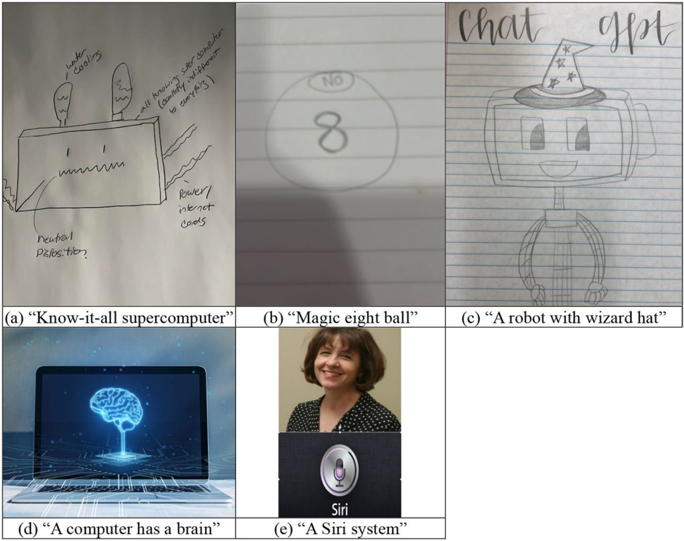
“One factor contributing to these misconceptions is anthropomorphism, which involves attributing human-like characteristics to AI, such as feelings, mental states, or behavioral characteristics (Airenti, 2015; Epley et al., 2007).”
BackgroundBAİDOO-ANU, D., & OWUSU ANSAH, L. (2023) · Journal of AI · doi:10.61969/jai.1337500 · Cited by 3,939
(2018) · Cited by 3,510
Research works printed but not linked: 3
- Bingham, A. J., & Witkowsky, P. (2022). Deductive and inductive approaches to qualitative data analysis. In C. Vanover, P. Mihas, & J. Saldaña (Eds.), Analyzing and interpreting qualitative data: After the interview (pp. 133–146). SAGE Publications.
- Hu, K. (2023). ChatGPT sets record for fastest-growing user base. Reuters.
- Removed for blinded review.
Cited by
Sorted by citations
Does ChatGPT enhance student learning? A systematic review and meta-analysis of experimental studies
Deng, R., Jiang, M., Yu, X., Lu, Y., & Liu, S. (2025) · Computers & Education · doi:10.1016/j.compedu.2024.105224 · Cited by 531
Wang, J., & Fan, W. (2025) · Humanities and Social Sciences Communications · doi:10.1057/s41599-025-04787-y · Cited by 322
RetractedLee, H.-Y., Chen, P.-H., Wang, W.-S., Huang, Y.-M., & Wu, T.-T. (2024) · International Journal of Educational Technology in Higher Education · doi:10.1186/s41239-024-00447-4 · Cited by 273
“The ease of accessing information and problem-solving assistance through tools like ChatGPT could discourage students from engaging in thorough thinking or independent problem-solving (Chan & Hu, 2023; Ding et al., 2023).”
BackgroundChatGPT in the higher education: A systematic literature review and research challenges
Baig, M. I., & Yadegaridehkordi, E. (2024) · International Journal of Educational Research · doi:10.1016/j.ijer.2024.102411 · Cited by 208
Νικολοπούλου, Κ. (2024) · International Journal of Changes in Education · doi:10.47852/bonviewijce42022489 · Cited by 208
Fathi, T. E., Saad, A., Larhzil, H., Lamri, D., & Ibrahmi, E. M. A. (2025) · Disciplinary and Interdisciplinary Science Education Research · doi:10.1186/s43031-025-00125-z · Cited by 143
Xiaoyu, W., Zainuddin, Z., & Leng, C. H. (2025) · Cogent Education · doi:10.1080/2331186x.2025.2485499 · Cited by 137
Ahmed, Z., Shanto, S. S., Rime, M. H. K., Morol, M. K., Fahad, N., Hossen, M. J., & Abdullah-Al-Jubair, M. (2024) · IEEE Access · doi:10.1109/access.2024.3461874 · Cited by 123
Flodén, J. (2024) · British Educational Research Journal · doi:10.1002/berj.4069 · Cited by 124
Usher, M. (2025) · Assessment & Evaluation in Higher Education · doi:10.1080/02602938.2025.2487495 · Cited by 114
A systematic literature review of generative artificial intelligence (GenAI) literacy in schools
Park, J. (2025) · Computers and Education Artificial Intelligence · doi:10.1016/j.caeai.2025.100487 · Cited by 114
Exploring learners’ experiences and perceptions of ChatGPT as a learning tool in higher education
Monib, W. K., Qazi, A., & Mahmud, M. M. (2025) · Education and Information Technologies · doi:10.1007/s10639-024-13065-4 · Cited by 80
Artificial Intelligence for Academic Purposes (AIAP): Integrating AI literacy into an EAP module
Ngo, T. N., & Hastie, D. (2025) · English for Specific Purposes · doi:10.1016/j.esp.2024.09.001 · Cited by 72
“This fi nding provides empirical evidence for Ding et al. ’ s (2023), Farrelly and Baker ’ s (2023) and Walter ’ s (2024) suggestion that the integration of AI literacy into education should include activities which require students to analyse and assess GenAI output to foster critical thinking…”
InfluentialGenerative artificial intelligence and sustainable higher education: Mapping the potential
Νικολοπούλου, Κ. (2025) · Journal of Digital Educational Technology · doi:10.30935/jdet/15860 · Cited by 76
Wang, D., Bian, C., & Chen, G. (2024) · British Journal of Educational Technology · doi:10.1111/bjet.13466 · Cited by 77
Wu, T., Lee, H., Chen, P., Lin, C., & Huang, Y. (2024) · Journal of Computer Assisted Learning · doi:10.1111/jcal.13085 · Cited by 74
Chatbots and student motivation: a scoping review
Huang, W., Jiang, J., King, R. B., & Fryer, L. K. (2025) · International Journal of Educational Technology in Higher Education · doi:10.1186/s41239-025-00524-2 · Cited by 86
Lademann, J., Henze, J., & Becker, S. (2025) · Physical Review Physics Education Research · doi:10.1103/physrevphyseducres.21.010147 · Cited by 74
University students’ perceptions of using generative AI in translation practices
Zhang, W., Li, A. W., & Wu, C. (2025) · Instructional Science · doi:10.1007/s11251-025-09705-y · Cited by 60
Determinants of Student Adoption of Generative AI in Higher Education
Aldreabi, H., Dahdoul, N. K. S., Alhur, M., Alzboun, N., & Alsalhi, N. R. (2025) · The Electronic Journal of e-Learning · doi:10.34190/ejel.23.1.3599 · Cited by 72
Yang, S., & Appleget, C. (2024) · Journal of Digital Learning in Teacher Education · doi:10.1080/21532974.2024.2367573 · Cited by 55
Ba, S., Zhan, Y., Huang, L., & Lu, G. (2025) · British Journal of Educational Technology · doi:10.1111/bjet.13605 · Cited by 52
Development of an AI literacy assessment for non-technical individuals: What do teachers know?
Ding, L., Kim, S., & Allday, R. A. (2024) · Contemporary Educational Technology · doi:10.30935/cedtech/14619 · Cited by 57
Self-citationLi, S., Liu, J., & Dong, Q. (2025) · Australasian Journal of Educational Technology · doi:10.14742/ajet.9932 · Cited by 49
Essien, A. E., Salami, A., Ajala, O., Adebisi, B., Shodiya, A., & Essien, G. (2024) · Smart Learning Environments · doi:10.1186/s40561-024-00352-3 · Cited by 48
ChatGPT in Academia: University Students’ Attitudes Towards the use of ChatGPT and Plagiarism
Fajt, B., & Schiller, E. (2025) · Journal of Academic Ethics · doi:10.1007/s10805-025-09603-5 · Cited by 47
Urban, M., Brom, C., Lukavský, J., Děchtěrenko, F., Hein, V., Svacha, F., Kmoníčková, P., & Urban, K. (2025) · British Journal of Educational Technology · doi:10.1111/bjet.13591 · Cited by 47
Kortemeyer, G., Nöhl, J., & Onishchuk, D. (2024) · Physical Review Physics Education Research · doi:10.1103/physrevphyseducres.20.020144 · Cited by 42
Kortemeyer, G., & Nöhl, J. (2025) · Physical Review Physics Education Research · doi:10.1103/physrevphyseducres.21.010136 · Cited by 48
Gao, W., Mei, Y., Duh, H. B., & Zhou, Z. (2024) · The Design Journal · doi:10.1080/14606925.2024.2435703 · Cited by 34
Google or ChatGPT: Who is the better helper for university students
Zhang, M., & Yang, X. (2024) · Education and Information Technologies · doi:10.1007/s10639-024-13002-5 · Cited by 33
One year in the classroom with ChatGPT: empirical insights and transformative impacts
Guo, F., Li, T., & Cunningham, C. J. L. (2025) · Frontiers in Education · doi:10.3389/feduc.2025.1574477 · Cited by 35
Self-citationFrom prompt to polished: Exploring student-chatbot interactions for academic writing assistance
Usher, M., & Amzalag, M. (2025) · Education Sciences · doi:10.3390/educsci15030329 · Cited by 31
Cheung, K. K. C., Zerouali, A., Koenen, J., & Erduran, S. (2025) · Studies in Science Education · doi:10.1080/03057267.2025.2578091 · Cited by 32
Wen, Y., Zhao, X., Li, X., & Zang, Y. (2025) · Sustainability · doi:10.3390/su17031127 · Cited by 30
Pence, H. E., Hightower, G. L., Forlenza, J. T., Leonard, K., McLellan, A., Suero, A., Amoah, B., Mbow, M., Borner, S., Castillo, A., et al. (2024) · Journal of Chemical Education · doi:10.1021/acs.jchemed.4c00242 · Cited by 30
Wang, K. D., Wu, Z., Tufts, L., Wieman, C., Salehi, S., & Haber, N. (2025) · 2025 IEEE Global Engineering Education Conference (EDUCON) · doi:10.1109/educon62633.2025.11016406 · Cited by 28
Critical minds: enhancing education with ChatGPT
Costa, A. R., Lima, N., Viegas, C., & Caldeira, A. (2024) · Cogent Education · doi:10.1080/2331186x.2024.2415286 · Cited by 28
Kortemeyer, G., Babayeva, M., Polverini, G., Widenhorn, R., & Gregorcic, B. (2025) · Physical Review Physics Education Research · doi:10.1103/98hg-rkrf · Cited by 35
Min, T., Lee, B., & Jho, H. (2025) · Education and Information Technologies · doi:10.1007/s10639-025-13410-1 · Cited by 26
Huang, C., Zhong, Y., Li, Y., Wang, X., Han, Z., Zhang, D., & Liu, M. (2025) · Humanities and Social Sciences Communications · doi:10.1057/s41599-025-04919-4 · Cited by 26
How does students' perception of ChatGPT shape online learning engagement and performance?
Mehrvarz, M., Salimi, G., Abdoli, S., & McLaren, B. M. (2025) · Computers and Education: Artificial Intelligence · doi:10.1016/j.caeai.2025.100459 · Cited by 17
GenAI and misinformation in education: a systematic scoping review of opportunities and challenges
Fulsher, A., Pagkratidou, M., & Kendeou, P. (2025) · AI & Society · doi:10.1007/s00146-025-02536-y · Cited by 25
Engineering Students’ Initial Use Schemes of ChatGPT as an Instrument for Learning
Kock, Z.-J., Salinas-Hernández, U., & Pepin, B. (2025) · Digital Experiences in Mathematics Education · doi:10.1007/s40751-025-00169-w · Cited by 25
The impact of large language models on computer science student writing
Zdravkova, K., & Ilijoski, B. (2025) · International Journal of Educational Technology in Higher Education · doi:10.1186/s41239-025-00525-1 · Cited by 23
Utilizing AI for Physics Problem Solving: A Literature Review and ChatGPT Experience
Mustofa, H. A., Bilad, M. R., & Grendis, N. W. B. (2024) · Lensa Jurnal Kependidikan Fisika · doi:10.33394/j-lkf.v12i1.11748 · Cited by 23
Ardyansyah, A., Yuwono, A. B., Rahayu, S. L., Alsulami, N. M., & Sulistina, O. (2024) · Journal of Chemical Education · doi:10.1021/acs.jchemed.4c00220 · Cited by 26
Usher, M., Barak, M., & Erduran, S. (2025) · International Journal of STEM Education · doi:10.1186/s40594-025-00567-x · Cited by 21
Generative AI as a lab partner: A case study
Kilde-Westberg, S., Johansson, A., & Enger, J. (2025) · Physical Review Physics Education Research · doi:10.1103/ggy1-3kjk · Cited by 26
Fadillah, M. A., Usmeldi, U., Lufri, L., Mawardi, M., & Festiyed, F. (2024) · Advances in Mobile Learning Educational Research · doi:10.25082/amler.2024.02.013 · Cited by 26
Using ChatGPT in Teaching Arabic as a Foreign Language
Nasaruddin, N. (2024) · ARABIYATUNA Jurnal Bahasa Arab · doi:10.29240/jba.v8i1.9413 · Cited by 19
Enhancing Critical Thinking: Exploring Human-AI Synergy in Student Cognitive Development
LAMIMI, I. J., Jemli, S. E., & ZERYOUH, I. (2025) · Arab World English Journal · doi:10.24093/awej/ai.14 · Cited by 19
Enhancing AI Literacy: A Collaborative Self-Study of Elementary Teacher Educators
Yang, S., & Banks, A. (2024) · Studying Teacher Education · doi:10.1080/17425964.2024.2434213 · Cited by 18
Martha, A. S. D., Widowati, S., & Rahayu, D. P. (2025) · Journal of Information Technology Education Research · doi:10.28945/5599 · Cited by 24
Hong, S., & Shin, Y. K. (2025) · System · doi:10.1016/j.system.2025.103820 · Cited by 19
Ethel: A virtual teaching assistant
Kortemeyer, G. (2024) · The Physics Teacher · doi:10.1119/5.0231187 · Cited by 20
AI Study Partner : Development of an LLM and Gen AI-Enhanced Study Assistant Tool
Information Science and Engineering & Bannari Amman Institute of Technology, & P, J. (2024) · INTERANTIONAL JOURNAL OF SCIENTIFIC RESEARCH IN ENGINEERING AND MANAGEMENT · doi:10.55041/ijsrem29626 · Cited by 17
What Shapes Learners’ Trust in AI? A Meta-Analytic Review of Its Antecedents and Consequences
Cui, Y., Zeng, M. L., Du, X. K., & He, W. M. (2025) · IEEE Access · doi:10.1109/access.2025.3611367 · Cited by 18
Tang, V., Paìnho, M., & Vorobeva, D. (2025) · Innovations in Education and Teaching International · doi:10.1080/14703297.2025.2523898 · Cited by 17
Can generative AI Be an effective Co-Teacher? An experiment
Niloy, A. C., Akter, S., Sultana, J., Rahman, M. A., Sultana, N., Islam, T., Isha, N. J., Afroz, M., Zabeen, M., Tabassum, M., et al. (2025) · Computers and Education Artificial Intelligence · doi:10.1016/j.caeai.2025.100418 · Cited by 18
Prompting for creative problem-solving: A process-mining study
Urban, M., Lukavský, J., Brom, C., Hein, V., Svacha, F., Děchtěrenko, F., & Urban, K. (2025) · Learning and Instruction · doi:10.1016/j.learninstruc.2025.102156 · Cited by 20
AI-supported data analysis boosts student motivation and reduces stress in physics education
Henze, J., Lademann, J., Becker, S., & Bresges, A. (2026) · Frontiers in Education · doi:10.3389/feduc.2026.1719670 · Cited by 18
Başaran, F., & Duru, P. (2024) · Sexuality and Disability · doi:10.1007/s11195-024-09873-8 · Cited by 14
Al-Obaydi, L. H., & Pikhart, M. (2025) · SAGE Open · doi:10.1177/21582440251381683 · Cited by 15
Cabuquin, J. C., Acidre, M. A. S. T., Manabat, M. A. A., Aruta, M. G. H., Sangutan, J., & Yu, R. F. B. (2024) · Salud Ciencia y Tecnología - Serie de Conferencias · doi:10.56294/sctconf2024.1205 · Cited by 15
Generative artificial intelligence use in the workplace: implications for management practice
Hernández-Tamurejo, Á., Bužinskienė, R., Barbosa, B., Miceikienė, A., & Saura, J. R. (2025) · Review of Managerial Science · doi:10.1007/s11846-025-00949-z · Cited by 17
Kahaleh, R., & Simó, V. L. (2025) · Physics Education · doi:10.1088/1361-6552/adb235 · Cited by 13
Eddine, R. J., Gide, E., & Al-Sabbagh, A. (2025) · STEM Education · doi:10.3934/steme.2025035 · Cited by 13
Co-Creating With AI: How Communication Students Learn, Think, and Rely on Intelligent Systems
Lin, L. C.-S. (2025) · Journal of Educational Computing Research · doi:10.1177/07356331251385944 · Cited by 14
Artificial intelligence and undergraduate physics education
Trout, J. J., & Winterbottom, L. (2024) · Physics Education · doi:10.1088/1361-6552/ad98de · Cited by 12
Yang, F., & Stefaniak, J. E. (2025) · Educational Technology Research and Development · doi:10.1007/s11423-025-10509-7 · Cited by 12
Advancing language education with ChatGPT: A path to cultivate 21st-century digital skills
Rahimi, A. R., & Teimouri, R. (2025) · Research Methods in Applied Linguistics · doi:10.1016/j.rmal.2025.100218 · Cited by 15
Choustoulakis, E. (2024) · European Journal of Open Education and E-learning Studies · doi:10.46827/ejoe.v9i1.5683 · Cited by 11
Khan, W., Topham, L., Jones, N., Atherton, P., Al-Shabandar, R., Kolivand, H., Khan, I., Alatrany, A., & Hussain, A. J. (2026) · PLoS ONE · doi:10.48550/arxiv.2411.08892 · Cited by 10
Integration of Artificial Intelligence (ChatGPT) into Science Teaching and Learning
Mustofa, H. A., Kola, A. J., & Owusu-Darko, I. (2025) · International Journal of Ethnoscience and Technology in Education · doi:10.33394/ijete.v2i1.14195 · Cited by 10
The Role of Artificial Intelligence (AI) in Transforming Physics Education: A Narrative Review
Verawati, N. N. S. P., & Nisrina, N. (2024) · Lensa Jurnal Kependidikan Fisika · doi:10.33394/j-lkf.v12i2.13523 · Cited by 10
Can ChatGPT Pass a Physics Test?
Rēvalde, G., Zholdakhmet, M., Abola, A., & Murzagaliyeva, A. (2025) · Technology Knowledge and Learning · doi:10.1007/s10758-025-09814-0 · Cited by 9
Yu-bin, X., Liu, L., Xiong, J., & Zhu, G. (2025) · Journal of Baltic Science Education · doi:10.33225/jbse/25.24.187 · Cited by 10
Choi, Y.-S. (2024) · Journal of the Korean earth science society · doi:10.5467/jkess.2024.45.6.586 · Cited by 8
Ergene, Ö., & ERGENE, B. Ç. (2025) · Digital Experiences in Mathematics Education · doi:10.1007/s40751-025-00176-x · Cited by 10
van Wyk, M. M. (2025) · Open Praxis · doi:10.55982/openpraxis.17.1.711 · Cited by 8
Exploring Students’ Perception of EFL on the Use of ChatGPT to Complete the English Writing Task
Salwa, A., & Tyas, N. K. (2024) · Berumpun International Journal of Social Politics and Humanities · doi:10.33019/berumpun.v7i1.186 · Cited by 8
Unlocking Insights: Investigating Student AI Tutor Interactions in a Large Introductory STEM Course
Russell, J. M., Smith, A. M., George, S., Pratt, J., Fodale, B., Monk, C., & Brummett, A. E. (2025) · International Conference on Learning Analytics and Knowledge (LAK) · doi:10.1145/3706468.3706524 · Cited by 7
The Role of Generative AI in Revolutionizing Healthcare, Education, and Finance: A Mini Review
Mishra, V., Mandavia, A., Adoyo, G. O., Gupta, D., & Chand, S. K. (2025) · International Journal of Advanced Research in Science Communication and Technology · doi:10.48175/ijarsct-23724 · Cited by 8
Descending an inclined plane with a large language model
Dunlap, J. C., Sissons, R., & Widenhorn, R. (2025) · Physical Review Physics Education Research · doi:10.1103/physrevphyseducres.21.010153 · Cited by 8
Using ChatGPT errors to encourage student exploration and self-learning in mathematics
Slobodsky, P., & Durcheva, M. (2025) · International Journal of Mathematical Education in Science and Technology · doi:10.1080/0020739x.2025.2505200 · Cited by 7
Impact of AI use on postgraduate students: a systematic review
Mabungela, A. B., Nyusani, S., & Mthalane, N. (2025) · Insights into Regional Development · doi:10.70132/z4973888974 · Cited by 11
Tu, Y., Guo, X.-G., Fang, J.-W., Meng, X.-P., & Hwang, G. (2025) · Educational Technology Research and Development · doi:10.1007/s11423-025-10579-7 · Cited by 8
Zhou, Y., Curle, S. M., & Zou, J. (2025) · Journal of Information Technology Education Research · doi:10.28945/5675 · Cited by 7
Impact of generative artificial intelligence feedback on online student satisfaction
Medina, J., Morales, M., Barchino, R., Amado-Salvatierra, H. R., & Hernández-Rizzardini, R. (2026) · Frontiers in Computer Science · doi:10.3389/fcomp.2025.1708114 · Cited by 7
Castañeda, R., Martínez-Gomez-Aldaraví, A., Mercadé, L., Gómez, V. J., Mengual, T., Díaz-Fernández, F. J., Lozano, M. S., Navarro‐Arenas, J., Barreda, A. I., Gómez-Gómez, M., et al. (2024) · Knowledge · doi:10.3390/knowledge4040031 · Cited by 8
Dobre, S.-C., & Popescu, E. (2024) · International Conference on Information Technology Based Higher Education and Training (ITHET) · doi:10.1109/ithet61869.2024.10837650 · Cited by 7
Choi, Y.-S., & Chung, J.-I. (2025) · Journal of the Korean earth science society · doi:10.5467/jkess.2025.46.1.78 · Cited by 7
Yeslyamov, S. (2024) · Journal of Robotics and Control (JRC) · doi:10.18196/jrc.v5i2.21083 · Cited by 7
Lu, Y., Supriya, K., Shaked, S., Simmons, E. H., & Kusenko, A. (2025) · Physical Review Physics Education Research · doi:10.1103/v93w-ytyc · Cited by 6
Tafhi, O. (2025) · International Journal of Information and Education Technology · doi:10.18178/ijiet.2025.15.1.2230 · Cited by 6
Zhu, J., Kempermann, M., Cannanure, V. K., Hartland, A., Navarrete, R. M., Carteny, G., Braun, D., & Weber, I. G. (2025) · ACM Conference on Conversational User Interfaces (CUI) · doi:10.1145/3719160.3736611 · Cited by 6
Aptyka, H., Großschedl, J., & Hartelt, T. (2025) · International Journal of Science Education · doi:10.1080/09500693.2025.2524083 · Cited by 6
Zhang, X., Huang, R., Zhang, R., Li, M., Tu, Y., Chen, Y., Hu, L., & Hwang, G. (2025) · Journal of Computer Assisted Learning · doi:10.1111/jcal.70131 · Cited by 6
Effectiveness of Generative AI Tools in Computer Science and Engineering Education
Waqas, M., Hasan, S., & Ali, A. (2025) · International Journal of Artificial Intelligence in Education · doi:10.1007/s40593-025-00525-2 · Cited by 6
Metadata
- Authors
- Ding, L., Li, T., Jiang, S., & Gapud, A.
- Affiliations
- University of South Alabama (US)
- Ball State University (US)
- North Carolina State University (US)
- Corresponding author
- Ding, Lu
- Venue
- International Journal of Educational Technology in Higher Education
- Published
- 2023-12-22
- Volume
- 20
- Issue
- 1
- ISSN
- 2365-9440 (ISSN-L)
- OpenAlex
- W4390082902
- Cited by
- 208
- References
- 59
- Citations by year
- 2026: 67 · 2025: 97 · 2024: 44
- FWCI
- 48.82
- Type
- journal article
- Language
- en
- Open access
- diamond
- doi.org
- Locations
- International Journal of Educational Technology in Higher Education (publishedVersion, cc-by)
- DOAJ (DOAJ: Directory of Open Access Journals) (submittedVersion, cc-by-sa)
- Topics
- Social Sciences › Education › Artificial Intelligence in Education
- Health Sciences › Medicine › Health Informatics › Artificial Intelligence in Healthcare and Education
- Physical Sciences › Computer Science › Artificial Intelligence › Intelligent Tutoring Systems and Adaptive Learning
- Keywords
- ChatGPT, generative AI, online tutoring, physics education, student perceptions, trust in AI, answer accuracy, AI literacy, misconceptions about AI, undergraduate students
About these checks
Registry, retraction, Cites and statistics results are computed, not judged, with one exception: a printed reference that no index lists is read once by a model before it counts as a citation error. Claims are extracted by a model and kept only when their quote appears verbatim in the text; each cited source is then checked, with a model’s help, for whether it says what the claim relies on. Those verdicts can be wrong — read the claim’s quote and the cited source before relying on one.
Statistics and arithmetic are recomputed, not judged.
Confidence bands are shown only for fields calibrated on our annotated test set. None is calibrated yet, so no band is shown.
What counts as a claim ›How we measure confidence ›How we check this ›
Are you an author, or do you see a problem with this page? Request a review
