

Empowering ChatGPT with guidance mechanism in blended learning: effect of self-regulated learning, higher-order thinking skills, and knowledge construction
Open accessThe DOI matches its Crossref record; 78 of the 82 references it cites were found in a registry or an index, and 4 are not checked yet; 3 of the 23 sources its claims cite were checked for support.
Abstract
In the evolving landscape of higher education, challenges such as the COVID-19 pandemic have underscored the necessity for innovative teaching methodologies. These challenges have catalyzed the integration of technology into education, particularly in blended learning environments, to bolster self-regulated learning (SRL) and higher-order thinking skills (HOTS). However, increased autonomy in blended learning can lead to learning disruptions if issues are not promptly addressed. In this context, OpenAI's ChatGPT, known for its extensive knowledge base and immediate feedback capability, emerges as a significant educational resource. Nonetheless, there are concerns that students might become excessively dependent on such tools, potentially hindering their development of HOTS. To address these concerns, this study introduces the Guidance-based ChatGPT-assisted Learning Aid (GCLA). This approach modifies the use of ChatGPT in educational settings by encouraging students to attempt problem-solving independently before seeking ChatGPT assistance. When engaged, the GCLA provides guidance through hints rather than direct answers, fostering an environment conducive to the development of SRL and HOTS. A randomized controlled trial (RCT) was employed to examine the impact of the GCLA compared to traditional ChatGPT use in a foundational chemistry course within a blended learning setting. This study involved 61 undergraduate students from a university in Taiwan. The findings reveal that the GCLA enhances SRL, HOTS, and knowledge construction compared to traditional ChatGPT use. These results directly align with the research objective to improve learning outcomes through providing guidance rather than answers by ChatGPT. In conclusion, the introduction of the GCLA has not only facilitated more effective learning experiences in blended learning environments but also ensured that students engage more actively in their educational journey. The implications of this study highlight the potential of ChatGPT-based tools in enhancing the quality of higher education, particularly in fostering essential skills such as self-regulation and HOTS. Furthermore, this research offers insights regarding the more effective use of ChatGPT in education.
Verified 2026-11-22 · 4 references not checked yet
Overview
CoChat Summary
TL;DR
This randomized controlled trial with 61 Taiwanese undergraduates found that a Guidance-based ChatGPT-assisted Learning Aid (GCLA), which requires students to attempt answers before receiving hints, improved self-regulated learning engagement/self-efficacy, higher-order thinking skills, and chemistry knowledge construction compared with traditional ChatGPT use in blended learning. The paper reports mixed/inconsistent prose on motivation, but its tables show GCLA advantages on several SRL and learning outcomes.
Key findings
- SRL: GCLA group scored higher than control on cognitive engagement (34.5 vs. 27.4), behavioral engagement (20.1 vs. 17.4), and self-efficacy (31.2 vs. 25.8); ANCOVA p < .001 for each, partial η² = .369, .333, and .313. The paper also reports significant differences for intrinsic motivation and amotivation, but its prose is inconsistent about direction; Table 6 shows TG intrinsic motivation 18.9 vs. CG 16.1 and amotivation 8.53 vs. 12.0.
- HOTS: GCLA group outperformed control on critical thinking (17.3 vs. 13.8), problem-solving (15.9 vs. 13.1), and creativity (11.0 vs. 10.1); ANCOVA p < .001, p < .001, and p = .004, with partial η² = .418, .400, and .134.
- Knowledge construction: GCLA group scored higher on post-test chemistry knowledge (79.7 vs. 74.7) and delayed test (75.9 vs. 69.3); ANCOVA p = .017 and p = .006, partial η² = .100 and .124. Pre-test scores showed no significant group difference (F = 0.231, p = .632).
- The study concludes GCLA enhanced SRL, HOTS, and knowledge construction compared with traditional ChatGPT use, though it did not clearly support motivation-related SRL benefits.
Methods
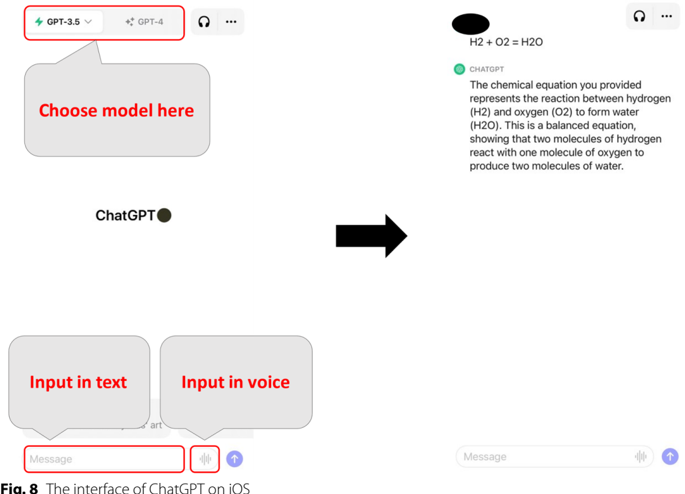
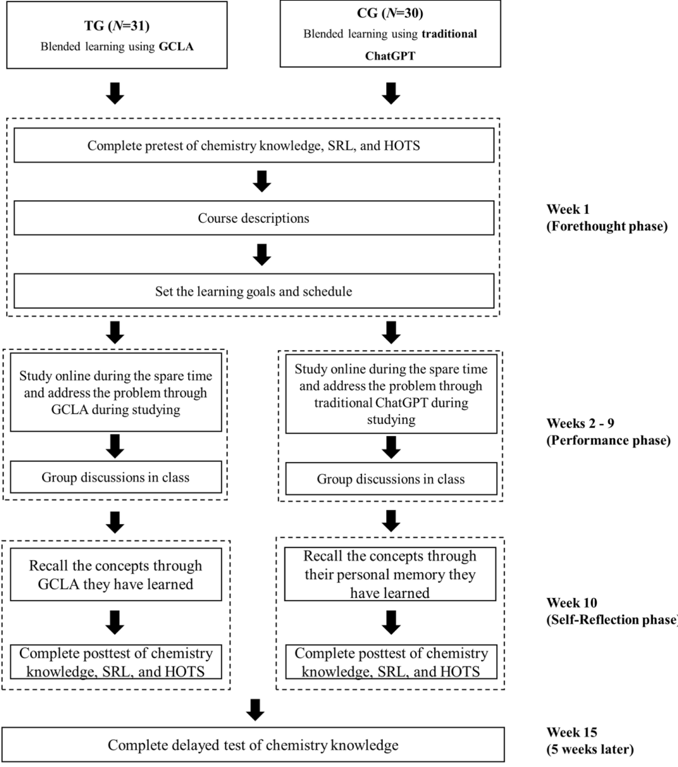
- Randomized controlled trial with 61 first-year undergraduate students in a compulsory chemistry course at a university in southern Taiwan; 31 males and 30 females. Participants were randomly assigned to a Treatment Group (n = 31; 16 males, 15 females) using GCLA or a Control Group (n = 30; 15 males, 15 females) using standard ChatGPT on iOS. Both groups had the same instructor, materials, learning environment, and iPads.
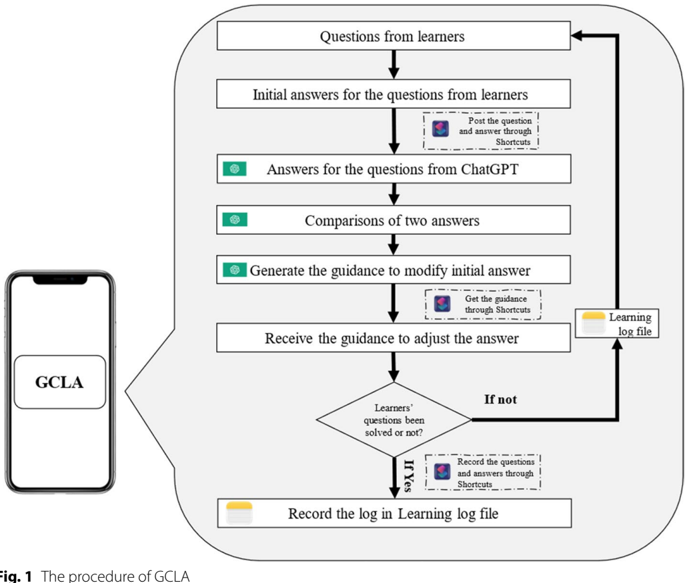
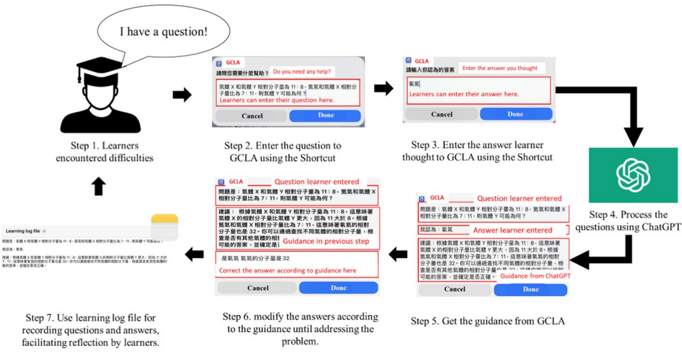
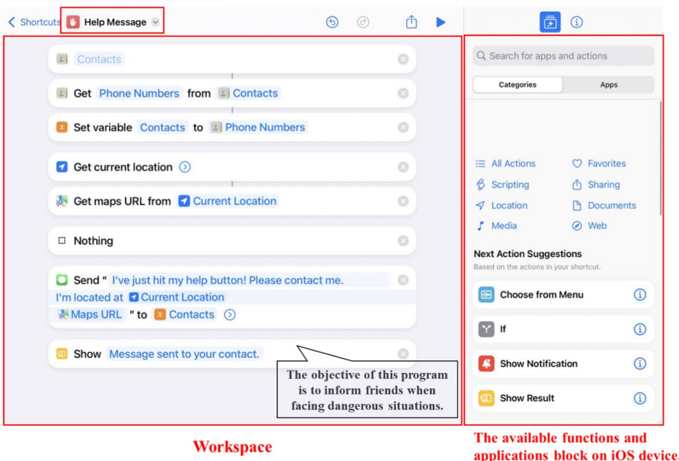
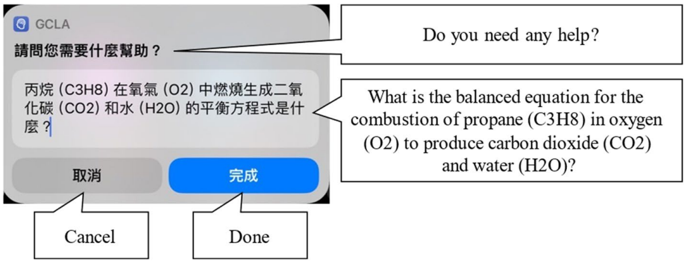
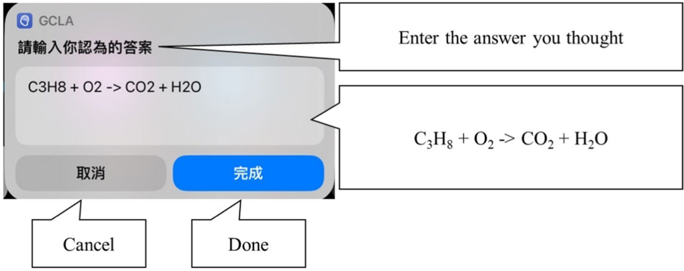
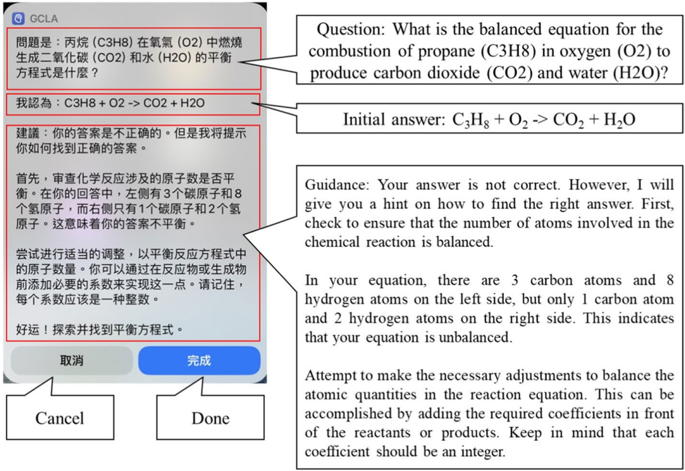
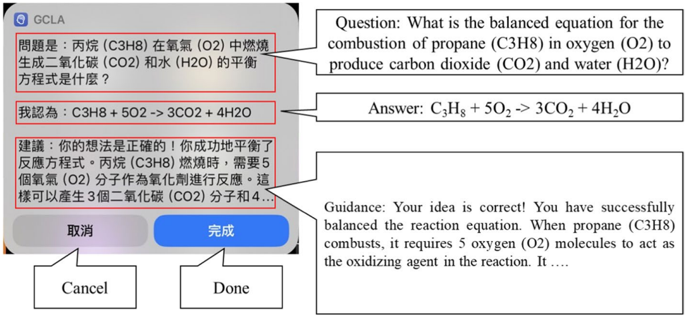
- GCLA used Apple Shortcuts with ChatGPT model gpt-3.5-turbo-16k, parameters max_tokens = 4000, temperature = 0.6, presence_penalty = 0.2. It required students to submit their own proposed answer first, then provided hints rather than direct answers, and kept a learning log.
- Measures included pre-, post-, and delayed chemistry multiple-choice tests (20 items × 5 points = 100), an 11-item HOTS scale (critical thinking, problem-solving, creativity), and a 46-item SRL scale (motivation 20, engagement 18, self-efficacy 8) on 5-point Likert scales. Analysis used ANCOVA with pre-test covariates, Levene’s tests, partial η² effect sizes, and JAMOVI 2.4.
Limitations
- Stated: the sample was relatively small and from a single university in Taiwan, limiting generalizability; the study covered only chemistry and one blended learning setting; and it measured only short-term and medium-term effects via post-tests and delayed tests, not long-term retention, transfer, or application.
- Evident from the text: convenience sampling was used, so despite random assignment within the sample, the participants were not representative; the sample size of 61 is small.
- Evident from the text: the prose describing intrinsic motivation and amotivation is inconsistent with Table 6, which may complicate interpretation of the SRL motivation findings.
Model-written summary. Check it against the paper before relying on it.
Integrity signals
Registry
Cites
Statistics
Figures
Verification
Claims the paper makes
2 Valid · 2 Not valid · 17 Not checked · 82 Own results and interpretations
The cited sources support only part of this claim — read each source’s verdict below.
In the paper
“Nevertheless, it could also foster a dependency that might impede the development of HOTS.The ease of accessing information and problemsolving assistance through tools like ChatGPT could discourage students from engaging in thorough thinking or independent problem-solving (Chan & Hu, 2023;Ding et al., 2023).”
§ Empowering ChatGPT with guidance mechanism in blended learning: effect of self-regulated learning, higher-order thinking skills, and knowledge construction > Introduction
What the sources say
- Supportedcites Chan & Hu, 2023 matched to “Students’ voices on generative AI: perceptions, benefits, and challenges in higher education” (2023) source
In the discussion of challenges (p. 11), the paper says over-reliance on AI may hinder intellectual development and quotes a student concerned that it could reduce critical thinking and willingness to think independently. Table 4 (p. 8) also records concerns about over-reliance and the development of problem-solving skills. These are reported as potential risks, consistent with the citing sentence’s hedged wording. (LLM, conf=0.91)
- Partly supportedcites Ding et al., 2023 matched to “Students' perceptions of using ChatGPT in a physics class as a virtual tutor” (2023) sourceExperimental — accuracy not yet measured
The Implications section reports that many students blindly trusted ChatGPT and heavily relied on its answers, and recommends strengthening critical thinking. It does not establish that this reliance impeded the development of higher-order thinking skills or discouraged independent problem-solving. (LLM, conf=0.84)
hedgedstates a possible cause- Asserted: passes — The authors put it forward as true.
- Checkable: passes — It can be checked against evidence.
- Load-bearing: passes — The paper’s conclusions depend on it.
- Based: passes — The paper gives a reason why it holds.
- Supported
A result the paper reports from its own data — it cites no other source for it, so there is none to check. The quote shows it is in the paper.
In the paper
“The findings reveal that the GCLA enhances SRL, HOTS, and knowledge construction compared to traditional ChatGPT use.”
§ Empowering ChatGPT with guidance mechanism in blended learning: effect of self-regulated learning, higher-order thinking skills, and knowledge construction > Abstract
plainstates a cause- Asserted: passes — The authors put it forward as true.
- Checkable: passes — It can be checked against evidence.
- Load-bearing: passes — The paper’s conclusions depend on it.
- Based: passes — The paper gives a reason why it holds.
A result the paper reports from its own data — it cites no other source for it, so there is none to check. The quote shows it is in the paper.
In the paper
“and amotivation (M EG = 8.53 < M CG = 12.0, this being an adverse indicator).”
§ Empowering ChatGPT with guidance mechanism in blended learning: effect of self-regulated learning, higher-order thinking skills, and knowledge construction > The impact of GCLA on self-regulated learning (SRL)
plain- Asserted: passes — The authors put it forward as true.
- Checkable: passes — It can be checked against evidence.
- Load-bearing: passes — The paper’s conclusions depend on it.
- Based: passes — The paper gives a reason why it holds.
35 more claims
Create a free account to see all 103 claims and every source verdict.
- Probably not a substantial claim. 43
- It may state two separate claims as one. 32
Claims other papers make about this one
Each is checked against this paper’s own text: does it say what the citing paper says it does?
The source backs part of the claim, not all of it — or backs it for a different population, condition or comparison.
In the citing paper
“Within this evolving paradigm, there is a growing consensus that AI tools should be conceptualized not merely as corrective devices but as mediational instruments capable of scaffolding higher-order thinking, self-regulation, and learner agency (Lan & Zhou, 2025;Lee et al., 2024).”
From Generative AI, visual scaffolds, and metacognition in EFL writing (2026) · cites this paper as Lee et al., 2024
Experimental — accuracy not yet measuredThe source backs part of the claim, not all of it — or backs it for a different population, condition or comparison.
In the citing paper
“These tools enable students to engage in iterative dialogue, receive real-time feedback, and explore alternative viewpoints, features aligned with key CT processes such as analysis, synthesis, inference, and evaluation [28].”
From A Systematic Literature Review on the Pedagogical Implications and Impact of GenAI on Students' Critical Thinking (2026) · cites this paper as [28]
Experimental — accuracy not yet measuredThe source backs part of the claim, not all of it — or backs it for a different population, condition or comparison.
In the citing paper
“Students benefit from adaptive feedback mechanisms inherent in GenAI tools like ChatGPT, which prompt them to reflect on their assumptions and refine their reasoning iteratively [28,32].”
From A Systematic Literature Review on the Pedagogical Implications and Impact of GenAI on Students' Critical Thinking (2026) · cites this paper as [28]
Experimental — accuracy not yet measuredThe source backs part of the claim, not all of it — or backs it for a different population, condition or comparison.
In the citing paper
“Also, it fits the wider pattern in recent studies, in which scaffolding forms of GenAI use have preserved post-intervention performance while unlimited use has not (Bastani et al., 2025; Lee et al., 2024).”
From Effects of Partial vs. Full Cognitive Offloading with Generative AI on Learning Retention (2026) · cites this paper as Lee et al., 2024
Experimental — accuracy not yet measuredThe cited source says what the claim attributes to it.
In the citing paper
“These approaches keep students cognitively engaged and make it more difficult for them to drift into passive acceptance or superficial completion (Lee et al., 2024; Joo et al., 2026; Lukešová & Jennings, 2025; Sun et al., 2026; R. Zhou et al., 2025).”
From Generative AI, Cognitive Offloading, and Learner Agency in Higher Education: A Scoping Review (2026) · cites this paper as Lee et al., 2024
3 more claims about this paper
Create a free account to see every claim other papers make about this one.
Self-check
Percentages, sums and reported differences re-computed from the paper’s own numbers.
Each contradiction between two passages listed here was confirmed by an independent check.
Rated major: it would touch a result — a value a result rests on, reported and recomputed p-values on opposite sides of the significance level, two passages that conflict with no sign which is right, or a cited work retracted before this paper was published.
In the paper
§ Empowering ChatGPT with guidance mechanism in blended learning: effect of self-regulated learning, higher-order thinking skills, and knowledge construction > Conclusion
“the GCLA did not have a significant effect on students' intrinsic motivation and amotivation”
§ Empowering ChatGPT with guidance mechanism in blended learning: effect of self-regulated learning, higher-order thinking skills, and knowledge construction > The impact of GCLA on self-regulated learning (SRL)
“statistically significant differences were observed in intrinsic motivation, amotivation, cognitive engagement, behavioral engagement, and self-efficacy.”
Rated major: it would touch a result — a value a result rests on, reported and recomputed p-values on opposite sides of the significance level, two passages that conflict with no sign which is right, or a cited work retracted before this paper was published.
In the paper
§ Empowering ChatGPT with guidance mechanism in blended learning: effect of self-regulated learning, higher-order thinking skills, and knowledge construction > The impact of GCLA on self-regulated learning (SRL)
“the CG notably outperformed the TG in terms of intrinsic motivation (M EG = 18.9 > M CG = 16.1)”
§ Empowering ChatGPT with guidance mechanism in blended learning: effect of self-regulated learning, higher-order thinking skills, and knowledge construction > Future directions
“| Intrinsic motivation | 16.2 | 1.88 | 18.9 | 2.82 | 16.0 | 2.46 | 16.1 | 2.55 |”
Rated major: it would touch a result — a value a result rests on, reported and recomputed p-values on opposite sides of the significance level, two passages that conflict with no sign which is right, or a cited work retracted before this paper was published.
In the paper
§ Empowering ChatGPT with guidance mechanism in blended learning: effect of self-regulated learning, higher-order thinking skills, and knowledge construction > • Week 1: Forethought phase
“A delayed test in Week 15 was designed to evaluate the persistence of their acquired knowledge.”
§ Empowering ChatGPT with guidance mechanism in blended learning: effect of self-regulated learning, higher-order thinking skills, and knowledge construction > Details of pre-test of and post-test
“The delayed tests, taking place two weeks following the intervention, were 20 min long.”
Rated major: it would touch a result — a value a result rests on, reported and recomputed p-values on opposite sides of the significance level, two passages that conflict with no sign which is right, or a cited work retracted before this paper was published.
In the paper
§ Empowering ChatGPT with guidance mechanism in blended learning: effect of self-regulated learning, higher-order thinking skills, and knowledge construction > Discussion
“traditional ChatGPT holds a slight edge, particularly in higher education contexts.Its ability to provide immediate feedback seems to foster motivation and stave off feelings of helplessness”
§ Empowering ChatGPT with guidance mechanism in blended learning: effect of self-regulated learning, higher-order thinking skills, and knowledge construction > The impact of GCLA on self-regulated learning (SRL)
“amotivation (M EG = 8.53 < M CG = 12.0, this being an adverse indicator)”
Rated minor: it would not touch a result — a value no result rests on, a p-value that stays on the same side of the significance level, or a conflict that is clerical, resolved elsewhere in the paper, or outside its own findings.
In the paper
§ Empowering ChatGPT with guidance mechanism in blended learning: effect of self-regulated learning, higher-order thinking skills, and knowledge construction > Measurement
“For engagement, the Math and Science Engagement Scales proposed by Wang et al. (2016) was adapted, dividing engagement into cognitive, behavioral, and emotional aspects.”
§ Empowering ChatGPT with guidance mechanism in blended learning: effect of self-regulated learning, higher-order thinking skills, and knowledge construction > Future directions
“| | Social engagement | 0.77 |”
Citations
Cites
Vaswani, A., Shazeer, N., Parmar, N., Uszkoreit, J., Jones, L., Gomez, A. N., Kaiser, L., & Polosukhin, I. (2017) · arXiv · doi:10.48550/arxiv.1706.03762 · Cited by 120,404
Research Design: Qualitative, Quantitative, and Mixed Methods Approaches
Creswell, J. W. (1994) · Cited by 35,503
ChatGPT for good? On opportunities and challenges of large language models for education
Kasneci, E., Sessler, K., Küchemann, S., Bannert, M., Dementieva, D., Fischer, F., Gasser, U., Groh, G., Günnemann, S., Hüllermeier, E., et al. (2023) · Learning and Individual Differences · doi:10.1016/j.lindif.2023.102274 · Cited by 15,365 · cited 1×
“Investigations by Kasneci et al. (2023) elucidate how ChatGPT engenders engagement and fosters a more interactive learning paradigm.”
BackgroundResearch Design: Qualitative, Quantitative, and Mixed Methods Approaches
ภู่พันธ์, ศ. (2018) · วารสารวิธีวิทยาการวิจัย (Journal of Research Methodology: JRM) · Cited by 13,070
A revision of bloom's taxonomy: an overview
Krathwohl, D. R. (2002) · Theory Into Practice · doi:10.1207/s15430421tip4104_2 · Cited by 8,132 · cited 1×
“This level of scrutiny encourages learners to not just passively accept information but to actively engage in questioning and appraising its validity and utility (Krathwohl, 2002).”
BackgroundChatGPT for Good? On Opportunities and Challenges of Large Language Models for Education
Kasneci, E., Seßler, K., Küchemann, S., Bannert, M., Dementieva, D., Fischer, F., Gasser, U., Groh, G., Günnemann, S., Hüllermeier, E., et al. (2023) · doi:10.35542/osf.io/5er8f · Cited by 7,552
Zimmerman, B. J. (2000) · Handbook of Self-Regulation · doi:10.1016/b978-012109890-2/50031-7 · Cited by 6,069
The Role of Goal Orientation in Self-Regulated Learning
Pintrich, P. R. (2000) · Handbook of Self-Regulation · doi:10.1016/b978-012109890-2/50043-3 · Cited by 5,173
Zimmerman, B. J. (2008) · American Educational Research Journal · doi:10.3102/0002831207312909 · Cited by 3,735 · cited 2×
“Wu et al., (2023a) under-line the importance of sustaining motivation in the forethought phase (Pintrich, 2000; Zimmerman, 2000, 2008), actively engaging in the performance phase (Bernardo et al., 2022; Doo & Bonk, 2020), and enhancing self-efficacy during self-reflection (Rabin et al., 2020;…”
BackgroundSelf-Regulated Learning and Academic Achievement: An Overview
Zimmerman, B. J. (1990) · Educational Psychologist · doi:10.1207/s15326985ep2501_2 · Cited by 3,687 · cited 5×
“…settings, as noted by Rasheed et al. (2020), SRL necessitates significant self-disci-pline and initiative, especially online where learners choose their engagement levels—a dynamic essential for the self-reflection phase, as discussed by Hood et al. (2015) and grounded in Zimmerman (1990)’s work.”
BackgroundMethodInfluential
Research works printed but not linked: 1
- 82. Yueh-Min Huang received the M.S. and Ph.D. degrees in Electrical Engineering from the University of Arizona in 1988 and 1991 respectively. He is a Chair Professor in Department of Engineering Science, National Cheng-Kung University, Taiwan. He has co-authored 3 books and has published more than 250 refereed journal research papers. His research interests include e-Learning, multimedia communications, wireless networks, and artificial intelligence. He is in the editorial board of several international journals in the area of educational technology, computer communications, and web intelligence, including 3 SSCI- indexed e-Learning ones. In e-Learning area, except of publishing more than 100 SSCI-indexed journal
Cited by
Items 101–200 of 274
Quan, X. (2026) · Education and Information Technologies · doi:10.1007/s10639-025-13887-w · Cited by 10
Escaffi, C. A. V., & Martínez-Líbano, J. (2026) · International Medical Education · doi:10.3390/ime5020034 · Cited by 9
“This proactive approach, in addition to optimizing the educational process and curricular progress, acts as a strong protective factor against demotivation and academic dropout in demanding contexts [5,9].”
Pensky, A. C., Jackson, L. E., Melville, M. C., Pottmeyer, L., Mineroff, Z., Chawla, A., Brooks, J., Hershock, C., & Lovett, M. C. (2026) · Computers & Education · doi:10.1016/j.compedu.2026.105640 · Cited by 7
Wu, T., Lee, H., Chen, P., Wang, W., & Huang, Y. (2025) · Journal of Computer Assisted Learning · doi:10.1111/jcal.70121 · Cited by 8
Self-citationLi, P., Wu, T., & Huang, Y. (2025) · Education and Information Technologies · doi:10.1007/s10639-025-13734-y · Cited by 9
“…dynamically adjust the difficulty and guidance of prompts according to learners’ knowledge backgrounds and learning trajectories, ensuring an appropriate level of learning challenge while preventing overly simple or excessively complex feedback from affecting learning outcomes(Lee et al., 2024 ).”
Self-citationIqbal, J., Hashmi, Z. F., Seitamaa‐Hakkarainen, P., & Asghar, M. Z. (2025) · Scientific Reports · doi:10.1038/s41598-025-19625-z · Cited by 9
Stadnik, M., Coskovic, A. L., Banko, T., & Ružak, D. (2025) · Interdisciplinary Description of Complex Systems · doi:10.7906/indecs.23.1.3 · Cited by 6
“A recent study 34 introduces a novel approach that modifies the use of ChatGPT by providing guidance rather than direct answers.”
Chen, P., Huang, Y., Wu, T., & Lee, H. (2024) · International Conference on Modern Educational Technology (ICMET) · doi:10.1145/3729434.3729435 · Cited by 4
“While this approach provides immediate assistance, it raises concerns about potential overreliance on AI [3].”
InfluentialSelf-citationJere, S., & Mpeta, M. (2025) · Eurasia Journal of Mathematics Science and Technology Education · doi:10.29333/ejmste/17077 · Cited by 12
“ChatGPT was developed and launched by OpenAI in November 2022, bringing massive potential to the transformation of the way children learn (Lee et al., 2024).”
Ba, S., Lu, G., Mendoza, N. B., Yang, Y. P., Pan, Z., & Wang, Y. (2025) · Journal of Educational Computing Research · doi:10.1177/07356331251396357 · Cited by 6
“This fi nding partially aligns with Lee et al. (2024), who reported that traditional ChatGPT usage was less effective in fostering higher-order thinking compared to approaches where students fi rst attempted to solve problems independently before consulting ChatGPT.”
Tian, J., Hu, W., Li, R., & Li, Y. (2025) · Distance Education · doi:10.1080/01587919.2025.2578773 · Cited by 3
“Guo et al., 2025; Lee et al., 2024; Sun et al., 2024; Wu et al., 2024).”
Yin, X., Ye, J., Yu, S., Li, H., & Lu, G. (2025) · Education and Information Technologies · doi:10.1007/s10639-025-13831-y · Cited by 9
“Given these characteristics, GenAI is rap - idly integrating into the educational landscape, fostering more interactive learning environments and notably enhancing overall learning experiences and academic per - formance (Lee et al., 2024; Al-Emran, 2024).”
Wei, L., Qiu, L., & Man, S. (2025) · SAGE Open · doi:10.1177/21582440251407506 · Cited by 13
“Collectively, these AI-related interventions enhance students’ engagement in music technology application (Lee et al., 2024) and artistic practice (Kong & Lin, 2023) by strengthening the four sources of self-efficacy.”
Cheng, M., & Cheung, K. K. C. (2026) · Interactive Learning Environments · doi:10.1080/10494820.2025.2609793 · Cited by 5
Lee, H., Chen, P., Huang, Y., & Wu, T. (2026) · Journal of Educational Computing Research · doi:10.1177/07356331261429306 · Cited by 6
“This fi nding extends Lee et al. (2024) ’ s work on student preferences, instead demonstrating student capacity to recognize and value more sophisticated pedagogical approaches when they experience clear learning bene fi ts.”
InfluentialSelf-citationXiao, S., & Hu, B. (2026) · Education and Information Technologies · doi:10.1007/s10639-026-13909-1 · Cited by 3
“The results revealed significant positive associations between the frequency of Chat - GPT use and problem-solving skills, critical thinking, and creativity, which align with prior empirical findings (Lee et al., 2024; Wang & Fan, 2025).”
Mendoza, N. B., Xiong, Y., & Yan, Z. (2026) · Educational Psychology · doi:10.1080/01443410.2026.2641521 · Cited by 9
Effects of Generative AI Tools On Students’ Critical Thinking: A Three-Level Meta-Analysis
Sun, X., Liu, C., Li, P., & Cai, Z. (2026) · Educational Psychology Review · doi:10.1007/s10648-026-10180-1 · Cited by 10
Nguyen, H., Chen, H., & Asfani, K. (2026) · Journal of Educational Computing Research · doi:10.1177/07356331261450647 · Cited by 10
STUDENTS' PERCEPTIONS OF ARTIFICIAL INTELLIGENCE TECHNOLOGY TO DEVELOP 21ST CENTURY LEARNING SKILLS
Fadli, F., & Iskarim, M. (2024) · Lentera Pendidikan Jurnal Ilmu Tarbiyah dan Keguruan · doi:10.24252/lp.2024v27n1i11 · Cited by 8
“Using ChatGPT in learning offers many advantages, such as accessibility and personalization of learning, so it is beneficial for supporting the teaching and learning process and improving the student learning experience (Lee, Chen, Wang, & Huang, 2024).”
BackgroundΠέλλας, Ν. (2024) · Research Square · doi:10.21203/rs.3.rs-4627814/v1 · Cited by 3
Evaluation of LLM-Based Feedback Generation for Distance Project-Based Learning
Sasaki, K., & Inoue, T. (2025) · Lecture notes in computer science · doi:10.1007/978-3-032-10156-3_11 · Cited by 2
Donadel, V., & Zuin, M. (2026) · Technology Knowledge and Learning · doi:10.1007/s10758-025-09949-0 · Cited by 5
Guiding Novice Programmers With CPS-GPT: A Prompt-Driven AI Assistant for Creative Problem Solving
Wang, S. T., Li, P.-H., & Huang, Y. (2026) · Journal of Educational Computing Research · doi:10.1177/07356331261431145 · Cited by 4
Self-citationHasanein, A. M., & Al‐Romeedy, B. S. (2026) · Information · doi:10.3390/info17030303 · Cited by 7
Chen, P., Huang, Y., Wu, T., & Lee, H. (2025) · International Conference on Modern Educational Technology (ICMET) · doi:10.1109/icmet67594.2025.11451842 · Cited by 4
“This indicates that the design of educational AI should prioritize clear, direct explanations that mirror the structure of formal instruction [34; 35].”
Self-citationEFFICIENCY, ENGAGEMENT, AND COGNITIVE OFFLOADING: A REVIEW OF GENERATIVE AI IN EDUCATION
Khalid, N., Kasbun, R., & Rahman, N. F. A. (2026) · International Journal of Education Psychology and Counseling · doi:10.35631/ijepc.1162072 · Cited by 5
Zhang, H., & Jiang, R. (2026) · Education and Information Technologies · doi:10.1007/s10639-026-14026-9 · Cited by 6
“…feedback may be more readily available, and learners may find it easier to engage in self-explanation and structured integration; the extent to which such generative engagement is associated with higher HOTS is examined empirically in the present study (Lee et al., 2024 ; Nakamoto et al., 2023 ).”
Jing, Y., Hu, R., & Shadiev, R. (2026) · Interactive Learning Environments · doi:10.1080/10494820.2026.2657517 · Cited by 2
“Learning resources, dynamically generated in multimodal formats on demand, offer learners diverse options aligned with their learning styles – such as GenAI-generated text, images, videos, and animations (Chen et al., 2024; Hu, Yu, et al., 2025; Li, Wang, et al., 2025).”
Generative AI in Chemical Education: A Bibliometric Perspective
Park, J.-T., Choi, Y., Han, K., Bong, S., & Lee, H. J. (2026) · Journal of Chemical Education · doi:10.1021/acs.jchemed.5c01667 · Cited by 6
Self-citationAlsuwaylim, A. M., Alshehri, M. A., Lamouchi, A., Abdellatif, M. S., Ibrahim, A., & Nemt-allah, M. A. (2026) · Frontiers in Psychology · doi:10.3389/fpsyg.2026.1834791 · Cited by 7
Generative AI in higher education: A systematic review of empirical uses, outcomes, and risks
Hawi, N. S., & Samaha, M. (2026) · International Journal of Educational Research Open · doi:10.1016/j.ijedro.2026.100584 · Cited by 2
A bibliometric analysis of learning environments in chemistry education
Lykhopavlo, N. Y. (2025) · Science education quarterly. · doi:10.55056/seq.1071 · Cited by 2
Wang, K. (2025) · International Journal of Web-Based Learning and Teaching Technologies · doi:10.4018/ijwltt.380729 · Cited by 3
李, 博. (2025) · Advances in Social Sciences · doi:10.12677/ass.2025.146475 · Cited by 1
Perception and use of ChatGPT among university students. Analysis based on K-Modes
Diaz, D. J. C., & Caluña, E. R. M. (2025) · Data & Metadata · doi:10.56294/dm2025729 · Cited by 4
Tohir, A., Muslim, S., & Situmorang, R. (2025) · International Journal of Computational and Experimental Science and Engineering · doi:10.22399/ijcesen.3474 · Cited by 15
Yang, B., & Sun, Y. (2025) · International Journal of Human-Computer Interaction · doi:10.1080/10447318.2025.2543990 · Cited by 3
“Thus, while SRL enhances the effective use of AILAs for productivity, achieving creative gains might necessitate a deeper engagement with AILAs or the use of AILAs with features designed to foster creative exploration (Lee et al., 2024; Rahimi & Shute, 2021).”
Wang, J., Ismail, H. H., & Mansor, A. Z. (2025) · International Journal of Computer-Assisted Language Learning and Teaching · doi:10.4018/ijcallt.388707 · Cited by 7
Berraies, S., & Rejeb, W. B. (2025) · Advances in computational intelligence and robotics book series · doi:10.4018/979-8-3373-3815-6.ch008 · Cited by 3
Chen, Y., & Zheng, C. (2025) · Discover Applied Sciences · doi:10.1007/s42452-025-07847-9 · Cited by 1
“These advancements demonstrate the promise of smart technology and AI in the classroom; however, no framework has been established to integrate all these aspects in a scalable, flexible, and service-quality-focused manner (Lee et al., 2023) [13].”
Riantoni, C., Maison, M., & Pathoni, H. (2025) · Indonesian Journal of Science and Mathematics Education · doi:10.24042/ijsme.v8i2.28832 · Cited by 1
Balasoto, R. L., de la Peña, M. T. C., & Domingo, J. F. C. (2025) · International Journal of Research and Review · doi:10.52403/ijrr.20251144 · Cited by 3
Zhang, L. H., Wang, Y., Li, J., & Wang, J. L. (2026) · Frontiers in Psychology · doi:10.3389/fpsyg.2025.1668749 · Cited by 1
Gençel, N., Yılmaz, F. G. K., & Yılmaz, R. (2026) · Computers in Human Behavior Artificial Humans · doi:10.1016/j.chbah.2026.100252 · Cited by 4
Perceptions challenges and ethical concerns of ChatGPT use in Indian higher education institutions
Singh, A., Bajpai, A., & Singh, S. (2026) · Discover Education · doi:10.1007/s44217-026-01300-8 · Cited by 4
Teaching innovation mechanism of higher education driven by AI fusion data
Chen, Z., Qin, S., Han, H., Peng, W., & Liang, H. (2026) · Discover Computing · doi:10.1007/s10791-026-10036-w · Cited by 3
Jiang, X. (2026) · Interactive Technology and Smart Education · doi:10.1108/itse-01-2026-0004 · Cited by 2
Shehata, B., Huang, R., Kanwar, A. S., Liu, D., Zheng, L., & Liu, Z. (2026) · Smart Learning Environments · doi:10.1186/s40561-026-00449-x · Cited by 2
Zhang, X., Yang, L., & Cui, Y. (2026) · Innovation in Language Learning and Teaching · doi:10.1080/17501229.2026.2648082 · Cited by 2
Lin, Y., Wang, W., & Chen, C. (2026) · The International Journal of Management Education · doi:10.1016/j.ijme.2026.101411 · Cited by 7
Self-citationYılmaz, A., & Serin, M. K. (2026) · Frontiers in Psychology · doi:10.3389/fpsyg.2026.1797656 · Cited by 1
“Higher education increasingly requires students not only to acquire disciplinary knowledge but also to regulate their learning, evaluate their own performance, and respond effectively to complex cognitive demands (Hague, 2024; Lee et al., 2024; Lobos et al., 2024; OECD, 2019).”
Wu, J., Gu, J., Sun, D., Yuhan, X., He, H., Zhang, P., & Yan, Z. (2026) · Journal of Research on Technology in Education · doi:10.1080/15391523.2026.2643171 · Cited by 2
Kızıltaş, Y. (2026) · Education and Information Technologies · doi:10.1007/s10639-026-14029-6 · Cited by 2
“…of self-regulated learning in facilitating learning in digital environments, as well as those investigating the potential effects of ChatGPT on developing self-regulation skills, support this perspective and the aim of the current study (Chiu, 2024; Lee et al., 2024; Weng et al., 2024; Zhu, 2025).”
Yulanda, N. I. P., Gestiardi, R., Subanji, S., Nusantara, T., & Setyosarı, P. (2026) · Learning Research and Practice · doi:10.1080/23735082.2026.2672411 · Cited by 3
Wang, Q. (2026) · Computer Applications in Engineering Education · doi:10.1002/cae.70217 · Cited by 1
“Lee et al. [25] indicated that guidance chatbots that are incorporated in blended learning environments contribute to self‐regulated learning, higher‐ order thinking, and knowledge building with significant positive effects.”
Zhang, Q., & Liang, Y. (2026) · Education and Information Technologies · doi:10.1007/s10639-026-14038-5 · Cited by 11
“Through these inter - actions, learners may have further elaborated their ideas using additional perspectives provided by chatbots (Lee et al., 2024), supporting greater sufficiency and depth of content in their written responses.”
Cui, Y., & Li, M. (2026) · SAGE Open · doi:10.1177/21582440261449529 · Cited by 1
“H. Lee et al. (2024) found that structure support provided by teachers, along with autonomy support provided by Gen AI, had a significant positive impact on undergraduate students’ creativity compared to traditional ChatGPT use.”
InfluentialFrom Prediction to Stewardship: Framing Educational Data Science in the Age of Generative AI
McNamara, D. S., & Huynh, L. (2026) · Information · doi:10.3390/info17060610 · Cited by 1
Xia, Q., Aldharman, N. S., & Chiu, T. K. F. (2026) · TechTrends · doi:10.1007/s11528-026-01203-3 · Cited by 5
“Through critical analysis of their cognitive processes alongside Chat-GPT’s feedback, students can more effectively gauge their learning progress and pinpoint improvement areas (Hartley et al., 2024; Lee et al., 2024).”
AI Literacy Scale for Undergraduate Design Students: Development and Validation
Lin, S., & Tan, Z. (2026) · SAGE Open · doi:10.1177/21582440261463131 · Cited by 6
“Generative AI tools such as ChatGPT, Midjourney, and Stable Diffusion are revolutionizing creative workflows, knowledge construction, and instructional objectives in higher education (Caner-Yıldırım, 2025; Chiu, 2024; Lee et al., 2024).”
Jiang, Y., Feng, X., Liu, Y., Liu, B., & Bao, L. (2026) · Interactive Learning Environments · doi:10.1080/10494820.2026.2691907 · Cited by 1
Oltramonti, R., & Collaguazo, N. C. A. (2026) · Revista Científica Enfoques del Conocimiento · doi:10.55813/gaea/revistacec/v3/n3/52 · Cited by 2
Psychometric analysis of ethnomathematics-based problem solving items
Setiyadi, D., Zaenuri, & Trimurtini (2026) · Multidisciplinary Science Journal · doi:10.31893/multiscience.2027033 · Cited by 1
“Recent studies indicate that strengthening problem-solving skills in primary education is positively correlated with the enhancement of higher-order thinking skills and learning readiness for subsequent educational levels (Lee et al., 2024; Sikk & Tammets, 2023).”
Shaya, N., Baroudi, S., Aoun, S., & Abukhait, R. (2026) · Frontiers in Education · doi:10.3389/feduc.2026.1884153 · Cited by 1
Huang, B., Xie, L., Liu, Y., Liu, X., Tang, H., Feng, X., Qiao, C., Guo, Q., Wu, C., & Bao, L. (2026) · International Journal of STEM Education · doi:10.1186/s40594-026-00652-9 · Cited by 1
“Lee et al. (2024) developed the Guidance-based ChatGPT-assisted Learning Aid (GCLA) for a university chemistry course, requiring students to attempt problem-solving independently before consulting the AI, which delivers hints rather than direct answers, and their results showed improvements in SRL,…”
Karaköse, T., & Polat, H. (2025) · Studies in computational intelligence · doi:10.1007/978-3-031-82915-4_18 · Cited by 2
李, 柠. (2025) · Advances in Education · doi:10.12677/ae.2025.155736 · Cited by 1
Πέλλας, Ν. (2024) · Research Square · doi:10.21203/rs.3.rs-4627814/v2 · Cited by 1
Wang, R., & Raman, A. L. (2025) · Research Square · doi:10.21203/rs.3.rs-6372448/v1 · Cited by 2
Shaya, N., Baroudi, S., Aoun, S., & Abukhait, R. (2025) · SSRN Electronic Journal · doi:10.2139/ssrn.5384108 · Cited by 1
Generative AI, visual scaffolds, and metacognition in EFL writing
Chen, M.-R. A. (2026) · Language Learning & Technology · doi:10.64152/10125/73695 · Cited by 1
Mas’ud, B., Hajina, & Darwis, D. (2024) · EDULAB Majalah Ilmiah Laboratorium Pendidikan · doi:10.14421/edulab.2024.91.03
Buchem, I., Bonga, G. A. K., & Tutul, R. (2024) · Lecture notes in networks and systems · doi:10.1007/978-3-031-67059-6_34
Ansiedad Generalizada y Estrés Académico en Estudiantes Universitarios
Menéndez, A. A. S., & Bitar-Cabezas, J. P. (2025) · Estudios y Perspectivas Revista Científica y Académica · doi:10.61384/r.c.a..v5i1.956
Marlina, M., Hadi, S., & Rahim, A. (2025) · International Journal of Educational Reform · doi:10.1177/10567879251323884 · Cited by 2
Experiencia de aplicación de la IA en los procesos de prácticas en ciencias administrativas
Fernández, M. O. G., Almendárez, J. M. F., & Gómez, B. F. M. (2025) · Revista Practicum · doi:10.24310/rep.10.1.2025.21951
Posibilidades de la IA en el prácticum: visión estudiantil desde la literatura
Fernández-Otoya, F. A., Fernández, M. O. G., Quadros-Flores, P. A. D., & García, M. S. (2025) · Revista Practicum · doi:10.24310/rep.10.1.2025.21952 · Cited by 1
Enhancing the Development of Higher Order Thinking in Beginners Through Creative Guided GPT
Wang, S., Chen, J.-L., & Huang, Y. (2025) · Lecture notes in computer science · doi:10.1007/978-3-031-98185-2_17
Self-citationChen, P.-H., Rønningsbakk, L., & Huang, Y. (2025) · Lecture notes in computer science · doi:10.1007/978-3-031-98185-2_13 · Cited by 2
Self-citationLee, H., & Wu, T. (2025) · Lecture notes in computer science · doi:10.1007/978-3-031-98185-2_16
Self-citationShi-jin, L., & Li, R. (2025) · Journal of Educational Computing Research · doi:10.1177/07356331251381755 · Cited by 2
“Future AIED applications should prioritize direct human-machine interaction paradigms (Lee et al., 2024), incorporating adaptive interface design and real-time feedback mechanisms to optimize learning outcomes.”
Leveraging Student Feedback to Enhance a Blended/Hybrid Model in Intermediate Accounting
Krivacek, G. J. (2025) · International Journal of Innovative Teaching and Learning in Higher Education · doi:10.4018/ijitlhe.393621
Thurman, J. (2025) · Advances in Applied Sociology · doi:10.4236/aasoci.2025.1511062 · Cited by 1
Problem-Based Learning and Artificial Intelligence
Taranikanti, V., & Vuthaluru, S. (2025) · Springer eBooks · doi:10.1007/978-3-032-05405-0_9 · Cited by 2
Bakri, R., del Val, E. B., Bado, B., & Ahmar, A. S. (2025) · MethodsX · doi:10.1016/j.mex.2025.103739
“This aligns with [31,32], who argue that practice-based learning combined with in-app guidance enhances self-directed learning and promotes higher-order cognitive skills.”
Du, B., & Wang, Y. (2025) · Education and Information Technologies · doi:10.1007/s10639-025-13861-6 · Cited by 1
Benlaria, H., Alanazi, A. S., & Boudaoui, A. (2025) · Journal of Disability Research · doi:10.57197/jdr-2025-0679
Abidin, Z., & Aminudin, S. (2025) · Integrated Science Education Journal · doi:10.37251/isej.v6i3.1851 · Cited by 1
Artificial Intelligence and Information Technology Education: A Systematic Literature Review
Çiftçi, S. (2025) · Adnan Menderes Üniversitesi Sosyal Bilimler Enstitüsü Dergisi · doi:10.30803/adusobed.1822028 · Cited by 1
Li, N. (2025) · International Conference on Modern Education and Information Management (ICMEIM) · doi:10.1109/icmeim66684.2025.11307103
“In blended contexts, in which offline activities (for instance, case discussions, and live simulations) interact with online micro-lessons, such as structure helps align resources, assessments, and classroom interventions into a coherent whole [5].”
Critical Thinking and ChatGPT: Navigating Diversity in English Language Education
Liang, W., & Cheng, X. (2026) · Springer eBooks · doi:10.1007/978-3-032-11430-3_8
Learning from Chatbots: Main Themes in Recent Research
Shah, R., Kolishetty, M., & Gehringer, E. F. (2025) · IEEE Frontiers in Education Conference (FIE) · doi:10.1109/fie63693.2025.11328689 · Cited by 1
Zhang, X., He, X., Fang, J., & Zhang, S. (2025) · International Conference on Educational Technology (ICET) · doi:10.1109/icet67421.2025.11380428
“…monitoring and regulation of their learning processes, not only optimizes cognitive workflows to facilitate deep understanding of knowledge [1][2] but also fosters the development of higher-order competencies such as critical thinking [3], self-regulation [4], and reflective capacity [5].”
How and when does artificial intelligence augment management student creativity?
Leong, A. M. W., Li, X., Lee, J. C.-K., Ji, L., & Bai, J. (2026) · The International Journal of Management Education · doi:10.1016/j.ijme.2026.101391 · Cited by 2
Boost or Block? Exploring the Impact Mechanisms of Deep Learning in GenAI Interactions
Mo, J., Peng, S., Guo, C., & Gao, J. (2025) · International Conference on Educational Technology Management (ICETM) · doi:10.1109/icetm67477.2025.11413575
“Previous studies have shown that improper use of GenAI or low-quality interactions may have a negative impact on college students’ creativity [1 8].”
ChatGPT in Secondary Education: A Multi-Theoretical Case Study from a Developing Country
Pardede, S., Sinaga, D. F., & Simamora, S. (2026) · Education as Change · doi:10.25159/1947-9417/20308 · Cited by 6
Pineda, F. V. C., & Meléndez, J. G. P. (2026) · Horizon Nexus Journal. · doi:10.70881/hnj/v4/n1/108 · Cited by 3
Tu, Y., Huang, C., Gao, C., Tu, Y.-F., Pan, Y., & Hwang, G. (2026) · Computers in Human Behavior · doi:10.1016/j.chb.2026.108998
Antoine, G., Mtonga, K., Martin, K., Bosco, T. J., & Bosco, N. J. (2026) · Progress in IS · doi:10.1007/978-3-031-99219-3_31 · Cited by 2
Metadata
- Authors
- Lee, H.-Y., Chen, P.-H., Wang, W.-S., Huang, Y.-M., & Wu, T.-T.
- Affiliations
- National Cheng Kung University (TW)
- National Yunlin University of Science and Technology (TW)
- Corresponding author
- Huang, Yueh-Min
- Venue
- International Journal of Educational Technology in Higher Education
- Published
- 2024-03-04
- Volume
- 21
- Issue
- 1
- ISSN
- 2365-9440 (ISSN-L)
- OpenAlex
- W4392342858
- Cited by
- 273
- References
- 74
- Citations by year
- 2026: 133 · 2025: 110 · 2024: 30
- FWCI
- 102.19
- Type
- journal article
- Language
- en
- Open access
- diamond
- doi.org
- Licence
- cc-by
- creativecommons.org/licenses/by/4.0 (tdm)
- creativecommons.org/licenses/by/4.0 (vor)
- Locations
- International Journal of Educational Technology in Higher Education (publishedVersion, cc-by)
- DOAJ (DOAJ: Directory of Open Access Journals) (submittedVersion)
- Funders
- National Science and Technology Council (110-2511-H-006-008-MY3, 112-2410-H-006-053-MY3)
- Topics
- Social Sciences › Education › Artificial Intelligence in Education
- Physical Sciences › Computer Science › Artificial Intelligence › Intelligent Tutoring Systems and Adaptive Learning
- Social Sciences › Psychology › Developmental and Educational Psychology › Innovative Teaching and Learning Methods
- Keywords
- ChatGPT, blended learning, student self-regulation, higher-order thinking skills, knowledge construction, AI-assisted learning, chemistry education, student independence, undergraduate students
About these checks
Registry, retraction, Cites and statistics results are computed, not judged, with one exception: a printed reference that no index lists is read once by a model before it counts as a citation error. Claims are extracted by a model and kept only when their quote appears verbatim in the text; each cited source is then checked, with a model’s help, for whether it says what the claim relies on. Those verdicts can be wrong — read the claim’s quote and the cited source before relying on one.
The claim verdicts this report counts are experimental: their accuracy is not yet measured.
A language model drew the claims from the paper on 2026-10-23, under version 3 of the claim definition (model deepseek-v4.1-flash, prompt extract-v3).
A second model labelled each claim on 2026-10-23 (model jev-1.13-20260917, definition revision gold-guideline-v0.2).
Cited sources are checked with a language model’s help (gpt-6-sol).
Statistics and arithmetic are recomputed, not judged.
Confidence bands are shown only for fields calibrated on our annotated test set. None is calibrated yet, so no band is shown.
What counts as a claim ›How we measure confidence ›How we check this ›
Are you an author, or do you see a problem with this page? Request a review
Data sources
Bibliographic data: Semantic Scholar, OpenAlex, Crossref.
Contains information from the Semantic Scholar Academic Graph Datasets, made available under the ODC Attribution License (ODC-BY 1.0).
Semantic Scholar’s data is described in: Kinney, R., et al. (2023). The Semantic Scholar Open Data Platform. arXiv:2301.10140.
