

Twenty-first century California, USA, wildfires: fuel-dominated vs. wind-dominated fires
Open accessThe DOI matches its Crossref record; 46 of the 47 references it cites were found in a registry or an index.
Abstract
Since the beginning of the twenty-first century California, USA, has experienced a substantial increase in the frequency of large wildfires, often with extreme impacts on people and property. Due to the size of the state, it is not surprising that the factors driving these changes differ across this region. Although there are always multiple factors driving wildfire behavior, we believe a helpful model for understanding fires in the state is to frame the discussion in terms of bottom-up vs. top-down controls on fire behavior; that is, fires that are clearly dominated by anomalously high fuel loads from those dominated by extreme wind events. Of course, this distinction is somewhat artificial in that all fires are controlled by multiple factors involving fuels, winds, and topography. However, we believe that fires clearly recognizable as fuel-dominated vs. wind-dominated provide interesting case studies of factors behind these two extremes. These two types of fires differ greatly in their (1) geographical distribution in the state, (2) past fire history, (3) prominent sources of ignition, (4) seasonal timing, (5) resources most at risk, and (6) requirement for different management responses.
Overview
The claims and statistics of this paper haven’t been checked yet.
Free: it reads the open-access text and checks the first 5 claims that cite a source we can check. Create a free account to check every claim.
Integrity signals
Registry
Cites
Statistics
Figures
Verification
Claims the paper makes
The claims and statistics of this paper haven’t been checked yet.
Free: it reads the open-access text and checks the first 5 claims that cite a source we can check. Create a free account to check every claim.
Claims other papers make about this one
Each is checked against this paper’s own text: does it say what the citing paper says it does?
The cited source says what the claim attributes to it.
In the citing paper
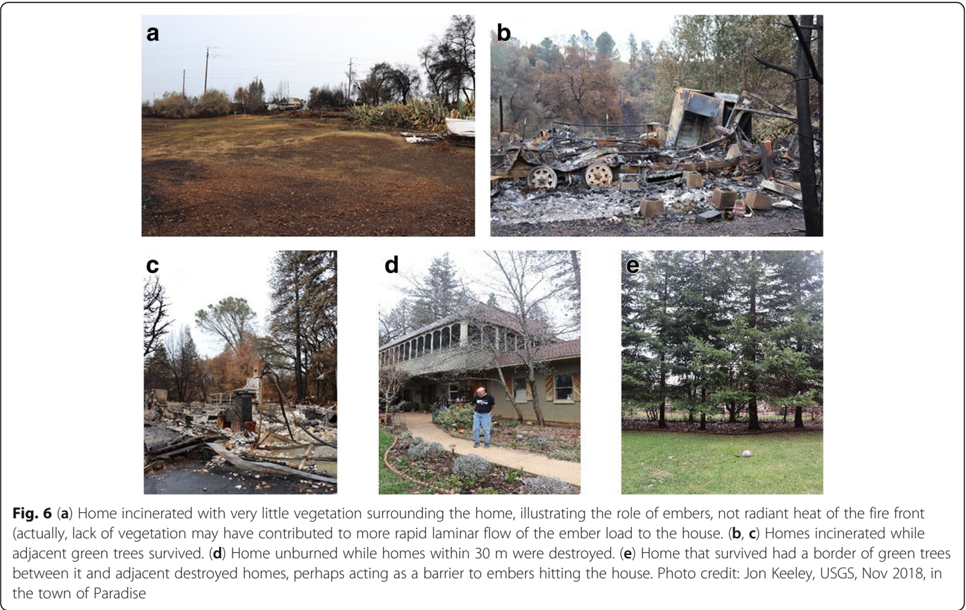
“With the Camp Fire, many overstory trees located away from burning homes survived (Keeley and Syphard 2019; Cohen and Strohmaier 2020) (Fig. 7).”
From Housing arrangement and vegetation factors associated with single-family home survival in the 2018 Camp Fire, California (2021) · cites this paper as Keeley and Syphard 2019
Self-check
Percentages, sums and reported differences re-computed from the paper’s own numbers.
The self-check needs the paper’s full text.
Citations
Cites
Impact of anthropogenic climate change on wildfire across western US forests
Abatzoglou, J. T., & Williams, A. P. (2016) · Proceedings of the National Academy of Sciences · doi:10.1073/pnas.1607171113 · Cited by 3,073
The wildland urban interface in the United States
Radeloff, V. C., Hammer, R. B., Stewart, S. I., Fried, J. S., Holcomb, S. S., & McKeefry, J. F. (2005) · Ecological Applications · doi:10.1890/04-1413 · Cited by 1,236
Climate and wildfire area burned in western U.S. ecoprovinces, 1916–2003
Littell, J. S., McKenzie, D., Peterson, D. L., & Westerling, A. L. (2009) · Ecological Applications · doi:10.1890/07-1183.1 · Cited by 1,053
Contribution of anthropogenic warming to California drought during 2012–2014
Williams, A. P., Seager, R., Abatzoglou, J. T., Cook, B. I., Smerdon, J. E., & Cook, E. R. (2015) · Geophysical Research Letters · doi:10.1002/2015gl064924 · Cited by 587
Long-term climate and competition explain forest mortality patterns under extreme drought
Young, D. J. N., Stevens, J. T., Earles, J. M., Moore, J., Ellis, A., Jirka, A. L., & Latimer, A. M. (2017) · Ecology Letters · doi:10.1111/ele.12711 · Cited by 443
Drought, Tree Mortality, and Wildfire in Forests Adapted to Frequent Fire
Stephens, S. L., Collins, B. M., Fettig, C. J., Finney, M. A., Hoffman, C. M., Knapp, E. E., North, M. P., Safford, H., & Wayman, R. B. (2018) · BioScience · doi:10.1093/biosci/bix146 · Cited by 407
Ecological effects of large fires on US landscapes: benefit or catastrophe?A
Keane, R. E., Agee, J. K., Fulé, P., Keeley, J. E., Key, C., Kitchen, S. G., Miller, R., & Schulte, L. A. (2008) · International Journal of Wildland Fire · doi:10.1071/wf07148 · Cited by 251
Self-citationHammer, R. B., Stewart, S. I., Winkler, R. L., Radeloff, V. C., & Voss, P. R. (2004) · Landscape and Urban Planning · doi:10.1016/j.landurbplan.2003.08.011 · Cited by 247
Housing Arrangement and Location Determine the Likelihood of Housing Loss Due to Wildfire
Syphard, A. D., Keeley, J. E., Massada, A. B., Brennan, T. J., & Radeloff, V. C. (2012) · PLoS ONE · doi:10.1371/journal.pone.0033954 · Cited by 220
Self-citationTaylor, A. H. (2000) · Journal of Biogeography · doi:10.1046/j.1365-2699.2000.00353.x · Cited by 219
The role of defensible space for residential structure protection during wildfires
Syphard, A. D., Brennan, T. J., & Keeley, J. E. (2014) · International Journal of Wildland Fire · doi:10.1071/wf13158 · Cited by 213
Self-citationThe 2007 Southern California Wildfires: Lessons in Complexity
Keeley, J. E., Safford, H., Fotheringham, C. J., Franklin, J., & Moritz, M. (2009) · Journal of Forestry · doi:10.1093/jof/107.6.287 · Cited by 193
Self-citationClimate Change and Future Fire Regimes: Examples from California
Keeley, J., & Syphard, A. (2016) · Geosciences · doi:10.3390/geosciences6030037 · Cited by 186
Self-citationLocation, timing and extent of wildfire vary by cause of ignition
Syphard, A. D., & Keeley, J. E. (2015) · International Journal of Wildland Fire · doi:10.1071/wf14024 · Cited by 182
Self-citationThe 2017 North Bay and Southern California Fires: A Case Study
Nauslar, N. J., Abatzoglou, J. T., & Marsh, P. T. (2018) · Fire · doi:10.3390/fire1010018 · Cited by 176
Historical patterns of wildfire ignition sources in California ecosystems
Keeley, J. E., & Syphard, A. D. (2018) · International Journal of Wildland Fire · doi:10.1071/wf18026 · Cited by 173
Self-citationSpatial variation in extreme winds predicts large wildfire locations in chaparral ecosystems
Moritz, M. A., Moody, T. J., Krawchuk, M. A., Hughes, M., & Hall, A. (2010) · Geophysical Research Letters · doi:10.1029/2009gl041735 · Cited by 141
Keeley, J. E., & Zedler, P. H. (2009) · Ecological Applications · doi:10.1890/08-0281.1 · Cited by 141
Self-citationLand Use Planning and Wildfire: Development Policies Influence Future Probability of Housing Loss
Syphard, A. D., Bar Massada, A., Butsic, V., & Keeley, J. E. (2013) · PLoS ONE · doi:10.1371/journal.pone.0071708 · Cited by 138
Self-citationSafford, H. D., & Van de Water, K. M. (2014) · doi:10.2737/psw-rp-266 · Cited by 127
Fire in California's Ecosystems
(2018) · University of California Press eBooks · doi:10.1525/9780520961913 · Cited by 127
Kramer, H. A., Mockrin, M. H., Alexandre, P. M., Stewart, S. I., & Radeloff, V. C. (2018) · International Journal of Wildland Fire · doi:10.1071/wf17135 · Cited by 125
Venturas, M. D., MacKinnon, E. D., Dario, H., Jacobsen, A. L., Pratt, R. B., & Davis, S. D. (2016) · PLoS ONE · doi:10.1371/journal.pone.0159145 · Cited by 124
Comparing the role of fuel breaks across southern California national forests
Syphard, A. D., Keeley, J. E., & Brennan, T. J. (2011) · Forest Ecology and Management · doi:10.1016/j.foreco.2011.02.030 · Cited by 122
Self-citationInteractions between antecedent climate and wildfire variability across south-eastern Arizona
Crimmins, M. A., & Comrie, A. C. (2004) · International Journal of Wildland Fire · doi:10.1071/wf03064 · Cited by 116
van Wagtendonk, J. W., & Fites-Kaufman, J. A. (2006) · University of California Press eBooks · doi:10.1525/california/9780520246058.003.0012 · Cited by 108
Knapp, E. E., Lydersen, J. M., North, M. P., & Collins, B. M. (2017) · Forest Ecology and Management · doi:10.1016/j.foreco.2017.08.028 · Cited by 105
Human-related ignitions concurrent with high winds promote large wildfires across the USA
Abatzoglou, J. T., Balch, J. K., Bradley, B. A., & Kolden, C. A. (2018) · International Journal of Wildland Fire · doi:10.1071/wf17149 · Cited by 104
Extensive drought‐associated plant mortality as an agent of type‐conversion in chaparral shrublands
Jacobsen, A. L., & Pratt, R. B. (2018) · New Phytologist · doi:10.1111/nph.15186 · Cited by 96
Jin, Y., Randerson, J. T., Faivre, N., Capps, S., Hall, A., & Goulden, M. L. (2014) · Journal of Geophysical Research: Biogeosciences · doi:10.1002/2013jg002541 · Cited by 93
Alexandre, P. M., Stewart, S. I., Mockrin, M. H., Keuler, N. S., Syphard, A. D., Bar-Massada, A., Clayton, M. K., & Radeloff, V. C. (2016) · Landscape Ecology · doi:10.1007/s10980-015-0257-6 · Cited by 83
Self-citationDifferent historical fire–climate patterns in California
Keeley, J. E., & Syphard, A. D. (2017) · International Journal of Wildland Fire · doi:10.1071/wf16102 · Cited by 79
Self-citationKrofcheck, D., Hurteau, M. D., Scheller, R. M., & Loudermilk, E. L. (2017) · Global Change Biology · doi:10.1111/gcb.13913 · Cited by 70
Fire-Silviculture Relationships in Sierra Forests
Weatherspoon, C. P. (1996) · Digital Commons - USU (Utah State University) · Cited by 61
Chaparral Landscape Conversion in Southern California
Syphard, A. D., Brennan, T. J., & Keeley, J. E. (2018) · Springer series on environmental management · doi:10.1007/978-3-319-68303-4_12 · Cited by 54
Self-citationRestoring Fire to High Elevation Forests in California
Kilgore, B. M., & Briggs, G. S. (1972) · Journal of Forestry · doi:10.1093/jof/70.5.266 · Cited by 49
Options for reducing house-losses during wildfires without clearing trees and shrubs
Gibbons, P., Gill, A. M., Shore, N., Moritz, M. A., Dovers, S., & Cary, G. J. (2018) · Landscape and Urban Planning · doi:10.1016/j.landurbplan.2018.02.010 · Cited by 46
Historical reconstructions of California wildfires vary by data source
Syphard, A. D., & Keeley, J. E. (2016) · International Journal of Wildland Fire · doi:10.1071/wf16050 · Cited by 44
Self-citationPark, I. W., Hooper, J., Flegal, J. M., & Jenerette, G. D. (2018) · Diversity and Distributions · doi:10.1111/ddi.12693 · Cited by 44
Downslope Windstorms of San Diego County. Part II: Physics Ensemble Analyses and Gust Forecasting
Cao, Y., & Fovell, R. G. (2018) · Weather and Forecasting · doi:10.1175/waf-d-17-0177.1 · Cited by 42
The Santa Ana Wildfire Threat Index: Methodology and Operational Implementation
Rolinski, T., Capps, S. B., Fovell, R. G., Cao, Y., D’Agostino, B. J., & Vanderburg, S. (2016) · Weather and Forecasting · doi:10.1175/waf-d-15-0141.1 · Cited by 40
Assessing housing growth when census boundaries change
Syphard, A. D., Stewart, S. I., McKeefry, J. F., Hammer, R. B., Fried, J. S., Holcomb, S. S., & Radeloff, V. C. (2008) · International Journal of Geographical Information Systems · doi:10.1080/13658810802359877 · Cited by 24
Self-citationPrincipal short-term findings of the National Fire and Fire Surrogate study
McIver, J. D., Erickson, K., & Youngblood, A. P. (2012) · doi:10.2737/pnw-gtr-860 · Cited by 24
The 2003 and 2007 Wildfires in Southern California
Keeley, J. E., Syphard, A. D., & Fotheringham, C. J. (2013) · Natural Disasters and Adaptation to Climate Change · doi:10.1017/cbo9780511845710.007 · Cited by 15
Self-citationBrennan, T. J., & Keeley, J. E. (2017) · Fire Ecology · doi:10.4996/fireecology.130312013 · Cited by 15
Self-citationEffects of changing development patterns and ignition locations within Central Texas
Mobley, W. (2019) · PLoS ONE · doi:10.1371/journal.pone.0211454 · Cited by 7
Research works printed but not linked: 6
- Kennedy, R.G., and A. Troy. 2009. Advances in the economics of environmental resources. Volume 6. Living on the edge: economic, institutional and management perspectives on wildfire hazard in the urban interface. Bradford: Emerald Group Publishing Limited.
- Schuft, P.H. 1973. A prescribed burning program for Sequoia and Kings Canyon national parks. Proceedings of the Tall Timbers Fire Ecology Conference 12: 377-389.
- Stephens, S.L., and B.M. Collins. 2004. Fire regimes of mixed conifer forests in the north- central Sierra Nevada at multiple spatial scales. Northwest Science 78: 12-23.
- Davis: Centers for Water and Wildland Resources, University of California.
- Wuerthner, G. 2006. Logging and wildfire: ecological differences and the need to preserve large fires. In The wildfire reader: a century of failed forest policy. ed. G. Wuerthner, 178-190. Washington, D.C.: Island Press.
- Zimmerman, G.T., and R. Lasko. 2006. The changing face of wildland fire use. Fire Management Today 66 (4): 7-12.
Cited by
Pausas, J. G., & Keeley, J. E. (2021) · Frontiers in Ecology and the Environment · doi:10.1002/fee.2359 · Cited by 626
“Application of these tools will vary across ecosystems, however; for instance, areas in which fuel-driven fires dominate require very different management approaches from those dominated by wind-driven fires (fuel versus ignition control, respectively; Keeley and Syphard 2019).”
BackgroundInfluentialSelf-citationLarge California wildfires: 2020 fires in historical context
Keeley, J. E., & Syphard, A. D. (2021) · Fire Ecology · doi:10.1186/s42408-021-00110-7 · Cited by 227
“While large fires are known in the historical record, in the first few decades of the twenty-first century, the pace of these events has greatly accelerated (Keeley and Syphard 2019).”
BackgroundSelf-citationFactors Associated with Structure Loss in the 2013–2018 California Wildfires
Syphard, A., & Keeley, J. (2019) · Fire · doi:10.3390/fire2030049 · Cited by 122
“In the last several years, however, this recognition has turned into bewilderment and terror as tens of thousands of structures and hundreds of human lives have been lost in fire events throughout the state [2].”
BackgroundSelf-citationHazardous air pollutant emissions estimates from wildfires in the wildland urban interface
Holder, A. L., Ahmed, A., Vukovich, J. M., & Rao, V. (2023) · PNAS Nexus · doi:10.1093/pnasnexus/pgad186 · Cited by 117
Climate change and extreme weather: A review focusing on the continental United States
Robinson, W. A. (2021) · Journal of the Air & Waste Management Association · doi:10.1080/10962247.2021.1942319 · Cited by 108
Metadata
- Authors
- Keeley, J. E., & Syphard, A. D.
- Affiliations
- University of California, Los Angeles (US)
- Corresponding author
- Keeley, Jon E.
- Venue
- Fire Ecology
- Published
- 2019-07-18
- Volume
- 15
- Issue
- 1
- ISSN
- 1933-9747 (ISSN-L)
- OpenAlex
- W2959255705
- Cited by
- 190
- References
- 47
- Citations by year
- 2026: 22 · 2025: 28 · 2024: 36 · 2023: 20 · 2022: 28 · 2021: 37 · 2020: 17 · 2019: 2
- FWCI
- 10.81
- Type
- journal article
- Language
- en
- Open access
- gold
- doi.org
- Licence
- cc-by
- creativecommons.org/licenses/by/4.0 (tdm)
- creativecommons.org/licenses/by/4.0 (vor)
- Locations
- Fire Ecology (publishedVersion, cc-by)
- Funders
- U.S. Geological Survey
- California Department of Forestry and Fire Protection
- Topics
- Physical Sciences › Environmental Science › Global and Planetary Change › Fire effects on ecosystems
- Physical Sciences › Environmental Science › Ecology › Rangeland and Wildlife Management
- Social Sciences › Sociology and Political Science › Disaster Management and Resilience
- Keywords
- forest fires, California wildfires, fire behavior, fuel load, extreme wind events, fire history, ignition sources, seasonal timing, fire management, fire risk
About these checks
Registry, retraction, Cites and statistics results are computed, not judged, with one exception: a printed reference that no index lists is read once by a model before it counts as a citation error. Claims are extracted by a model and kept only when their quote appears verbatim in the text; each cited source is then checked, with a model’s help, for whether it says what the claim relies on. Those verdicts can be wrong — read the claim’s quote and the cited source before relying on one.
Statistics and arithmetic are recomputed, not judged.
Confidence bands are shown only for fields calibrated on our annotated test set. None is calibrated yet, so no band is shown.
What counts as a claim ›How we measure confidence ›How we check this ›
Are you an author, or do you see a problem with this page? Request a review
Data sources
Bibliographic data: Semantic Scholar, OpenAlex, Crossref.
Contains information from the Semantic Scholar Academic Graph Datasets, made available under the ODC Attribution License (ODC-BY 1.0).
Semantic Scholar’s data is described in: Kinney, R., et al. (2023). The Semantic Scholar Open Data Platform. arXiv:2301.10140.
