

Depression in adolescence: a review
Open accessThe DOI matches its Crossref record; 92 of the 92 references it cites were found in a registry or an index.
Abstract
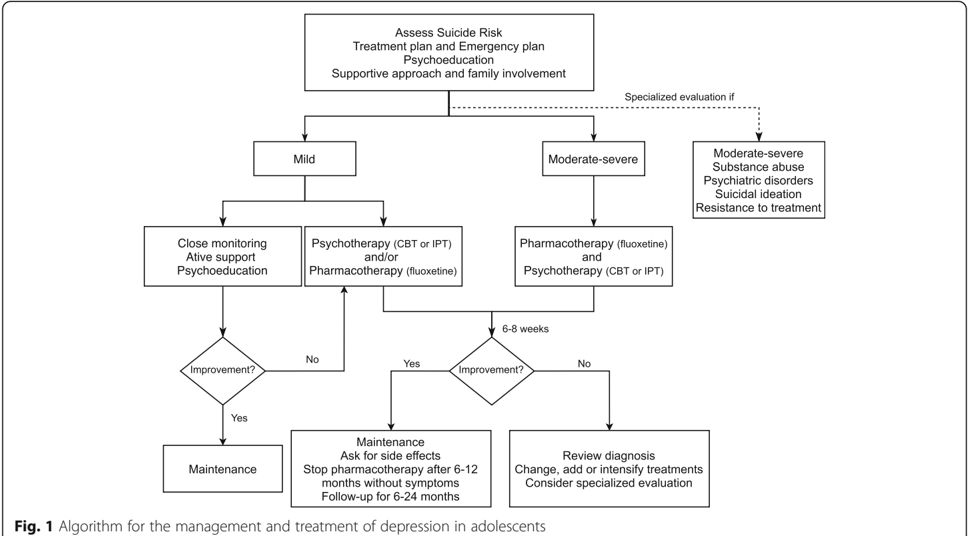
Abstract Background Depression is a common mental health disease, especially in mid to late adolescence that, due to its particularities, is a challenge and requires an effective diagnosis. Primary care providers are often the first line of contact for adolescents, being crucial in identifying and managing this pathology. Besides, several entities also recommend screening for depression on this period. Thus, the main purpose of this article is to review the scientific data regarding screening, diagnosis and management of depression in adolescence, mainly on primary care settings. Main body Comprehension of the pathogenesis of depression in adolescents is a challenging task, with both environmental and genetic factors being associated to its development. Although there are some screening tests and diagnostic criteria, its clinical manifestations are wide, making its diagnosis a huge challenge. Besides, it can be mistakenly diagnosed with other psychiatric disorders, making necessary to roll-out several differential diagnoses. Treatment options can include psychotherapy (cognitive behavioural therapy and interpersonal therapy) and/or pharmacotherapy (mainly fluoxetine), depending on severity, associated risk factors and available resources. In any case, treatment must include psychoeducation, supportive approach and family involvement. Preventive programs play an important role not only in reducing the prevalence of this condition but also in improving the health of populations. Conclusion Depression in adolescence is a relevant condition to the medical community, due to its uncertain clinical course and underdiagnosis worldwide. General practitioners can provide early identification, treatment initiation and referral to mental health specialists when necessary.
Overview
The claims and statistics of this paper haven’t been checked yet.
Free: it reads the open-access text and checks the first 5 claims that cite a source we can check. Create a free account to check every claim.
Integrity signals
Registry
Cites
Statistics
Figures
Verification
Claims the paper makes
The claims and statistics of this paper haven’t been checked yet.
Free: it reads the open-access text and checks the first 5 claims that cite a source we can check. Create a free account to check every claim.
Claims other papers make about this one
Each is checked against this paper’s own text: does it say what the citing paper says it does?
The cited source says what the claim attributes to it.
In the citing paper
“In medical research, depression is often conceptualized as a clinical disorder with a specific set of symptoms that can be identified and treated (4, 5).”
From Anti-stigmatizing: a collaborative autoethnography on recovery from depression (2024) · cites this paper as [4]
Self-check
Percentages, sums and reported differences re-computed from the paper’s own numbers.
The self-check needs the paper’s full text.
Citations
Cites
Diagnostic and Statistical Manual of Mental Disorders
American Psychiatric Association (2013) · doi:10.1176/appi.books.9780890425596 · Cited by 116,369
A psychobiological model of temperament and character
Cloninger, C. R. (1993) · Archives of General Psychiatry · doi:10.1001/archpsyc.1993.01820240059008 · Cited by 5,458 · cited 1×
“According to Cloninger, temperament is responsible for automatic and emotional responses to environmental stimuli and encompasses four dimensions: novelty seeking, exploratory activity, harm avoidance, reward dependence and persistence [22].”
BackgroundThapar, A., Collishaw, S., Pine, D. S., & Thapar, A. K. (2012) · The Lancet · doi:10.1016/s0140-6736(11)60871-4 · Cited by 2,365
(2009) · Cited by 2,013
The social brain in adolescence
Blakemore, S.-J. (2008) · Nature Reviews Neuroscience · doi:10.1038/nrn2353 · Cited by 1,896
Mental Health Surveillance Among Children — United States, 2013–2019
Bitsko, R. H., Claussen, A. H., Lichstein, J., Black, L. I., Jones, S. E., Danielson, M. L., Hoenig, J. M., Davis Jack, S. P., Brody, D. J., Gyawali, S., et al. (2022) · MMWR Supplements · doi:10.15585/mmwr.su7102a1 · Cited by 1,723
Risch, N., Herrell, R., Lehner, T., Liang, K.-Y., Eaves, L., Hoh, J., Griem, A., Kovacs, M., Ott, J., & Merikangas, K. R. (2009) · JAMA · doi:10.1001/jama.2009.878 · Cited by 1,655 · cited 1×
“However, such findings seem to vary not only by genotype but also by age, sex, and severity of symptoms, and are also reliant on good quality measures of adversity and depression [18, 20].”
BackgroundSeedat, S., Scott, K. M., Angermeyer, M. C., Berglund, P., Bromet, E. J., Brugha, T. S., Demyttenaere, K., de Girolamo, G., Haro, J. M., Jin, R., et al. (2009) · Archives of General Psychiatry · doi:10.1001/archgenpsychiatry.2009.36 · Cited by 1,518
Mental Health of Children and Young People in Great Britain, 2004: (557702010-001)
Green, H., McGinnity, A., Meltzer, H., Ford, T., & Goodman, R. (2005) · PsycEXTRA Dataset · doi:10.1037/e557702010-001 · Cited by 1,216
Research works printed but not linked: 1
- Roberts C, Ballantyne F, Van Der Klift P (2003) Aussie optimism. Curtin University of Technology, Perth, Australia, Social life skills. Teacher resource
Cited by
The Mediterranean Diet and the Western Diet in Adolescent Depression-Current Reports
Zielińska, M., Łuszczki, E., Michońska, I., & Dereń, K. (2022) · Nutrients · doi:10.3390/nu14204390 · Cited by 84
“5% of disability adjusted life years (DALY) in young people [11].”
BackgroundBai, S., Xie, J., Bai, H., Tian, T., Zou, T., & Chen, J.-J. (2021) · Journal of Inflammation Research · doi:10.2147/jir.s324922 · Cited by 51
Maftei, A., Merlici, I.-A., & Dănilă, O. (2023) · Frontiers in Public Health · doi:10.3389/fpubh.2022.1062688 · Cited by 49
Depression, Anxiety, and Suicide Among Adolescents: Sex Differences and Future Perspectives
Toro, G. V. R., Arias, P., de la Torre‐Luque, A., Singer, J. B., & Lagunas, N. (2025) · Journal of Clinical Medicine · doi:10.3390/jcm14103446 · Cited by 51
Calandri, E., Graziano, F., Begotti, T., Cattelino, E., Gattino, S., Rollero, C., & Fedi, A. (2021) · Frontiers in Psychology · doi:10.3389/fpsyg.2021.643088 · Cited by 31
Metadata
- Authors
- Beirão, D., Monte, H., Amaral, M., Longras, A., Matos, C., & Villas-Boas, F.
- Affiliations
- Fernando Pessoa University (PT)
- Corresponding author
- Beirão, Diogo
- Venue
- Middle East Current Psychiatry
- Published
- 2020-10-02
- Volume
- 27
- Issue
- 1
- ISSN
- 2090-5408 (ISSN-L)
- 2090-5416
- OpenAlex
- W3090484732
- Cited by
- 70
- References
- 92
- Citations by year
- 2026: 11 · 2025: 13 · 2024: 24 · 2023: 11 · 2022: 8 · 2021: 3
- FWCI
- 2.20
- Type
- journal article
- Language
- en
- Open access
- diamond
- doi.org
- Licence
- cc-by
- creativecommons.org/licenses/by/4.0 (tdm)
- creativecommons.org/licenses/by/4.0 (vor)
- Locations
- Middle East Current Psychiatry (publishedVersion, cc-by)
- DOAJ (DOAJ: Directory of Open Access Journals) (submittedVersion, cc-by-sa)
- Topics
- Social Sciences › Psychology › Clinical Psychology › Child and Adolescent Psychosocial and Emotional Development
- Health Sciences › Medicine › Psychiatry and Mental health › Mental Health Treatment and Access
- Health Sciences › Medicine › Pharmacology (medical) › Treatment of Major Depression
- Keywords
- adolescent depression, depression screening, depression diagnosis, primary care, differential diagnosis, pathogenesis, genetic and environmental risk factors, cognitive behavioral therapy, interpersonal psychotherapy, fluoxetine, psychoeducation, family involvement, depression prevention, general practitioners
About these checks
Registry, retraction, Cites and statistics results are computed, not judged, with one exception: a printed reference that no index lists is read once by a model before it counts as a citation error. Claims are extracted by a model and kept only when their quote appears verbatim in the text; each cited source is then checked, with a model’s help, for whether it says what the claim relies on. Those verdicts can be wrong — read the claim’s quote and the cited source before relying on one.
Statistics and arithmetic are recomputed, not judged.
Confidence bands are shown only for fields calibrated on our annotated test set. None is calibrated yet, so no band is shown.
What counts as a claim ›How we measure confidence ›How we check this ›
Are you an author, or do you see a problem with this page? Request a review
How to cite
Cite CoChat for the checks on this page, and the paper for its own findings.
- This page
- CoChat. (2026). Citation check: Depression in adolescence: a review. https://app.cochat.ai/papers/10.1186/s43045-020-00050-z
- The paper
- Beirão, D., Monte, H., Amaral, M., Longras, A., Matos, C., & Villas-Boas, F. (2020). Depression in adolescence: a review. Middle East Current Psychiatry. https://doi.org/10.1186/s43045-020-00050-z
Data sources
Bibliographic data: Semantic Scholar, OpenAlex, Crossref.
Contains information from the Semantic Scholar Academic Graph Datasets, made available under the ODC Attribution License (ODC-BY 1.0).
Semantic Scholar’s data is described in: Kinney, R., et al. (2023). The Semantic Scholar Open Data Platform. arXiv:2301.10140.
