

The DOI matches its Crossref record; 54 of the 57 references it cites were found in a registry or an index.
Science That Matters: The Importance of a Cultural Connection in Underrepresented Students’ Science Pursuit
Open accessAbstract
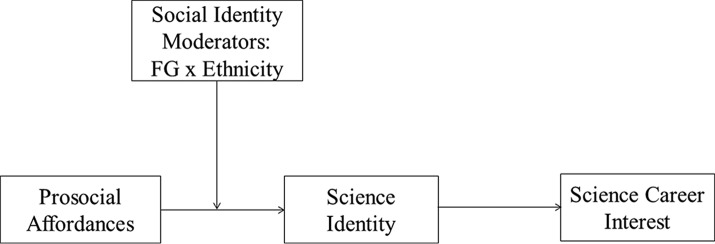
Recent research suggests that underrepresented minority (URM) college students, and especially first-generation URMs, may lose motivation to persist if they see science careers as unable to fulfill culturally relevant career goals. In the present study, we used a mixed-methods approach to explore patterns of motivation to pursue physical and life sciences across ethnic groups of freshman college students, as moderated by generational status. Results from a longitudinal survey (N = 249) demonstrated that freshman URM students who enter with a greater belief that science can be used to help their communities identified as scientists more strongly over time, but only among first-generation college students. Analysis of the survey data were consistent with content analysis of 11 transcripts from simultaneously conducted focus groups (N = 67); together, these studies reveal important differences in motivational characteristics both across and within ethnicity across educational generation status. First-generation URM students held the strongest prosocial values for pursuing a science major (e.g., giving back to the community). URM students broadly reported additional motivation to increase the status of their family (e.g., fulfilling aspirations for a better life). These findings demonstrate the importance of culturally connected career motives and for examining intersectional identities to understand science education choices and inform efforts to broaden participation.
Overview
The claims and statistics of this paper haven’t been checked yet.
Run the check — free, no account needed. It reads the open-access text and checks the sources it cites.
Integrity signals
Registry
Cites
Statistics
Figures
Verification
Claims the paper makes
The claims and statistics of this paper haven’t been checked yet.
Run the check — free, no account needed. It reads the open-access text and checks the sources it cites.
Claims other papers make about this one
Each is checked against this paper’s own text: does it say what the citing paper says it does?
The source backs part of the claim, not all of it — or backs it for a different population, condition or comparison.
In the citing paper
“This grittiness may be based on differences in motivation, as students from MGS are more likely than students from non-MGS to be driven by a commitment to family and community (41–43).”
From Active learning narrows achievement gaps for underrepresented students in undergraduate science, technology, engineering, and math (2020) · cites this paper as [42]
Experimental — accuracy not yet measured
Self-check
Percentages, sums and reported differences re-computed from the paper’s own numbers.
The self-check needs the paper’s full text.
Citations
Cites
Three Approaches to Qualitative Content Analysis
Hsieh, H.-F., & Shannon, S. E. (2005) · Qualitative Health Research · doi:10.1177/1049732305276687 · Cited by 44,601 · cited 3×
“Following procedures outlined for conventional and directed content analysis (Hsieh and Shannon, 2005), G.”
MethodInfluential(2013) · Cited by 44,563
Stereotype threat and the intellectual test performance of African Americans.
Steele, C. M., & Aronson, J. (1995) · Journal of Personality and Social Psychology · doi:10.1037/0022-3514.69.5.797 · Cited by 9,020 · cited 2×
“, 2007, 2009), carry the burden of worrying that his or her performance will be judged through a stereotyped lens (Steele and Aronson, 1995; Chang et al., 2011), and feel uncertain about whether he or she can develop a sense of belonging in the science community (Darling et al.”
BackgroundErikson, E. H. (1959) · Medical Entomology and Zoology · Cited by 6,863
A threat in the air: How stereotypes shape intellectual identity and performance
Steele, C. M. (1997) · American Psychologist · doi:10.1037/0003-066x.52.6.613 · Cited by 6,770 · cited 1×
“A voluminous body of research driven by stereotype threat theory (Steele, 1992, 1997)—which posits that the academic underperformance of underrepresented students can be partly explained by an anxiety caused by the fear that others’ judgments of their actions will be perceived as confirming…”
BackgroundRacial microaggressions in everyday life: Implications for clinical practice.
Sue, D. W., Capodilupo, C. M., Torino, G. C., Bucceri, J. M., Holder, A. M. B., Nadal, K. L., & Esquilin, M. (2007) · American Psychologist · doi:10.1037/0003-066x.62.4.271 · Cited by 5,569 · cited 1×
“…from a URM group does not directly experience overt discrimination, he or she is likely to face regular experiences with racial microaggressions (Sue et al., 2007, 2009), carry the burden of worrying that his or her performance will be judged through a stereotyped lens (Steele and Aronson,…”
BackgroundGoulding, C. (2002) · SAGE Publications Ltd eBooks · doi:10.4135/9781849209236 · Cited by 5,182
The Constant Comparative Method of Qualitative Analysis
Glaser, B. G. (1965) · Social Problems · doi:10.2307/798843 · Cited by 4,937 · cited 1×
“Constant comparative methods were used to determine saturation (Glaser, 1965).”
MethodTalking about Leaving: Why Undergraduates Leave the Sciences
Correll, S. J., Seymour, E., & Hewitt, N. M. (1997) · Contemporary Sociology A Journal of Reviews · doi:10.2307/2655673 · Cited by 3,088
Promoting Interest and Performance in High School Science Classes
Hulleman, C. S., & Harackiewicz, J. M. (2009) · Science · doi:10.1126/science.1177067 · Cited by 1,220 · cited 2×
“…body of evidence showing that attending to ways in which science can help students embody their personal values is an important aspect of science education, but even more so for particular groups of students (Hulleman and Harackiewicz, 2009; Hulleman et al. 2010; Harackiewicz et al., 2014, 2015).”
Background
Research works printed but not linked: 7
- Cabrera AF, 1999, J High Educ, 70, 134
- Harackiewicz JM, 2015, J Pers Soc Psychol
- Morgan DL, 1998, The Focus Group Kit, Vols. 1–6
- National Center for Education Statistics (NCES), 2013, STEM in Postsecondary Education: Entrance, Attrition, and Coursetaking among 2003−04 Beginning Postsecondary Students (NCES 2013-152)
- QSR International, 2014, NVivo Qualitative Data Analysis Software, version 10
- Smedley BD, 1993, J High Educ, 64, 434, 10.2307/2960051 · DOI · Paper page
- Steele CM, 1992, Atlantic Monthly, 269, 68
Cited by
Sorted by citations
Theobald, E. J., Hill, M. J., Tran, E., Agrawal, S., Arroyo, E. N., Behling, S., Chambwe, N., Cintrón, D. L., Cooper, J. D., Dunster, G., et al. (2020) · Proceedings of the National Academy of Sciences · doi:10.1073/pnas.1916903117 · Cited by 1,387
First-Generation College Students as Academic Learners: A Systematic Review
Ives, J., & Castillo‐Montoya, M. (2020) · Review of Educational Research · doi:10.3102/0034654319899707 · Cited by 339
“For instance, in her case study of TRIO students in a learning community course at a Research 1 institution, Jehangir (2010) used multicultural curriculum and critical pedagogy to illustrate how the framework can bring “students’ narratives, stories, and lived experiences into academic spaces .”
BackgroundCovarrubias, R., Valle, I., Laiduc, G., & Azmitia, M. (2018) · Journal of Adolescent Research · doi:10.1177/0743558418788402 · Cited by 196
“That is, the experience of being a person of color from a lowincome background facilitates a commitment to remain connected to and to support family members at home (see Covarrubias & Fryberg, 2015; Jackson et al., 2016; Jehangir et al., 2015; Nelson, Englar-Carlson, Tierney, & Hau, 2006; Vasquez-Salgado et al., 2015)…”
BackgroundHarris, R. B., Mack, M. R., Bryant, J. R., Theobald, E. J., & Freeman, S. (2020) · Science Advances · doi:10.1126/sciadv.aaz5687 · Cited by 198
“Work on student affect suggests that this grittiness—defined as perseverance and passion in the pursuit of long-term goals—may spring from differences in motivation, with URM and first-generation students more likely to be driven by a commitment to help their families and broader communities than their well-represente…”
BackgroundCanning, E. A., LaCosse, J., Kroeper, K. M., & Murphy, M. C. (2019) · Social Psychological and Personality Science · doi:10.1177/1948550619882032 · Cited by 221
Metadata
- Authors
- Jackson, M. C., Galvez, G., Landa, I., Buonora, P., & Thoman, D. B.
- Affiliations
- California State University, Long Beach (US)
- San Diego State University (US)
- Corresponding author
- Jackson, Matthew C.
- Venue
- CBE—Life Sciences Education
- Published
- 2016-09
- Volume
- 15
- Issue
- 3
- Pages
- ar42
- ISSN
- 1931-7913 (ISSN-L)
- PMC
- PMC5008889
- OpenAlex
- W2507640572
- Cited by
- 128
- References
- 57
- Citations by year
- 2026: 5 · 2025: 17 · 2024: 22 · 2023: 12 · 2022: 7 · 2021: 22 · 2020: 17 · 2019: 15 · 2018: 6 · 2017: 4 · 2016: 1
- FWCI
- 21.18
- Type
- journal article
- Language
- en
- Open access
- hybrid
- doi.org
- Licence
- cc-by-nc-sa
- Locations
- CBE—Life Sciences Education (publishedVersion, cc-by-nc-sa)
- PubMed Central (publishedVersion, cc-by-nc-sa)
- PubMed (publishedVersion)
- Funders
- National Science Foundation (1420271)
- National Institute of General Medical Sciences (T34GM008074, R25GM071638)
- Topics
- Social Sciences › Psychology › Applied Psychology › Career Development and Diversity
- Social Sciences › Education › Higher Education Research Studies
- Social Sciences › Psychology › Developmental and Educational Psychology › Science Education and Perceptions
- Keywords
- underrepresented minority students, first-generation college students, cultural connections, prosocial values, ethnic differences, generational status, intersectional identities, broadening participation in STEM
- MeSH terms
- Family, Humans, Minority Groups, Surveys and Questionnaires, Science, Students, Focus Groups, Cultural Diversity
About these checks
Registry, retraction, Cites and statistics results are computed, not judged, with one exception: a printed reference that no index lists is read once by a model before it counts as a citation error. Claims are extracted by a model and kept only when their quote appears verbatim in the text; each cited source is then checked, with a model’s help, for whether it says what the claim relies on. Those verdicts can be wrong — read the claim’s quote and the cited source before relying on one.
Statistics and arithmetic are recomputed, not judged.
Confidence bands are shown only for fields calibrated on our annotated test set. None is calibrated yet, so no band is shown.
What counts as a claim ›How we measure confidence ›How we check this ›
Are you an author, or do you see a problem with this page? Request a review
