

Improving Academic Performance and Retention of First-Year Biology Students through a Scalable Peer Mentorship Program
Open accessThe DOI matches its Crossref record; 93 of the 99 references it cites were found in a registry or an index, and 5 are not checked yet; 5 of the 34 sources its claims cite were checked for support.
Abstract
This study evaluates the performance of a near-peer mentoring program for first-year biology majors. The program’s intention is to improve student retention generally, and academic and soft skills more specifically. The effect of the program was investigated via ethnographic methods, a program-specific survey, and regression analyses.
Verified 2026-11-22 · 5 references not checked yet
Overview
CoChat Summary
TL;DR
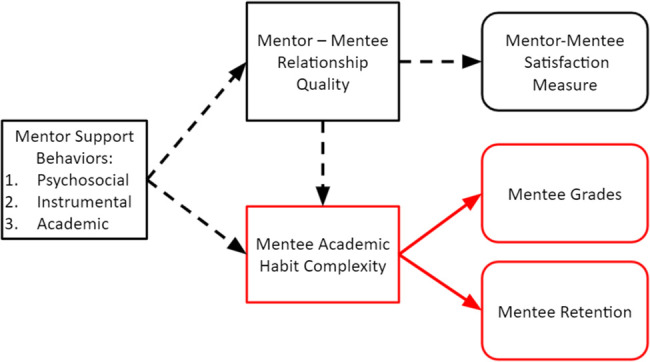
In a mixed-methods evaluation of the Biology Mentoring and Engagement (BIOME) near-peer mentorship seminar, participation was associated with greater academic habit complexity, higher General Chemistry 1A grades, and higher on-time enrollment in General Chemistry 1B among first-year biology majors. The authors conclude that course-based near-peer mentorship may be a scalable way to support academic success and short-term retention, though observational selection limits causal claims.
Key findings
- BIOME participation was associated with higher “academic habit complexity”: latent regression estimated a BIOME effect of 0.29 logits (SE = 0.14, p = 0.019), described as roughly 0.3 logits or about 5% higher than the comparison group at the end of Fall; example endorsement probabilities were 59% vs. 51% for reworking chemistry problems and 64% vs. 52% for attending tutoring.
- Academic habit complexity was positively related to CHEM 1A grades (beta = 0.176, p = 0.002); the text states students earned an average of half a letter grade higher for every four academic habits reported. BIOME enrollment was associated with CHEM 1A grades 0.19 GPA points higher in the matched sample (p < 0.001 in text; Table 5 p = 0.002).
- BIOME students were more likely to take CHEM 1B on time: unadjusted, 75% more likely; adjusted unmatched odds ratio = 1.92, p < 0.001; matched text reports odds ratio = 2.07, p < 0.001, while Table 6 lists odds ratio = 1.72, p = 0.008.
- Subgroup analyses found no significant BIOME × ethnicity interactions for CHEM 1A grades or on-time CHEM 1B enrollment; PEER estimates were not significant.
Methods
- Mixed-methods design: qualitative ethnography and focus groups identified the “academic habit complexity” construct, followed by development of a 22-item instrument and quantitative analyses.
- Data came from three 2017–2019 cohorts of first-year biology majors (2920 total; 437 BIOME participants), with institutional demographic, grade, and enrollment records; BIOME enrollment was optional, and propensity score matching produced a matched sample of 393 BIOME and 344 control students.
- Analyses included latent regression/Rasch modeling for academic habit complexity, linear regression for CHEM 1A GPA, multilevel logistic regression for on-time CHEM 1B enrollment, propensity score matching, and subgroup interaction models.
Limitations
- The paper states that BIOME participation was optional and the data are observational, so causal claims cannot be made; unmeasured determinants of BIOME membership and selection bias remain threats, and propensity score matching itself may introduce bias.
- The paper states the academic habit complexity instrument was tailored to the BIOME/biology context and tested only in three cohorts at one institution, limiting generalizability; the study also cannot disentangle effects of peer mentoring from other BIOME course elements, and retention is measured only as short-term on-time CHEM 1B enrollment.
- Evident from the text: the reported 0.19 GPA increase is smaller than the roughly 0.3 GPA difference between C− and C, so it may not change letter grades unless students are near a boundary; survey response was only about 35–40%, and some reported statistics differ between the text and tables (e.g., matched retention odds ratio 2.07 in text vs. 1.72 in Table 6).
Model-written summary. Check it against the paper before relying on it.
Integrity signals
Registry
Cites
Statistics
Figures
Verification
Claims the paper makes
4 Valid · 1 Not valid · 17 Not checked · 47 Own results and interpretations
The cited sources support only part of this claim — read each source’s verdict below.
In the paper
“However, given the public university context, which often includes noninteractive, large-enrollment courses, it is difficult to provide first-year students with intimate experiences that inculcate student experiences and traits that lead to improved retention (Stains et al., 2018).”
§ Improving Academic Performance and Retention of First-Year Biology Students through a Scalable Peer Mentorship Program > INTRODUCTION
What the sources say
- Partly supportedcites Stains et al., 2018 matched to “Anatomy of STEM teaching in North American universities” (2018) sourceExperimental — accuracy not yet measured
The classroom-observation findings (section labeled Abstract; page not provided) report that large STEM courses were more often didactic and less often student-centered than expected by chance. They do not establish that public universities have difficulty providing first-year students with intimate experiences, or that such experiences improve retention. (LLM, conf=0.86)
plainstates a cause- Asserted: passes — The authors put it forward as true.
- Checkable: passes — It can be checked against evidence.
- Load-bearing: passes — The paper’s conclusions depend on it.
- Based: passes — The paper gives a reason why it holds.
- Partly supported
In the paper
“students who earn less than a “C−” grade in the Fall offering of CHEM 1A are less likely to be retained to the Fall of their second year (Supplemental Table 1).”
§ Improving Academic Performance and Retention of First-Year Biology Students through a Scalable Peer Mentorship Program > INTRODUCTION > The Study Context
What the sources say
- Not matchedcites Supplemental Table 1
This doesn’t read as a citation we can look up.
plainstates an association- Asserted: passes — The authors put it forward as true.
- Checkable: passes — It can be checked against evidence.
- Load-bearing: passes — The paper’s conclusions depend on it.
- Based: passes — The paper gives a reason why it holds.
- Not matched
A result the paper reports from its own data — it cites no other source for it, so there is none to check. The quote shows it is in the paper.
In the paper
“Enrollment in BIOME, and the associated development of academic habit complexity, is related to higher course grades in General Chemistry, a biology major prerequisite.”
§ Improving Academic Performance and Retention of First-Year Biology Students through a Scalable Peer Mentorship Program > Abstract
plainstates an association- Asserted: passes — The authors put it forward as true.
- Checkable: passes — It can be checked against evidence.
- Load-bearing: passes — The paper’s conclusions depend on it.
- Based: passes — The paper gives a reason why it holds.
A result the paper states — it cites no source for it, so there is none to check. The quote shows it is in the paper.
In the paper
“Approximately 25–30% of declared biology majors do not earn the minimum grade;”
§ Improving Academic Performance and Retention of First-Year Biology Students through a Scalable Peer Mentorship Program > INTRODUCTION > The Study Context
plain- Asserted: passes — The authors put it forward as true.
- Checkable: passes — It can be checked against evidence.
- Load-bearing: passes — The paper’s conclusions depend on it.
- Based: passes — The paper gives a reason why it holds.
38 more claims
Create a free account to see all 69 claims and to verify the 2 references still open.
- Probably not a substantial claim. 16
- It may state two separate claims as one. 11
- The quote only partly states this claim. 1
Self-check
Percentages, sums and reported differences re-computed from the paper’s own numbers.
Each contradiction between two passages listed here was confirmed by an independent check.
Rated major: it would touch a result — a value a result rests on, reported and recomputed p-values on opposite sides of the significance level, two passages that conflict with no sign which is right, or a cited work retracted before this paper was published.
In the paper
§ Improving Academic Performance and Retention of First-Year Biology Students through a Scalable Peer Mentorship Program > RESULTS > BIOME Improves Student Retention
“Here, holding all covariates constant, the odds of a student in BIOME taking CHEM 1B on time are 2.07 times those of students in the matched sample (p < 0.001; Table 6).”
§ Improving Academic Performance and Retention of First-Year Biology Students through a Scalable Peer Mentorship Program > RESULTS > BIOME Improves Student Retention
“| BIOME | 1.72 | 0.206 | 0.008 |”
Rated minor: it would not touch a result — a value no result rests on, a p-value that stays on the same side of the significance level, or a conflict that is clerical, resolved elsewhere in the paper, or outside its own findings.
In the paper
§ Improving Academic Performance and Retention of First-Year Biology Students through a Scalable Peer Mentorship Program > METHODS
“| Academic habit complexity | Novel items authored and fit to a Rasch modelMeasure validation using evidence from ethnographic observation, cognitive interviews, relationships to other variables, and other data | Two years: 2018–2019 |”
§ Improving Academic Performance and Retention of First-Year Biology Students through a Scalable Peer Mentorship Program > DISCUSSION > Limitations
“the measure was only tested with the three cohorts of biology majors at our institution”
Citations
Cites
Data Analysis Using Regression and Multilevel/Hierarchical Models
Gelman, A., & Hill, J. (2006) · doi:10.1017/cbo9780511790942 · Cited by 13,597
(2002) · Cited by 13,211
Designing and Conducting Mixed Methods Research
นิลพันธุ์, ม. (2010) · Silpakorn Educational Research Journal · Cited by 9,351
Matching Methods for Causal Inference: A Review and a Look Forward
Stuart, E. A. (2010) · Statistical Science · doi:10.1214/09-sts313 · Cited by 5,478
The Psychology of Survey Response
Tourangeau, R., Rips, L. J., & Rasinski, K. (2000) · doi:10.1017/cbo9780511819322 · Cited by 4,734
MatchIt : Nonparametric Preprocessing for Parametric Causal Inference
Ho, D. E., Imai, K., King, G., & Stuart, E. A. (2011) · Journal of Statistical Software · doi:10.18637/jss.v042.i08 · Cited by 4,385 · cited 1×
“Our matching procedures primarily used genetic matching via the MatchIt package in R (Ho et al., 2011).”
MethodJournal of Statistical Software
Leeuw, J. D. (2009) · WIREs Computational Statistics · doi:10.1002/wics.10 · Cited by 3,599
Dunlosky, J., Rawson, K. A., Marsh, E. J., Nathan, M. J., & Willingham, D. T. (2013) · Psychological Science in the Public Interest · doi:10.1177/1529100612453266 · Cited by 3,138
Mentoring at Work: Developmental Relationships in Organizational Life.
Arthur, M. B., & Kram, K. E. (1985) · Administrative Science Quarterly · doi:10.2307/2392687 · Cited by 2,670 · cited 1×
“…this practice facilitates mentee integration in a number of ways (Jacobi, 1991; Austin, 2002; Allen and Eby, 2003; Ostrove and Long, 2007; NASEM, 2019), including psychosocial support, instrumental support, and academic support (Kram, 1988; Scandura, 1992; Nora and Crisp, 2007; Eby et al., 2013).”
BackgroundApplied Regression Analysis and Generalized Linear Models
Fox, J. (2008) · Cited by 2,283
Research works printed but not linked: 13
- Allen, T. D. Eby, L. T. (2003). Relationship effectiveness for mentors: Factors associated with learning and quality. Journal of Management, 29, 469– 486. doi: 10.1016/S0149- 2063(03)00021-7 · doi:10.1016/s0149-
- Aryee, M. (2017). College students’ persistence and degree completion in science, technology, engineering, and mathematics (STEM): The role of non-cognitive attributes of self-efficacy, outcome expectations, and interest (Doctoral dissertation). Seton Hall University dissertations and theses (ETDs), no. 2246. Retrieved May 16, 2021, from https://scholarship.shu.edu/dissertations/2246
- Clairmont, A. (2020). A discovery-based workflow for educational measurement (Doctoral dissertation). University of California, Santa Barbara, CA: ProQuest. https://www.proquest.com/openview/c65715106aec663ae7deca18bb05230a/1?pq-origsite=gscholar&cbl=18750&diss=y
- Dearlove, J. Farrell, H. Handa, N. Pastore, C. (2007). The evolution of peer mentoring at the University of Western Sydney. Journal of the Australia and New Zealand Student Services Association, 29, 21– 35.
- Eagan, M. K. Stolzenberg, E. B. Zimmerman, H. B. Aragon, M. C. Whang Sayson, H. Rios-Aguilar, C. (2017). The American freshman: National norms Fall 2016. Los Angeles: Higher Education Research Institute, UCLA.
- Fabert, N. (2014). Growth mindset training to increase women’s self-efficacy in science and engineering: A randomized-controlled trial (Doctoral dissertation by Arizona State University). Retrieved May 16, 2021, from https://repository.asu.edu/attachments/137308/content/Fabert_asu_0010E_14151.pdf
- Filippou, J. Cheong, C. Cheong, F. (2015). Designing persuasive systems to influence learning: Modelling the impact of study habits on academic performance. In PACIS 2015 Proceedings of Pacific Asia Conference on Information Systems (PACIS), Singapore held form July 6–9, 2015.
- Flaxman, E. Ascher, C. Harrington, C. (1988). Youth mentoring: Programs and practices. New York: ERIC Clearinghouse on Urban Education, Institute for Minority Education, Teachers College, Columbia University.
- Griffin, A. M. Romm, J.((2008). Exploring the evidence, Vol. 4, Reporting research on first-year seminars. Columbia: National Resource Center for the First-Year Experience and Students in Transition, University of South Carolina.
- Kram, K. (1985). Mentoring at work. Glenview, IL: Scott Foresman.
- Morgan, S. L. Winship, C. (2015). Counterfactuals and causal inference. New York, NY: Cambridge University Press.
- National Research Council (NRC). (2009). A new biology for the 21st century. Washington, DC: National Academies Press.
- President’s Council of Advisors on Science and Technology. (2012). Engage to excel: Producing one million additional college graduates with degrees in science, technology, engineering, and mathematics. Washington, DC: U.S. Government Office of Science and Technology.
Cited by
Creating inclusive environments in cell biology by casual mentoring
Lora, J. A. D., Hinton, A. O., Jr., & Termini, C. M. (2022) · Trends in Cell Biology · doi:10.1016/j.tcb.2022.04.009 · Cited by 15
Jones, V. O., & Wendt, J. L. (2025) · Trends in Higher Education · doi:10.3390/higheredu4010003 · Cited by 12
“However, research has indicated that the development of strong relationships with a mentor can assist in the development of a sense of belonging and, in turn, support diverse participation [11,12,14,15].”
Lemma, A., Muller, K., Torres, Z., Senespleda, C., & Legron-Rodriguez, T. (2025) · Chemistry Education Research and Practice · doi:10.1039/d5rp00031a · Cited by 6
Assessment of Community-Engaged Research Experiences in Introductory General Biology Laboratories
Nyutu, E. N., Carmona-Galindo, V. D., & Polanco, M. (2024) · The American Biology Teacher · doi:10.1525/abt.2024.86.7.426 · Cited by 6
Boutakidis, I. P., Espinoza, G., Sevier, M., & Sadek, A. (2024) · Journal of College Student Retention Research Theory & Practice · doi:10.1177/15210251241268852 · Cited by 6
“…with student samples from predominantly White ethnic backgrounds have shown that students participating in peer mentor programs have better course grades (Asgari & Carter, 2016; DeMarinis et al., 2017; Wilton et al., 2021) and higher retention rates (Leidenfrost et al., 2011; Wilton et al., 2021).”
Oduwaye, O., Kiraz, A., & Sorakın, Y. (2024) · Cyprus Turkish Journal of Psychiatry and Psychology · doi:10.35365/ctjpp.24.2.08 · Cited by 25
Peer mentors' experiences in an online STEM peer mentoring program: “beacons of light”
Wendt, J. L., & Jones, V. O. (2024) · International Journal of Mentoring and Coaching in Education · doi:10.1108/ijmce-03-2023-0033 · Cited by 7
Gross, M. M., Marquardt, K., Hasson, R. E., Vesia, M., King, A. R., & Bodary, P. F. (2022) · Kinesiology Review · doi:10.1123/kr.2022-0021 · Cited by 5
Supporting BIPOC Males in STEM: Insights from a Case Study on Online Peer Mentoring
Wendt, J. L., & Jones, V. (2024) · Journal of Research in STEM Education · doi:10.51355/j-stem.2024.145 · Cited by 4
“A large body of evidence shows that mentors and mentees need to be intentionally trained in how to engage in reciprocal and productive mentoring relationships (Pon-Barry et al., 2017; Sánchez et al., 2018; Wilton et al., 2021).”
InfluentialVasiou, A., Gkontelos, A., Vasilaki, E., Veloni, M., & Vaiopoulou, J. (2026) · Education Sciences · doi:10.3390/educsci16020276 · Cited by 4
Cucas, A. V. M., Gallegos, F. E. V., Medina, A. M. M., et al. (2026) · ASCE MAGAZINE · doi:10.70577/asce.v5i1.639 · Cited by 1
Irizarry, H. G. L., Donis, K., González, R., Uzcategui, M., & McCartney, M. L. (2026) · PLoS ONE · doi:10.1371/journal.pone.0355290
Student Retention in Higher Education
Serey, M., Sophat, P., Tieng, M., Hill, S., & Keo, H. (2026) · IGI Global eBooks · doi:10.4018/979-8-3373-7946-3.ch001
Garviso-Dufau, A., & Pérez, M. (2026) · Frontiers in Education · doi:10.3389/feduc.2026.1828454
Kayvani, M. S., Yu, M. S., & Sharan, N. (2026) · International Journal of Basic Sciences and Applied Computing · doi:10.35940/ijbsac.d0541.12080426 · Cited by 1
Mentees’ Perceived the Effectiveness of Peer Mentoring in First Year Programme
Lam, K. H., Huang, X., Wong, A., et al. (2026) · Lecture notes in educational technology · doi:10.1007/978-981-95-9414-6_14
So You Want to Teach a Field-Based Course: A Practical Toolkit for Teaching Teams
Hernández, L. M. A., Payne, A. R., Kaplanis, N. J., Borker, A. L., Dunkin, R. T., Alissa, L. M., Balachandran, L., Bhatti, H. A., Carr, M., Croll, D. A., et al. (2026) · Integrative Organismal Biology · doi:10.1093/iob/obag047
Santana, L. M., Malespina, A., Cwik, S., & Singh, C. (2025) · The journal of college science teaching · doi:10.1080/0047231x.2025.2472137
An�lisis cr�tico de un programa de mentor�a en f�sica
Bertschinger, E., & Drury, B. C. (2024) · doi:10.1119/revperv3.1.2.es
Reagan, L. E. (2024) · San José State University ScholarWorks (San Jose State University) · doi:10.31979/etd.h724-pp38
Metadata
- Authors
- Wilton, M., Katz, D., Clairmont, A., Gonzalez-Nino, E., Foltz, K. R., & Christoffersen, R. E.
- Affiliations
- Department of Molecular, Cellular, and Developmental Biology and
- University of California, Santa Barbara (US)
- Corresponding author
- Wilton, Mike
- Venue
- CBE—Life Sciences Education
- Published
- 2021-12
- Volume
- 20
- Issue
- 4
- Pages
- ar63-ar63
- ISSN
- 1931-7913 (ISSN-L)
- PMC
- PMC8715785
- OpenAlex
- W3204327967
- Cited by
- 20
- References
- 89
- Citations by year
- 2026: 8 · 2025: 3 · 2024: 7 · 2022: 2
- FWCI
- 2.20
- Type
- journal article
- Language
- en
- Open access
- diamond
- doi.org
- Licence
- cc-by-nc-sa
- Locations
- CBE—Life Sciences Education (publishedVersion, cc-by-nc-sa)
- PubMed Central (publishedVersion, cc-by-nc-sa)
- PubMed (publishedVersion)
- Funders
- Howard Hughes Medical Institute
- Topics
- Social Sciences › Education › Mentoring and Academic Development
- Social Sciences › Education › Higher Education Research Studies
- Social Sciences › Psychology › Applied Psychology › Career Development and Diversity
- Keywords
- near-peer mentorship, first-year students, biology students, student retention, academic performance, metacognition, growth mindset, study habits, general chemistry, student engagement
- MeSH terms
- Mentoring, Academic Performance, Biology, Humans, Mentors, Students
About these checks
Registry, retraction, Cites and statistics results are computed, not judged, with one exception: a printed reference that no index lists is read once by a model before it counts as a citation error. Claims are extracted by a model and kept only when their quote appears verbatim in the text; each cited source is then checked, with a model’s help, for whether it says what the claim relies on. Those verdicts can be wrong — read the claim’s quote and the cited source before relying on one.
The claim verdicts this report counts are experimental: their accuracy is not yet measured.
A language model drew the claims from the paper on 2026-10-10, under version 3 of the claim definition (model deepseek-v4.1-flash, prompt extract-v3).
A second model labelled each claim on 2026-10-10 (model jev-1.13-20260917, definition revision gold-guideline-v0.2).
Cited sources are checked with a language model’s help (gpt-6-sol).
Statistics and arithmetic are recomputed, not judged.
Confidence bands are shown only for fields calibrated on our annotated test set. None is calibrated yet, so no band is shown.
What counts as a claim ›How we measure confidence ›How we check this ›
Are you an author, or do you see a problem with this page? Request a review
Data sources
Bibliographic data: Semantic Scholar, OpenAlex, Crossref.
Contains information from the Semantic Scholar Academic Graph Datasets, made available under the ODC Attribution License (ODC-BY 1.0).
Semantic Scholar’s data is described in: Kinney, R., et al. (2023). The Semantic Scholar Open Data Platform. arXiv:2301.10140.
