

Effects of sentence writing in second language lexical acquisition
Open accessThe DOI matches its Crossref record; 36 of the 36 references it cites were found in a registry or an index; 1 of the 33 sources its claims cite were checked for support.
Abstract
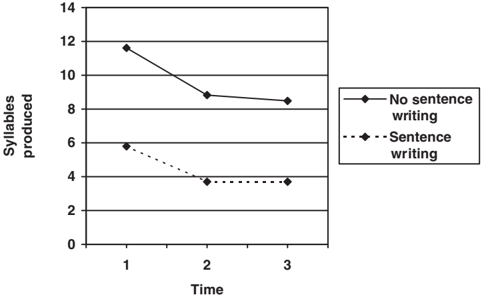
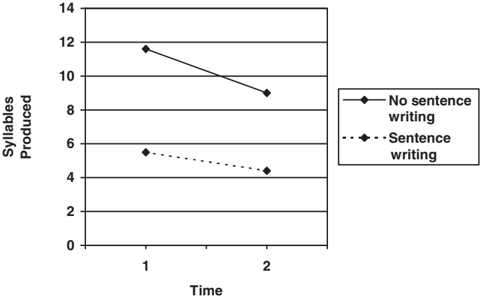
This study compared the effects of writing new words in sentences with word picture repetition learning alone. Second language (L2) Spanish learners attempted to learn 24 new Spanish words in one of two conditions while viewing word picture pairs. In Experiment 1, in the no sentence writing condition, the participants viewed 4 repetitions of each word for 6 seconds each. In the sentence writing condition, they viewed 1 repetition of each word for 48 seconds and were asked to write the word in a Spanish sentence. In Experiment 2, the participants were shown one repetition of each word for 24 seconds in both the sentence writing and no sentence writing conditions. Immediate and delayed posttests on productive vocabulary knowledge were administered in both experiments. Scores were submitted to analyses of variance. Condition and time were independent variables. Target word production was scored based on syllables and whole words produced. Results of both experiments indicated strong negative effects for the sentence writing conditions, suggesting that sentence writing can inhibit word form learning during the initial stages of L2 lexical acquisition.
Overview
CoChat Summary
TL;DR
Two experiments with second-semester L2 Spanish learners found that writing new words in sentences strongly inhibited productive vocabulary learning compared with word–picture repetition/no sentence writing. The negative effect persisted over time in Experiment 1 and remained in Experiment 2 when repetitions and overall time on task were controlled.
Key findings
- In Experiment 1, syllable-scoring overall means were 9.64 for no sentence writing vs. 4.40 for sentence writing, a 119% difference; ANOVA showed a significant condition effect, F(1,43) = 86.01, p < .001, η² = .667, and a significant time effect, F(2,86) = 40.56, p < .001, η² = .485, with no interaction. Whole-word scoring showed overall means of 2.75 vs. 1.29, 113% higher for no sentence writing, with significant condition, F(1,43) = 84.97, p < .001, η² = .664, and time effects, F(2,86) = 9.88, p < .001, η² = .187.
- In Experiment 2, syllable-scoring overall means were 10.30 for no sentence writing vs. 4.95 for sentence writing, a 108% difference; ANOVA showed a significant condition effect, F(1,9) = 12.18, p = .007, η² = .575, while time did not reach significance, F(1,9) = 4.13, p = .073, η² = .315. Whole-word scoring in Experiment 2 revealed no significant main effects or interactions.
- The negative effect of sentence writing based on syllable scoring maintained over time in both experiments, and Experiment 2 indicated it was not dependent on the extra repetitions or interspersed presentation used in Experiment 1.
- The author interprets the results as consistent with transfer appropriate processing (TAP) theory and the TOPRA model: increased semantic elaboration and elicited output can inhibit learning of new word form when processing demands are high.
Methods
- Experiment 1 was a within-group study with 44 English-speaking second-semester university L2 Spanish learners who attempted to learn 24 concrete Spanish nouns via word–picture pairs; each participant learned 12 words in a sentence writing condition and 12 in a no sentence writing condition, with presentation order counterbalanced. Experiment 2 used the same words with 10 remaining participants after exclusions.
- In Experiment 1, the no sentence writing condition presented 4 repetitions of each word for 6 seconds each (24 seconds total), while the sentence writing condition presented 1 repetition for 48 seconds and required writing the word in a Spanish sentence. In Experiment 2, each word was presented once for 24 seconds in both conditions, and participants were asked to cover previously written sentences.
- Immediate and delayed posttests measured productive vocabulary knowledge; Experiment 1 tested immediately, two days later, and one week later, while Experiment 2 tested immediately and two days later. Responses were scored by syllables and whole words and submitted to repeated measures ANOVAs with condition and time as independent variables.
Limitations
- The paper states that future research is needed to isolate the independent effects of semantic elaboration and output, and that generalizability may be limited by the relatively low L2 proficiency of participants, the specific L1/L2, and the tasks used.
- The paper notes that Experiment 2’s whole-word scoring may have lacked precision as a measure of word-form knowledge and that its smaller sample may explain the null whole-word results.
- Evident from the text: Experiment 2 had only 10 participants, and sentence writing confounds semantic elaboration, elicited output, L2 grammar/lexical demands, and motor writing demands, which the author acknowledges cannot be fully separated in this study.
Model-written summary. Check it against the paper before relying on it.
Integrity signals
Registry
Cites
Statistics
Figures
Verification
Claims the paper makes
1 Valid · 0 Not valid · 30 Not checked · 78 Own results and interpretations
Every source the paper cites for this claim was checked and supports it.
In the paper
“McDaniel and Kearney found that semantic orienting conditions resulted in less vocabulary recall than an uninstructed condition”
What the sources say
- Supportedcites McDaniel and Kearney (1984) matched to “Optimal learning strategies and their spontaneous use: The importance of task-appropriate processing” (1984) source
The Results continuation (section labeled “MSe”; page not provided) reports significantly higher vocabulary recall in the uninstructed group than in the semantic-orienting group (.80 versus .64). This directly supports the claim. (LLM, conf=0.95)
plainstates a cause- Asserted: passes — The authors put it forward as true.
- Checkable: passes — It can be checked against evidence.
- Load-bearing: unclear — It is unclear whether the paper’s conclusions depend on it.
- Based: passes — The paper gives a reason why it holds.
- Supported
A result the paper reports from its own data — it cites no other source for it, so there is none to check. The quote shows it is in the paper.
In the paper
“Overall means were 113 % higher for no sentence writing.”
plainstates an association- Asserted: passes — The authors put it forward as true.
- Checkable: passes — It can be checked against evidence.
- Load-bearing: passes — The paper’s conclusions depend on it.
- Based: passes — The paper gives a reason why it holds.
A result the paper reports from its own data — it cites no other source for it, so there is none to check. The quote shows it is in the paper.
In the paper
“and for time, F (2,86) ¼ 9.88, p < .001, g 2 ¼ .187.”
plainstates an association- Asserted: passes — The authors put it forward as true.
- Checkable: passes — It can be checked against evidence.
- Load-bearing: unclear — It is unclear whether the paper’s conclusions depend on it.
- Based: passes — The paper gives a reason why it holds.
A result the paper reports from its own data — it cites no other source for it, so there is none to check. The quote shows it is in the paper.
In the paper
“The results based on syllable scoring indicated that the means for the no sentence writing condition were much higher than the means for the sentence writing condition.”
hedged- Asserted: passes — The authors put it forward as true.
- Checkable: passes — It can be checked against evidence.
- Load-bearing: passes — The paper’s conclusions depend on it.
- Based: passes — The paper gives a reason why it holds.
A result the paper reports from its own data — it cites no other source for it, so there is none to check. The quote shows it is in the paper.
In the paper
“In Experiment 2, the effects of sentence writing based on syllable scoring remained strongly negative when a single 24-second repetition presentation format was used in both conditions.”
boostedstates a cause- Asserted: passes — The authors put it forward as true.
- Checkable: passes — It can be checked against evidence.
- Load-bearing: passes — The paper’s conclusions depend on it.
- Based: passes — The paper gives a reason why it holds.
46 more claims
Create a free account to see all 109 claims and every source verdict.
- Probably not a substantial claim. 37
- It may state two separate claims as one. 30
- The quote only partly states this claim. 2
Self-check
Percentages, sums and reported differences re-computed from the paper’s own numbers.
Each contradiction between two passages listed here was confirmed by an independent check.
Rated minor: it would not touch a result — a value no result rests on, a p-value that stays on the same side of the significance level, or a conflict that is clerical, resolved elsewhere in the paper, or outside its own findings.
In the paper
§ 1 Participants · p. 19
“The original participant pool in Experiment 1 consisted of 22 English-speaking second-semester L2 Spanish students enrolled at Parkland University in Champaign, Illinois.”
§ 2 Participants · p. 11
“The original pool of participants meeting the criteria for the study were 60 second-semester university-level L2 Spanish students enrolled in four different course sections at the University of Illinois at Urbana-Champaign.”
Rated minor: it would not touch a result — a value no result rests on, a p-value that stays on the same side of the significance level, or a conflict that is clerical, resolved elsewhere in the paper, or outside its own findings.
In the paper
§ 5 Exposure time and repetitions · p. 14
“In the no sentence writing condition, 4 presentations of each word were interspersed over the presentation sequence. Each time the words appeared in the same order.”
§ 6 Procedure · p. 15
“In the no sentence writing condition, word picture pairs appeared 4 times successively on the screen for 6 seconds each.”
Citations
Cites
The magical number seven, plus or minus two: Some limits on our capacity for processing information.
Miller, G. A. (1956) · Psychological Review · doi:10.1037/h0043158 · Cited by 17,812
Levels of processing: A framework for memory research
Craik, F. I. M., & Lockhart, R. S. (1972) · Journal of Verbal Learning and Verbal Behavior · doi:10.1016/s0022-5371(72)80001-x · Cited by 9,566 · cited 1×
“Such findings are in line with the levels of processing (LOP) theory of human memory (Craik and Lockhart, 1972), which posits that memory for an item depends on the level or relative depth at which the item is processed in a learner’s cognitive system.”
ResultBroadbent, D. E. (1958) · doi:10.1037/10037-000 · Cited by 4,337
Depth of Processing and the Retention of Words in Episodic Memory
Craik, F. I. M., & Tulving, E. (1975) · Journal of Experimental Psychology: General · doi:10.1037/0096-3445.104.3.268 · Cited by 4,121 · cited 2×
“…elaboration positively affects memory for known words (Tresselt and Mayzner, 1960; Hyde and Jenkins, 1969; Bower and Reitman, 1972; Schulman, 1974; Craik and Tulving, 1975; Epstein et al., 1975; Johnson-Laird et al., 1978; Ross, 1981) and memory for other types of stimuli (e.g., L1 sentence…”
BackgroundBroadbent, D. (1958) · doi:10.1002/9781119449737.ch2 · Cited by 3,628
The Input Hypothesis: Issues and Implications
Gregg, K. R., & Krashen, S. D. (1986) · TESOL Quarterly · doi:10.2307/3586393 · Cited by 3,032
Input in Second Language Acquisition
Bottigheimer, R. B., Gass, S. M., & Madden, C. G. (1986) · The Modern Language Journal · doi:10.2307/327330 · Cited by 2,332
Levels of processing versus transfer appropriate processing
Morris, C. D., Bransford, J. D., & Franks, J. J. (1977) · Journal of Verbal Learning and Verbal Behavior · doi:10.1016/s0022-5371(77)80016-9 · Cited by 2,296 · cited 2×
“…of semantic elaboration depending on the nature of the learning task in question, or transfer appropriate processing (McDaniel and Kearney, 1984; Morris et al., 1977), and (3) a double dissociation between semantic vs. structural orientation and free recall of known vs. new words (Barcroft,…”
BackgroundResultThe Effects of Vocabulary Instruction: A Model-Based Meta-Analysis
Stahl, S. A., & Fairbanks, M. M. (1986) · Review of Educational Research · doi:10.2307/1170287 · Cited by 1,003
Attending to Form and Content in the Input: An Experiment in Consciousness
VanPatten, B. (1990) · Studies in Second Language Acquisition · doi:10.1017/s0272263100009177 · Cited by 629 · cited 1×
“…semantic elaboration can increase processing and learning of the semantic (conceptual) properties of words while simultaneously decreasing processing and learning of the structural properties of words (for evidence of a similar type of relationship at the sentence level, see VanPatten, 1990; 1996).”
Background
Research works printed but not linked: 5
- Barcroft, J. 1999: Processing resources and L2 lexical acquisition in three writing tasks. Paper presented at the Second Language Research Forum, Minneapolis, MN.
- --2000: The effects of sentence writing as semantic elaboration on the allocation of processing resources and second language lexical acquisition. Unpublished doctoral dissertation, University of Illinois at Urbana-Champaign, Urbana, IL.
- -- 1984: Teaching reading vocabulary. 2nd edition. New York: Holt, Rinehart and Winston.
- Laufer, B. 1997: Incidental vocabulary acquisition: in praise of output. Paper presented at the Second Language Research Forum, East Lansing, MI.
- Wickens, C.D. 1984: Processing resources in attention. In Parasuramanand, R. and Davies, D., editors, Varieties of attention . New York: Academic Press, 63 102.
Cited by
Nakata, T. (2011) · Computer Assisted Language Learning · doi:10.1080/09588221.2010.520675 · Cited by 241
“One advantage of computer-based flashcards over paper-based ones is that computers can help flashcard creation by automatically supplying information about lexical items (Burston, 2007; Foster, 2009; Ishikawa, 2004).”
InfluentialHow Effective Are Intentional Vocabulary‐Learning Activities? A Meta‐Analysis
WEBB, S., YANAGISAWA, A., & UCHIHARA, T. (2020) · The Modern Language Journal · doi:10.1111/modl.12671 · Cited by 100
“Laboratory-based studies that focused on the influence of specific factors on learning (e.g., influences of stimulus characteristics and background music on paired-associate learning; de Groot, 2006) or had limited amounts of time for learning (e.g., Barcroft, 2004) were excluded.”
Effects of Synonym Generation on Incidental and Intentional L2 Vocabulary Learning During Reading
BARCROFT, J. (2009) · TESOL Quarterly · doi:10.1002/j.1545-7249.2009.tb00228.x · Cited by 116
Self-citationLexical Input Processing and Vocabulary Learning
Barcroft, J. (2015) · Language Learning & Language Teaching · doi:10.1075/lllt.43 · Cited by 95
Self-citationIncidental Vocabulary Learning Through Listening to Teacher Talk
Jin, Z., & Webb, S. (2020) · Modern Language Journal · doi:10.1111/modl.12661 · Cited by 108
Barcroft, J. (2006) · Second language Research · doi:10.1191/0267658306sr276oa · Cited by 100
“The present experiments approximated the experimental paradigm used by Barcroft (1998; 2000; 2004) in studies showing negative effects for sentence writing.”
BackgroundMethodInfluentialSelf-citationStrategies and performance in intentional L2 vocabulary learning
Barcroft, J. (2009) · Language Awareness · doi:10.1080/09658410802557535 · Cited by 113
“These same words were used in previous research by Barcroft (2000, 2004).”
MethodSelf-citationDo the cognacy characteristics of loanwords make them more easily learned than noncognates?
Rogers, J., Webb, S., & Nakata, T. (2014) · Language Teaching Research · doi:10.1177/1362168814541752 · Cited by 96
“Research has shown that scoring responses at two levels of sensitivity can provide a more accurate measurement of learning than a single scoring protocol because one method of scoring may not be sensitive to varying degrees of gains in partial knowledge (Barcroft, 2004; Webb, 2008b; Webb & Kagimoto, 2009).”
MethodSentence Reading and Writing for Second Language Vocabulary Acquisition
Pichette, F., de Serres, L., & Lafontaine, M. (2011) · Applied Linguistics · doi:10.1093/applin/amr037 · Cited by 100
“Significant effects can be observed based on syllable scoring that may not be visible for whole word scoring, due to a lack of precision of the latter as a measure of word form knowledge, as hypothesized by Barcroft (2004).”
BackgroundYanagisawa, A., & Webb, S. (2021) · Language Learning · doi:10.1111/lang.12444 · Cited by 111
Kuhi, D., & Behnam, B. (2010) · Written Communication · doi:10.1177/0741088310387259 · Cited by 77
HOW INVOLVED ARE AMERICAN L2 LEARNERS OF SPANISH IN LEXICAL INPUT PROCESSING TASKS DURING READING?
Pulido, D. (2009) · Studies in Second Language Acquisition · doi:10.1017/s0272263109090020 · Cited by 67
“This fi nding provides some evidence that tasks designed to promote deep word processing do not automatically guarantee receptive retention (see, e.g., Barcroft, 2002 , 2004 , for similar reports for productive retention).”
BackgroundIntegrating a computer-based flashcard program into academic vocabulary learning
Altıner, C. (2011) · Iowa State University Digital Repository (Iowa State University) · doi:10.31274/etd-180810-375 · Cited by 68
“…for word card learning discussed in the previous section, the features of an ideal flashcard program include presentation and retrieval modes, scheduling ability, flexibility about block size and ability to help learners increase retrieval effort (Barcroft, 2004; Nation, 2001; Pyc & Rawson, 2007).”
BackgroundRehearsal effects in adult word learning
Kaushanskaya, M., & Yoo, J. (2010) · Language and Cognitive Processes · doi:10.1080/01690965.2010.486579 · Cited by 50
“Second, it is possible that vocal rehearsal biased learners to focus more on the forms of the novel words, than on their meanings (for similar effects of sentence writing on novel vocabulary learning, see Barcroft, 2004 ).”
BackgroundSzudarski, P. (2012) · Journal of Second Language Teaching & Research (University of Central Lancashire) · Cited by 84
Effects of Word and Fragment Writing During L2 Vocabulary Learning
Barcroft, J. (2007) · Foreign Language Annals · doi:10.1111/j.1944-9720.2007.tb02889.x · Cited by 55
Self-citationEffects of Referent Token Variability on L2 Vocabulary Learning
Sommers, M. S., & Barcroft, J. (2013) · Language Learning · doi:10.1111/lang.12007 · Cited by 42
Self-citationThe Effects of Sentence Writing on Second Language French and Korean Lexical Retention
Wong, W., & Pyun, D. O. (2012) · Canadian Modern Language Review/ La Revue canadienne des langues vivantes · doi:10.3138/cmlr.68.2.164 · Cited by 44
“In the same vein, if the present study and Barcroft (2004) had included a task that measured knowledge of word meaning only, we may have expected to see positive effects for the SW condition.”
BackgroundMethodResultInfluentialTracking the changes: vocabulary acquisition in the study abroad context
Fitzpatrick, T. (2012) · Language Learning Journal · doi:10.1080/09571736.2012.658227 · Cited by 53
“Barcroft 2004) or unstable (e.g. Romaine 2003) states of knowledge. These imperfectly known items are of particular interest to L2 acquisition researchers, because it is here that the actual process of acquisition is taking place. The study reported in this paper addresses the challenge of eliciting items in such a wa…”
BackgroundSustaining Vocabulary Acquisition through Computer Game: A Case Study
Bakar, N. A., & Nosratirad, E. (2013) · Asian Social Science · doi:10.5539/ass.v9n5p235 · Cited by 36
Is explicit vocabulary focus the reading teacher’s job?
Folse, K. S. (2010) · Reading in a Foreign Language · doi:10.64152/10125/66643 · Cited by 73
Language Learning and the Brain: Lexical Processing in Second Language Acquisition
Schütze, U. (2016) · Cited by 28
Re-examining the effects of word writing on vocabulary learning
Webb, S., & Piasecki, A. E. (2018) · ITL Review of Applied Linguistics · doi:10.1075/itl.00007.web · Cited by 31
“The present study was based on Barcroft’s (2006) research.”
BackgroundMethodResultInfluentialLlach, M. D. P. A. (2009) · Revista Española de Lingüística Aplicada/Spanish Journal of Applied Linguistics · Cited by 37
Joe, A. (2010) · Reading in a Foreign Language · doi:10.64152/10125/66647 · Cited by 38
“Barcroft (2004) conducted an experiment comparing a group of learners who wrote sentences using new word forms with a group of learners who only viewed the words.”
Asaad, H. Q. M., & Shabdin, A. A. (2021) · Eurasian Journal of Applied Linguistics · doi:10.32601/ejal.911149 · Cited by 37
“Barcroft (2004) pointed out the importance of vocabulary for L2 learners to improve in such a way that the more the L2 learners acquire vocabulary, the better they become.”
BackgroundEffect of Focus on Form on Vocabulary Acquisition in Computer-Assisted Learning
Wang, Q., Zhang, Y., Kolletar-Zhu, K., Xu, X., & Zhao, L. (2022) · Mobile Information Systems · doi:10.1155/2022/4602998 · Cited by 20
“’s TAP theory [30] and Barcroft’s TOPRA model [5], which relate semantic and structural processing to verbal learning.”
BackgroundInfluentialThe Effect of Three Consecutive Context Sentences on EFL Vocabulary-Learning
Baleghizadeh, S., & Shahri, M. N. N. (2011) · TESL Canada Journal · doi:10.18806/tesl.v28i2.1073 · Cited by 17
“Barcroft (2004), for example, limited the vocabulary in his experiment to concrete nouns, and Folse (2006) restricted his research to verbs.”
BackgroundKida, S., & Barcroft, J. (2017) · Studies in Second Language Acquisition · doi:10.1017/s0272263117000146 · Cited by 21
“These points being clarified, various studies (e.g., Barcroft, 2002, 2003, 2004; Wong & Pyun, 2012) have provided support for the semantic/structural bipartite version of the TOPRA model (Figure 1C) by demonstrating how semantically elaborative tasks can negatively affect L2 word-form learning when…”
BackgroundInfluentialSelf-citationThe Effect of Post-Teaching Activity Type on Vocabulary Learning of Elementary EFL Learners
Sadeghi, K., & Sharifi, F. (2013) · English Language Teaching · doi:10.5539/elt.v6n11p65 · Cited by 22
“Although a large body of work (Foil & Alber, 2002; Muncie, 2002; Lee, 2003; Barcroft, 2004; Charlton, B., Williams, & McLaughlin, 2005; Folse, 2006) has investigated the role of different activities, namely writing tasks, and games in the retention of newly-learned vocabulary items in ESL/EFL…”
BackgroundExamining the conditions of using an on-line dictionary to learn words and comprehend texts
Dilenschneider, R. (2017) · ReCALL · doi:10.1017/s0958344017000234 · Cited by 14
“First, with regard to the retention of word forms, the TOPRA model states that if the processing demands of word forms are high, learning the form of that word will also be high.”
BackgroundInfluentialL2 Spanish vocabulary teaching in US universities: Instructors’ beliefs and reported practices
Sánchez‐Gutiérrez, C., García, P. R., & Serrano, M. P. (2022) · Language Teaching Research · doi:10.1177/13621688221074443 · Cited by 19
“…was often seen as a complement of grammar rather than a course content in its own right, which, again, does not align with previous research that emphasizes the need for intentional and explicit vocabulary teaching/learning (Barcroft, 2004, 2020; Laufer, 2006, 2008; Laufer & Girsai, 2008).”
Ahmadian, M., Amerian, M., & Goodarzi, A. (2015) · Advances in Language and Literary Studies · doi:10.7575/aiac.alls.v.6n.2p.96 · Cited by 13
“After years of being neglected and receiving little attention, second language (L2) vocabulary instruction have now become the center of attention of many applied linguists and language teachers (Decaricco, 2001, Barcroft, 2004; Read, 2004).”
BackgroundKida, S., Barcroft, J., & Sommers, M. S. (2022) · Memory & Cognition · doi:10.3758/s13421-022-01274-6 · Cited by 9
“Based on the prediction of the TOPRA model and results of previous TOPRA-modelbased studies (e.g., Barcroft, 2002, 2003, 2004; Kida, 2020; Kida & Barcroft, 2018), our primary focus was different according to the types of processing and types of recall.”
ResultSelf-citationRe-Thinking the Principles of (Vocabulary) Learning and Their Applications
Nation, P. (2024) · Languages · doi:10.3390/languages9050160 · Cited by 39
“A large number of studies have provided support for this idea (Barcroft 2002, 2003, 2004, 2006, 2009; Kida 2022; Kida and Barcroft 2018; Wang and Pellicer-S á nchez 2022).”
BackgroundKida, S. (2020) · Second language Research · doi:10.1177/0267658320931919 · Cited by 15
“The TOPRA model predictions were empirically tested in follow-up intentional L2 vocabulary learning studies (Barcroft, 2002, 2003, 2004a, 2004b), with most findings generally supporting the model predictions.”
MethodSemantic and Structural Elaboration in L2 Vocabulary Learning and Retention
Ahmadi, M. (2014) · Procedia - Social and Behavioral Sciences · doi:10.1016/j.sbspro.2014.03.395 · Cited by 8
Hazrat, M., & Hessamy, G. (2013) · Theory and Practice in Language Studies · doi:10.4304/tpls.3.8.1453-1461 · Cited by 10
“…effect of sentence writing on vocabulary learning during initial stages of L2 lexical acquisition and Pressley, Levin, and Miller (1982; cited in Barcroft, 2004), and McDaniel and Kearney (1984; cited in Barcroft, 2004) found either no effect or even negative effect for sentence writing, Muncie…”
BackgroundResultInfluentialGraphomotor memory in Exner’s area enhances word learning in the blind
Mizuochi, T., Itou, K., Makuuchi, M., Kato, B., Ikeda, K., & Nakamura, K. (2021) · Communications Biology · doi:10.1038/s42003-021-01971-z · Cited by 8
The Effects of Task Type and Task Involvement Load on Vocabulary Learning
Hazrat, M. (2015) · Waikato journal of education · doi:10.15663/wje.v20i2.189 · Cited by 8
An Investigation into Good and Poor Iranian EFL Majors’ Vocabulary Learning Strategies
Afshar, H. S., Ketabi, S., & Tavakoli, M. (2009) · Teaching English Language · doi:10.22132/tel.2009.128610 · Cited by 6
Wang, D., & Kelly, P. (2017) · The English Teacher · Cited by 8
El método IBI en la enseñanza del léxico: teoría, investigación y nuevas perspectivas
Barcroft, J. (2015) · Journal of Spanish Language Teaching · doi:10.1080/23247797.2015.1105512 · Cited by 9
Self-citationGallardo, M. H. (2020) · RILEX Revista sobre investigaciones léxicas · doi:10.17561/rilex.3.1.5377 · Cited by 5
“…sobre selección del vocabulario meta (Jiménez Calderón y Rufat, 2019, Hidalgo Gallardo, en prensa); sobre los efectos de varios métodos de trabajo (Barcroft, 2004, 2006, 2009) y tipologías de actividades (San Mateo-Valdehíta y Chacón-García, 2019); sobre el impacto de la elaboración semántica y…”
BackgroundValdehíta, A. S. M., & Herrero, M. A. A. (2012) · Epos Revista de filología · doi:10.5944/epos.28.2012.12265 · Cited by 6
“- Barcroft (2004; 2006; 2007); España - San Mateo Valdehíta (2005); EE.”
Self-reference promotes vocabulary learning in a foreign language
Pruss, S., Karni, A., & Prior, A. (2025) · Psychonomic Bulletin & Review · doi:10.3758/s13423-025-02674-w · Cited by 4
“Indeed, there are claims that any form of semantic processing does not promote the learning of new L2 vocabulary (Barcroft, 2002, 2003, 2004, 2009).”
Re-examining the effects of word writing on vocabulary learning
Webb, S., & Piasecki, A. E. (2020) · Benjamins current topics · doi:10.1075/bct.109.itl.00007.web · Cited by 3
Valdehíta, A. S. M. (2016) · Verba: Anuario galego de filoloxia · doi:10.15304/verba.43.1887 · Cited by 2
Baleghizadeh, S., & Abbasi, M. (2013) · Journal of teaching language skills · doi:10.22099/jtls.2013.1521 · Cited by 2
“However, the results are inconsistent with what Barcroft (2004, 2006) has suggested about sentence-writing.”
ResultKhabiri, M., & Masoumpanah, Z. (2012) · DOAJ (DOAJ: Directory of Open Access Journals) · doi:10.22111/ijals.2012.1348 · Cited by 4
“An impressive body of research has been conducted in order to ascertain the effects of writing on cognitive abilities (Barcroft, 2004; Lee, 2003; Swain, 1996; Zamel, 1992).”
BackgroundThe role of AI in improving writing skills of Indian undergraduate EFL learners: A research review
Banana, L., Majji, E. R., Kotnana, R., & Chaduvula, S. (2025) · AIP conference proceedings · doi:10.1063/5.0279965 · Cited by 2
Krawczyk, A., Vanryckeghem, M., Węsierska, K., et al. (2023) · Logopaedica Lodziensia · doi:10.18778/2544-7238.07.06 · Cited by 1
“The basis of the cloze test rests on participants’ exposure and understanding of a non‑native language’s semantics and syntax, which is a key component of second language acquisition [Barcroft, 2004].”
BackgroundYABANCI DİL OLARAK TÜRKÇE ÖĞRENENLER İÇİN CÜMLE YAZMA ÖZ YETERLİK ÖLÇEĞİNİN PSİKOMETRİK ÖZELLİKLERİ
DOYUMĞAÇ, İ., & BÖREKÇİ, M. (2023) · International Journal of Language Academy · doi:10.29228/ijla.69490 · Cited by 3
Gallardo, M. H. (2021) · Sintagma revista de lingüística · doi:10.21001/sintagma.2021.33.04 · Cited by 1
Herrero, M. A. A., & Valdehíta, A. S. M. (2018) · Calidoscópio · doi:10.4013/cld.2018.163.08 · Cited by 3
Investigating knowledge and use of technical vocabulary in Traditional Chinese Medicine
Lu, C. (2018) · Open Access Victoria University of Wellington | Te Herenga Waka (Figshare) · doi:10.26686/wgtn.17131862.v1 · Cited by 8
Ghasemi, E., & Feyzi-Behnagh, R. (2016) · International Journal of Research Studies in Language Learning · doi:10.5861/ijrsll.2016.1491 · Cited by 1
“The related literature shows positive effects of semantic elaboration on memory for L1 known words and memory for other types of stimuli including sentence recall and text recall (Barcroft, 2004) but for new words (especially in FL learning) that effect is not necessarily positive.”
BackgroundMethodInfluentialMeasurement of Vocabulary Knowledge
Yue, Y., & Fan, S. (2016) · SensePublishers eBooks · doi:10.1007/978-94-6300-524-1_16 · Cited by 2
Valdehíta, A. S. M. (2015) · Epos Revista de filología · doi:10.5944/epos.31.2015.17372 · Cited by 1
“Si bien, hay investigadores, como Barcroft (2004) y Folse (2006), que llegan a conclusiones diferentes; para Barcroft (2004:329), la actividad productiva dificulta el aprendizaje de los nuevos vocablos, ya que consume recursos que sería posible emplear para procesar la forma de la palabra.”
BackgroundThe Effects Of Techniques Of Vocabulary Portfolioon L2 Vocabulary Learning
Zarei, A. A. (2014) · i-manager’s Journal on English Language Teaching · doi:10.26634/jelt.4.3.2860 · Cited by 1
“According to Barcroft (2004), it should be helpful for learners to take part in activities that are semantically elaborative, for example attaching new words to individual experiences, concentrating on usage contexts, speaking about words' different meanings, contrasting and comparing new words and…”
BackgroundEl conocimiento productivo y receptivo del vocabulario en L2
Valdehíta, A. S. M. (2013) · Revista Nebrija de Lingüística aplicada a la enseñanza de Lenguas · doi:10.26378/rnlael714201 · Cited by 15
Valdehíta, A. S. M. (2013) · Revista Electrónica de Lingüística Aplicada · Cited by 6
The effects of synonym generation and oral output on incidental and intentional vocabulary learning
Rassaei, E. (2012) · ITL Review of Applied Linguistics · doi:10.1075/itl.164.01ras · Cited by 4
Li, K. (2026) · Journal of Language Teaching · doi:10.54475/jlt.2026.003
Cai, J., Zhang, X., & Liu, Y. (2024) · Second language Research · doi:10.1177/02676583241280244
“These three predictions have been largely confirmed by studies with English-speaking adults’ intentional learning of new Spanish words (Barcroft, 2002, 2003, 2004, 2006) and French and Korean words (Wong and Pyun, 2012), Spanish-speaking adults’ intentional and incidental learning of new English…”
Effects of processing tasks on children's learning of second language words
Cai, J., Zhang, X., & Wang, Y. (2024) · System · doi:10.1016/j.system.2024.103435 · Cited by 1
Vocabulary card learning: Testing multilingual translations and increased semantic processing
Deuber, F., & Berthelé, R. (2024) · Language Teaching Research · doi:10.1177/13621688241254311 · Cited by 3
Vocabulary: A guide to researching instructed second language vocabulary acquisition
Iwaizumi, E., & Webb, S. (2022) · Research methods in applied linguistics · doi:10.1075/rmal.3.08iwa · Cited by 1
Incidental Lexical Learning and the Involvement Load Hypothesis
Silva, B. B. (2022) · Second language learning and teaching · doi:10.1007/978-3-031-06505-7_2 · Cited by 2
A Language Learning and Teaching Journey: Practicalities and Possibilities
Abell, E. I. (2016) · Digital Commons - USU (Utah State University) · doi:10.26076/5f2f-6d98
Shabani, G., & Dogolsara, S. A. (2021) · International Journal of Research in English Education · doi:10.52547/ijree.6.3.69
THE FIFTH SEMESTER STUDENTS’ SENTENCE VARIETIES IN WRITING STORIES AT UIN ALAUDDIN MAKASSAR
Nur, N. A., Hilmia, S., Muthi’ah, M., et al. (2021) · English Language Linguistics and Culture International Journal · doi:10.24252/elstic-ij.v1i1.21883
Foreign language vocabulary learning and the type of processing-resource allocation model
Kida, S. (2019) · Vocabulary Learning and Instruction · doi:10.7820/vli.v08.1.kida · Cited by 2
Using gestures and English as a Foreign Language vocabulary learning: Does gender make a difference?
Ghasemi, E., & Feyzi-Behnagh, R. (2017) · International Journal of Research Studies in Language Learning · doi:10.5861/ijrsll.2017.1784
“…of free recall tasks in Persian, since participants already knew the words in their native tongue, there was no need to encode it in mind in the first place (Barcroft, 2004); the semantic elaboration (gestures) had a facilitative role since it helped them process experimental words more easily.”
BackgroundMethodRodríguez, L. M. G., & Manzano, M. (2017) · ODISEA Revista de estudios ingleses · doi:10.25115/odisea.v0i9.150 · Cited by 8
김이경 (2016) · Seoul National University Open Repository (Seoul National University)
Chapter 14. Summary of Theoretical and Instructional Implications
Barcroft, J. (2015) · Language learning and language teaching · doi:10.1075/lllt.43.14ch14
Self-citationChapter 13. Effects of Acoustically Varied Input
Barcroft, J. (2015) · Language learning and language teaching · doi:10.1075/lllt.43.13ch13 · Cited by 1
Self-citationChapter 11. Effects of Semantic versus Thematic Sets
Barcroft, J. (2015) · Language learning and language teaching · doi:10.1075/lllt.43.11ch11
Self-citationChapter 6. Effects of Tasks Involving Semantic and Structural Elaboration
Barcroft, J. (2015) · Language learning and language teaching · doi:10.1075/lllt.43.06ch6
Self-citationChapter 9. Privileging and Patterns in Partial Word Form Learning
Barcroft, J. (2015) · Language learning and language teaching · doi:10.1075/lllt.43.09ch9
Self-citationChapter 15. Directions for Future Research
Barcroft, J. (2015) · Language learning and language teaching · doi:10.1075/lllt.43.15ch15
Chapter 5. Specificity in Type of Processing and Learning: The TOPRA Model
Barcroft, J. (2015) · Language learning and language teaching · doi:10.1075/lllt.43.05ch5 · Cited by 2
Self-citationChapter 4. Contexts of Lexical Input Processing: L1/L2 and Incidental/Intentional
Barcroft, J. (2015) · Language learning and language teaching · doi:10.1075/lllt.43.04ch4
Self-citationChapter 10. Effects of Increased and Spaced Exposure
Barcroft, J. (2015) · Language learning and language teaching · doi:10.1075/lllt.43.10ch10
Self-citationChapter 8. Effects of Opportunities for Target Word Retrieval
Barcroft, J. (2015) · Language learning and language teaching · doi:10.1075/lllt.43.08ch8
Self-citationChapter 3. Three Key Components of Learning a Word: Form, Meaning, Mapping
Barcroft, J. (2015) · Language learning and language teaching · doi:10.1075/lllt.43.03ch3
Self-citationChapter 12. Effects of Input Enhancement
Barcroft, J. (2015) · Language learning and language teaching · doi:10.1075/lllt.43.12ch12
Self-citationChapter 7. Effects of Output with and without Access to Meaning
Barcroft, J. (2015) · Language learning and language teaching · doi:10.1075/lllt.43.07ch7
Self-citationChapter 2. Multiple Levels of Input Processing and Language Learning
Barcroft, J. (2015) · Language learning and language teaching · doi:10.1075/lllt.43.02ch2
Self-citationBarcroft, J. (2015) · Language learning and language teaching · doi:10.1075/lllt.43.01ch1
(2015) · Language learning and language teaching · doi:10.1075/lllt.43.toc
Barcroft, J. (2015) · Language learning and language teaching · doi:10.1075/lllt.43.ack
Barcroft, J. (2015) · Language learning and language teaching · doi:10.1075/lllt.43.prelim
Barcroft, J. (2015) · Language learning and language teaching · doi:10.1075/lllt.43.app1
Barcroft, J. (2015) · Language learning and language teaching · doi:10.1075/lllt.43.index
Barcroft, J. (2015) · Language learning and language teaching · doi:10.1075/lllt.43.refs
Barcroft, J. (2015) · Language learning and language teaching · doi:10.1075/lllt.43.app2
Effect of Fine-Grained Lexical Rating on L2 Learners’ Lexical Learning Gain
Niu, R. (2015) · Open Journal of Modern Linguistics · doi:10.4236/ojml.2015.55038 · Cited by 2
“Since different scoring approaches count partial lexical knowledge to different degrees, some studies have adopted multiple approaches to capture a fine-grained picture of learners’ productive word gain (Barcroft, 2002, 2004).”
BackgroundMethodInfluential
Metadata
- Authors
- Barcroft, J.
- Affiliations
- Washington University in St. Louis (US)
- Corresponding author
- Barcroft, Joe
- ORCID
- Barcroft, Joe
- Venue
- Second Language Research
- Publisher
- SAGE Publications
- Published
- 2004-10
- Volume
- 20
- Issue
- 4
- Pages
- 303-334
- ISSN
- 0165-9960 (ISSN-L)
- 0267-6583
- 1477-0326
- OpenAlex
- W2168367428
- Cited by
- 105
- References
- 33
- Citations by year
- 2026: 1 · 2025: 2 · 2024: 4 · 2023: 2 · 2022: 5 · 2021: 7 · 2020: 5 · 2019: 1 · 2018: 4 · 2017: 5 · 2016: 5 · 2015: 29 · 2014: 3 · 2013: 8 · 2012: 7
- FWCI
- 1.19
- Type
- journal article
- Language
- en
- Open access
- green
- hal.science
- Licence
- other-oa
- journals.sagepub.com/page/policies/text-and-data-mining-license (tdm)
- Locations
- Second language Research (publishedVersion)
- HAL (submittedVersion, other-oa)
- Trinity's Access to Research Output (TARA) (Trinity College Dublin) (submittedVersion, other-oa)
- Topics
- Social Sciences › Psychology › Developmental and Educational Psychology › Second Language Acquisition and Learning
- Social Sciences › Arts and Humanities › Language and Linguistics › EFL/ESL Teaching and Learning
- Social Sciences › Psychology › Developmental and Educational Psychology › Reading and Literacy Development
- Keywords
- sentence writing, word learning, Spanish as a second language, productive vocabulary knowledge, word production
About these checks
Registry, retraction, Cites and statistics results are computed, not judged, with one exception: a printed reference that no index lists is read once by a model before it counts as a citation error. Claims are extracted by a model and kept only when their quote appears verbatim in the text; each cited source is then checked, with a model’s help, for whether it says what the claim relies on. Those verdicts can be wrong — read the claim’s quote and the cited source before relying on one.
A language model drew the claims from the paper on 2026-10-02, under version 3 of the claim definition (model deepseek-v4.1-flash, prompt extract-v3).
A second model labelled each claim on 2026-10-02 (model jev-1.13-20260917, definition revision gold-guideline-v0.2).
Cited sources are checked with a language model’s help (gpt-6-sol).
Statistics and arithmetic are recomputed, not judged.
Confidence bands are shown only for fields calibrated on our annotated test set. None is calibrated yet, so no band is shown.
What counts as a claim ›How we measure confidence ›How we check this ›
Are you an author, or do you see a problem with this page? Request a review
Data sources
Bibliographic data: Semantic Scholar, OpenAlex, Crossref.
Contains information from the Semantic Scholar Academic Graph Datasets, made available under the ODC Attribution License (ODC-BY 1.0).
Semantic Scholar’s data is described in: Kinney, R., et al. (2023). The Semantic Scholar Open Data Platform. arXiv:2301.10140.
